
Judge, 1918-02-02 · page 6 of 36
Judge — February 2, 1918 — page 6: what you’re looking at
What you’re looking at
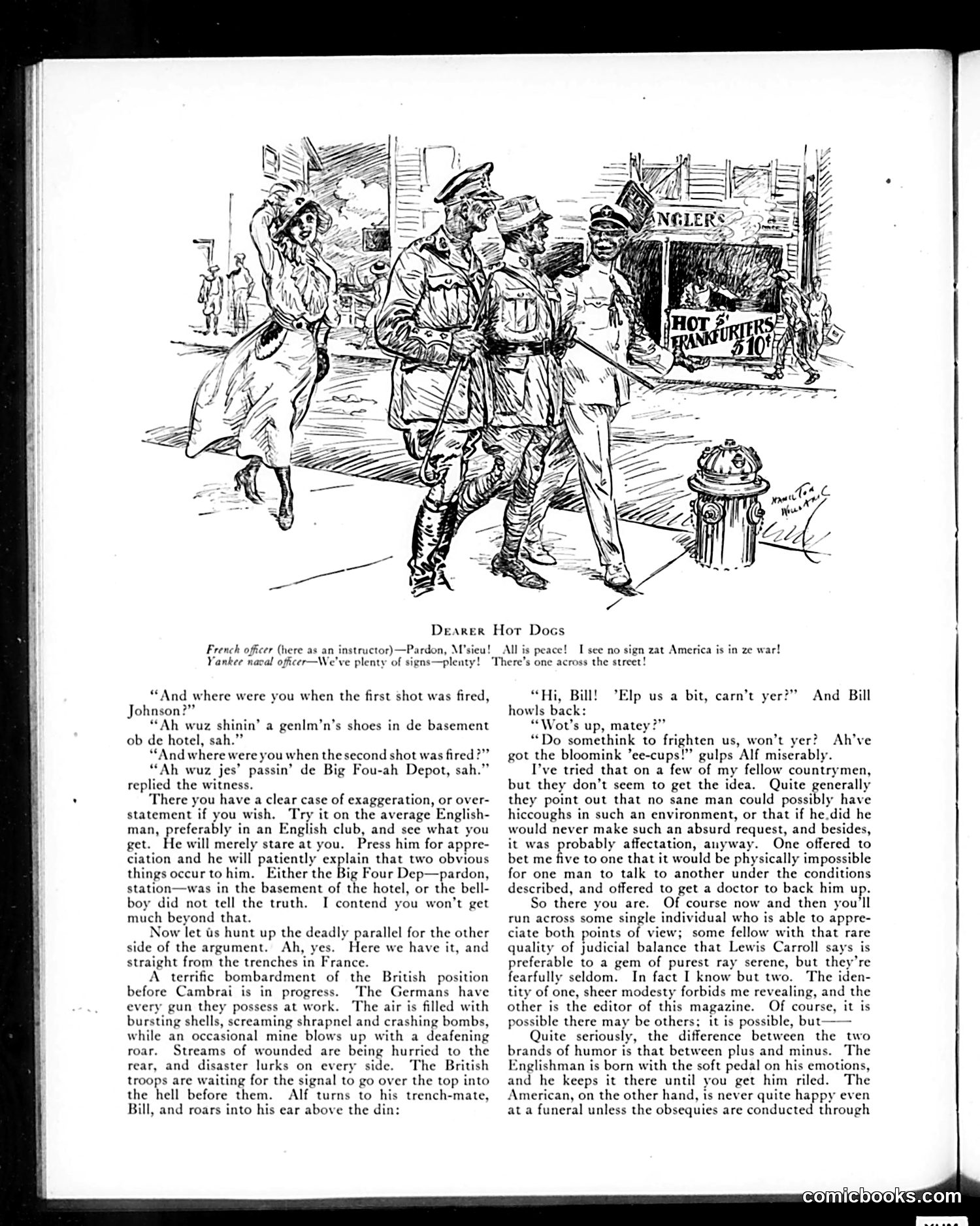
This cartoon satirizes American soldiers' complaints during World War I. The illustration shows a French officer instructing soldiers, with a hot dog vendor visible—the setup for the joke's title. The accompanying text records soldiers discussing where they were when shots were fired, with their responses focusing on mundane details (shining shoes, eating) rather than heroic war stories. The humor derives from soldiers deflating expectations of combat narratives with petty, domestic concerns. The broader satire critiques the difference between British and American humor: the text notes that English soldiers suppress emotions stoically, while Americans "never quite happy even at a funeral" unless things are done their way—suggesting American soldiers' persistent complaining about conditions, including food, even during wartime.
📄 Transcribed text from this page (OCR, searchable)
Machine-transcribed from the original scan — historical spelling and the odd misread are preserved.
Dearer French officer (here as an instructor)—Pardon, M’sieu! Yankee naval offcer—We've plenty of signs—plenty! “And where were you when the first shot was fired, Johnson?” “Ah wuz shinin’ a genlm’n’s shoes in de basement ob de hotel, sah.”” “‘And where were you when the second shot was fired?” “Ah wuz jes’ passin’ de Big Fou-ah Depot, sah.” replied the witness. ‘There you have a clear case of exaggeration, or over- statement if you wish. Try it on the average English- man, preferably in an English club, and see what you get. He will merely stare at you. Press him for appre- ciation and he will patiently explain that two obvious things occur to him. Either the Big Four Dep—pardon, station—was in the basement of the hotel, or the bell- boy did not tell the truth. I contend you won't get much beyond that. Now let ds hunt up the deadly parallel for the other side of the argument. Ah, yes. Here we have it, and straight from the trenches in France. A terrific bombardment of the British position before Cambrai is in progress. The Germans have every gun they possess at work. The air is filled with bursting shells, screaming shrapnel and crashing bombs, while an occasional mine blows up with a deafening roar. Streams of wounded are being hurried to the rear, and disaster lurks on every side. The British troops are waiting for the signal to go over the top into the hell before them. Alf turns to his trench-mate, Bill, and roars into his ear above the din: Hor Docs I see no sign zat America is in ze war! All is peace! There’s one across the street! “Hi, Bill! howls back: “Wot's up, matey?” “Do somethink to frighten us, won’t yer? got the bloomink ’ee-cups!”” gulps Alf miserably. I’ve tried that on a few of my fellow countrymen, but they don’t seem to get the idea. Quite generally they point out that no sane man could possibly have hiccoughs in such an environment, or that if he.did he would never make such an absurd request, and besides, it was probably affectation, anyway. One offered to bet me five to one that it would be physically impossible for one man to talk to another under the conditions described, and offered to get a doctor to back him up. So there you are. Of course now and then you'll run across some single individual who is able to appre- ciate both points of view; some fellow with that rare quality of judicial balance that Lewis Carroll says is preferable to a gem of purest ray serene, but they’re fearfully seldom. In fact I know but two. The iden- tity of one, sheer modesty forbids me revealing, and the other is the editor of this magazine. Of course, it is possible there may be others; it is possible, but—— Quite seriously, the difference between the two brands of humor is that between plus and minus. The Englishman is born with the soft pedal on his emotions, and he keeps it there until you get him riled. The American, on the other hand, is never quite happy even ata funeral unless the obsequies are conducted through ’Elp us a bit, carn’t yer?” And Bill Ah’ve