
Judge, 1918-02-02 · page 9 of 36
Judge — February 2, 1918 — page 9: what you’re looking at
What you’re looking at
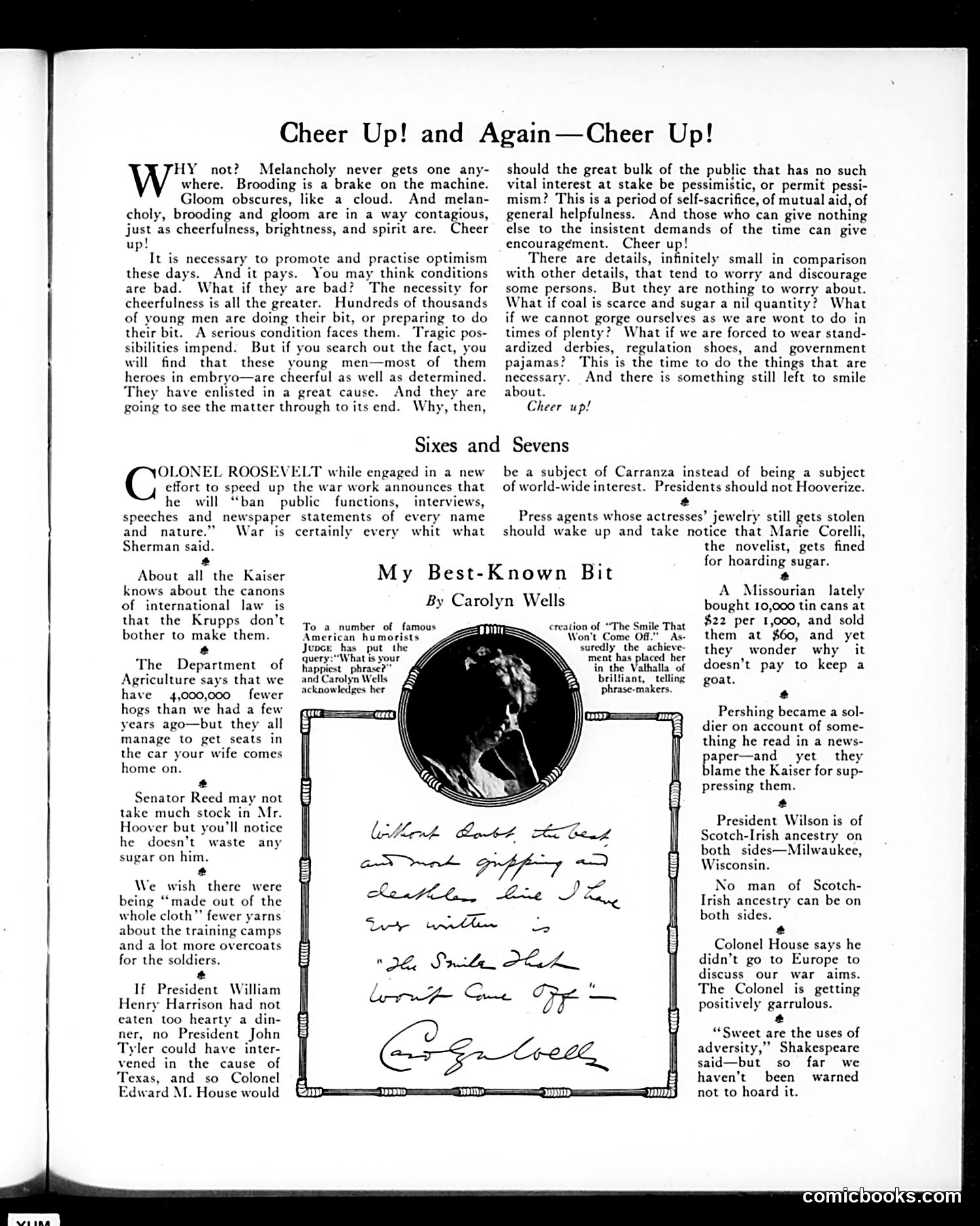
This is a WWI-era editorial page promoting wartime morale. The main article "Cheer Up! and Again—Cheer Up!" urges Americans to maintain optimism despite rationing (coal, sugar shortages) and mandatory standardization (government-issue shoes, pajamas, "Hooverizing"). It appeals to patriotism by contrasting soldiers' courage with civilians' minor hardships. The "Sixes and Sevens" section contains satirical jabs: Colonel Roosevelt's ban on public statements is mocked as typical Rooseveltian excess; the Kaiser's ignorance of international law is ridiculed; agricultural data about hog shortages is twisted into a joke about crowded cars. The center feature showcases Carolyn Wells' "The Smile That Won't Come Off"—apparently her well-known witty phrase. Sidebar jokes mock wartime profiteering (tin cans), press agent corruption, and hypocrisy (Marie Corelli fined for hoarding despite being famous for clever phrases). The overall message: sacrifice cheerfully; don't complain about minor deprivations when soldiers face danger.
📄 Transcribed text from this page (OCR, searchable)
Machine-transcribed from the original scan — historical spelling and the odd misread are preserved.
HY not? Melancholy never gets one any- W where. Brooding is a brake on the machine. Gloom obscures, like a cloud. And melan- choly, brooding and gloom are in a way contagious, just as cheerfulness, brightness, and spirit are. Cheer up! ; It is necessary to promote and practise optimism these days. And it pays. You may think conditions are bad. What if they are bad? The necessity for cheerfulness is all the greater. Hundreds of thousands of young men are doing their bit, or preparing to do their bit. A serious condition faces them. Tragic pos- sibilities impend. But if you search out the fact, you will find that these young men—most of them heroes in embryo—are cheerful as well as determined. They have enlisted in a great cause. And they are going to see the matter through to its end. Why, then, Cheer Up! and Again—Cheer Up! should the great bulk of the public that has no such vital interest at stake be pessimistic, or permit pessi- mism? This is a period of self-sacrifice, of mutual aid, of general helpfulness. And those who can give nothing else to the insistent demands of the time can give encouragement. Cheer up! There are details, infinitely small in comparison with other details, that tend to worry and discourage some persons. But they are nothing to worry about. What if coal is scarce and sugar a nil quantity? What if we cannot gorge ourselves as we are wont to do in times of plenty? What if we are forced to wear stand- ardized derbies, regulation shoes, and government pajamas? This is the time to do the things that are necessary. And there is something still left to smile about. Cheer up! Sixes and Sevens effort to speed up the war work announces that he will “ban public functions, interviews, speeches and newspaper statements of every name and nature.” War is certainly every whit what Sherman said. Citton to ROOSEVELT while engaged in a new ¢ About all the Kaiser knows about the canons of international law is that the Krupps don’t To a number of famous bother to make them. American humorists Juoce has put the query:"“What is your happiest. phrase?” and Carolyn Wells acknowledges her e The Department of Agriculture says that we have 4,000,000 fewer hogs than we had a few years ago—but they all manage to get seats in the car your wife comes home on. # Senator Reed may not take much stock in Mr. Hoover but you'll notice he doesn’t waste any sugar on him. My Best-Known Bit By Carolyn Wells be a subject of Carranza instead of being a subject of world-wide interest. Presidents should not Hooverize. 2 Press agents whose actresses’ jewelry still gets stolen should wake up and take notice that Marie Corelli, the novelist, gets fined for hoarding sugar. & A Missourian lately bought 10,000 tin cans at creation of “The Smile That $22 Per 1,000, and sold Won't Come Of.” As- them at $60, and yet suredly the achieve- they wonder why it ment has placed her 4 i 2 k in the Valhalla, of loesnt pay to keep a brilliant, telling Oat. phrase-makers. 8 ¢ Pershing became a sol- dier on account of some- thing he read in a news- papers and yet they lame the Kaiser for sup- pressing them. 2 President Wilson is of Scotch-Irish ancestry on both sides—Milwaukee, Wisconsin. We wish there were being ‘made out of the whole cloth” fewer yarns about the training camps and a lot more overcoats for the soldiers. e If President William Henry Harrison had not eaten too hearty a din- ner, no President John Tyler could have inter- vened in the cause of Texas, and so Colonel ward M. House would No man of Scotch- Irish ancestry can be on both sides. 2 Colonel House says he didn’t go to Europe to discuss our war aims. The Colonel is getting positively garrulous. 2 “Sweet are the uses of adversity,” Shakespeare said—but so far we haven't been warned not to hoard it.