
Judge, 1918-02-02 · page 8 of 36
Judge — February 2, 1918 — page 8: what you’re looking at
What you’re looking at
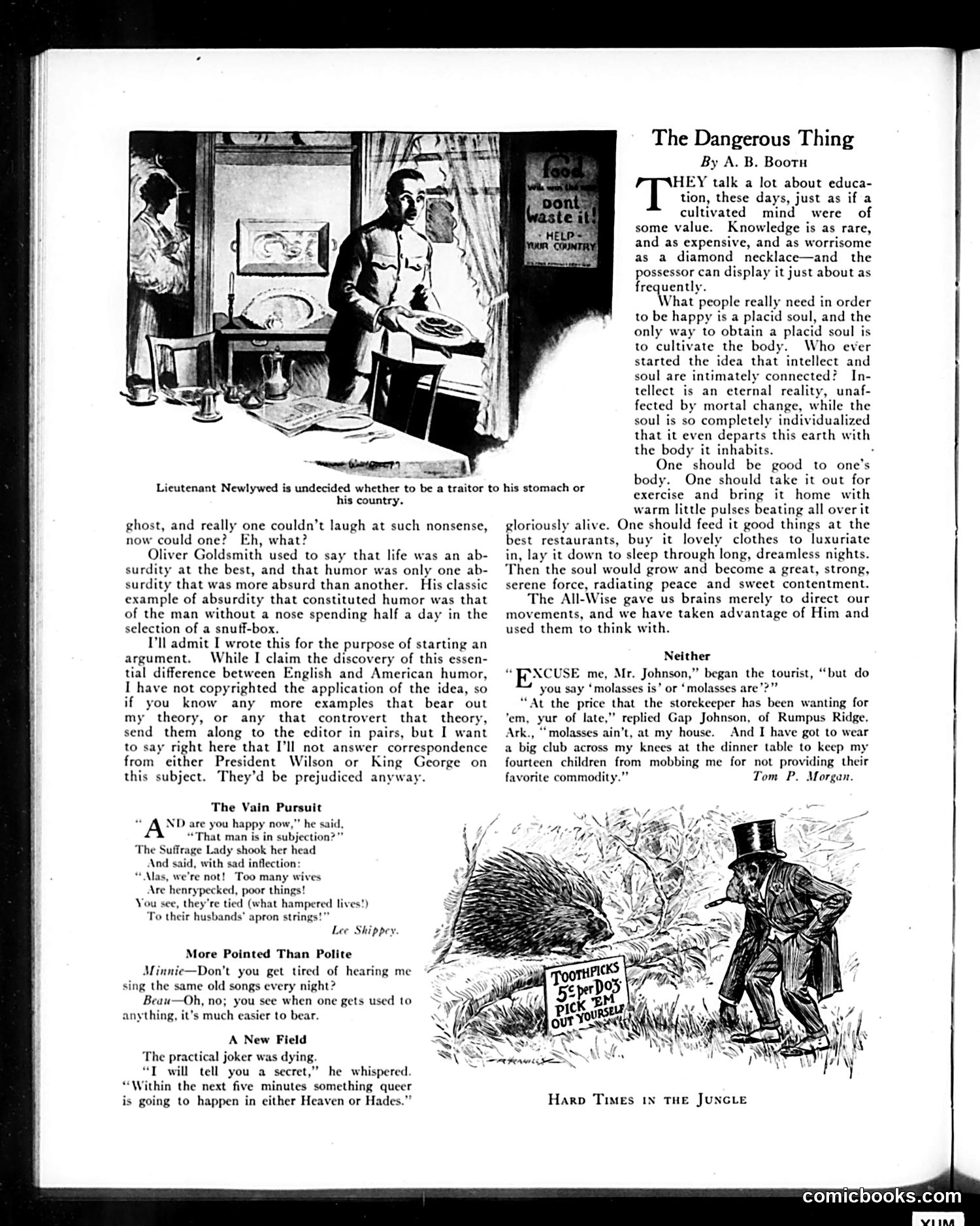
This page from **Judge** (an American satirical magazine) contains multiple short humor pieces typical of early 20th-century periodicals. The main article, "The Dangerous Thing" by A.B. Booth, satirizes contemporary obsession with education and intellect. Booth argues ironically that cultivating the *body* through good food, fine clothes, and exercise—rather than developing the mind—produces happiness and contentment. He dismisses intellect as merely a tool for directing physical movements, inverting the era's progressive emphasis on education as society's solution. The accompanying cartoon depicts **Lieutenant Newlywed** torn between military duty and hunger, humorously illustrating the conflict between patriotic obligation and bodily appetite—reinforcing Booth's theme. Other pieces mock women's suffrage ("The Vain Pursuit"), romantic boredom, and rural dialect humor. The page reflects Judge's satirical stance: mocking both intellectual pretension and social reform movements popular with progressive readers.
📄 Transcribed text from this page (OCR, searchable)
Machine-transcribed from the original scan — historical spelling and the odd misread are preserved.
Lieutenant Newlywed is undecided whether to be a traitor to his stomach or his country. ghost, and really one couldn’t laugh at such nonsense, now could one? Eh, what? Oliver Goldsmith used to say that life was an ab- surdity at the best, and that humor was only one ab- surdity that was more absurd than another. s classic example of absurdity that constituted humor was that of the man without a nose spending half a day in the selection of a snuff-box. I'll admit I wrote this for the purpose of starting an argument. While I claim the discovery of this essen- tial difference between English and American humor, I have not copyrighted the application of the idea, so if you know any more examples that bear out my theory, or any that controvert that theory, send them along to the editor in pairs, but I want to say right here that I'll not answer correspondence from either President Wilson or King George on this subject. They'd be prejudiced anyway. The Vain Pursuit “ A ND are you happy now,” he said, “That man is in subjection?” The Suffrage Lady shook her head And said, with sad inflection: “Alas, we're not! Too many wives Are henrypecked, poor things! You see, they're tied (what hampe To their husbands’ apron string lives!) Lee Shippey. More Pointed Than Polite Minnie—Don't you get tired of hearing me sing the same old songs every night? Beau—Oh, no; you sce when one gets used to anything, it’s much easier to bear. A New Field The practical joker was dying. “T will tell you a secret,” he whispered “Within the next five minutes something queer is going to happen in either Heaven or Hades.” The Dangerous Thing By A. B. Bootu "T tee, talk a lot about educa- tion, these days, just as if a cultivated mind were of some value. Knowledge is as rare, and as expensive, and as worrisome as a diamond necklace—and the possessor can display it just about as frequently. What people really need in order to be happy is a placid soul, and the only way to obtain a placid soul is to cultivate the body. Who ever started the idea that intellect and soul are intimately connected? In- tellect is an eternal reality, unaf- fected by mortal change, while the soul is so completely individualized that it even departs this earth with the body it inhabits. : One should be good to one’s body. One should take it out for exercise and bring it home with warm little pulses beating all over it gloriously alive. One should feed it good things at the best restaurants, buy it lovely clothes to luxuriate in, lay it down to sleep through long, dreamless nights. Then the soul would grow and become a great, strong, serene force, radiating peace and sweet contentment. The All-Wise gave us brains merely to direct our movements, and we have taken advantage of Him and used them to think with. Neither me, Mr. Johnson,” began the tourist, “but do ‘molasses is’ or ‘molasses are’?”” you say “At the price that the storekeeper has been wanting for ‘em, yur of late,” replied Gap Johnson, of Rumpus Ridge. Ark., “molasses ain’t, at my house. And I have got to wear a big club across my knees at the dinner table to keep my fourteen children from mobbing me for not providing their favorite commodity.” Tom P. Morgan. NSN rere Harp Times In THE JUNGLE comicbooks.com