
Judge, 1918-02-02 · page 7 of 36
Judge — February 2, 1918 — page 7: what you’re looking at
What you’re looking at
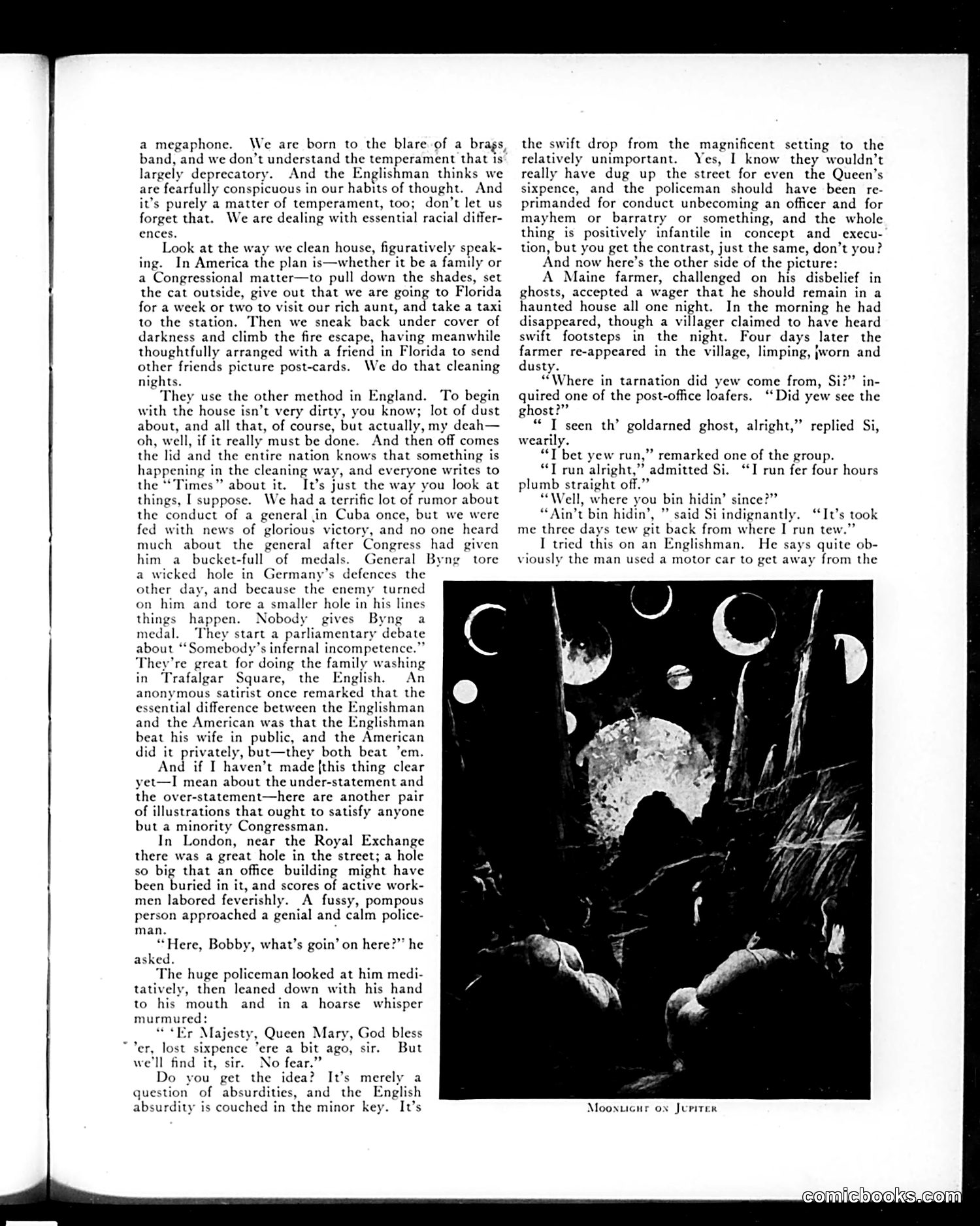
This illustration accompanies a satirical essay contrasting English and American temperaments. The cartoon depicts a Maine farmer's supernatural encounter—part of the author's argument about national character differences. The text describes the farmer accepting a wager to spend a night in a haunted house. By morning, he's vanished, though villagers report hearing swift footsteps. Post-office loafers debate whether he saw a ghost; one claims the farmer ran for four hours straight without stopping. The joke satirizes American *exaggeration*: Americans dramatize events with grand, obvious reactions, while English people understate everything. The farmer's extreme response (possibly fleeing in terror) exemplifies American excess. The celestial imagery ("Moonlight on Jupiter") emphasizes the fantastical, larger-than-life nature of the American tall tale—contrasting with the English policeman's deadpan understatement in the accompanying text about a lost sixpence.
📄 Transcribed text from this page (OCR, searchable)
Machine-transcribed from the original scan — historical spelling and the odd misread are preserved.
“er, lost sixpence a megaphone. We are born to the blare of a brags band, and we don’t understand the temperament that is largely deprecatory. And the Englishman thinks we are fearfully conspicuous in our habits of thought. And it’s purely a matter of temperament, too; don’t let us forget that. We are dealing with essential racial differ- ences. Look at the way we clean house, figuratively speak- ing. In America the plan is—whether it be a family or a Congressional matter—to pull down the shades, set the cat outside, give out that we are going to Florida for a week or two to visit our rich aunt, and take a taxi to the station. Then we sneak back under cover of darkness and climb the fire escape, having meanwhile thoughtfully arranged with a friend in Florida to send other friends picture post-cards. We do that cleaning nights. They use the other method in England. To begin with the house isn’t very dirty, you know; lot of dust about, and all that, of course, but actually, my deah— oh, well, if it really must be done. And then off comes the lid and the entire nation knows that something is happening in the cleaning way, and everyone writes to the “Times” about it. It’s just the way you look at things, I suppose. We had a terrific lot of rumor about the conduct of a general in Cuba once, but we were fed with news of glorious victory, and no one heard much about the general after Congress had given him a bucket-full of medals. General Byng tore a wicked hole in Germany's defences the other day, and because the enemy turned on him and tore a smaller hole in his lines things happen. Nobody gives Byng a medal. ‘They start a parliamentary debate about “Somebody’s infernal incompetence.” They're great for doing the family washing in Trafalgar Square, the English. An anonymous satirist once remarked that the essential difference between the I and the American was that the Englis beat his wife in public, and the American did it privately, but—they both beat ’em. And if I haven’t made {this thing clear yet—I mean about the under-statement and the over-statement—here are another pair of illustrations that ought to satisfy anyone but a minority Congressman. In London, near the Royal Exchange there was a great hole in the street; a hole so big that an office building might have been buried in it, and scores of active work- men labored feverishly. A fussy, pompous person approached a genial and calm police- man. . “Here, Bobby, what’s goin’ on here?”’ he asked. The huge policeman looked at him medi- tatively, then leaned down with his hand to his mouth and in a hoarse whisper murmured: “Er Majesty, Queen Mary, God bless ere a bit ago, sir. But we'll find it, sir. No fear.” Do you get the idea? It’s merely a question of absurdities, and the English absurdity is couched in the minor key. It’s ft drop from the magnificent setting to the relativ unimportant. Yes, I know they wouldn’t really have dug up the street for even the Queen’s sixpence, and the policeman should have been re- primanded for conduct unbecoming an officer and for mayhem or barratry or something, and the whole thing is positively infantile in concept and execu- tion, but you get the contrast, just the same, don’t you? And now here’s the other side of the picture: A Maine farmer, challenged on his disbelief in ghosts, accepted a wager that he should remain in a haunted house all one night. In the morning he had disappeared, though a villager claimed to have heard swift footsteps in the night. Four days later the farmer re-appeared in the village, limping, worn and dusty. “Where in tarnation did yew come from, Si?” in- quired one of the post-office loafers. “Did yew see the ghost?” “T seen th’ goldarned ghost, alright,” replied Si, wearily. “T bet yew run,” remarked one of the group. “T run alright,” admitted Si. “I run fer four hours plumb straight off.” “Well, where you bin hidin’ since?” “Ain’t bin hidin’, ” said Si indignantly. “It’s took me three days tew git back from where I run tew.” I tried this on an Englishman. He says quite ob- viously the man used a motor car to get away from the Moosuicur ox Juriter