
A complete issue · 28 pages · 1916
Judge — April 1, 1916
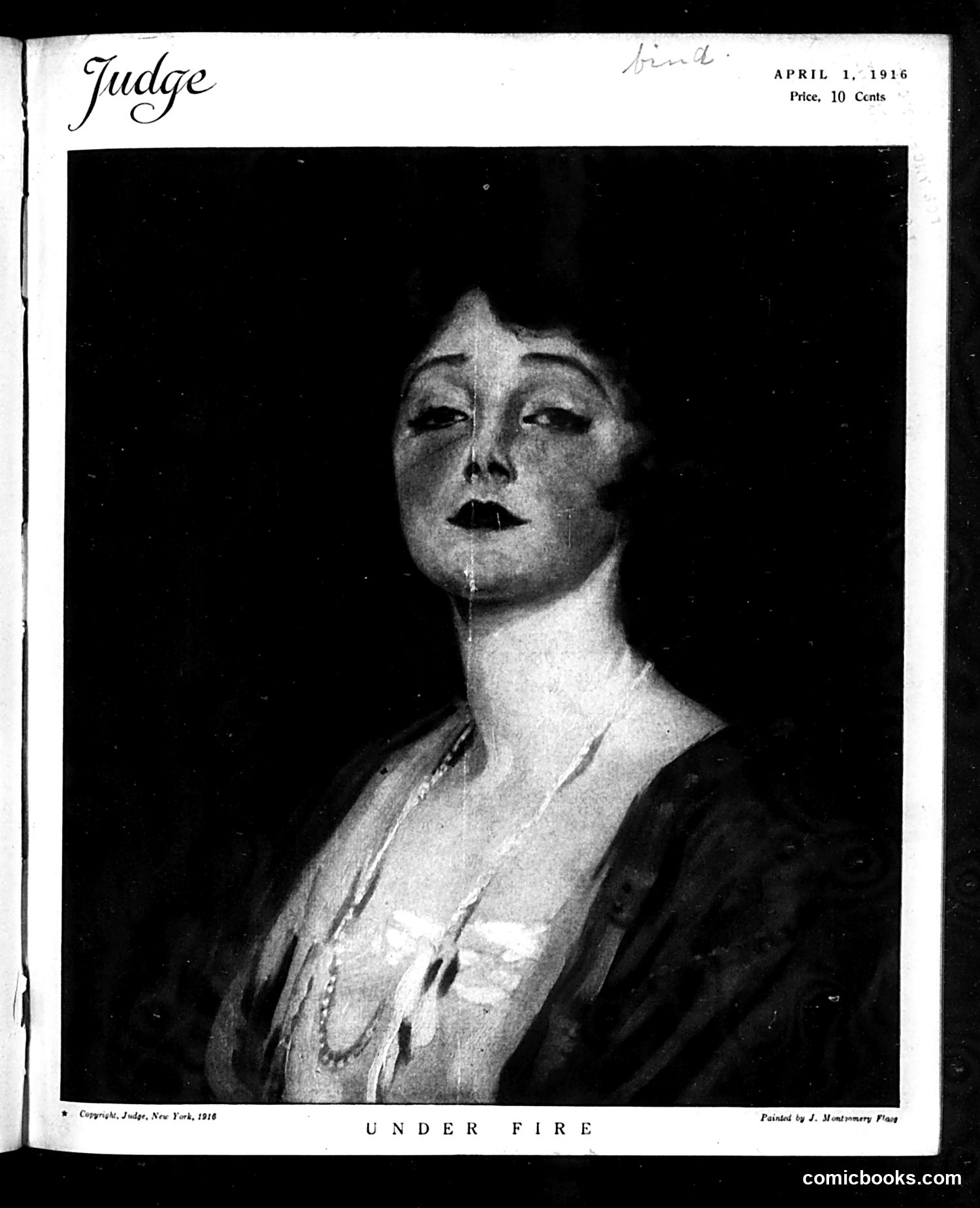
This appears to be a portrait rather than a political cartoon. The image shows a woman in early 1900s dress, painted by J. Montgomery Flagg (a renowned illustrator of the era). The title "Under Fire" suggests commentary on women's roles during World War I—a period when women were increasingly entering the workforce and public sphere while men served in combat. The painting style and formal presentation indicate this is likely a serious artistic statement rather than satire. Without additional context or identifying information visible on the page, the specific subject cannot be definitively determined, though the "Under Fire" title implies commentary on women's wartime experiences or changing social positions during the WWI era.
This page is primarily **advertising, not satire or political commentary**. It's a full-page advertisement for Munsey's Magazine's April issue, promoting author Emerson Hough's serialized novel "The Magnificent Adventure." The ad emphasizes Hough's credentials as a Western writer, claiming he's done more than any living writer to tell "the true story of the great American West." It highlights that the novel features "two of the most romantic and attractive figures of American history" as its hero and heroine, though their identities aren't specified here. The ad lists other notable contributors and promotes the magazine's 192 pages of content, priced at 10 cents, available at newsstands. This is commercial promotion typical of early 20th-century magazine advertising.
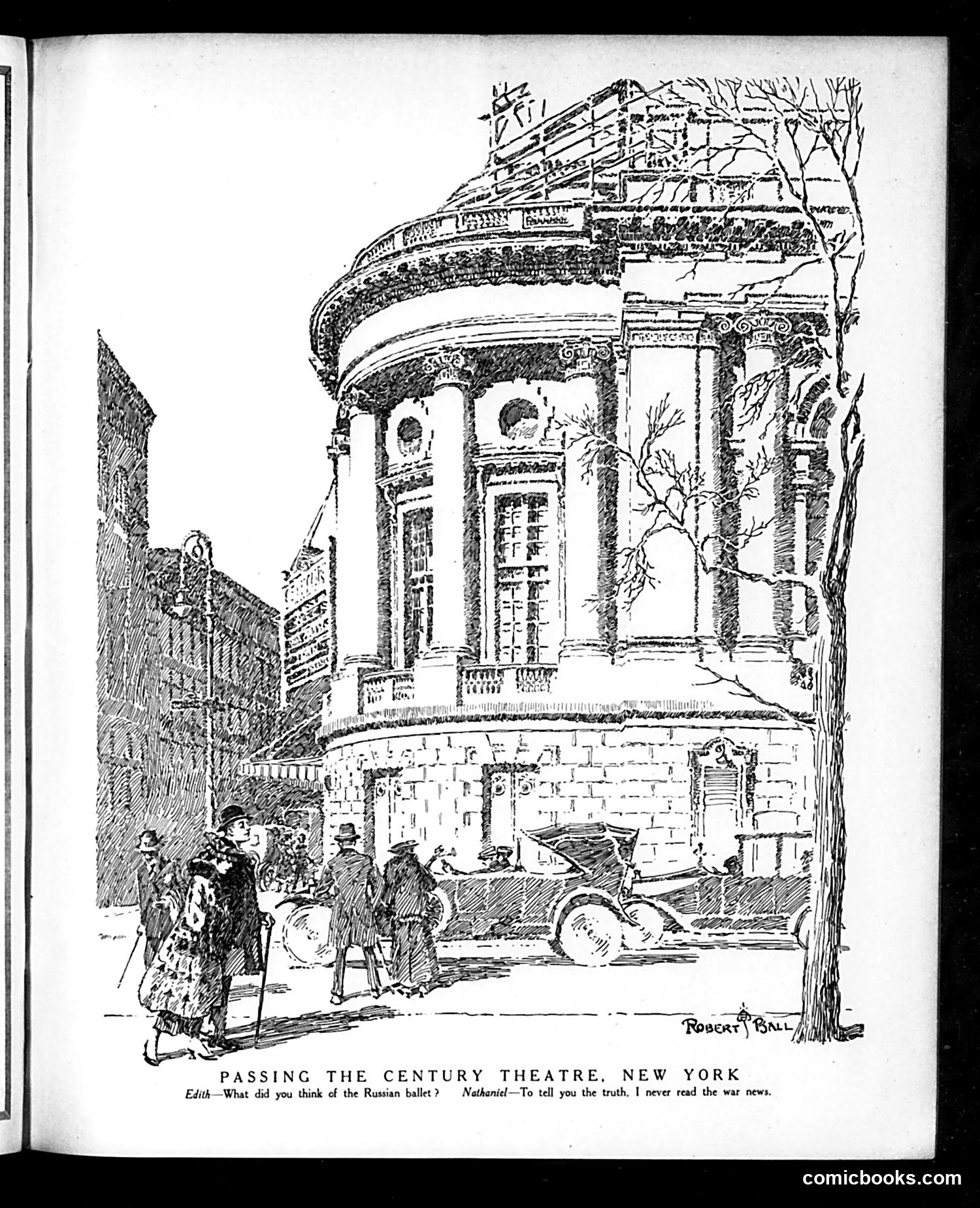
This cartoon by Robeart Ball depicts a street scene outside New York's Century Theatre. Two men in period dress observe the building, with one (Edith) asking the other (Nathaniel) about the Russian ballet. Nathaniel's response—"To tell you the truth, I never read the war news"—is the satirical point. The joke targets selective ignorance about serious current events. By claiming he doesn't follow war news, Nathaniel implies he focuses only on entertainment and cultural events like the Russian ballet. This satirizes Americans who prioritize theatrical amusements over awareness of significant historical developments, likely referencing World War I-era tensions and international conflicts that contemporary readers would have followed through newspapers.
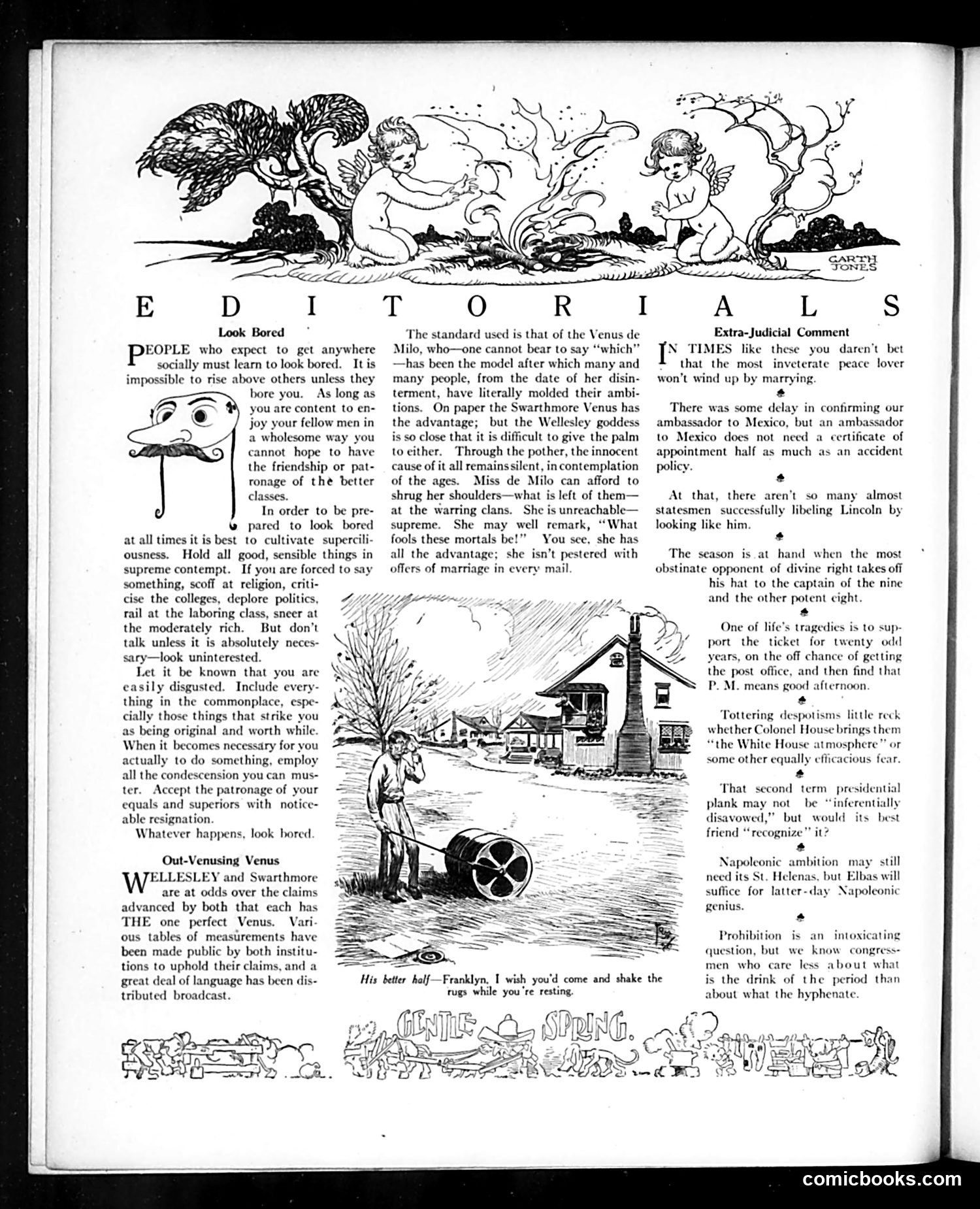
This page contains editorial commentary rather than political cartoons. The main illustration shows a farmer with a plow near a rural house, captioned "His better half—Franklyn, I wish you'd come and shake the rug while you're resting." The text addresses social etiquette and comportment, advising readers to cultivate "superfiliousness" and supercilious contempt. It mocks those who claim superiority by criticizing colleges, politics, labor movements, and the moderately rich—suggesting such posturing is transparent and foolish. The "Out-Venusing Venus" section compares Wellesley and Swarthmore colleges' claims to perfection, using "Venus de Milo" as a standard of beauty. The satire criticizes pretentious institutional rivalry and the performative snobbery of the educated classes.
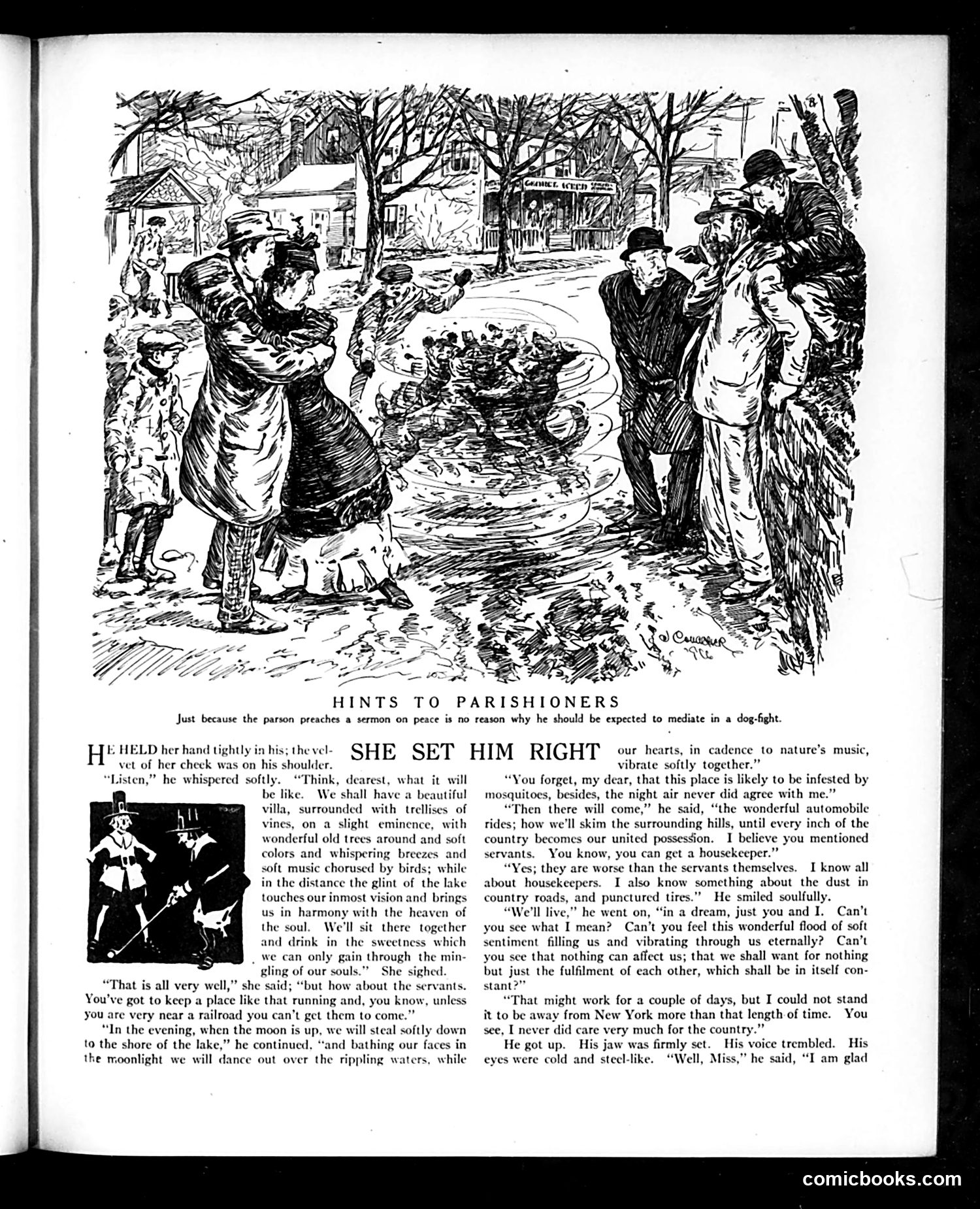
This page satirizes clergy who preach moral sermons while failing to practice what they teach. The top illustration shows a dog-fight breaking out in a town square, with well-dressed gentlemen (likely parishioners or clergy) gathered around, suggesting hypocrisy: the parson preaches peace but ignores violence occurring publicly. The lower narrative mocks a clergyman who seduces a parishioner with romantic fantasies about a rural villa and shared happiness, only to reveal he won't leave New York for long and has little regard for "the country." The satire exposes the gap between clergy's pious words and selfish actions—they demand moral virtue from congregants while pursuing pleasure and material comfort themselves.
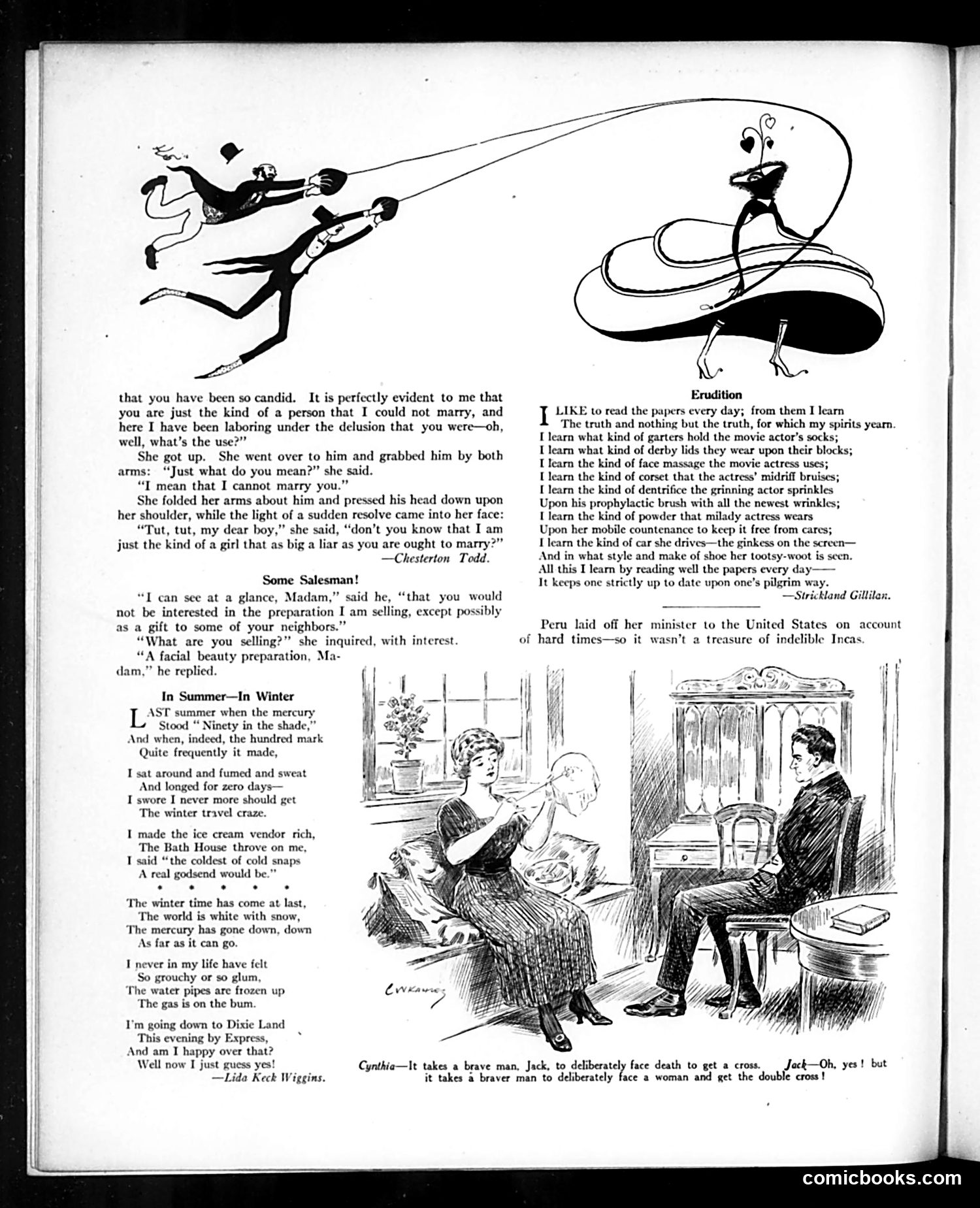
This page contains several unrelated humorous pieces typical of early 20th-century satirical magazines: **Top cartoon**: Two divers being pulled by an octopus—illustrating the "Some Salesman!" anecdote below about a facial beauty product salesman whose backhanded compliment backfires when the woman reveals she's exactly the manipulative type suited to his dishonesty. **"In Summer—In Winter" poem**: Social commentary on human inconsistency. The narrator complains about summer heat, then winter cold—unable to be satisfied regardless of season. It's satire of perpetual human discontent. **"Erudition" section**: Mockery of newspaper readers who glean trivial celebrity gossip (movie stars' clothing, grooming products, cars) while believing they're gaining meaningful knowledge. It satirizes tabloid culture and shallow reading habits. **Bottom cartoon**: A gender-relations joke. The dialogue contrasts masculine bravery (facing death) with the supposedly greater challenge of dealing with women romantically—mocking both male toughness mythology and female manipulation stereotypes. The page reflects early 20th-century concerns: consumerism, celebrity culture, gender dynamics, and the unreliability of mass media.
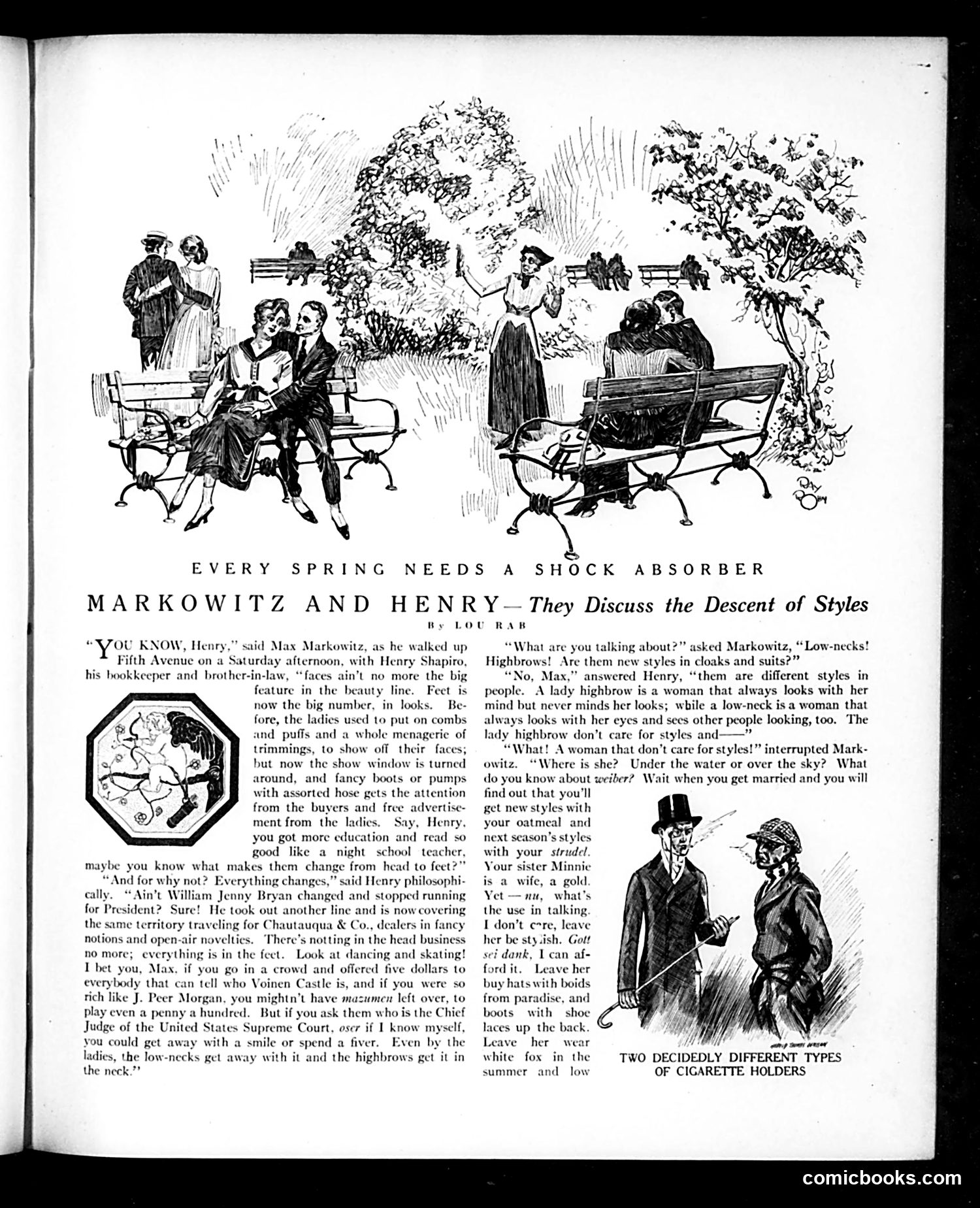
This is a humorous dialogue between two Jewish immigrant characters, Max Markowitz and Henry, discussing changing fashion trends. The satire mocks how women's fashion has shifted focus from facial beauty to footwear and legs—a commentary on early 20th-century fashion evolution (likely 1910s-1920s, given references to dancing and skating). Henry uses exaggerated examples to illustrate society's shallowness: mentioning William Jennings Bryan (who abandoned presidential runs for lecture circuit work) and celebrity figures like Voimen Castle and J.P. Morgan. His point is that people care more about superficial status symbols than intellectual achievement. The "low-necks" versus "highbrows" distinction plays on both neckline fashion and intellectual pretension—a woman focused on appearance versus one focused on ideas. The cigarette-holder illustration at bottom appears unrelated advertising or filler content. The humor relies on ethnic stereotyping common to period Judge magazine, using Yiddish-inflected speech patterns for comedic effect.
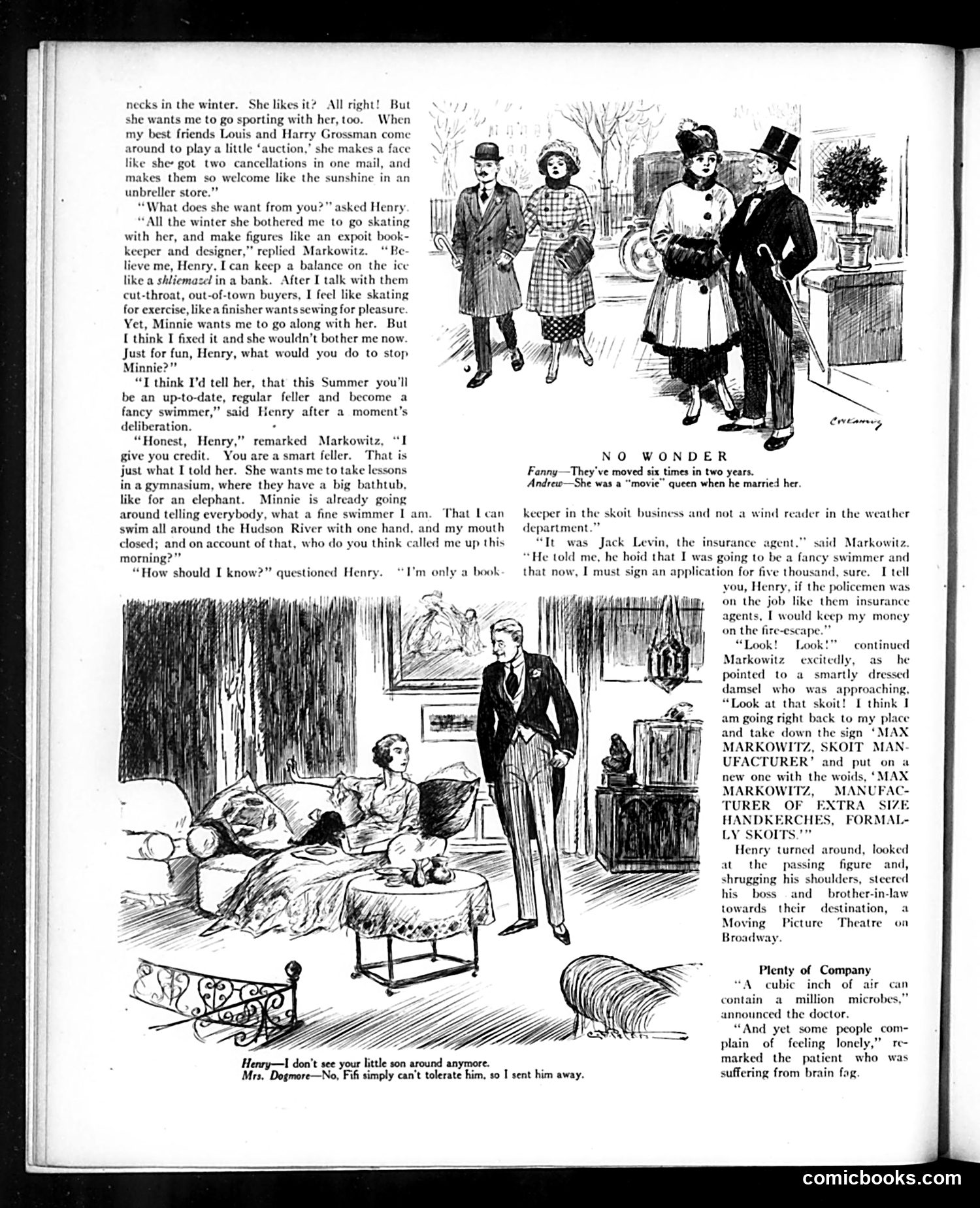
This page satirizes Jewish immigrant life in early 20th-century America through the character Markowitz, a "skirt manufacturer" (garment industry worker). The humor centers on his nagging wife Minnie, who pressures him into leisure activities—skating, swimming—that he finds exhausting after long workdays negotiating with difficult buyers. The satire targets the tension between Old World values (work, duty) and American consumer culture's demands for leisure and self-improvement. Markowitz's Yiddish-inflected English ("shliemazel," "skoit") marks him as a recent immigrant. The joke escalates when an insurance agent exploits his boasting about swimming prowess to sell him a policy—suggesting Jews as both gullible and entrepreneurial. The accompanying cartoons mock marital discord and modern dating (the "movie queen" who wants constant excitement). The medical joke about loneliness amid microbes provides social commentary on urban disconnection. Overall, the page reflects Judge's satirical treatment of immigrant experiences and changing American social mores during the Jazz Age.
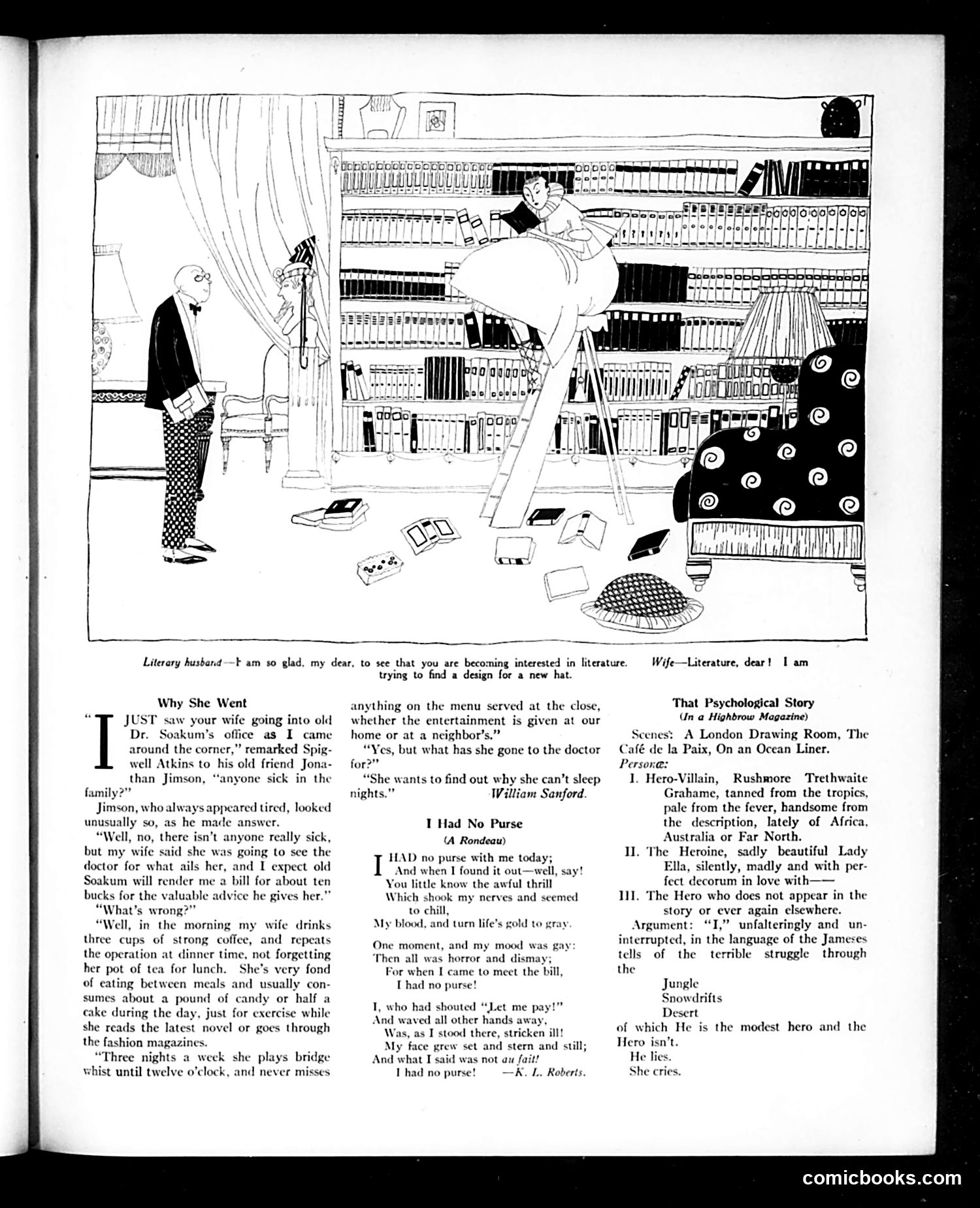
This page contains three separate satirical pieces mocking early 20th-century domestic life and literary pretension. **"Why She Went"** ridicules wives' health anxieties. A husband complains his wife visits the doctor despite no genuine illness—she merely overindulges in coffee, candy, late-night bridge, and rich food while reading novels and fashion magazines, then can't sleep. The joke: her "ailment" is self-inflicted lifestyle excess, not medical. **"I Had No Purse"** humorously depicts male embarrassment at being unable to pay a bill—a social mortification of the era when men were expected to be providers. **"That Psychological Story"** parodies pretentious literary magazines (likely *The* *Highbrow Magazine*) that featured dense, introspective fiction. The satire lists a melodramatic setup with exotic locales and tragic lovers, yet notes the actual "hero" never appears in the story—only the narrator's endless monologue. The punchline: "He lies. / She cries"—mocking overwrought emotional narrative stripped of substance. The cartoons above illustrate these pieces with period-appropriate domestic scenes.
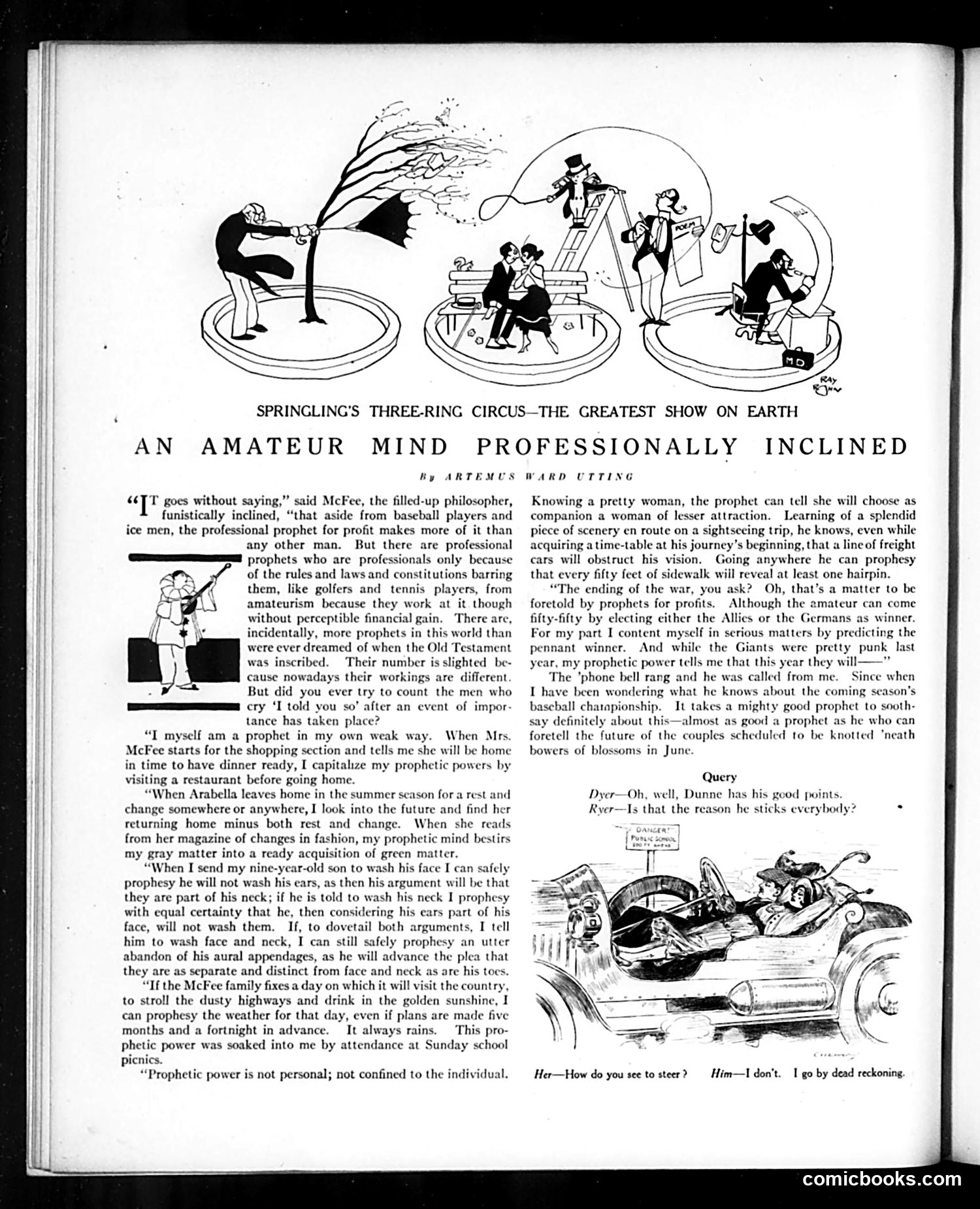
This is a satirical humor piece titled "An Amateur Mind Professionally Inclined" by Artemus Ward Utting. The main cartoon shows three circus rings representing amateur "prophets"—ordinary people who make predictions without professional credentials or payment. The article mocks self-proclaimed fortune-tellers and amateur predictors through the character McFee, a working-class philosopher who claims "prophetic powers." His examples are deliberately mundane: predicting his wife will overspend, that his son won't wash his ears properly, that rain will ruin family outings, and that freight cars will block scenic views. The satire targets two things: (1) Americans' obsession with fortune-telling and predictions, and (2) the pretentiousness of treating everyday common sense as mystical foresight. McFee's "prophetic power" is simply accumulated life experience and cynical expectations. The cartoon's three rings parody P.T. Barnum's circus spectacle, suggesting that prediction-mongering is itself a form of entertainment or con artistry—a show for gullible audiences.
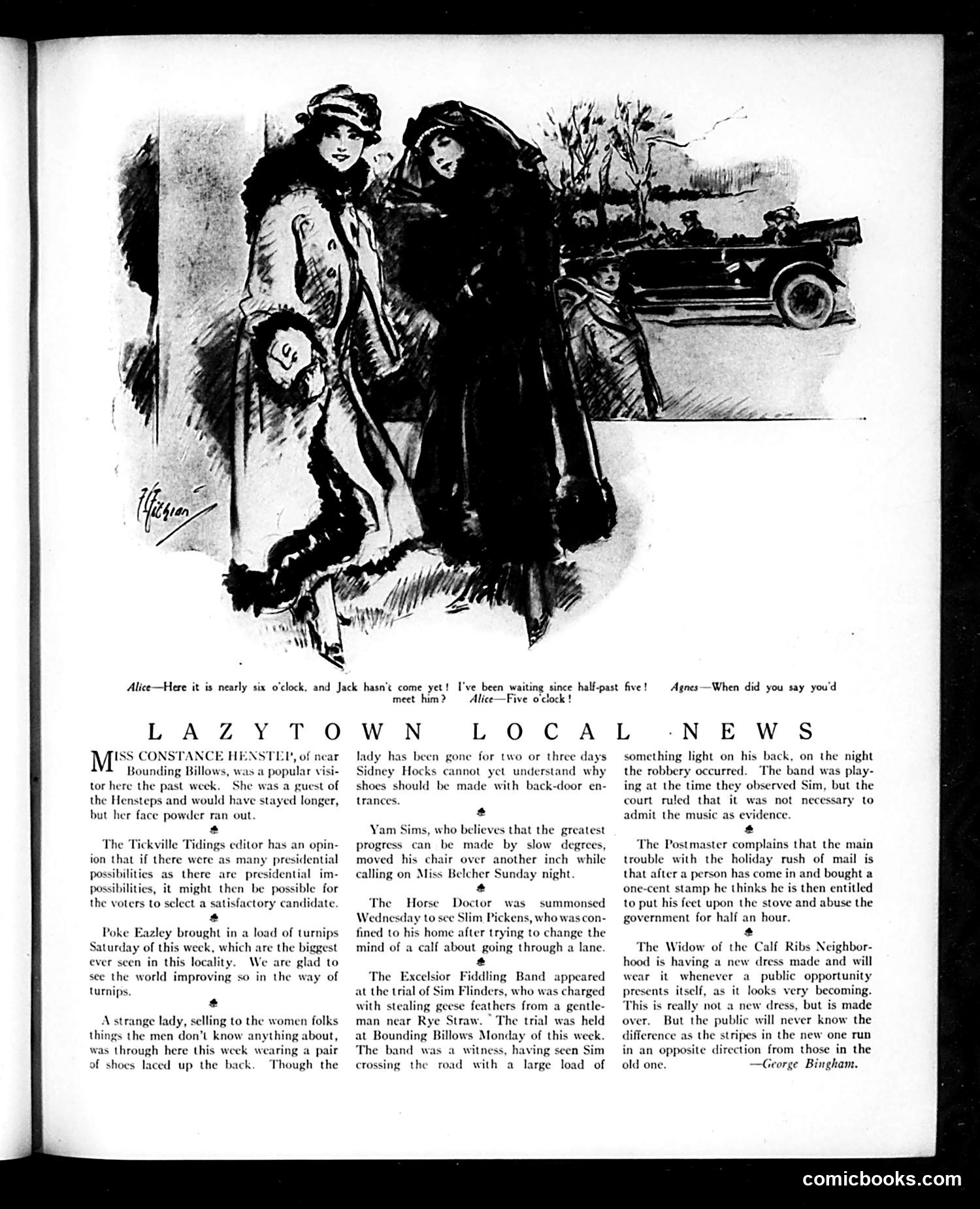
This page from Judge magazine is a humorous "small-town gossip column" satirizing rural American life and provincial attitudes. The cartoon at top depicts two women (Alice and Agnes) waiting for dates—a relatable domestic comedy about punctuality and feminine impatience. The "Local News" section that follows parodies small-town newspapers through exaggerated, mundane items: a woman running out of face powder, turnips being notably large, shoes mysteriously laced in back, and a band's musical testimony being legally inadmissible. The humor targets rural simplicity and backwards logic—like the postmaster's complaint that customers expect government service for one cent. The final items mock small-town vanity and deception: a widow recycling an old dress by reversing its stripes, confident "the public will never know the difference." Overall, the satire gently ridicules rural Americans as unsophisticated, fashion-unconscious, and prone to petty gossip—common Judge magazine themes reflecting urban middle-class attitudes toward rural life.
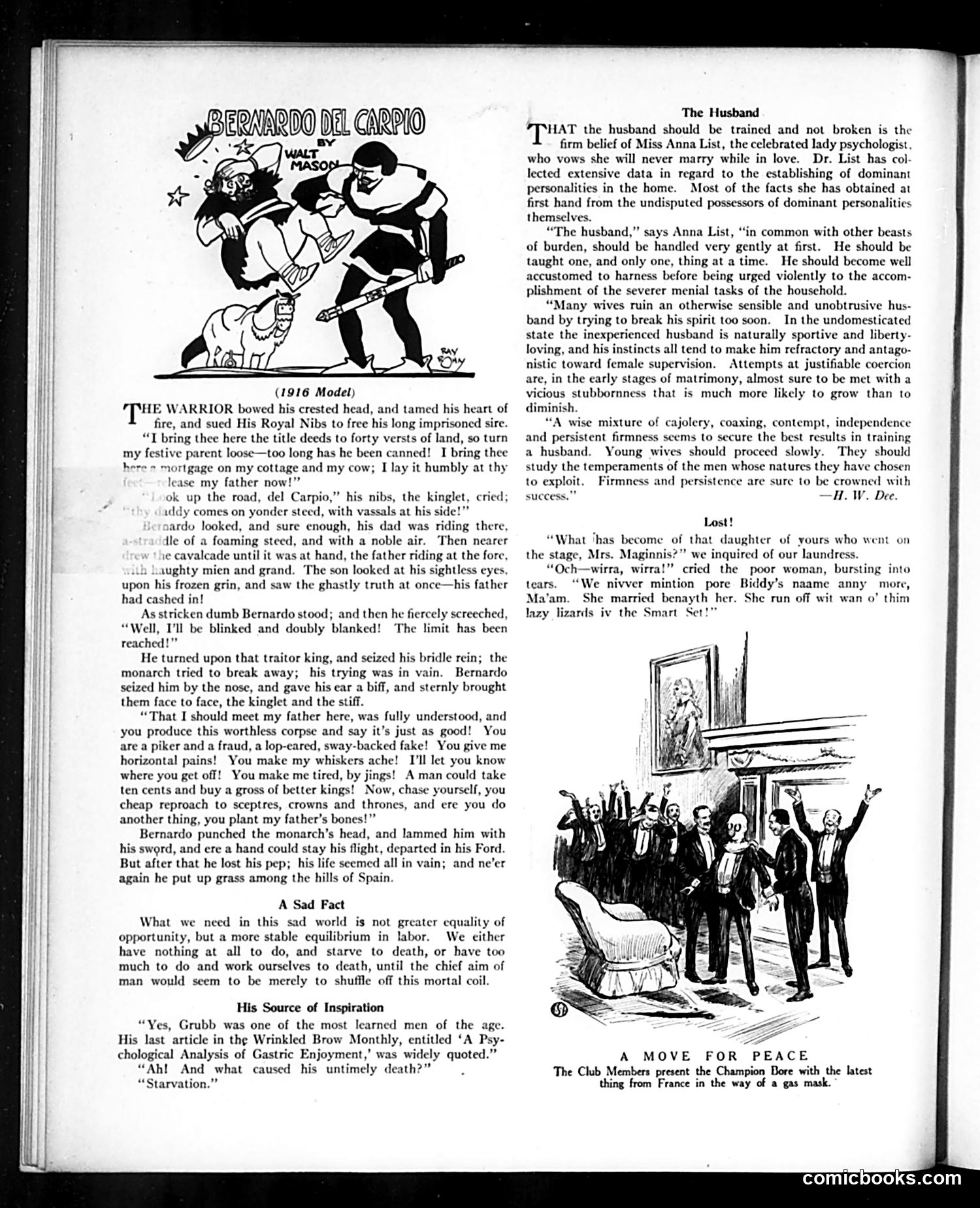
This page contains two satirical pieces from 1916: **"Bernardo del Carpio" (top):** A comedic retelling of a Spanish legend about a warrior who bargains with a king to free his imprisoned father. The joke is that when the father arrives, he's dead—the king has literally delivered a corpse. Bernardo, enraged at this betrayal, beats the king and drives off in a Ford (a modern automobile, making the ancient legend anachronistic for satirical effect). The piece mocks both corrupt monarchy and the futility of noble sacrifice. **"The Husband" (right column):** A satirical advice piece by "Miss Anna List, a celebrated lady psychologist," comparing husband-training to animal training. She recommends gentle handling and gradual conditioning, using language that treats husbands like beasts of burden requiring "harness" before harder tasks. The satire targets both pseudo-scientific psychology and contemporary debates about gender roles and marriage dynamics—poking fun at both domineering wives and the supposedly "natural" subordination of husbands.
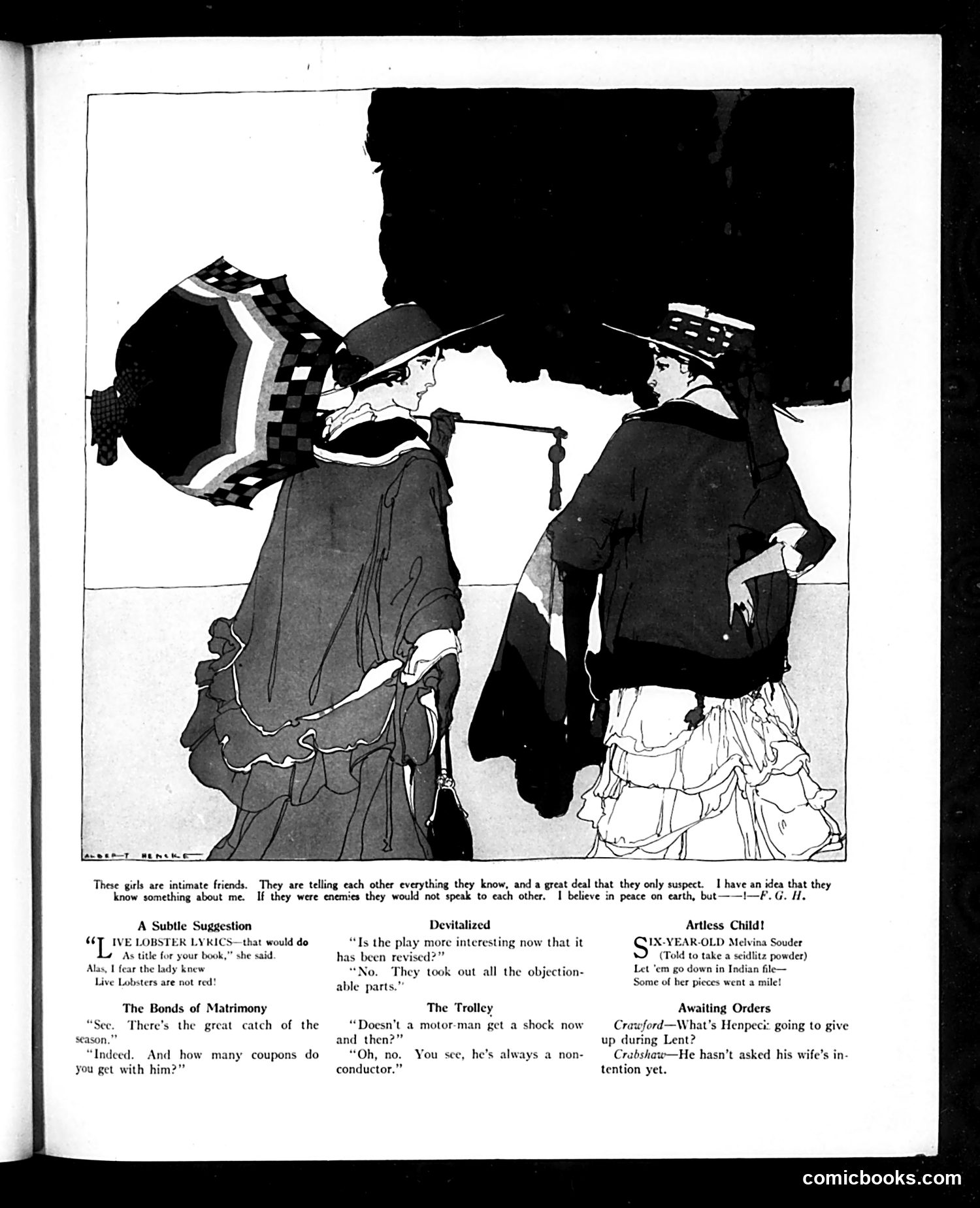
This page contains six separate humorous vignettes satirizing early 20th-century American social conventions and relationships. The top illustration depicts two fashionably-dressed women gossiping, with commentary mocking female friendships as vehicles for spreading rumors and speculation rather than genuine intimacy. The six captioned jokes target various targets: a woman's literary ambitions ("Live Lobster Lyrics"), marriage as a financial transaction ("coupons"), misleading book promotion, the tedium of theatrical revivals, streetcar workers' safety (implying they *should* be shocked by conditions), and a child's uncontrolled behavior with laxative powder. The final joke satirizes henpecked husbands who must consult wives before making decisions. The overall tone reflects period attitudes toward women's gossip, marital power dynamics, and working-class conditions, all presented as light comedy rather than serious critique. The art style and sensibility are typical of Judge's satirical approach to middle-class American life.
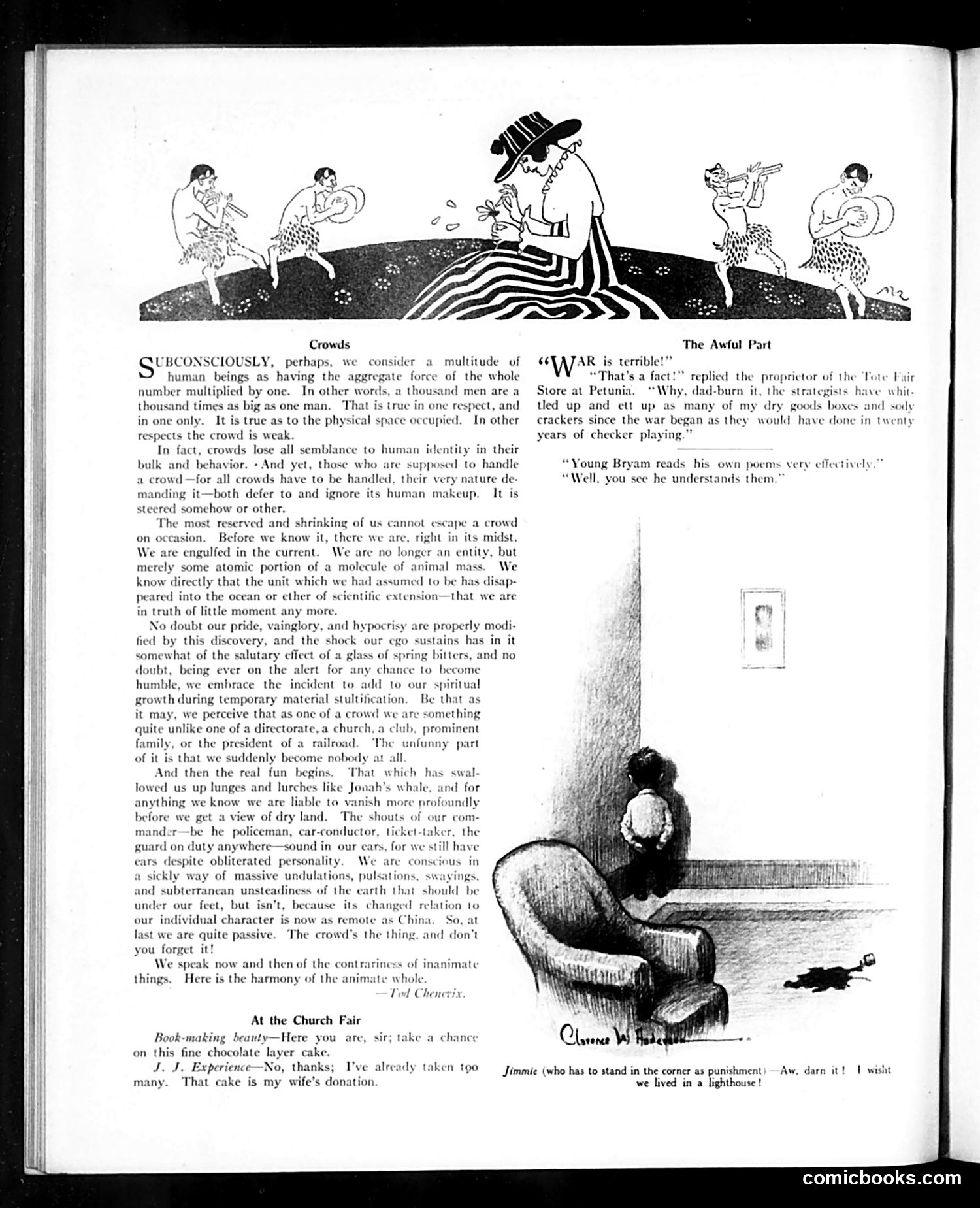
**Main Article ("Crowds"):** A philosophical essay on crowd psychology. The author argues that while crowds are physically large, they paradoxically render individuals powerless and anonymous—people lose their identity, becoming mere "atomic portions" of a collective mass. The piece reflects early-20th-century anxiety about mass society and urban anonymity, suggesting crowds strip away individual dignity and agency. **Cartoons:** The header illustration depicts a large crowd figure dominating smaller individuals, visualizing the essay's theme. The bottom cartoon shows a domestic scene where a boy being punished in a corner wishes they "lived in a lighthouse"—a humorous commentary on crowded home life and desire for isolation/peace. **"Church Fair" and "War" sections:** Brief comedic anecdotes about everyday social situations—a man declining cake his wife donated, and a store proprietor lamenting wartime scarcity of supplies. These appear as filler humor typical of Judge magazine's satirical format. The page reflects Progressive Era concerns about urbanization, mass culture, and individual autonomy amid rapid social change.
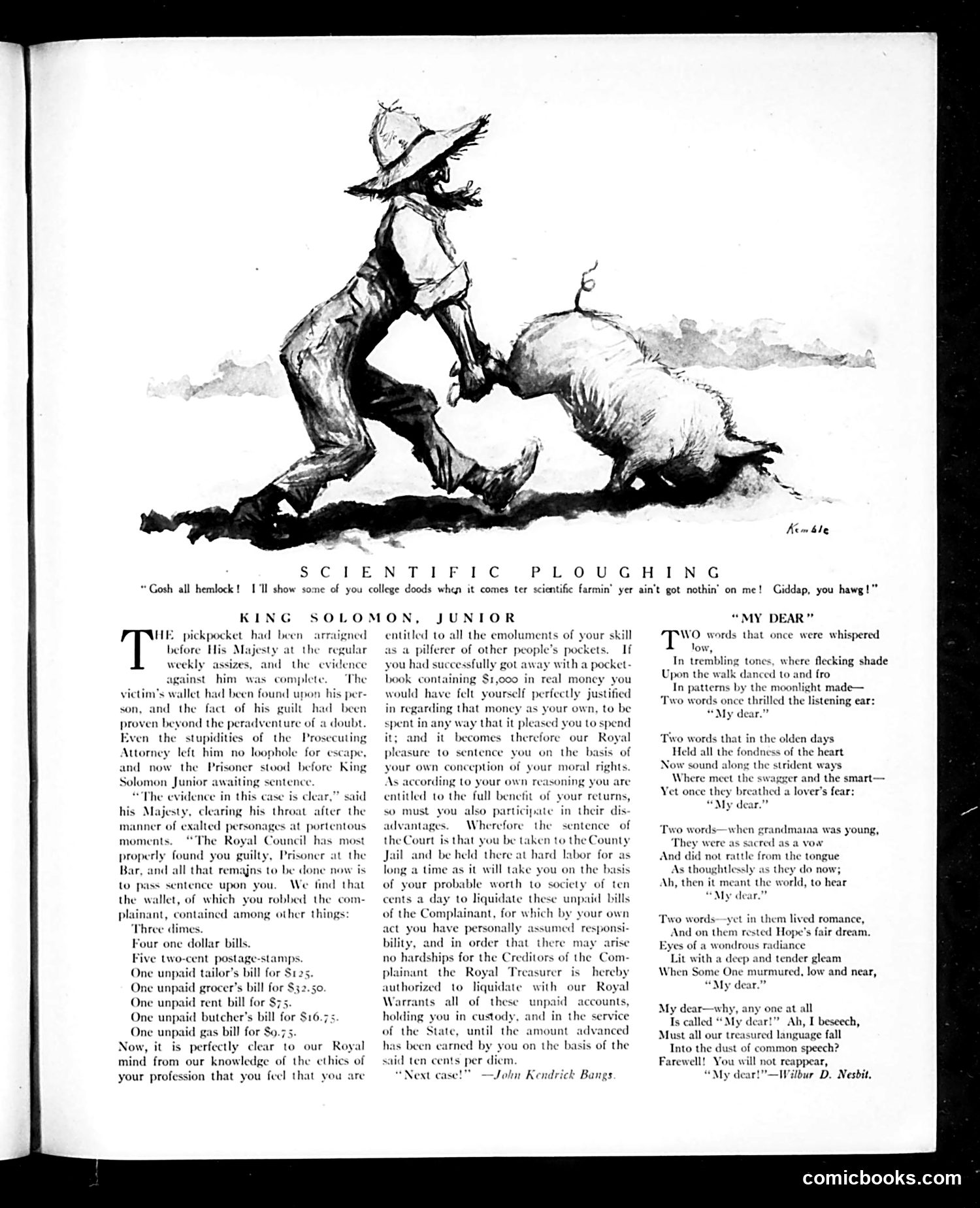
This Judge magazine page contains two satirical pieces: **"Scientific Ploughing" (top cartoon):** A farmer with a plow and pig confronts a gentleman, boasting about his agricultural knowledge. The satire appears to mock pretentious "scientific farming" claims—the farmer's crude dialect ("yer ain't got nothin' on me") contrasts with would-be sophistication, suggesting rural skepticism toward academic agricultural methods gaining popularity in this era. **"King Solomon, Junior" (main story):** A judge sentences a pickpocket based on the thief's own moral logic: since the criminal believed he deserved stolen money, he should work at ten cents daily until he pays off the victim's unpaid bills (tailor, grocer, rent, butcher, gas). The satire criticizes both criminal reasoning and debt systems—the judge's "poetic justice" exposes how criminals rationalize theft while society traps the poor in debt servitude. **"My Dear" (poem):** Nostalgic verse lamenting how the romantic phrase "my dear" has become commonplace and casual, stripped of its former intimacy—social commentary on modernity's erosion of meaningful language.
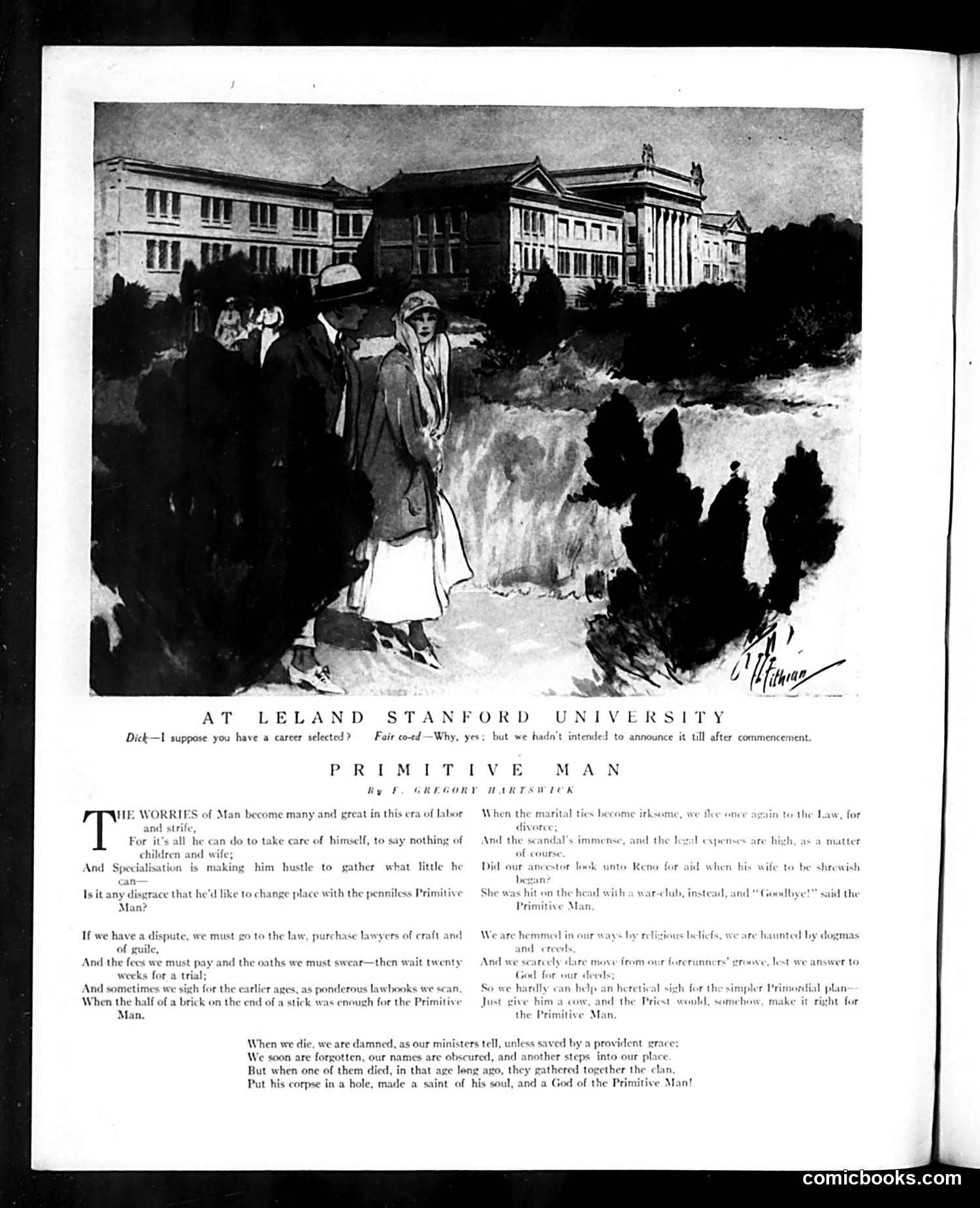
This satirical piece contrasts modern life's complications with simpler times. Two figures—a man and a woman (identified as "Dick" and a "Fair co-ed")—discuss career plans at Stanford University. The dialogue joke hinges on the woman's announcement of marriage plans, which she hadn't meant to reveal yet. The accompanying poem by Gregory Hartswick laments how contemporary life burdens men with legal fees, anxiety, and moral constraints imposed by society and religion. It nostalgically contrasts this with "Primitive Man," who needed only a stick to survive and whose community honored him in death without modern complications. The satire targets early 20th-century anxieties: professional ambitions, matrimonial expectations for educated women, legal entanglement, and the loss of simpler values—suggesting modern "civilization" creates more problems than it solves.
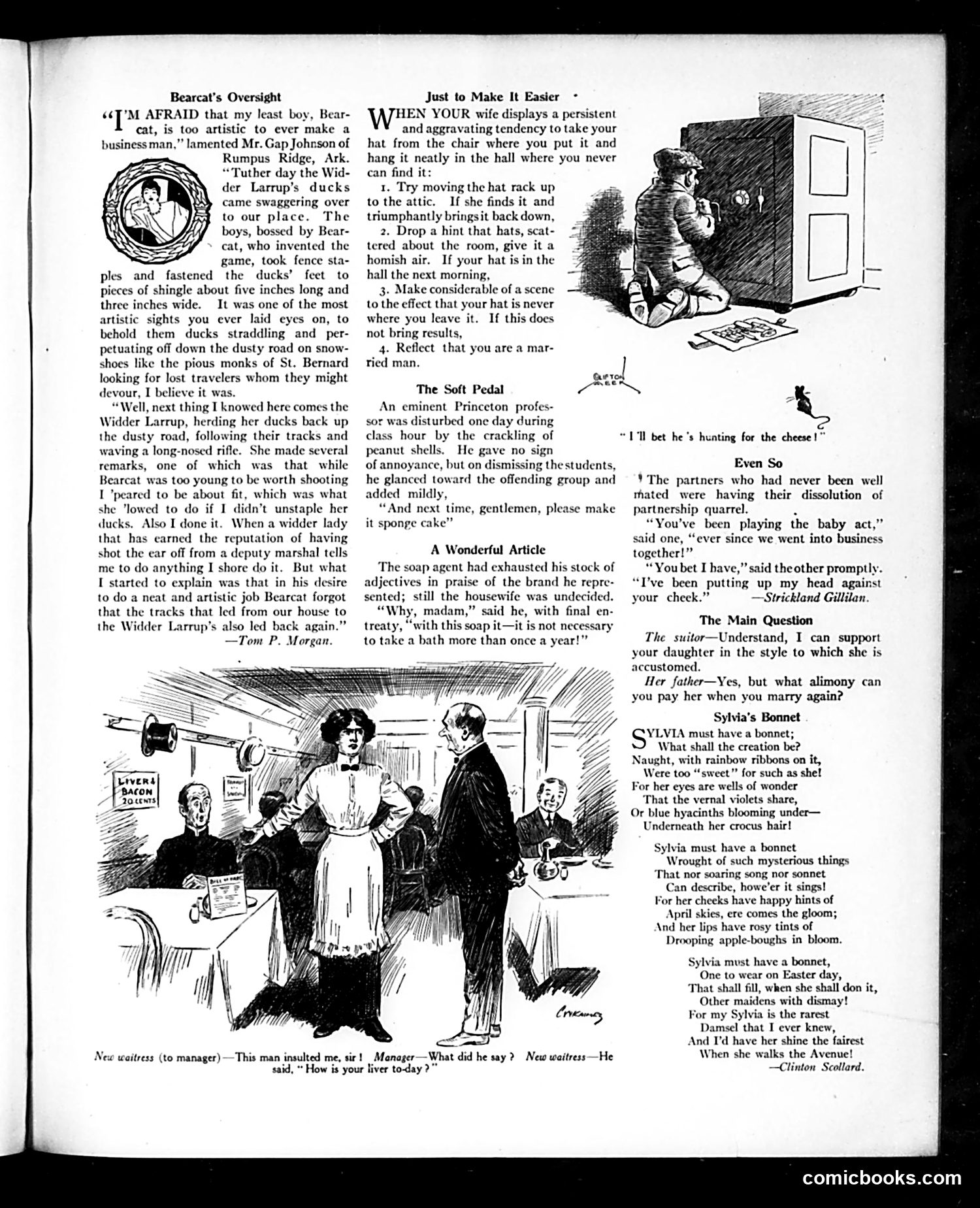
This page contains several short humorous pieces typical of early 20th-century American satirical magazines: **"Bearcat's Oversight"** mocks rural simplicity and parental blindness. A farmer's son, Bearcat, fashions "snowshoes" from fence staples and shingles attached to the Widow Larrup's ducks—presented as "artistic" but destructive. The father fails to anticipate consequences: the widow tracks the ducks back using their hoof-prints, threatening violence. The satire targets both artistic pretension divorced from practicality and parental inability to see obvious trouble. **The practical humor pieces** ("Just to Make It Easier," "The Soft Pedal," "A Wonderful Article") mock domestic life and sales dishonesty through brief anecdotes. **"The Main Question"** satirizes gold-digging by having a prospective father-in-law ask what alimony a suitor will pay *after* inevitable divorce. **"Sylvia's Bonnet"** appears to be light romantic verse about a woman's hat. The cartoons and text together capture Judge's focus: mocking middle-class pretension, rural naïveté, marital discord, and consumer culture through gentle, accessible humor.
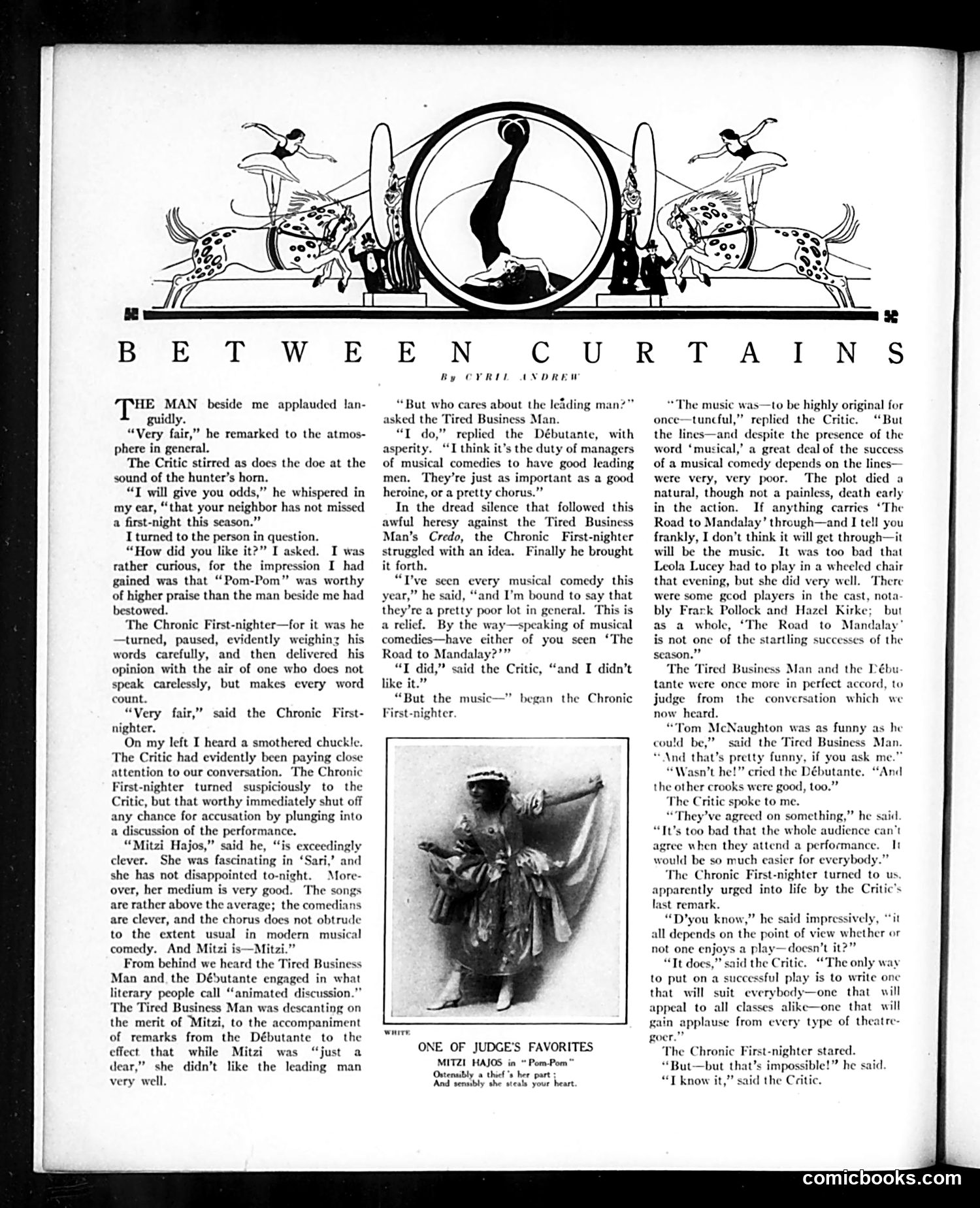
This Judge article satirizes the "Chronic First-nighter"—a stereotypical Broadway regular who attends every musical comedy premiere but offers only bland, non-committal opinions ("Very fair"). The piece mocks this type through dialogue at a performance of "Pom-Pom" starring Mitzi Hajos. The satire targets the gap between claimed expertise and actual taste: the First-nighter has seen everything yet expresses nothing distinctive, while a genuine Critic offers detailed, reasoned judgments (praising Hajos but criticizing "The Road to Mandalay's" weak plot and dialogue). The central joke involves social pretension—the First-nighter's careful, measured speech masks empty opinion-making, contrasting sharply with the Critic's substantive analysis. The photograph of Hajos emphasizes Judge's promotion of the actual theatrical talent being discussed. The piece gently ridicules New York theater society's status-conscious opening-night culture.
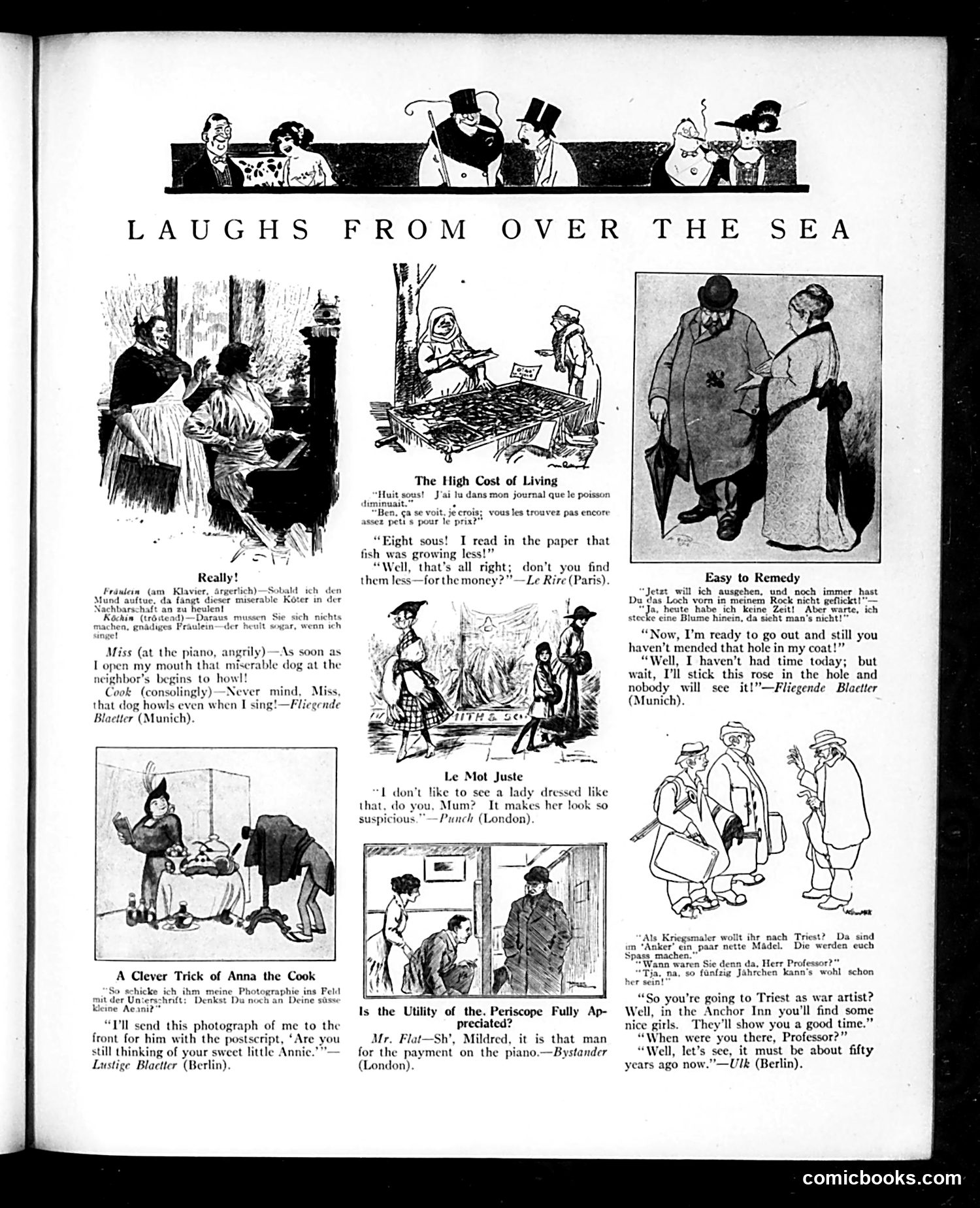
This page collects humorous comic strips and jokes translated from European satirical magazines (German, French, British publications). The cartoons address relatable domestic and wartime concerns: **Recurring themes:** - **Domestic annoyances**: A woman's singing causes a neighbor's dog to howl; a cook's solution to a torn coat is hiding it with a flower rather than mending it. - **Economic hardship**: Fish prices are absurdly high despite supposedly diminishing supply—vendors sell tiny portions at premium cost. - **WWI references**: A woman plans sending her photograph to a soldier boyfriend; a professor discusses visiting Trieste as a war artist and pursuing women there. - **Social observation**: A periscope joke satirizes avoiding bill collectors; another cartoon mocks women's suspicious fashion choices. The page's purpose is cultural cross-pollination, showing American Judge readers that humor about wartime rationing, relationship troubles, and social awkwardness transcends national borders. The translations preserve original publication credits, emphasizing international appeal.
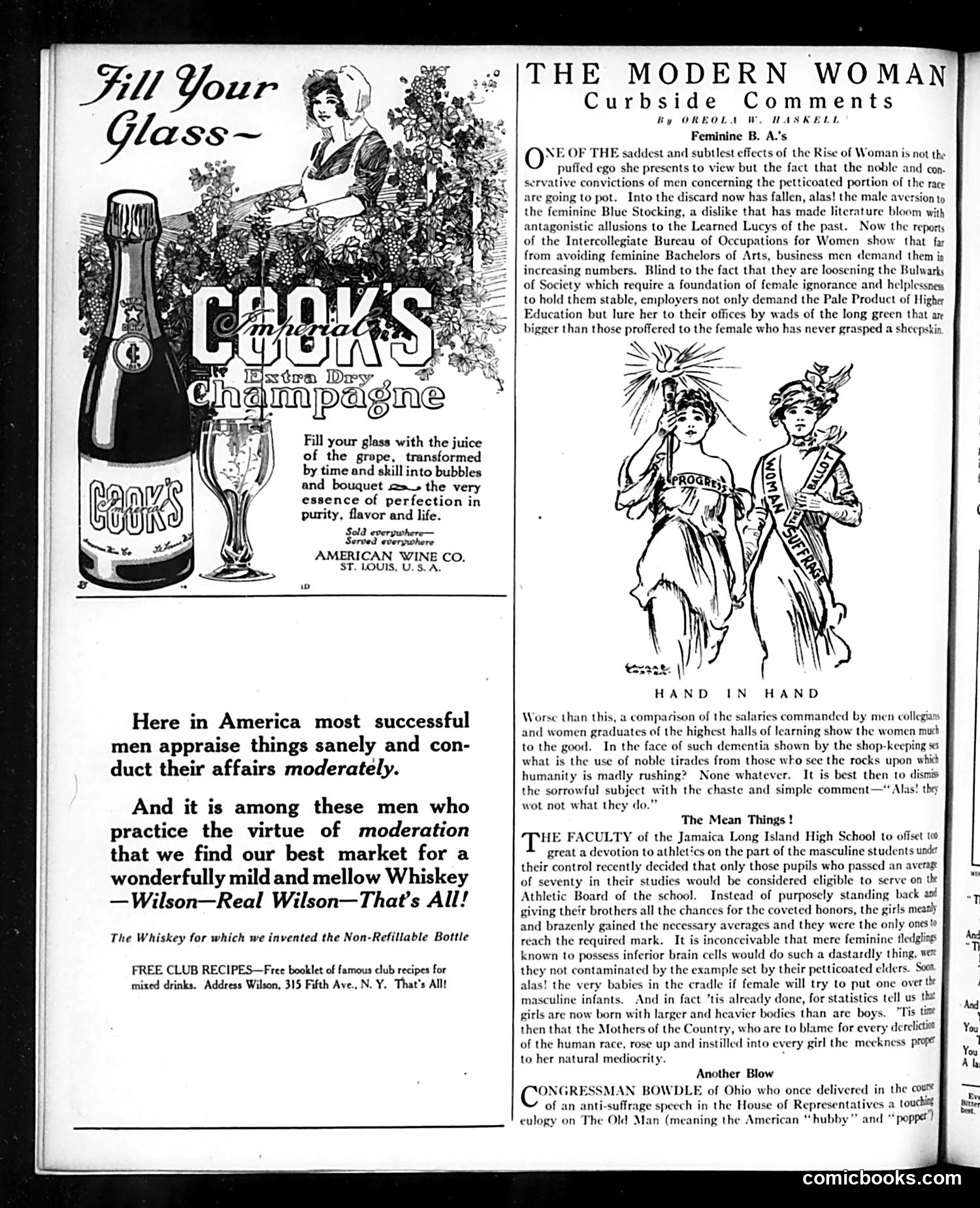
This page satirizes anti-feminist anxieties of the early 20th century. The column "The Modern Woman: Curbside Comments" mock-laments that educated women (holding B.A. degrees) are now *desirable* to employers, contradicting traditional prejudices against "blue stockings" (intellectual women). The satire's target: male anxiety disguised as social concern. The author ironically "mourns" that women's education threatens society's stability, that female graduates earn competitive salaries, and that schoolgirls outperform boys academically—presenting these as disasters rather than progress. The piece includes a jab at Congressman Bowdle's anti-suffrage speech, further mocking resistance to women's advancement. The irony is the satire's weapon: by exaggerating male complaints as "sorrowful," the author ridicules them as baseless fears. The ads (Wilson whiskey, Cook's champagne) frame the commentary ironically within "modern" consumer culture.
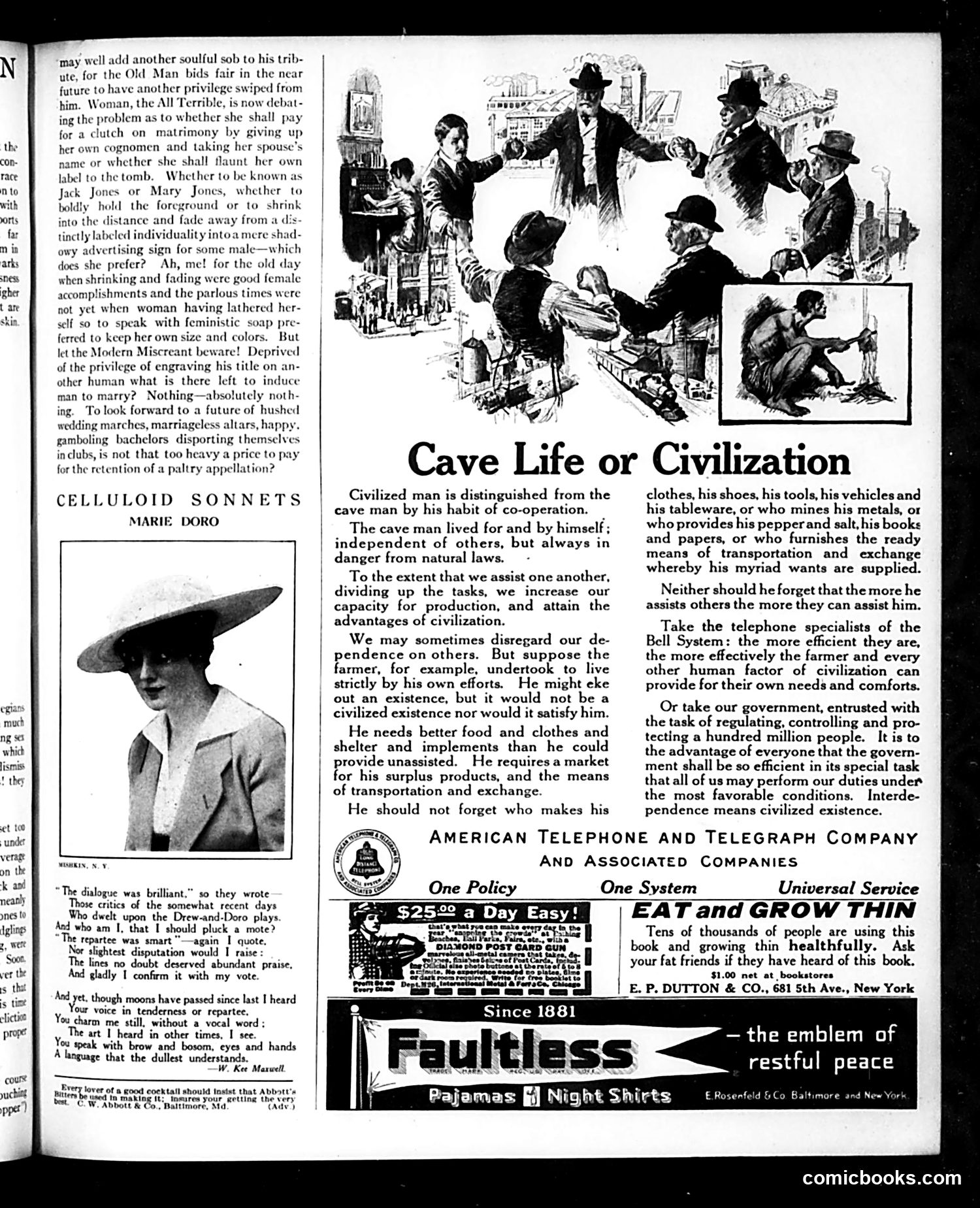
This page features a satirical article and advertisements promoting **interdependence and cooperation** as markers of civilization. The main cartoon contrasts "cave life" (solitary self-sufficiency) with "civilization" (mutual cooperation). The article argues that modern society depends on specialized workers—farmers, telephone operators, government officials—each relying on others. It uses the Bell System telephone company as an example of how efficiency in one sector benefits everyone. The implicit satire targets **individualism and self-reliance ideology**, suggesting that Americans who boast of independence actually depend entirely on cooperative systems they often take for granted. The contrast between "cave man" and "civilized man" mocks the notion that anyone can truly live independently. The page also includes lighter content: a sonnet about actress Marie Doro's silent film performances, and advertisements for diet books and pajamas—typical Judge magazine fare mixing social commentary with commercial appeals.
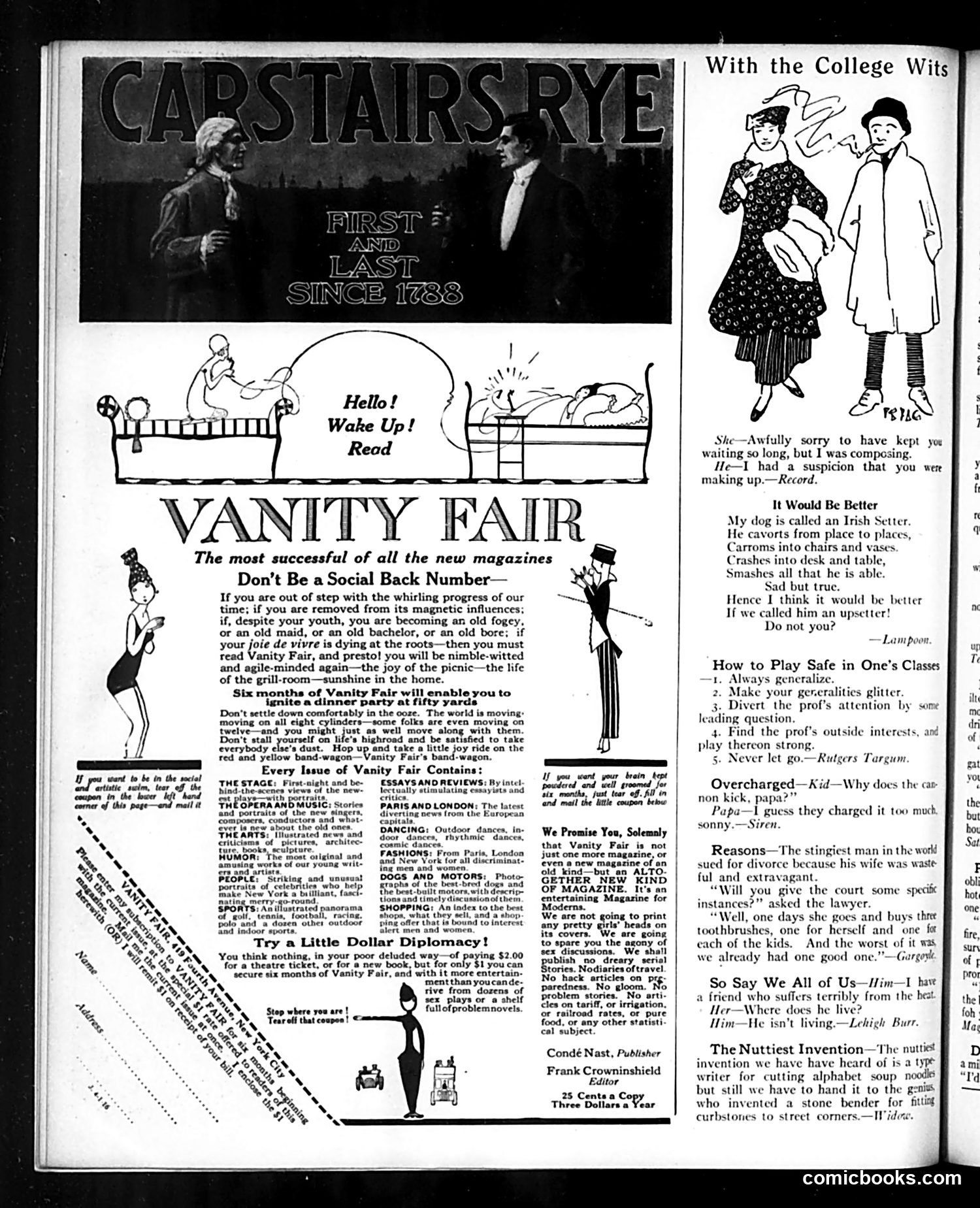
This is primarily a **full-page advertisement for Vanity Fair magazine** (a real 1920s publication), disguised as satirical editorial content in Judge magazine. **The Main Satire:** The ad mocks people who are "out of step" with modern life—portrayed as old-fashioned "fogeys," "old maids," or "old bores." The pitch: reading Vanity Fair will make you fashionable and witty. The humor targets social anxiety about appearing dated in a rapidly changing era (the "whirling progress of our time"). **Key References:** - "Dollar Diplomacy"—a jab at Theodore Roosevelt-era foreign policy, here repurposed as a joke about getting good value - References to "eight cylinders" and automobiles reflect 1920s modernity obsession - Content promises (Paris fashions, dancing, motors, golf) appeal to Jazz Age sophistication **Side Content:** Smaller college humor pieces mock student life and dating customs of the period. The page essentially satirizes consumer anxiety while *being* the consumer product itself—a meta-joke typical of Judge's editorial approach.
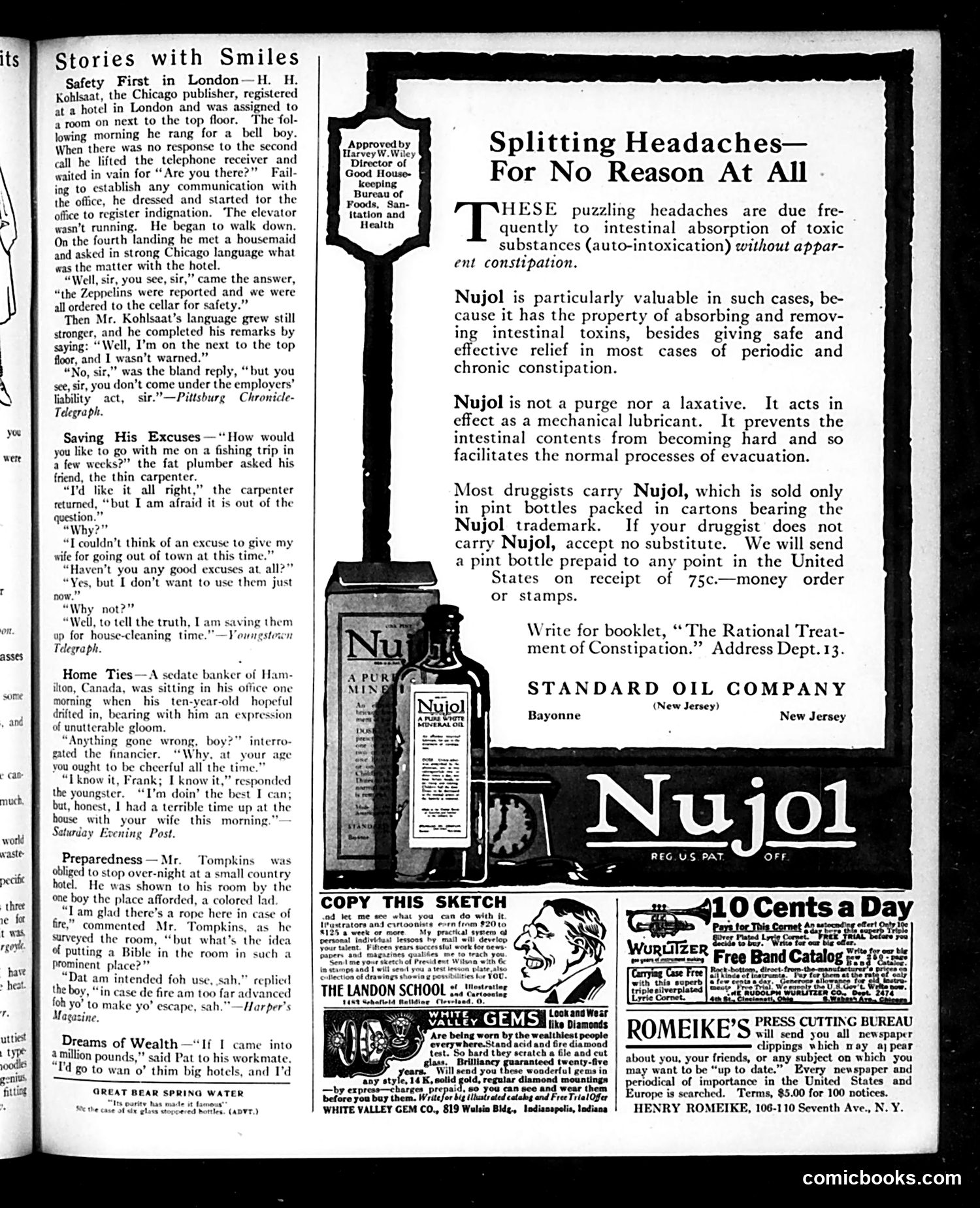
This page contains humorous short stories and advertisements typical of early 20th-century American satirical journalism. **The Stories:** Four brief anecdotes satirize contemporary social situations: 1. **"Safety First in London"** mocks a Chicago publisher's complaint about not receiving air-raid warnings during a Zeppelin alert—a reference to German aerial attacks during WWI. The joke's punchline plays on employer liability law. 2. **"Saving His Excuses"** depicts a carpenter hoarding excuses for his wife, reserving them for "house-cleaning time"—satirizing domestic tension and marital negotiation. 3. **"Home Ties"** shows a banker's young ward describing trouble with the banker's wife, a mild joke about household hierarchy. 4. **"Preparedness"** features a hotel clerk suggesting a Bible is provided for use during fire—absurdist humor about safety equipment. The dominant advertisement promotes **Nujol**, a mineral oil laxative sold by Standard Oil Company, claiming to treat headaches caused by constipation. This reflects period medical theories linking digestive issues to various ailments. The ad emphasizes Nujol is not a harsh laxative but a "mechanical lubricant."
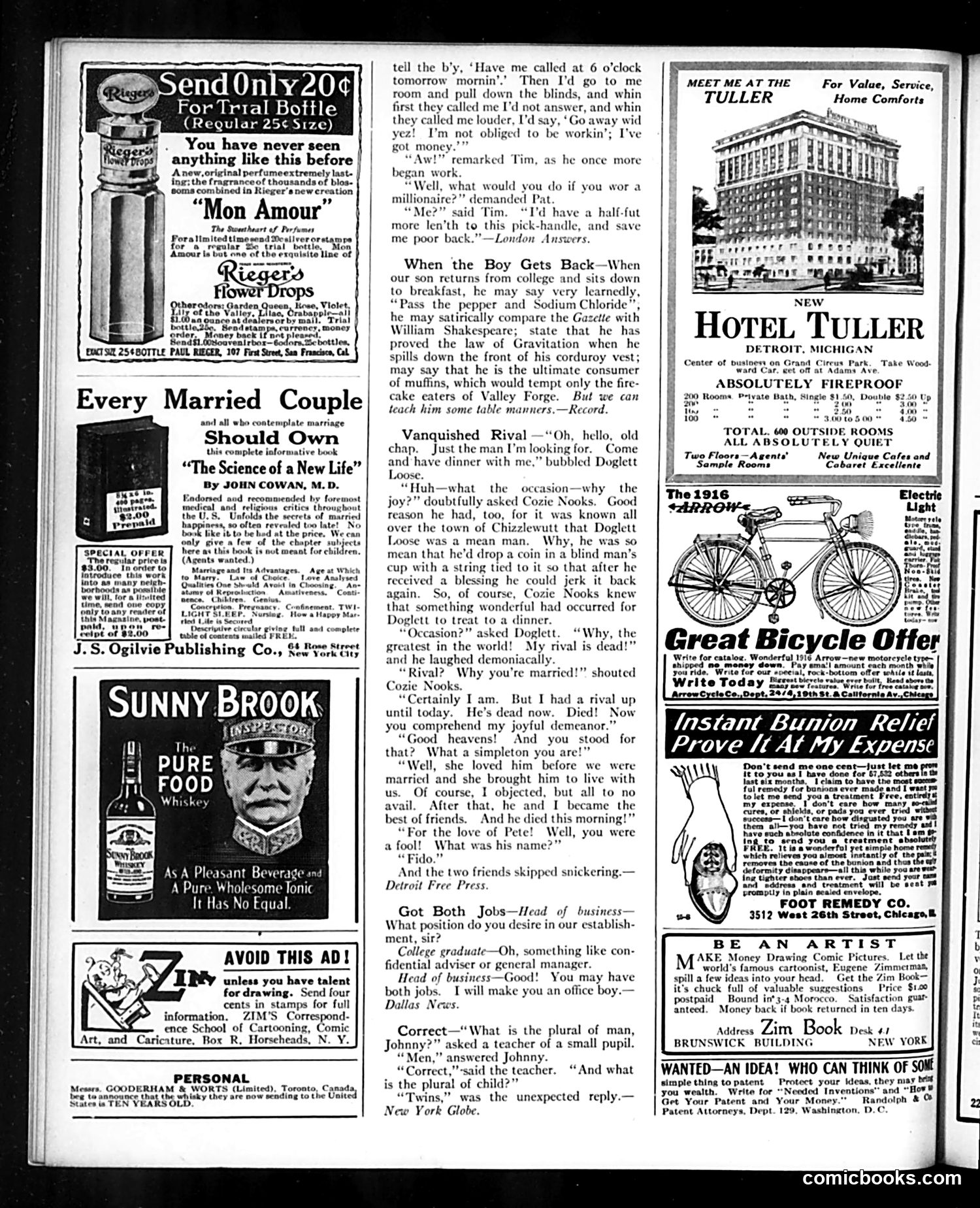
This page from *Judge* magazine contains several humorous short stories and advertisements typical of early 20th-century American magazines. **The main content includes:** 1. **"Vanquished Rival"** — A darkly comic story about a man named Doglett Loose who invites his rival Cozie Nooks to dinner. The "rival" turns out to be Doglett's wife's ex-lover whom she brought to live with them after marriage. The rival has died, prompting Doglett's celebration. The joke satirizes both miserliness (Doglett is so cheap he ties string to coins given to beggars) and the absurdity of the situation. 2. **"When the Boy Gets Back"** — Gentle satire about college students returning home and pretentiously using scientific terminology ("sodium chloride" for salt, discussing gravitation while spilling food). 3. **Short jokes** about working-class aspirations, business positions, and grammar. The page is primarily **advertising-heavy**, promoting perfume, whiskey, hotels, bicycles, and self-help books—typical of this era's magazine business model.
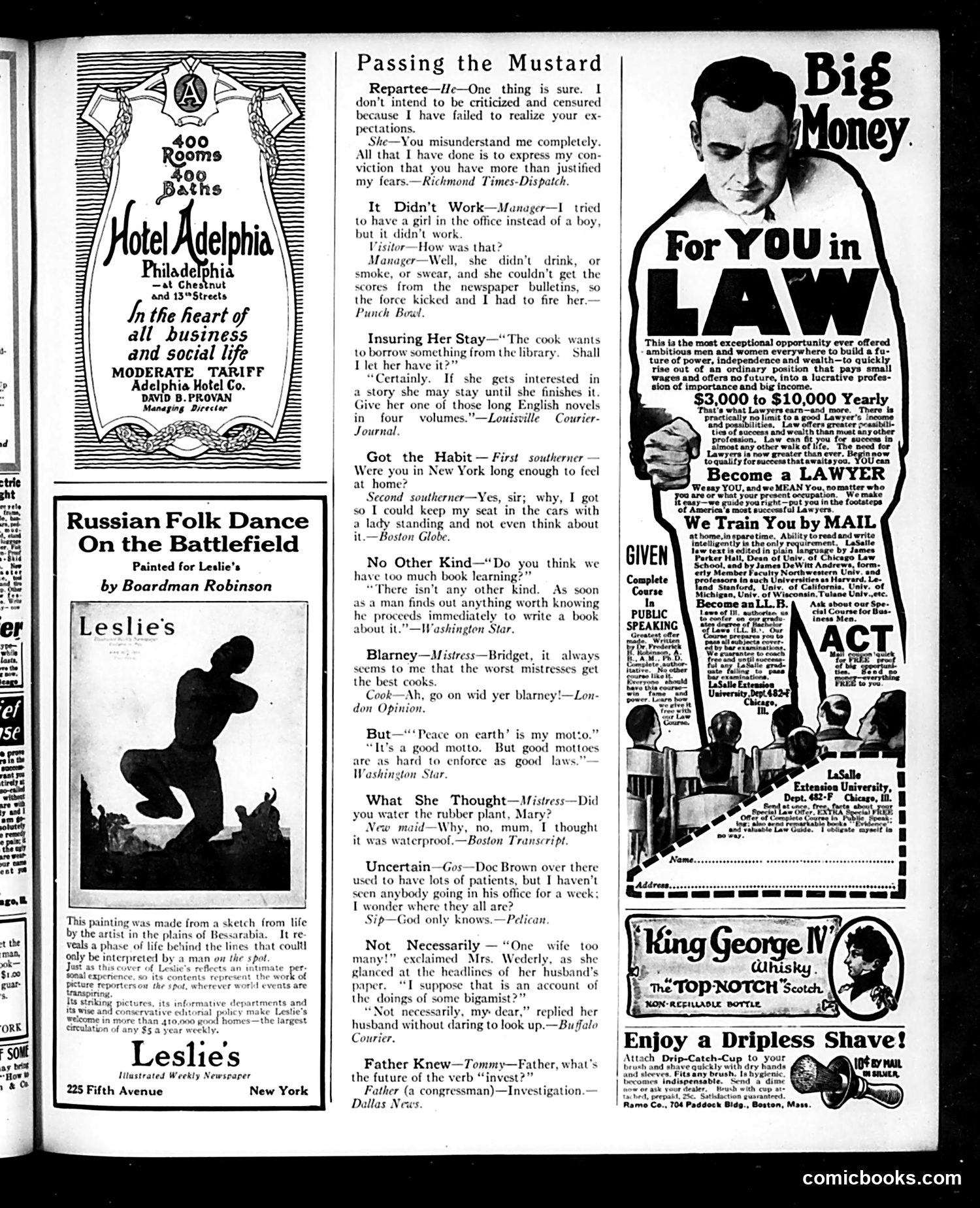
This page is primarily **advertising with humor columns**, not political cartoons. The main content consists of short joke exchanges labeled "Passing the Mustard." The humor pieces are light domestic and social satire typical of early 20th-century magazines: - **"It Didn't Work"**: Jokes about hiring a female office worker who lacks male vices (drinking, smoking) and can't access sports scores—implying women were seen as disruptive to workplace culture. - **"Blarney"** and **"Insuring Her Stay"**: Class-based humor about servants and employers. - **"What She Thought"**: A "stupid maid" joke about misunderstanding "waterproof." The advertisements are era-typical: a Philadelphia hotel, Leslie's magazine, law school correspondence courses ($3,000-$10,000 yearly income promised), and a "dripless shave" cup. One illustration shows a Boardman Robinson painting titled "Russian Folk Dance on the Battlefield" from Leslie's—likely depicting Bessarabian conflict during WWI, though context is unclear from this page alone. Overall: **Miscellaneous humor and advertising, no significant political content.**
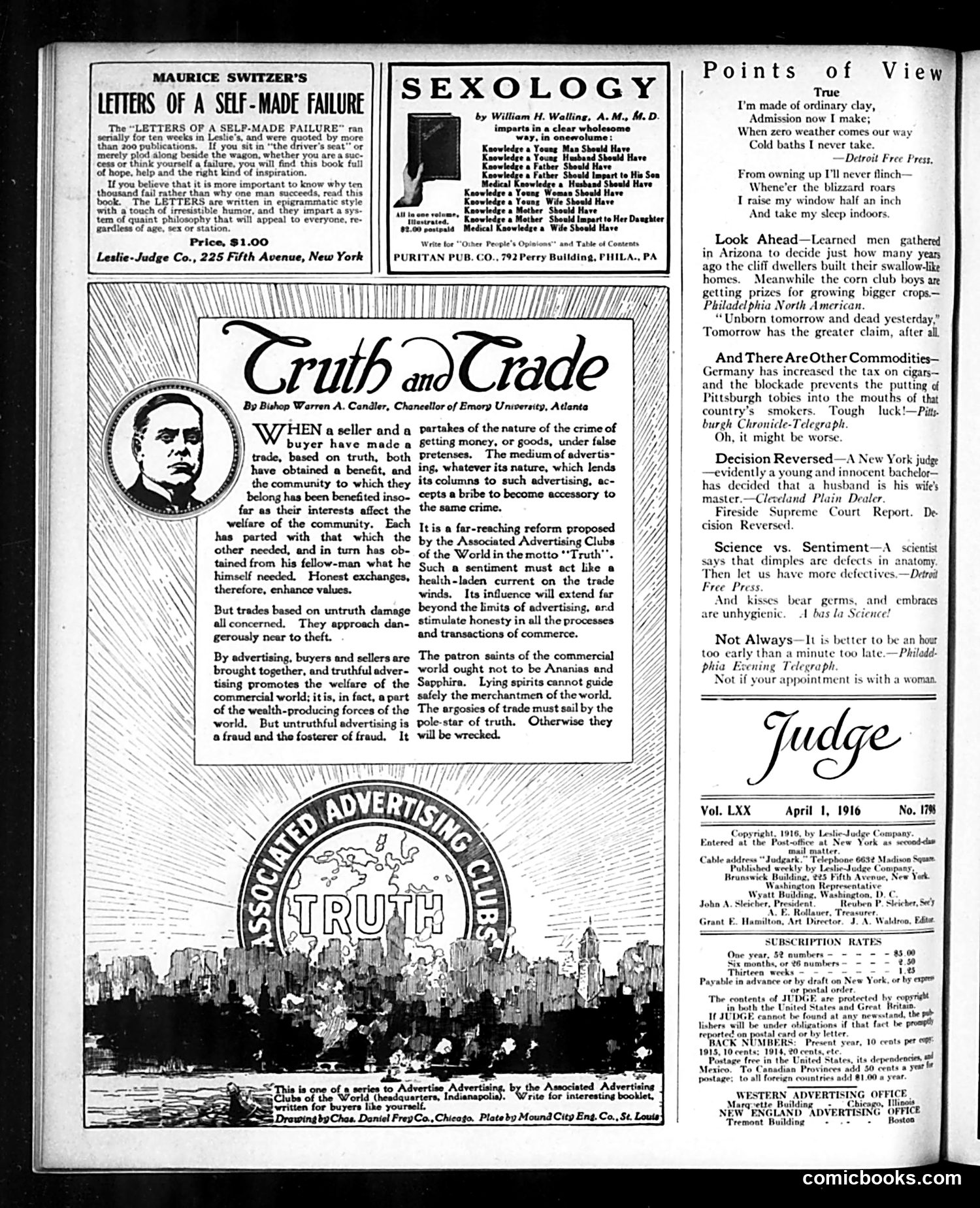
This page contains several distinct elements: **Main Article: "Truth and Trade"** by Bishop Warren Candler argues that dishonest advertising is a form of theft. He condemns sellers and buyers who profit through false claims, comparing them to biblical fraudsters Ananias and Sapphira. The piece advocates for the Associated Advertising Clubs' motto of "Truth" as a moral imperative for commerce. **Advertisements** promote self-help and instructional books typical of the era: Maurice Switzer's "Letters of a Self-Made Failure" and a "Sexology" guide promising practical marital/family knowledge. **Right Column** contains brief satirical "Points of View"—short humorous observations on everyday life (cold baths, weather, etc.). The overall theme reflects Progressive-era concerns about consumer protection and business ethics, advocating for advertising reform as a moral and social issue rather than purely commercial one.
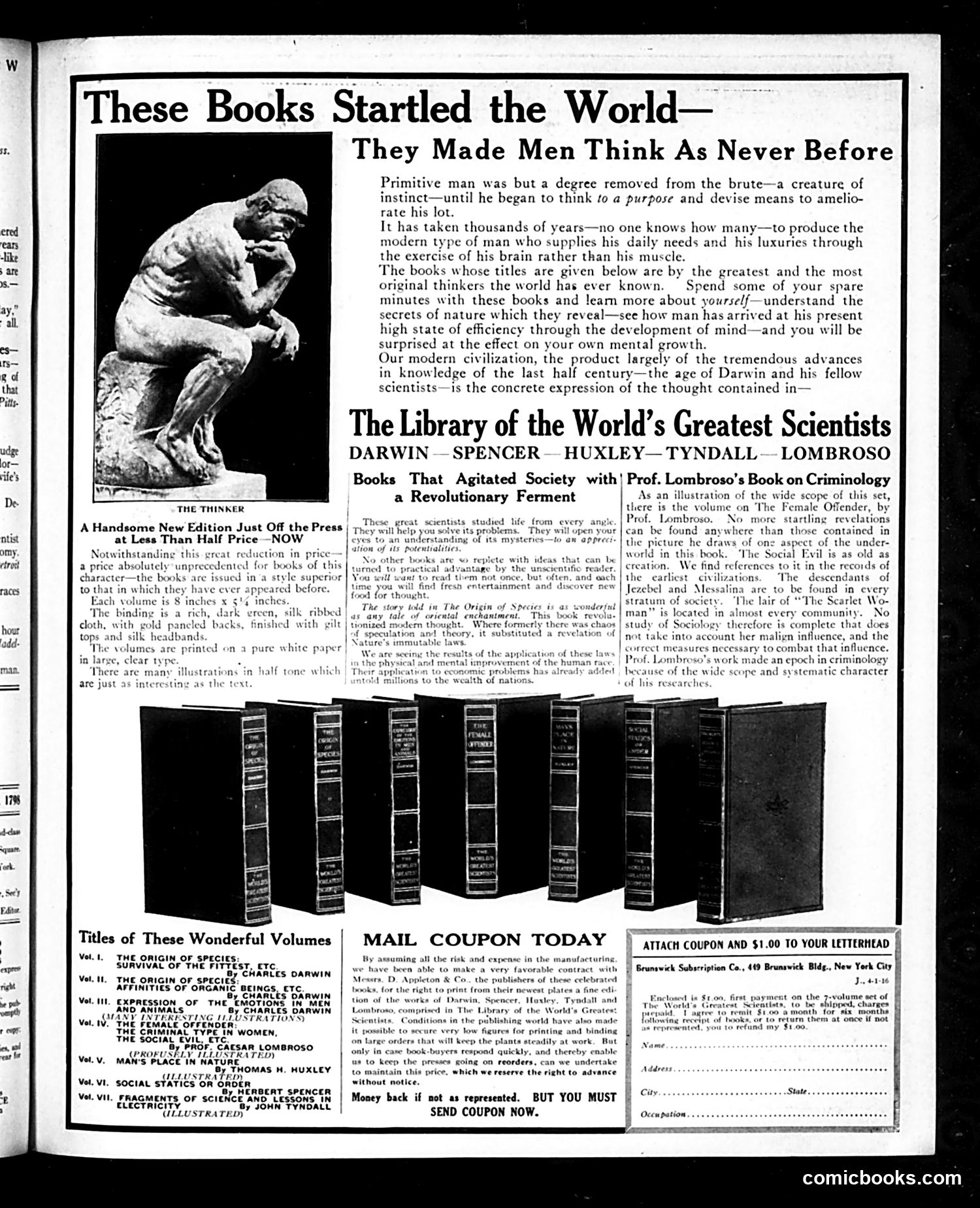
This is **primarily a full-page advertisement**, not a political cartoon. It promotes a mail-order book set called "The Library of the World's Greatest Scientists." ## Key Content: The ad features "The Thinker" statue and advertises seven volumes by Darwin, Spencer, Huxley, Tyndall, and Lombroso—prominent 19th-century scientific thinkers. The pitch emphasizes how these books represent "tremendous advances in knowledge" and modern civilization's intellectual progress. ## Historical Context: This reflects the **late 19th/early 20th-century fascination with scientific authority**. The ad invokes evolution and criminology as markers of intellectual sophistication, appealing to readers' aspirations for self-improvement through "great" thinkers. **Notable element**: The inclusion of Lombroso's work on criminology—particularly "The Female Offender"—reflects period pseudoscience that claimed to identify criminal "types," especially women. This is presented uncritically as cutting-edge knowledge. The advertisement essentially sells intellectual prestige and personal betterment through consumer purchase.
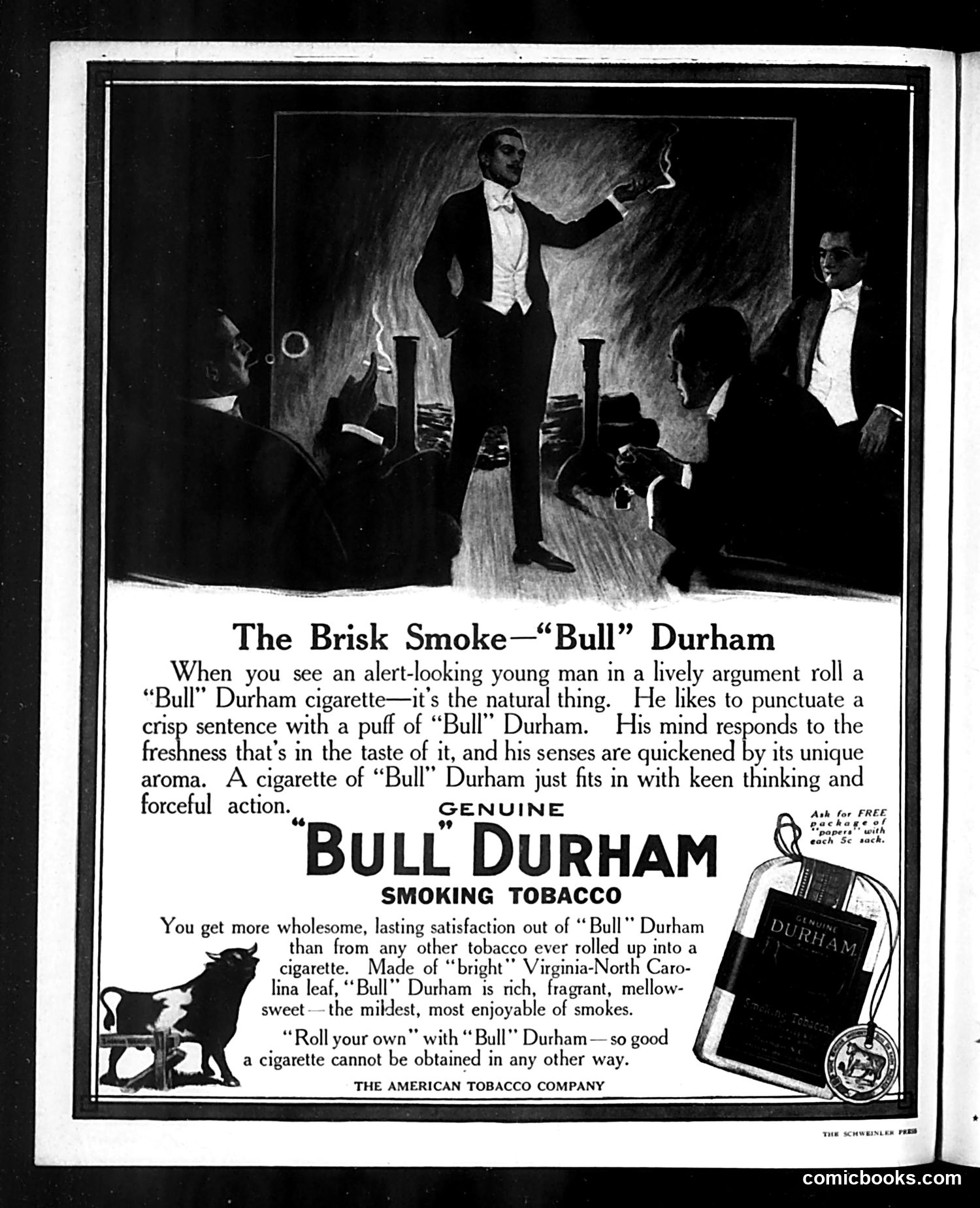
This is a **cigarette advertisement**, not political satire. It occupies the full page of Judge magazine. The image depicts a well-dressed man standing on a table, gesturing dramatically while smoking, surrounded by seated men in formal attire—apparently engaged in "lively argument." The ad copy associates "Bull" Durham smoking tobacco with intellectual vigor and persuasive speech: the smoker "punctuates a crisp sentence with a puff," his "mind responds to the freshness," and "keen thinking and forceful action" naturally pair with this brand. The appeal is aspirational masculinity—smokers are portrayed as alert, articulate, and commanding. The "roll your own" angle emphasizes craftsmanship and quality. This represents typical early 20th-century tobacco advertising that linked smoking to sophistication, mental sharpness, and social authority—claims that would be illegal today.