
Judge, 1916-04-01 · page 15 of 28
Judge — April 1, 1916 — page 15: what you’re looking at
What you’re looking at
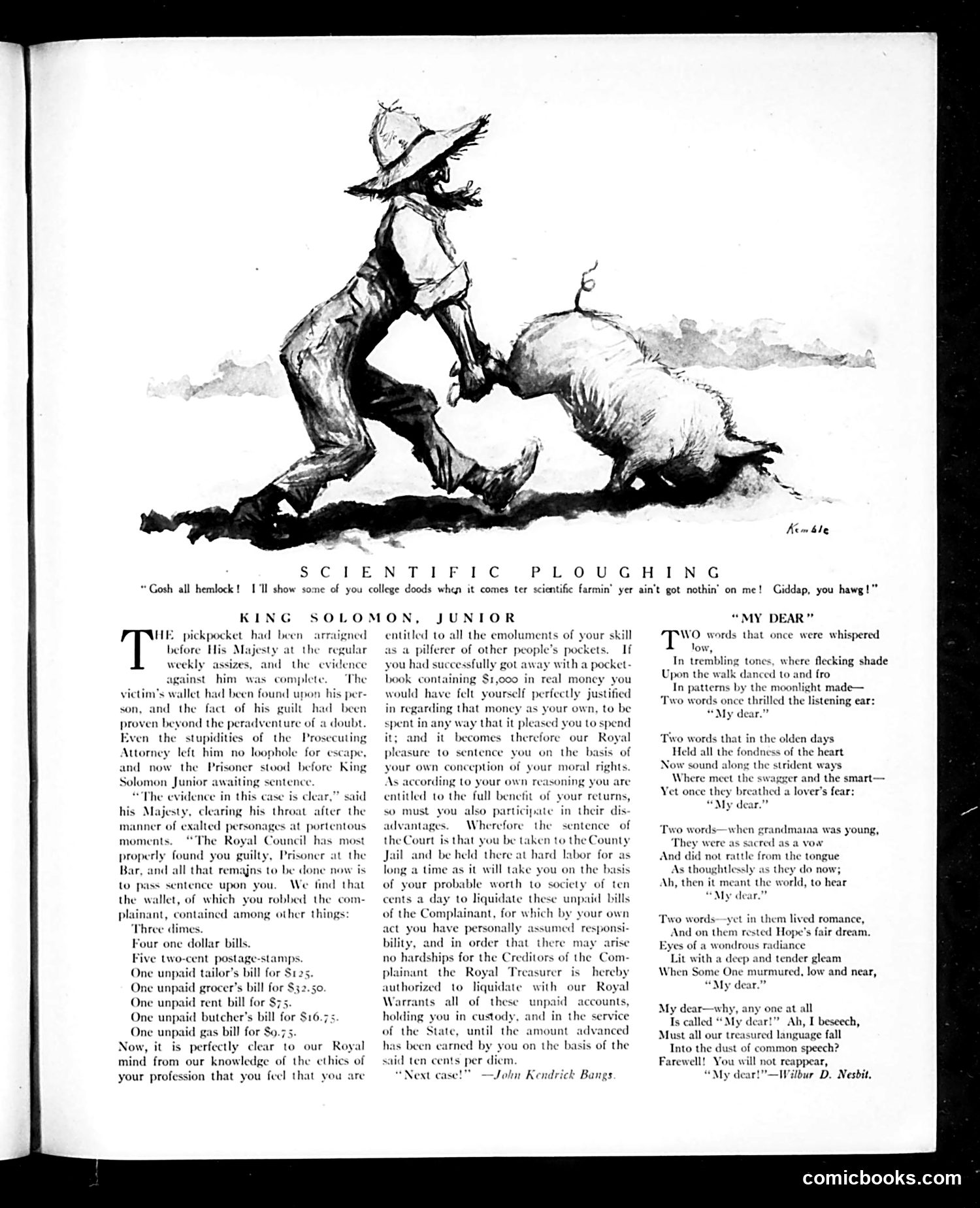
This Judge magazine page contains two satirical pieces: **"Scientific Ploughing" (top cartoon):** A farmer with a plow and pig confronts a gentleman, boasting about his agricultural knowledge. The satire appears to mock pretentious "scientific farming" claims—the farmer's crude dialect ("yer ain't got nothin' on me") contrasts with would-be sophistication, suggesting rural skepticism toward academic agricultural methods gaining popularity in this era. **"King Solomon, Junior" (main story):** A judge sentences a pickpocket based on the thief's own moral logic: since the criminal believed he deserved stolen money, he should work at ten cents daily until he pays off the victim's unpaid bills (tailor, grocer, rent, butcher, gas). The satire criticizes both criminal reasoning and debt systems—the judge's "poetic justice" exposes how criminals rationalize theft while society traps the poor in debt servitude. **"My Dear" (poem):** Nostalgic verse lamenting how the romantic phrase "my dear" has become commonplace and casual, stripped of its former intimacy—social commentary on modernity's erosion of meaningful language.
📄 Transcribed text from this page (OCR, searchable)
Machine-transcribed from the original scan — historical spelling and the odd misread are preserved.
scl "Gosh all hemlock ! KIN HE pickpocket had been arraigned before His Majesty at the regular weekly assizes, and the evidence against’ him was complete. ‘The victim's wallet had been found upon his per- son, and the fact of his guilt’ had been proven beyond the peradventure of a doubt. Even the stupidities of the Prosecuting Attorney left him no loophole for escape, and now the Prisoner stood before King Solomon Junior awaiting sentence. “The evidence in this case is clear,” said his Majesty, clearing his throat after the manner of exalted personages at portentous moments. “The Royal Council has most properly found you guilty, Prisoner at the Bar, and all that remajns to be done now is to pass sentence upon you. We find that the wallet, of which you robbed the com- plainant, contained among other things: Three dimes. Four one dollar bills. Five two-cent postage-stamps. One unpaid tailor’s bill for Si One unpaid grocer’s bill for $. One unpaid rent bill for $75. One unpaid butcher's bill for $16.75 One unpaid gas bill for $0.75 Now, it is perfectly clear to our Royal mind from our knowledge of the ethics of your profession that you feel that you are ENTIFIC P I'll show some of you college doods when it comes ter scientific farmin’ yer ain't got nothin’ on me! SOLOMON, JUNIOR entitled to all the emoluments of your skill as a pilferer of other people's pockets. If you had successfully got away with a pocket- book containing $1,000 in real money you would have felt yourself perfectly justified in regarding that money as your own, to be spent in any way that it pleased you to spend t; and it becomes therefore our Royal pleasure to sentence you on the basis of your own conception of your moral rights. \s according to your own reasoning you are entitled to the full benefit of your returns, © must you also participate in their dis advanta Wherefore the sentence of the Court is that you be taken to the County Jail and be held there at hard labor for as long a time as it will take you on the basis of your probable worth to society of ten cents a day to liquidate these unpaid bills of the Complainant, for which by your own act you have personally assumed responsi- bility, and in order that there may arise no hardships for the Creditors of the Com- plainant the Royal Treasurer is hereby authorized to liquidate with our Royal Warrants all of these unpaid account holding you in custody, and in the service of the State, until the amount advanced has been earned by you on the basis of the stid ten cents per diem. “Newt case!" —Joln Kendrick Bangs. LOUGHING Giddap, you hawg!” “MY DEAR” WO words that once were whispered low, In trembling tones, where flecking shade Upon the walk danced to and fro In patterns by the moonlight made— Two words once thrilled the listening ear: “My dear.” Tio words that in the olden days Held all the fondness of the heart Now sound along the strident ways Where meet the swagger and the smart— Yet once they breathed a lover’s fear: “My de when grandmataa was young, They were as sacred as a vow And did not rattle from the tongue As thoughtlessly as they do now; Ah, then it meant the world, to h “My dear.” Two words Two words—yet in them lived romance, And on them rested Hope's fair dream. Eyes of a wondrous radiance Lit with a deep and tender gleam When Some One murmured, low and near, “My dear.” My dear—why, any one at all Is called “My dear!” Ah, I beseech, Must all our treasured language fall Into the dust of common speech? Farewell! You will not reappear, “My dear!” —Wilbur D. Nesbit, comicbooks.com