
Judge, 1916-04-01 · page 14 of 28
Judge — April 1, 1916 — page 14: what you’re looking at
What you’re looking at
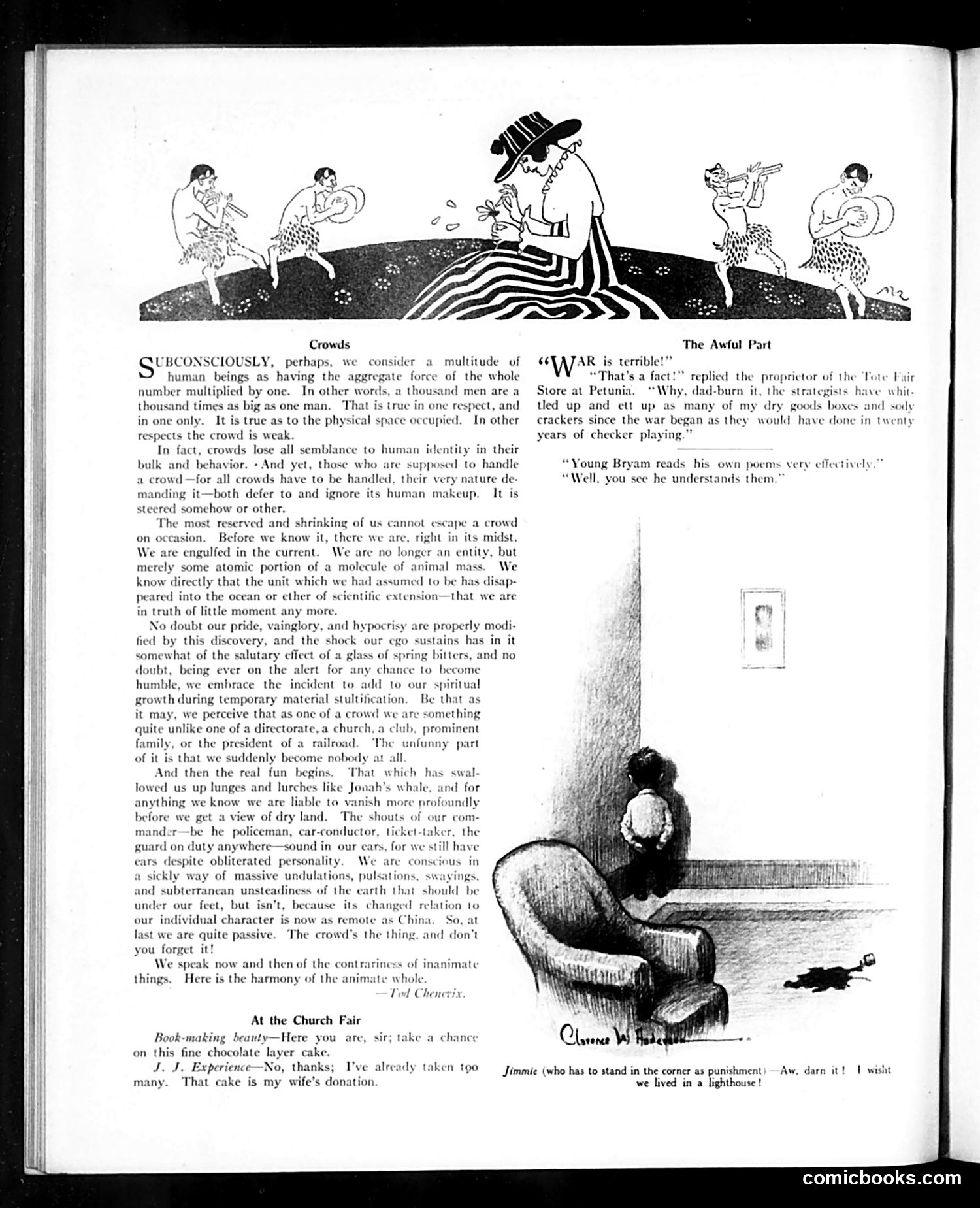
**Main Article ("Crowds"):** A philosophical essay on crowd psychology. The author argues that while crowds are physically large, they paradoxically render individuals powerless and anonymous—people lose their identity, becoming mere "atomic portions" of a collective mass. The piece reflects early-20th-century anxiety about mass society and urban anonymity, suggesting crowds strip away individual dignity and agency. **Cartoons:** The header illustration depicts a large crowd figure dominating smaller individuals, visualizing the essay's theme. The bottom cartoon shows a domestic scene where a boy being punished in a corner wishes they "lived in a lighthouse"—a humorous commentary on crowded home life and desire for isolation/peace. **"Church Fair" and "War" sections:** Brief comedic anecdotes about everyday social situations—a man declining cake his wife donated, and a store proprietor lamenting wartime scarcity of supplies. These appear as filler humor typical of Judge magazine's satirical format. The page reflects Progressive Era concerns about urbanization, mass culture, and individual autonomy amid rapid social change.
📄 Transcribed text from this page (OCR, searchable)
Machine-transcribed from the original scan — historical spelling and the odd misread are preserved.
Crowds UBCONSCIOUSLY, perhaps, we human beings as having the aggregate fc number multiplied by one. In other words, a th thousand times as big as one man. That is truc in one respect, and in one only. It is true as to the physical space occupied. In other respects the crowd is weak. In fact, crowds lose all semblance to human identity in their bulk and behavior. «And yet, those who are supposed to handle a crowd —for all crowds have to be handled, their very nature de- manding it—both defer to and ignore its human makeup. It is steered somehow or other. The most reserved and shrinking of us cannot escape a crowd on occasion. Before we know it, there we are, right in its midst. We are engulfed in the current. We are no longer an entity, but merely some atomic portion of a molecule of animal mass. We know directly that the unit which we had assumed to be has disap- peared into the ocean or ether of scientific extension—that we are in truth of little moment any more, No doubt our pride, vainglory, and hypocrisy are properly modi- fied by this discovery, and the shock our ego sustains has in it somewhat of the salutary effect of a glass of spring bitters, and no doubt, being ever on the alert for any chance to become humble, we embrace the incident to add to our spiritual growth during temporary material stultificati Be that as it may, we perceive that as one of a crowd we are something quite unlike one of a directorate. a church, a club, prominent family, or the president of a railroad. ‘The unfunny part of it is that we suddenly become nobody at all And then the real fun begins. That which has swal lowed us up lunges and lurches like Jonah’s whale, and for anything we know we are liable to vanish more profoundly before we get a view of dry land. The shouts of our com- mander—be he policeman, car-conductor, ticket-taker, the guard on duty anywhere—sound in our ears, for we still have cars despite obliterated personality. We are conscious in a sickly way of massive undulations, pulsations, swayings. and subterranean unsteadiness of the earth that should be multitude of ce of the whole usand men are a consider a under our feet, but isn’t, because its changed relation to our individual character is now as remote as China. So, at last we are quite passive. The crowd's the thing, and don’t you forget it! We speak now and then of the contrariness of inanimate things. Here is the harmony of the animate whole. Tod ¢ At the Church Fair Book-making beauty—Here you are, sir; on this fine chocolate layer cake. J. J. Experience—No, thanks; I've already taken too many. That cake is my wife’s donation a chance Jimmie (who has to stand in the corner as punishment The Awful Part “ AR is terrible! “That’s a fact!” replied the proprietor of the ‘Tote Pair Store at Petunia. “Why, dad-burn it, the strategists have whit- tled up and ett up as many of my dry goods boxes and sody crackers since the war began as they would have done in twenty years of checker playing “Young Bryam reads his own poems very effectively “Well, you see he understands them.” Aw, darn it! | wisht we lived in a lighthouse ! comicbooks.com