
Judge, 1916-04-01 · page 7 of 28
Judge — April 1, 1916 — page 7: what you’re looking at
What you’re looking at
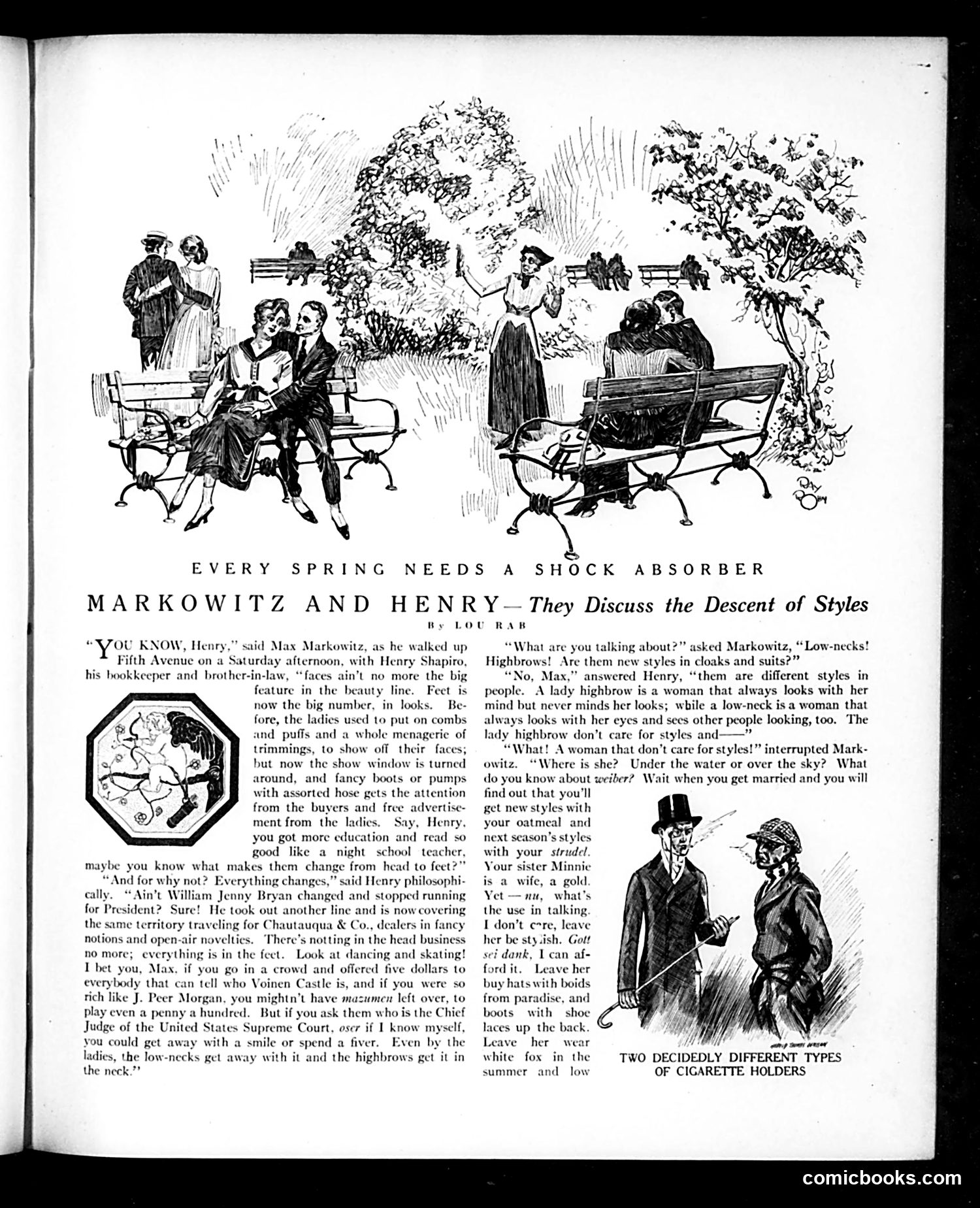
This is a humorous dialogue between two Jewish immigrant characters, Max Markowitz and Henry, discussing changing fashion trends. The satire mocks how women's fashion has shifted focus from facial beauty to footwear and legs—a commentary on early 20th-century fashion evolution (likely 1910s-1920s, given references to dancing and skating). Henry uses exaggerated examples to illustrate society's shallowness: mentioning William Jennings Bryan (who abandoned presidential runs for lecture circuit work) and celebrity figures like Voimen Castle and J.P. Morgan. His point is that people care more about superficial status symbols than intellectual achievement. The "low-necks" versus "highbrows" distinction plays on both neckline fashion and intellectual pretension—a woman focused on appearance versus one focused on ideas. The cigarette-holder illustration at bottom appears unrelated advertising or filler content. The humor relies on ethnic stereotyping common to period Judge magazine, using Yiddish-inflected speech patterns for comedic effect.
📄 Transcribed text from this page (OCR, searchable)
Machine-transcribed from the original scan — historical spelling and the odd misread are preserved.
EVERY SPRING NEEDS MARKOWITZ AND HENR hy Low “YWoOvU KNOW, Henry,” said Max Markowitz, as he walked up Fifth Avenue on a Saturday afternoon, with Henry Shapiro his bookkeeper and brother-in-law, “faces ain’t no more the bi feature in the beauty line. ot is now the big number, in loc Be- fore, the ladies used to put on combs and puffs and a whole menagerie of trimmings, to show off their faces; but now the show window is turned around, and fancy boots or pumps with assorted hose gets the attention from the buyers and free advertise- ment from the ladies. Say, Henry, you got more education and read so good like a night school teacher, maybe you know what makes them change from head to fee “And for why not? Everything changes,” said Henry philosophi- cally. “Ain't William Jenny Bryan changed and stopped running for President? Sure! He took out another line and is now covering the same territory traveling for Chautauqua & Co., dealers in fancy notions and open-air novelties. There’s notting in the head business no more; everything is in the feet. Look at dancing and skating! I bet you, Max. if you go in a crowd and offered f everybody that can tell who Voinen Castle is, and if you were so tich like J. Peer Morgan, you mightn’t have mazumen left over, to play even a penny a hundred. But if you ask them who is the Chief Judge of the United States Supreme Court, oser if I know myself, you could get away with a smile or spend a fiver. Even by the ladies, the low-necks get away with it and the highbrows get it in the neck.”" & A SHOCK ABSORBER Y — They Discuss the Descent of Styles RAB “What are you talking abou asked Markowitz, “Low-necks! Highbrows! Are them new styles in cloaks and suits?” “No, Max,” answered Henry, “them are different styles in people. A lady highbrow is a woman that always looks with her mind but never minds her looks; while a low-neck is a woman that ys looks with her eyes and secs other people looking, too, The lady highbrow don’t care for styles and——” “What! A woman that don’t care for styles!” interrupted Mark- owitz. “Where is she? Under the water or over the sky? What do you know about weiber? Wait when you get married and you will find out that you'll get new styles with your oatmeal and next season’s styles with your strudel Your sister Minnie is a wife, a gold Yet — nu, what's the use in talking I don’t core, leave sei dan ford it. Leave her buy hats with boids from paradise, ¢ boots with lg wear fox in the and low TWO DECIDEDLY DIFFERENT TYPES OF CIGARETTE HOLDERS white summer comicbooks.com