
Judge, 1916-04-01 · page 18 of 28
Judge — April 1, 1916 — page 18: what you’re looking at
What you’re looking at
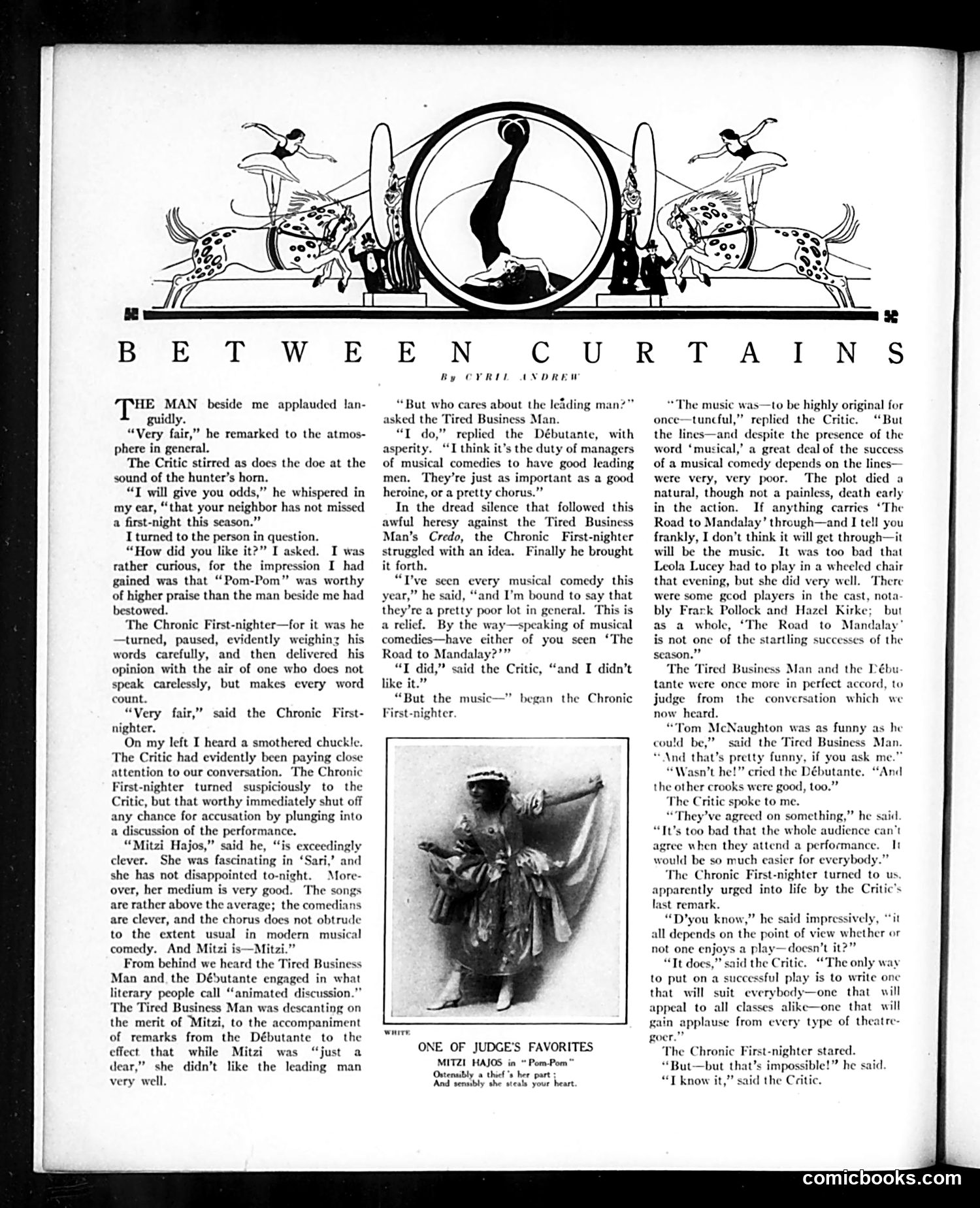
This Judge article satirizes the "Chronic First-nighter"—a stereotypical Broadway regular who attends every musical comedy premiere but offers only bland, non-committal opinions ("Very fair"). The piece mocks this type through dialogue at a performance of "Pom-Pom" starring Mitzi Hajos. The satire targets the gap between claimed expertise and actual taste: the First-nighter has seen everything yet expresses nothing distinctive, while a genuine Critic offers detailed, reasoned judgments (praising Hajos but criticizing "The Road to Mandalay's" weak plot and dialogue). The central joke involves social pretension—the First-nighter's careful, measured speech masks empty opinion-making, contrasting sharply with the Critic's substantive analysis. The photograph of Hajos emphasizes Judge's promotion of the actual theatrical talent being discussed. The piece gently ridicules New York theater society's status-conscious opening-night culture.
📄 Transcribed text from this page (OCR, searchable)
Machine-transcribed from the original scan — historical spelling and the odd misread are preserved.
B E T W E HE MAN beside me applauded !an- guidly. “Very fair,” he remarked to the atmos- phere in general. The Critic stirred as does the doe at the sound of the hunter’s horn. “T will give you odds,” he whispered in my ear, “that your neighbor has not missed a first-night this season.” I turned to the person in question. “How did you like it?” I asked. I was rather curious, for the impression I had gained was that “Pom-Pom” was worthy of higher praise than the man beside me had bestowed. The Chronic First-nighter—for it he —turned, paused, evidently weighing his words carefully, and then delivered his opinion with the air of one who does not speak carelessly, but makes every word count. “Very fair,” said the Chronic First- nighter. On my left I heard a smothered chuckle. The Critic had evidently been paying close attention to our conversation. The Chronic First-nighter turned suspiciously to the Critic, but that worthy immediately shut off any chance for accusation by plunging into a discussion of the performance. “Mitzi Hajos,” said he, “is exceedingly clever. She fascinating in ‘ .” and she has not disappointed to-night. More- over, her medium is very good. The songs are rather above the average; the comedians are clever, and the chorus does not obtrude to the extent usual in modern musical comedy. And Mitzi is—Mitzi.” From behind we heard the Tired Business Man and the Débutante engaged in what literary people call “animated discussion.” The Tired Business Man was descanting on the merit of Mitzi, to the accompaniment of remarks from the Débutante to the effect that while Mitzi was “just a dear,” she didn’t like the leading man very well. E N By CYRIL ANDREW “But who cares about the leiding man?” asked the Tired Business Man. “I do,” replied the Débutante, with asperity. “I think it’s the duty of managers of musical comedies to have good leading men. They’re just as important as a good heroine, or a pretty chorus.” In the dread silence that followed this awful heresy against the Tired Business Man’s Credo, the Chronic First-nighter struggled with an idea. Finally he brought it forth. “T’ve seen every musical comedy this year,” he said, “and I’m bound to say that they’re a pretty poor lot in general. This is a relief. By the way—speaking of musical comedies—have either of you seen ‘The Road to Mandalay?’” “I did,” said the Critic, “and I didn’t like it.” “But the music—” First-nighter. began the Chronic wore ONE OF JUDGE'S FAVORITES MITZI HAJOS in * Pom-Pom ~ Ostensibly a thie part: And sensibly she steals your heart. C U RTA “The music was—to be highly original for once—tuncful,” replied the Crit “But the lines—and despite the presence of the word ‘musical,’ a great deal of the success of a musical comedy depends on the lines— were very, very poor. The plot died a natural, though not a painless, death early in the action. If anything carrics ‘The Road to Mandalay’ through—and I tell you frankly, I don’t think it will get through—it will be the music. It was too bad that Leola Lucey had to play in a wheeled chair that evening, but she did very well. There were some gcod players in the cast, nota bly Frark Pollock and Hazel Kirke; but as a whole, ‘The Road to Mandalay’ is not one of the startling successes of the season.” he Tired Business Man and the Pébu tante were once more in perfect accord, to judge from the conversation which we now heard. “Tom McNaughton was as funny as he could be,” said the Tired Business Man. “And that’s pretty funny, if you ask me.” “Wasn’t he!” cried the Débutante. “And the other crooks were good, too.” The Critic spoke to me. “They've agreed on something,” he said “It’s too bad that the whole audience can’t agree when they attend a performance. It would be so much easier for everybody. The Chronic First-nighter turned apparently urged into life by the C last remark. “D'you know,” he said impressivel: all depends on the point of view whether or not one enjo: doesn’t it?” Ithe Critic. “The only wa to put ona successful play is to write one that will suit everybody—one that will appeal to all classes ke—one that will gain applause from every type of theatre- goe ‘The Chronic First-nighter stared. “But—but that’s impossible!” he said. “T know it,” sa comicbooks.com