
Judge, 1916-04-01 · page 21 of 28
Judge — April 1, 1916 — page 21: what you’re looking at
What you’re looking at
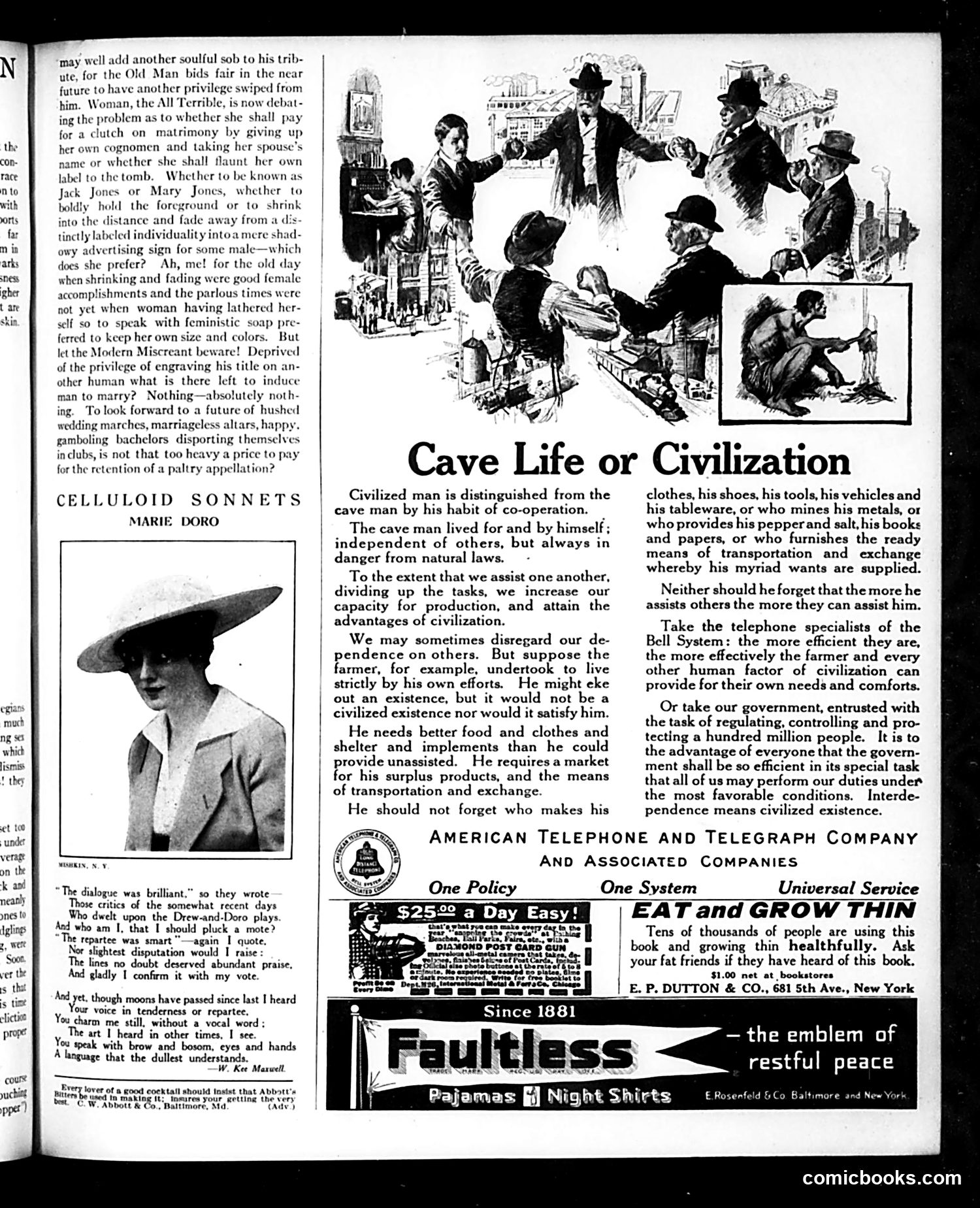
This page features a satirical article and advertisements promoting **interdependence and cooperation** as markers of civilization. The main cartoon contrasts "cave life" (solitary self-sufficiency) with "civilization" (mutual cooperation). The article argues that modern society depends on specialized workers—farmers, telephone operators, government officials—each relying on others. It uses the Bell System telephone company as an example of how efficiency in one sector benefits everyone. The implicit satire targets **individualism and self-reliance ideology**, suggesting that Americans who boast of independence actually depend entirely on cooperative systems they often take for granted. The contrast between "cave man" and "civilized man" mocks the notion that anyone can truly live independently. The page also includes lighter content: a sonnet about actress Marie Doro's silent film performances, and advertisements for diet books and pajamas—typical Judge magazine fare mixing social commentary with commercial appeals.
📄 Transcribed text from this page (OCR, searchable)
Machine-transcribed from the original scan — historical spelling and the odd misread are preserved.
egians much ng ss whic isms ! they ver the s that is tine rlictiee prope: court ruchieg pe) may well add another soulful sob to his trib- ute, for the Old Man bids fair in the near future to have another privilege swiped from him. Woman, the All Territ is now debat- ing the problem as to whether she shall pay for a clutch on matrimony by giving up her own cognomen and taking her spouse’s name or whether she shall flaunt her own label to the tomb. Whether to be known as Jack Jones or Mary Joncs, whether to boldly hold the foreground or to. shrink into the distance and fade away from a dis- tinctly labeled individuality intoa mere shad- owy advertising sign for some male—which does she prefer? Ah, me! for the old day when shrinking and fading were good female accomplishments and the parlous times were not yet when woman having lathered her- self so to speak with feministic soap pre- ferred to keep her own size and colors. But let the Modern Miscreant beware! Deprived of the privilege of engraving his title on an- other human what is there left to induce man to marry? Nothing—absolutely noth- ing. To look forward to a future of hushed wedding marches, marriageless altars, happy. gamboling bachelors disporting themselves inclubs, is not that too heavy a price to pay for the retention of a paltry appellation? CELLULOID SONNETS MARIE DORO Muu, Sy “The dialogue was brilliant,” so they wrote jose critics of the somewhat recent days Who dwelt upon the Drew-and-Doro plays And who am I, that I should pluck a mote? he repartee was smart "—again I quote, Nor slightest disputation would I raise : ¢ lines no doubt deserved abundant praise, And gladly I confirm it with my vote. Our voice in tenderness or repartee, charm me still, without a. vocal word : The art I heard You speak with brow and bosom, eyes and hands A language that the dullest understands. W. Kee Maxwell. Aad yet though moons have passed since last | heard You in other times, I see. lover of a good cocktail should Insist that Abbott's be used In making it; insures your getting the very W. Abbott & Co, Baltimore, Md (ade) Cave Life or Civilization Civilized man is distinguished from the cave man by his habit of co-operation. The cave man lived for and by himself ; independent of others, but always in danger from natural laws. To the extent that we assist one another, dividing up the tasks, we increase our capacity for production, and attain the advantages of civilization. We may sometimes disregard our de- pendence on others. But suppose the farmer, for example, undertook to live strictly by his own efforts. He might eke out an existence, but it would not be a civilized existence nor would it satisfy him. He needs better food and clothes and shelter and implements than he could provide unassisted. He requires a market for his surplus products, and the means of transportation and exchange. He should not forget who makes his clothes, his shoes, his tools, his vehicles and his tableware, or who mines his metals, or who provides his pepper and salt, his books and papers, or who furnishes the ready means of transportation and exchange whereby his myriad wants are supplied. Neither should he forget that the more he assists others the more they can assist him. Take the telephone specialists of the Bell System: the more efficient they are, the more effectively the farmer and every other human factor of civilization can provide for their own needs and comforts. Or take our government, entrusted with the task of regulating, controlling and pro- tecting a hundred million people. It is to the advantage of everyone that the govern- ment shall be so efficient in its special task that all of us may perform our duties under the most favorable conditions. Interde- pendence means civilized existence. AMERICAN TELEPHONE AND TELEGRAPH COMPANY AND ASSOCIATED COMPANIES One System Universal Service | EAT and GROW THIN Tens of thousands of people are using this | book and growing thin healthfully. Ask | your fat friends if they have heard of this book. $1.00 net at bookstores |_E. P, DUTTON & CO., 681 Sth Ave., New York Since 1881 . — ; cena Faultless Pajamas fi] Night Shirt —the emblem of restful peace 0 Baltimore and New York comicbooks.com