
Judge, 1916-04-01 · page 9 of 28
Judge — April 1, 1916 — page 9: what you’re looking at
What you’re looking at
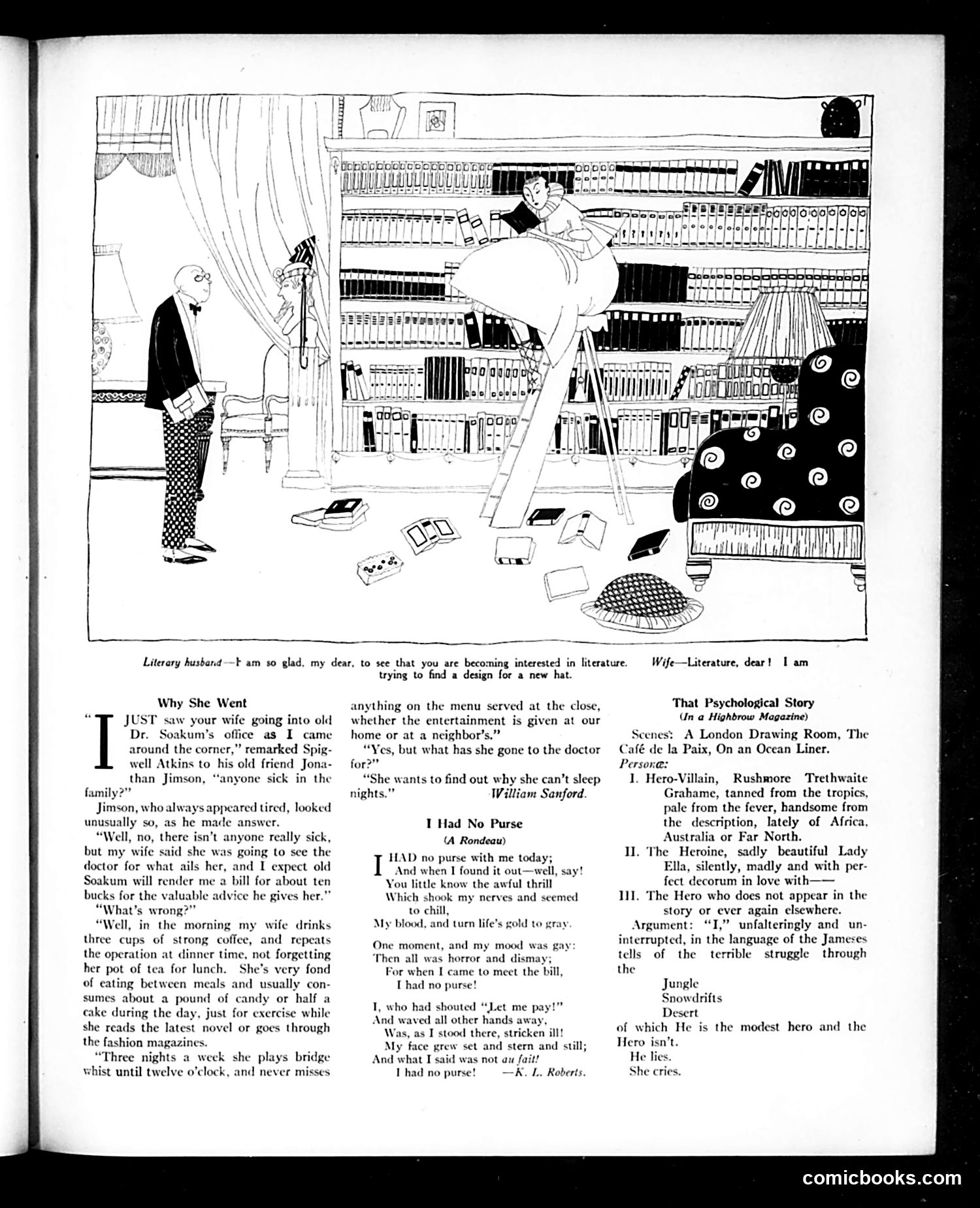
This page contains three separate satirical pieces mocking early 20th-century domestic life and literary pretension. **"Why She Went"** ridicules wives' health anxieties. A husband complains his wife visits the doctor despite no genuine illness—she merely overindulges in coffee, candy, late-night bridge, and rich food while reading novels and fashion magazines, then can't sleep. The joke: her "ailment" is self-inflicted lifestyle excess, not medical. **"I Had No Purse"** humorously depicts male embarrassment at being unable to pay a bill—a social mortification of the era when men were expected to be providers. **"That Psychological Story"** parodies pretentious literary magazines (likely *The* *Highbrow Magazine*) that featured dense, introspective fiction. The satire lists a melodramatic setup with exotic locales and tragic lovers, yet notes the actual "hero" never appears in the story—only the narrator's endless monologue. The punchline: "He lies. / She cries"—mocking overwrought emotional narrative stripped of substance. The cartoons above illustrate these pieces with period-appropriate domestic scenes.
📄 Transcribed text from this page (OCR, searchable)
Machine-transcribed from the original scan — historical spelling and the odd misread are preserved.
Literary husband Why She Went JUST saw your wife going into old Dr. Soakum’s office as I came around the corner,” remarked Spig- well Atkins to his old friend Jona- than Jimson, “anyone sick in the family?” Jimson, who always appeared tired, looked unusually so, he made answer. “Well, no, there isn’t anyone really sick, but my wife said she was going to see the doctor for what ails her, and I expect old Soakum will render me a bill for about ten bucks for the valuable advice he gives her.” “What’s wrong?” “Well, in the morning my wife drinks three cups of strong coffee, and repeats the operation at dinner time, not forgetting her pot of tea for lunch. She’s very fond of eating between meals and usually con- sumes about a pound of candy or half a cake during the day, just for exercise while she reads the latest novel or goes through the fashion magazines. “Three nights a week she plays bridge whist until twelve o'clock, and never misses F am so glad, my dear, to see that you are becoming interested in literature. trying to find a design for a new hat. anything on the menu served at the close, whether the entertainment is given at our home or at a neighbor’s.” “Yes, but what has she gone to the doctor for?” “She wants to find out why she can’t sleep nights.” William Sanford. I Had No Purse (A Rondeau) HAD no purse with me today; And when I found it out—well, say! ‘ou little know the awful thrill Which shook my nerves and seemed to chill, My blood, and turn life's gold to gray One moment, and my mood was gay ‘Then all was horror and dismay For when I came to meet the bill, Thad no purse! I, who had shouted “Let me pay! And waved all other hands awa Was, as I stood there, stricken ill! face grew set and stern and still; at I said was not au fait! Thad no purse! -K. 1. Roberts. Wife—Literature, dear! I am That Psychological Story Un a Highbrow Magazine) cenes: A London Drawing Room, The Café de la Paix, On an Ocean Liner. Persone: 1. Hero-Villain, Rushmore Trethwaite Grahame, tanned from the tropics, pale from the fever, handsome from the description, lately of Africa, Australia or Far North. II. The Heroine, sadly beautiful Lady Ella, silently, madly and with per- fect decorum in love with—— III, The Hero who does not appear in the story or ever again elsewhere. Argument: “I,” unfalteringly and un- interrupted, in the language of the Jameses tells of the terrible struggle through the Jungle Snowdrifts Desert of which He is the modest hero and the Hero isn’t. He lies. She cries. comicbooks.com