
Judge, 1916-04-01 · page 5 of 28
Judge — April 1, 1916 — page 5: what you’re looking at
What you’re looking at
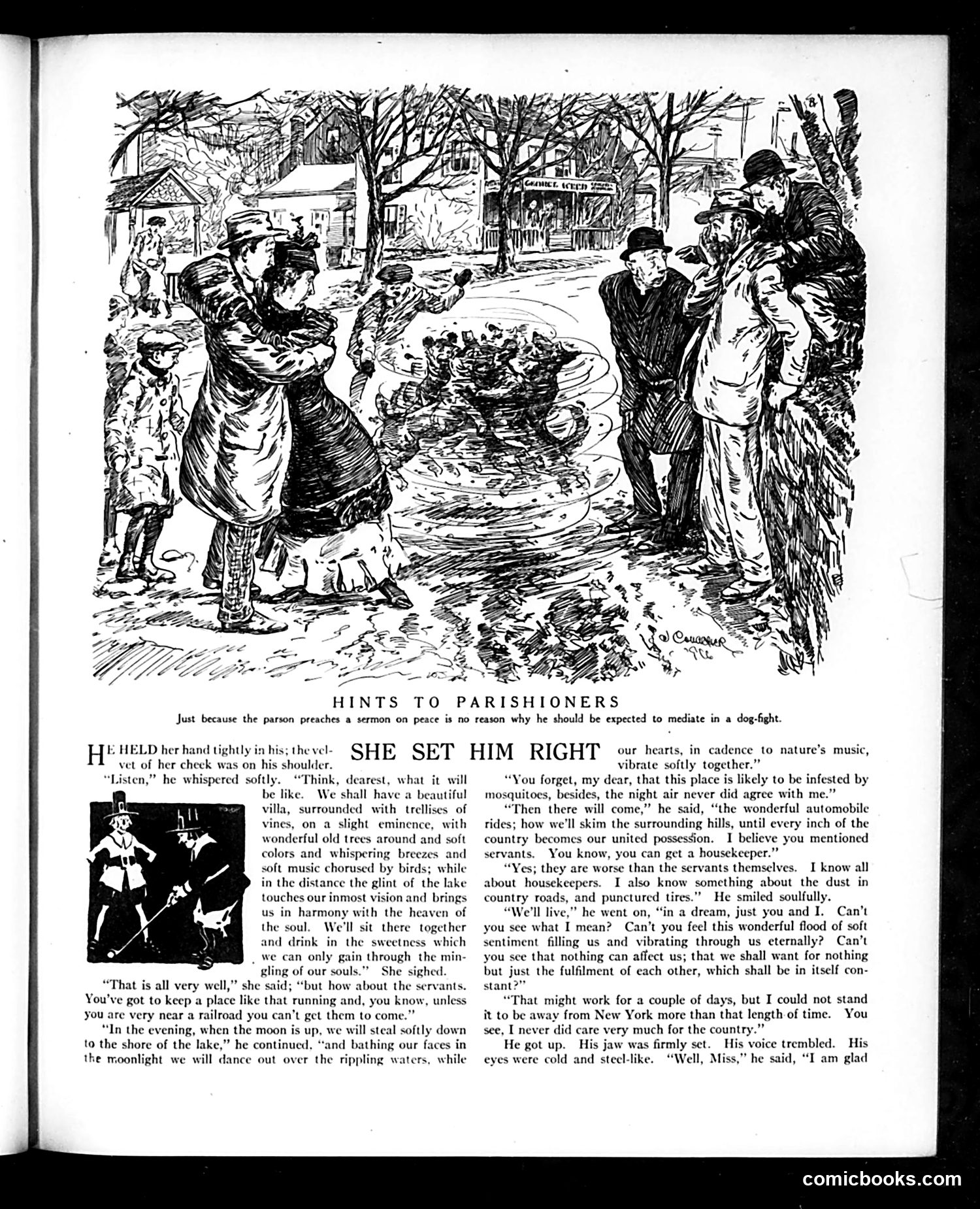
This page satirizes clergy who preach moral sermons while failing to practice what they teach. The top illustration shows a dog-fight breaking out in a town square, with well-dressed gentlemen (likely parishioners or clergy) gathered around, suggesting hypocrisy: the parson preaches peace but ignores violence occurring publicly. The lower narrative mocks a clergyman who seduces a parishioner with romantic fantasies about a rural villa and shared happiness, only to reveal he won't leave New York for long and has little regard for "the country." The satire exposes the gap between clergy's pious words and selfish actions—they demand moral virtue from congregants while pursuing pleasure and material comfort themselves.
📄 Transcribed text from this page (OCR, searchable)
Machine-transcribed from the original scan — historical spelling and the odd misread are preserved.
HINTS TO PARISHION RS Just because the parson preaches a sermon on peace is no reason why he should be expected to mediate in a dog-fight. H* HELD her hand tightly in his; the vel- vet of her check was on his shoulder. “Think, dearest, what it will “Listen,” he whispered softly. be like. We shall have a beautiful villa, surrounded with trellises of vines, on a slight eminence, with wonderful old trees around and soft colors and whispering breezes and soft music chorused by birds; while in the distance the glint of the lake touches our inmost vision and brings us in harmony with the heaven of the soul. We'll sit there together and drink in the sweetness which _ we can only gain through the min- gling of our souls.” She sighed. “That is all very well,” she said; “but how about the servants. You've got to keep a place like that running and, you know, unless you are very near a railroad you can’t get them to come.” “In the evening, when the moon is up, we will steal softly down to the shore of the lake,” he continued, “and bathing our faces in the moonlight we will dance out over the rippling waters, while SHE SET HIM RIGHT our hearts, in cadence to nature’s music, vibrate softly together.” “You forget, my dear, that this place is likely to be infested by mosquitoes, besides, the night air never did agree with me.” “Then there will come,” he said, “the wonderful automobile rides; how we'll skim the surrounding hills, until every inch of the country becomes our united possession. I believe you mentioned servants. You know, you can get a housekeeper.” “Yes; they are worse than the servants themselves. I know all about housekeepers. I also know something about the dust in country roads, and punctured tires." He smiled soulfully. “We'll live,” he went on, “in a dream, just you and I, Can't you see what I mean? Can’t you feel this wonderful flood of soft sentiment filling us and vibrating through us eternally? Can’t you see that nothing can affect us; that we shall want for nothing but just the fulfilment of each other, which shall be in itself con- stant?” hat might work for a couple of days, but I could not stand it to be away from New York more than that length of time. You see, I never did care very much for the country.” He got up. His jaw was firmly set. His voice trembled. His eyes were cold and stecl-like. “Well, Miss,” he said, “I am glad comicbooks.com