
A complete issue · 28 pages · 1915
Judge — November 27, 1915
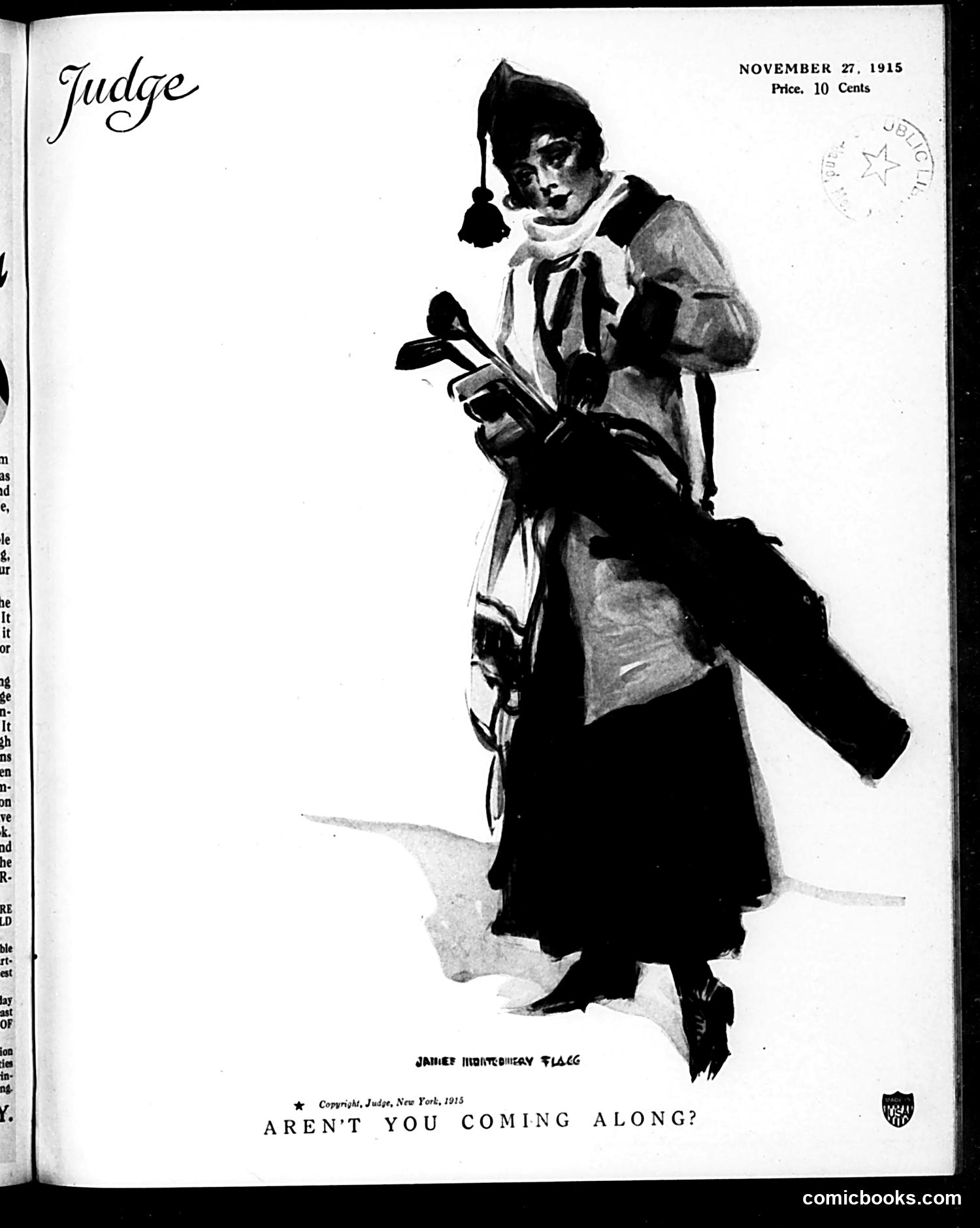
This cover illustration by James Montgomery Flagg depicts a fashionably dressed woman in winter attire, carrying a golf bag and holding a telephone receiver on a cord. The caption "AREN'T YOU COMING ALONG?" serves as the punch line. The satire likely mocks the "New Woman" of the 1910s—women gaining independence through activities like golf and telephone use (then still relatively novel). The woman appears to be inviting someone (presumably a man) to join her leisure activities, inverting traditional gender roles where men typically initiated social plans. This reflects contemporary anxieties and humor about women's expanding social freedoms and changing expectations in early 20th-century America, presenting these changes as both modern and slightly absurd to Judge's audience.
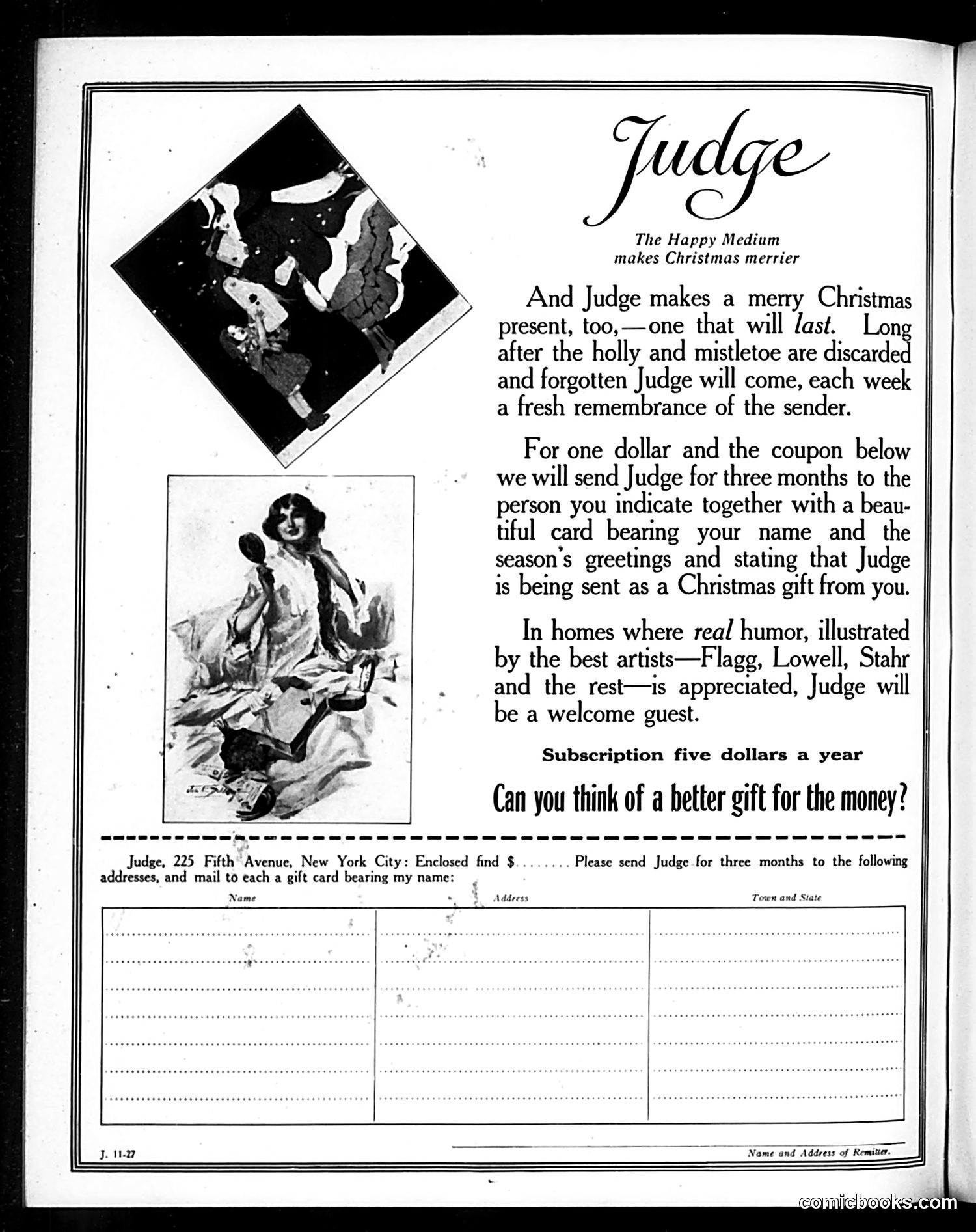
This page is primarily a **subscription advertisement** for Judge magazine itself, not political satire. The ad promotes a Christmas gift offer: for one dollar, Judge will send three months of subscriptions to recipients you name, accompanied by gift cards crediting you as the sender. The full annual subscription costs five dollars. The illustrations show whimsical figures in classical/artistic style, typical of Judge's visual branding. The text emphasizes that Judge contains "real humor, illustrated by the best artists—Flagg, Lowell, Stahr and the rest," positioning the magazine as sophisticated entertainment for audiences appreciating quality comic illustration. The closing line ("Can you think of a better gift for the money?") is a straightforward sales pitch rather than satire.
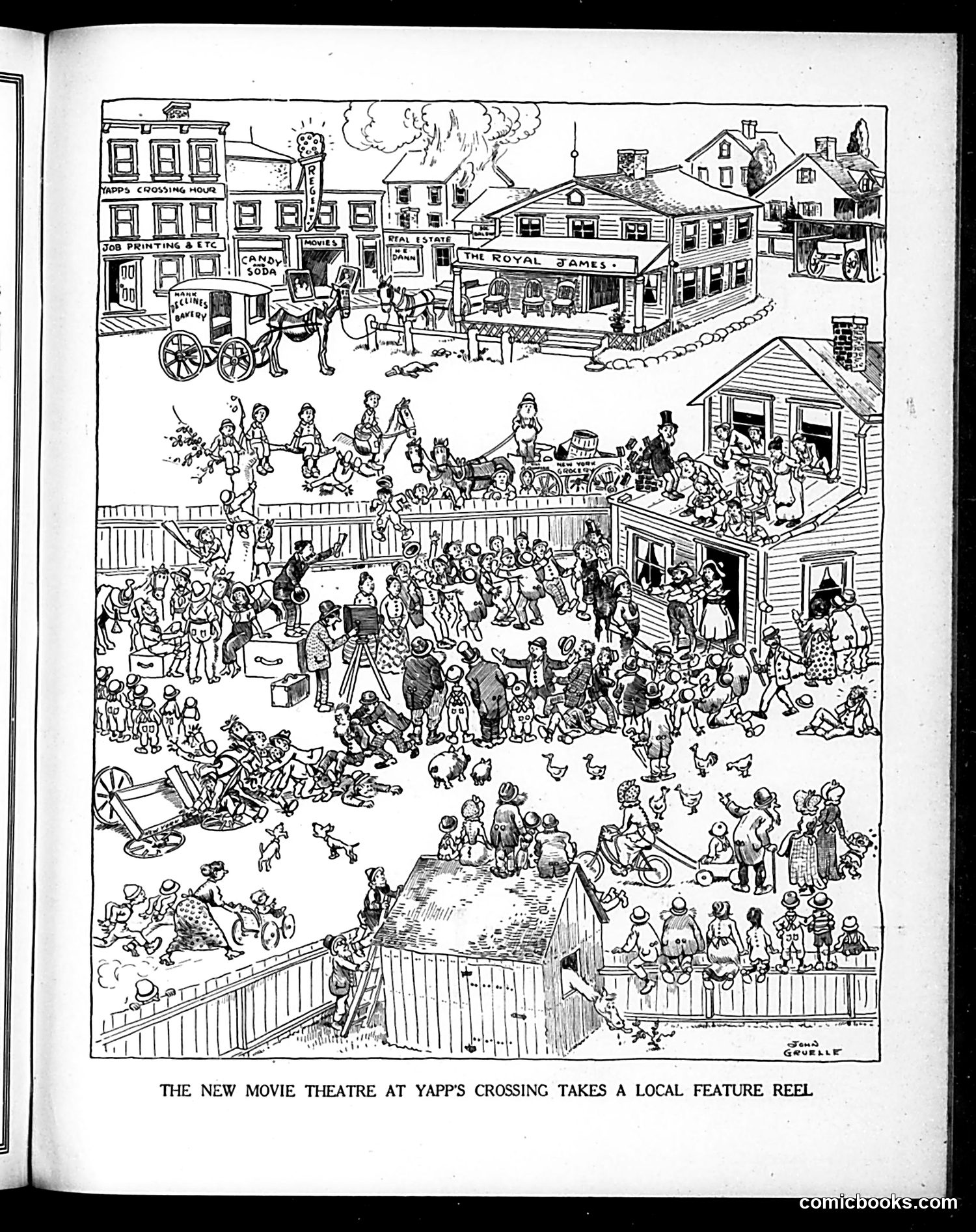
This is a celebratory illustration rather than political satire. The caption reads: "THE NEW MOVIE THEATRE AT YAPP'S CROSSING TAKES A LOCAL FEATURE REEL." The cartoon depicts a bustling small-town scene centered on a new movie theater (labeled "THE ROYAL" and "JAMES"). The drawing shows the theater as a significant community gathering place, with crowds of townspeople, children, animals, and vendors celebrating its opening or operation. The humor appears gentle and observational—documenting how a modern movie theater has become the social hub of a rural community. Various activities surround it: people on the boardwalk, children playing, vendors with carts, and families enjoying leisure time. This reflects early 20th-century attitudes toward cinema as a novel form of entertainment that transformed small-town life and social gathering patterns.
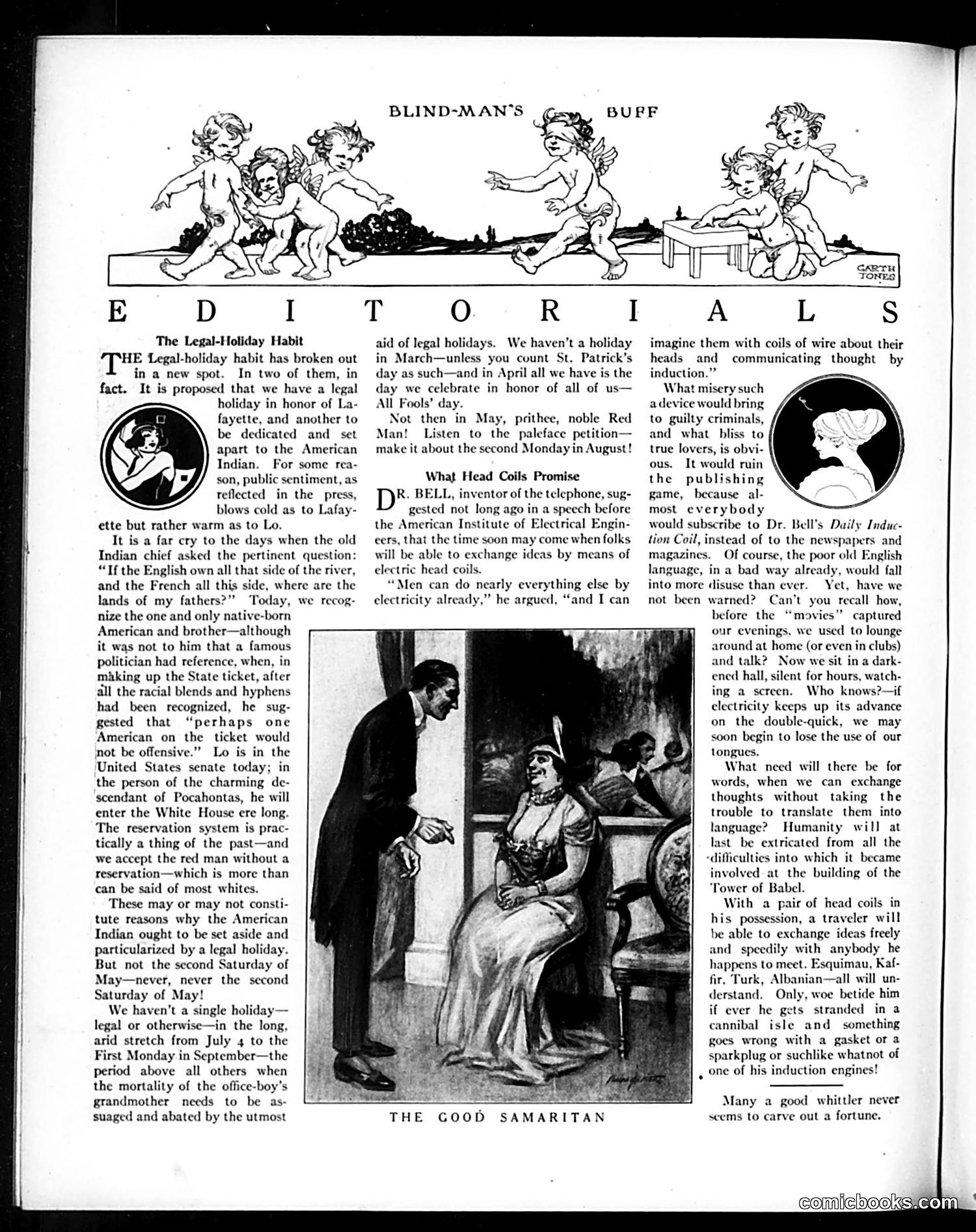
This Judge magazine page satirizes American holiday traditions and technological optimism. The header illustration depicts cherubs playing "Blind Man's Buff," framing editorial commentary about legal holidays. The left column argues the U.S. lacks adequate national holidays compared to other nations, suggesting Native Americans deserve a dedicated legal holiday rather than sporadic recognition. The right column, titled "What Head Coils Promise," mocks Dr. Bell's (Alexander Graham Bell's) proposal for "head coils" enabling wireless thought transmission. The author sarcastically suggests this would eliminate language barriers but fears it would devastate publishing and newspapers. The central image, "The Good Samaritan," depicts a helping scene, likely illustrating the editorial's broader themes about social welfare and humanitarian duty rather than partisan politics.
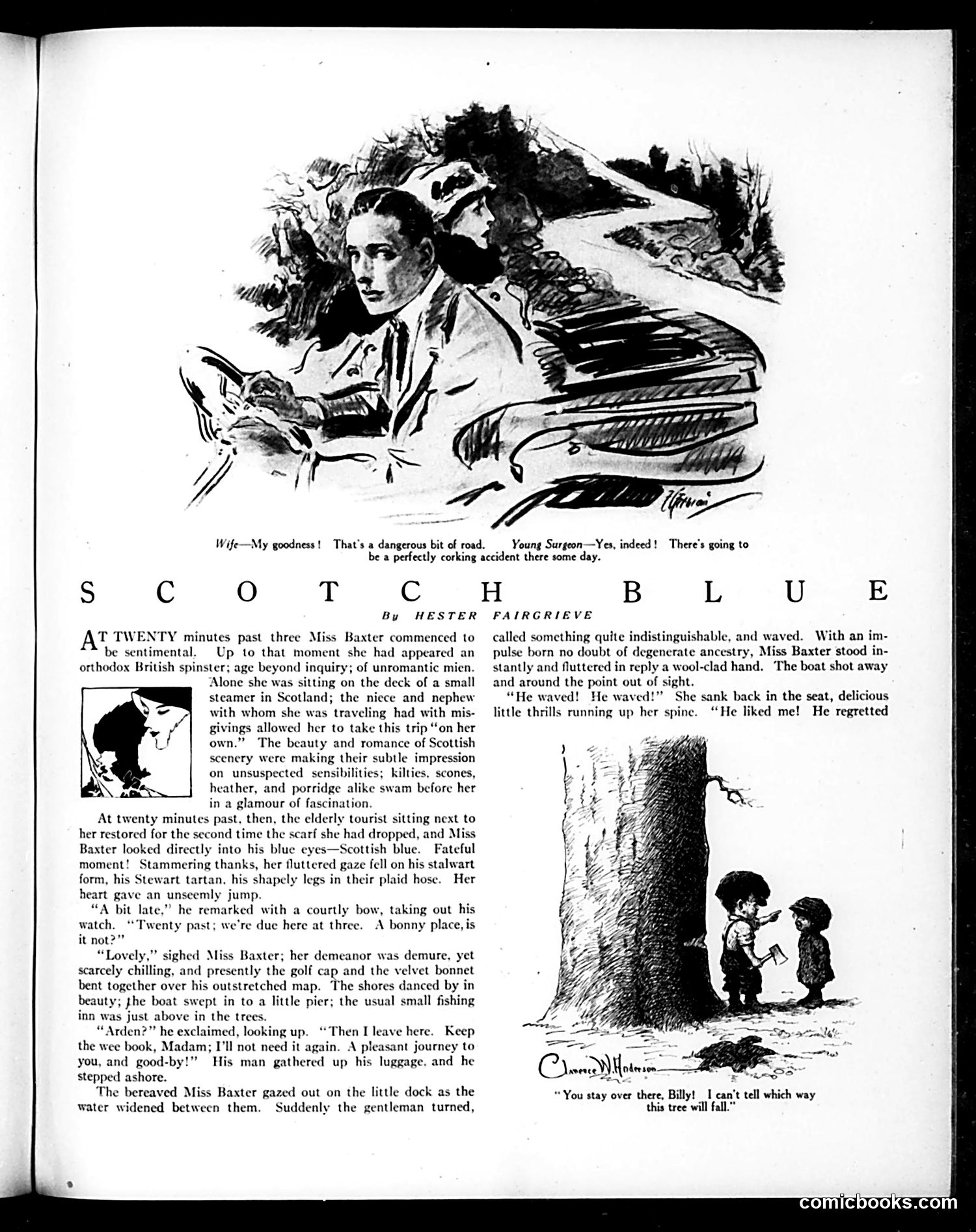
This page from Judge magazine presents a short story titled "Scotch Blue" by Hester Fairgrieve. The narrative depicts a romantic encounter between Miss Baxter and a gentleman during a Scottish steamboat journey. The story satirizes romantic sensibilities and tourist experiences rather than politics. It plays on stereotypes about Scottish scenery ("kilties, scones, heather") captivating unsuspecting British travelers. The humor derives from Miss Baxter's sentimental reaction to Scottish landscape and a chance meeting with a charming stranger, culminating in his abrupt departure with the cryptic line "I will not need it again." The accompanying illustrations complement the narrative romantically rather than critically. This appears to be light entertainment rather than political satire—typical of Judge's mixed content during this era.
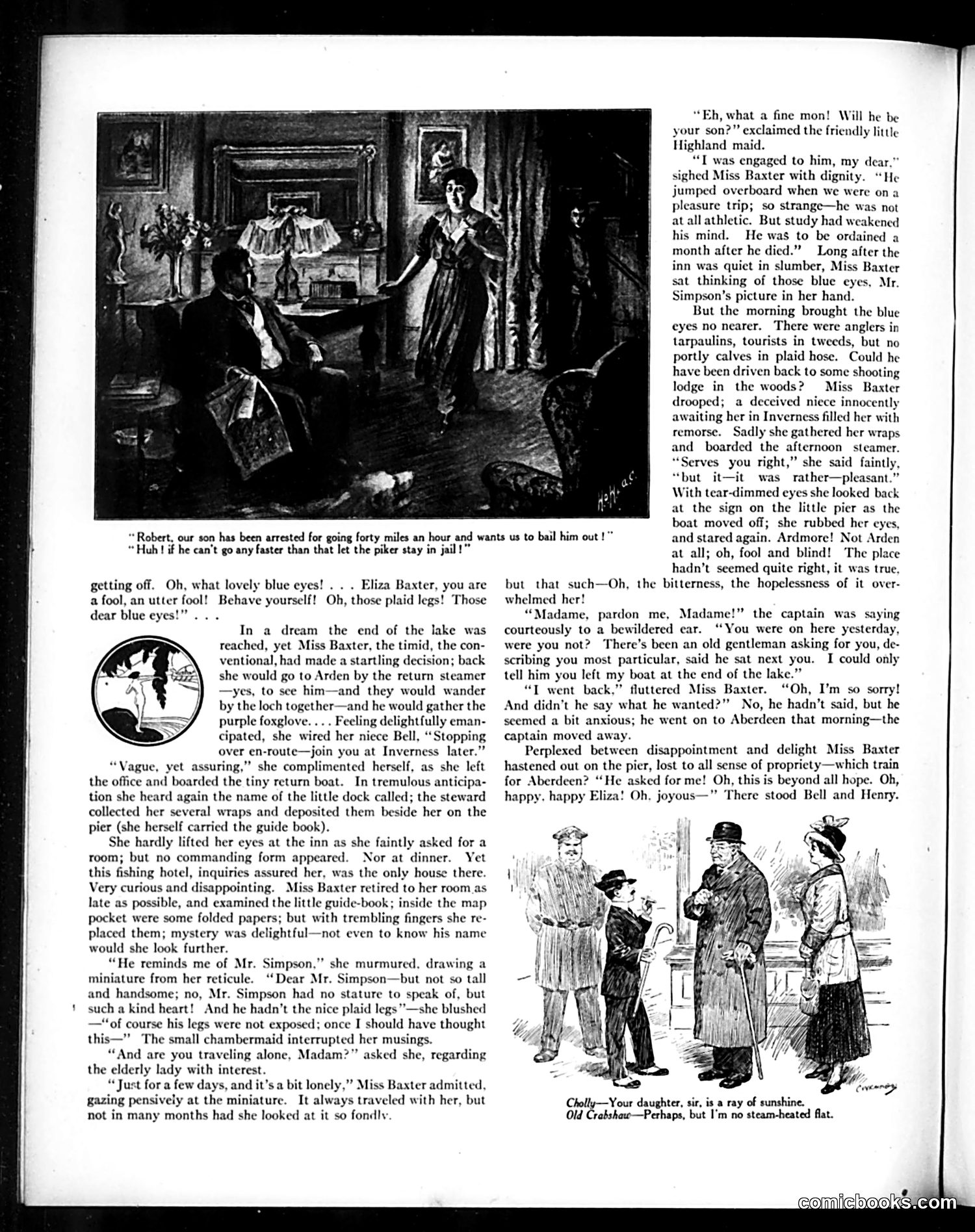
This page contains **two distinct pieces**: a brief joke and a serialized short story. **The Opening Joke** satirizes reckless driving and parental attitudes toward automotive speed. A father refuses to bail out his son arrested for doing "forty miles an hour"—suggesting it's too slow. This reflects early 1900s anxieties about automobiles and generational differences, with the humor inverting expected parental concern. **The Main Story** ("Eliza Baxter") is a romantic comedy-of-errors. An elderly spinster, Miss Baxter, travels to Scotland to reunite with a long-deceased fiancé (Mr. Simpson), sustained only by his miniature portrait. She arrives at the wrong Scottish location—Ardmore instead of Arden—and leaves disappointed when no man appears. The humor derives from her romantic delusion and the ironic twist: an old gentleman has been searching for *her*. The tale mocks sentimental spinsters while suggesting unexpected romance may still await. The accompanying illustrations show period dress and Scottish settings characteristic of early 20th-century romantic fiction serialized in magazines.
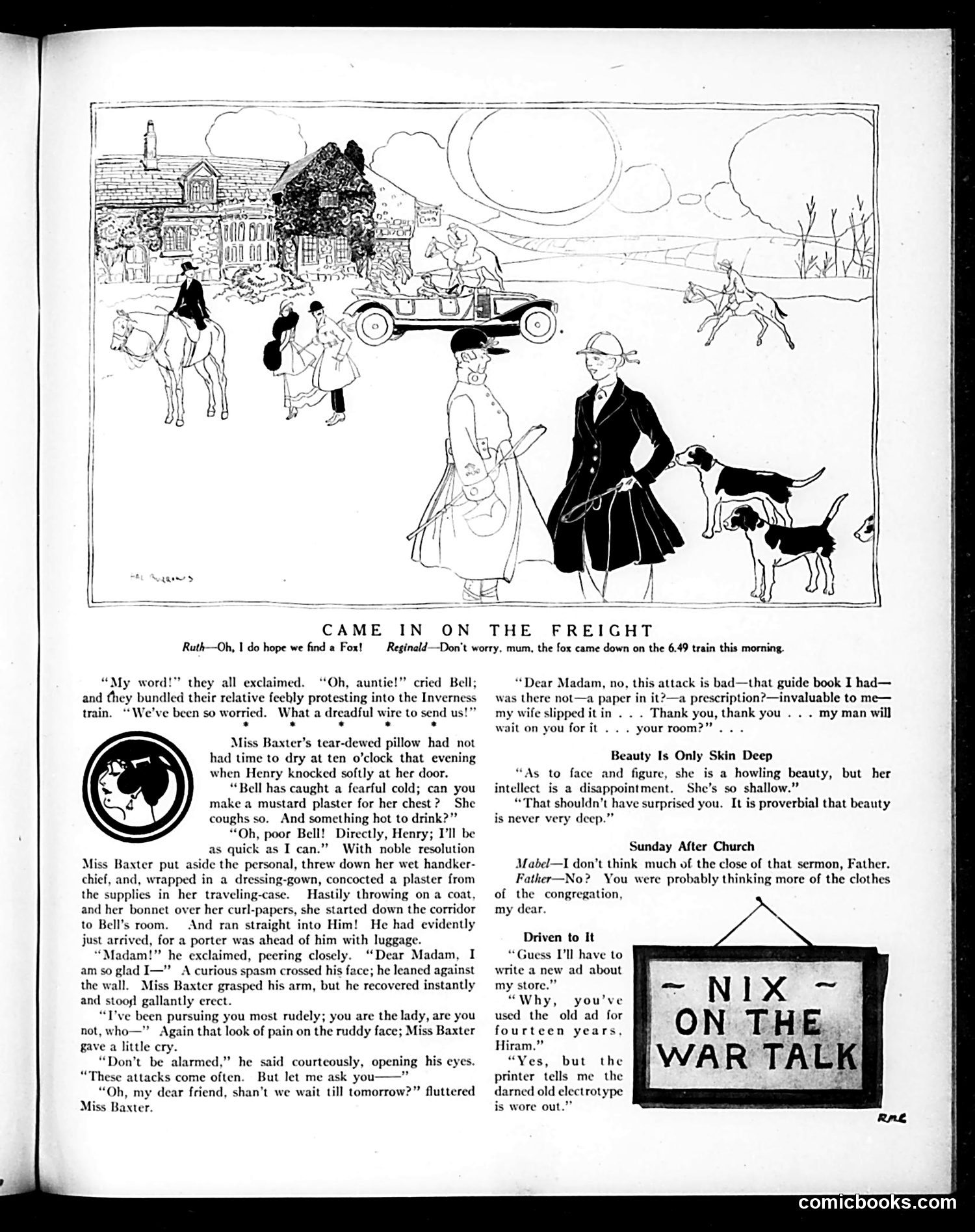
This page contains multiple short satirical pieces typical of Judge magazine's social humor: **Main Story ("Came in on the Freight"):** A romantic narrative where Miss Baxter, summoned to care for her cousin Bell, encounters a mysterious gentleman suffering recurring attacks. The humor plays on the awkwardness of their meeting and his apparent mysterious ailment—likely suggesting illness or injury rather than explicit reference. The punchline involves a fox arriving by train, subverting the opening hunting reference. **"Beauty Is Only Skin Deep":** Social commentary mocking men who judge women purely on appearance while dismissing their intellect as shallow. **"Sunday After Church":** Domestic satire about a woman (Mabel) being more interested in fashionable clothing worn by church-goers than the sermon itself—conventional period mockery of female vanity. **"Driven to It":** A merchant must replace worn printing plates for his store advertisement—commentary on business expenses and the wear of commercial machinery. The overall tone reflects early 20th-century magazine humor: romantic intrigue, gender stereotypes, and everyday commercial complaints.
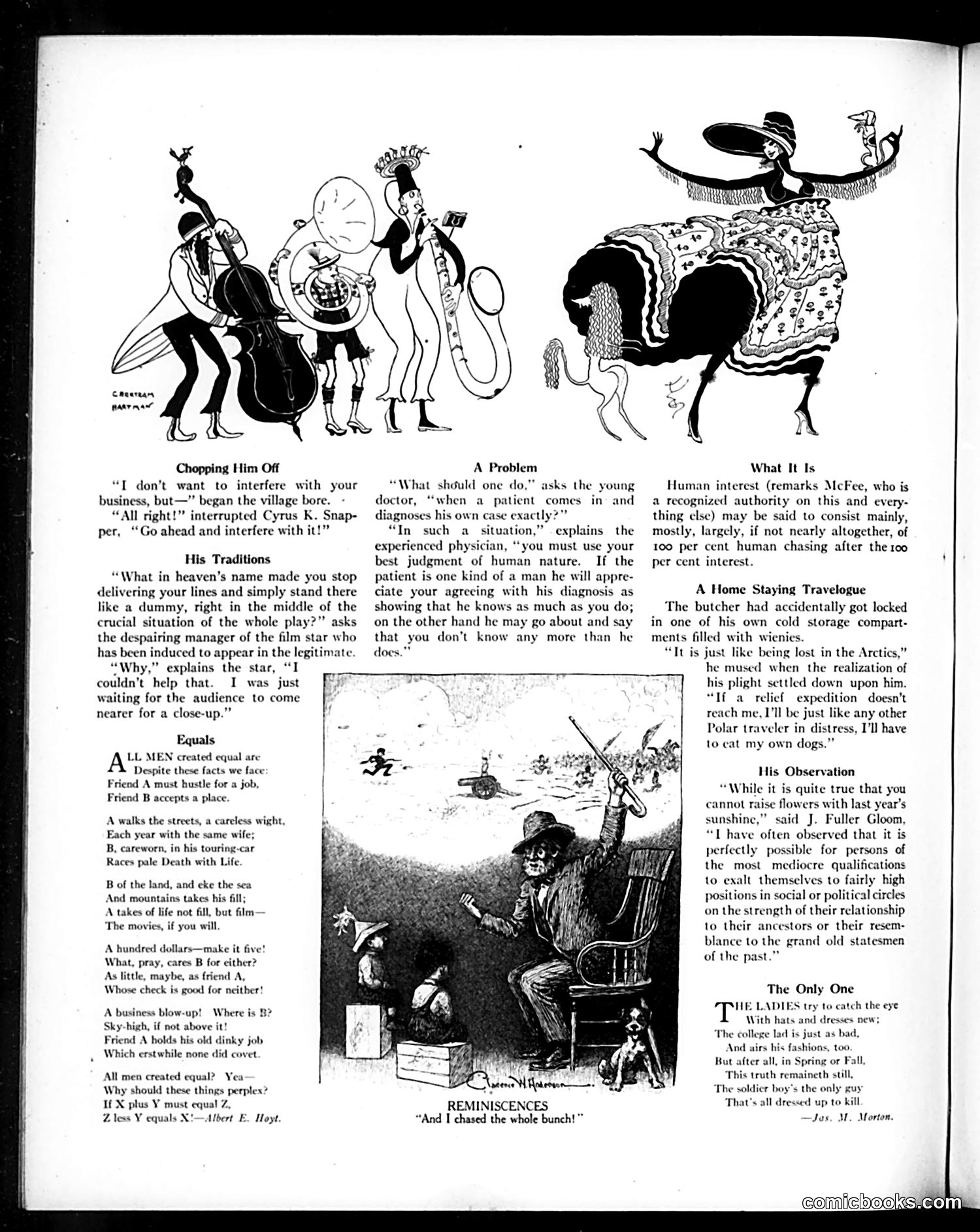
This page from Judge contains several brief satirical pieces typical of early 20th-century American humor: **"Chopping Him Off"** mocks the village bore archetype—a social nuisance whose attempts at polite conversation are rebuffed. **"His Traditions"** satirizes silent film actors transitioning to stage theater, who awkwardly pause mid-performance expecting close-up camera shots rather than projecting to a live audience. **"A Problem"** jokes about the impossible position of doctors consulting with self-diagnosing patients—damned either way. **"Equals"** (poem by Albert E. Hoyt) uses mathematical wordplay to expose the hypocrisy of "all men are created equal," showing wealth and circumstance, not democracy, determine outcomes. The remaining pieces humorously address everyday situations: a butcher locked in cold storage imagining Arctic survival, observations about social climbing through ancestor-worship, and a poem about soldiers being the only ones truly "dressed to kill." The cartoon illustrations depict vaudeville performers and comedic situations matching the text.
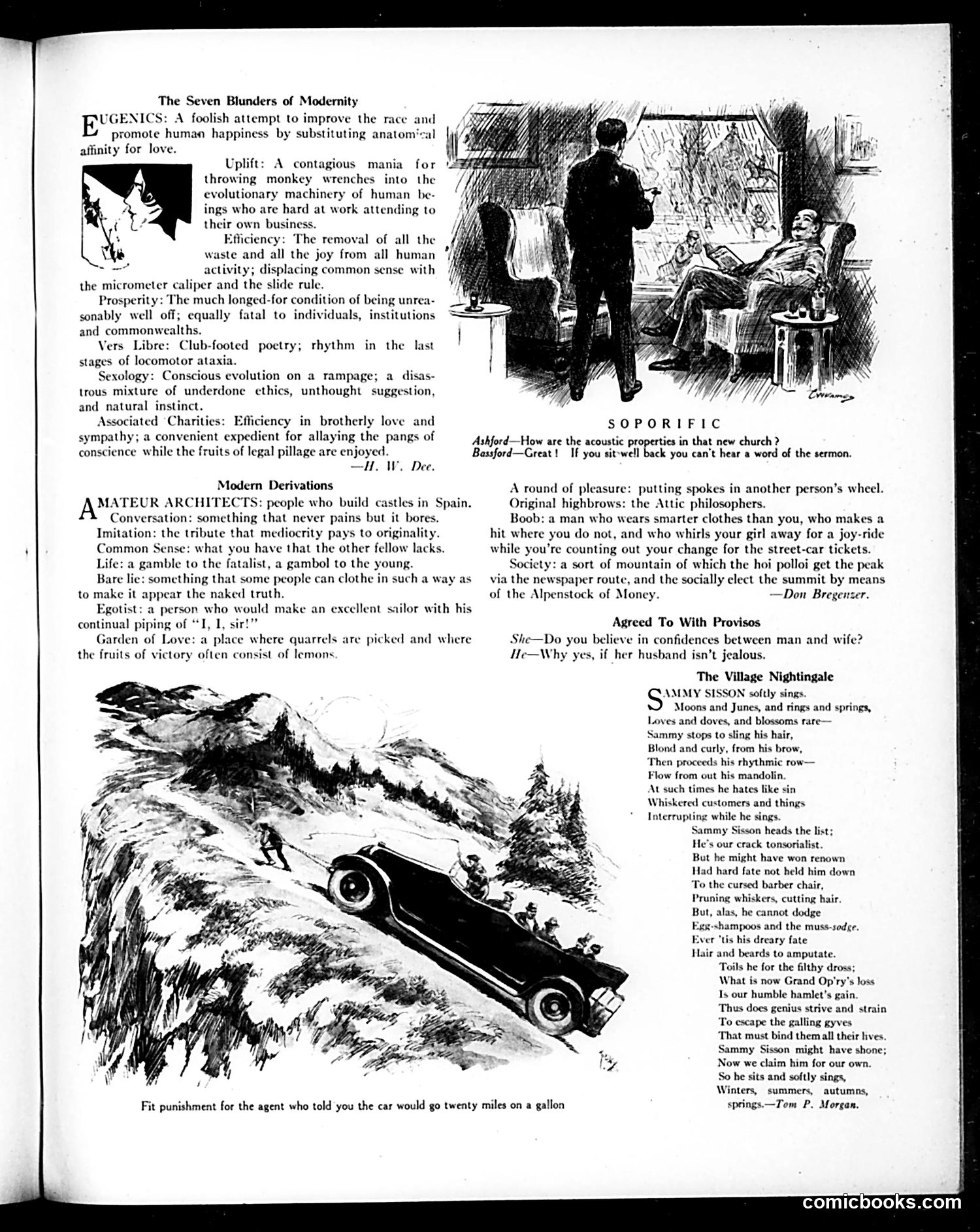
This page satirizes early 20th-century progressive reforms and modern trends. The opening section mocks **Eugenics** (improving the race through selective breeding), **Uplift** (reformers meddling in others' affairs), and **Efficiency** (removing human joy through excessive systematization)—all fashionable among reformers of the era. The "Modern Derivations" section offers cynical redefinitions: **Egotist** as an excellent sailor, **Life** as a gamble or dance, **Society** as a hierarchy where the wealthy climb via "Alpenstock of Money." The bottom cartoon shows a car disaster with caption mocking deceptive advertising claims about fuel efficiency. The poem "Village Nightingale" describes **Sammy Sisson**, a barber with operatic talent trapped in his mundane job—a commentary on wasted potential and the grinding constraints of ordinary life. The overall tone: *skeptical mockery* of both progressive idealism and modern consumerism, celebrating traditional values over trendy reform movements.
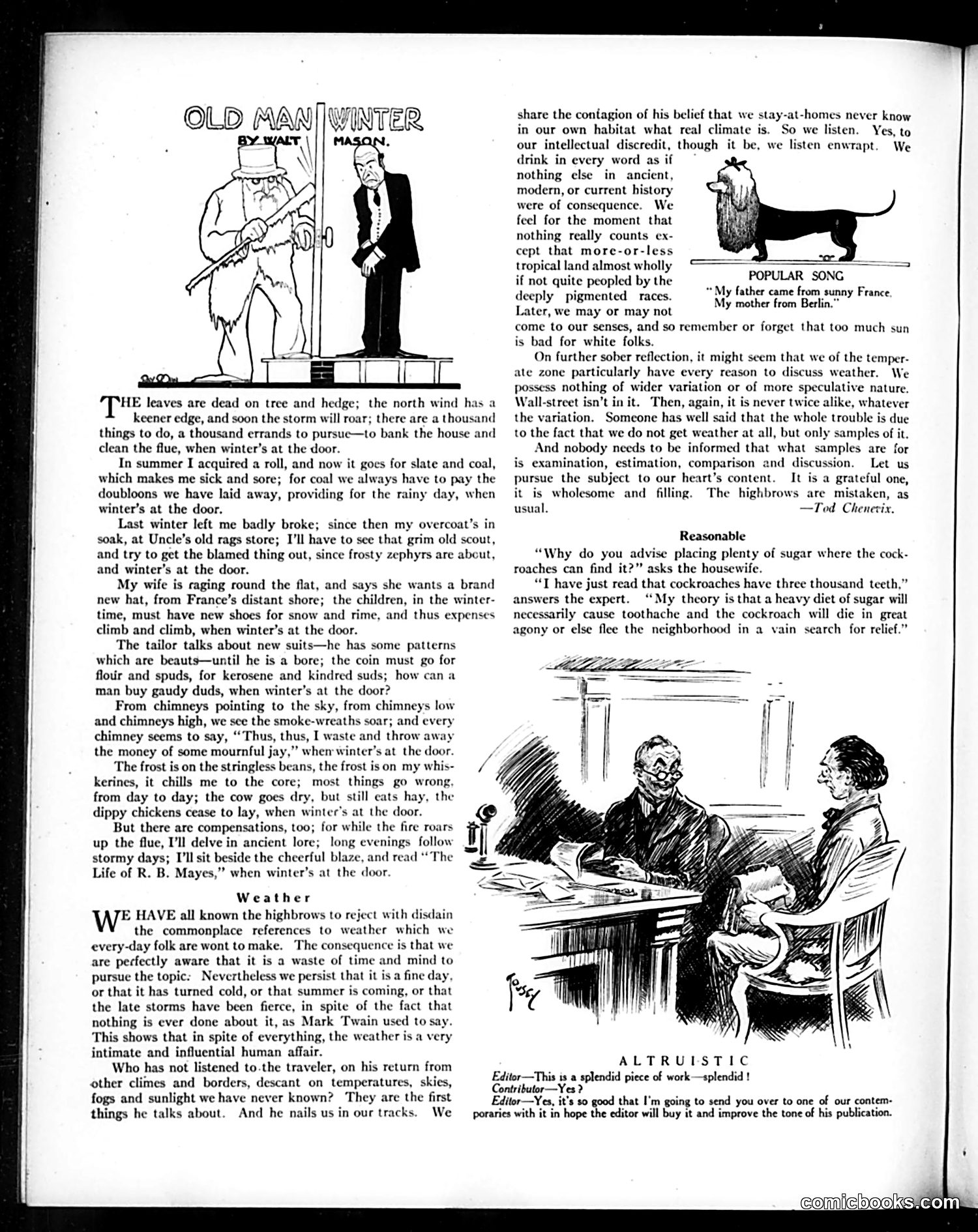
This page contains Walt Mason's poem "Old Man Winter," a humorous lament about winter's financial and domestic burdens. The cartoon at top left depicts "Old Man Winter" as a ragged, menacing figure confronting a well-dressed gentleman—contrasting poverty with comfortable living. The poem catalogs winter's expenses: coal, new clothes, children's shoes, wife's fashions from France. Mason uses repetition ("when winter's at the door") to emphasize the seasonal hardship's relentless return. The satire targets middle-class anxieties about maintaining appearances and comfort during winter months while managing limited budgets. The accompanying essay "Weather" mocks highbrow intellectuals who dismiss casual weather discussion, yet the author argues weather is legitimately important—especially in temperate zones where conditions vary unpredictably. There's subtle social commentary: the reference to "tropical land...peopled by the deeply pigmented races" reflects era-typical racial assumptions about climate and civilization. The bottom illustration shows an editor-contributor exchange about the quality of the work—likely self-referential Judge humor.
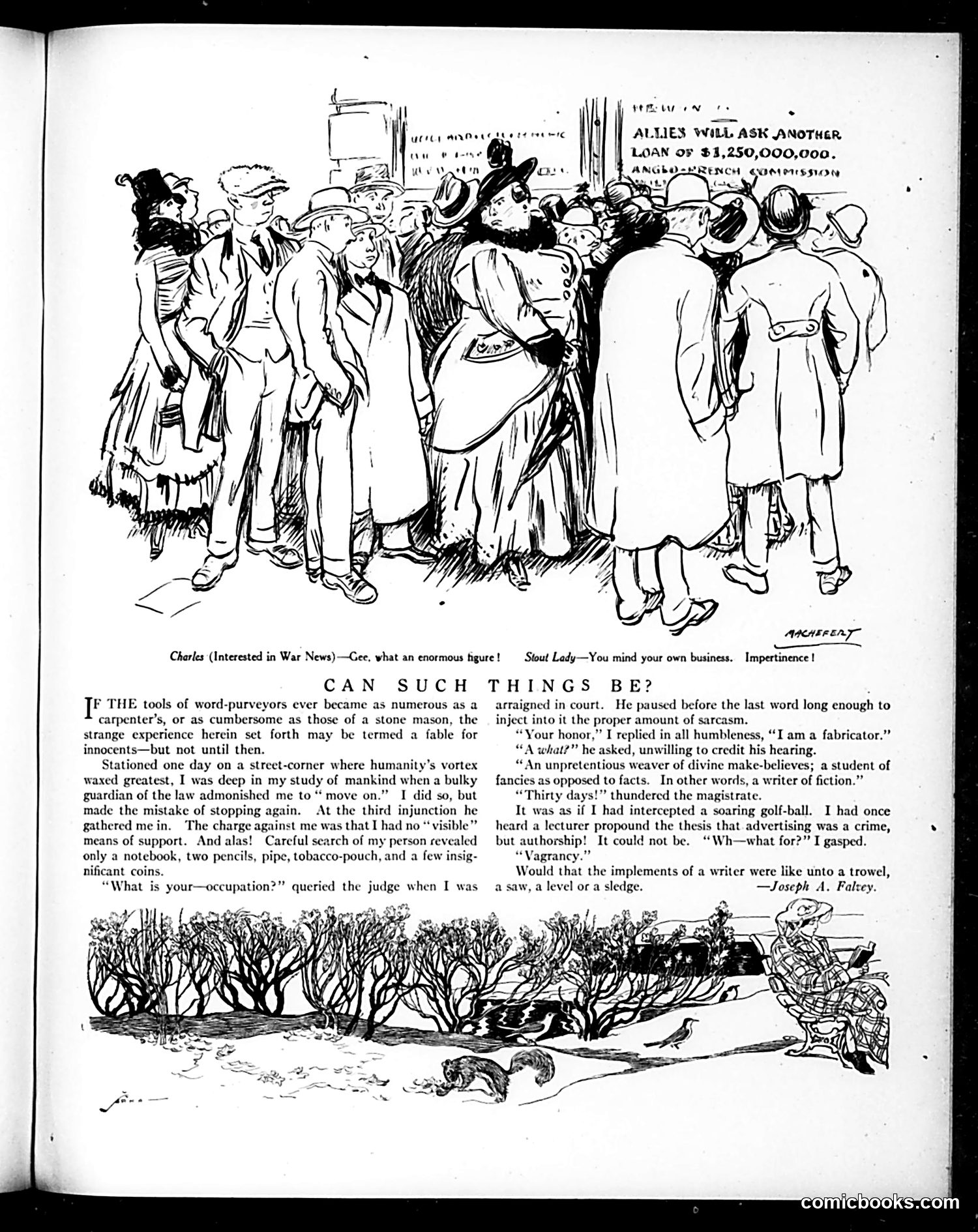
**Top Cartoon:** This satirical scene depicts public reaction to Allied war financing. The headline announces the Allies requesting another $3.25 billion loan. A man ("Charles") comments on a woman's "enormous figure," but she sharply rebuffs him—the joke being that her size actually represents the massive financial burden of sustaining World War I. The cartoon mocks both citizens' obliviousness to wartime costs and the audacity of repeated loan requests from Britain and France to American lenders. **Main Story ("Can Such Things Be?"):** A writer is arrested for "vagrancy" because he lacks visible means of support—possessing only a notebook and pencils. The judge sentences him to thirty days, calling authorship essentially criminal idleness ("vagrancy"). The satire critiques society's failure to recognize intellectual labor as legitimate work, contrasting writers' intangible tools with carpenters' or masons' tangible equipment.
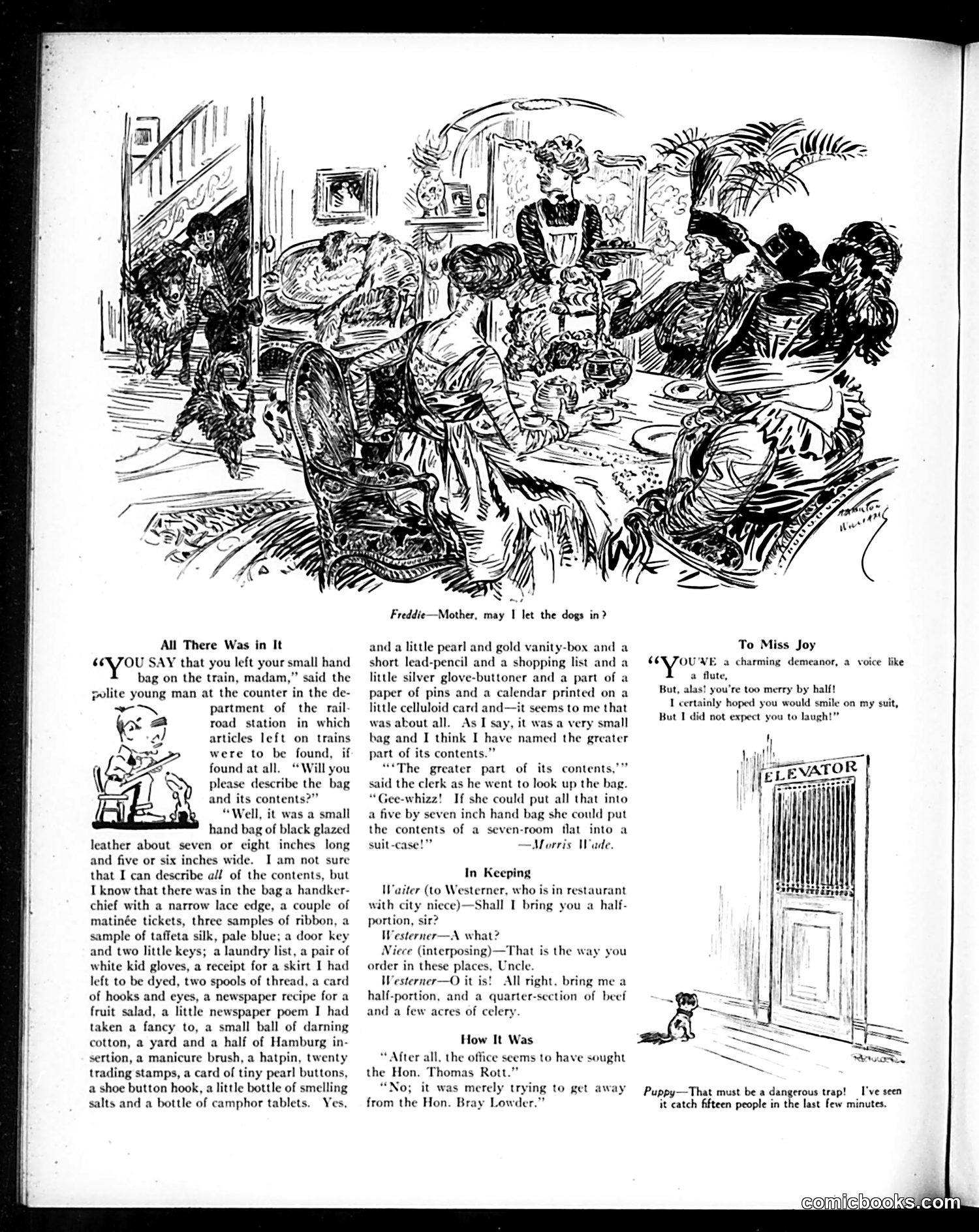
This page contains three separate humor pieces typical of early 20th-century satirical magazine content. **"All There Was in It"**: A woman reports a lost handbag to a railroad station clerk. The joke lies in the absurd contrast between her claim that it was a "small bag" and her exhaustive itemization of its contents—handkerchiefs, theater tickets, ribbons, keys, laundry lists, gloves, thread, pins, buttons, smelling salts, and more. The clerk's exasperated response ("she could put the contents of a seven-room flat into a suit-case!") is the punchline, mocking the woman's obliviousness to how impossibly packed her supposedly small bag was. **"In Keeping"**: A Western man dining with his city niece misunderstands "half-portion" as a regional term, thinking it means "half-acre" when she explains it's standard restaurant ordering. The humor targets rural ignorance of city conventions. **Minor pieces**: Brief jokes about political offices and a romantic rejection, plus a caption about an elevator trap catching people. The overall tone reflects turn-of-the-century domestic humor mocking absent-minded women and rural-urban cultural gaps.
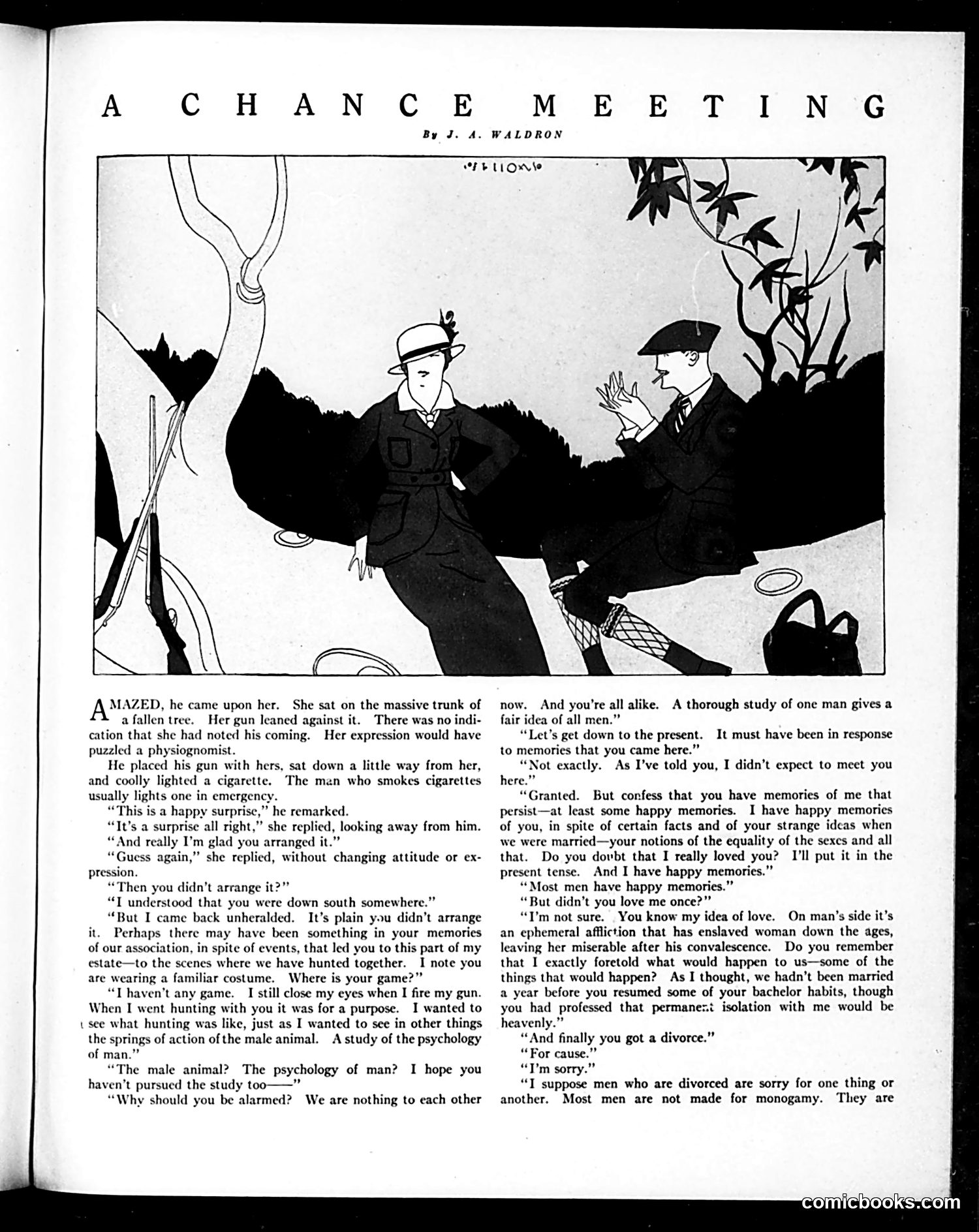
This story-cartoon depicts a chance encounter between ex-spouses hunting on the man's estate. The woman, dressed in hunting attire, initially claims she didn't arrange the meeting, but the man suspects her presence among their former hunting grounds isn't coincidental. The satire targets early 20th-century gender politics and marriage. The woman is portrayed as an intellectual who studied men "scientifically" and held progressive views on sexual equality—ideas the text presents as naive or troubling. The man represents traditional masculinity: he assumes her reappearance means lingering affection, dismisses her feminist notions, and admits his own infidelity. The story's cynicism suggests the era's skepticism toward women's independence and equality arguments. The woman's rationalization of love as "ephemeral affliction" enslaving women, and her prediction that the man would resume "bachelor habits," frames her as both prescient and embittered—vindicating the satirist's apparent view that modern women's expectations are unrealistic.
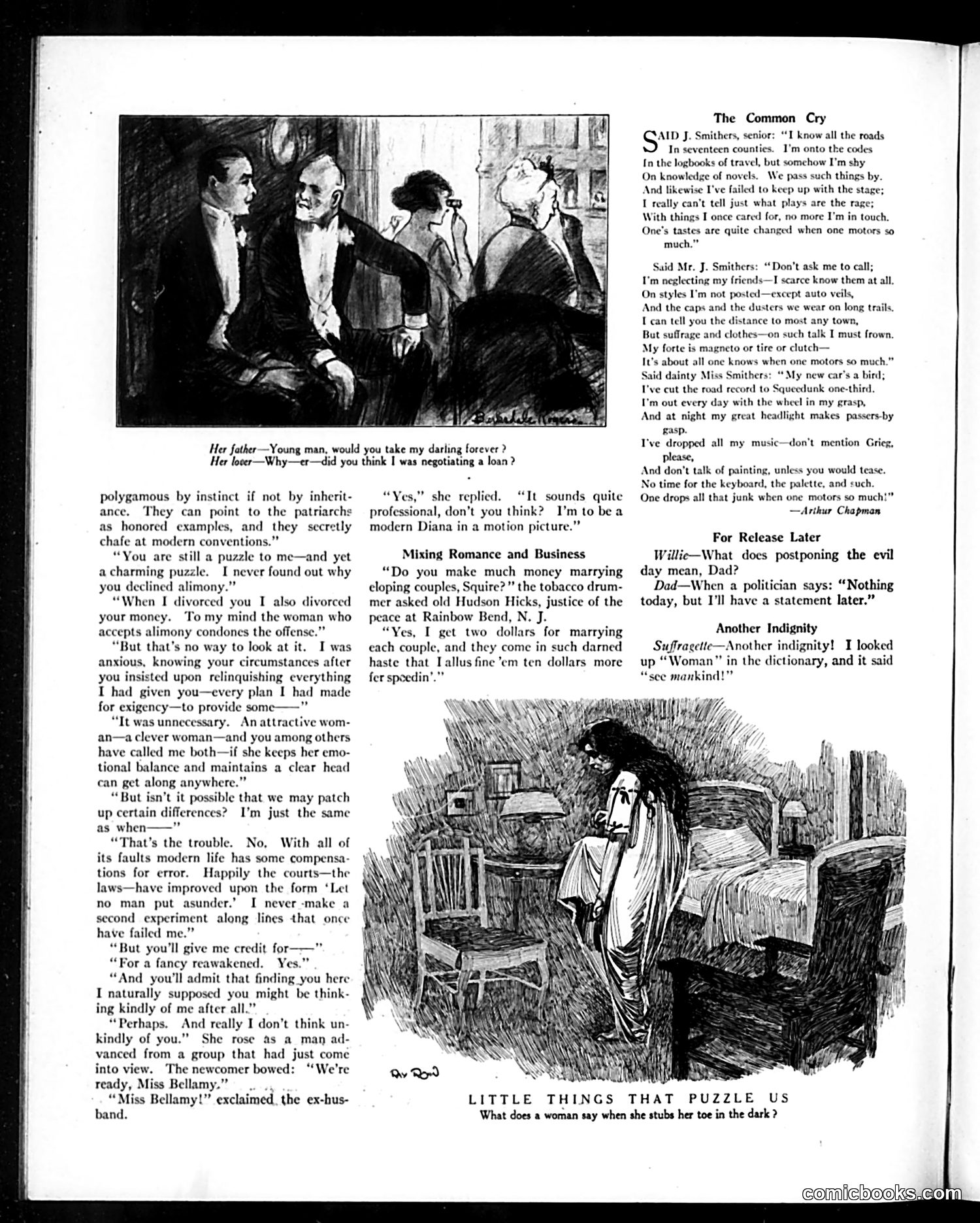
**The Main Cartoon** depicts a divorce settlement negotiation. A man asks a woman to reconcile, but she rebuffs him, explaining she rejected alimony after their divorce because accepting it would condone his offense. She's moving on—literally, as a film director arrives to cast her as "Diana" in a motion picture. The satire targets both **modern divorce culture** (then controversial) and the **emerging film industry**, suggesting independent women could reinvent themselves through cinema rather than depend on men financially. **"The Common Cry"** satirizes the **automobile craze** consuming American society. Mr. and Mrs. Smithers have abandoned all cultured interests—novels, theater, music, painting—obsessing entirely over cars: routes, engines, speeds, and accessories. Their daughter similarly neglects the arts for motoring. The satire mocks how new technology was displacing traditional culture and intellectual pursuits among the wealthy. **Minor jokes** include a justice of the peace profiting from hurried elopements, and a suffragette's indignation at dictionary definitions placing women under "mankind."
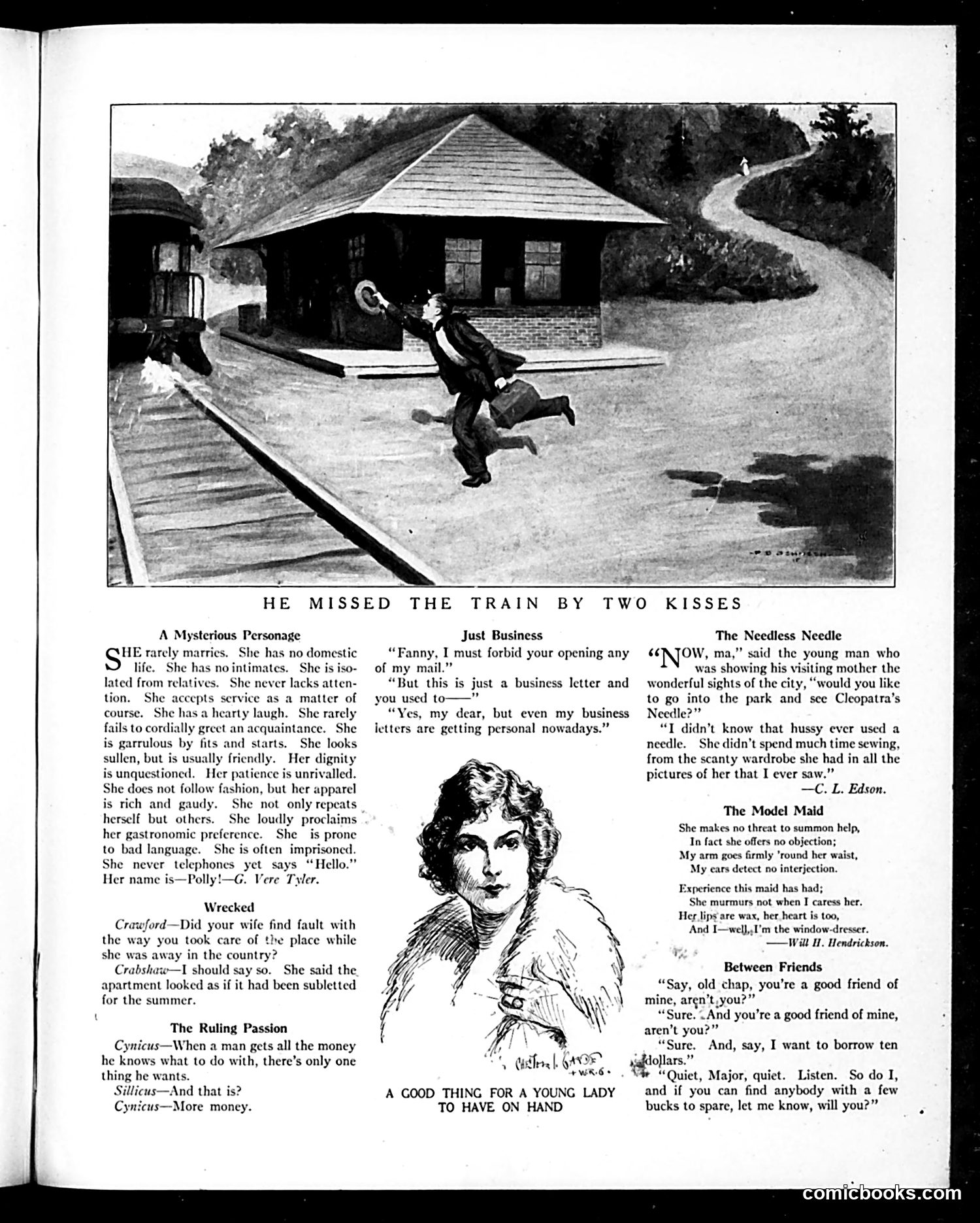
This page from *Judge* presents several humorous sketches satirizing early 20th-century social conventions and relationships. The main photograph shows a man running to catch a train while a woman waves goodbye—illustrating the caption "He Missed the Train by Two Kisses," a commentary on romantic entanglement interfering with practical obligations. The written sketches mock various social types: "A Mysterious Personage" describes a woman named Polly (likely a servant or working woman) through contradictory traits, implying her social position makes her inscrutable. "Just Business" jokes about romantic language infiltrating business correspondence—reflecting anxiety about blurred professional boundaries. "The Needless Needle" puns on Cleopatra's Needle (the obelisk) while making crude remarks about Cleopatra's famously scanty clothing and morals. Other pieces lampoon materialism ("The Ruling Passion"), domestic disappointment ("Wrecked"), and idealized femininity ("The Model Maid"). The humor targets class anxieties, changing gender roles, and romantic/business etiquette confusion of the era.
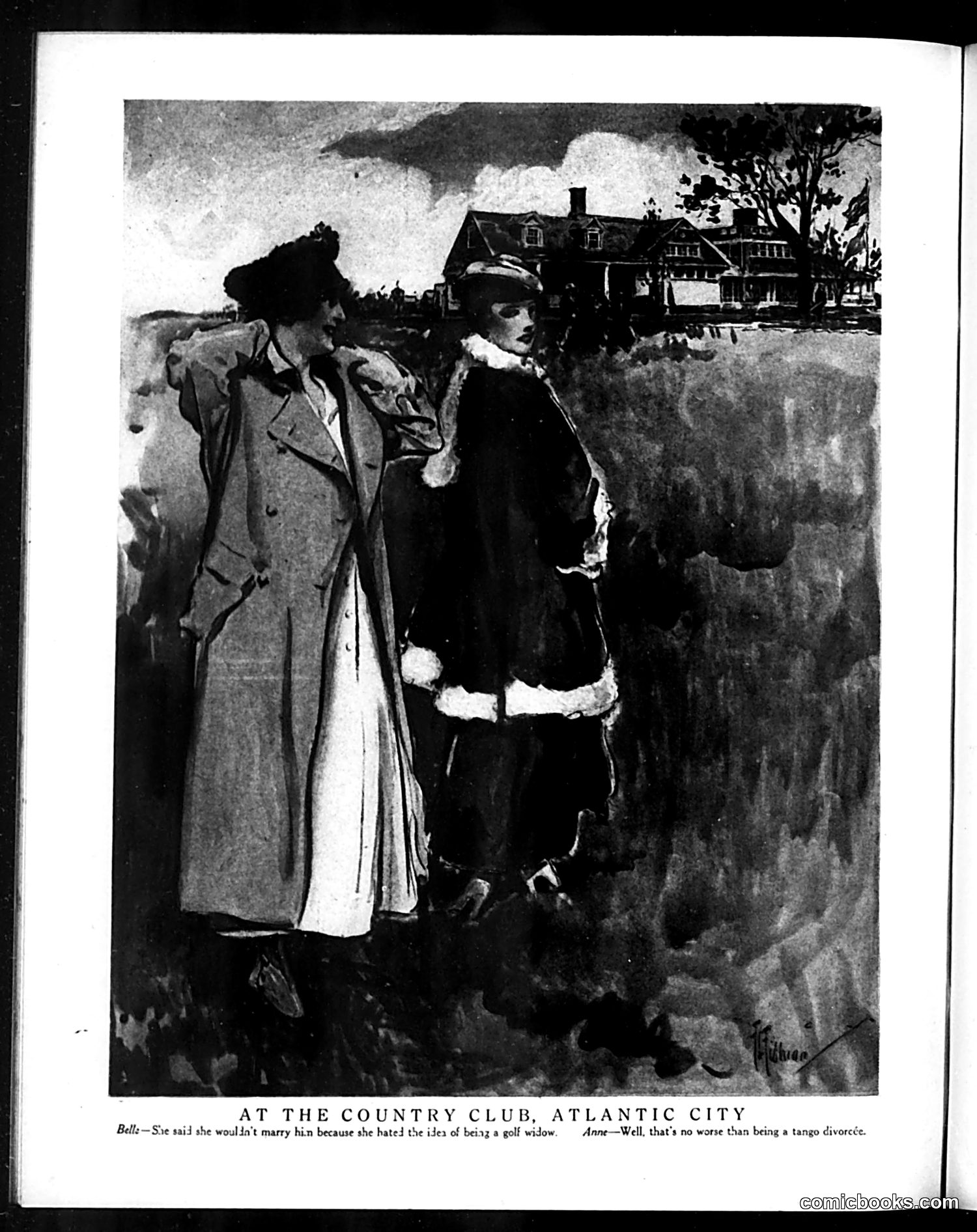
This cartoon satirizes early 20th-century marriage anxieties among wealthy Americans. Two women at an Atlantic City country club discuss romantic rejections: **The joke:** One woman (Bell) says she refused a suitor because she didn't want to become a "golf widow"—a wife neglected while her husband obsesses over golf. Her friend Anne replies that being a "tango divorcée" (a divorced woman associated with scandalous tango dancing) is no better. **The satire:** The cartoon mocks how upper-class women faced limited choices: either accept marriages where husbands ignored them for leisure activities, or risk social shame through divorce and association with questionable dancing crazes. Both options are presented as equally undesirable, highlighting women's constrained agency in marriage during this era. The setting at the exclusive country club emphasizes this is a wealthy-class problem.
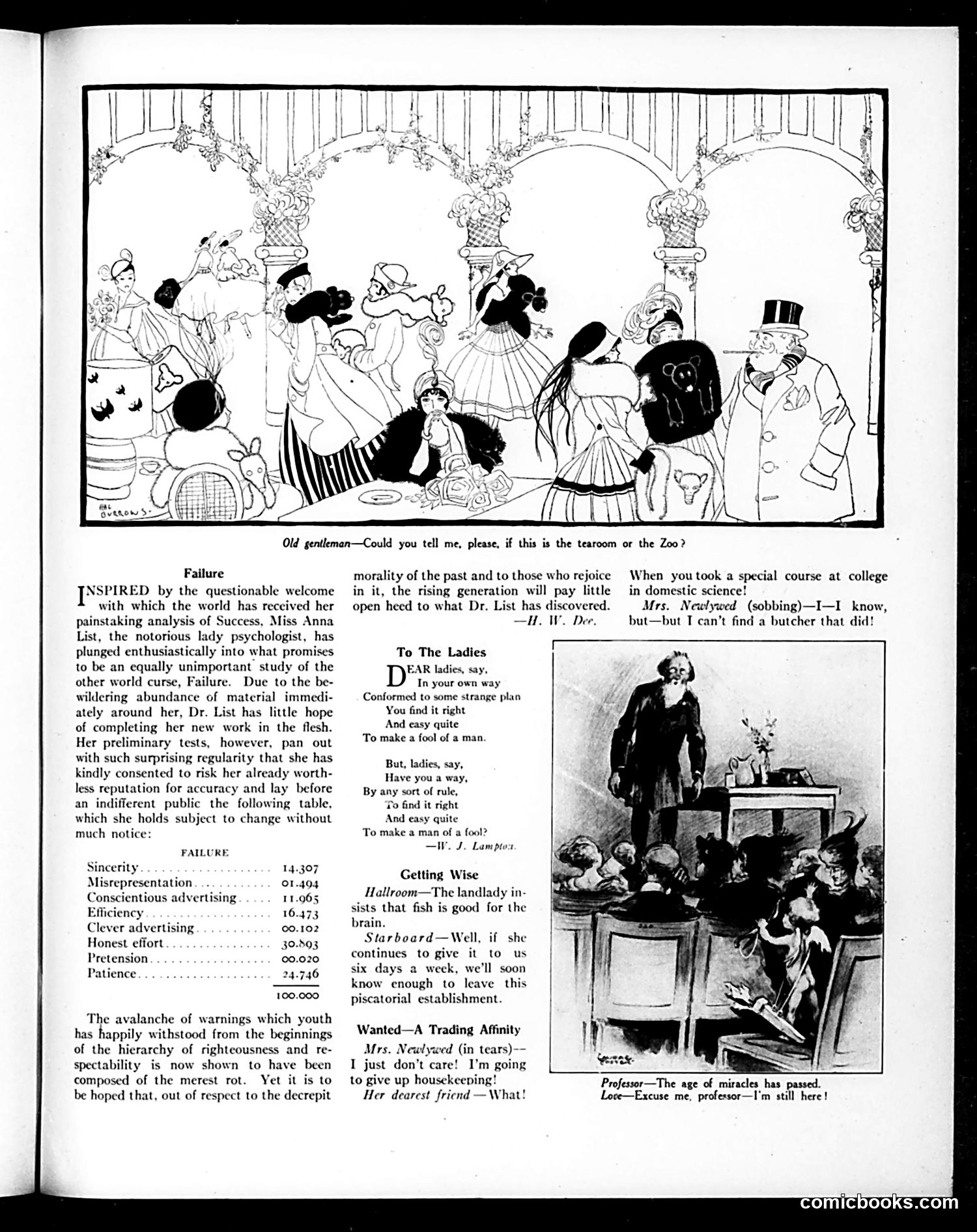
The top cartoon satirizes high society's chaotic behavior: a fashionable tearoom has become so rowdy and undisciplined that an elderly gentleman cannot distinguish it from a zoo—a jab at the declining manners of the wealthy elite. The article mocks "Dr. List," a psychologist who published a study on Success and now attempts an equally pretentious analysis of Failure, with absurd numerical breakdowns (sincerity causes 14.307% of failure, etc.). The satire suggests her work is pseudo-scientific nonsense masquerading as scholarship. Subsidiary jokes target contemporary domestic life: a new bride cannot cook (a "domestic science" course failure), landlords feed tenants cheap fish, and newlyweds lack marital harmony. The verse "To The Ladies" sardonically questions women's ability to improve foolish men—reflecting period anxieties about gender roles and education. Overall, the page ridicules pretentious psychology, declining social etiquette, and domestic incompetence among the modern upper classes.
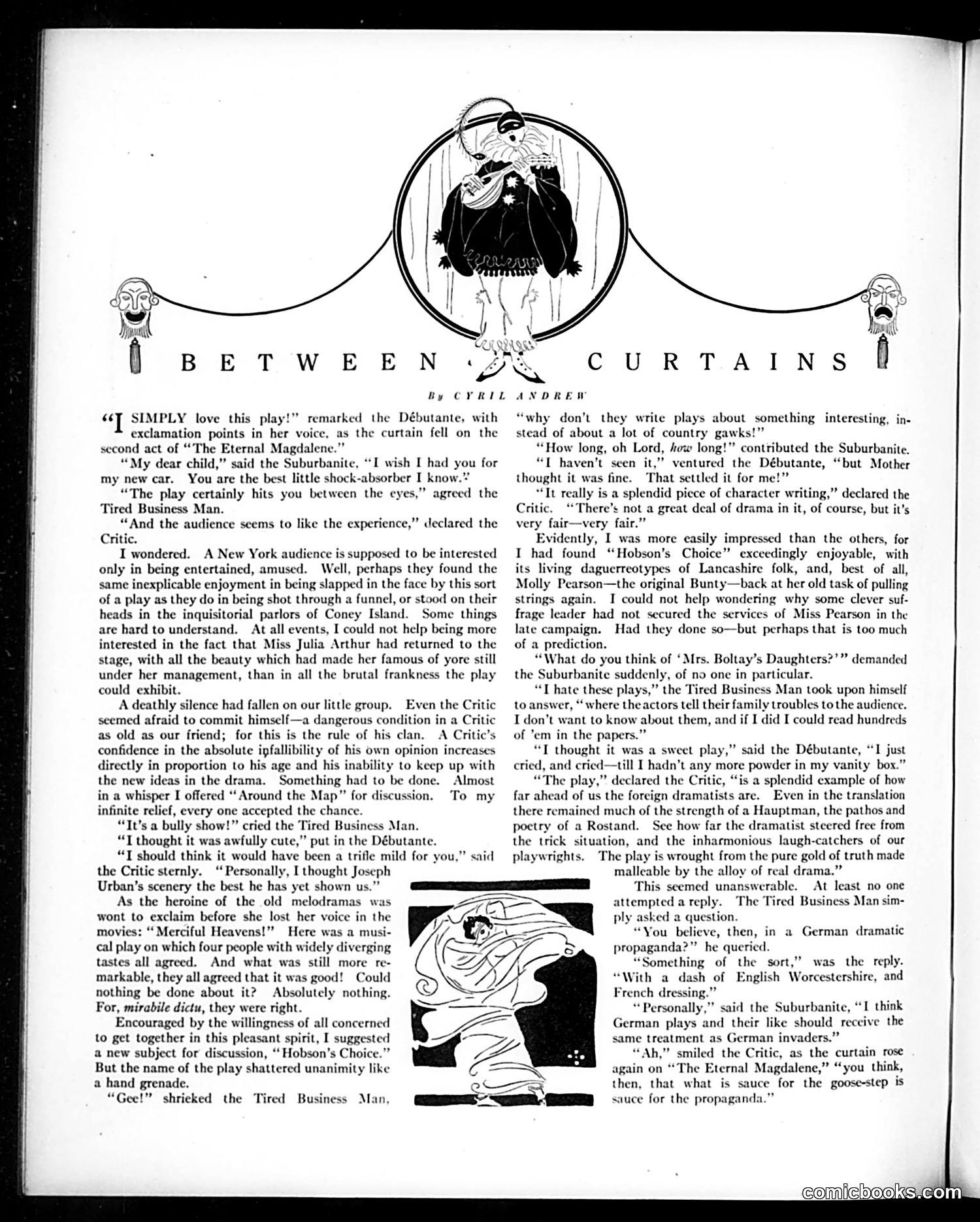
This is a theater criticism essay disguised as social satire. The author presents four stock characters—a Débutante, Suburbanite, Tired Business Man, and Critic—discussing recent Broadway plays: "The Eternal Magdalene," "Around the Map," and "Hobson's Choice." The satire targets theater audiences and critics themselves. The Critic represents pompous dramatic criticism: confidently dismissive, focused on scenery rather than substance, and increasingly opinionated with age. The other characters represent ordinary theatergoers with varied, unsophisticated tastes. The joke is that despite their different perspectives, all four unanimously praised "Around the Map"—yet the author can't explain why, suggesting audiences (and critics) often lack coherent standards for evaluation. The piece mocks both pretentious theater criticism and mass audience entertainment preferences in early 20th-century New York.
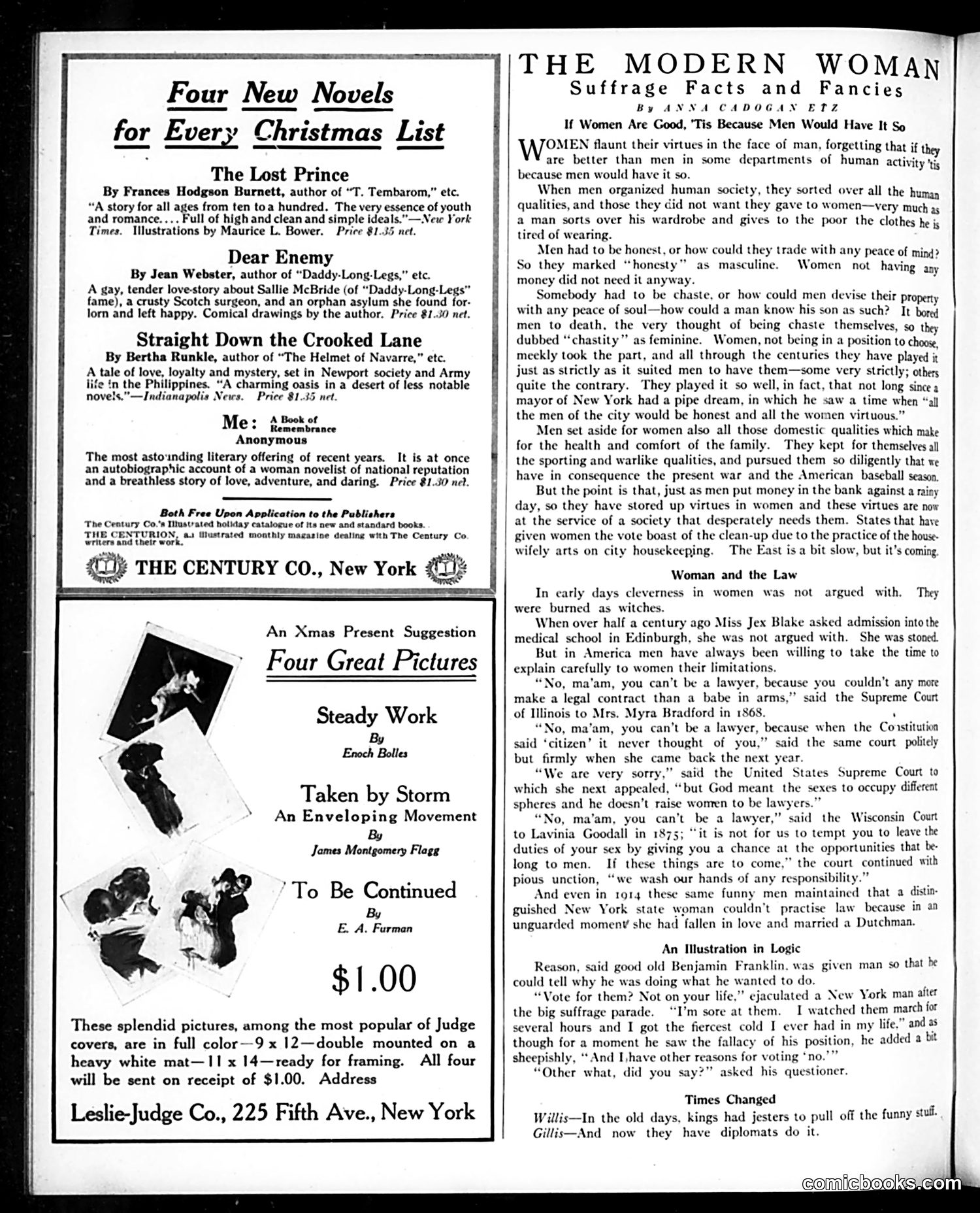
This page contains book advertisements and a satirical essay on women's rights. The left side promotes four novels as Christmas gifts, including works by Frances Hodgson Burnett and Jean Webster. Below are picture prints by Judge cover artists like James Montgomery Flagg. The right side features "The Modern Woman: Suffrage Facts and Fancies" by Anna Cadogan Etz—a sharp satirical critique of gender inequality. The author argues that women's virtues (honesty, chastity, domesticity) aren't inherently feminine but were *assigned* by men who needed them for social order. She sarcastically notes men kept for themselves "sporting and warlike qualities," resulting in war and baseball obsession. The essay mocks male hypocrisy: men demand women be chaste while reserving freedom for themselves. This is suffrage-era advocacy disguised as humor, exposing how patriarchal society constructed "feminine virtue" as convenient social control rather than genuine female nature.
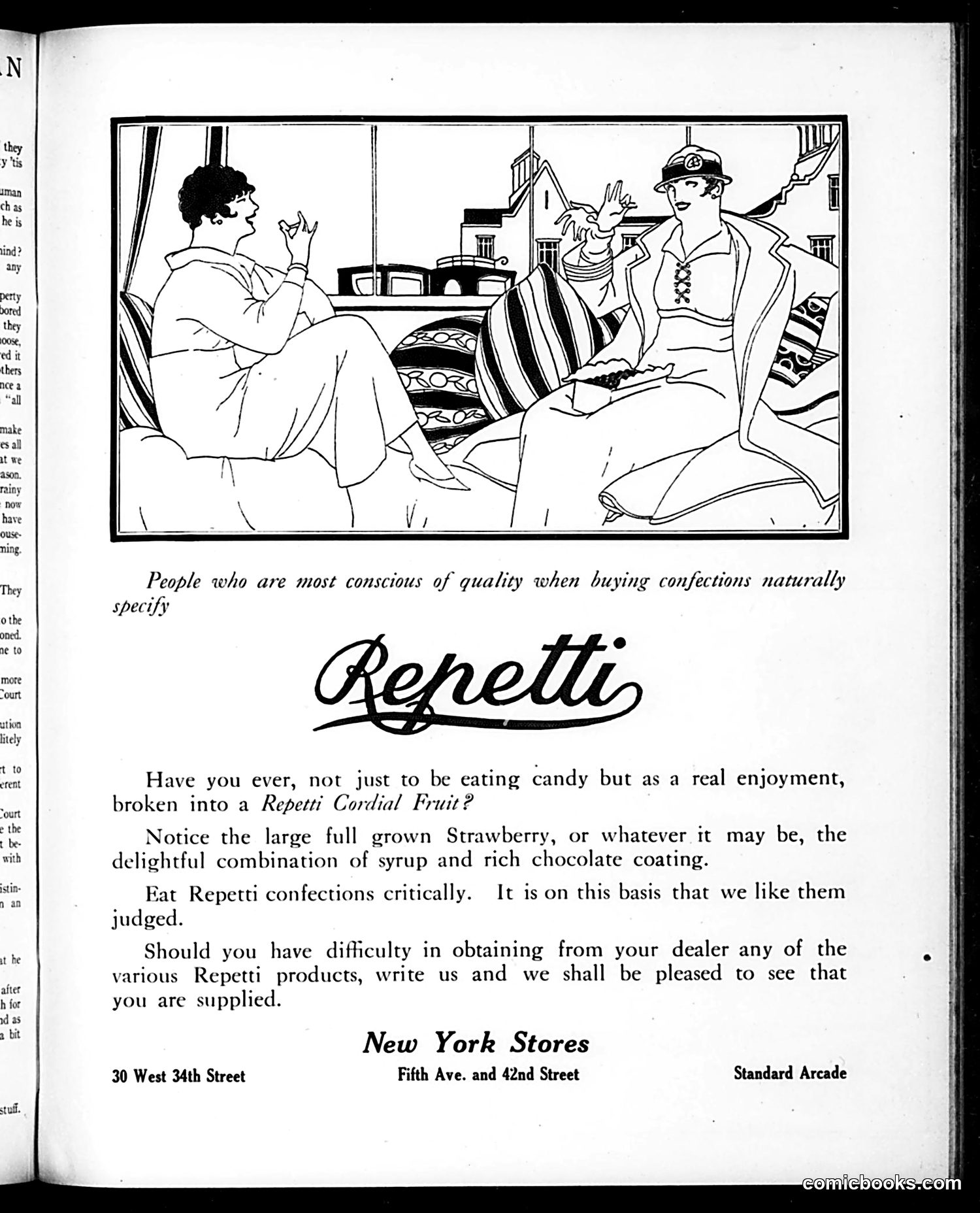
This page is **primarily an advertisement**, not editorial satire. It's a Repetti confections ad placed in *Judge* magazine. The illustration shows two stylishly dressed women in 1920s fashion having a casual conversation, likely in a home setting with a cityscape visible through windows. The ad positions Repetti candies (specifically "Cordial Fruit"—chocolate-covered fruits) as a quality product for discerning consumers. The messaging appeals to social class and refinement: people of "quality" naturally specify Repetti. The ad encourages readers to eat candy "critically," emphasizing the real fruit and chocolate coating rather than viewing it as mere indulgence. For modern readers: this reflects early 20th-century advertising strategy—using aspirational imagery and appeals to taste/sophistication to market mass-produced goods. The three New York store locations suggest Repetti was a regional brand seeking broader distribution.
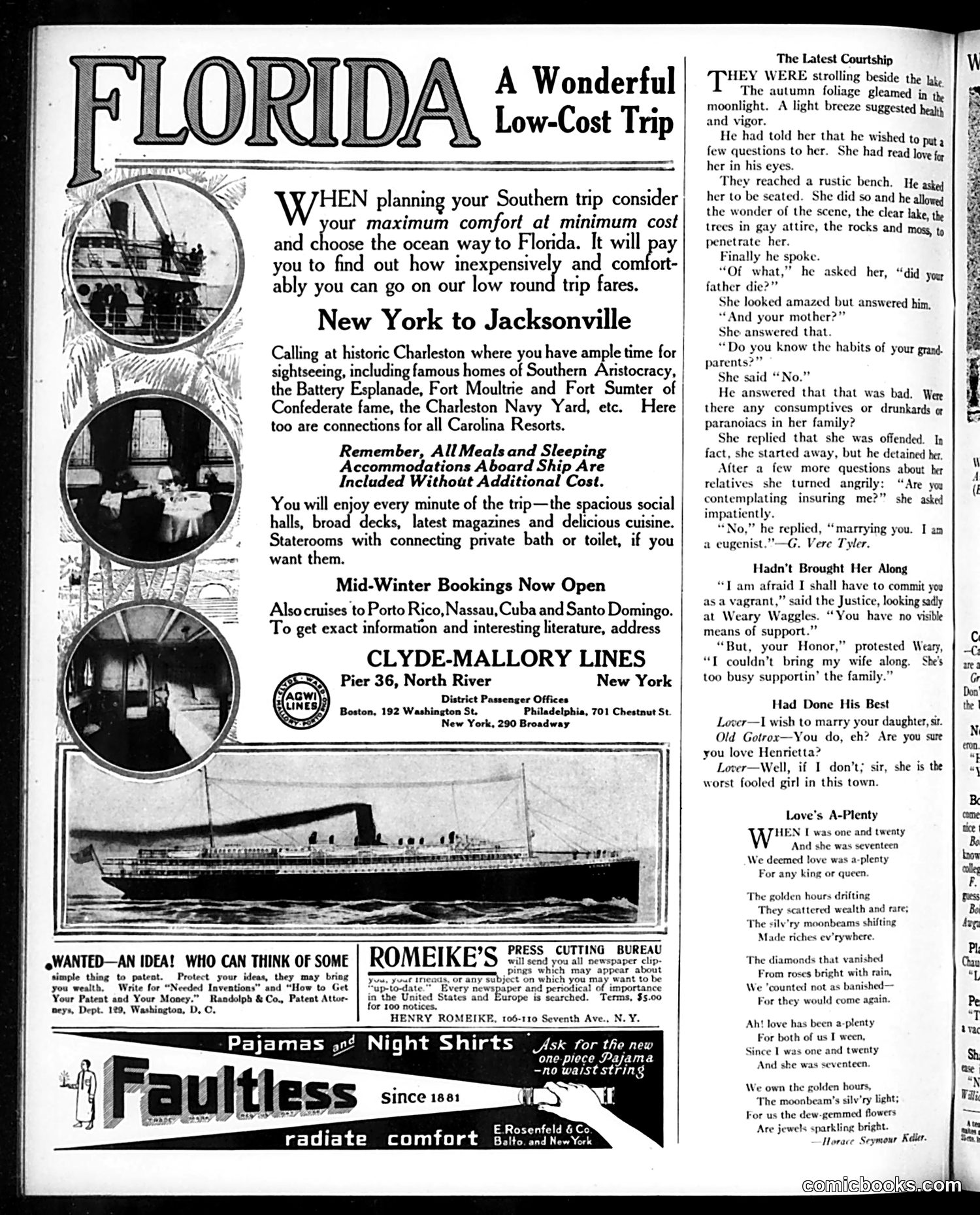
This page is primarily **advertising**, not political satire. The dominant content is a Clyde-Mallory Lines cruise advertisement promoting budget ocean travel from New York to Jacksonville, Florida, with stops in Charleston. The ad emphasizes "maximum comfort at minimum cost" and highlights sightseeing at historic Southern sites (Fort Sumter, the Battery) and includes meals and accommodations. The right column contains **humorous short stories** typical of Judge magazine's lighter content—romantic and comedic vignettes with no political dimension. "The Latest Courtship" satirizes a eugenic-minded suitor interrogating a woman about her family's medical history before proposing. Other brief jokes address vagrancy and courtship. There is **no political cartoon** on this page. The page reflects early 20th-century magazine format: travel promotion alongside light domestic humor and advertisements for pajamas, patent services, and newspaper clipping bureaus.
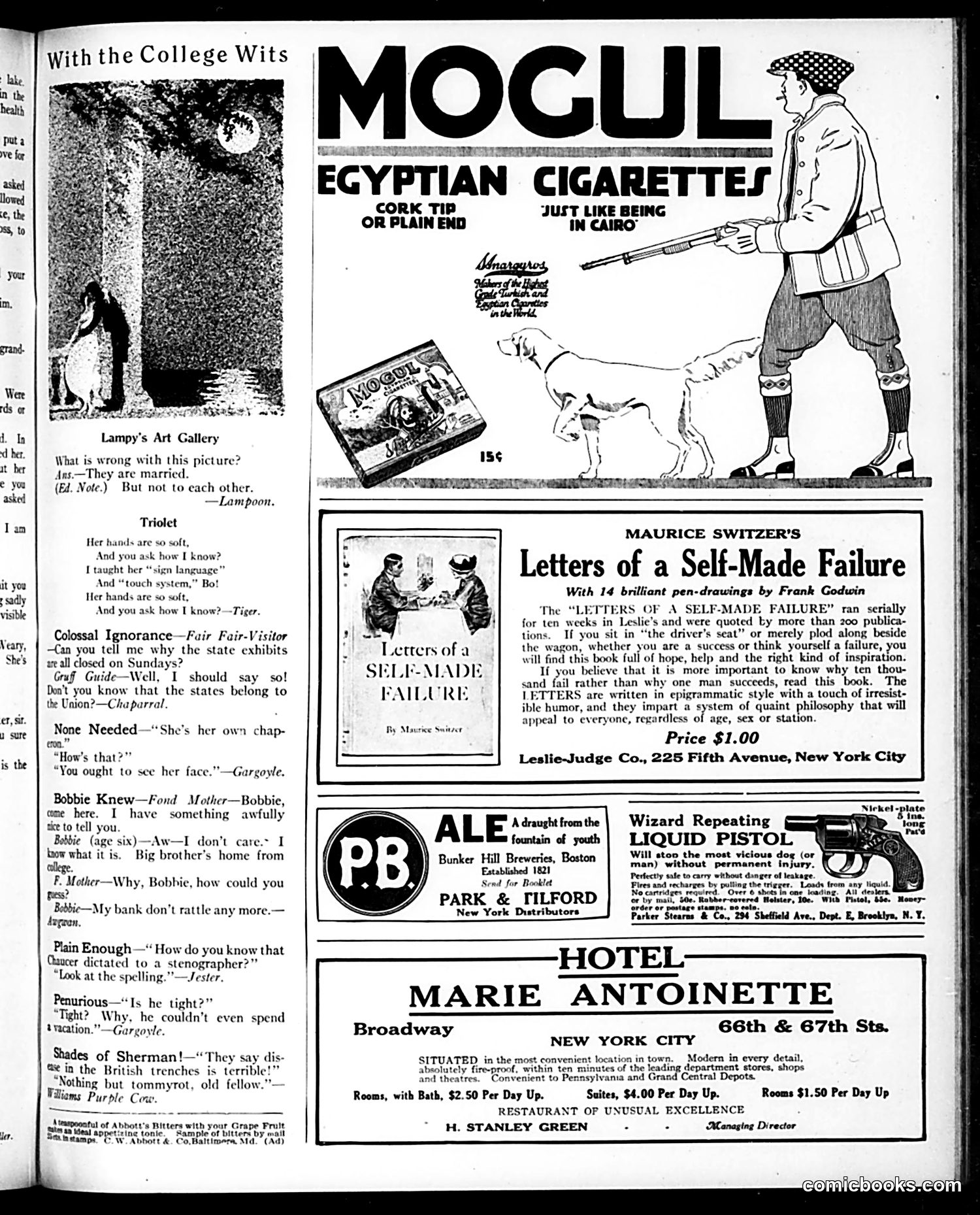
This page primarily contains **humorous short jokes and advertisements** rather than political cartoons. The content includes: **"Lampy's Art Gallery"** presents a visual gag: a photograph showing two figures, captioned "What is wrong with this picture? Ans.—They are married... But not to each other." This is a marital infidelity joke. The page features several brief comedic exchanges labeled by type ("Triolet," "Colossal Ignorance," "None Needed," etc.), typical of Judge's humor column format. These are witty one-liners playing on misunderstandings, malapropisms, and domestic situations—standard early 20th-century magazine humor. **Advertisements dominate the lower half**: Mogul Egyptian cigarettes, P.B. Ale, a "Wizard Repeating Liquid Pistol" (a novelty item), Hotel Marie Antoinette, and Maurice Switzer's book "Letters of a Self-Made Failure." There is **no significant political or social satire** on this page—it's primarily light entertainment and advertising aimed at a general audience.
This page combines a **Collier's magazine advertisement** featuring Sir Arthur Conan Doyle with a collection of **short humorous anecdotes**. ## The Doyle Advertisement The left side promotes Doyle's article "Stranger Than Fiction" appearing November 27th in Collier's. The quote presents Doyle defending occult study against skeptics who dismiss it without serious investigation—a relevant debate for the early 20th century when spiritualism and psychic phenomena were subjects of genuine public interest and intellectual dispute. ## The Humor Section ("Stories with Smiles") The right side contains brief jokes exploiting linguistic and cultural stereotypes: Irish characters ("Pat," "Mickey Dugan"), Scottish dialect ("Weel"), and working-class speech patterns. The humor typically derives from misunderstandings, double meanings, or characters displaying naiveté (the son indifferent about which daughter he'll marry; the sailor's absurd claim about Pharaoh's chariot). **For modern readers:** The occult reference remains recognizable, but the ethnic stereotyping and dialect humor reflect outdated comedic conventions.
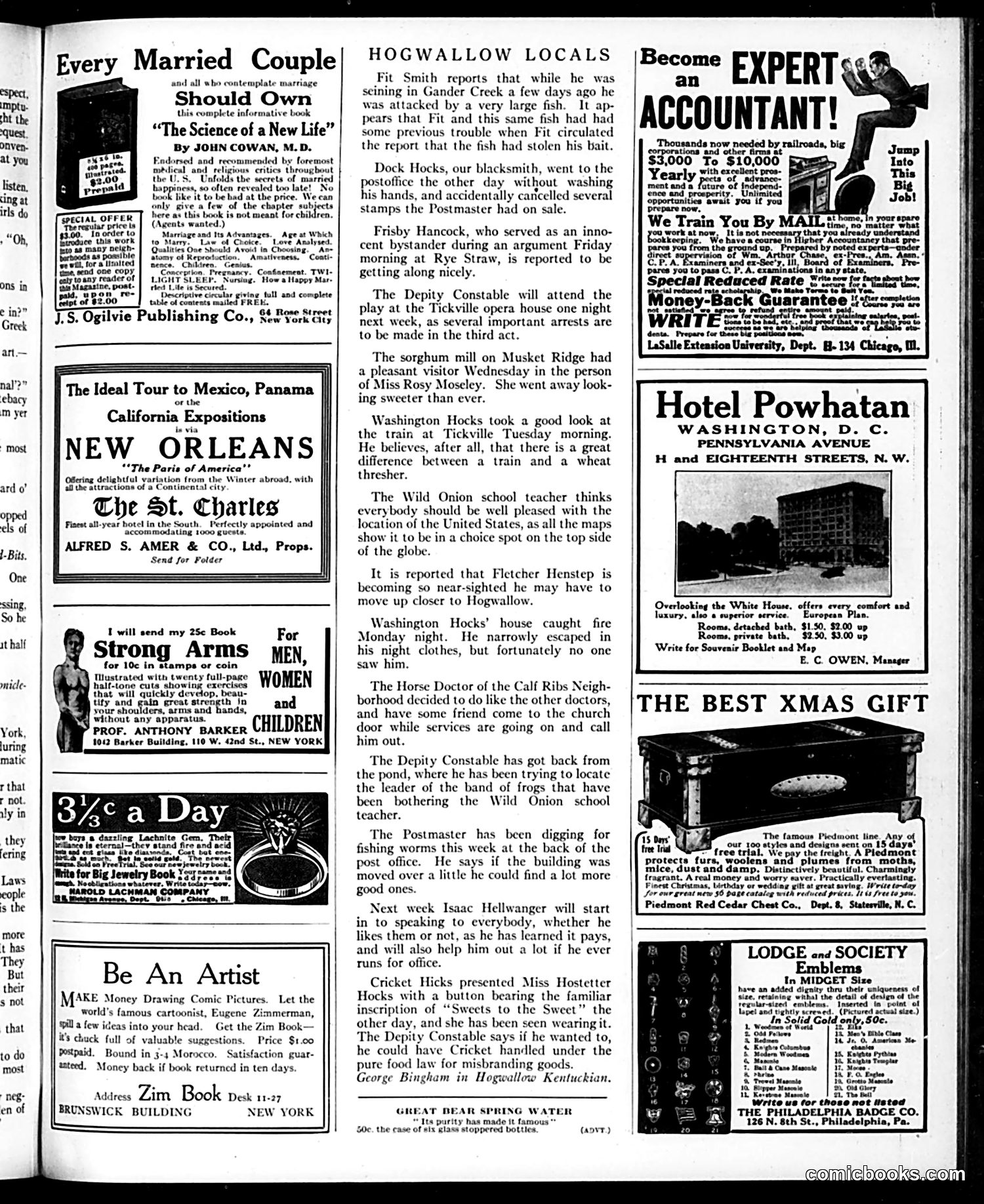
This page is primarily **advertising** with an embedded satirical humor column titled "Hogwallow Locals"—a fictional rural community featuring absurd, deadpan anecdotes. The satire targets **rural life and small-town characters** through mock-serious local news items. Examples include: - A man attacked by a fish he'd previously slandered - A blacksmith carelessly canceling postage stamps with unwashed hands - A "Deputy Constable" attending an opera to make arrests during the third act - A schoolteacher pleased the United States sits "on top side of the globe" - A man becoming near-sighted and needing to "move up closer to Hogwallow" The humor relies on **exaggerated stupidity and absurdist logic**—playing on urban readers' stereotypes of rural Americans as simple-minded and comically backwards. The deadpan delivery (treating ridiculous events as routine local news) amplifies the mockery. This represents **early 20th-century cosmopolitan satire** mocking rural/"backwards" Americans—a common Judge magazine trope reflecting urban intellectual condescension toward provincial life.
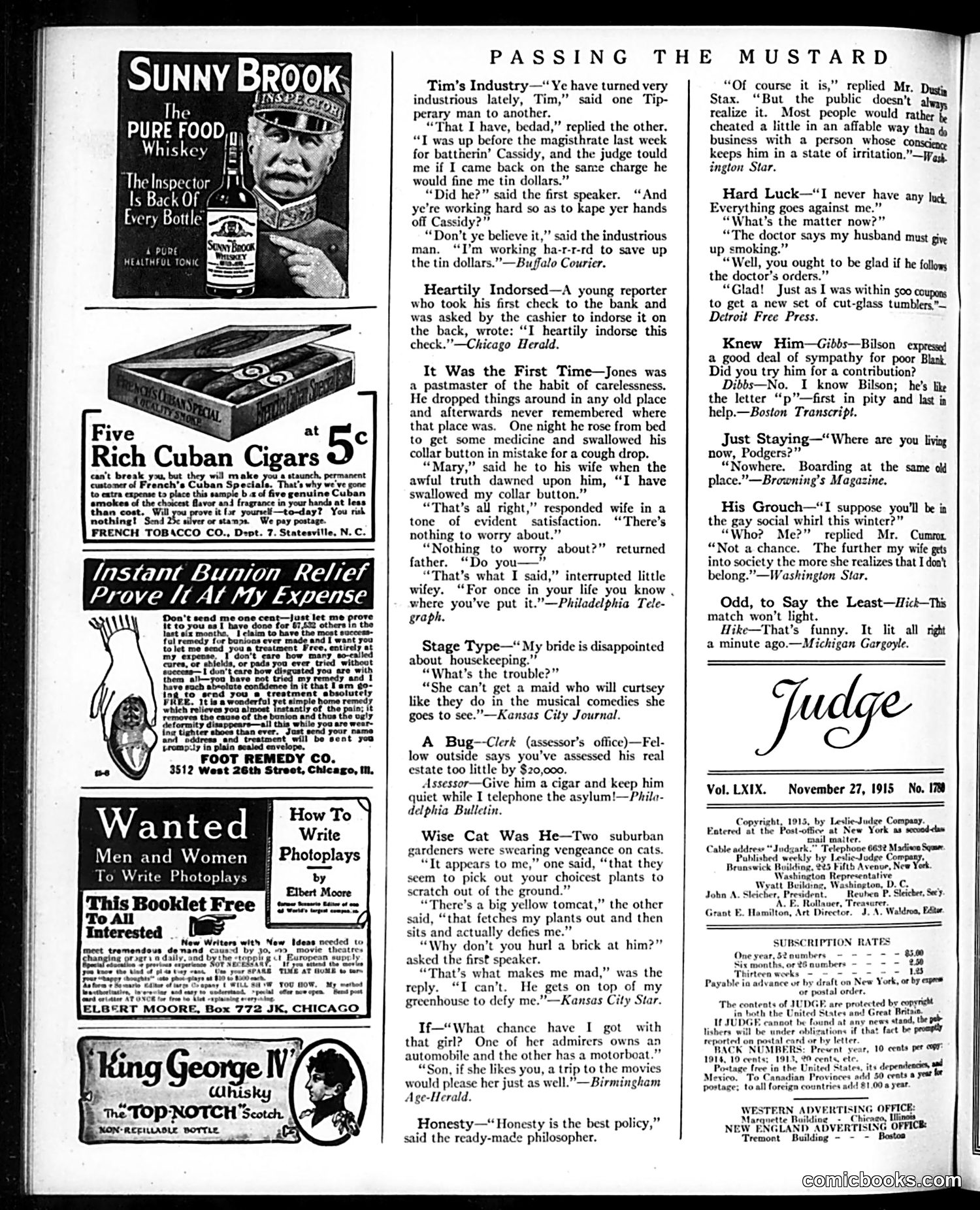
This page is primarily **advertisements and humor columns**, not political cartoons. The content consists of: **Advertisements**: Sunny Brook whiskey (emphasizing "pure food"), Cuban cigars, a foot remedy, bunion relief product, and King George IV whiskey dominate the layout. **Humor Columns** ("Passing the Mustard"): Short anecdotal jokes about: - An Irish laborer working to afford a fine rather than reform - A bank clerk's literal interpretation of "endorse" - A careless husband who swallows his collar button - A bride disappointed theatrical maids don't curtsey - Suburban gardeners battling a defiant cat **Social Context**: The jokes reflect early 20th-century concerns—class anxieties, bureaucratic literalism, domestic life, and minor absurdities of daily existence. The humor is gentle, observational rather than satirical, targeting no specific political figures or events visible here.
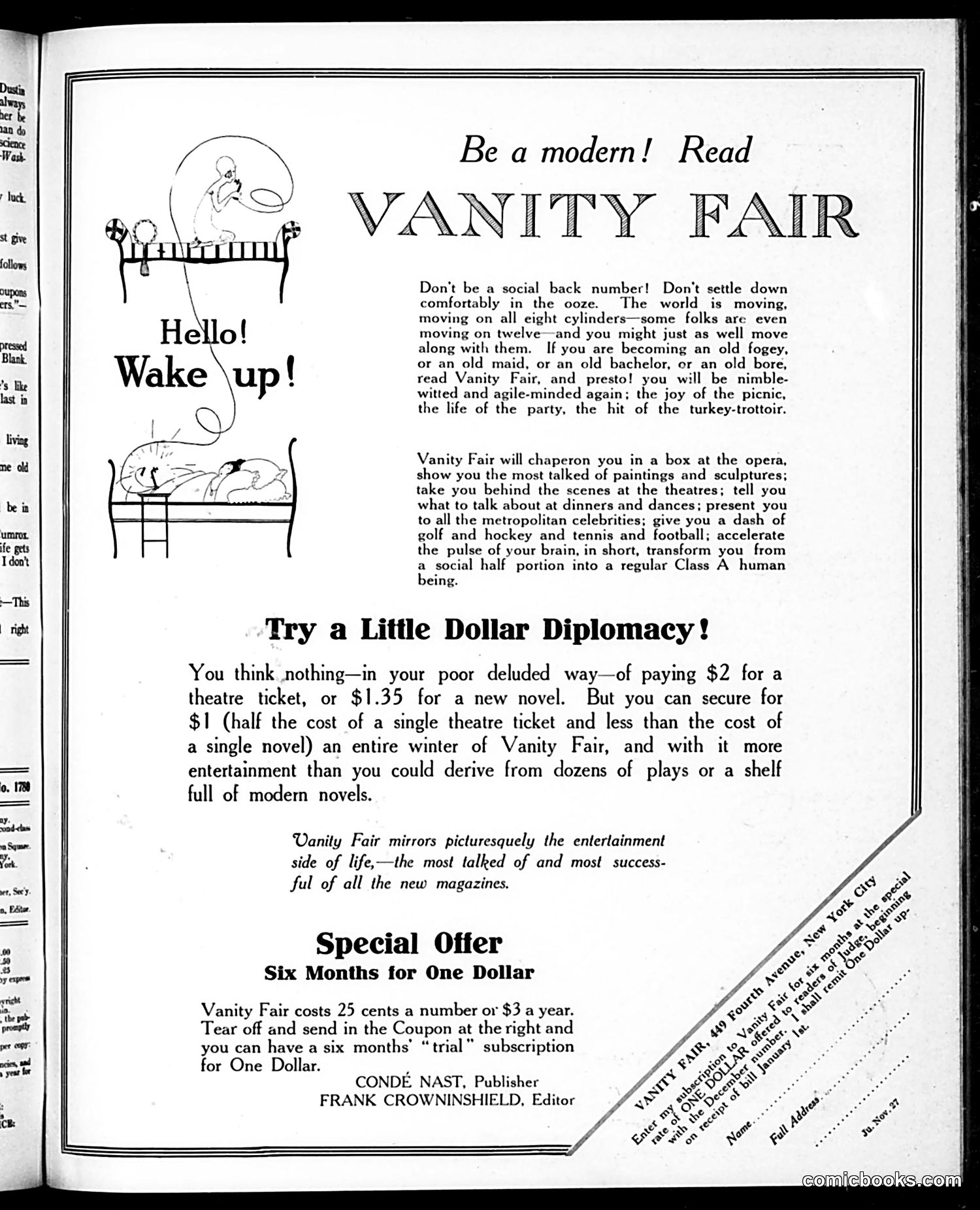
This is a **full-page advertisement** for *Vanity Fair* magazine, not political satire. The cartoon imagery (showing someone sleeping/waking) is decorative rather than satirical. The ad's humor targets **social anxiety and self-improvement anxieties** of the era. It warns readers against becoming "social back numbers"—outdated, boring people. References like "old fogey," "old maid," "old bachelor," and "turkey-trottoir" (a dance) signal early 20th-century concerns about appearing modern and socially relevant. The pitch emphasizes *Vanity Fair's* role as a **cultural guide**: teaching readers what to discuss at dinners, which artworks matter, which celebrities to know. The "dollar diplomacy" section uses self-deprecating humor, mocking readers' spending habits to justify the magazine's bargain price. The underlying message reflects **1920s aspirational marketing**—that reading the right magazine transforms you from a "social half portion" into a "Class A human being," reflecting period anxieties about status and cultural sophistication.
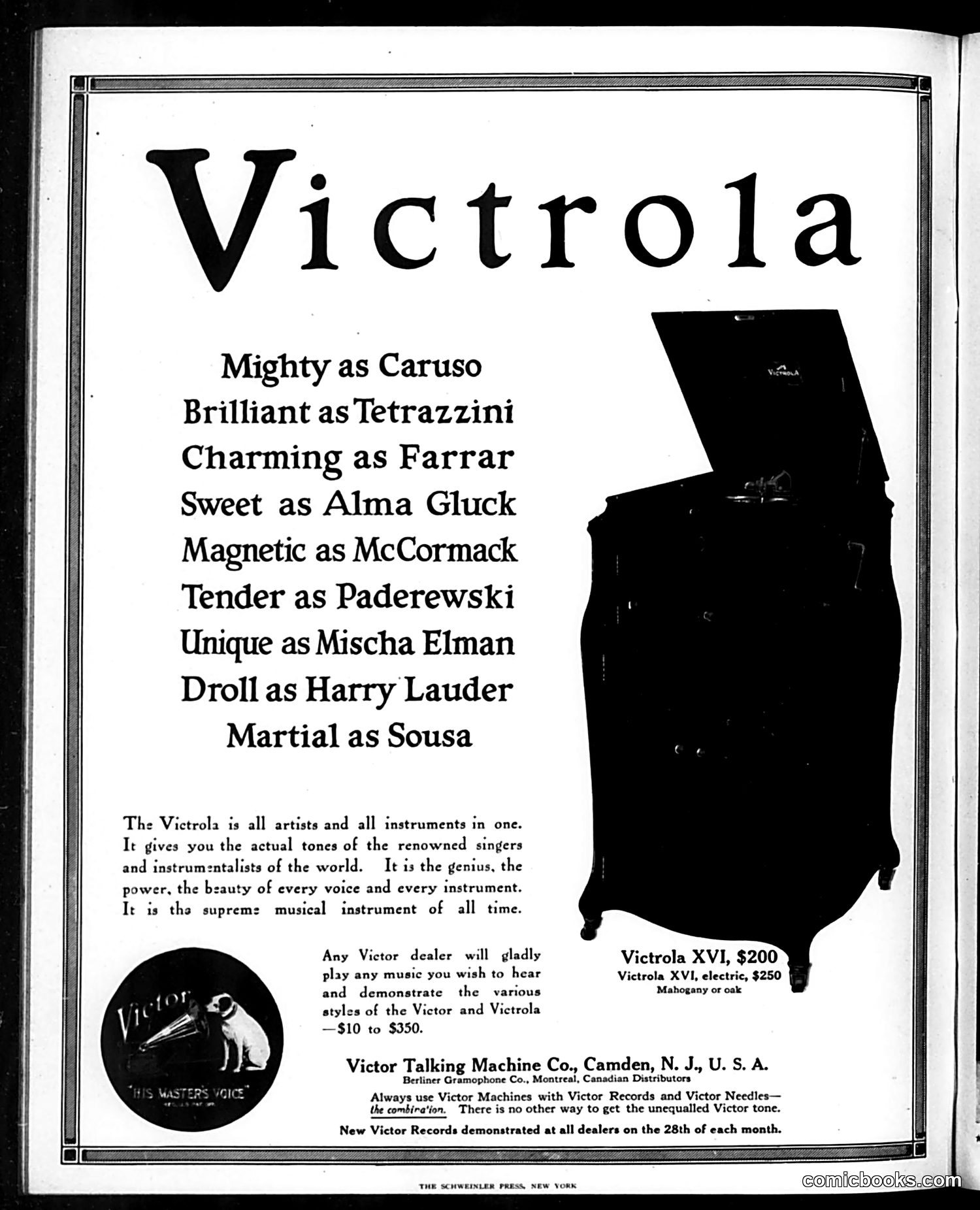
This is a **Victrola phonograph advertisement**, not political satire. The page promotes Victor Talking Machine Co.'s gramophone by comparing it to famous early-20th-century singers and musicians: Caruso (tenor), Tetrazzini (soprano), Farrar (soprano), Alma Gluck (soprano), John McCormack (tenor), Paderewski (pianist), Mischa Elman (violinist), Harry Lauder (Scottish entertainer), and John Philip Sousa (conductor/composer). The marketing claim: owning a Victrola gives you access to these renowned artists' actual recorded voices in your home—making the machine "all artists and all instruments in one." The silhouette shows the Victrola XVI model priced at $200 (or $250 for the electric version). This reflects the early phonograph era when recorded music was a luxury novelty, and hearing famous performers' voices at home was genuinely remarkable technology.