
Judge, 1915-11-27 · page 14 of 28
Judge — November 27, 1915 — page 14: what you’re looking at
What you’re looking at
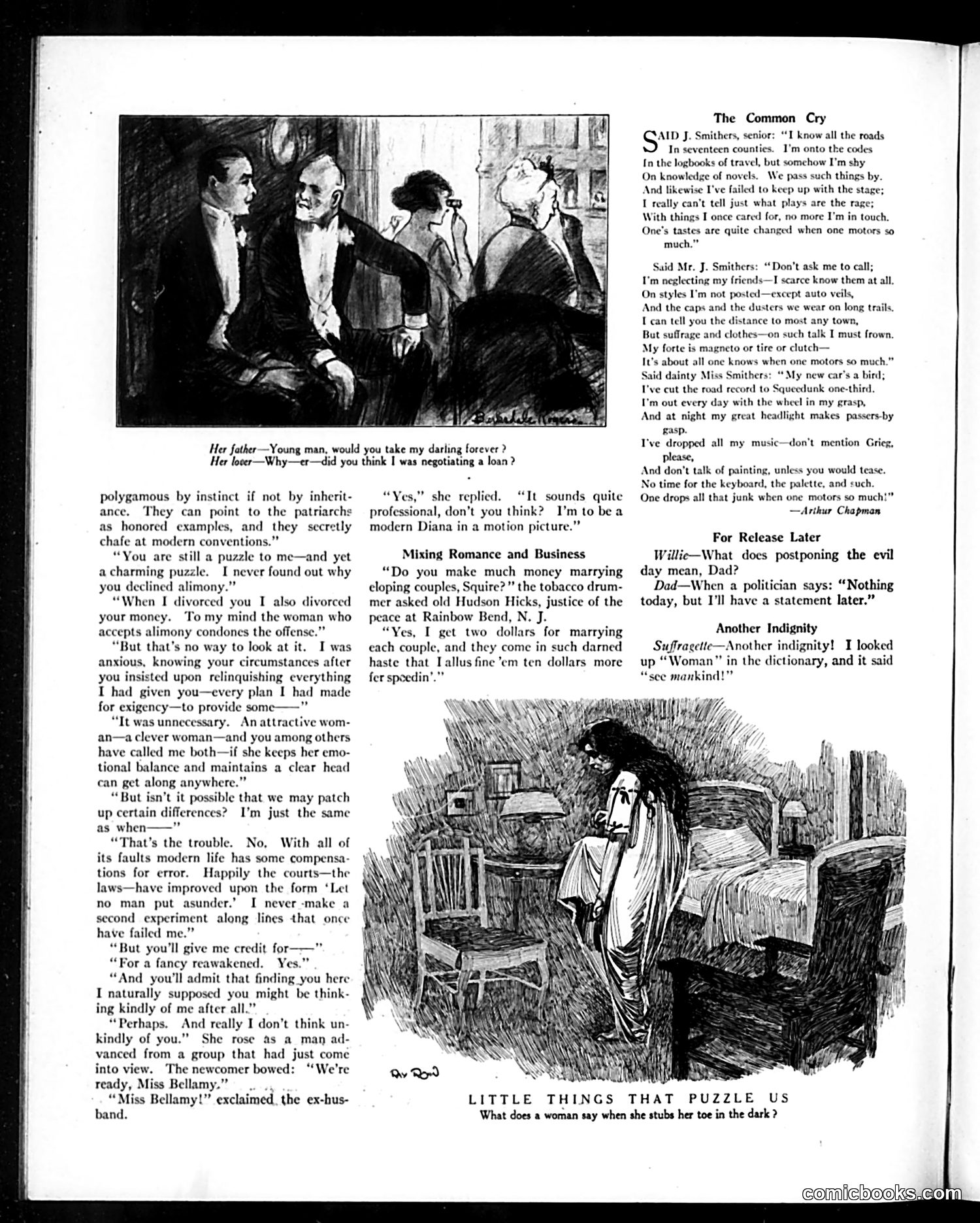
**The Main Cartoon** depicts a divorce settlement negotiation. A man asks a woman to reconcile, but she rebuffs him, explaining she rejected alimony after their divorce because accepting it would condone his offense. She's moving on—literally, as a film director arrives to cast her as "Diana" in a motion picture. The satire targets both **modern divorce culture** (then controversial) and the **emerging film industry**, suggesting independent women could reinvent themselves through cinema rather than depend on men financially. **"The Common Cry"** satirizes the **automobile craze** consuming American society. Mr. and Mrs. Smithers have abandoned all cultured interests—novels, theater, music, painting—obsessing entirely over cars: routes, engines, speeds, and accessories. Their daughter similarly neglects the arts for motoring. The satire mocks how new technology was displacing traditional culture and intellectual pursuits among the wealthy. **Minor jokes** include a justice of the peace profiting from hurried elopements, and a suffragette's indignation at dictionary definitions placing women under "mankind."
📄 Transcribed text from this page (OCR, searchable)
Machine-transcribed from the original scan — historical spelling and the odd misread are preserved.
Her father —Young man, would you take my darling forever ? Her locer—Why—er—did you think I was negotiating a loan ? polygamous by instinct if not by inherit- ance. They can point to the patriarchs as honored examples, and they secretly chafe at modern conventions.” “You are still a puzzle to me—and yet acharming puzzle. I never found out why you declined alimony.” “When I divorced you I also divorced your mone To my mind the woman who accepts alimony condones the offense.”” “But that’s no way to look at it. I was anxious, knowing your circumstances after you insisted upon relinquishing everything I had given you—every plan I had made for exigency—to provide some——” “It was unnecessary. An attractive wom- an—a clever woman—and you among others have called me both—if she keeps her emo- tional balance and maintains a clear head can get along anywhere.” “But isn’t it possible that we may patch up certain differences? I’m just the same as when——” “That's the trouble. No, With all of faults modern life has some compensa- for error. Happily the courts—the laws—have improved upon the form ‘Let no man put asunder.’ I never -make a second experiment along lines that once have failed me.” “But you'll give me credit for——” “For a fancy reawakened. Yes.” “And you'll admit that finding you here I naturally supposed you might be think- ing kindly of me after all.” “Perhaps. And really I don’t think un- kindly of you.” She rose as a man ad- vanced from a group that had just come into view. The newcomer bowed: ‘We're ready, Miss Bellamy.” .. ., fiss Bellamy!” exclaimed, the ex-hus- “y she replied. “It sounds quite professional, don’t you think? I’m to be a modern Diana in a motion picture.” Mixing Romance and Business “Do you make much money marrying eloping couples, Squire?” the tobacco drum- mer asked old Hudson Hicks, justice of the peace at Rainbow Bend, N. J. “Yes, [I get two dollars for marrying each couple, and they come in such darned haste that Tallus fine ’em ten dollars more fer spoedin’, ‘ RACING The Common Cry AID J. Smithers, senior: “I know all the roads In seventeen counties. I'm onto the codes In the logbooks of travel, but somehow I'm shy On knowledge of novels. We pass such things by. And likewise I've failed to keep up with the stage; I really can't tell just what plays are the rage; With things I once cared for, no more I'm in touch. One's tastes are quite changed when one motors so much.” Said Mr. J. Smithers: “Don’t ask me to call; I'm neglecting my friends—I scarce know them at all. On styles I'm not posted—except auto veils, And the caps and the dusters we wear on long trails. I can tell you the distance to most any town, ge and clothes—on such talk I must frown. is magneto or tire or clutch— It’s about all one knows when one motors so much.” Said dainty Miss Smithers: “My new car's a bird; I've cut the road record to Squecdunk one-third. I'm out every day with the wheel in my grasp, And at night my great headlight makes passers-by gasp. I've dropped all my music—don't mention Grieg, please, And don’t talk of painting, unless you would tease. No time for the keyboard, the palette, and such. One drops all that junk when one motors so much!” Arthur Chapman For Release Later Willie—What docs postponing the evil day mean, Dad? Dad—When a politician says: “Nothing today, but I'll have a statement later.” Another Indignity Suffragette—Another indignity! I looked up “Woman” in the dictionary, and it said “see mankind!” LITTLE THINGS THAT PUZZLE US What does a woman say when she stubs her toe in the dark ? comichooks FeEOom