
Judge, 1915-11-27 · page 5 of 28
Judge — November 27, 1915 — page 5: what you’re looking at
What you’re looking at
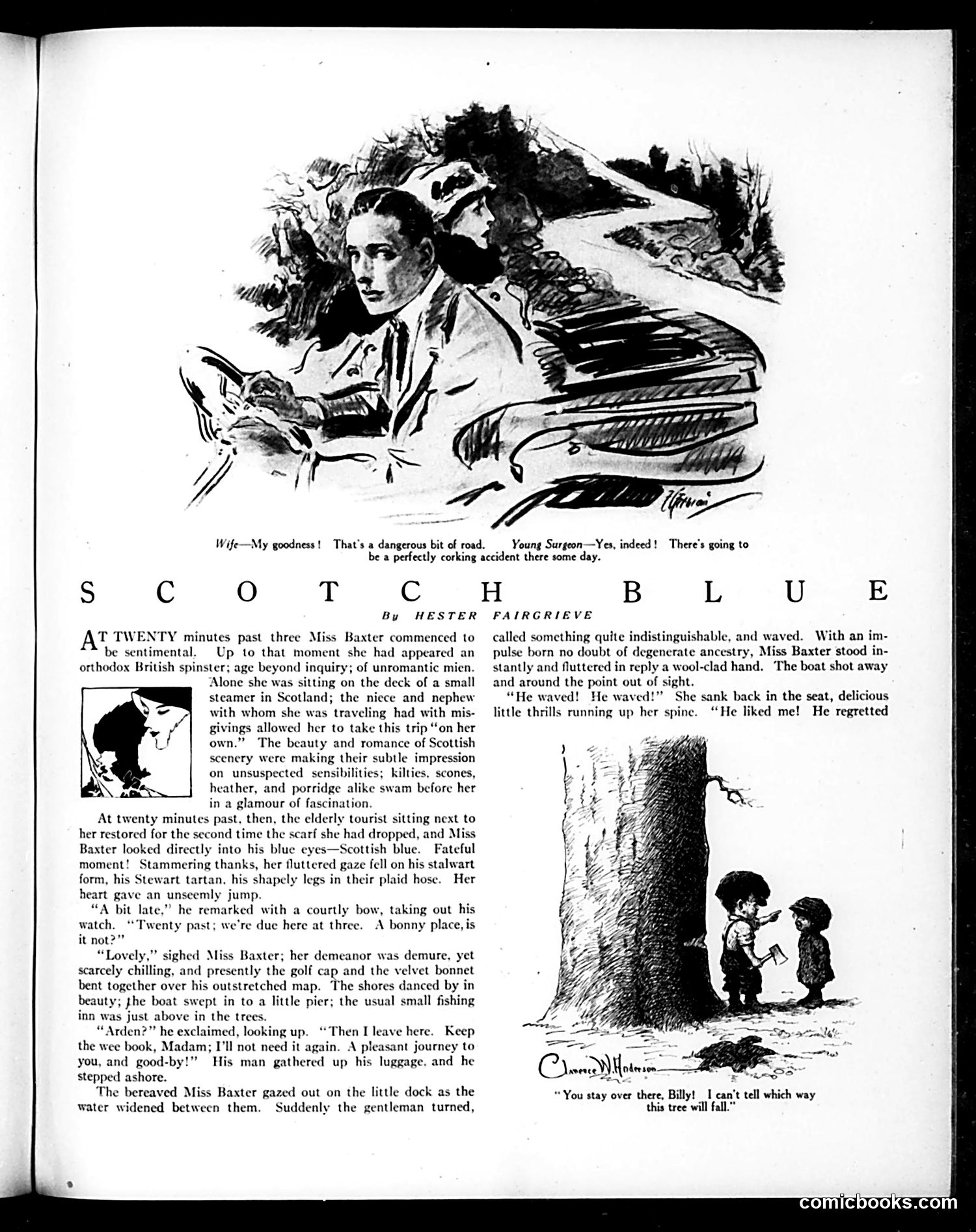
This page from Judge magazine presents a short story titled "Scotch Blue" by Hester Fairgrieve. The narrative depicts a romantic encounter between Miss Baxter and a gentleman during a Scottish steamboat journey. The story satirizes romantic sensibilities and tourist experiences rather than politics. It plays on stereotypes about Scottish scenery ("kilties, scones, heather") captivating unsuspecting British travelers. The humor derives from Miss Baxter's sentimental reaction to Scottish landscape and a chance meeting with a charming stranger, culminating in his abrupt departure with the cryptic line "I will not need it again." The accompanying illustrations complement the narrative romantically rather than critically. This appears to be light entertainment rather than political satire—typical of Judge's mixed content during this era.
📄 Transcribed text from this page (OCR, searchable)
Machine-transcribed from the original scan — historical spelling and the odd misread are preserved.
Wife—My goodness ! C O T T TWENTY minutes past three Miss Baxter commenced to be sentimental. Up to that moment she had appeared an orthodox British spinster; age beyond inquiry; of unromantic mien. Alone she was sitting on the deck of a small steamer in Scotland; the niece and nephew with whom she was traveling had with mis- givings allowed her to take this trip “on her own.” The beauty and romance of Scottish scenery were making their subtle impression on unsuspected sensibili kilt heather, and porridge alike swam before her in a glamour of fascination. At twenty minutes past, then, the elderly tourist sitting next to her restored for the second time the scarf she had dropped, and Miss Baxter looked directly into his blue Scottish blue. Fateful moment! Stammering thanks, her fluttered gaze fell on his stalwart form, his Stewart tartan, his shapely legs in their plaid hose. Her heart gave an unseemly jump. “A bit late,” he remarked with a courtly bow, taking out his watch. Twenty past; we're due here at three. A bonny place, is it not?” “Lovely,” sighed Miss Baxter; her demeanor was demure, yet scarcely chilling, and presently the golf cap and the velvet bonnet bent together over his outstretched map. The shores danced by in beauty; the boat swept in to a little pier; the usual small fishing inn was just above in the trees. “Arden?” he exclaimed, looking up. “Then I leave here. Keep the wee book, Madam; I'll not need it again. A pleasant journey to you, and good-by!” His man gathered up his luggage. and he stepped ashore. The bereaved Miss Baxter gazed out on the little dock as the water widened between them. Suddenly the gentleman turned, be a perfectly corking C HESTER S By \e.-3 That's a dangerous bit of road. Young Surgeon—Yes, indeed! There's going to accident there some day. B L U FAIRGRIEVE called something quite indistinguishable, and ved. With an im- pulse born no doubt of degenerate ancestry, Miss Baxter stood in- stantly and fluttered in reply a wool-clad hand. The boat shot away and around the point out of sight. “He waved! He waved!” She sank back in the seat, delicious little thrills running up her spine. ‘He liked me! He regretted “You stay over there, Billy! I can’t tell which way this tree will fall.”