
Judge, 1915-11-27 · page 6 of 28
Judge — November 27, 1915 — page 6: what you’re looking at
What you’re looking at
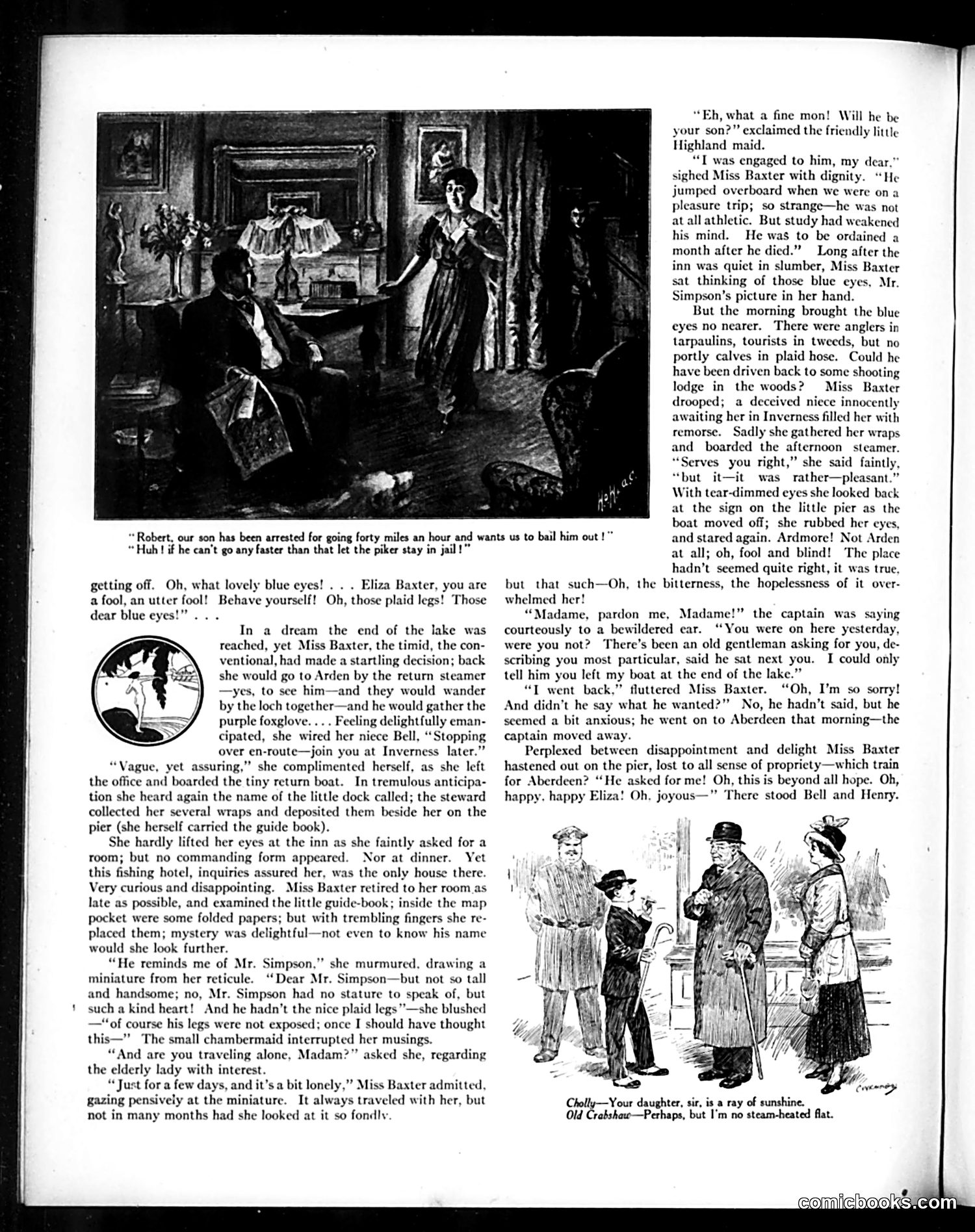
This page contains **two distinct pieces**: a brief joke and a serialized short story. **The Opening Joke** satirizes reckless driving and parental attitudes toward automotive speed. A father refuses to bail out his son arrested for doing "forty miles an hour"—suggesting it's too slow. This reflects early 1900s anxieties about automobiles and generational differences, with the humor inverting expected parental concern. **The Main Story** ("Eliza Baxter") is a romantic comedy-of-errors. An elderly spinster, Miss Baxter, travels to Scotland to reunite with a long-deceased fiancé (Mr. Simpson), sustained only by his miniature portrait. She arrives at the wrong Scottish location—Ardmore instead of Arden—and leaves disappointed when no man appears. The humor derives from her romantic delusion and the ironic twist: an old gentleman has been searching for *her*. The tale mocks sentimental spinsters while suggesting unexpected romance may still await. The accompanying illustrations show period dress and Scottish settings characteristic of early 20th-century romantic fiction serialized in magazines.
📄 Transcribed text from this page (OCR, searchable)
Machine-transcribed from the original scan — historical spelling and the odd misread are preserved.
“ Robert, our son has been arrested for going forty miles an hour and wants us to bail him out!” “Huh ! if he can’t go any faster than that let the piker stay in jail!” . . Eliza Baxter, you are Those getting off. Oh, what lovely blue eyes! . a fool, an utter fool! Beh: dear blue eyes!” . . . yourself! Oh, those plaid legs! In a dream the end of the lake was reached, yet Miss Baxter, the timid, the con- ventional, had made a startling decision; back she would go to Arden by the return steamer —yes, to see him—and they would wander by the loch together—and he would gather the purple foxglov Feeling delightfully eman- cipated, she wired her niece Bell, “Stopping over en-route—join you at Inverness later.” “Vague, yet assuring,” she complimented herself, as she left the office and boarded the tiny return boat. In tremulous anticipa- tion she heard again the name of the little dock called; the steward collected her several wraps and deposited them beside her on the pier (she herself carried the guide book). She hardly lifted her eyes at the inn ¢ faintly asked for a room; but no commanding form appeared. Nor at dinner. Yet this fishing hotel, inquiries assured her, was the only house there. Very curious and disappointing. Miss Baxter retired to her room as late as possible, and examined the little guide-book; inside the map pocket were some folded papers; but with trembling fingers she re- placed them; mystery was delightful—not even to know his name would she look further. “He reminds me of Mr. Simpson,” she murmured, drawing a miniature from her reticule. ‘Dear Mr. Simpson—but not so tall and handsome; no, Mr. Simpson had no stature to speak of, but such a kind heart! And he hadn’t the nice plaid legs’’—she blushed ~ legs were not exposed; once I should have thought this—” The small chambermaid interrupted her musings. “And are you traveling alone, Madam?” asked she, regarding the elderly lady with interest. “Just for a few days, and it’s a bit lonely,” Mis gazing pensively at the miniature. It always tra’ not in many months had she looked at it so fondly Baxter admitted, eled with her, but “Eh, what a fine mon! Will he be your son?” exclaimed the friendly little Highland maid. “T was engaged to him, my dear,” sighed Miss Baxter with dignity. “He jumped overboard when we were on a pleasure trip; so strange—he w atallathletic. But study had we: his mind. He was to be ordained a month after he died.” Long after the inn was quict in slumber, Miss Baxter sat thinking of those blue eyes, Mr. Simpson’s picture in her hand. But the morning brought the blue eyes no nearer. There were anglers in tarpaulins, tourists in tweeds, but no portly calves in plaid hose. Could he have been driven back to some shooting lodge in the woods? Miss Baxter drooped; a deceived niece innocently awaiting her in Inverness filled her with remorse. Sadly she gathered her wraps and boarded the afternoon steamer. “Serves you right,” she said faintly. put it—it was rather—pleasant. With tear-dimmed eyes she looked back at the sign on the little pier as the boat moved off; she rubbed her eyes, and stared again. Ardmore! Not Arden at all; oh, fool and blind! The place hadn’t seemed quite right, it was true, but that such—Oh, the bitterness, the hopelessness of it over- whelmed her! “Madame, pardon me, Madame!” the captain was saying courteously to a bewildered car. ‘You were on here yesterday, were you not? There’s been an old gentleman asking for you, de- scribing you most particular, said he sat next you. I could only tell him you left my boat at the end of the lake.” “T went back,” fluttered Miss Baxter. ‘Oh, I’m so sorry! And didn’t he say what he wanted?” No, he hadn’t said, but he seemed a bit anxious; he went on to Aberdeen that morning—the captain moved aw Perplexed between disappointment and delight Miss Baxter hastened out on the pier, lost to all sense of propriety—which train for Aberdeen? “He asked for me! Oh, this is beyond all hope. Oh, happy. happy Eliza! Oh. joyous—" There stood Bell and Henry. Cholly—Y our daughter, sir, is a ray of sunshine. Old Crabshaw-—Perhaps, but I'm no steam-heated flat.