
Judge, 1915-11-27 · page 18 of 28
Judge — November 27, 1915 — page 18: what you’re looking at
What you’re looking at
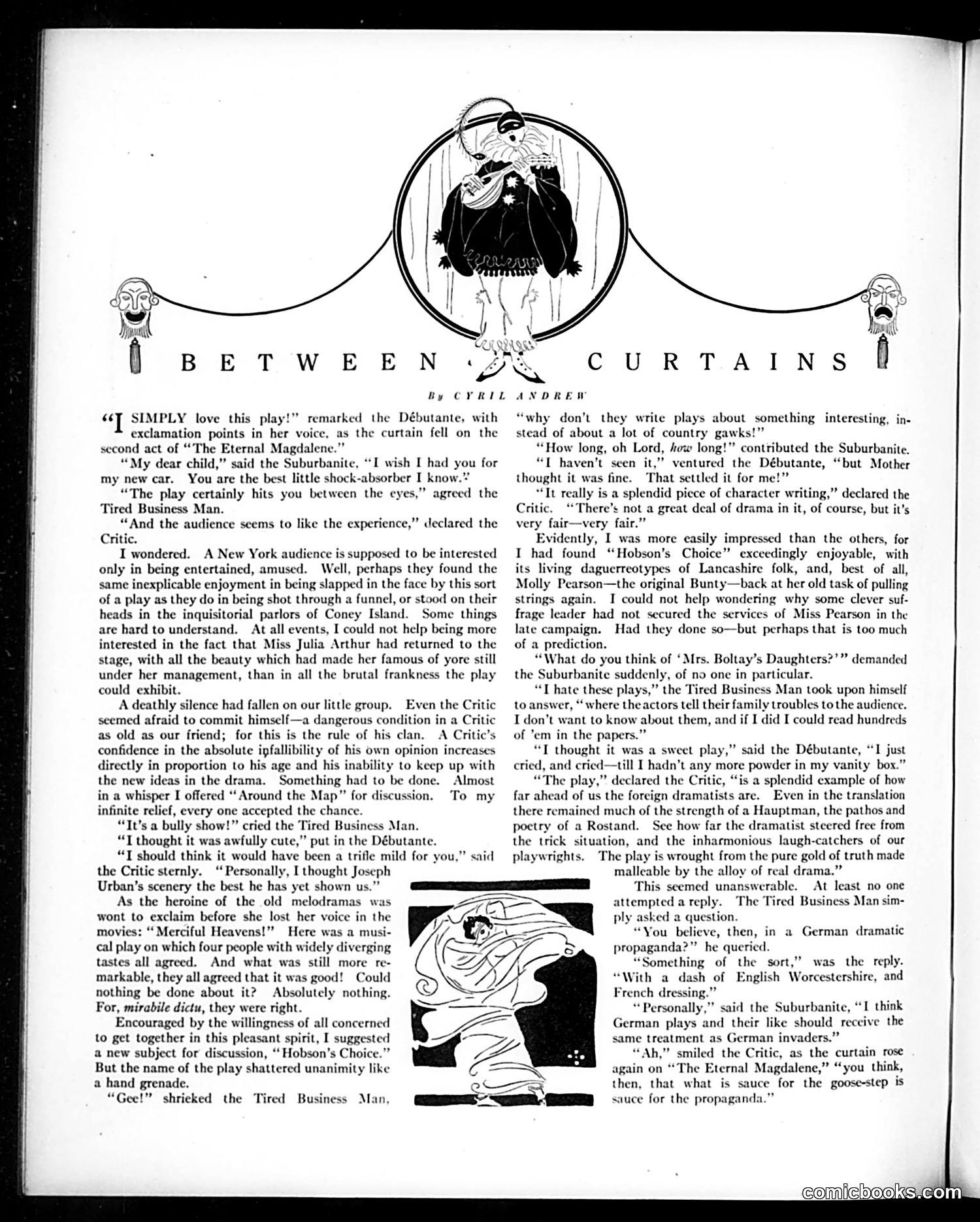
This is a theater criticism essay disguised as social satire. The author presents four stock characters—a Débutante, Suburbanite, Tired Business Man, and Critic—discussing recent Broadway plays: "The Eternal Magdalene," "Around the Map," and "Hobson's Choice." The satire targets theater audiences and critics themselves. The Critic represents pompous dramatic criticism: confidently dismissive, focused on scenery rather than substance, and increasingly opinionated with age. The other characters represent ordinary theatergoers with varied, unsophisticated tastes. The joke is that despite their different perspectives, all four unanimously praised "Around the Map"—yet the author can't explain why, suggesting audiences (and critics) often lack coherent standards for evaluation. The piece mocks both pretentious theater criticism and mass audience entertainment preferences in early 20th-century New York.
📄 Transcribed text from this page (OCR, searchable)
Machine-transcribed from the original scan — historical spelling and the odd misread are preserved.
BETWEEN By CYRIL “T SIMPLY love this play!” remarked the Débutante, with exclamation points in her voice, as the curtain fell on the second act of “The Eternal Magdalene. “My dear child,” said the Suburbanite, “I wish I had you for my new car. You are the best little shock-absorber I know.” “The play certainly hits you between the eyes,” agreed the Tired Business Man. “And the audience seems to like the experience,” declared the Critic. I wondered. A New York audience is supposed to be interested only in being entertained, amused. Well, perhaps they found the same inexplicable enjoyment in being slapped in the face by this sort of a play as they do in being shot through a funnel, or stood on their heads in the inquisitorial parlors of Coney Island. Some things are hard to understand. At all events, I could not help being more interested in the fact that Miss Julia Arthur had returned to the stage, with all the beauty which had made her famous of yore still under her management, than in all the brutal frankness the play could exhibit. A deathly silence had fallen on our little group. Even the Cri seemed afraid to commit himself—a dangerous condition in a Critic as old as our friend; for this is the rule of his clan. A Critic’s confidence in the absolute ipfallibility of his own opinion increases directly in proportion to his age and his inability to keep up with the new ideas in the drama. Something had to be done. Almost in a whisper I offered ‘‘ Around the Map” for discussion. To my infinite relief, every one accepted the chance. “Tt’s a bully show!” cried the Tired Business Man. “T thought it was awfully cute,” put in the Débutante. “T should think it would have been a trifle mild for you,’ the Critic sternly. “‘ Personally, I thought Joseph Urban’s scenery the best he has yet shown us.” As the heroine of the old melodramas was wont to exclaim before she lost her voice in the movies: “‘ Merciful Heavens!” Here was a musi- cal play on which four people with widely diverging tastes all agreed. And what was still more re- markable, they all agreed that it was good! Could nothing be done about it? Absolutely nothing. For, mirabile dictu, they were right. Encouraged by the willingnes: to get together in this pleasan' a new subject for discussion, ‘‘ Hobson’s Choice. But the name of the play shattered unanimity like a hand grenade. “Gee!” shricked * said all concerned t, I suggestec the Tired Business Man, CURTAINS ANDREN “why don’t they write plays about something interesting, in. stead of about a lot of country gawks!” “How long, oh Lord, how long!” contributed the Suburbanite. “LT haven’t seen it,” ventured the Débutante, “but Mother thought it was fine. That settled it for me!” “It really is a splendid piece of character writing,” declared the “There’s not a great deal of drama in it, of course, but it’s fair—very fair.” vidently, I was more easily impressed than the others, for I had found “Hobson’s Choice” exceedingly enjoyable, with its living daguerreotypes of Lancashire folk, and, best of all, Molly Pearson—the original Bunty—back at her old task of pulling strings again. I could not help wondering why some clever suf- frage leader had not secured the services of Miss Pearson in the late campaign. Had they done so—but perhaps that is too much of a prediction. “What do you think of ‘Mrs. Boltay’s Daughters?’ demanded uburbanite suddenly, of no one in particular. “T hate these plays,” the Tired Business Man took upon himself to answer, “where the actors tell their family troubles to the audience. I don’t want to know about them, and if I did I could read hundreds of ’em in the papers.” “T thought it was a sweet play,” said the Débutante, “I just cried, and cried—till I hadn’t any more powder in my vanity box.” “The play,” declared the Critic, “is a splendid example of how far ahead of us the foreign dramatists are. Even in the translation there remained much of the strength of a Hauptman, the pathos and poetry of a Rostand. See how far the dramatist steered free from the trick situation, and the inharmonious laugh-catchers of our The play is wrought from the pure gold of truth made malleable by the alloy of real drama.” This scemed unanswerable. At least no one attempted a reply. The Tired Business Man sim- ply asked a question. “You believe, then, in a German dramatic propaganda?” he queried. “Something of the sort,” was the reply. “With a dash of English Worcestershire, and French dressing.” “Personally,” said the Suburbanite, “I think German plays and their like should receive the same treatment as German invaders.” “Ah,” smiled the Critic, as the curtain rose again on “The Eternal Magdalene,” “you think, then, that what is sauce for the goose-step is siuce for the propaganda.” the playwrights.