
Judge, 1915-11-27 · page 24 of 28
Judge — November 27, 1915 — page 24: what you’re looking at
What you’re looking at
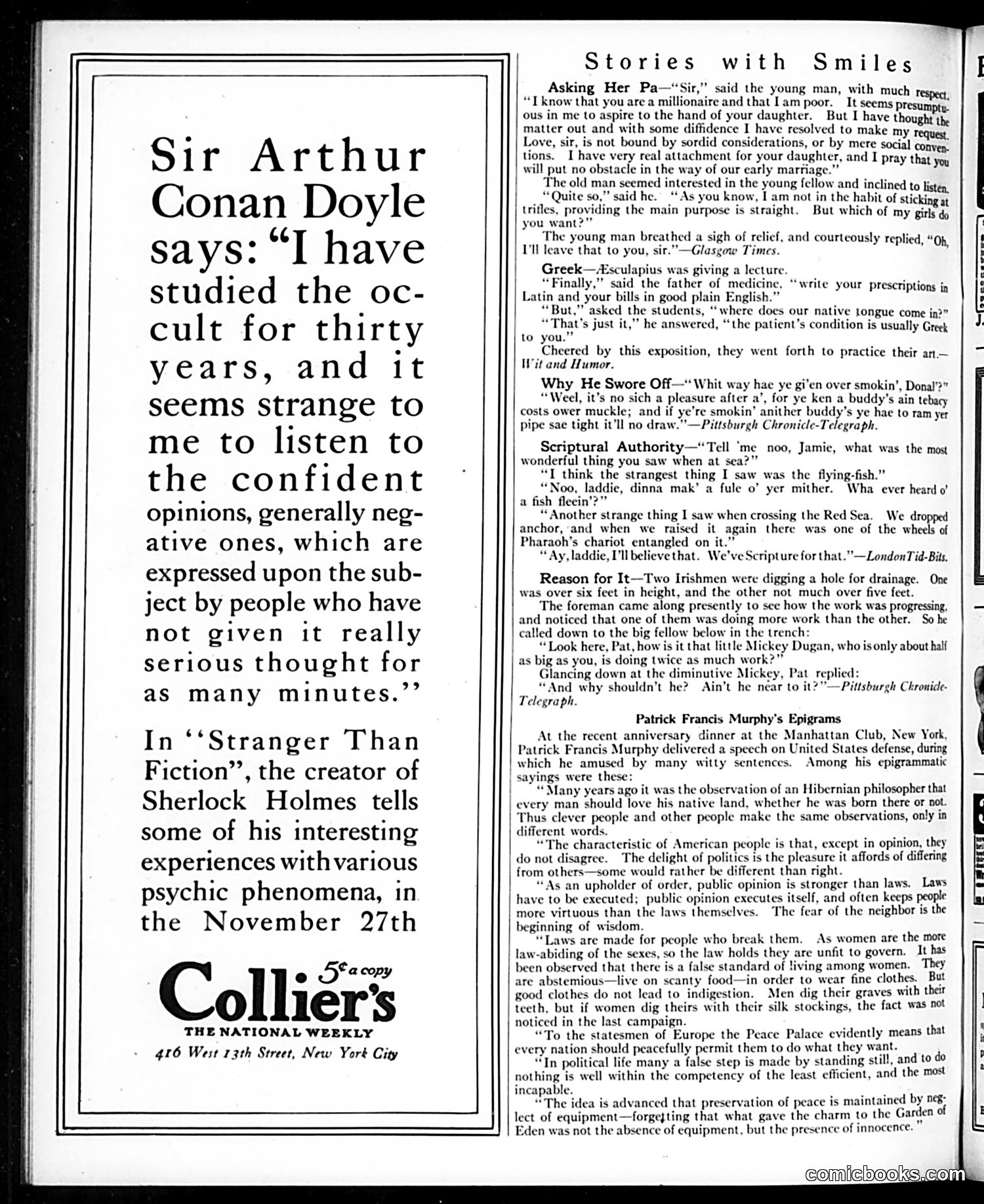
This page combines a **Collier's magazine advertisement** featuring Sir Arthur Conan Doyle with a collection of **short humorous anecdotes**. ## The Doyle Advertisement The left side promotes Doyle's article "Stranger Than Fiction" appearing November 27th in Collier's. The quote presents Doyle defending occult study against skeptics who dismiss it without serious investigation—a relevant debate for the early 20th century when spiritualism and psychic phenomena were subjects of genuine public interest and intellectual dispute. ## The Humor Section ("Stories with Smiles") The right side contains brief jokes exploiting linguistic and cultural stereotypes: Irish characters ("Pat," "Mickey Dugan"), Scottish dialect ("Weel"), and working-class speech patterns. The humor typically derives from misunderstandings, double meanings, or characters displaying naiveté (the son indifferent about which daughter he'll marry; the sailor's absurd claim about Pharaoh's chariot). **For modern readers:** The occult reference remains recognizable, but the ethnic stereotyping and dialect humor reflect outdated comedic conventions.
📄 Transcribed text from this page (OCR, searchable)
Machine-transcribed from the original scan — historical spelling and the odd misread are preserved.
Sir Arthur Conan Doyle says: “I have studied the oc- cult for thirty years, and it seems strange to me to listen to the confident opinions, generally neg- ative ones, which are expressed upon the sub- ject by people who have not given it really serious thought for as many minutes.’’ In ‘‘Stranger Than Fiction’’, the creator of Sherlock Holmes tells some of his interesting experiences with various psychic phenomena, in the November 27th C I el “6 oilier's THE NATIONAL WEEKLY 426 West 13th Street, New York City Stories with Smiles Asking Her Pa—‘Sir,” said the young man, with much “T know that you area millionaire and that Lam poor. It seems Presumpty. ous in me to aspire to the hand of your daughter. But I have thought te matter out and with some diffidence I have resolved to make my reques, Love, sir, is not bound by sordid considerations, or by mere social conven. tions. I have very real attachment for your daughter, and I pray that will put no obstacle in the way of our early marriage.” = The old man seemed interested in the young fellow and inclined to listen, “Quite so,” said he. “As you know, I am not in the habit of Sticking at s ig the main purpose is straight. But which of my girls do you want?” The young man breathed a sigh of relief, and courteously replied, “Oh, | I'll leave that to you, sir.” —Glasgow Times. English. the students, “where does our native Longue come in?” »” he answered, “the patient’s condition is usually Greek Cheered by this exposition, they went forth to practice their an— Wit and Humor. Why He Swore Off—‘ Whit way hae ye gi’en over smokin’, “Weel, it’s no sich a pleasure after a’, for ye ken a buddy’s aii costs ower muckle; and if ye’re smokin’ anither buddy’s ye hae to ram yer pipe sae tight it'll no draw." —Pittsburgh Chronicle-Telegraph. Scriptural Authority—‘Tell ‘me noo, Jamie, what was the most wonderful thing you saw when at sea?” think the strangest thing I saw was the flying-fish.” Noo, laddie, dinna mak’ a fule o' yer mither. Wha ever heard o’ a fish fleein’?” “Another strange thing I saw when crossing the Red Sea. We dropped anchor, and when we raised it again there was one of the wheels of Pharaoh’s chariot entangled on it.” “ Ay, laddie, I'll believe that. We've Scripture for that.” —LondonTid-Bits, Reason for It—Two Irishmen were digging a hole for drainage. One was over six feet in height, and the other not much over five feet. The foreman came along presently to see how the work was progressing, and noticed that one of them was doing more work than the other. So he called down to the big fellow below in the trench: “Look here, Pat, how is it that little Mickey Dugan, who is only about half as big as you, is doing twice as much work?” Glancing down at the diminutive Mick at replied: “And why shouldn’t he? Ain't he near to -Pittsburgh Chronide- Telegraph. Patrick Francis Murphy’s Epigrams At the recent anniversary dinner at the Manhattan Club, New York, Patrick Francis Murphy delivered a speech on United States defense, during | which he amused by many witty sentences. Among his epigrammatic sayings were these: Many years ago it was the observation of an Hibernian philosopher that every man should love his native land, whether he was born there or not. Thus clever people and other people make the same observations, only in different words. “The characteristic of American people is that, except in opinion, they do not disagree. The delight of politics is the pleasure it affords of differing from others—some would rather be different than right. “As an upholder of order, public opinion is stronger than laws, Laws have to be executed; public opinion executes itself, and often keeps people more virtuous than the laws themselves. The fear of the neighbor is the beginning of wisdom. “Laws are made for people who break them. As women are the more g of the sexes, so the law holds they are unfit to govern. It has been observed that there is a false standard of living among women. They in order to wear fine clothes. But good clothes do not lead to indigestion. Men dig their graves with their teeth, but if women dig theirs with their silk stockings, the fact was not noticed in the last campaign. “To the statesmen of Europe the Peace Palace evidently means that every nation should peacefully permit them to do what they want. “In political life many a false step is made by standing still, and to do nothing is well within the competency of the least efficient, and the most incapable : “The id advanced that preservation of peace is maintained by bs lect of equipment—forgejting that what gave the charm to the Garden Eden was not the absence of equipment, but the presence of innocence.