
Judge, 1915-11-27 · page 13 of 28
Judge — November 27, 1915 — page 13: what you’re looking at
What you’re looking at
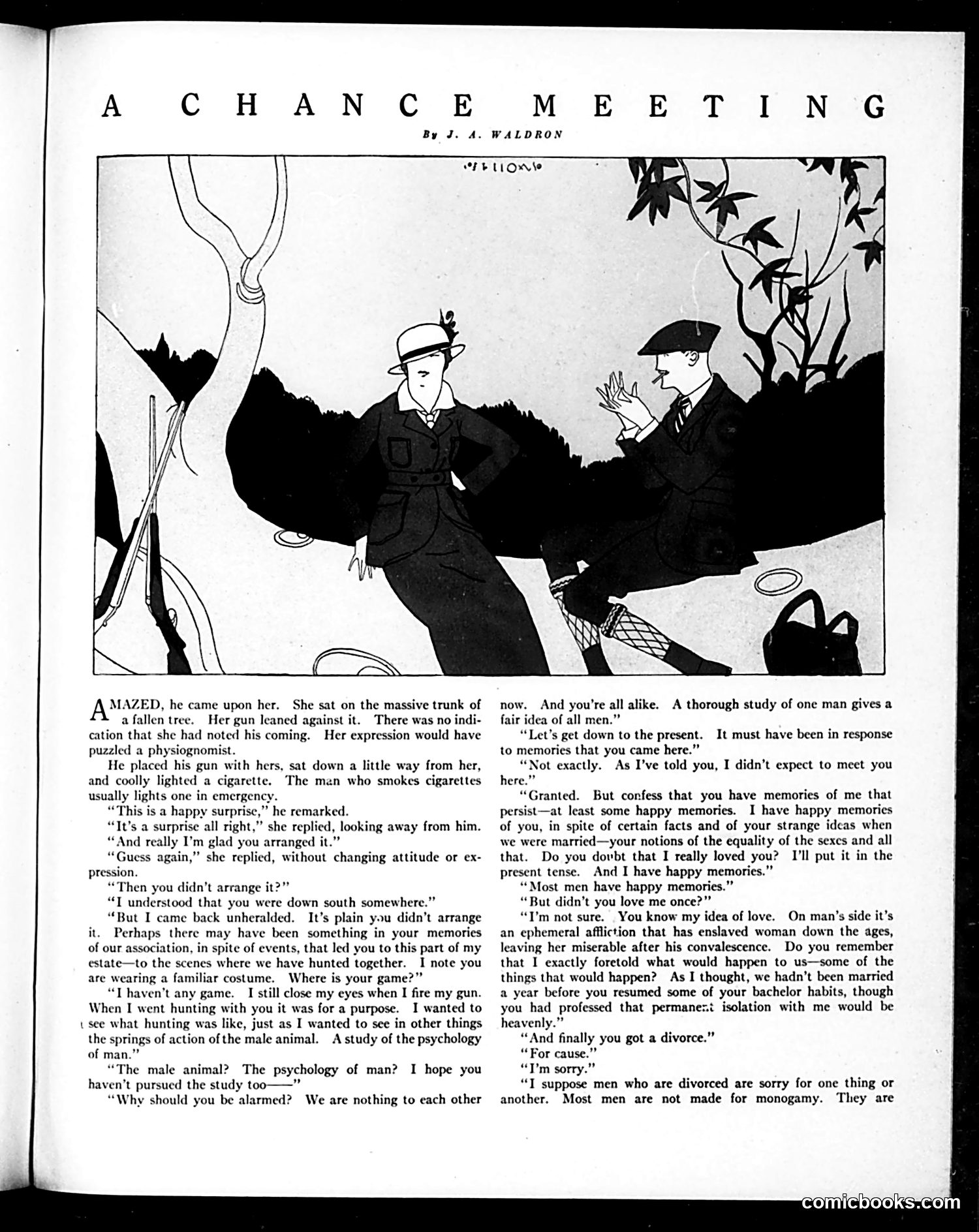
This story-cartoon depicts a chance encounter between ex-spouses hunting on the man's estate. The woman, dressed in hunting attire, initially claims she didn't arrange the meeting, but the man suspects her presence among their former hunting grounds isn't coincidental. The satire targets early 20th-century gender politics and marriage. The woman is portrayed as an intellectual who studied men "scientifically" and held progressive views on sexual equality—ideas the text presents as naive or troubling. The man represents traditional masculinity: he assumes her reappearance means lingering affection, dismisses her feminist notions, and admits his own infidelity. The story's cynicism suggests the era's skepticism toward women's independence and equality arguments. The woman's rationalization of love as "ephemeral affliction" enslaving women, and her prediction that the man would resume "bachelor habits," frames her as both prescient and embittered—vindicating the satirist's apparent view that modern women's expectations are unrealistic.
📄 Transcribed text from this page (OCR, searchable)
Machine-transcribed from the original scan — historical spelling and the odd misread are preserved.
C H AN C E By J. A. MAZED, he came upon her. She sat on the massive trunk of a fallen tree. Her gun leaned against it. There was no indi- cation that she had noted his coming. Her expression would have puzzled a physiognomist. He placed his gun with hers, sat down a little way from her, and coolly lighted a cigarette. The man who smokes cigarettes usually lights one in emergency. “This is a happy surprise,” he remarked. “It’s a surprise all right,” she replied, looking away from him. “And really I'm glad you arranged it.” “Guess again,” she replied, without changing attitude or ex- pression. “Then you didn’t arrange it?” “T understood that you were down south somewhere.” “But I came back unheralded. It’s plain you didn’t arrange it. Perhaps there may have been something in your memories of our association, in spite of events, that led you to this part of my estate—to the scenes where we have hunted together. I note you are wearing a familiar costume. Where is your game?” “T haven't any game. I still close my eyes when I fire my gun. When I went hunting with you it was for a purpose. I wanted to . see what hunting was like, just as I wanted to see in other things the springs of action of the male animal. A study of the psychology of man.”” “The male animal? The psychology of man? haven’t pursued the study too—” “Why should you be alarmed? I hope you We are nothing to each other M E E T WALDRON N now. And you're all alike. A thorough study of one man gives a fair idea of all men.” “Let’s get down to the present. to memories that you came here.” Not exactly. As I’ve told you, I didn’t expect to meet you here.” “Granted. But confess that you have memories of me that persist—at least some happy memories. I have happy memories of you, in spite of certain facts and of your strange ideas when we were married—your notions of the equality of the sexes and all that. Do you dovbt that I really loved you? I'll put it in the present tense. And I have happy memories.” “Most men have happy memories.” “But didn’t you love me once?” “T’m not sure. You know my idea of love. On man’s side it’s an ephemeral affliction that has enslaved woman down the ages, leaving her miserable after his convalescence. Do you remember that I exactly foretold what would happen to us—some of the things that would happen? As I thought, we hadn’t been married a year before you resumed some of your bachelor habits, though you had professed that permane:t isolation with me would be heavenly.” “And finally you got a divorce.” “For cause.” “D'm sorry.” “T suppose men who are divorced are sorry for one thing or another. Most men are not made for monogamy. They are It must have been in response