
Judge, 1915-11-27 · page 11 of 28
Judge — November 27, 1915 — page 11: what you’re looking at
What you’re looking at
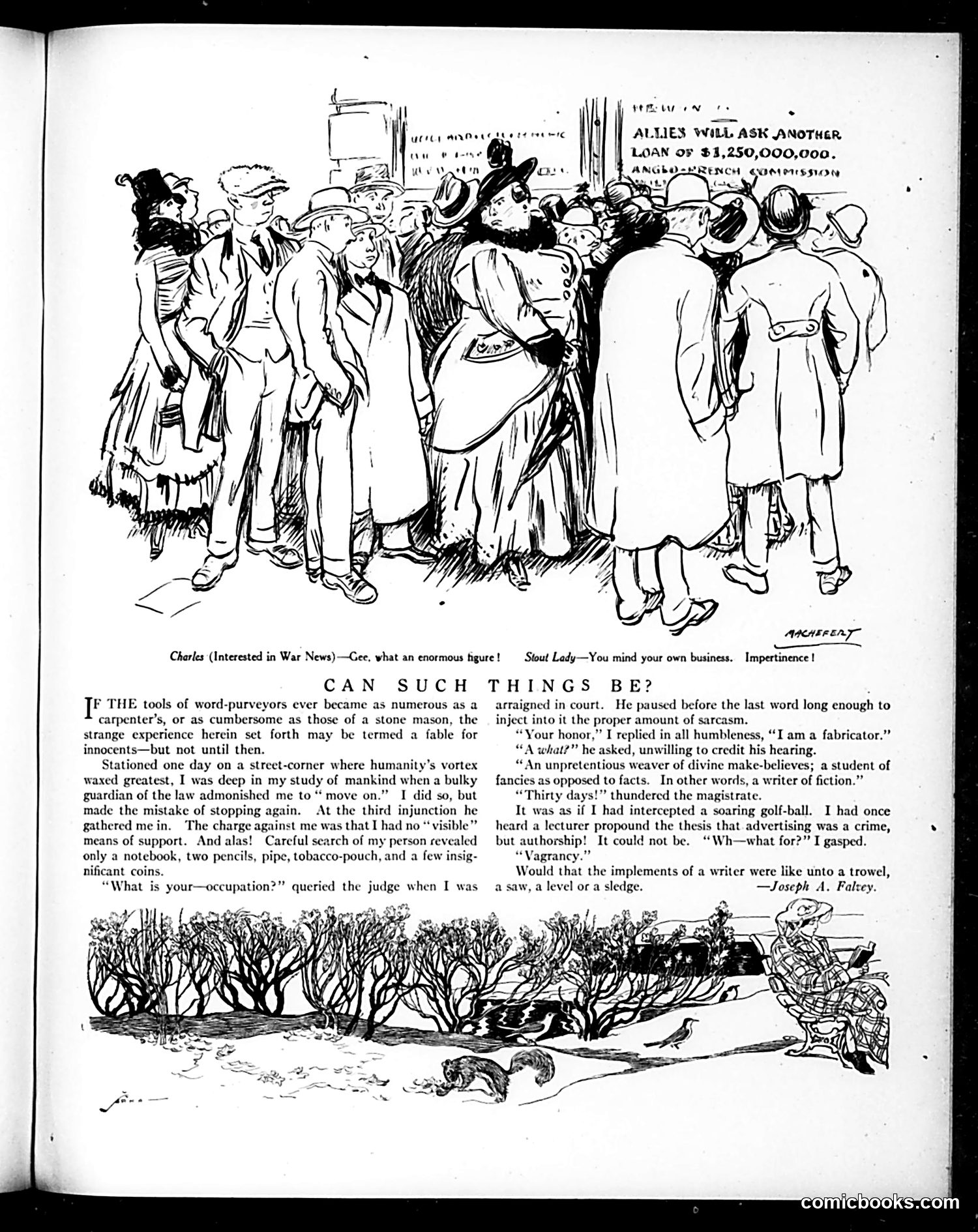
**Top Cartoon:** This satirical scene depicts public reaction to Allied war financing. The headline announces the Allies requesting another $3.25 billion loan. A man ("Charles") comments on a woman's "enormous figure," but she sharply rebuffs him—the joke being that her size actually represents the massive financial burden of sustaining World War I. The cartoon mocks both citizens' obliviousness to wartime costs and the audacity of repeated loan requests from Britain and France to American lenders. **Main Story ("Can Such Things Be?"):** A writer is arrested for "vagrancy" because he lacks visible means of support—possessing only a notebook and pencils. The judge sentences him to thirty days, calling authorship essentially criminal idleness ("vagrancy"). The satire critiques society's failure to recognize intellectual labor as legitimate work, contrasting writers' intangible tools with carpenters' or masons' tangible equipment.
📄 Transcribed text from this page (OCR, searchable)
Machine-transcribed from the original scan — historical spelling and the odd misread are preserved.
Charles (Interested in War News)—Gee, what an enormous figure ! J remeron re A ALLIES WILL ASK ANOTHER LOAN oF $3,250,000,000. ANGLO-KRENCH IOUS SAD Ne ora AKHE FER Stout Lady—You mind your own business. Impertinence ! CAN SUCH THINGS BE? IF THE tools of word-purveyors ever became as numerous as a carpenter’s, or as cumbersome as those of a stone mason, the strange experience herein set forth may be termed a fable for innocents—but not until then. Stationed one day on a street-corner where humanity’s vortex waxed greatest, I was deep in my study of mankind when a bulky guardian of the law admonished me to“ move on.” I did so, but made the mistake of stopping again. At the third injunction he gathered mein. The charge against me was that I had no “visible” means of support. And alas! Careful search of my person revealed only a notebook, two pencils, pipe, tobacco-pouch, and a few insig- nificant coins. “What is your—occupation?” queried the judge when I was Ky hs / ( We: ' BA AY a arraigned in court. He paused before the last word long enough to inject into it the proper amount of sarcasm. “Your honor,” I replied in all humbleness, “I am a fabricator.” “A what?” he asked, unwilling to credit his hearing. “An unpretentious weaver of divine make-believes; a student of fancies as opposed to facts. In other words, a writer of fiction.” “Thirty days!” thundered the magistrate. It was as if I had intercepted a soaring golf-ball. I had once heard a lecturer propound the thesis that advertising was a crime, but authorship! It could not be. “Wh—what for?” I gasped. “Vagrancy.” Would that the implements of a writer were like unto a trowel, a saw, a level or a sledge. —Joseph A. Falvey. ye ee,