
Judge, 1915-11-27 · page 10 of 28
Judge — November 27, 1915 — page 10: what you’re looking at
What you’re looking at
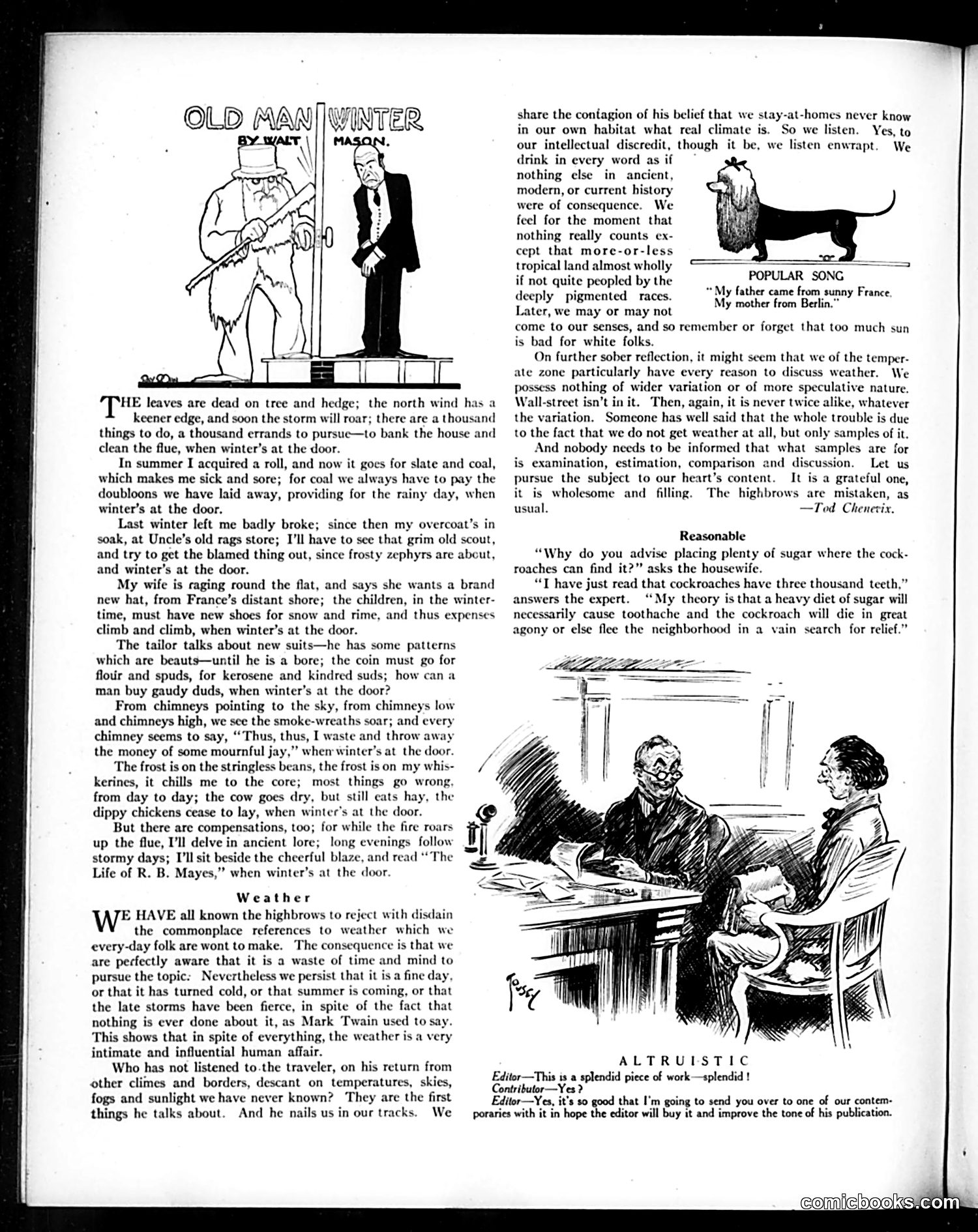
This page contains Walt Mason's poem "Old Man Winter," a humorous lament about winter's financial and domestic burdens. The cartoon at top left depicts "Old Man Winter" as a ragged, menacing figure confronting a well-dressed gentleman—contrasting poverty with comfortable living. The poem catalogs winter's expenses: coal, new clothes, children's shoes, wife's fashions from France. Mason uses repetition ("when winter's at the door") to emphasize the seasonal hardship's relentless return. The satire targets middle-class anxieties about maintaining appearances and comfort during winter months while managing limited budgets. The accompanying essay "Weather" mocks highbrow intellectuals who dismiss casual weather discussion, yet the author argues weather is legitimately important—especially in temperate zones where conditions vary unpredictably. There's subtle social commentary: the reference to "tropical land...peopled by the deeply pigmented races" reflects era-typical racial assumptions about climate and civilization. The bottom illustration shows an editor-contributor exchange about the quality of the work—likely self-referential Judge humor.
📄 Transcribed text from this page (OCR, searchable)
Machine-transcribed from the original scan — historical spelling and the odd misread are preserved.
THE leaves are dead on tree and hedge; the north wind has a keener edge, and soon the storm will roar; there are a thousand things to do, a thousand errands to pursue—to bank the house and clean the flue, when winter’s at the door. In summer I acquired a roll, and now it goes for slate and coal, which makes me sick and sore; for coal we always have to pay the doubloons we have laid away, providing for the rainy day, when winter’s at the door. Last winter left me badly broke; since then my overcoat’s in soak, at Uncle’s old rags store; I'll have to see that grim old scout, and try to get the blamed thing out, since frosty zephyrs are about, and winter’s at the door. My wife is caging round the flat, and says she wants a brand new hat, from France’s distant shore; the children, in the winter- time, must have new shoes for snow and rime, and thus expenses climb and climb, when winter’s at the door. The tailor talks about new suits—he has some patterns which are beauts—until he is a bore; the coin must go for flour and spuds, for kerosene and kindred suds; how can a man buy gaudy duds, when winter’s at the door? From chimneys pointing to the sky, from chimneys low and chimneys high, we sce the smoke-wreaths soar; and every chimney seems to say, “Thus, thus, I waste and throw away the money of some mournful jay,” wher winter’s at the door. The frost is on the stringless beans, the frost ison my whis- kerines, it chills me to the core; most things go wrong, from day to day; the cow goes dry, but still cats hay, the dippy chickens cease to lay, when win’ at the door. But there are compensations, too; for while the fire roars up the flue, I’ll delve in ancient lore; long evenings follow stormy days; I’ll sit beside the cheerful blaze, and read ‘The Life of R. B. Mayes,” when winter’s at the door. E HAVE all known the highbrows to reject with disdain the commonplace references to weather which we every-day folk are wont to make. The consequence is that we are perfectly aware that it is a waste of time and mind to pursue the topic: Nevertheless we persist that it is a fine day, or that it has turned cold, or that summer is coming, or that the late storms have been fierce, in spite of the fact that nothing is ever done about it, as Mark Twain used to say. This shows that in spite of everything, the weather is a very intimate and influential human affai Who has not listened to.the traveler, on his return from other climes and borders, descant on temperatures, skies, fogs and sunlight we have never known? They are the first things he talks about. And he nails us in our tracks. We share the contagion of his belief that we sta: -homes never know in our own habitat what real climate is. So we listen. Yes, to our intellectual discredit, though it be, we listen enwrapt. We drink in every word as if nothing else in ancient, modern, or current history were of consequence. We feel for the moment that nothing really counts ex- cept that more-or-less tropical land almost wholly if not quite peopled by the deeply pigmented _ races. Later, we may or may not come to our senses, and so remember or forget that too much sun is bad for white folks. On further sober reflection, it might seem that we of the temper- ate zone particularly have every reason to discuss weather. We possess nothing of wider variation or of more speculative nature, Wall-street isn’t in it. Then, again, it is never twice alike, whatever the variation. Someone has well said that the whole trouble is due to the fact that we do not get weather at all, but only samples of it. And nobody needs to be informed that what samples are for is examination, estimation, comparison and discussion. Let us pursue the subject to our heart’s content. It is a grateful one, it is wholesome and filling. The highbrows are mistaken, as usual. —Tod Chenevix. POPULAR SONG “ My father came from sunny France. My mother from Berlin.” Reasonable “Why do you advise placing plenty of sugar where the cock- roaches can find it?” asks the housewife. “T have just read that cockroaches have three thousand teeth,” answers the expert. ‘My theory is that a heavy diet of sugar will necessarily cause toothache and the cockroach will die in great agony or else flee the neighborhood in a vain search for relief.” ALTRUISTIC Editor—This is a splendid piece of work—splendid ! Contributor —Yes ? Edditor—Yes, it’s s0 good that I'm going to send you over to one of our contem- poraries with it in hope the editor will buy it and improve the tone of his publication.