
Judge, 1915-11-27 · page 27 of 28
Judge — November 27, 1915 — page 27: what you’re looking at
What you’re looking at
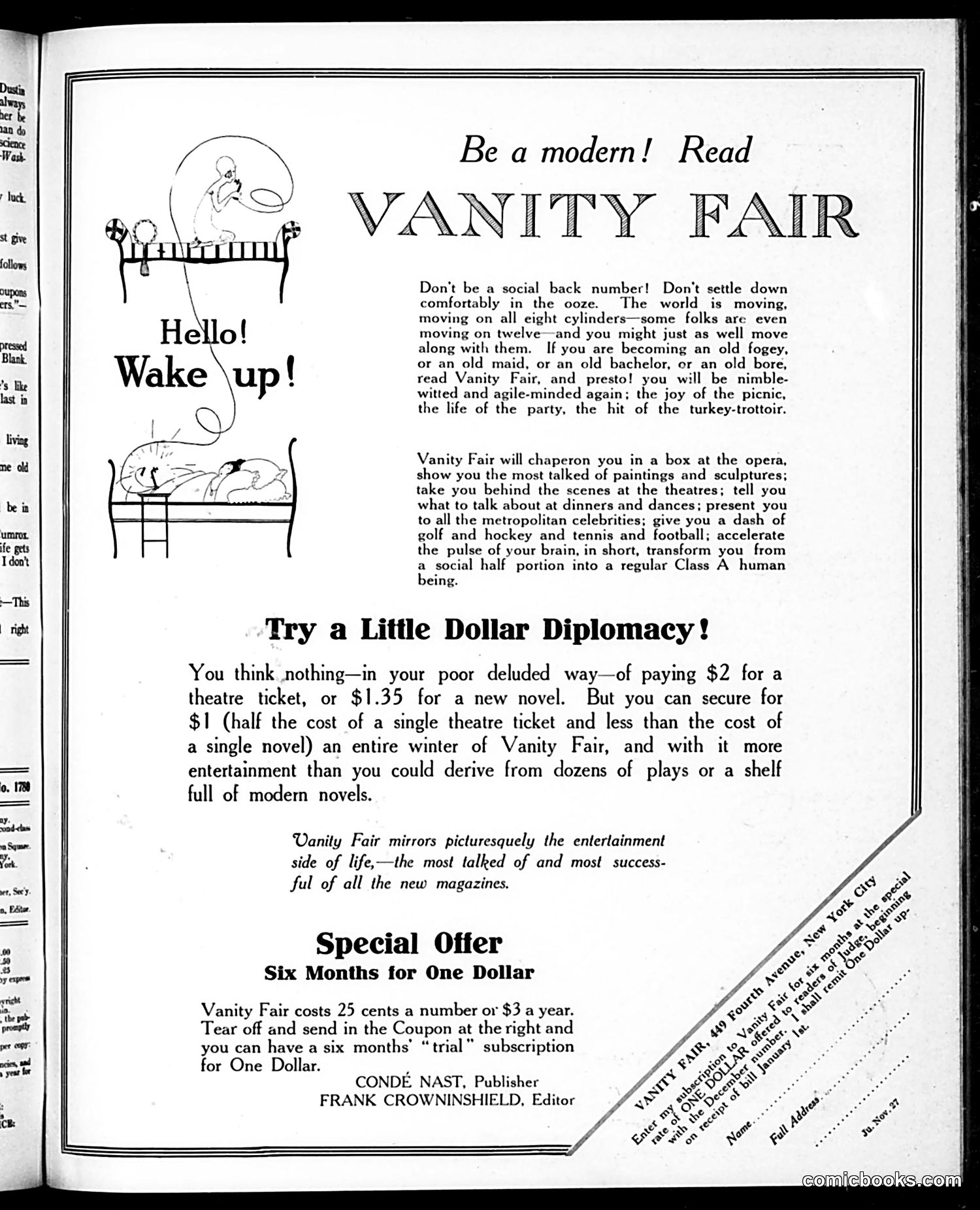
This is a **full-page advertisement** for *Vanity Fair* magazine, not political satire. The cartoon imagery (showing someone sleeping/waking) is decorative rather than satirical. The ad's humor targets **social anxiety and self-improvement anxieties** of the era. It warns readers against becoming "social back numbers"—outdated, boring people. References like "old fogey," "old maid," "old bachelor," and "turkey-trottoir" (a dance) signal early 20th-century concerns about appearing modern and socially relevant. The pitch emphasizes *Vanity Fair's* role as a **cultural guide**: teaching readers what to discuss at dinners, which artworks matter, which celebrities to know. The "dollar diplomacy" section uses self-deprecating humor, mocking readers' spending habits to justify the magazine's bargain price. The underlying message reflects **1920s aspirational marketing**—that reading the right magazine transforms you from a "social half portion" into a "Class A human being," reflecting period anxieties about status and cultural sophistication.
📄 Transcribed text from this page (OCR, searchable)
Machine-transcribed from the original scan — historical spelling and the odd misread are preserved.
Be a modern! Read VANITY FAIR Don't be a social back number! Don't settle down comfortably in the ooze. The world is moving, moving on all eight cylinders—some folks are even moving on twelve—and you might just as well move along with them. If you are becoming an old fogey, or an old maid, or an old bachelor, or an old bore, read Vanity Fair, and presto! you will be nimble- witted and agile-minded again; the joy of the picnic, the life of the party, the hit of the turkey-trottoir. Vanity Fair will chaperon you in a box at the opera, show you the most talked of paintings and sculptures; take you behind the scenes at the theatres; tell you what to talk about at dinners and dances; present you to all the metropolitan celebrities; give you a dash of golf and hockey and tennis and football; accelerate the pulse of your brain, in short, transform you from a social half portion into a regular Class A human being. Try a Little Dollar Diplomacy! You think nothing—in your poor deluded way—of paying $2 for a theatre ticket, or $1.35 for a new novel. But you can secure for $1 (half the cost of a single theatre ticket and less than the cost of a single novel) an entire winter of Vanity Fair, and with it more entertainment than you could derive from dozens of plays or a shelf full of modern novels. Vanity Fair mirrors picturesquely the entertainment side of life,—the most talked of and most success- ful of all the new magazines. Special Offer Six Months for One Dollar Vanity Fair costs 25 cents a number or $3 a year. Tear off and send in the Coupon at the right and you can have a six months’ “trial” subscription for One Dollar. : CONDE NAST, Publisher FRANK CROWNINSHIELD, Editor