
Judge, 1915-11-27 · page 20 of 28
Judge — November 27, 1915 — page 20: what you’re looking at
What you’re looking at
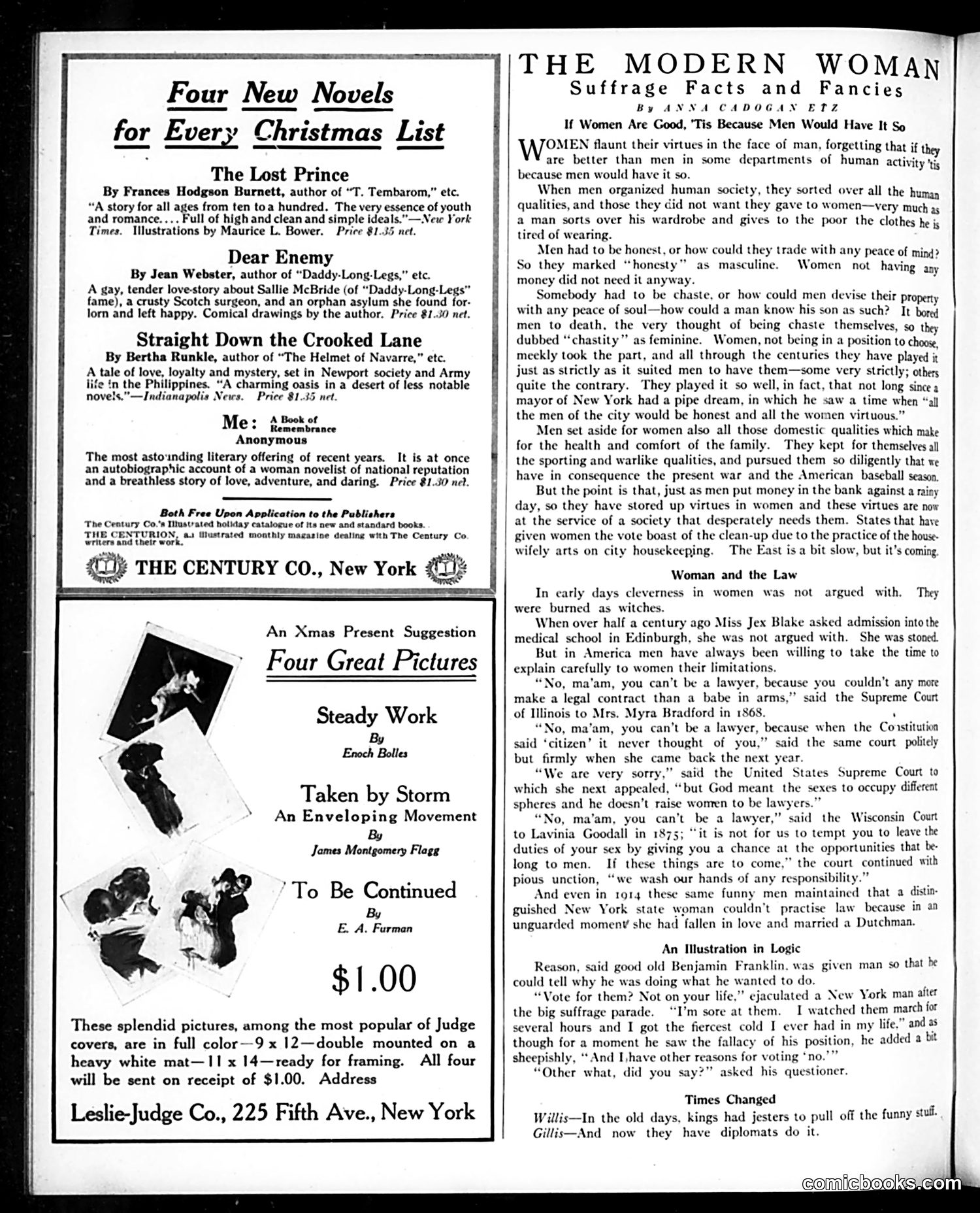
This page contains book advertisements and a satirical essay on women's rights. The left side promotes four novels as Christmas gifts, including works by Frances Hodgson Burnett and Jean Webster. Below are picture prints by Judge cover artists like James Montgomery Flagg. The right side features "The Modern Woman: Suffrage Facts and Fancies" by Anna Cadogan Etz—a sharp satirical critique of gender inequality. The author argues that women's virtues (honesty, chastity, domesticity) aren't inherently feminine but were *assigned* by men who needed them for social order. She sarcastically notes men kept for themselves "sporting and warlike qualities," resulting in war and baseball obsession. The essay mocks male hypocrisy: men demand women be chaste while reserving freedom for themselves. This is suffrage-era advocacy disguised as humor, exposing how patriarchal society constructed "feminine virtue" as convenient social control rather than genuine female nature.
📄 Transcribed text from this page (OCR, searchable)
Machine-transcribed from the original scan — historical spelling and the odd misread are preserved.
Four New Novels for Every Christmas List The Lost Prince By Frances Hodgson Burnett, author of “T. Tembarom,” etc. “A story for all ages from ten toa hundred. The very essence of youth and romance.... Full of high and clean and simple ideals.” —New York Times. Illustrations by Maurice L. Bower. Price $1.35 net. Dear Enemy By Jean Webster, author of “Daddy-Long-Legs,” etc. A gay, tender love-story about Sallie McBride (of “Daddy-Long-Legs” fame), a crusty Scotch surgeon, and an orphan asylum she found for- lorn and left happy. Comical drawings by the author. Price 81.30 net. Straight Down the Crooked Lane By Bertha Runkle, author of “The Helmet of Navarre,” etc. A tale of love, loyalty and mystery, set in Newport society and Army lik the Philippines. “A charming oasis in a desert of less notable novels.”—Indianapolis News. Price 81.35 net. A Book of Me: femchitiace Anonymous The most astounding literary offering of recent years. It is at once an autobiographic account of a woman novelist of national reputation and a breathless story of love, adventure, and daring. Price $1.30 nel. Both Free Upon Application to the Publishers ‘The Century Co."s Illustrated holiday catalogue of its new and standard books. THE CENTURION, a. illustrated monthly magazine dealing with The Century Co. writers and their work. (ilk THE CENTURY CO., New York #1) An Xmas Present Suggestion Four Great Pictures Steady Work By Enoch Bolles Taken by Storm An Enveloping Movement By James Montgomery Flagg ’To Be Continued By E. A. Furman $1.00 These splendid pictures, among the most popular of Judge covers, are in full color—9 x 12—double mounted on a heavy white mat—11 x 14—ready for framing. All four will be sent on receipt of $1.00. Address Leslie-Judge Co., 225 Fifth Ave., New York THE MODERN WOMAN Suffrage Facts and Fancies By ANNA CADOGAN ETZ If Women Are Good, 'Tis Because Men Would Have It So OMEN flaunt their virtues in the face of man, forgetting that if they are better than men in some departments of human activity ‘tis because men would have it so. When men organized human society, they sorted over all the human | qualities, and those they did not want they gave to women—very much as | a man sorts over his wardrobe and gives to the poor the clothes he is tired of wearing. Men had to be honest, or how could they trade with any peace of mind? So they marked “honesty” as masculine. Women not having any | money did not need it anyway. Somebody had to be chaste, or how could men devise their Property with any peace of soul—how could a man know his son as such? It bored men to death, the very thought of being chaste themselves, so they dubbed “chastity” as feminine. Women, not being in a position to choos, meckly took the part, and all through the centuries they have played it just as strictly as it suited men to have them—some very strictly; others quite the contrary. They played it so well, in fact, that not long since a mayor of New York had a pipe dream, in which he saw a time when “all the men of the city would be honest and all the women virtuous.” Men set aside for women also all those domestic qualities w make for the health and comfort of the family. They kept for themselves all the sporting and warlike qualities, and pursued them so diligently that we have in consequence the present war and the American baseball season, But the point is that, just as men put money in the bank against a rainy day, so they have stored up virtues in women and these virtues are now at the service of a society that desperately needs them. States that have given women the vote boast of the clean-up due to the practice of the house- wifely arts on city housekeeping. The East is a bit slow, but it’s coming. Woman and the Law In carly days cleverness in women was not were burned as witches. When over half a century ago Miss Jex Blake asked admission into the medical school in Edinburgh, she was not argued with. She was stoned. But in America men have always been willing to take the time to explain carefully to women their limitations. “No, ma’am, you can’t be a lawyer, becau: ‘ou couldn’t any more make a legal contract than a babe in arms,” 1 the Supreme Court of Illinois to Mrs. Myra Bradford in 1868. ’ “No, ma’am, you can’t be a lawyer, because when the Constitution ’ it never thought of you,” said the same court politely but firmly when she came back the next year. “We are very sorr} said the United States Supreme Court to which she next appealed, “but God meant the sexes to occupy different spheres and he doesn’t raise women to be lawyers. ‘0, ma'am, you can’t be a lawyer,” said the Wisconsin Court to Lavinia Goodall in 1875; “it is not for us to tempt you to leave the duties of your sex by giving you a chance at the opportunities that be long to men. If these things are to come,” the court continued with pious unction, “we wash our hands of any responsibility.” F And even in rorg these same funny men maintained that a distin- guished New York state woman couldn't practise law because in an unguarded momenv¥ she had fallen in love and married a Dutchman. argued with. They An Illustration in Logic Reason, said good old Benjamin Franklin, was given man so that be could tell why he was doing what he wanted to do. “Vote for them? Not on your li ejaculated a New York man after the big suffrage parade. “I’m sore at them. I watched them march for several hours and I got the fiercest cold I ever had in my life.” and as though for a moment he saw the fallacy of his position, he added a bit sheepishly, “And I,have other reasons for voting ‘no.’”” “Other what, did you sa asked his questioner. Times Changed “ Willis—In the old days, kings had jesters to pull off the funny sul Gillis—And now they have diplomats do it.