
A complete issue · 52 pages · 1910
Judge — December 3, 1910
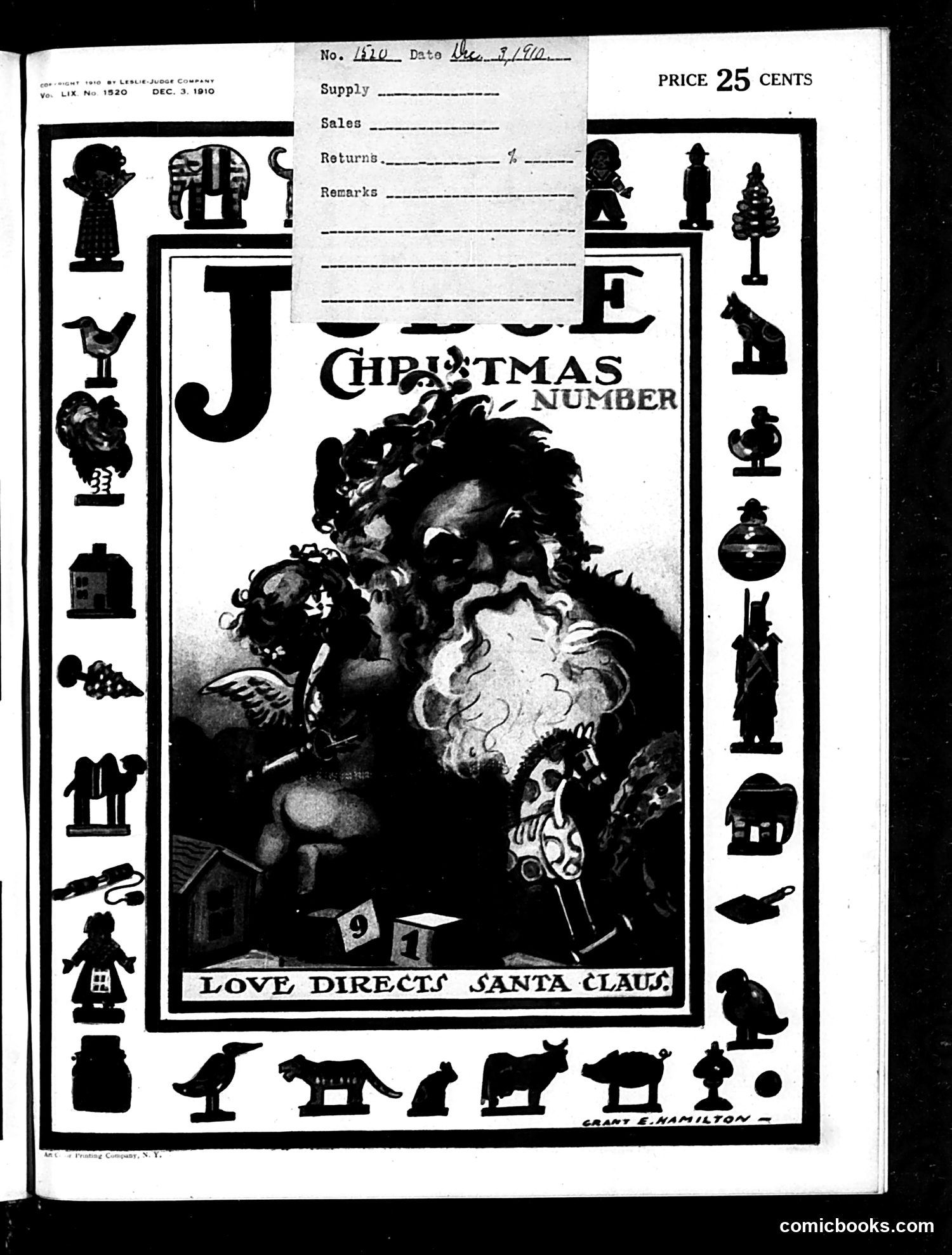
This is the cover of Judge's Christmas issue. The central image depicts Santa Claus with a child, captioned "Love Directs Santa Claus." The illustration appears sentimental rather than satirical—showing Santa in a warm, affectionate moment with a young child. The page is decorated with silhouetted Christmas ornaments and toy figures around the border, including dolls, animals, soldiers, and holiday decorations. This appears to be a special holiday edition emphasizing warmth and sentiment rather than political satire. The publication details indicate it costs 25 cents and was published December 3, 1910. The artwork is credited to Grant E. Hamilton.
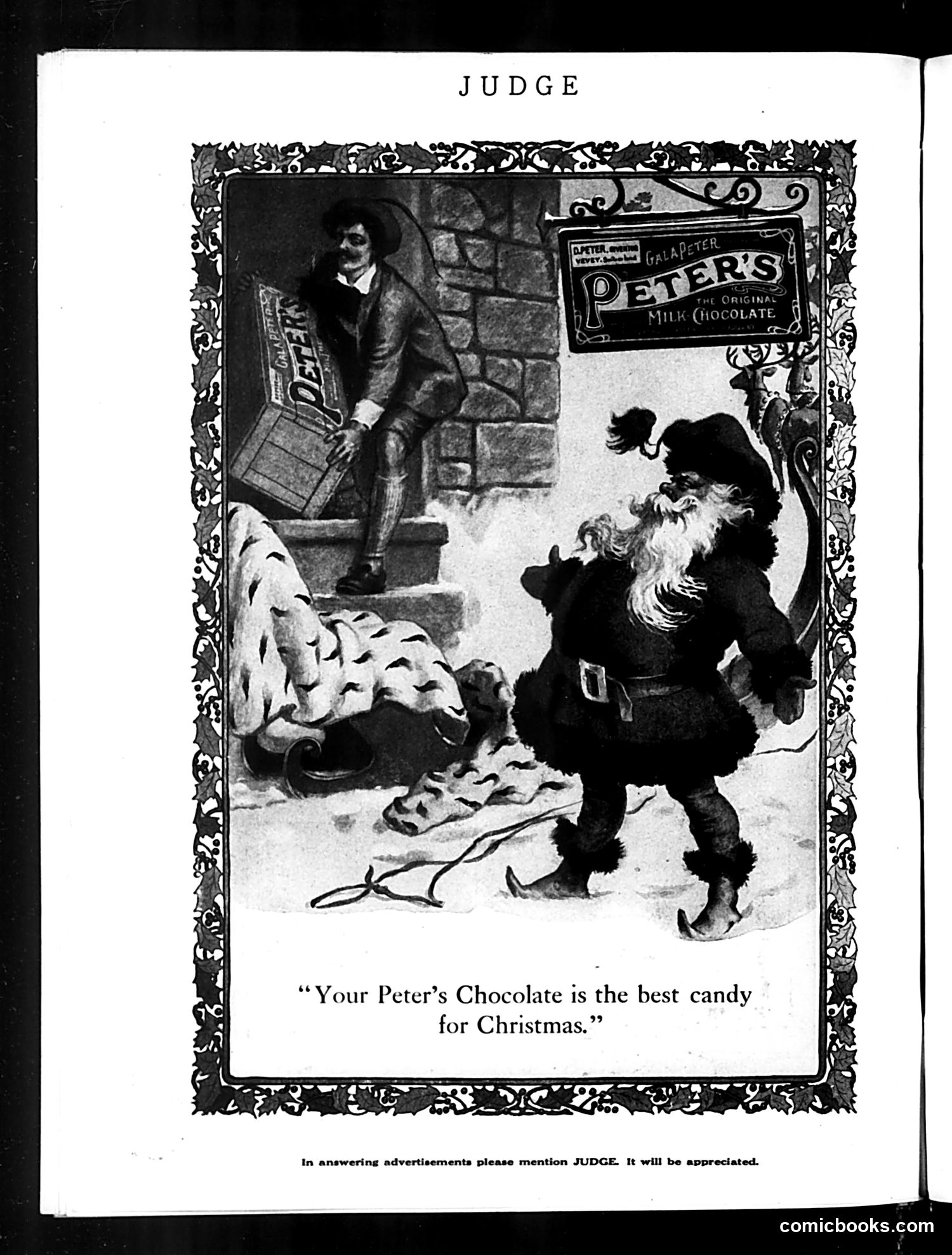
This page is primarily a **Peter's Milk Chocolate advertisement**, not political satire. The image depicts a Christmas-themed scene: a well-dressed man in a top hat stands on stairs in the background, while a gnome-like figure with a white beard examines Peter's chocolate in the foreground. The figure appears to be an elf or Santa-like character, fitting the holiday theme. The advertisement's tagline—"Your Peter's Chocolate is the best candy for Christmas"—is straightforward product promotion. The elaborate decorative border and vintage illustration style are typical of early 20th-century magazine advertising. There is no discernible political satire or social commentary here; Judge's page serves primarily as commercial advertising space.
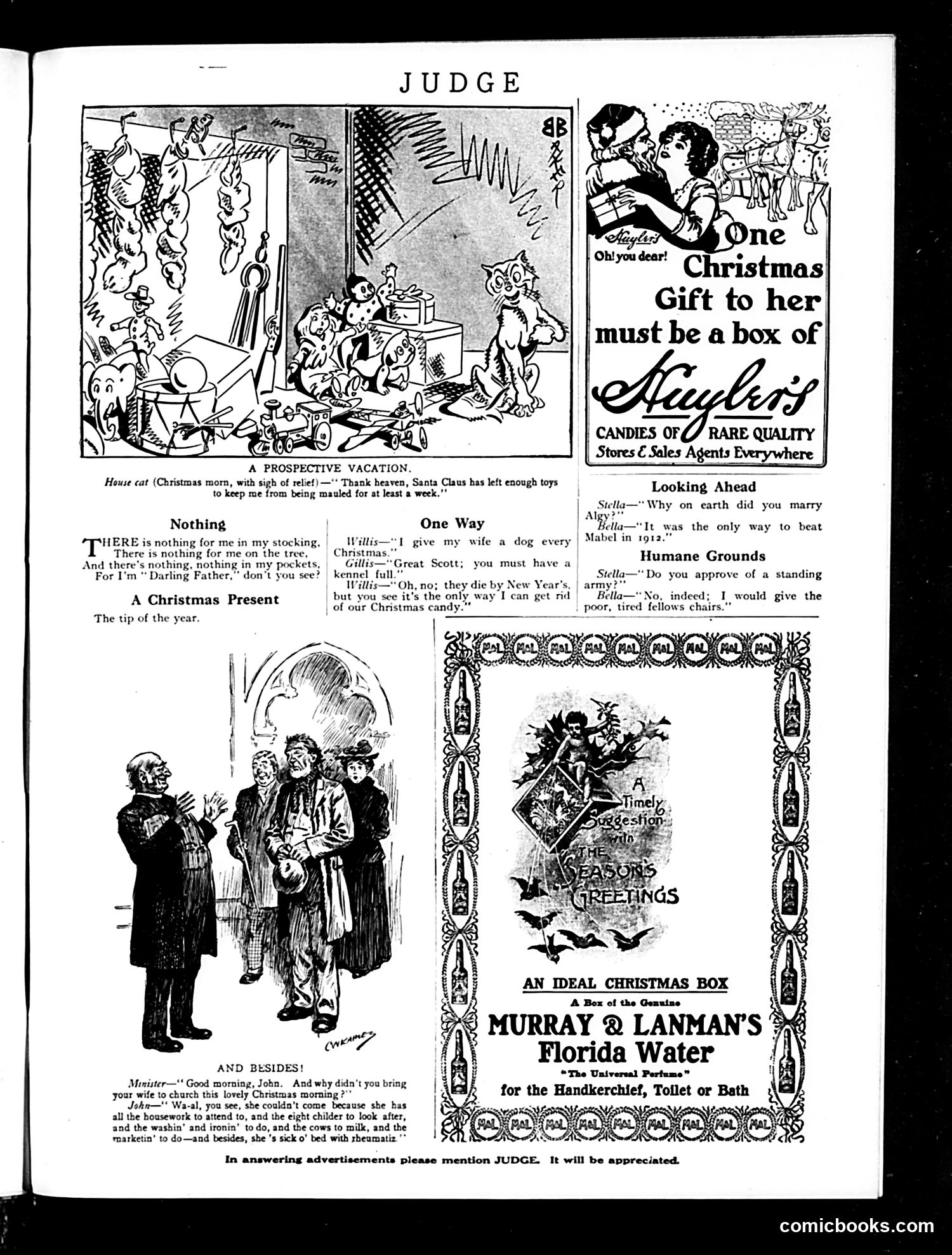
This page is primarily **advertising and light humor** rather than political satire. The main cartoon titled "A Prospective Vacation" shows Santa leaving toys because parents are exhausted from the previous year's abundance—a gentle joke about consumer excess and parental relief. The accompanying text "A Christmas Present" sarcastically suggests giving "nothing" as the ideal gift, mocking materialistic gift-giving culture. The bottom cartoon depicts a minister encountering parishioners, with dialogue suggesting marital discord—the wife couldn't attend church because she's managing household chaos (cooking, washing, ironing). The page also features period advertisements: **Suyler's Candies** and **Murray & Lanman's Florida Water** (a perfume/cosmetic product). These ads exemplify early 20th-century consumer marketing targeting holiday shoppers, particularly promoting gifts "for her."
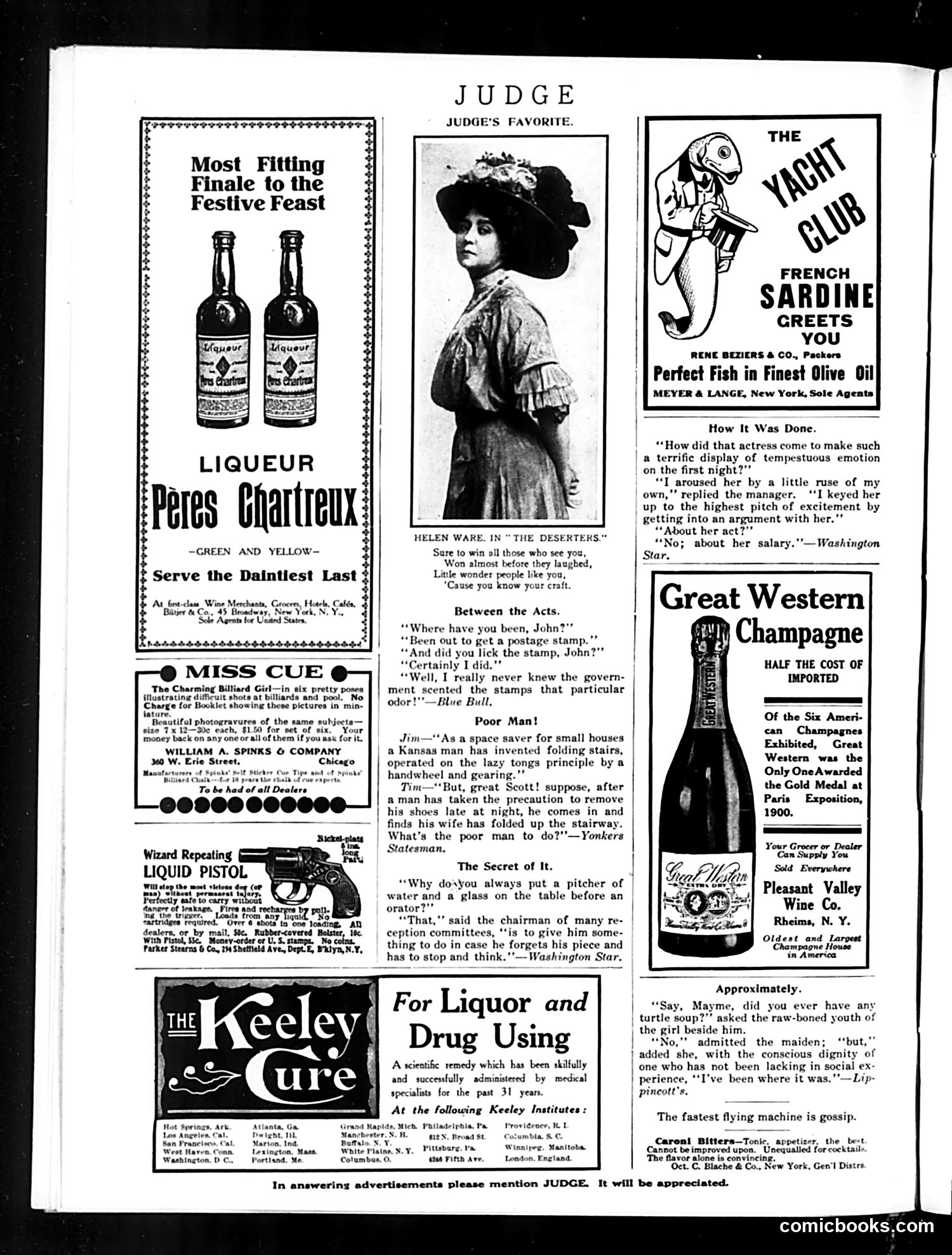
This page from *Judge* is primarily **advertising** rather than political satire. The dominant content includes ads for liqueurs (Pércs Chartreux), French sardines, champagne, wine, and a "Keeley Cure" for alcohol/drug addiction. The center features a photograph of actress **Helen Ware in "The Deserters,"** with humorous dialogue snippets below about government postal stamps and a space-saving folding staircase invention. A sidebar titled "The Secret of It" makes light of a chairman's habit of keeping water and glass nearby during receptions—implying he's avoiding alcohol while others indulge. The page's irony is evident: it advertises alcoholic beverages while simultaneously promoting the Keeley Institute's cure for "Liquor and Drug Using." This contradiction reflects *Judge*'s satirical commentary on American attitudes toward substance use and temperance debates of the era.
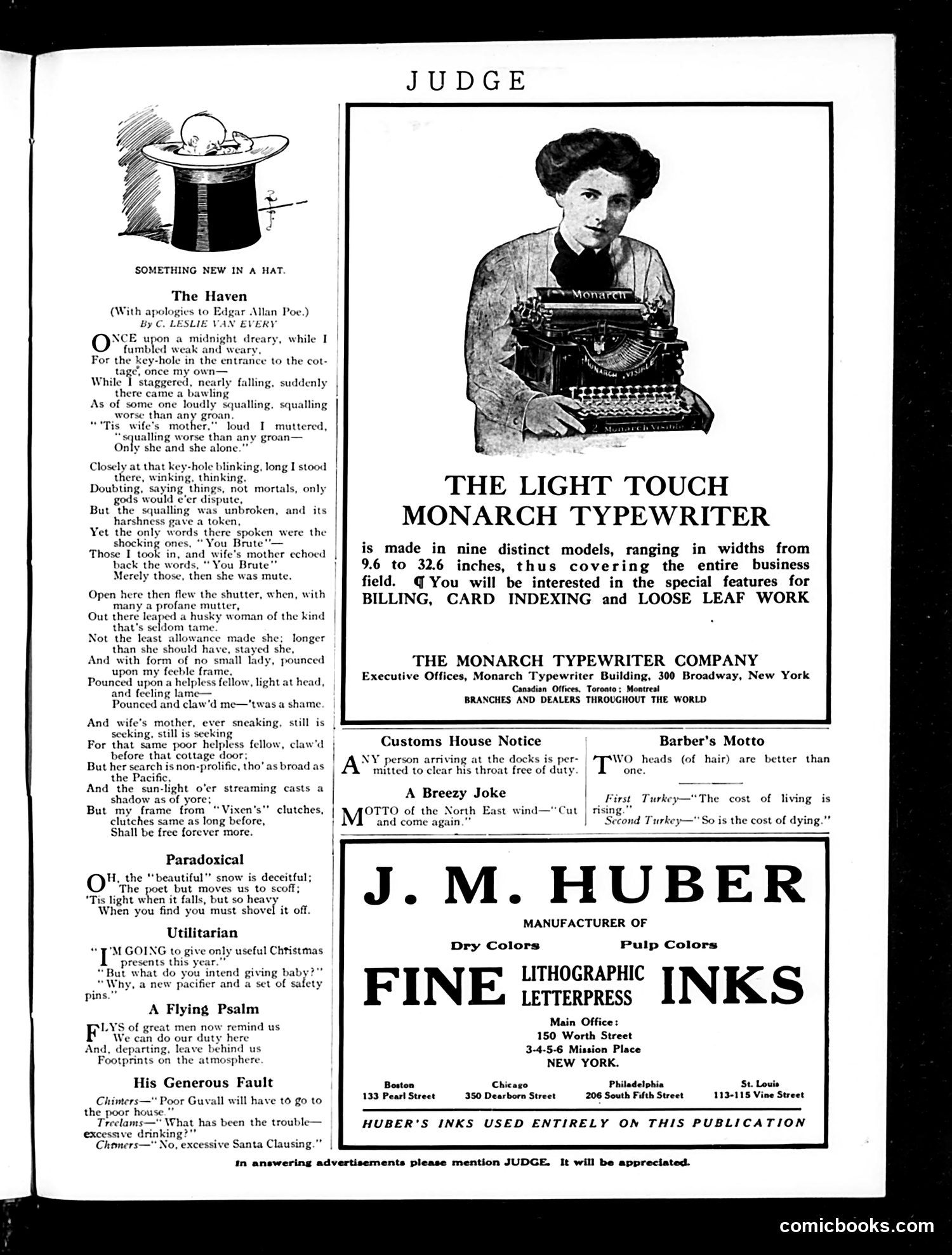
This page is **primarily advertising** with minimal satirical content. The main feature is a **Monarch Typewriter advertisement** showing a woman operating the machine, promoting its "light touch" across nine models for business uses like billing and indexing. The left column contains **humorous poetry and short jokes** rather than political cartoons—including verses titled "The Haven," "Paradoxical," "Utilitarian," and "A Flying Psalm." These appear to be general-interest satirical verse typical of Judge magazine, poking gentle fun at everyday situations rather than specific political figures or events. The rest of the page consists of **commercial notices and advertisements** for J.M. Huber's fine inks and other services. No identifiable political figures or contemporary events are referenced.
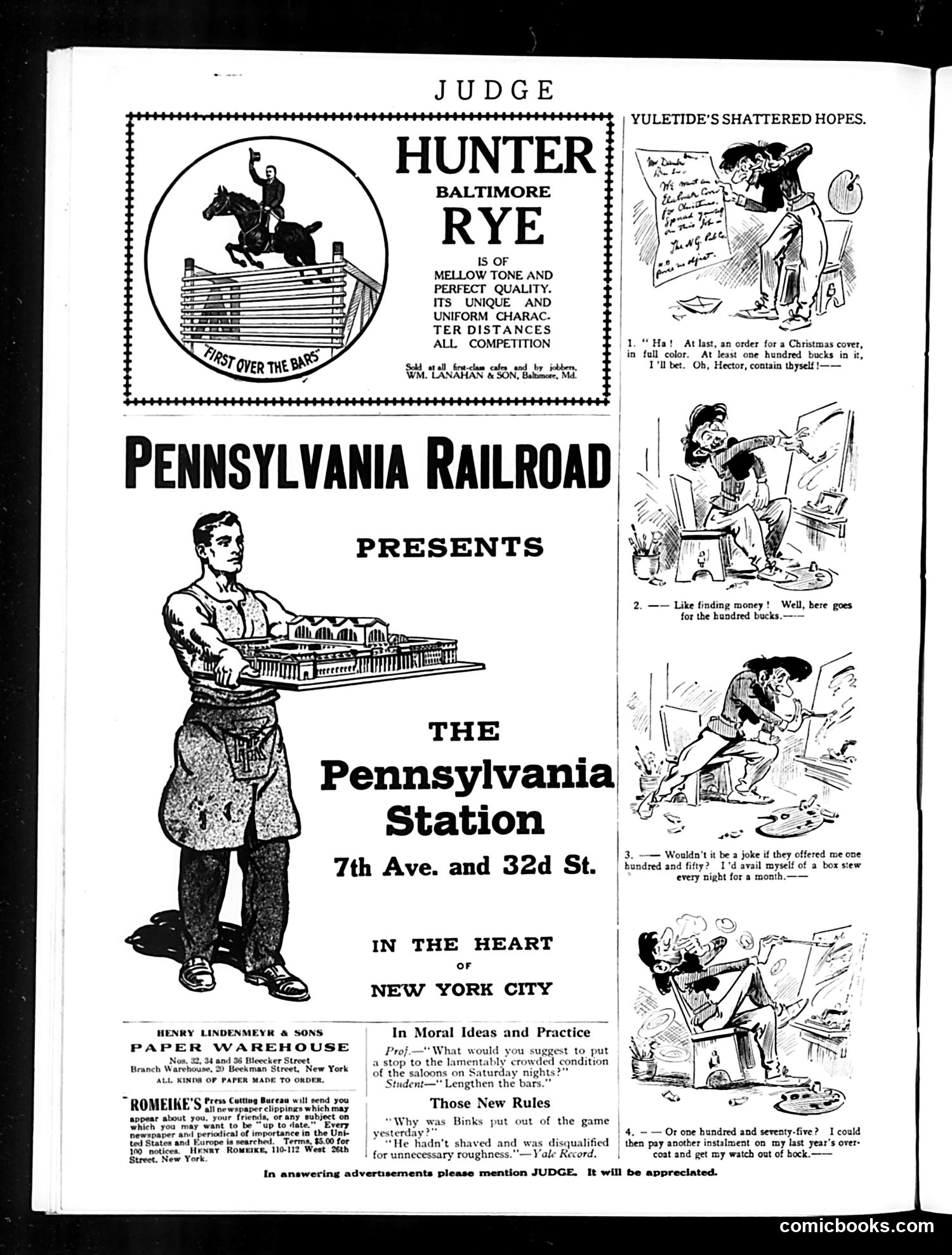
This page is primarily **advertising**, not political satire. The left side features ads for Hunter Baltimore Rye whiskey and the Pennsylvania Railroad's station in New York City. The right side contains "Yuletide's Shattered Hopes," a **humorous comic strip** about someone trying to order a Christmas cover for a publication (possibly Judge itself). The four-panel sequence shows a character's frustration when told the magazine has sold out of colored books, then jokes about finding money and offering payment in "box screws"—a dark comedic reference to self-inflicted harm as desperation. The humor relies on exaggeration and absurdist logic typical of early 20th-century magazine comedy, rather than political commentary. The strip satirizes holiday shopping anxiety and editorial frustration in a lighthearted manner.
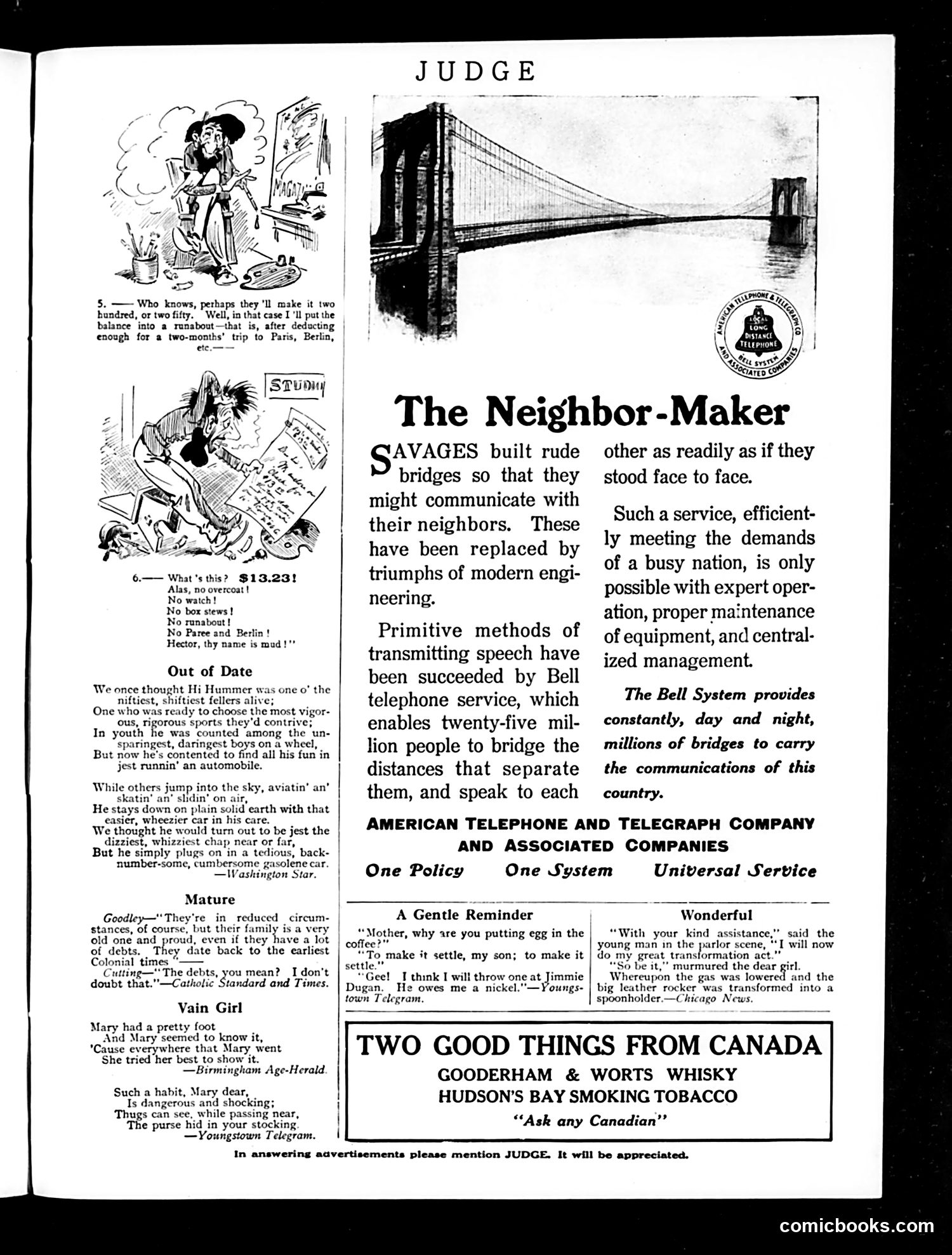
This page contains satirical cartoons and humorous stories typical of early 20th-century American humor magazines. **The main cartoons (numbered 5-6)** mock a man's inflated expectations: he fantasizes about inheriting wealth sufficient for expensive pursuits (Paris, Berlin trips, automobiles), but receives only $13.23—leaving him with nothing. The satire targets materialistic daydreaming and disappointment. **"Out of Date"** ridicules a man once considered daring and adventurous who now merely drives an automobile—portrayed as a mundane, unexciting activity. The joke reflects early automotive skepticism and generational decline. **"The Neighbor-Maker"** is an AT&T advertisement comparing primitive bridge-building to modern telephone service, framing telecommunications as civilization's latest "bridge" connecting people. It's corporate propaganda dressed as editorial content. The remaining items—**"Mature," "Vain Girl,"** and brief humor quotes—are typical period jokes about social pretension, vanity, and domestic situations. The page ends with **Canadian whisky and tobacco advertisements**, common in era publications.
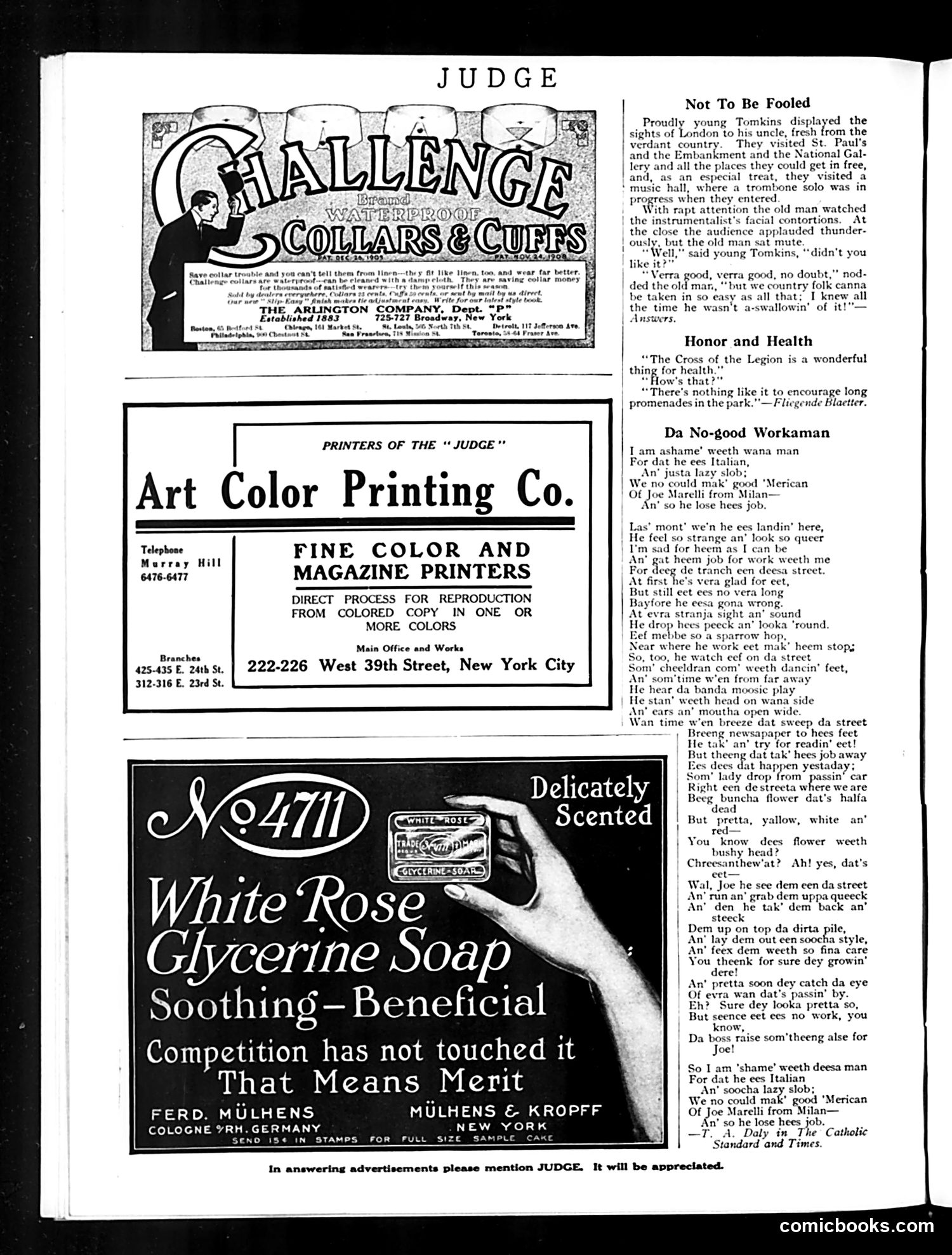
This page contains mostly **advertisements and filler content** rather than political cartoons. The main elements are: **Advertisements:** - Art Color Printing Co. (printing services) - No. 4711 White Rose Glycerine Soap (German product) **Short Humorous Stories:** The page features three brief comedic pieces typical of Judge's content: 1. **"Not To Be Fooled"** — A young Londoner brings his country uncle to a concert. The uncle watches the trombonist's exaggerated facial expressions but doesn't applaud, saying country folk "canna be taken in"—implying the musician was performing rather than genuinely playing. 2. **"Honor and Health"** — A joke about the Legion of Honor decoration encouraging health through park promenades. 3. **"Da No-good Workaman"** — An Italian immigrant named Joe Marelli loses his job arranging stolen flowers. The piece uses heavy dialect humor (characteristic of early-20th-century American publications) to portray Italian immigrants stereotypically as lazy and dishonest. The dialect story reflects period prejudices against Southern/Eastern European immigrants.
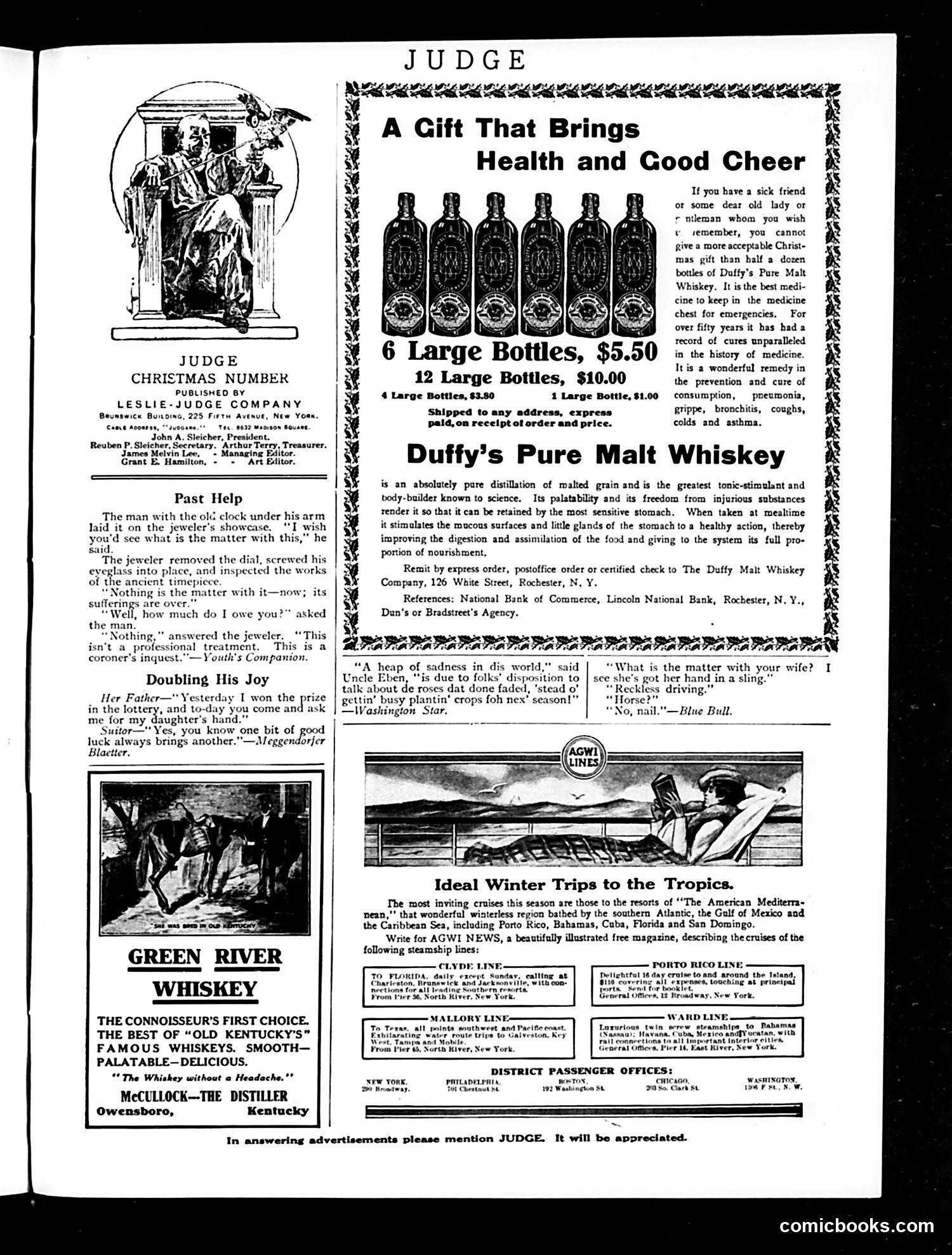
This is primarily an **advertising page** from Judge's Christmas issue, with two brief humorous anecdotes and multiple product advertisements. The two cartoons are short jokes: 1. **"Past Help"**: A man brings a broken clock to a jeweler. The jeweler declares nothing is wrong—because the clock is dead, making it a "coroner's inquest" rather than repair. The satire mocks futility and uses dark humor about irreversible damage. 2. **"Doubling His Joy"**: A suitor wins a lottery prize, then asks the girl's father for her hand. He claims "one bit of good luck always brings another"—implying the father's permission is mere luck, not earnest courtship. Light satire on mercenary romance. **Advertisements** dominate the page, hawking **whiskey as medicine** (Duffy's Pure Malt Whiskey and Green River Whiskey), promoting dubious health claims—cures for consumption, pneumonia, asthma. This reflects early 1900s patent medicine marketing before FDA regulation. Also advertised: winter Caribbean cruises on AGWI steamship lines.
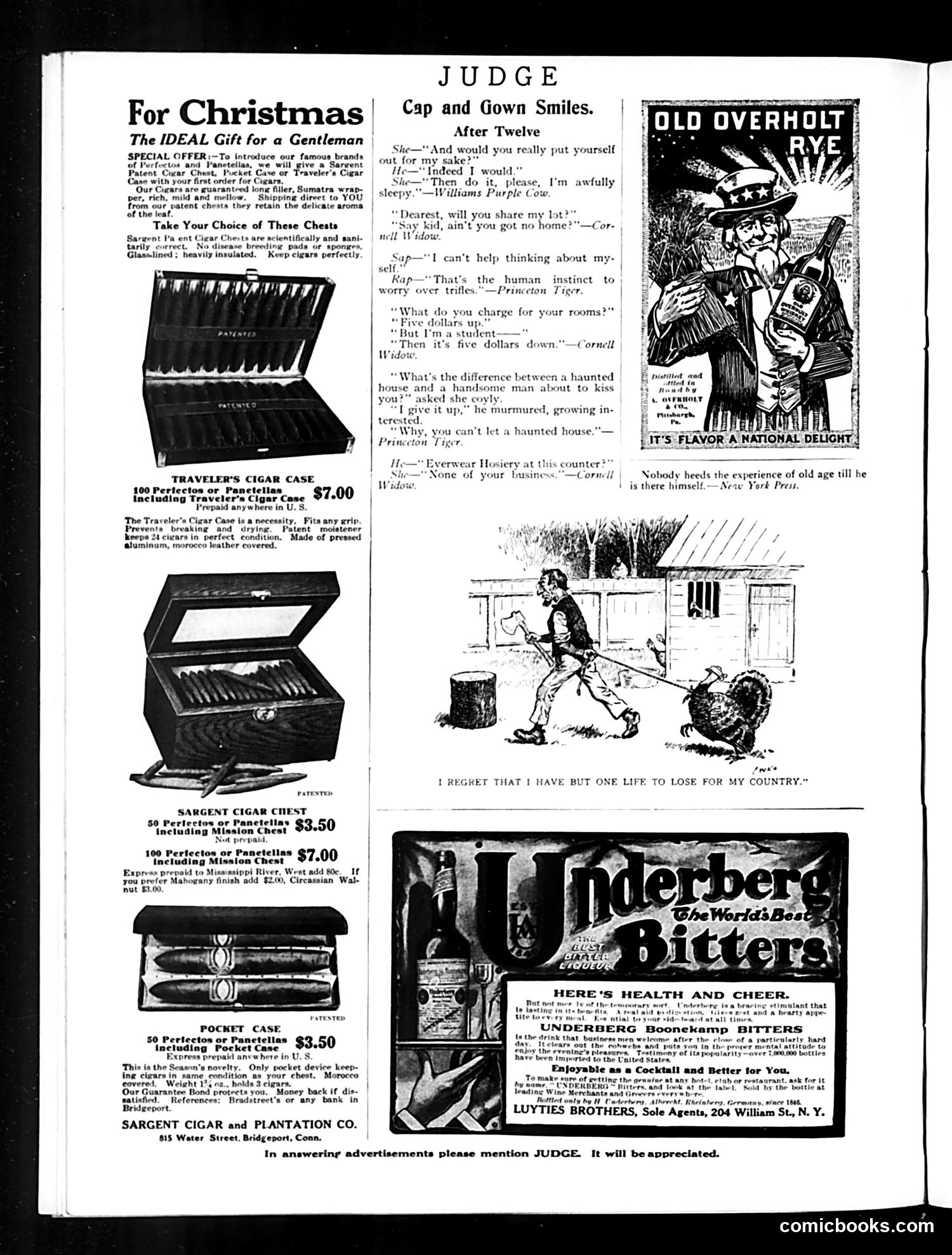
This page is primarily **advertising**, with a small section of humor content. The main elements are: **Advertisements:** Sargent Cigar cases dominate the left side—Christmas gift promotions for gentlemen featuring various cigar storage cases at prices like $7.00 and $3.50. **"Cap and Gown Smiles" humor section:** Brief college-themed jokes appearing to be reprinted from university publications (Cornell Widow, Princeton Tiger, Cornell). These are mild romantic and student-life quips typical of early 20th-century collegiate humor—nothing overtly satirical. **Political cartoon:** The "Old Overholt Rye" advertisement features an eagle and patriotic imagery with the tagline "It's Flavor a National Delight," wrapping alcohol marketing in American nationalism. **Underberg Bitters advertisement:** Claims health benefits in pseudo-scientific language typical of period patent medicine marketing. The page reflects early 1900s advertising conventions: cigars and alcohol as "ideal" male gifts, and health claims for liquor presented without scientific rigor.
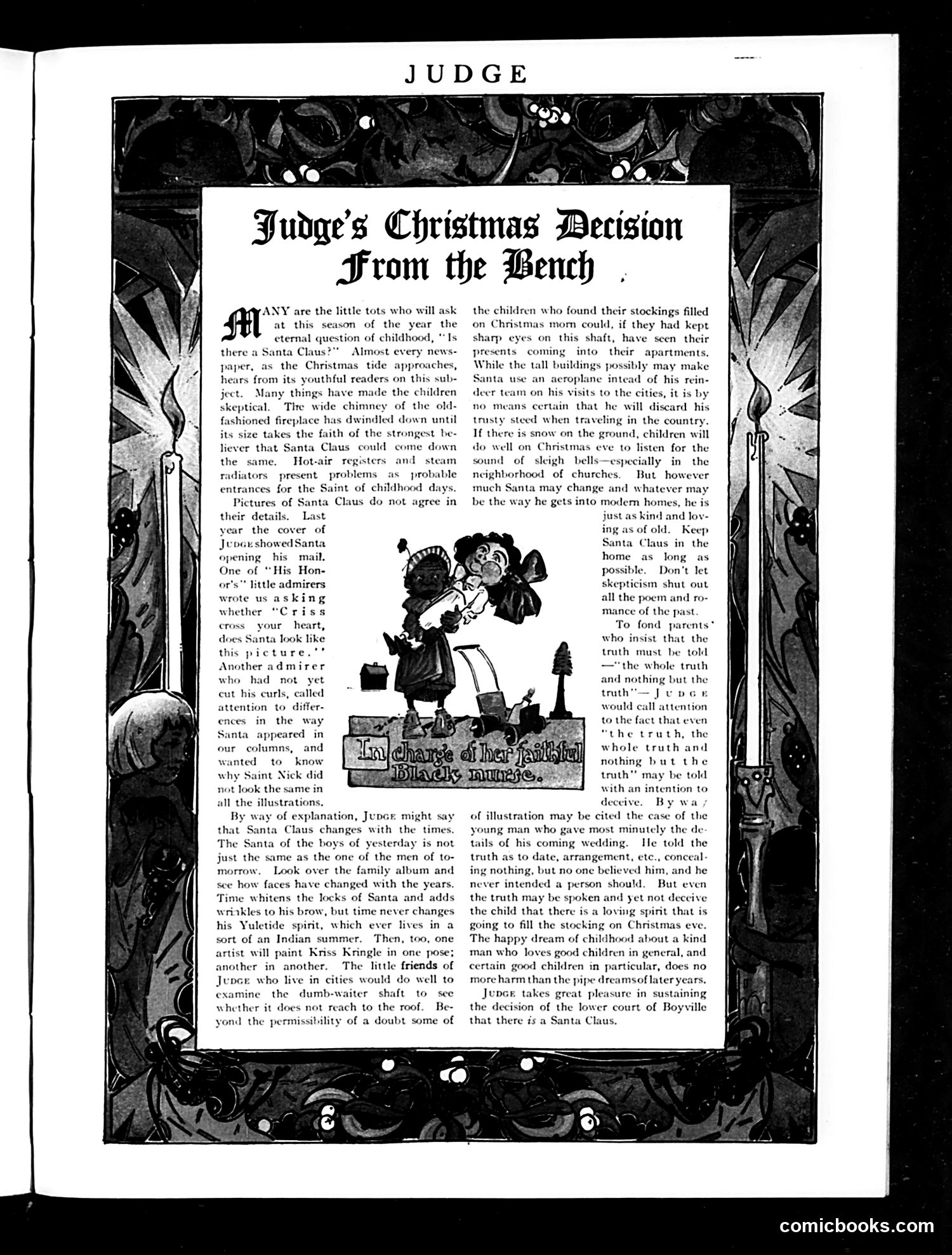
This is an editorial piece styled as a judicial ruling on whether Santa Claus exists. The "Judge" (the magazine itself, personified) addresses children's letters questioning Santa's reality, which newspapers receive annually around Christmas. The piece acknowledges modern obstacles to Santa belief: apartment buildings lack proper chimneys, steam radiators and dumbwaiters replace fireplaces, Santa's artistic depictions vary inconsistently. Rather than debunk Santa, the Judge argues that Santa adapts with the times—using airplanes instead of reindeer in cities, for instance. The central argument: parents demanding children accept "the whole truth and nothing but the truth" can technically tell the truth while still deceiving. The Judge sides with maintaining childhood wonder, ruling that the loving spirit of Santa—a kind man rewarding good children—causes no harm and enriches childhood imagination. The accompanying illustration shows Santa delivering presents via modern methods.
This appears to be a dramatic illustration titled "The Insurgents" from the satirical magazine *Judge*. The dark, shadowy image depicts what seems to be a confrontation or tense scene with multiple figures in an interior setting. However, without a visible date or clearer OCR text, I cannot definitively identify which historical "insurgent" movement or political event this cartoon references. *Judge* frequently satirized American political conflicts, labor disputes, and social upheaval. The dramatic chiaroscuro style suggests serious subject matter rather than light satire. To accurately explain the specific political or social commentary, I would need either: the publication date, clearer text, or caption information identifying the figures depicted. The image quality makes specific identification of individuals difficult.
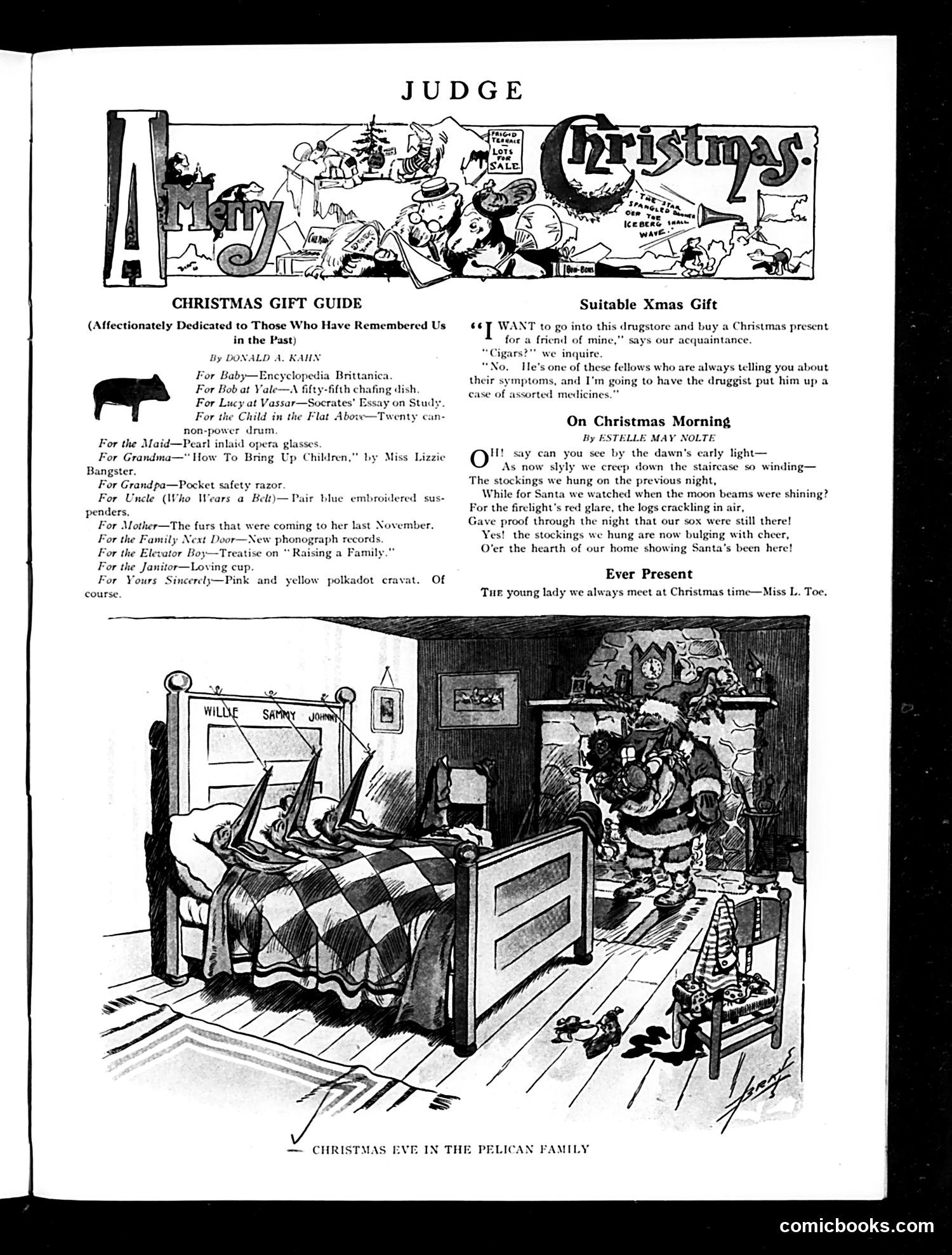
This is a **Christmas gift guide** from Judge magazine, a satirical American publication. The page contains three humorous sections: 1. **Gift suggestions** by Donald A. Kahn mock various social relationships through deliberately absurd or insulting "gifts"—a drum for the neighbor's child (noisy annoyance), a treatise on child-rearing for the elevator boy (condescension), furs delayed since last November (procrastination joke). 2. **A drugstore joke** satirizes hypochondriacs—the acquaintance wants to give a friend "assorted medicines" as a Christmas present because the friend constantly complains about symptoms. 3. **A sentimental poem** by Estelle May Nolte describes Christmas morning excitement over stockings and Santa's visit—straightforward nostalgia without satire. 4. **"Ever Present" sketch** references "Miss L. Toe" (likely a pun on "mistletoe"), the young woman perpetually encountered at Christmas gatherings. The large **illustration** depicts a chaotic Christmas Eve domestic scene, labeled "Christmas Eve in the Pelican Family," showing the festive disorder of holiday morning with children and toys.
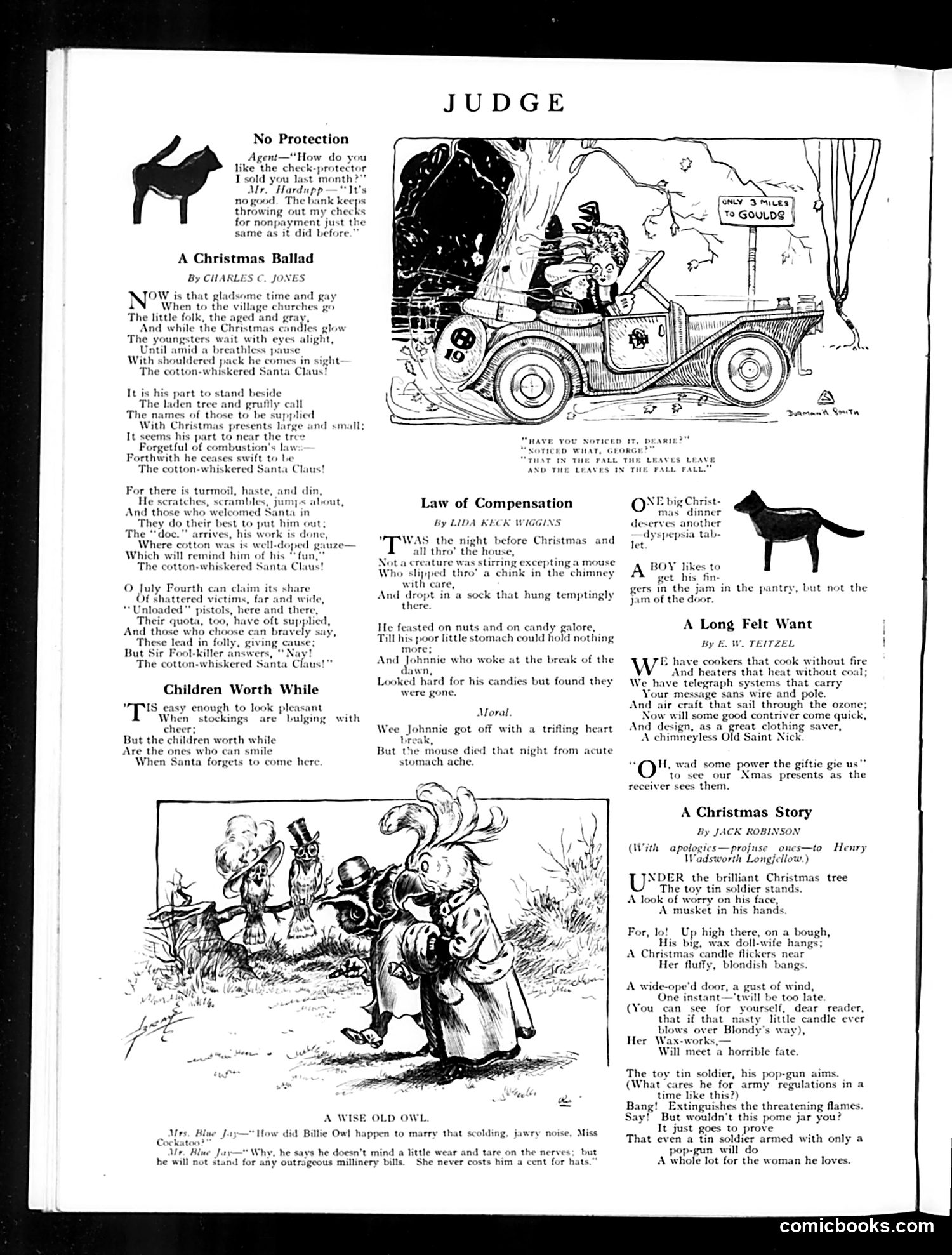
This page from *Judge* contains several satirical pieces typical of American humor magazines: **"No Protection"** mocks ineffective financial products—a customer complains that the "check-protector" he purchased doesn't actually prevent banks from rejecting his bounced checks, rendering it useless. **"A Christmas Ballad"** by Charles C. Jones humorously depicts Santa Claus repeatedly catching fire near Christmas trees and requiring medical attention, satirizing the genuine fire hazard posed by open flames near dry evergreens—a real danger in homes of that era. **"Law of Compensation"** presents dark humor: a mouse steals Christmas candy, gets indigestion, and dies—suggesting nature's justice operates even on small creatures. **"A Christmas Story"** by Jack Robinson offers sentimentality tinged with irony: a toy tin soldier rescues his wax doll-wife from danger posed by a nearby Christmas candle, celebrating domestic devotion in miniature form. The other brief pieces ("Children Worth While," "A Long Felt Want") offer gentle social commentary on family values and modern conveniences respectively.
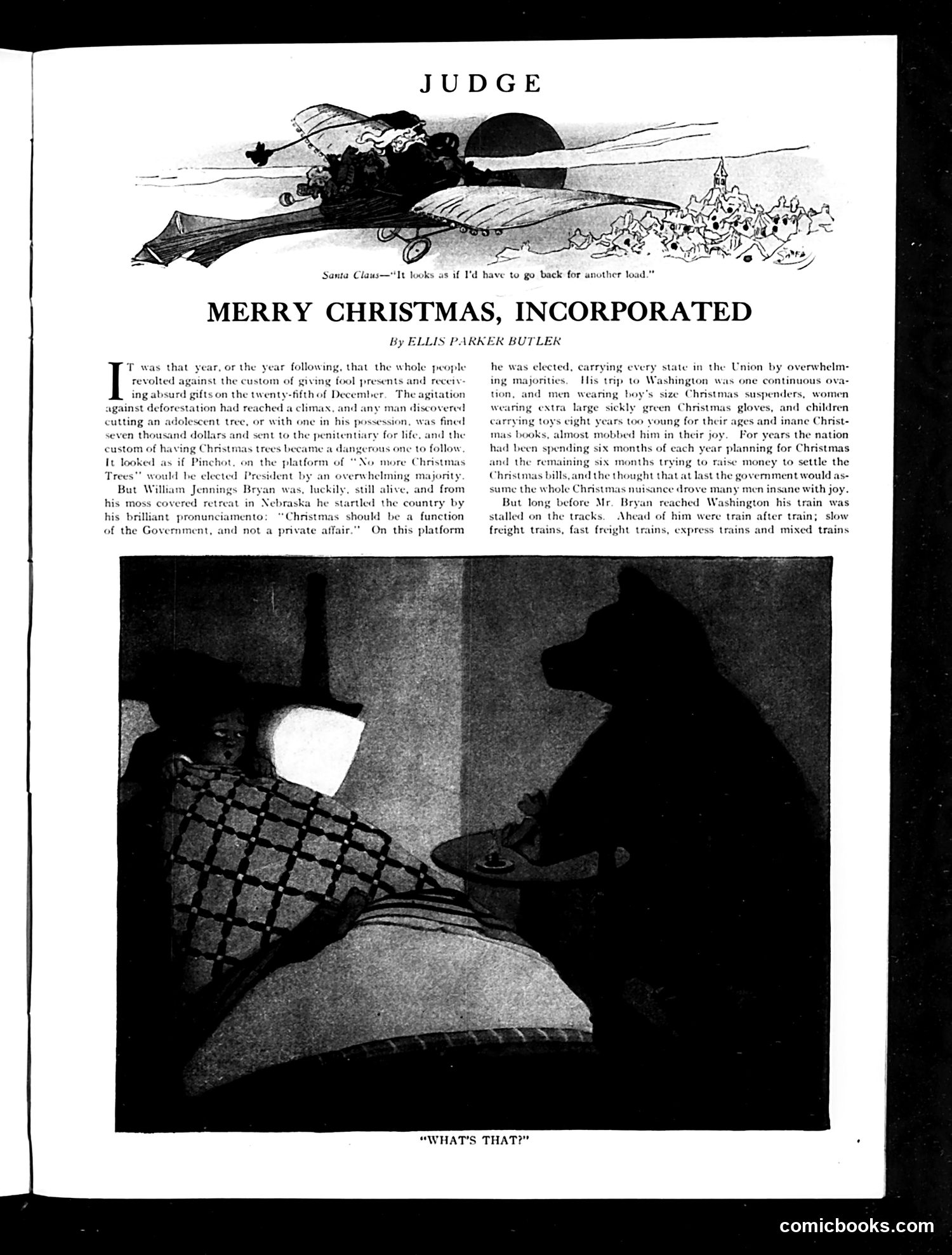
This satirical story mocks both progressive conservation efforts and William Jennings Bryan's political platform. The narrative imagines a future where anti-deforestation laws (likely referencing conservationist Gifford Pinchot) make Christmas trees illegal, threatening to elect an environmental candidate president. Bryan responds by proposing the government take over Christmas as a public function rather than private affair—winning overwhelming election support. The satire ridicules Bryan's populist socialism and Americans' commercialism: the nation spends half the year acquiring Christmas goods and half paying debts. The illustration caption ("It looks as if I'd have to go back for another load") and final scene showing Santa's sleigh stalled behind freight trains suggest the absurdity of industrializing and government-controlling even cherished traditions. The joke: Bryan's well-intentioned government intervention creates bureaucratic chaos, defeating its own purpose.
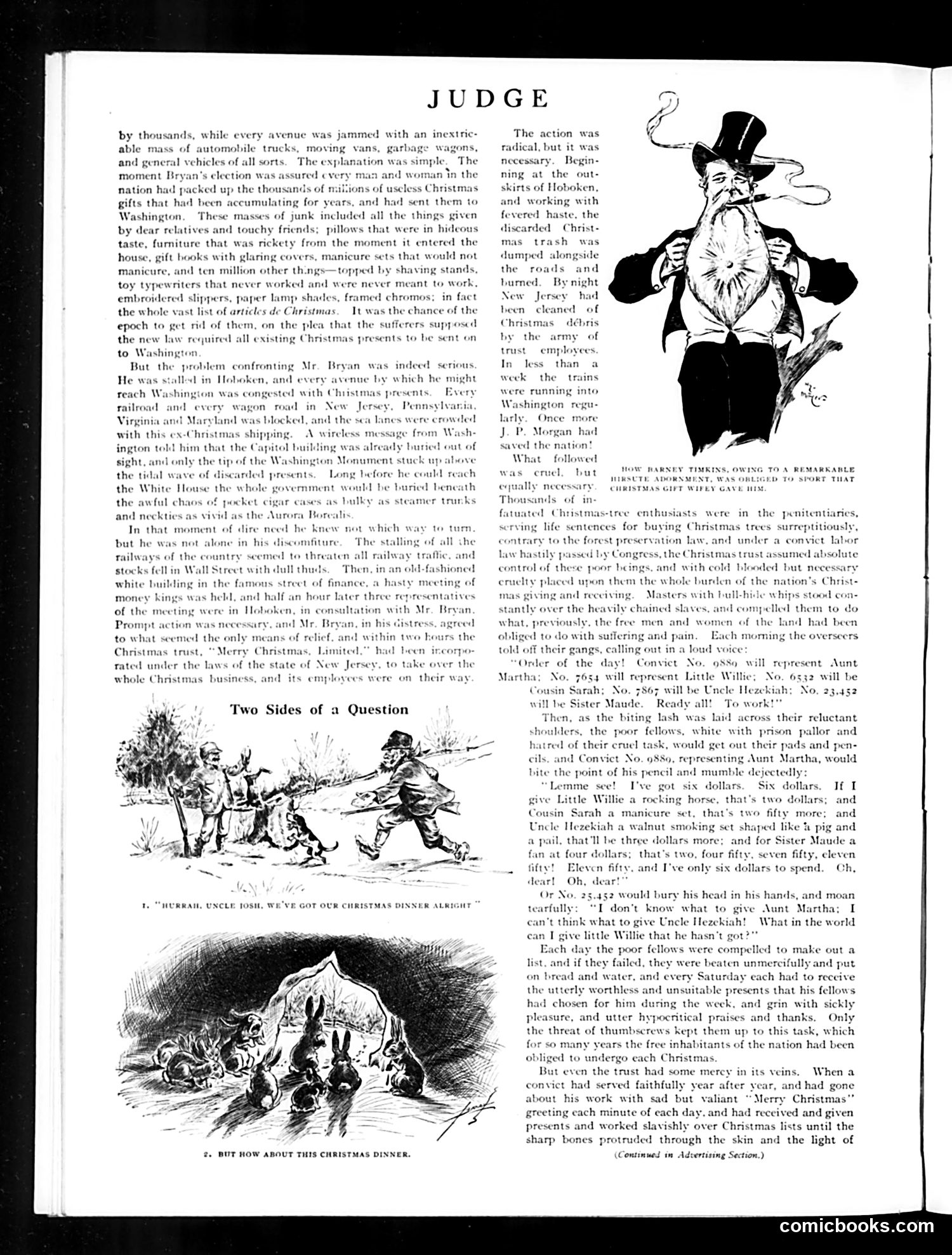
This page satirizes **William Jennings Bryan's 1896 presidential election victory** through absurdist humor about Christmas gift disposal. The cartoon depicts Bryan facing a practical crisis: after winning, he must travel to Washington, but every road is clogged with discarded Christmas presents—the page's metaphor for the massive accumulation of unwanted gifts Americans receive yearly. The satirist mocks this as representing the "useless" baggage of ordinary life. The solution portrayed is darkly comic: a hastily-formed "Christmas Trust" corporation forcibly collects and burns all Christmas gifts and decorates, then imprisons citizens who attempt to give gifts, enforcing gift-giving through convict labor under armed guards. The satire targets both **Bryan's populist reforms** (depicting government intervention as absurdly totalitarian) and **American consumer culture** (the endless tide of unwanted merchandise). The "two sides" section shows the contradiction: celebratory relief versus the cruel human cost of enforcing such policies. The illustrations emphasize scale and chaos—masses of wagons, overwhelmed infrastructure—to satirize Bryan's election as creating bureaucratic nightmare rather than reform.
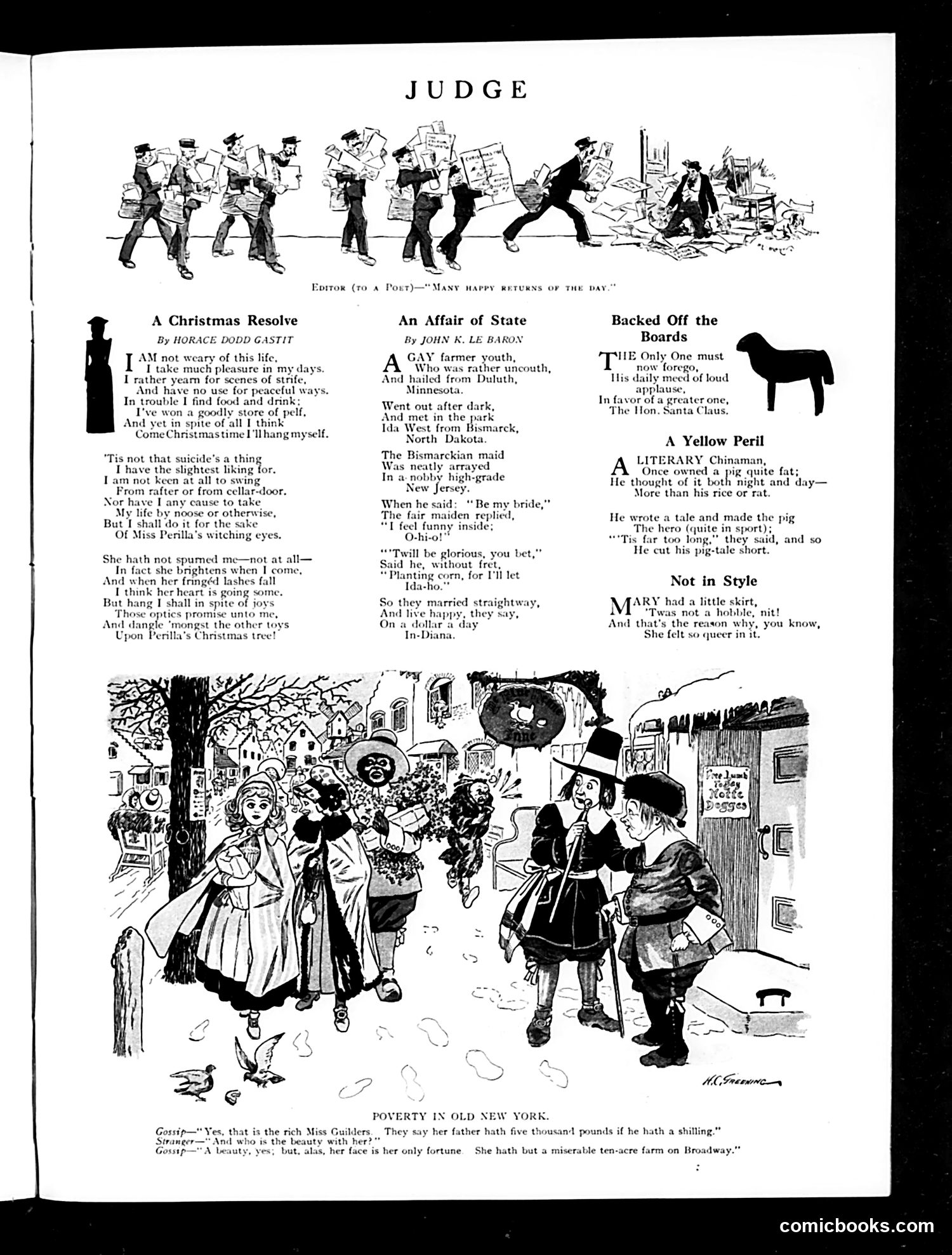
This page contains several short humorous pieces typical of Judge's satirical style: **"A Christmas Resolve"** is a darkly comedic poem where a man resolves to commit suicide at Christmas—not from genuine despair, but as a dramatic gesture to impress Miss Perilla, who actually likes him. **"An Affair of State"** is a light verse romance between a farmer from Duluth and a woman from Bismarck, filled with puns on state names (Ida-ho, In-diana). **"Backed Off the Boards"** briefly notes that an actor must yield to Santa Claus during the holiday season. **"A Yellow Peril"** plays on contemporary anti-Chinese sentiment; a Chinese writer shortens his pig-tale (pun) after criticism. **"Not in Style"** jokes about a woman named Mars feeling uncomfortable in an unfashionable skirt. The bottom illustration, "Poverty in Old New York," depicts street children and discusses wealth disparities—a social commentary typical of Judge's era. The overall tone mixes wordplay, romantic comedy, and light social observation.
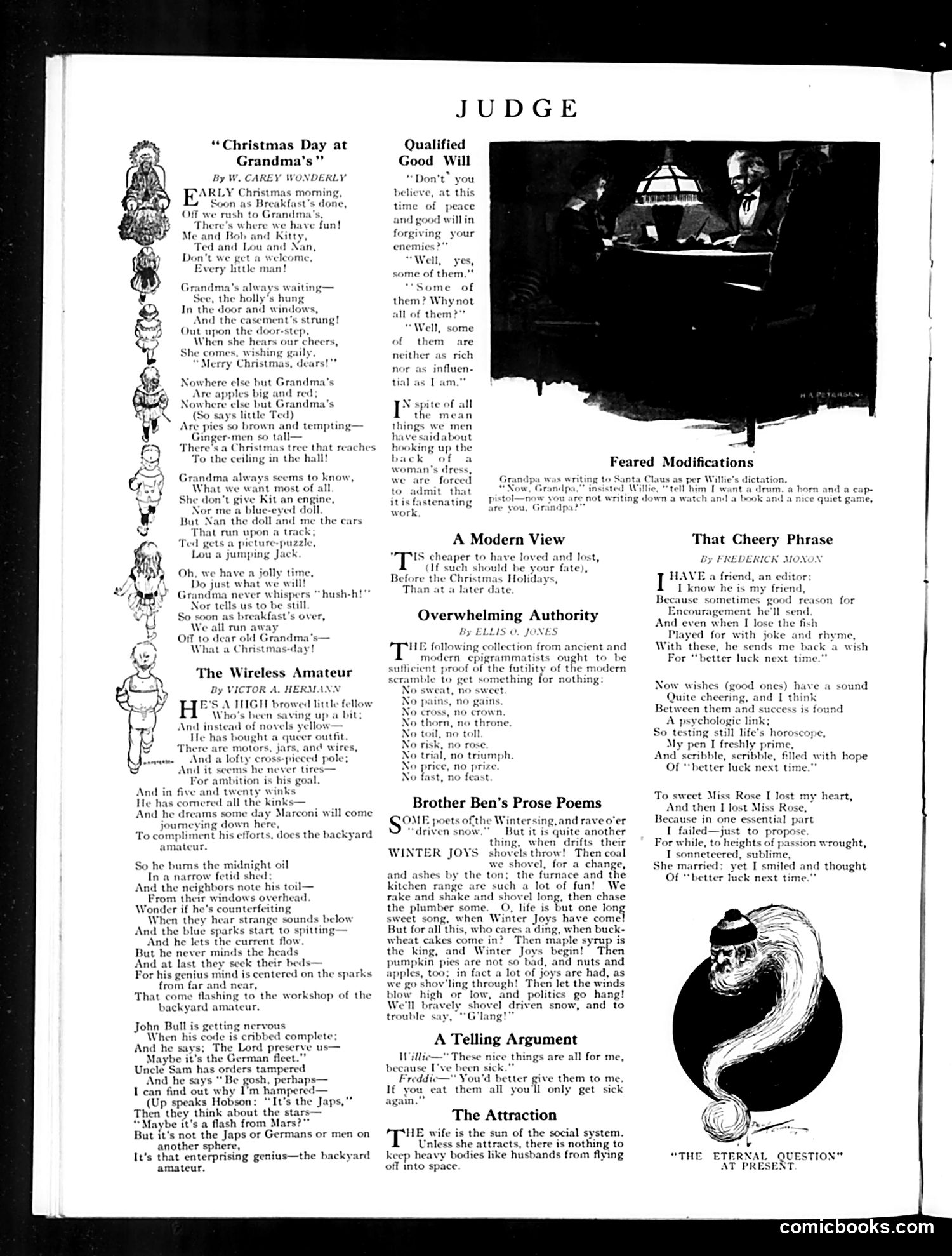
This page from the satirical magazine *Judge* contains several pieces of humor typical of early 20th-century American satire: **"The Wireless Amateur"** mocks the emerging radio hobby. A socially awkward "high-browed" young man obsesses over building wireless equipment in his shed, creating electrical sparks that alarm neighbors. The joke is that anxious observers—including "John Bull" (Britain) and neighbors—fear his transmissions represent German military signals or Martian contact, when it's merely an eccentric hobbyist. This reflects contemporary anxieties about new technology and pre-WWI tensions about German military capability. **Other pieces** include sentimental Christmas poetry, family humor, and aphorisms about human nature ("No sweet, no sweat"; "No price, no prize"). The page satirizes modernity's disruptive technology, social nervousness, and human folly—themes characteristic of *Judge*'s satirical mission during this period. Without a visible date, the wireless theme and references suggest early 1900s publication.
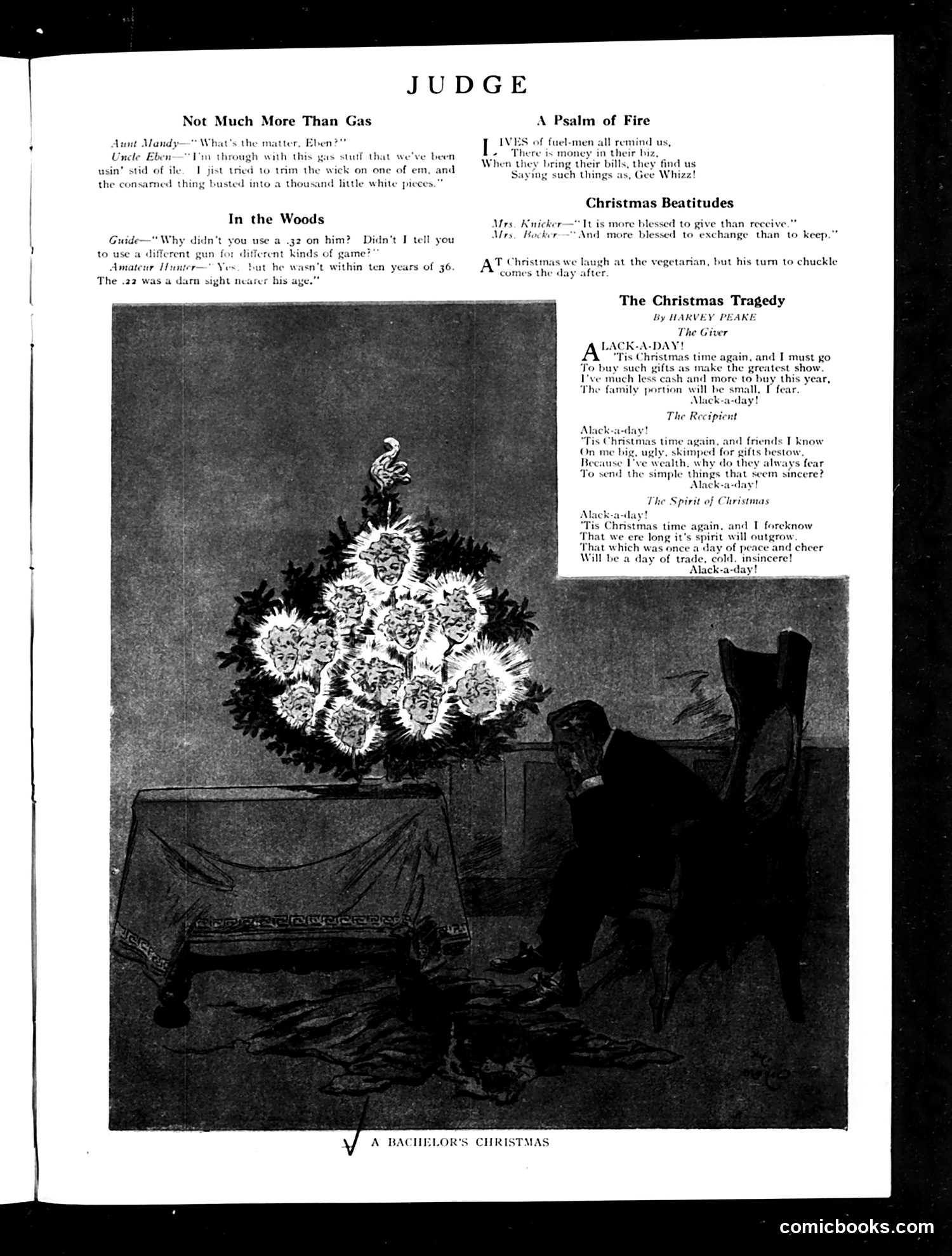
This page contains several satirical pieces about Christmas commercialism and gift-giving anxieties. **"Not Much More Than Gas"** mocks early electric lighting—Uncle Eben tries to trim a gas lamp wick on an electric bulb, destroying it. The joke: rural people confusing new technology with familiar old methods. **"Christmas Beatitudes"** offers ironic observations: Mrs. Knicker notes it's "more blessed to give than receive" yet "more blessed to exchange" gifts—satirizing the hypocrisy of Christmas generosity masking consumer culture. **"The Christmas Tragedy"** (by Harvey Peake) presents a giver's lament: financial strain from gift-buying, pressure to purchase lavish items, and the loss of sincere gift-giving to commercial excess. The repeated "Alack-a-day!" emphasizes mounting frustration as Christmas's "spirit" becomes corrupted by "trade, cold, insincere" materialism. **The illustration** shows a silhouetted figure contemplating flowers on a table—likely representing the bachelor's dilemma of selecting appropriate gifts. The page collectively satirizes 1910s-era anxieties about Christmas becoming commercialized rather than spiritual.
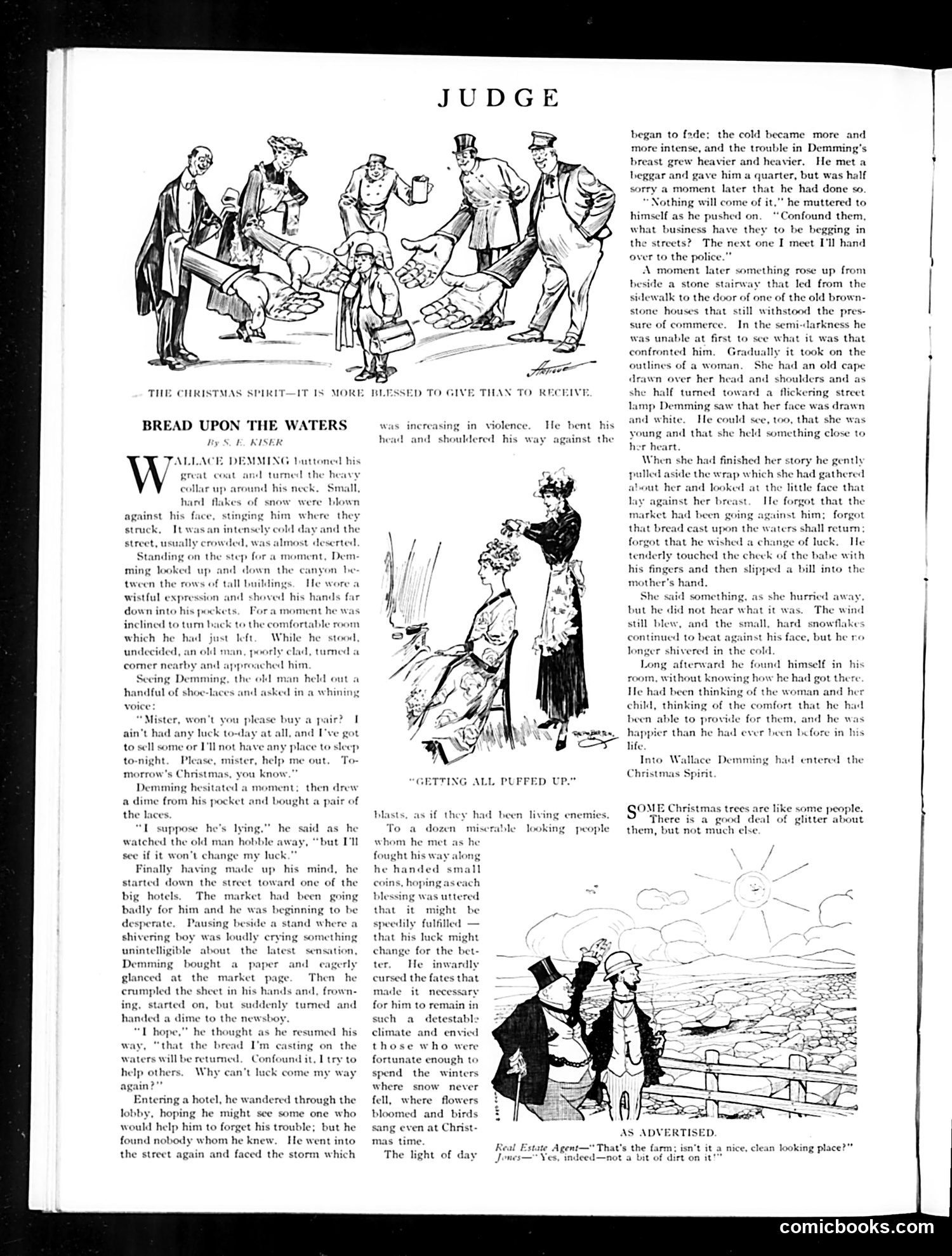
This page presents "Bread Upon the Waters," a Christmas morality tale about Wallace Demming, a financially struggling man facing a cold winter day in what appears to be late 19th-century America. **The Story's Point:** Despite his own financial desperation, Demming gives money to multiple poor people he encounters—a shoelace vendor, a newsboy, beggars on the street. He does this while cynically doubting it will help ("Nothing will come of it"), yet hoping his charitable acts might reverse his bad business luck, based on the biblical principle that generosity returns blessings. **The Satire/Message:** The page satirizes the tension between self-interest and Christian charity during the Gilded Age. Demming embodies the era's wealthy struggling with guilt—he wants luck to change *because* he helps others, not from pure altruism. The illustrations and text suggest this story will reveal whether his self-serving charity actually brings redemption or if the universe is indifferent to such calculations. The top cartoon emphasizes the Christmas moral: giving is "more blessed" than receiving—a pointed message for Judge's prosperous readership.
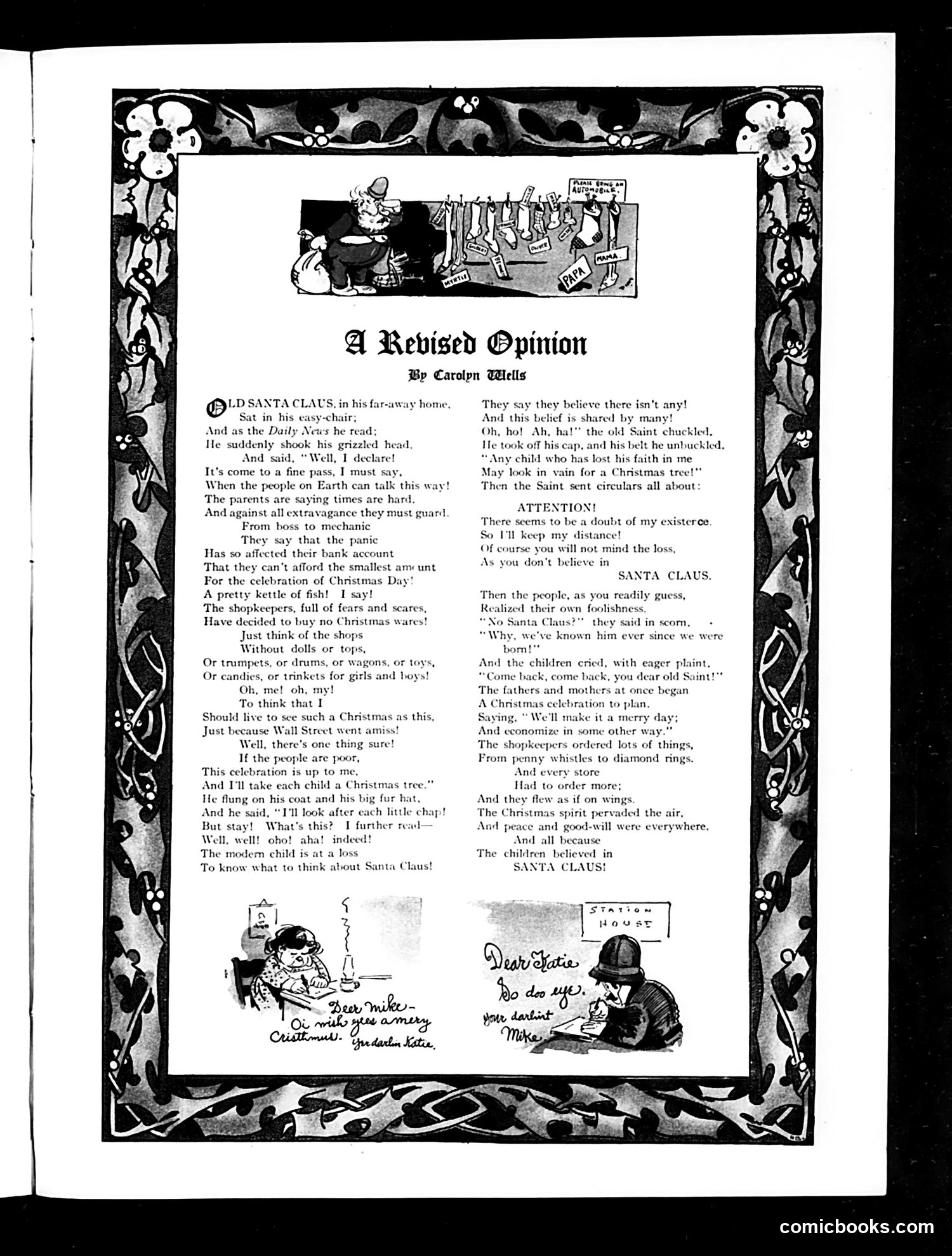
This satirical poem addresses the 1907-1908 financial panic and its social consequences. Santa Claus reads that parents, shopkeepers, and the general public—devastated by Wall Street's collapse—have abandoned Christmas spending and lost faith in both Santa and celebration itself. Santa responds by withdrawing his services, issuing circulars declaring he'll withhold Christmas trees from non-believers. This shock therapy works: realizing their foolishness, the public reverses course. Parents, shopkeepers, and children reconcile with Santa and resume Christmas commerce—ordering "from penny whistles to diamond rings." The satire critiques how economic panic triggers mass psychological collapse and loss of faith, while suggesting that consumer spending and belief in Santa (and by extension, American optimism) are interdependent. The "solution" ironically involves returning to the very consumption that preceded the crisis—a commentary on American materialism and cyclical economic behavior.
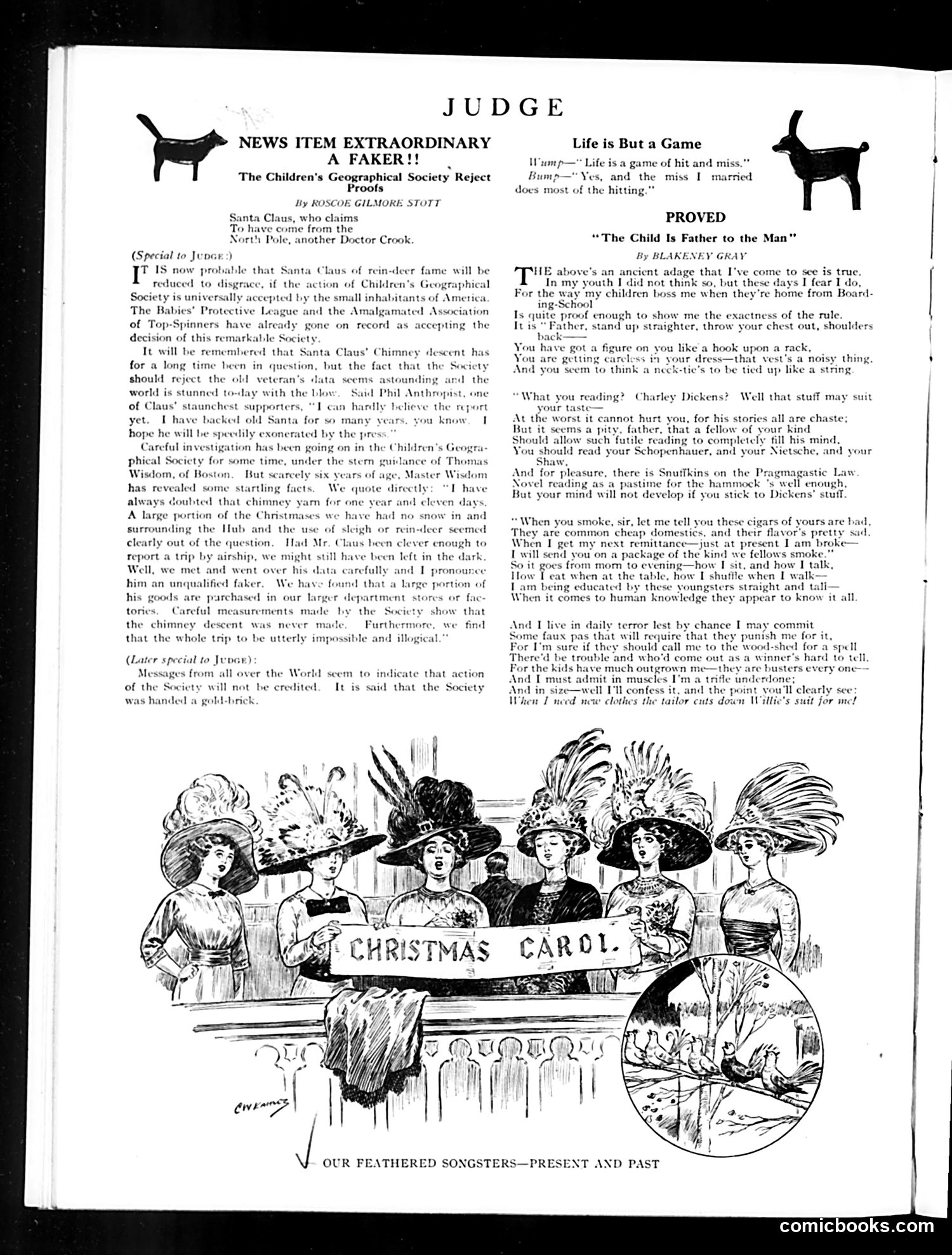
**Top Article:** "News Item Extraordinary—A Faker!!" satirizes the Children's Geographical Society "rejecting proofs" that Santa Claus exists. The joke mocks overly-serious scientific societies by depicting them scrutinizing Santa's chimney descent and reindeer logistics with absurd rigor, concluding he's a "faker." The satire targets both credulous adults who believe in Santa and pompous institutions claiming expertise. A subsidiary note jokes that the Society was "handed a gold-brick"—meaning they were duped themselves. **Bottom Poem:** "The Child Is Father to the Man" (borrowing Wordsworth's title) depicts role-reversal where children dominate and correct their fathers on literature, smoking, dining etiquette, and behavior. The father fears punishment. The satire mocks Edwardian youth culture and generational tension—children as tyrannical know-it-alls who've inverted traditional parental authority. **Illustration:** Shows women in elaborate Edwardian hats presenting a "Christmas Carol" banner, depicting period theatrical productions.
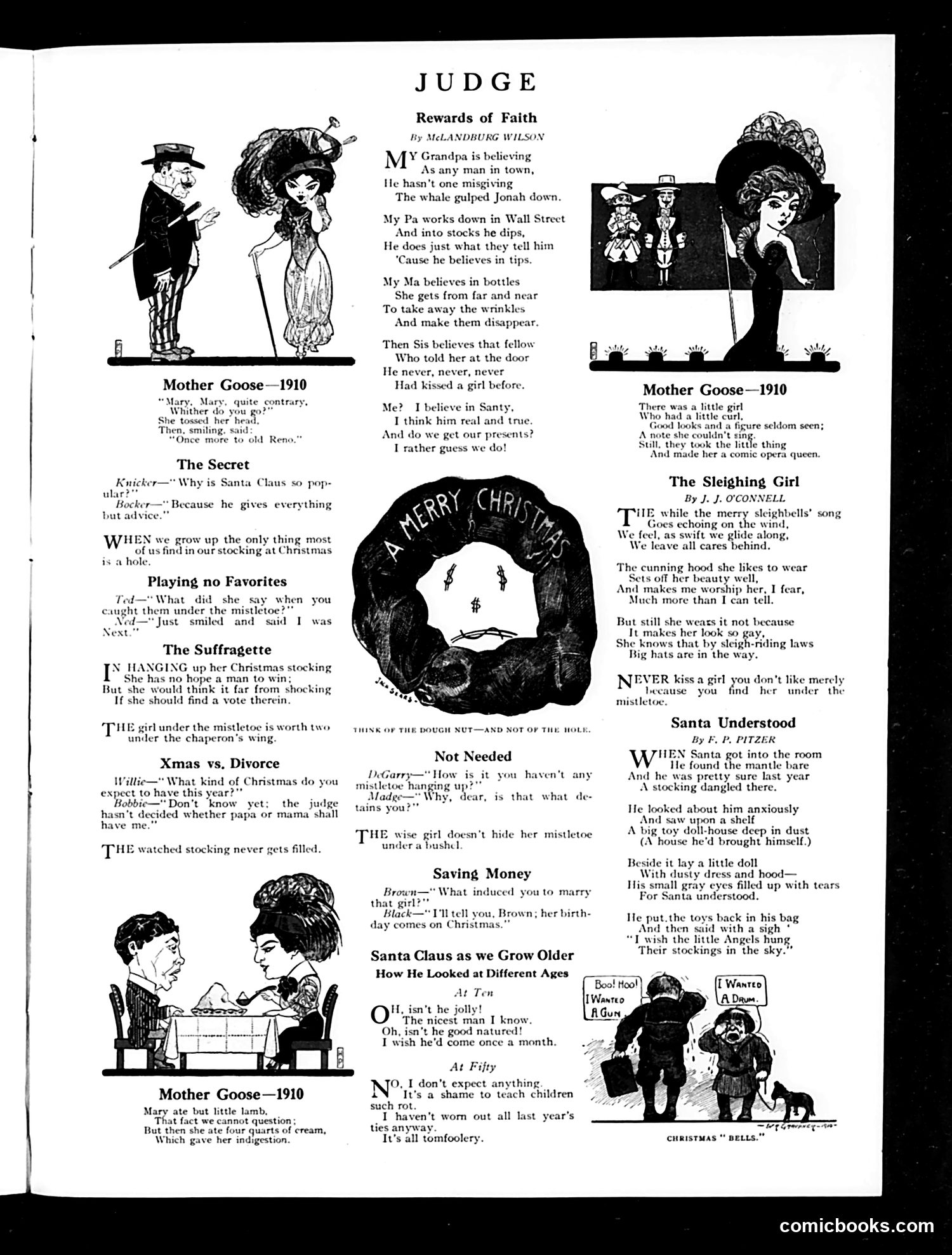
This page collects satirical Christmas-themed pieces targeting early 20th-century American social anxieties and trends: **"Rewards of Faith"** mocks blind faith across society: grandpa believes religious miracles, father trusts stock tips, mother buys cosmetics to hide aging, sister believes a man's false claims about virginity. The speaker ironically claims to believe in Santa while getting presents—suggesting adults receive nothing from their own misplaced faith. **Other pieces satirize contemporary issues**: "The Suffragette" jokes that women voting would be as unrealistic as finding a vote in a Christmas stocking. "Xmas vs. Divorce" comments on custody disputes. "Santa Claus as We Grow Older" shows cynicism increasing from childhood to adulthood, mocking commercialism and disappointment. **"Santa Understood"** offers sentimental contrast: Santa recognizes an abandoned child's toy and leaves gifts in compassion, wishing poor children could hang stockings "in the sky." The page reflects Progressive-era skepticism toward authority figures, class awareness, and changing social values regarding women's rights and consumerism.
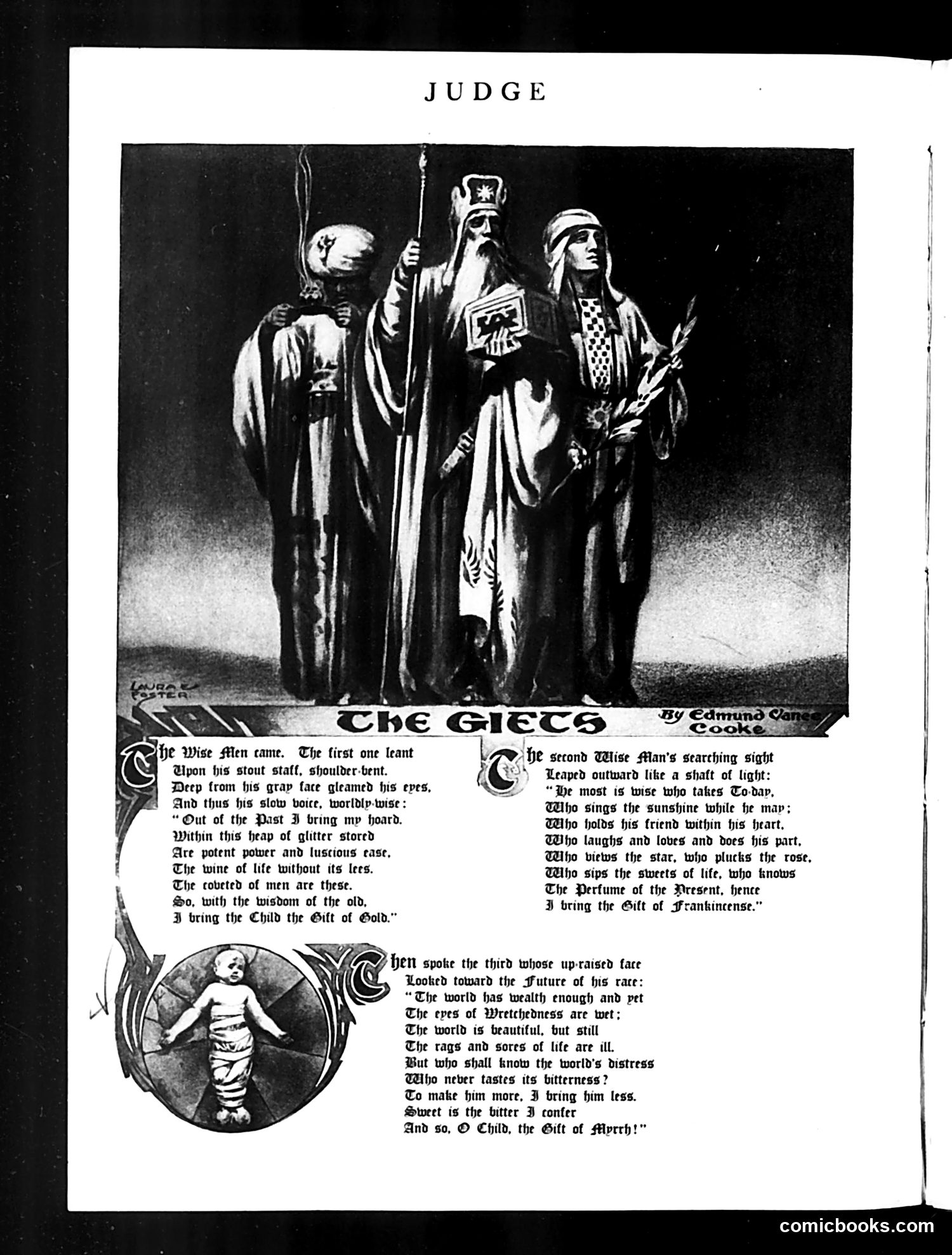
This page illustrates the biblical story of the Three Wise Men visiting the infant Jesus, reimagined as an allegorical poem about life's values. The three figures represent different philosophical approaches to existence: 1. **The first Wise Man** brings Gold—representing the Past and material wealth/power 2. **The second** brings Frankincense—representing the Present, advocating for enjoying life's pleasures and relationships in the moment 3. **The third** brings Myrrh—representing the Future, arguing that hardship and sorrow are necessary for wisdom and character The satire appears to critique materialism and nostalgia while championing mindful present-living. The poem suggests the child (humanity/each person) benefits most from experiencing life's bitter alongside its sweet—that suffering builds compassion and understanding. This reflects early-20th-century progressive thought valuing experience and personal growth over inherited wealth or future abstraction.
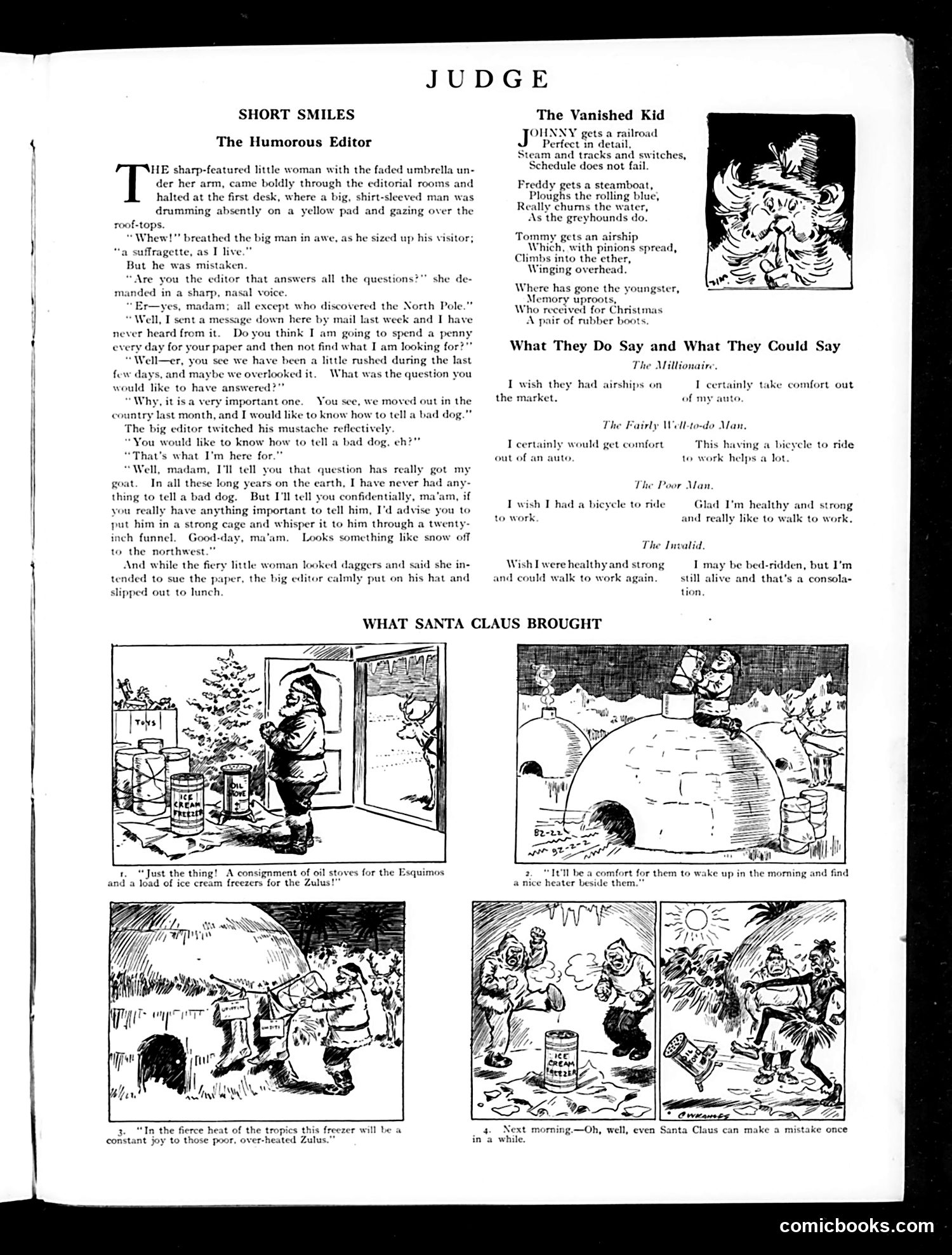
This Judge magazine page contains satirical humor about early 20th-century American life: **"The Humorous Editor"** mocks newspaper advice columns. A woman visits the editor asking how to identify a bad dog—a seemingly absurd question. The editor dismissively suggests putting the dog in a cage and whispering through a funnel, then leaves for lunch. The joke targets both readers' ridiculous questions and editors' unhelpful responses. **"The Vanished Kid"** is a sentimental poem contrasting children's Christmas presents: wealthy kids get luxury toys (trains, boats, airships), while one poor child receives only rubber boots—forgotten and overlooked. **"What They Do Say"** compares how different economic classes discuss automobiles. The millionaire wants airships; the middle-class man enjoys his auto; the poor man wishes for a bicycle; the invalid is simply grateful to be healthy. It satirizes class-based materialism and changing transportation technology. **"What Santa Claus Brought"** depicts Santa delivering inappropriate gifts to tropical regions—oil stoves and ice cream freezers to Zulus and Esquimos—showing the absurdity of colonial-era attitudes toward indigenous peoples.
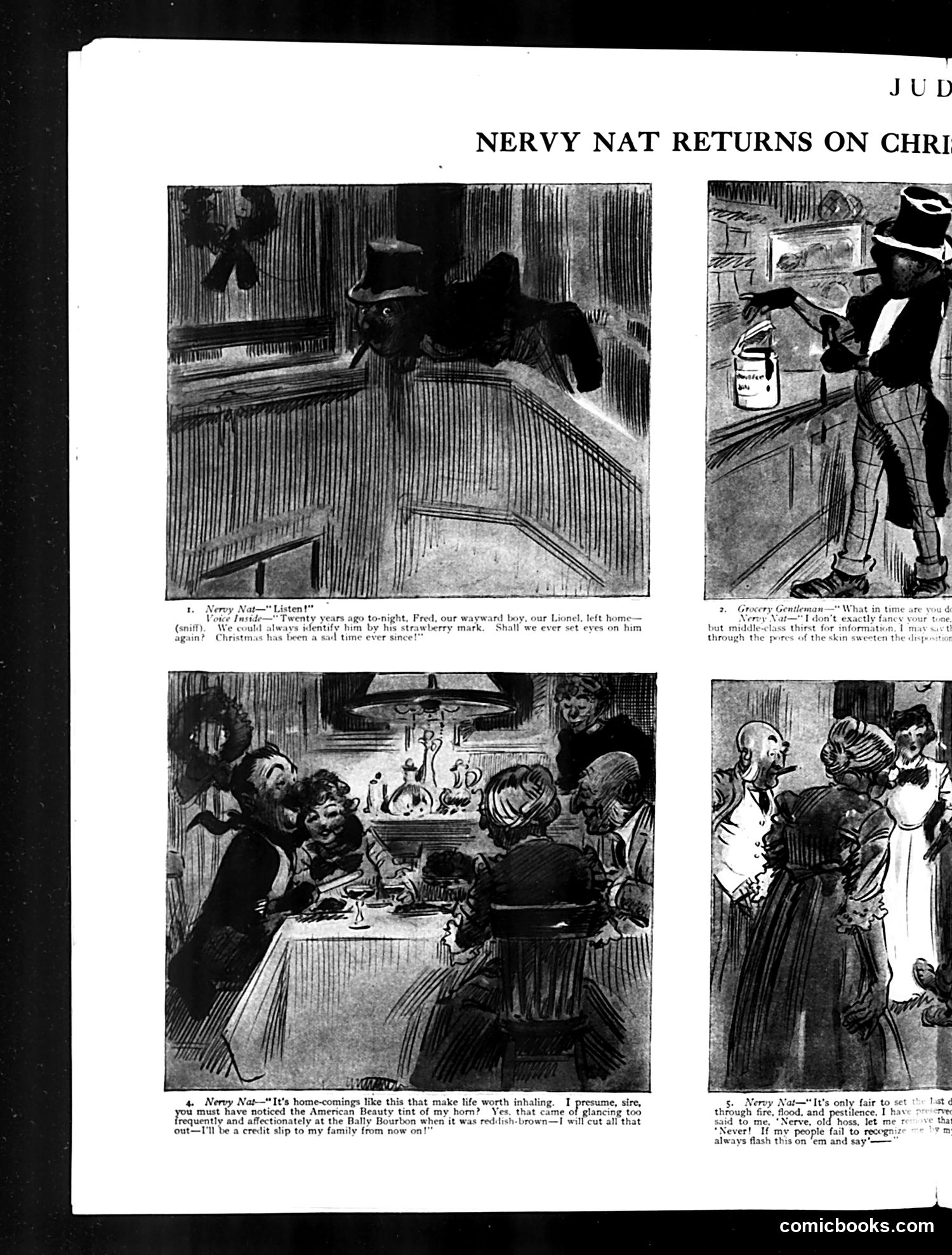
This appears to be a comic strip or narrative sequence featuring a character called "Nervy Nat." The visible panels show what seems to be a homecoming story, likely set during the Christmas holiday season (as indicated by the title). Panel 4's dialogue references "American Beauty" (likely the flower), a "Bally Bou[rbon]" (suggesting a saloon or bar), and family honor—suggesting the narrative involves Nat returning home after time away, possibly having spent money frivolously on luxuries and drink. The character appears concerned about being a "credit slip" to his family. The satirical humor seems to involve a wayward character returning home and attempting to justify or explain his absence and spending. Without clearer visibility of all panels and text, the specific social commentary remains partially unclear, though it likely satirizes working-class behavior and family expectations of the era.
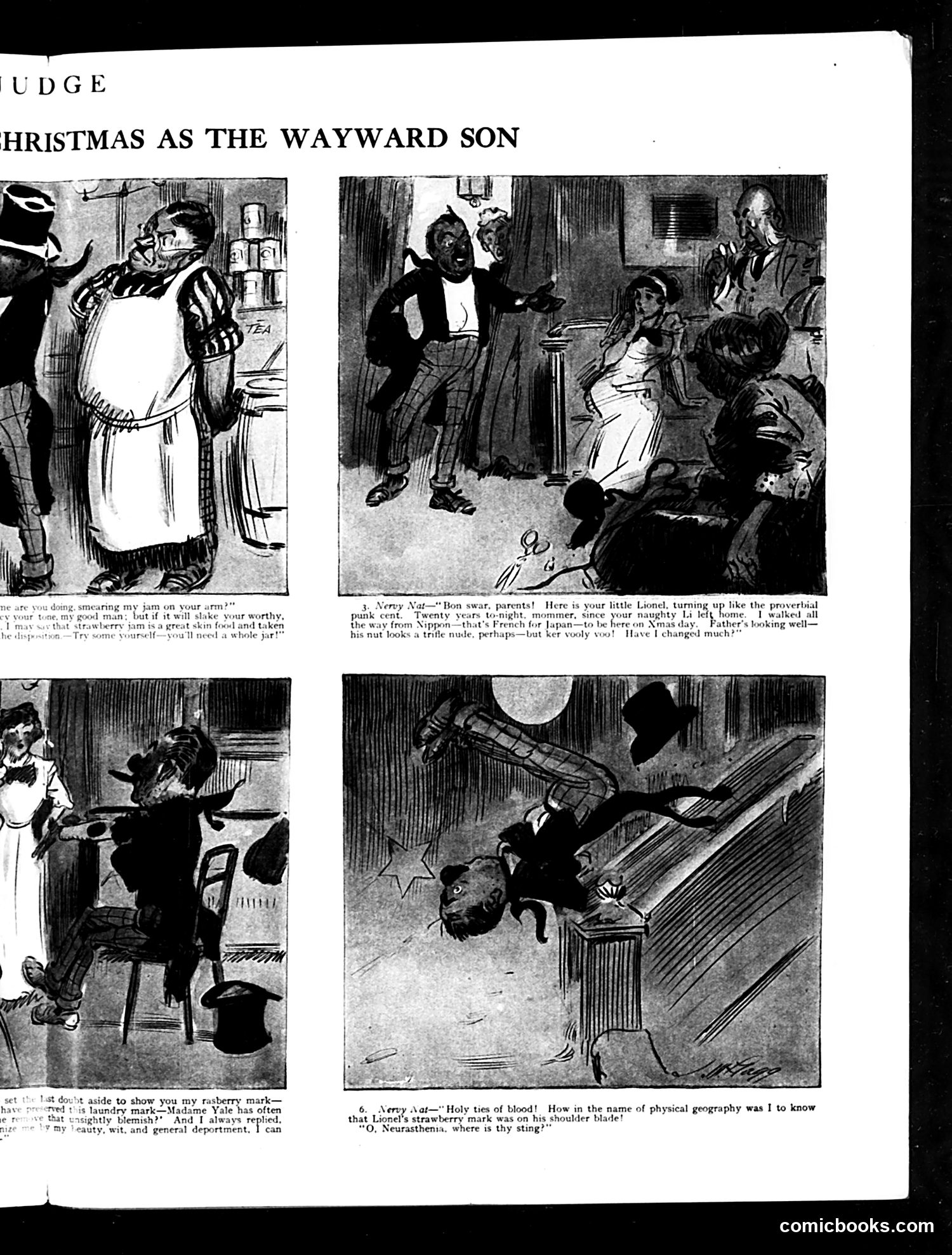
This is a four-panel satirical story from *Judge* magazine depicting Christmas personified as a misbehaving, absent son returning home to disappointed parents. The narrative follows a prodigal-son theme: a character named Lionel (representing Christmas) has been away—apparently traveling from Nippon (Japan) to France—and returns unexpectedly. The parents are shocked and confused by his appearance and behavior. The satire focuses on: **The joke**: Recognition failures and physical marks. The mother cannot identify her own son, confusing a strawberry mark's location. References to "Madame Yale" (a beauty treatment provider) and physical geography suggest the satirical point concerns commercialization and the changing, superficial nature of the holiday itself. **Social context**: The piece appears to mock how Christmas had become commercialized and unrecognizable from its traditional meaning—treated as a wayward, cosmetically altered stranger rather than a familiar, sacred observance. The emphasis on "marks" and "blemishes" suggests concerns about authenticity and corruption.
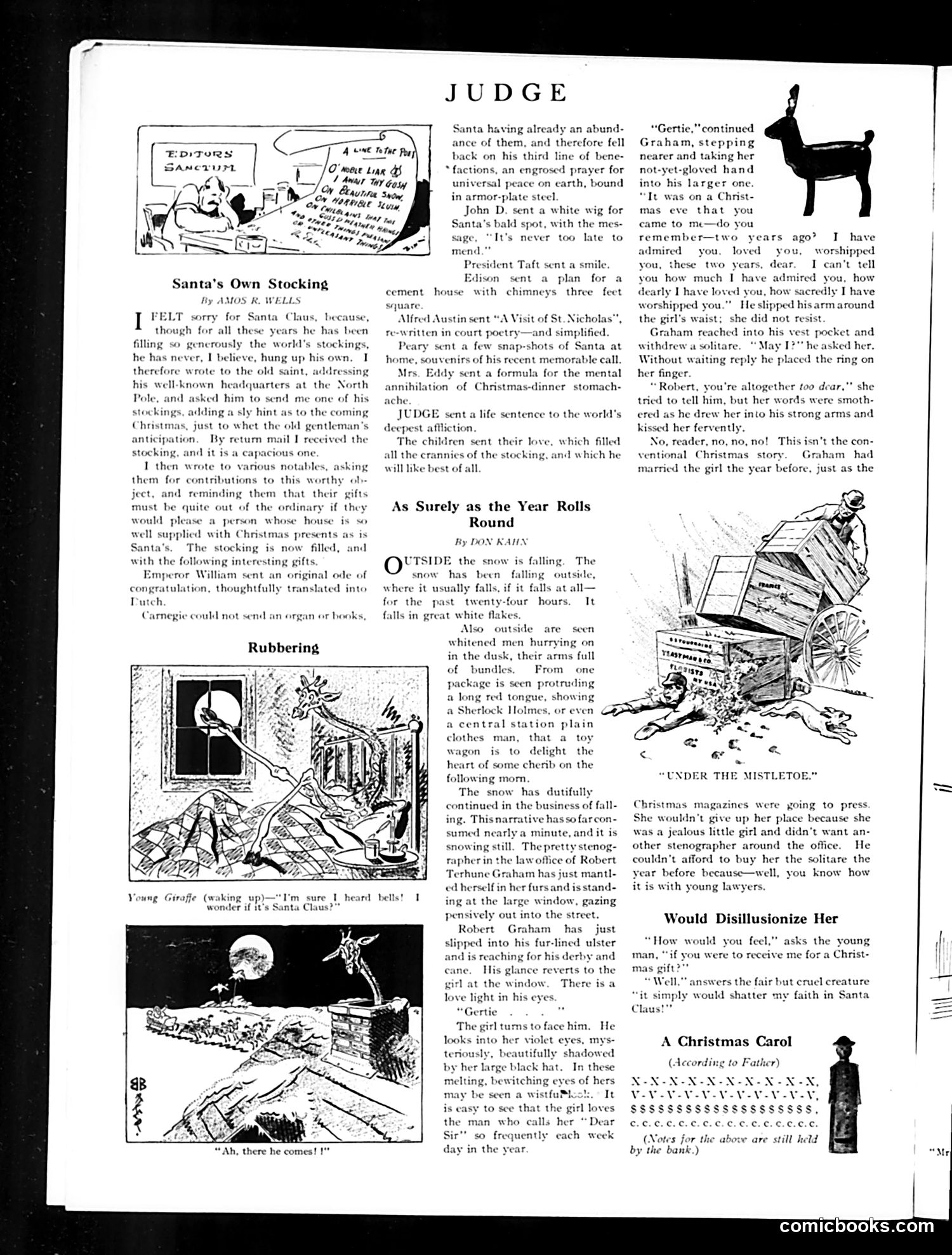
This page contains Christmas-themed satirical content typical of early 20th-century Judge magazine. **"Santa's Own Stocking"** is a humorous piece imagining what prominent figures would gift Santa Claus. The satire mocks wealthy and influential Americans: John D. Rockefeller sends a wig (implying baldness/age), Carnegie contributes (characteristic of his philanthropy), Edison offers practical invention, and Judge (the publication itself) sends "a life sentence to the world's deepest affliction"—a cutting joke about suffering. **"As Surely as the Year Rolls Round"** is a sentimental romantic story set during snowfall, featuring office worker Robert Graham and stenographer "Gertie." The illustration shows a snowy street scene with bundled figures and packages—establishing Christmas shopping season atmosphere. The cartoons use exaggeration and irony typical of Judge's satirical style to comment on wealth inequality, technological progress, and American social life during the holiday season.
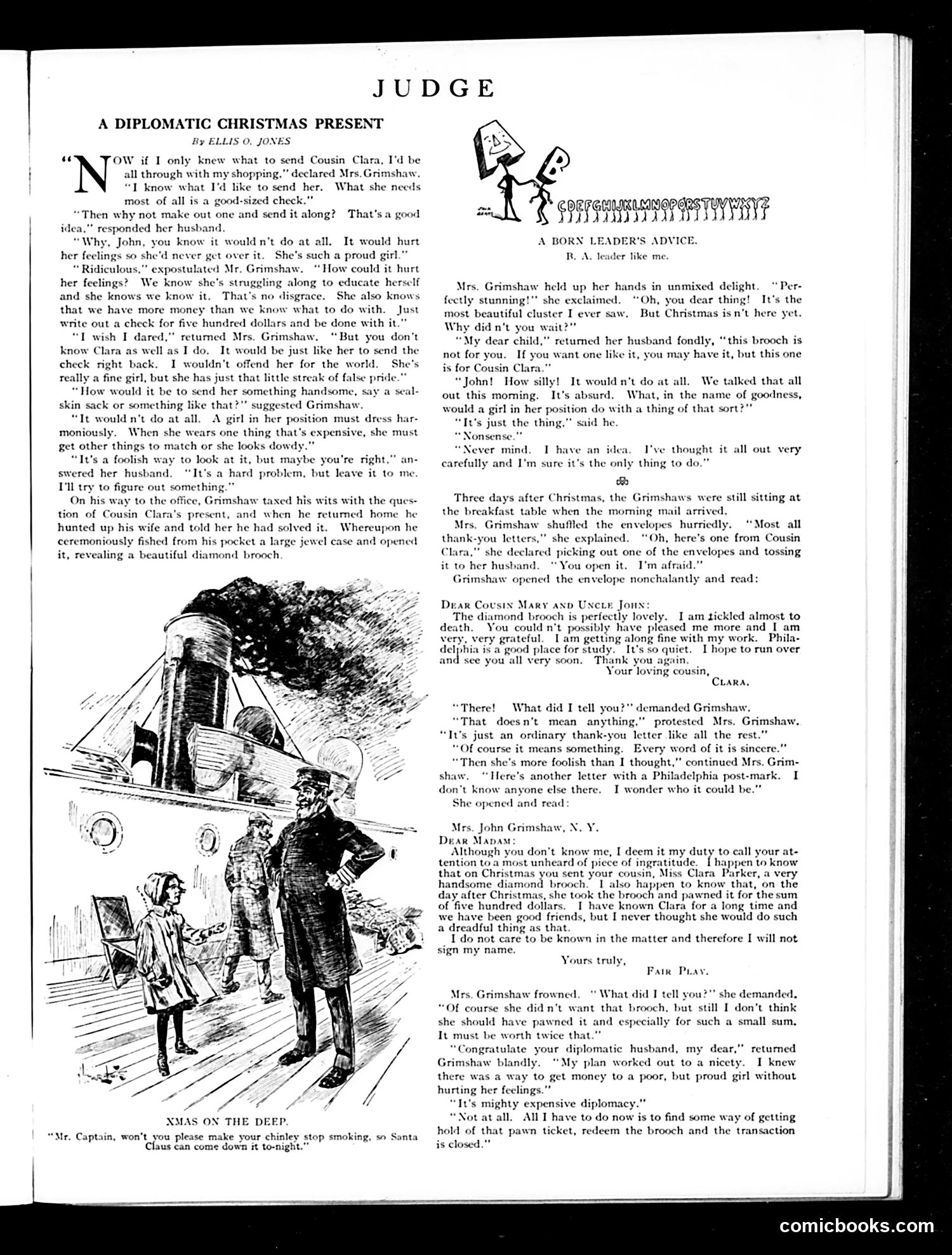
This story satirizes early 20th-century class anxieties and the peculiar etiquette surrounding charitable gift-giving to poor relatives. **The Setup**: Mrs. Grimshaw wants to help her struggling cousin Clara afford her education but fears insulting her pride with direct financial aid. Her husband Mr. Grimshaw eventually gifts Clara an expensive diamond brooch instead—a gift she cannot refuse because accepting jewelry involves no admission of financial need. **The Satire**: The joke exposes the absurdity of upper-class propriety: Clara cannot accept money (which would help her) without shame, but *can* accept a luxury brooch (which doesn't help her studies). Mr. Grimshaw solves the problem through diplomatic misdirection—the brooch's expense demonstrates generosity while avoiding the stigma of charity. **Social Context**: This reflects Gilded Age attitudes where accepting direct aid was considered degrading, yet conspicuous consumption was socially acceptable. The story mocks both the poor relation's false pride and the wealthy's elaborate psychological gymnastics to preserve her dignity. Clara's grateful letter confirms the scheme worked: she received the gift without losing face.
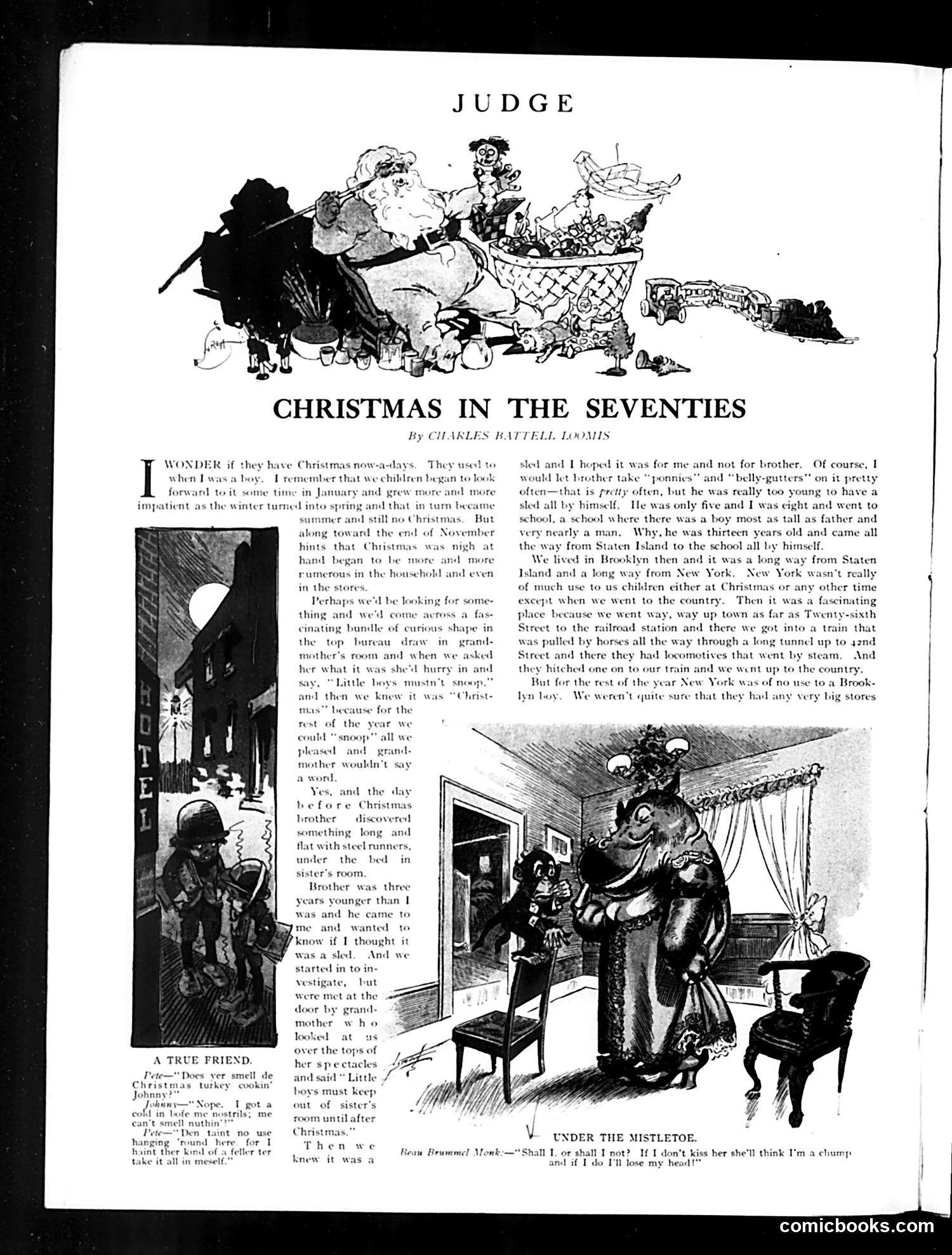
This nostalgic essay by Charles Battell Loomis recounts the author's childhood Christmas anticipation in 1870s Brooklyn. The narrative humor derives from contrasting Victorian-era Christmas customs with contemporary (1920s) expectations. The illustrations depict period details: a child peering through a keyhole at hidden gifts; Santa delivering toys; and a young man hesitating under mistletoe—a common courtship scenario of the era. The satire is gentle, not political. Loomis humorously emphasizes how Christmas anticipation stretched from January through November, how parents hid presents in bureau drawers, and how New York City seemed distant and largely irrelevant to Brooklyn children except for train rides to the countryside. The "True Friend" dialogue at bottom—about smelling Christmas turkey—appears unrelated advertising or filler content typical of Judge's layout. The piece celebrates nostalgic Americana rather than critiquing social conditions or politics.
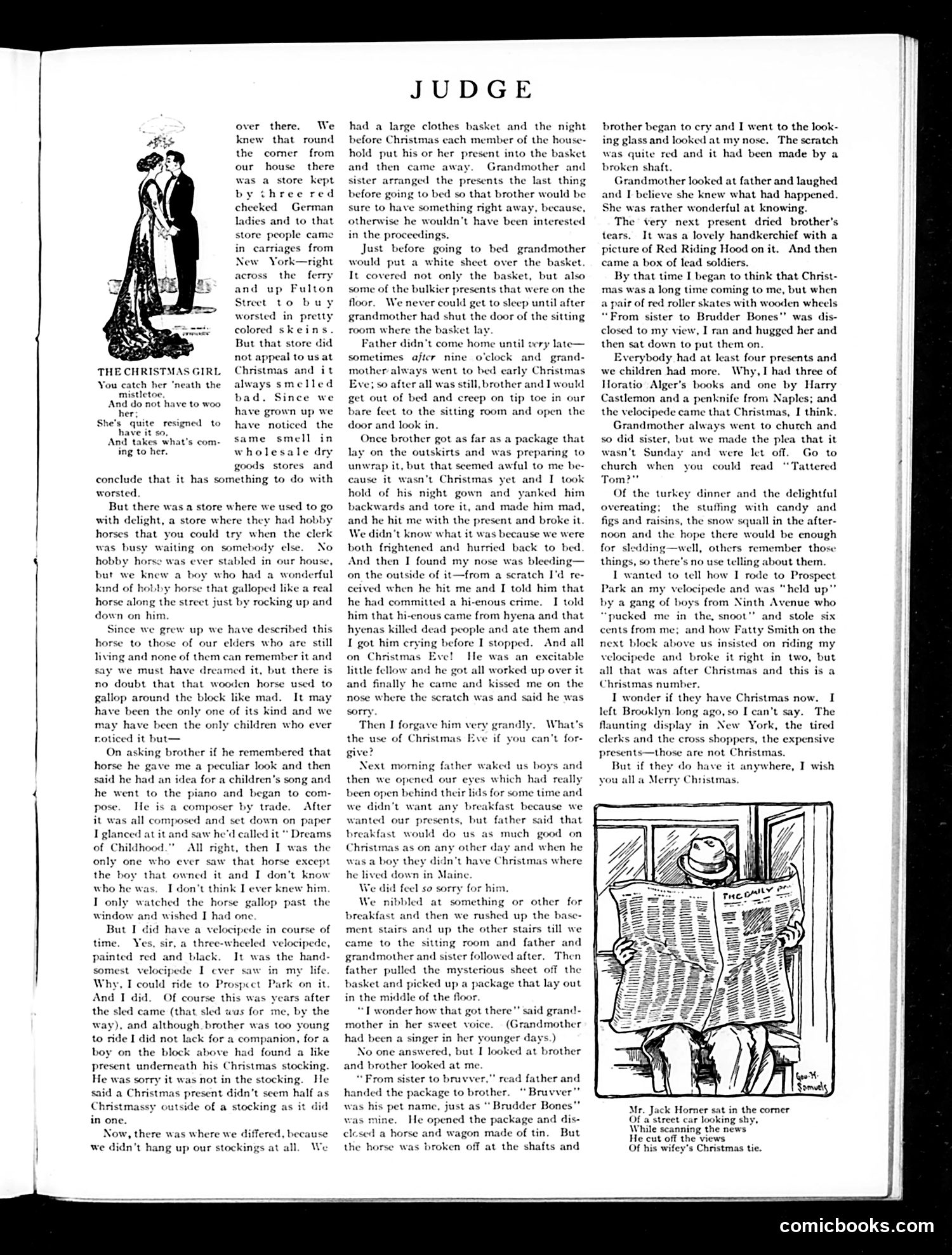
This page presents a nostalgic autobiographical essay about childhood Christmas memories, not political satire. The small illustration titled "THE CHRISTMAS GIRL" shows a fashionably dressed woman and appears to be an accompanying vignette (likely humorous commentary on courtship or romance), though its specific joke is unclear from the image alone. The main text humorously chronicles the author's recollections: a German import store, a miraculous wooden hobby horse, a velocipede (early tricycle), and the family's unconventional Christmas tradition using a clothes basket instead of stockings. The author notes later discovering their brother composed a piano piece called "Dreams of Childhood" about that wooden horse—suggesting the memory may have been imagination rather than fact. The humor lies in the self-aware, whimsical tone and the tension between childhood memory and adult skepticism about what was real.
This page appears to be a title or section divider from *Judge* magazine, rather than a cartoon with satirical content. The page displays: - The word "JUDGE" at the top - An ornate, decorative black frame with baroque-style flourishes at the corners - The word "FLAMES" on the right side The ornate frame is empty—there is no cartoon image, illustration, or text content within it. This appears to be a blank template page, possibly a chapter or section break used in the magazine's layout. Without visible cartoon imagery or satirical content, the political or social commentary cannot be determined from this image alone.
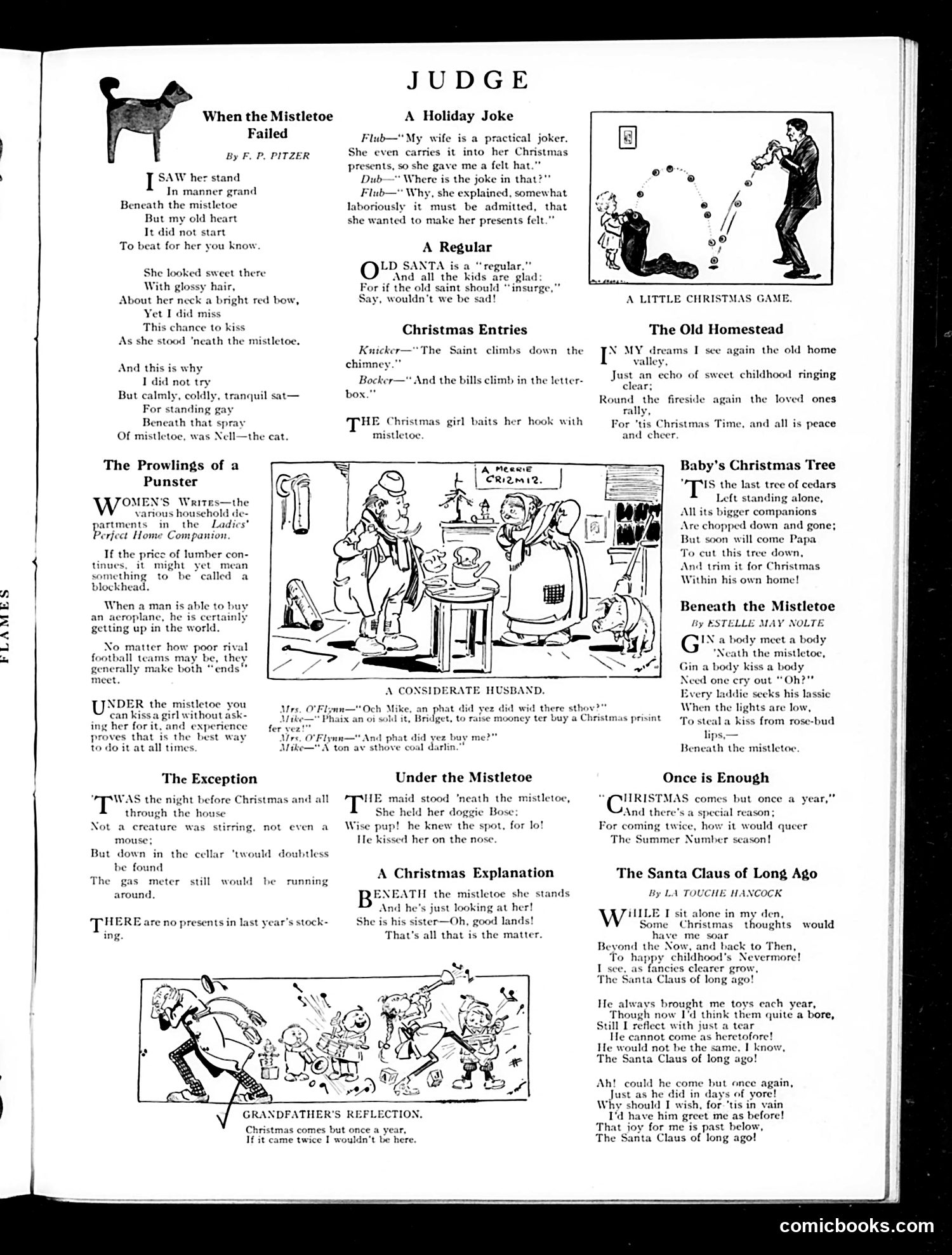
This Christmas-themed page from *Judge* magazine contains light holiday humor typical of early 20th-century American satire. The content includes: **"When the Mistletoe Failed"** presents a gentle anti-climax: the narrator anticipates romance beneath mistletoe but discovers the obstacle is a cat ("Nell"), subverting sentimental expectations. **"A Holiday Joke"** satirizes wives as practical jokers, with wordplay about a felt hat where "presents felt" (homophone joke). **"The Prowlings of a Punster"** mocks men who make terrible puns, presented as household nuisances. The page features multiple mistletoe-themed poems and jokes reflecting Victorian/Edwardian courtship customs where mistletoe provided socially-acceptable kissing opportunities. **"Grandfather's Reflection"** illustrates nostalgic melancholy about Santa Claus. The illustrations include domestic scenes and a "considerate husband" comic strip showing family Christmas activities. Overall, the humor targets predictable domestic situations, marital dynamics, and sentimentality—typical *Judge* magazine fare mocking middle-class American life.
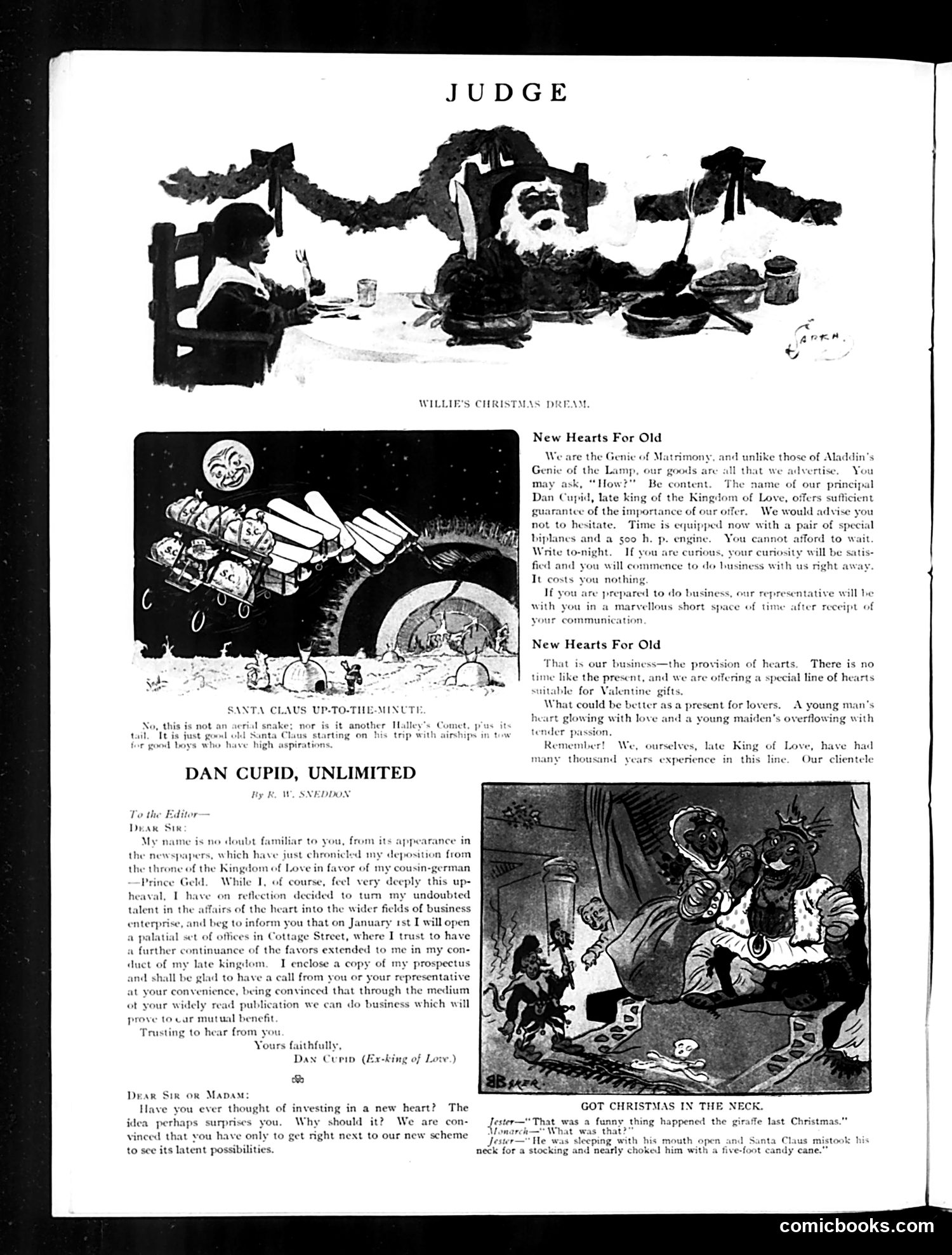
This page satirizes commercialization and romantic commodification through absurdist humor. **"Dan Cupid, Unlimited"** presents the Roman god of love as a deposed monarch who's pivoted to business. He's opening offices to sell "new hearts"—literally trading in romance as a commercial product, comparable to Aladdin's genie. The satire mocks how love itself has become a marketable commodity, with Cupid offering "special line of hearts suitable for Valentine gifts" and promising rapid service via "biplanes." **"Santa Claus Up-to-the-Minute"** (top illustration) shows Santa modernized with an airplane, satirizing how even traditional holiday figures are being updated with industrial-age technology—another jab at commercialism overtaking tradition. **"Got Christmas in the Neck"** (bottom) depicts a child who received a live giraffe as a Christmas gift that nearly choked him with a candy cane—dark humor about excessive, impractical gift-giving. Together, these pieces critique how capitalist enterprise and commercialism are reducing sacred or sentimental concepts (love, Christmas, childhood wonder) to mere business transactions.
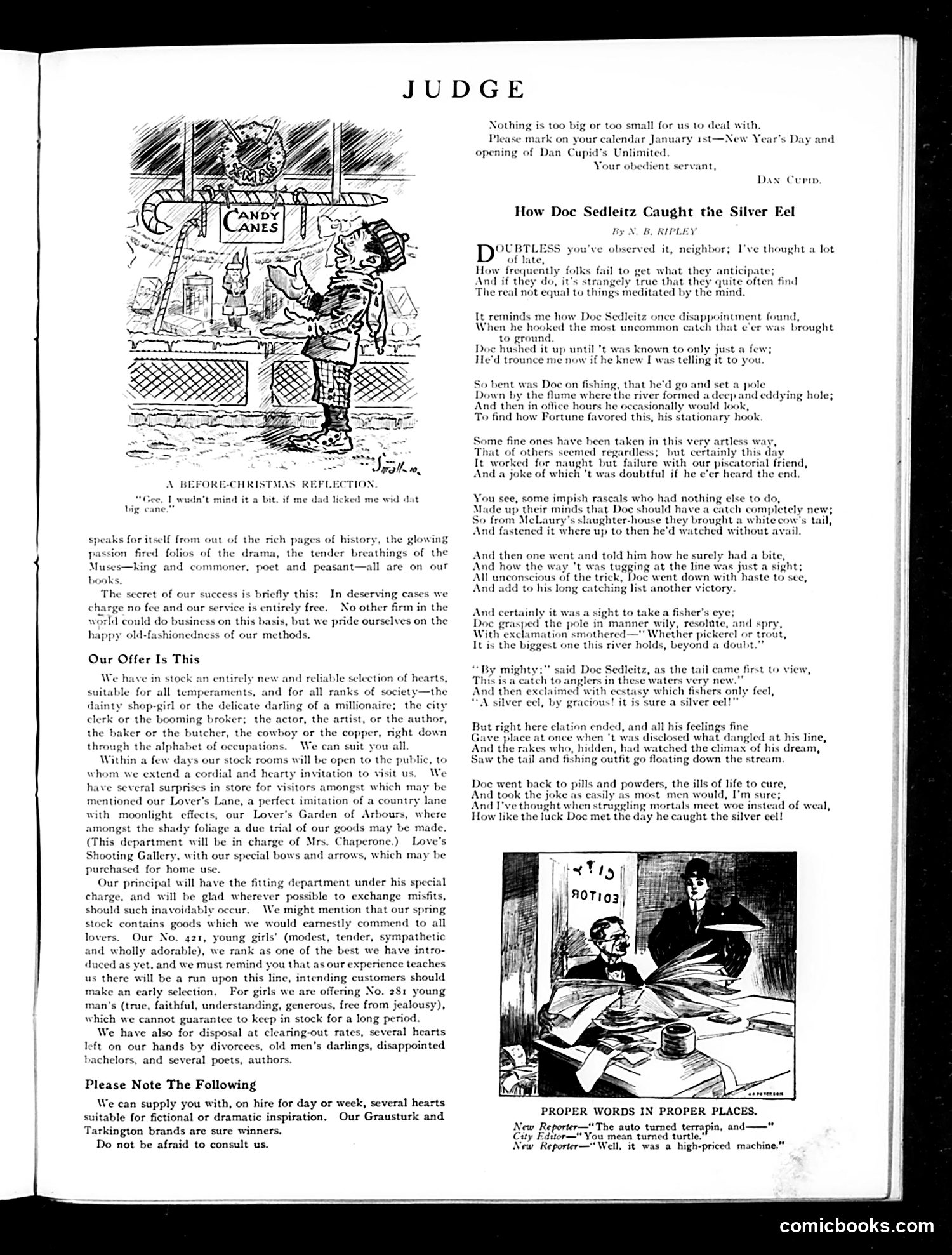
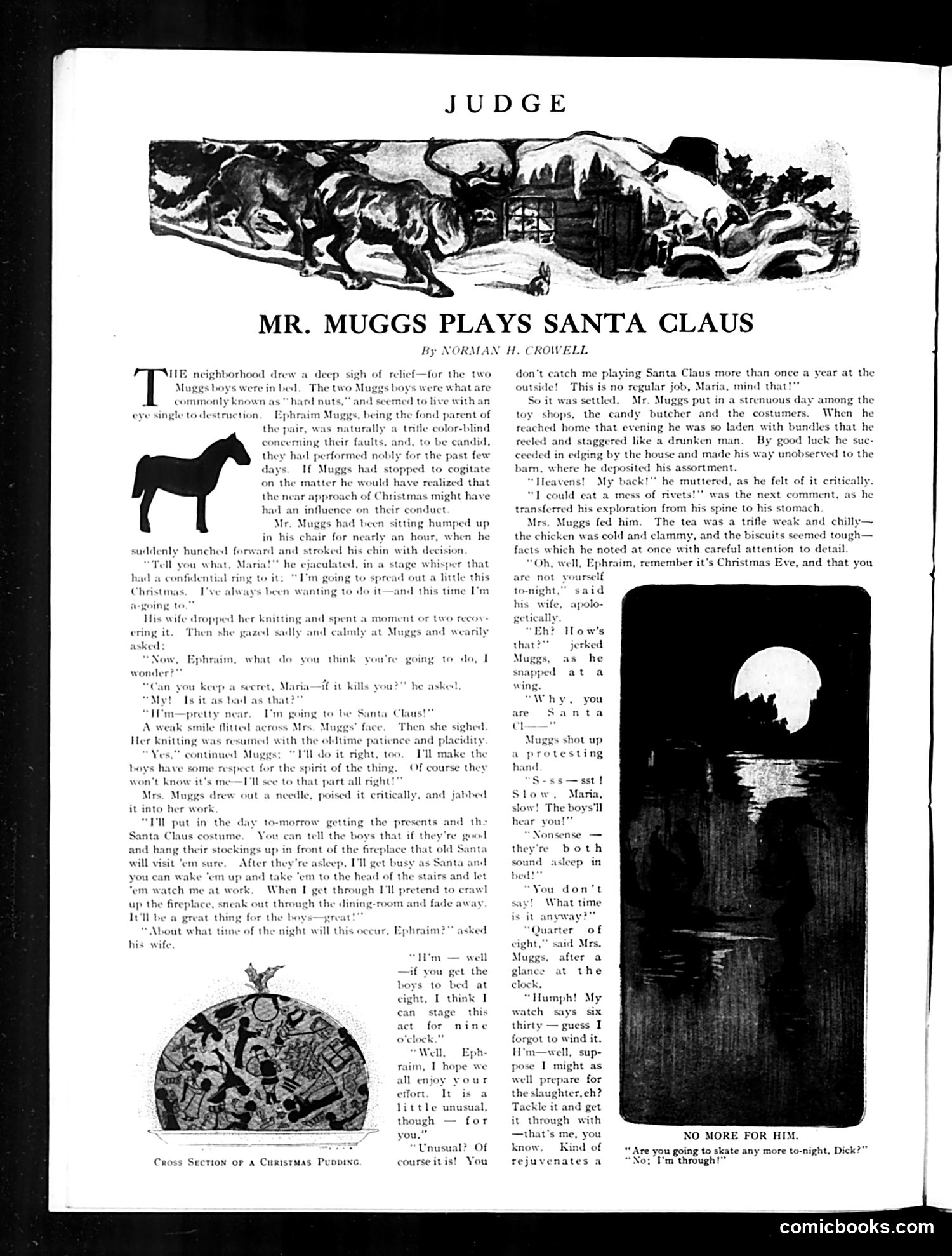
This is a humorous domestic story, not political satire. The plot concerns Mr. Ephraim Muggs, a working-class father, who decides to surprise his two mischievous sons (known as "hard nuts") by personally playing Santa Claus on Christmas Eve. He secretly purchases costumes and toys, hides them in the barn, and plans an elaborate surprise—taking the children downstairs after they're asleep to "catch" Santa at work. The humor derives from Muggs's elaborate scheming, his exhaustion from shopping, his cranky disposition after a poor dinner, and his wife's weary tolerance of his enthusiasm. The story satirizes not politics but rather the gap between fathers' grand Christmas ambitions and domestic reality—a relatable middle-class family scenario. The accompanying illustrations show Muggs in disguise and a cross-section Christmas pudding diagram.
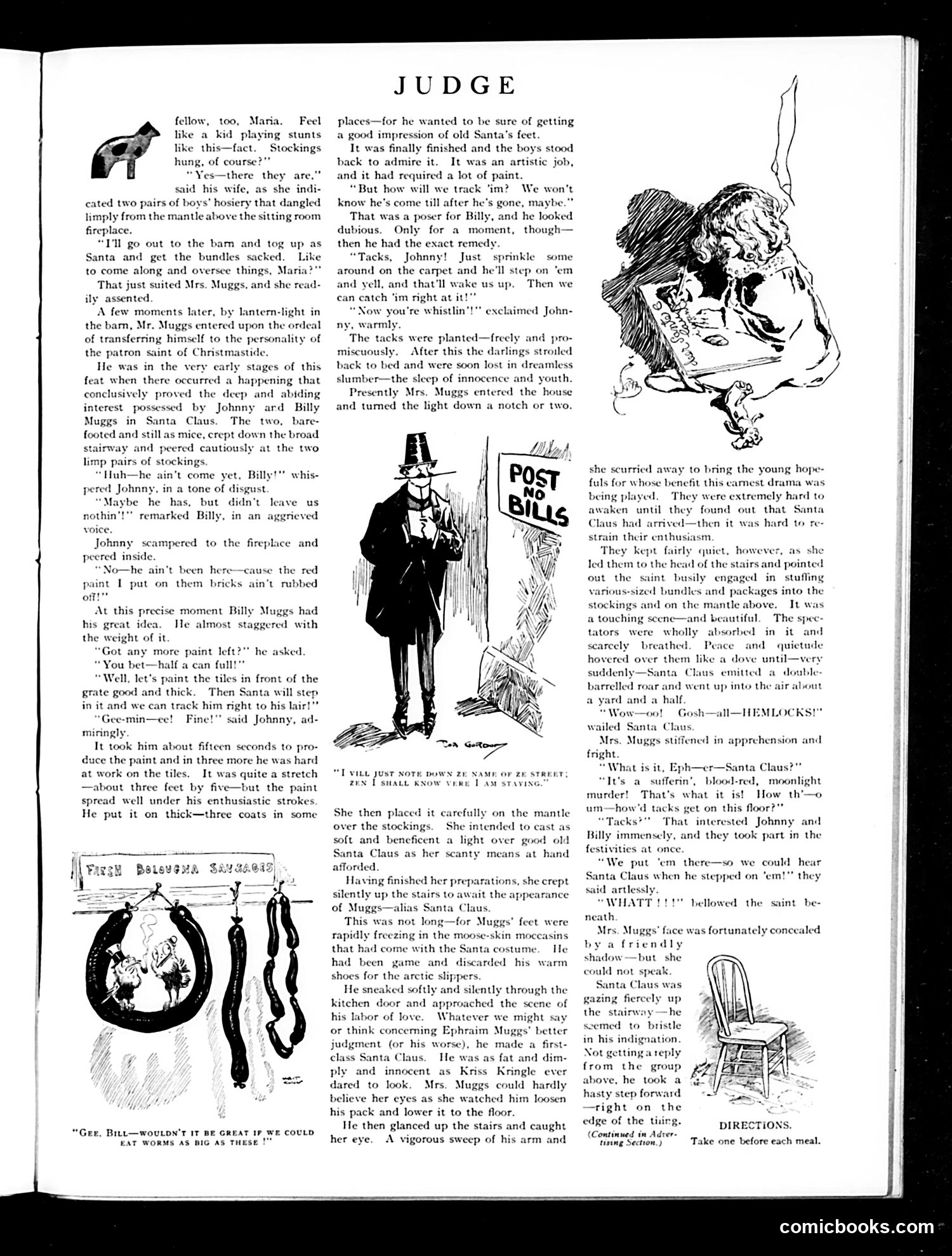
This page depicts a humorous Christmas story about a family's Santa Claus prank. Mr. and Mrs. Muggs plan for him to dress as Santa and fill stockings hung by the fireplace. Their sons, Johnny and Billy, devise an elaborate trap: they paint the floor tiles with thick paint to capture Santa's footprints, then scatter tacks on the carpet to catch him when he steps on them—intending to wake him up and "catch" Santa in the act. The satire targets the gap between children's innocent Christmas enthusiasm and their crude, potentially painful schemes. The boys' logic is childishly flawed (not realizing Santa will already have come and gone before they catch him). A secondary cartoon shows a figure with a German accent noting down street names, likely satirizing German immigrants or visitors—a common Judge magazine subject. The overall tone is gentle domestic humor rather than biting social commentary.
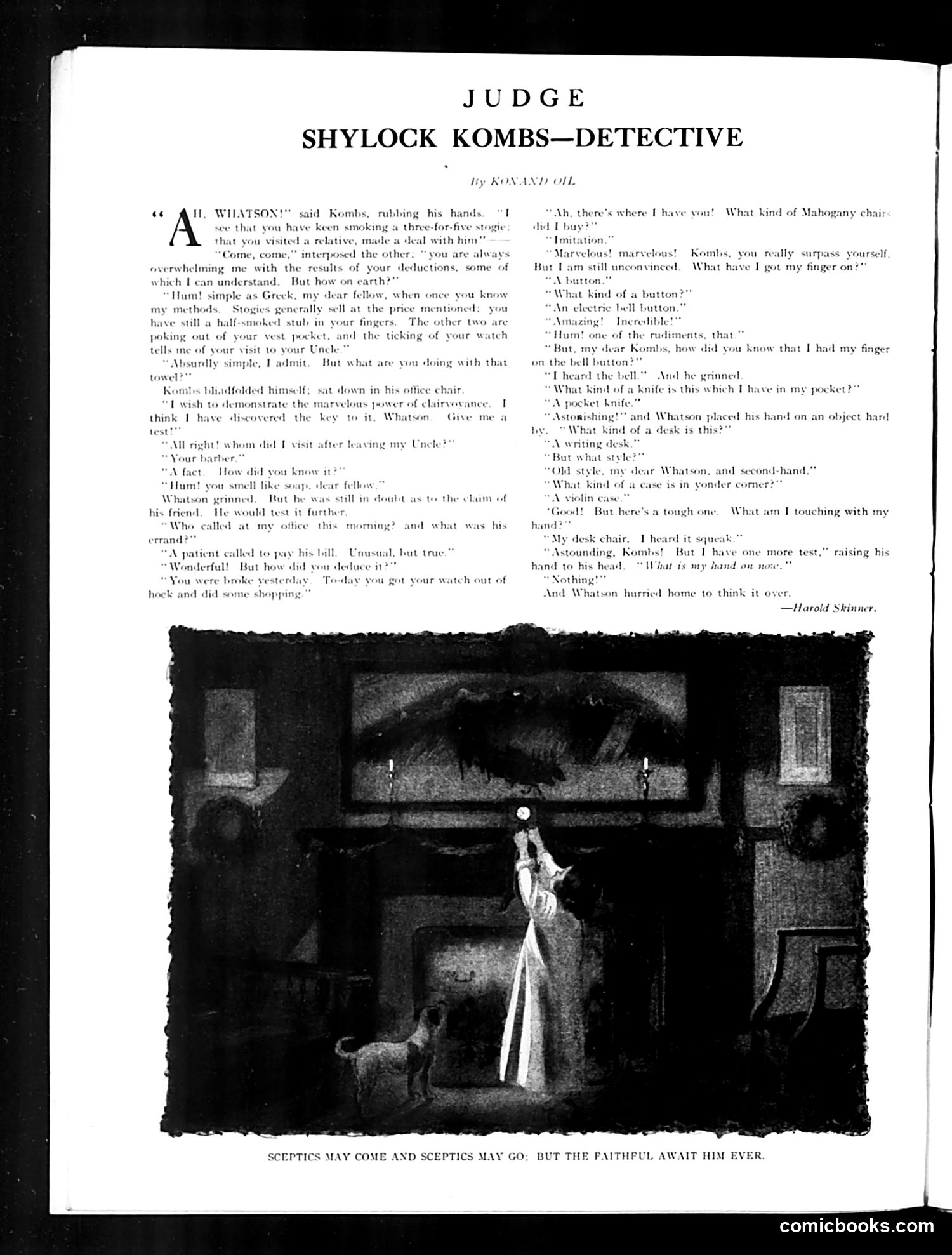
This is a parody of Sherlock Holmes, the famous fictional detective. The protagonist is named "Shylock Kombs" (combining "Shylock," the Jewish moneylender from *The Merchant of Venice*, with a play on Holmes). The satire mocks Holmes's deductive methods through absurd comedy. Kombs demonstrates his "detective skills" by stating obvious facts—that Watson smells like soap (because he visited a barber), that Watson is broke (because he retrieved his watch from hock), that objects in the room are a desk, chair, and violin case. Each "deduction" is comically trivial, deflating Holmes's famous intellectual superiority. The humor works through exaggeration: Watson increasingly questions whether these obvious observations constitute real detection. The final gag—when asked what he's touching with his hand, Kombs cannot answer—suggests his method collapses under scrutiny. This parodies the Holmes stories' popularity while poking fun at overly elaborate reasoning about simple matters.
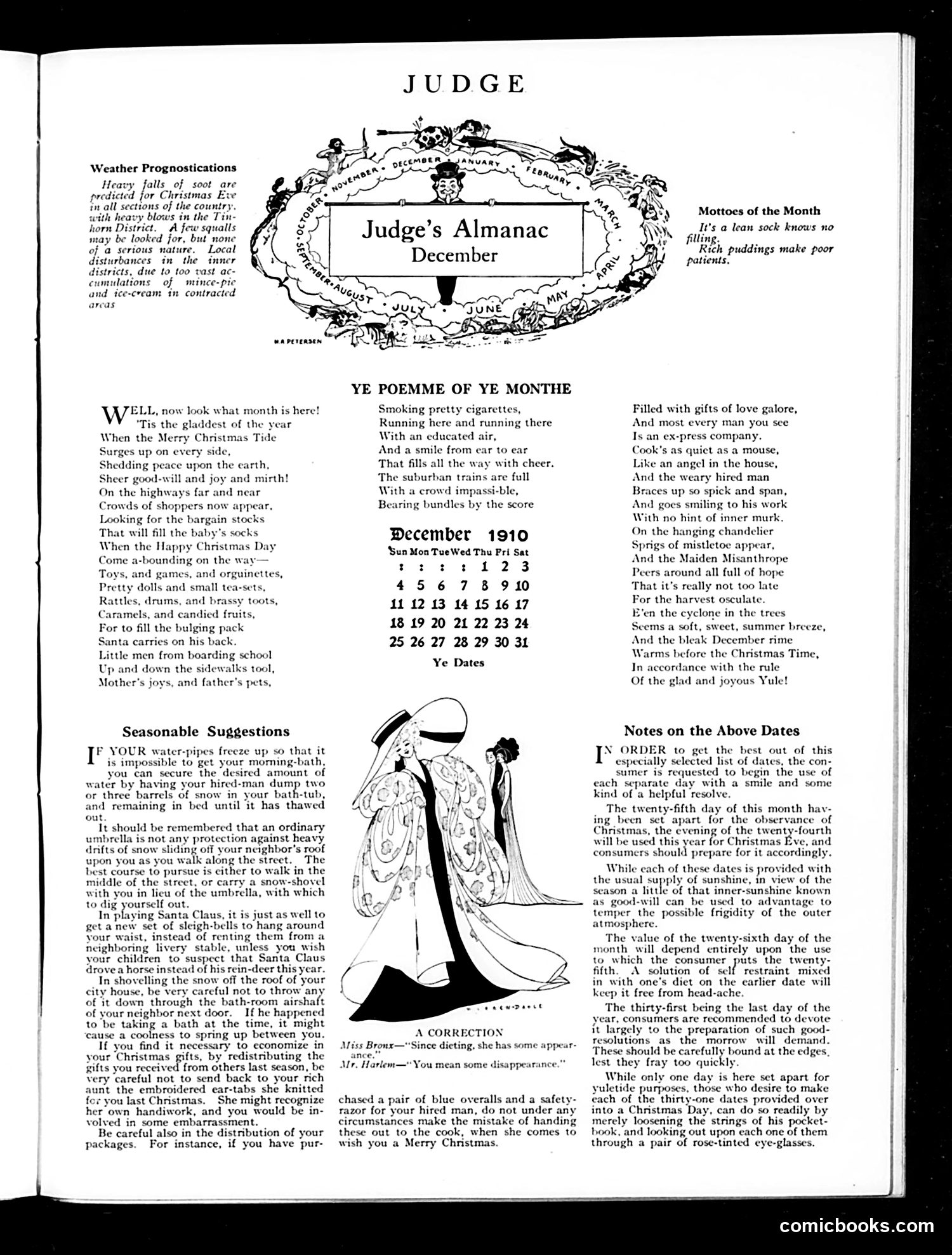
This is primarily a **holiday-themed almanac page** rather than political satire. The content consists of: **Main Features:** - A December 1910 calendar and seasonal humor - "Ye Poeme of Ye Monthe": A sentimental poem celebrating Christmas shopping, crowds, and holiday spirit - "Seasonable Suggestions": Satirical practical advice for winter in the city—humorous tips on frozen pipes, snow removal, and gift-giving etiquette **The Humor:** The satire targets middle-class urban life: the absurdity of winter inconveniences (replacing baths with melted snow), the social awkwardness of regifting, and the pretentiousness of holiday generosity. A small cartoon shows a woman claiming a dieting friend has "appearance" while a man quips she has "disappearance" instead—joking that dieting makes people literally vanish. **Context:** This reflects 1910 urban America: hired help, city plumbing problems, suburban commuting, and the commercialization of Christmas. The tone is gentle mockery of middle-class holiday customs rather than sharp political critique.
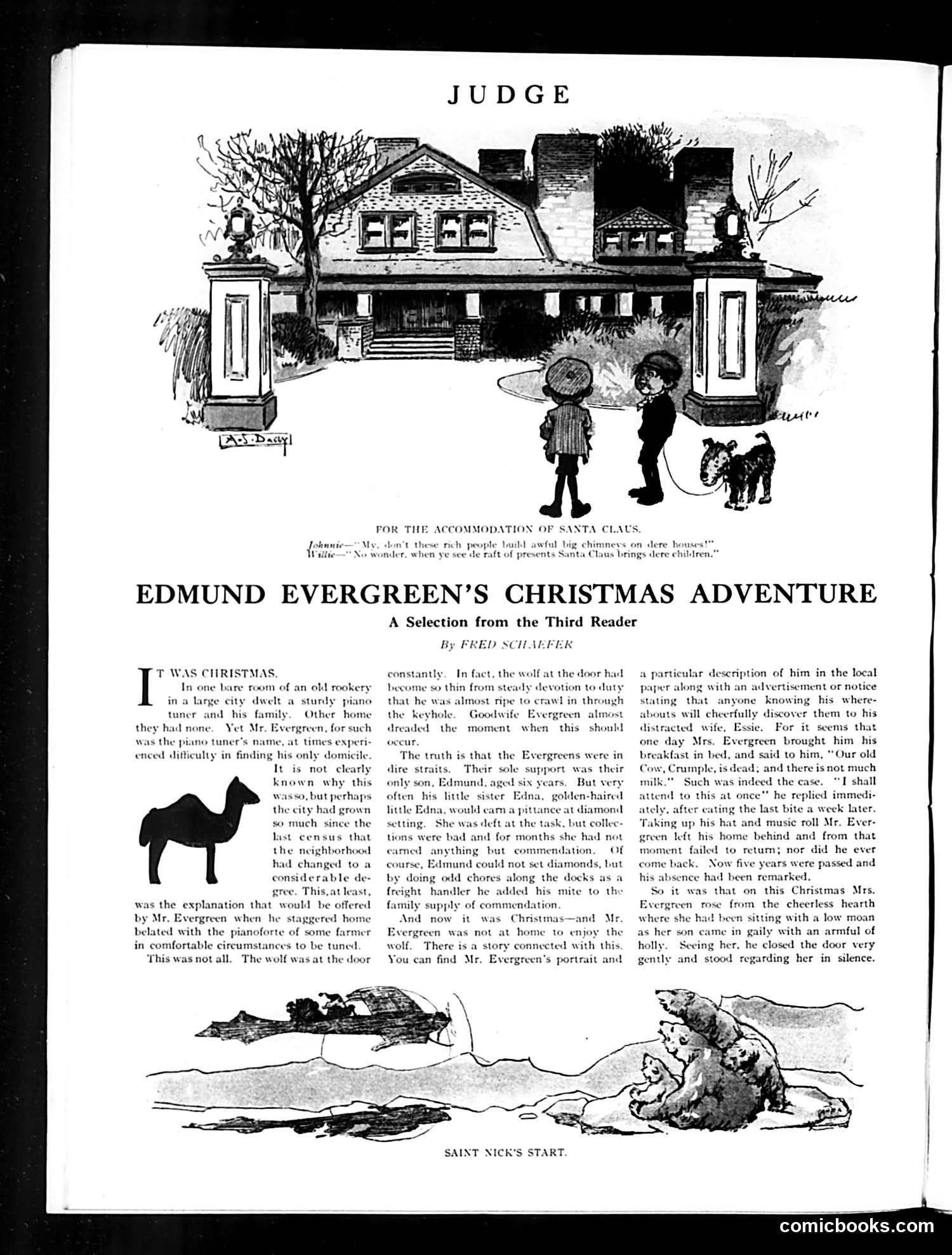
This is a serialized children's story (from a Third Reader textbook) rather than political satire. It depicts a poor piano-tuner family in a tenement ("old rookery") struggling through Christmas. The narrative establishes their poverty: Mr. Evergreen works odd jobs on the docks; his sister Edna does diamond-setting piecework; their cow has died; and the family faces destitution (the "wolf at the door" is a period metaphor for starvation). The opening dialogue satirizes wealth disparity—a child asks why rich people build large chimneys since Santa brings presents to all children, implying the wealthy's unnecessary ostentation. The page includes illustrations: the judge magazine's header image shows a mansion with children and a dog outside; "Saint Nick's Start" depicts Santa's sleigh beginning its journey. This appears to be wholesome period fiction rather than political commentary.
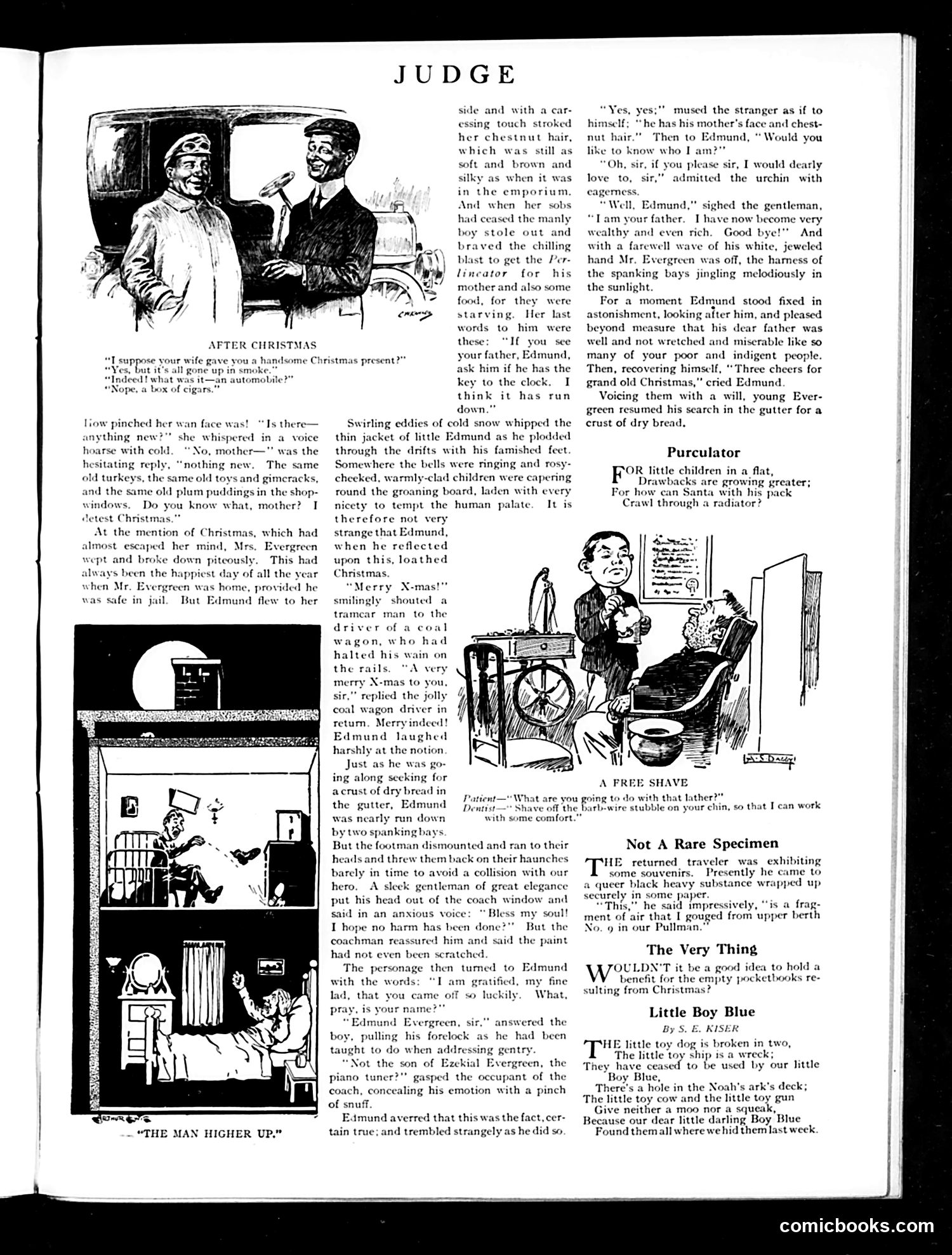
This page presents a sentimental Christmas tale mocking melodramatic Victorian fiction. The story follows poor young Edmund, whose starving family despises Christmas because his father is imprisoned. Edmund encounters a wealthy gentleman whose carriage nearly hits him; the gentleman—revealed to be Edmund's own father, now mysteriously rich—reconciles with his son after years in jail. The satire targets **overwrought serialized fiction** popular in the era: orphaned children in gutters, implausible coincidental reunions, and abrupt class mobility presented as heartwarming. The repeated emphasis on Edmund's "manly" poverty and the father's sudden wealth satirize how such stories resolved social problems through luck rather than systemic change. The gentleman's casual concern only about his coach's paint satirizes upper-class indifference to the poor—except their own relatives. The final "three cheers for Christmas" mockingly endorses the unrealistic happy ending such fiction promised working-class readers.
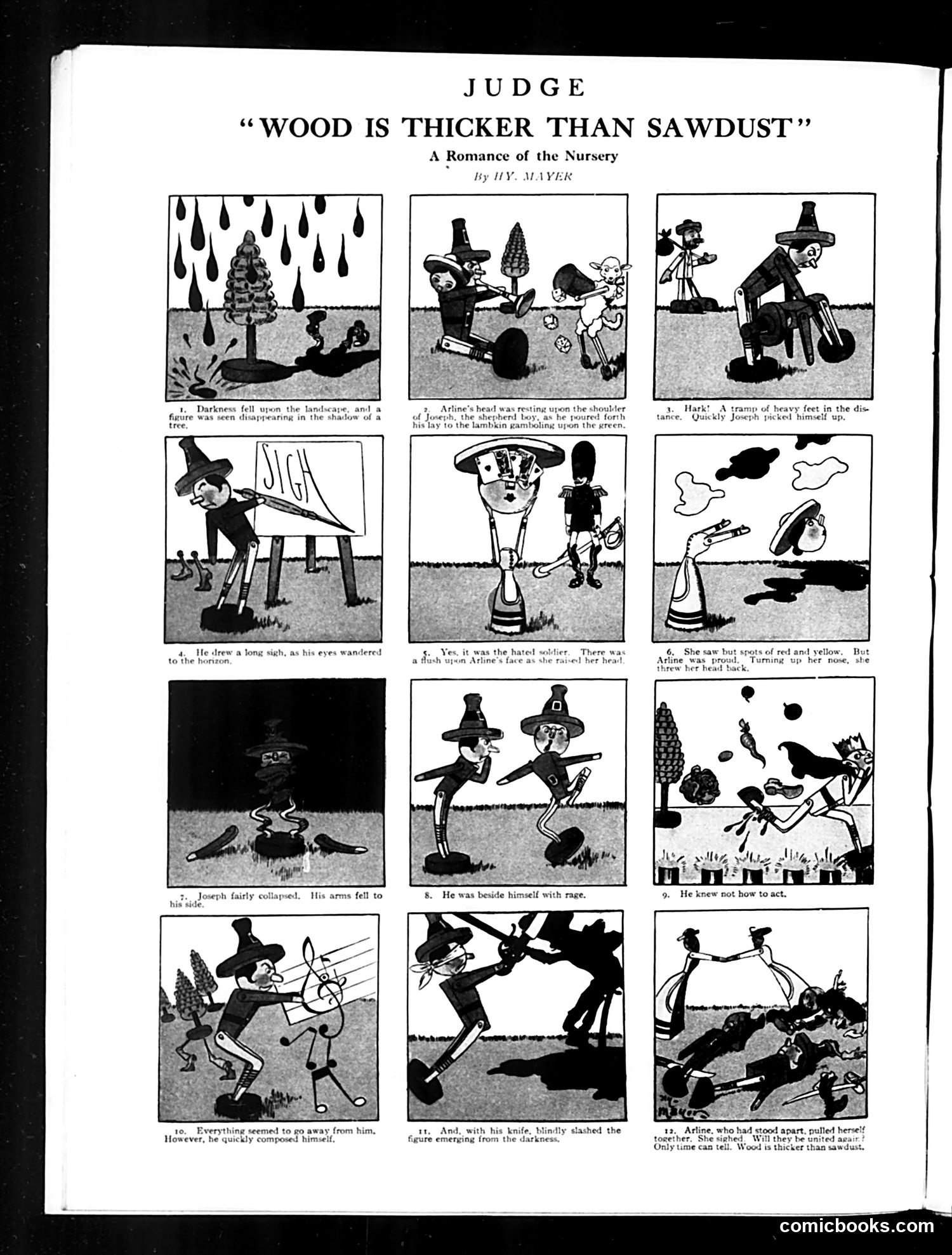
This is a 12-panel comic strip romance parody subtitled "A Romance of the Nursery" by H.Y. Mayer. The narrative appears to satirize melodramatic romance stories through nursery characters or fairy-tale figures. The plot involves characters named Arline and Joseph in a dramatic love story: darkness falls, a figure disappears, Arline's heart rests on a soldier's shoulder, Joseph faints and collapses, the soldier rages with jealousy, violence erupts (a knife slash), and the final panel suggests reconciliation—"Will they be united again? Only time can tell. Wood is thicker than sawdust." The title phrase "wood is thicker than sawdust" appears to be a humorous inversion of "blood is thicker than water," suggesting the wood (solid, substantial) of true love outlasts mere sawdust (hollow, insubstantial) of superficial romance. The cartoon mocks overwrought Victorian-era romance narratives through exaggerated, comedic illustrations.
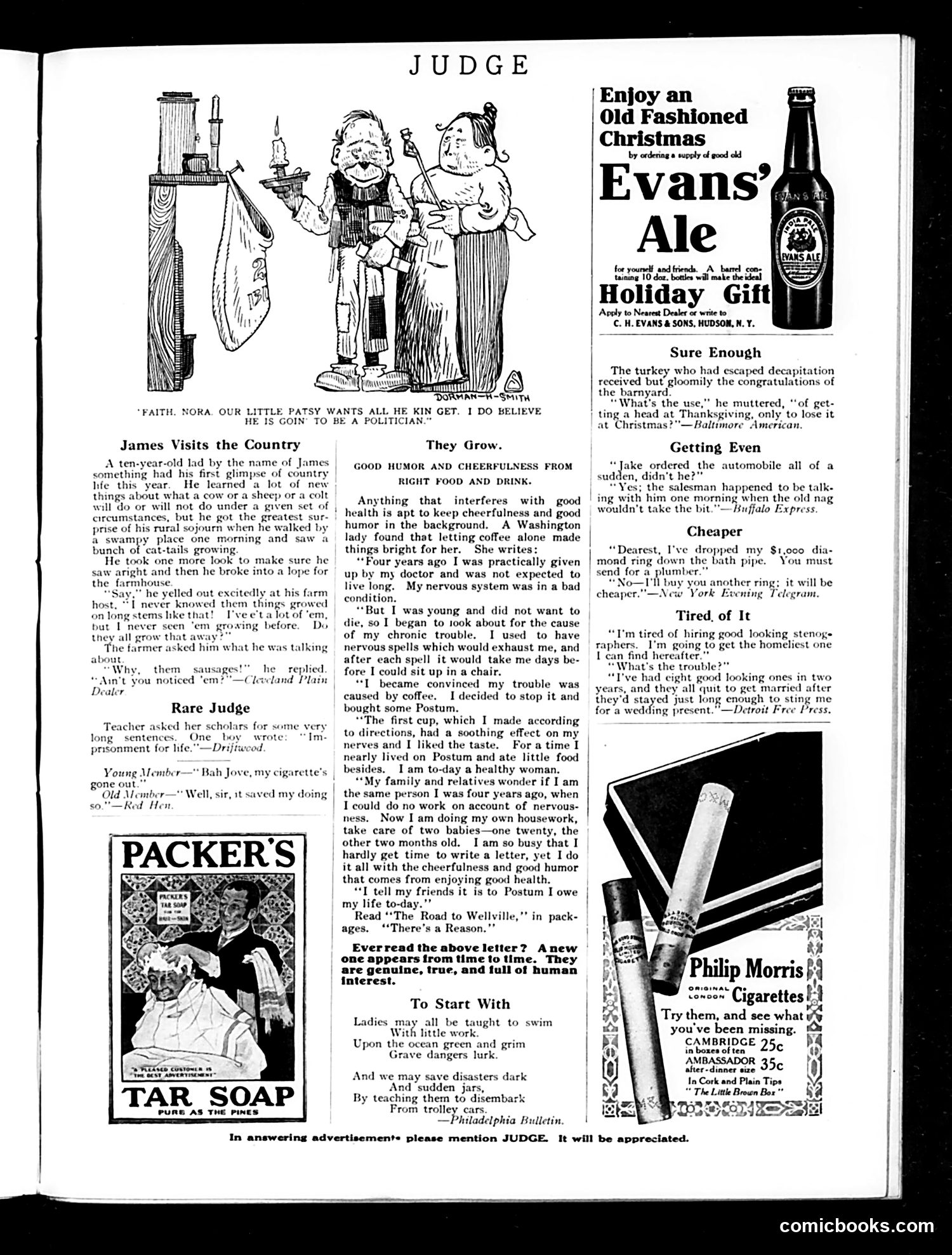
This Judge magazine page (date unclear from image) contains satirical cartoons and humorous anecdotes typical of early 20th-century American humor. **Main Cartoon:** The top illustration by Dorman-Smith depicts an Irish immigrant family ("Patsy," "Nora") discussing their young son's future, predicting he'll become a politician because he greedily wants "all he kin get." This reflects anti-Irish and anti-immigrant stereotypes common in that era, portraying Irish as corrupt politicians. **Text Stories:** The page includes brief humorous anecdotes: a rural boy mistaking cattails for sausages, and wordplay about teachers and cigarettes. These showcase mild, family-friendly humor. **Advertisements:** The page heavily features ads for Postum (a coffee substitute), Evans' Ale, Packer's Tar Soap, and Philip Morris cigarettes—products marketed with health claims now recognized as dubious or harmful. The overall tone reflects genteel satire aimed at middle-class readers, with immigrant caricatures representing common prejudices of the period.
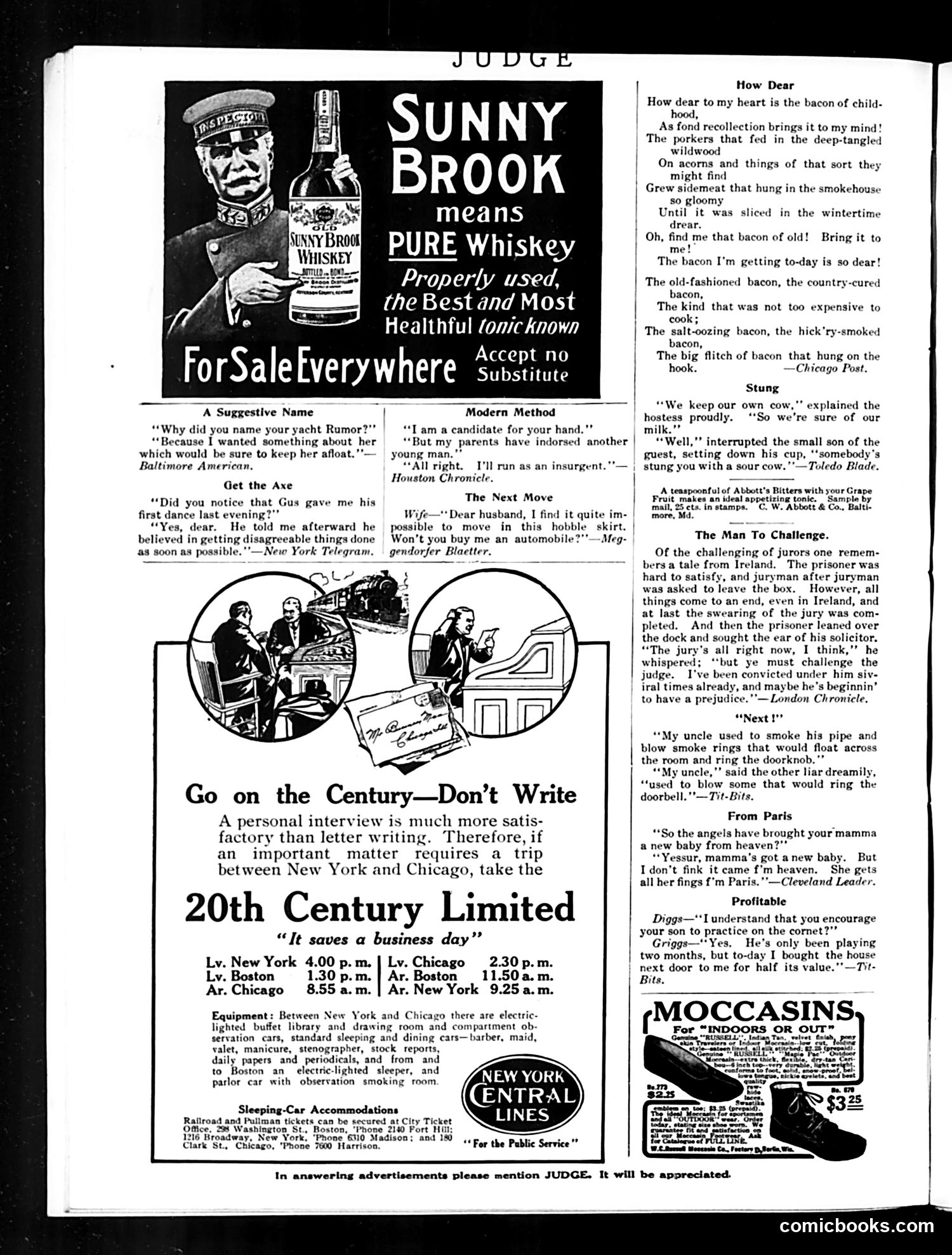
This page contains satirical humor pieces and advertisements typical of early-20th-century Judge magazine. The content includes: **Main Features:** - Multiple short joke columns lampooning contemporary social situations (courtship, marriage, automobiles, trains) - A nostalgic poem about old-fashioned bacon, written in deliberately overwrought romantic style—satirizing both food nostalgia and the magazine's own sentimental audience - An Irish anecdote about a prisoner challenging a judge out of prejudice—poking fun at legal absurdity and Irish stereotypes **Advertisements:** - Sunny Brook Whiskey (marketed as a "healthful tonic") - 20th Century Limited train service between New York and Chicago - Moccasins and other products The satire targets middle-class American concerns: matrimonial negotiations, consumer desires (automobiles), and commercial culture. The bacon poem particularly mocks sentimental reminiscence about "the good old days"—a recurring Judge theme.
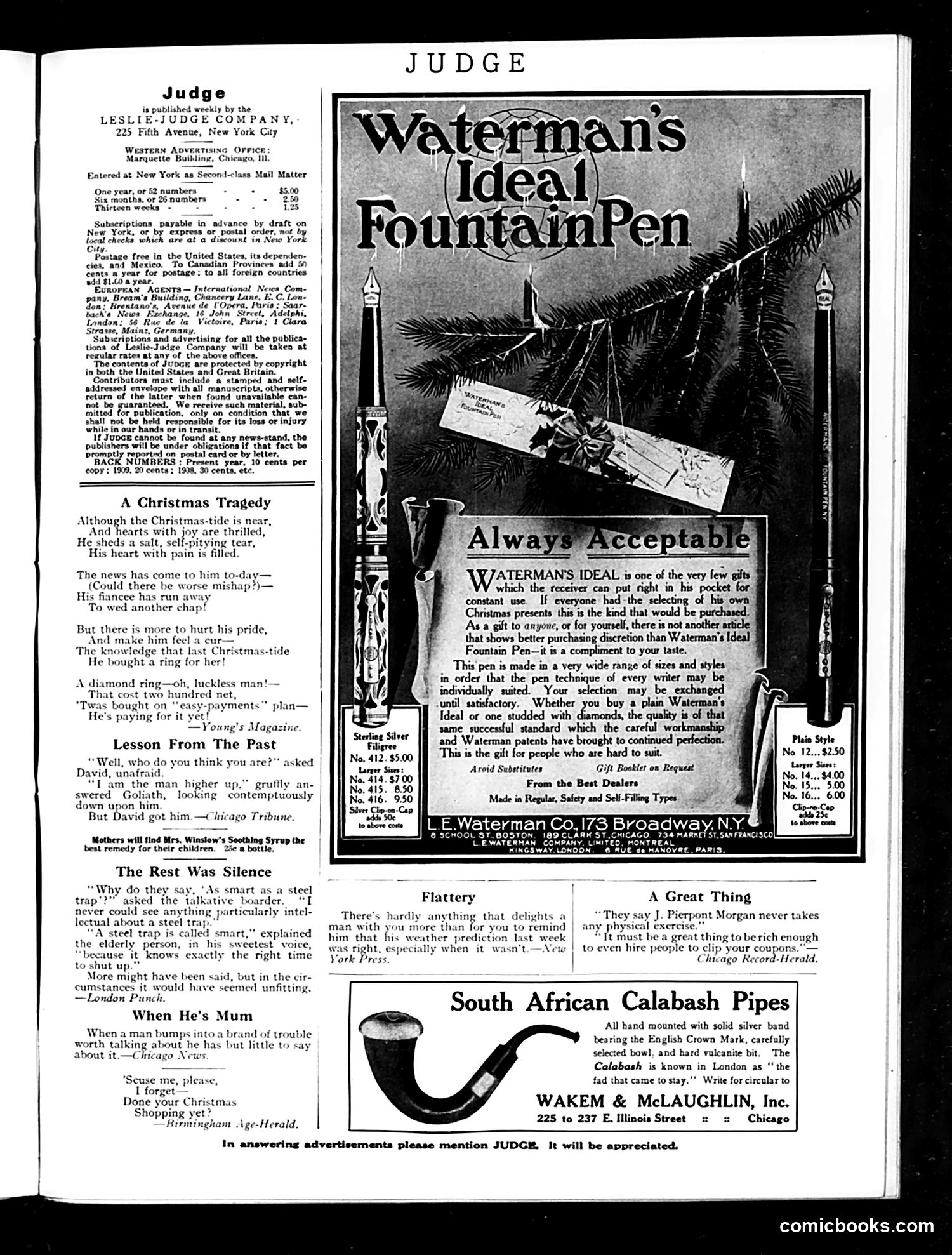
This page is primarily **advertising and magazine masthead**, with limited satirical content. The dominant feature is a large Waterman's Ideal Fountain Pen advertisement, emphasizing the pen as an "always acceptable" Christmas gift. The few short humorous pieces include: - **"A Christmas Tragedy"**: A sentimental poem about a man whose fiancée elopes, leaving him still paying "easy-payments" on her diamond ring—satirizing both romantic disappointment and consumer debt. - **"Lesson From The Past"**: A brief quip comparing a man's bold confidence to David facing Goliath, suggesting overconfidence gets comeuppance. - **Steel trap jokes**: Wordplay about "smart" steel traps that "know exactly the right time to shut up"—likely mocking overly clever people. The page reflects early 20th-century concerns: installment purchasing, romantic betrayal, and genteel humor typical of *Judge*'s middle-class readership. The advertisements (fountain pens, smoking pipes) target affluent consumers.
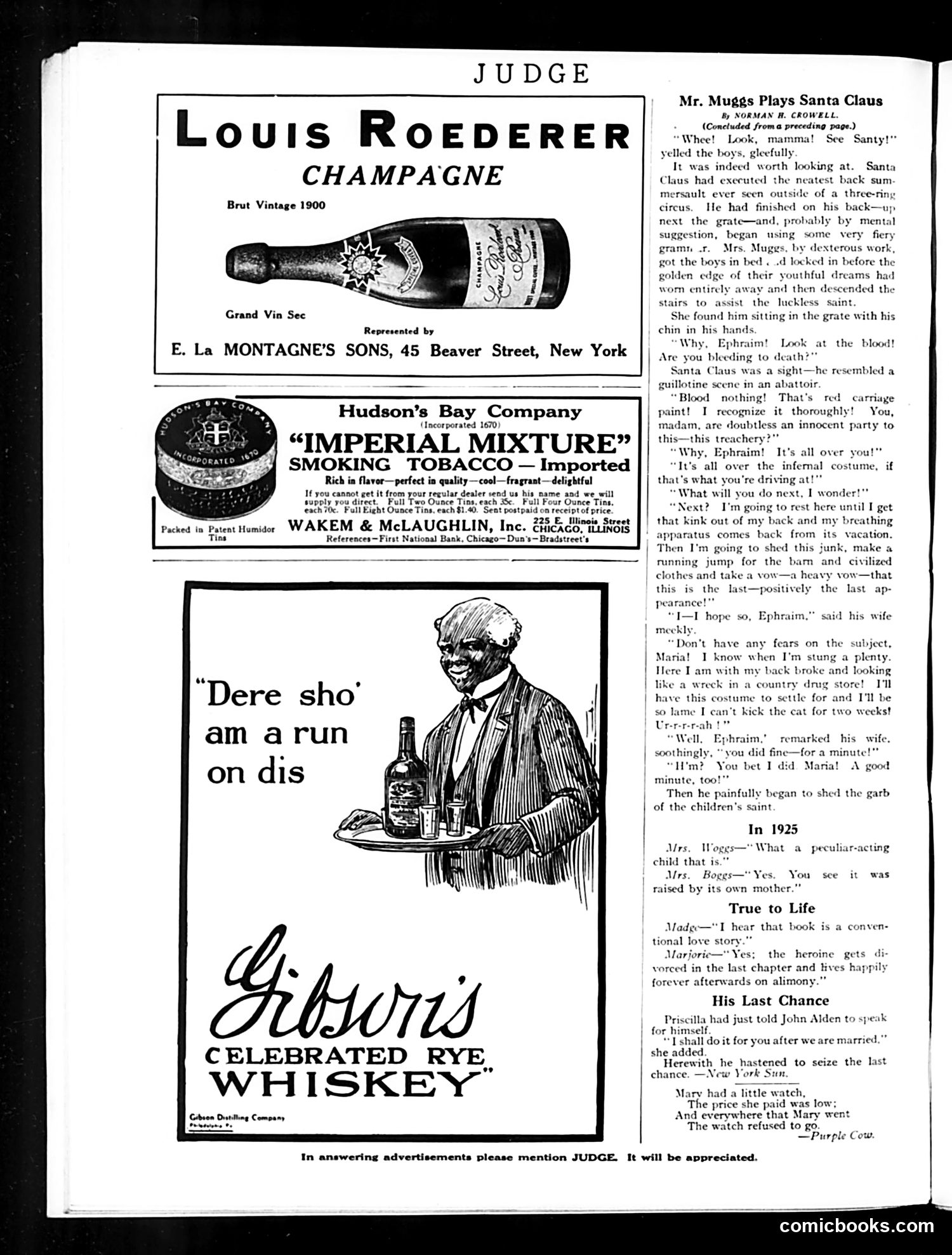
This page contains primarily **fictional humor content** rather than political satire. The main piece is "Mr. Muggs Plays Santa Claus" by Norman A. Crowell—a serialized domestic comedy story about a man (Ephraim) who attempts to play Santa for neighborhood children but crashes into a fireplace, getting covered in red paint and injuring himself. His exasperated wife Maria watches as he complains about the mishap. The page also includes three brief humorous short pieces ("In 1925," "True to Life," "His Last Chance") making jokes about modern social attitudes—unconventional child-rearing, divorce/alimony, and courtship. The **advertisements** (Louis Roederer Champagne, Hudson's Bay tobacco, Gibbon's Rye Whiskey) occupy significant space. The Gibbon's ad features a caricatured Black waiter saying "Dere sho' am a run on dis"—typical of the racist imagery common in early 20th-century American advertising. This is **not a political cartoon page** but rather a humor/entertainment magazine issue mixing slapstick domestic comedy with period advertising.
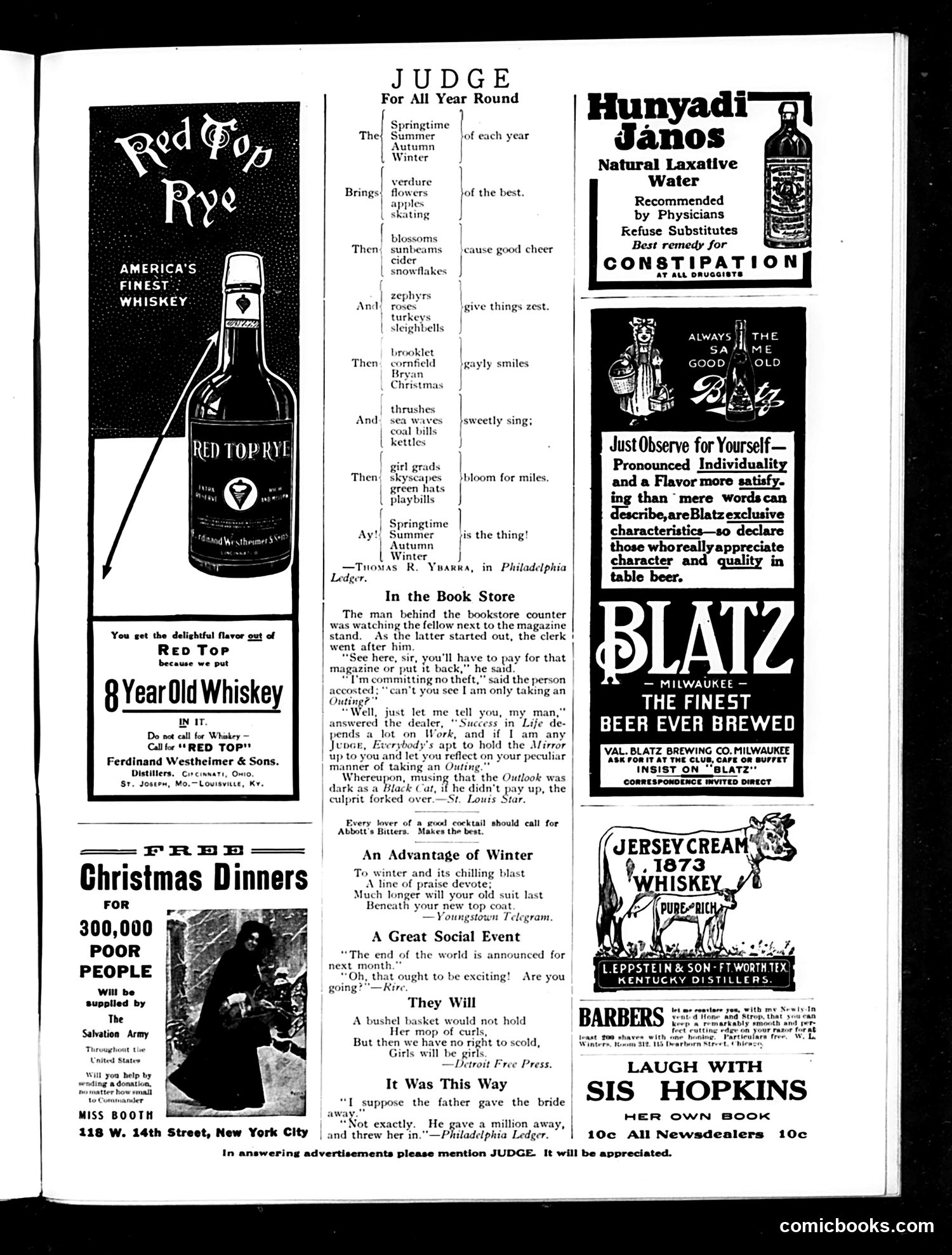
This page is primarily **advertising**, with minimal editorial content. The main elements are: **Advertisements:** - **Red Top Rye** whiskey (8-year-old) - **Hunyadi János** laxative water - **Blatz** beer (Milwaukee) - **Jersey Cream** whiskey - Salvation Army Christmas dinner appeal - Various other products **Editorial Content:** A short humorous anecdote titled "In the Book Store" depicts a clerk catching someone reading a magazine without purchasing it. The person defends themselves by citing various publications (*Success*, *Life*, *Outlook*, *Black Cat*) as justification—a satirical jab at self-help magazines and their grandiose promises of self-improvement. **Minor Poetry/Verse:** Several short poems celebrate seasonal pleasures (spring, summer, winter) and social commentary ("They Will," "It Was This Way"). **Context for Modern Readers:** This reflects early 20th-century American consumer culture and magazine humor. The laxative and alcohol advertisements were common in era publications, and the magazine's satire frequently targeted pretentious self-help literature and social pretension.
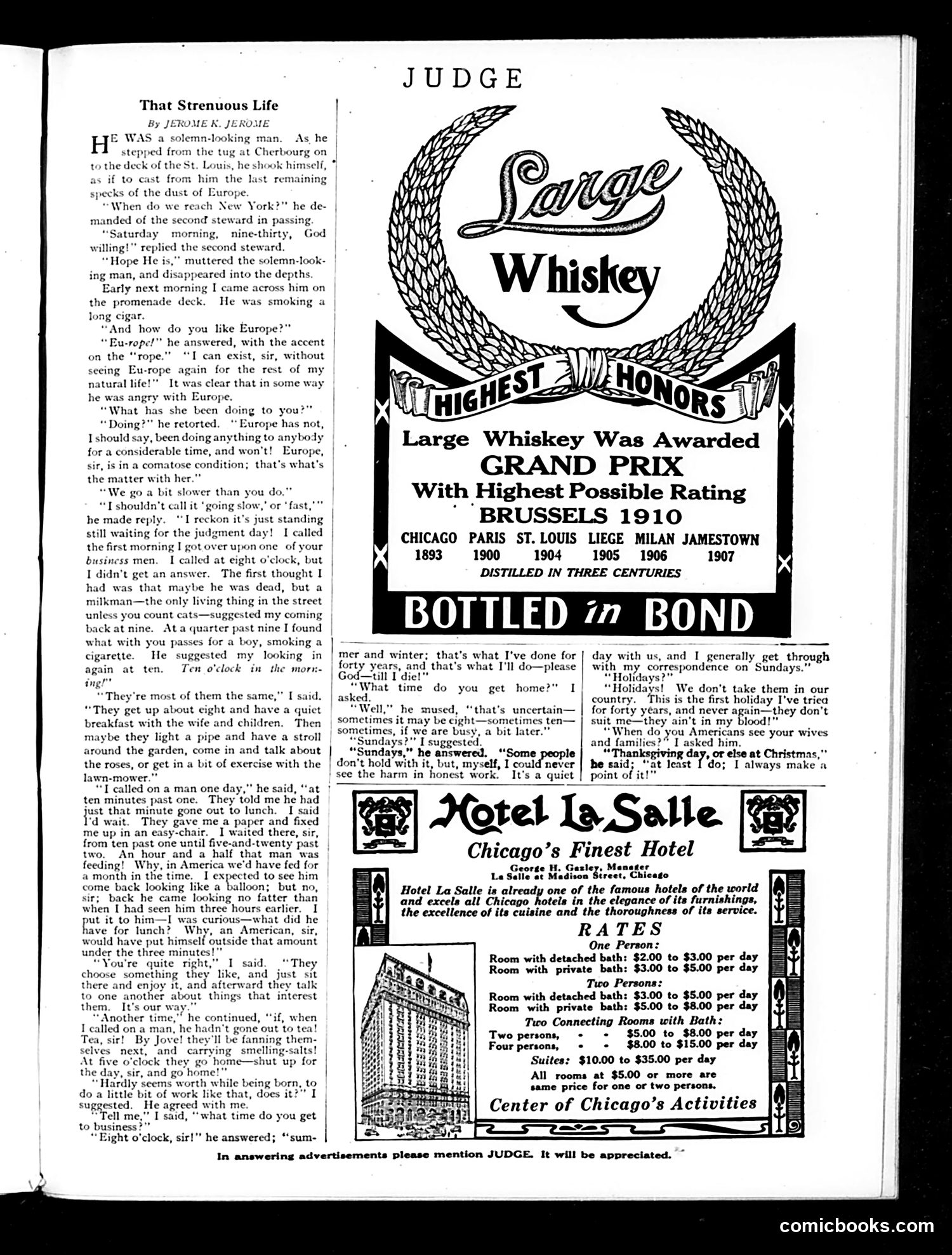
This page presents a satirical story (not a cartoon) contrasting American and European work cultures. An unnamed American businessman, recently returned from Europe, complains bitterly to a narrator about European inefficiency and leisure. The American criticizes Europeans for: slow business practices, long lunch breaks (2.5 hours), frequent tea time interruptions, late morning starts (8 AM), and general lack of urgency. He boasts that Americans work continuously from 8 AM until uncertain hours, with minimal breaks. The satire's **irony is subtle**: The story appears to mock the American character through his own words—his obsessive work ethic, impatience, and inability to appreciate life outside labor seem pathological rather than virtuous. The title "That Strenuous Life" references Theodore Roosevelt's famous philosophy, suggesting the author is gently satirizing American workaholism as excessive and dehumanizing. The page also contains advertisements for Judge whiskey and Hotel La Salle, typical of the magazine's format.
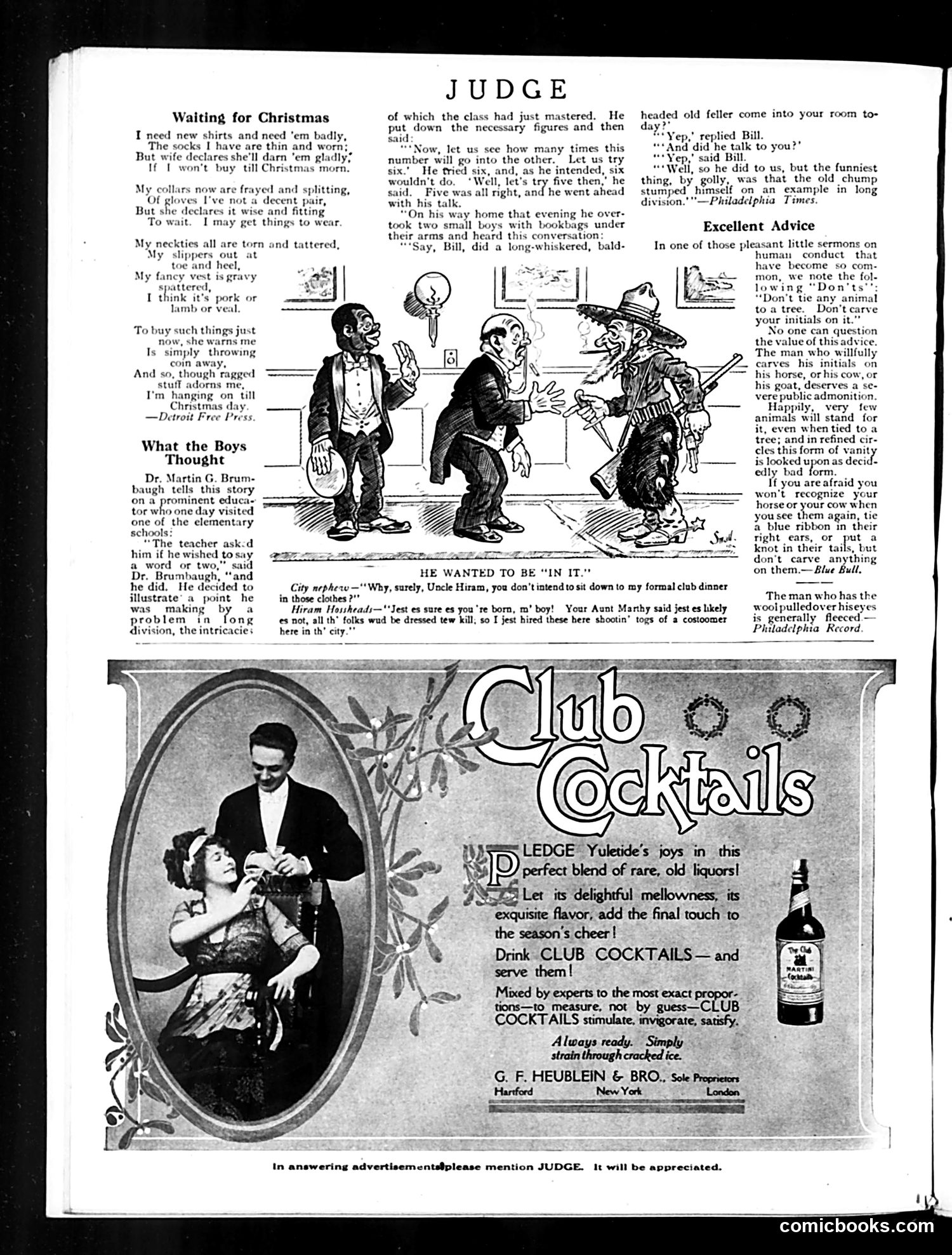
This page contains three distinct pieces of humor typical of early 20th-century American satirical magazines: **"Waiting for Christmas"** (top left): A husband's complaint about his wife refusing to buy him needed clothes before Christmas, insisting he wait for holiday gifts instead—a gentle domestic satire about consumer expectations and marital compromise. **"What the Boys Thought"** (middle): An anecdote mocking an educator who visits a school to demonstrate a math lesson but stumbles on his own long-division problem, embarrassing himself before students who recognize his failure. It satirizes pompous authority figures exposed by their own incompetence. **"He Wanted to Be 'In It'"** (bottom cartoon): A country man named Hiram rents formal "shooting clothes" to attend his nephew's fancy club dinner, misunderstanding the dress code. The satire targets rural ignorance of urban social conventions. The page concludes with a **Club Cocktails advertisement**—a liquor promotion typical of pre-Prohibition era Judge issues, capitalizing on holiday consumption.
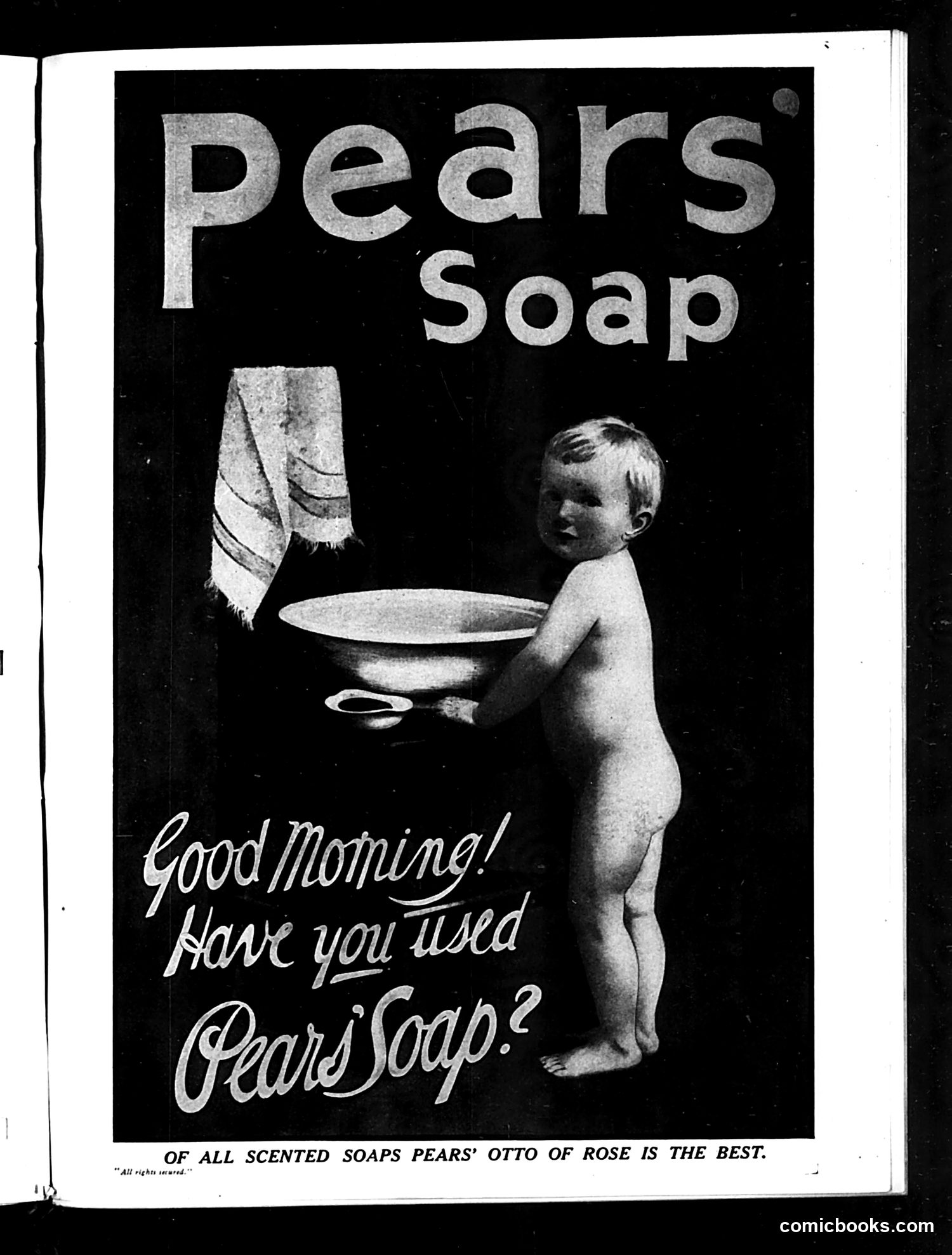
This is a **product advertisement**, not satire or political commentary. It features a naked toddler holding a bar of soap next to a basin and towel, with the tagline "Good Morning! Have you used Pears Soap?" The ad promotes **Pears' Otto of Rose** soap, claiming it's the best scented soap available. The innocent imagery of a clean child was a common advertising strategy in this era—associating the product with cleanliness, health, and childhood purity. This represents standard early-to-mid 20th century commercial advertising that appeared in *Judge* magazine alongside satirical content. No political or social satire is present; it's straightforward product marketing using sentimental, domestic imagery typical of the period.
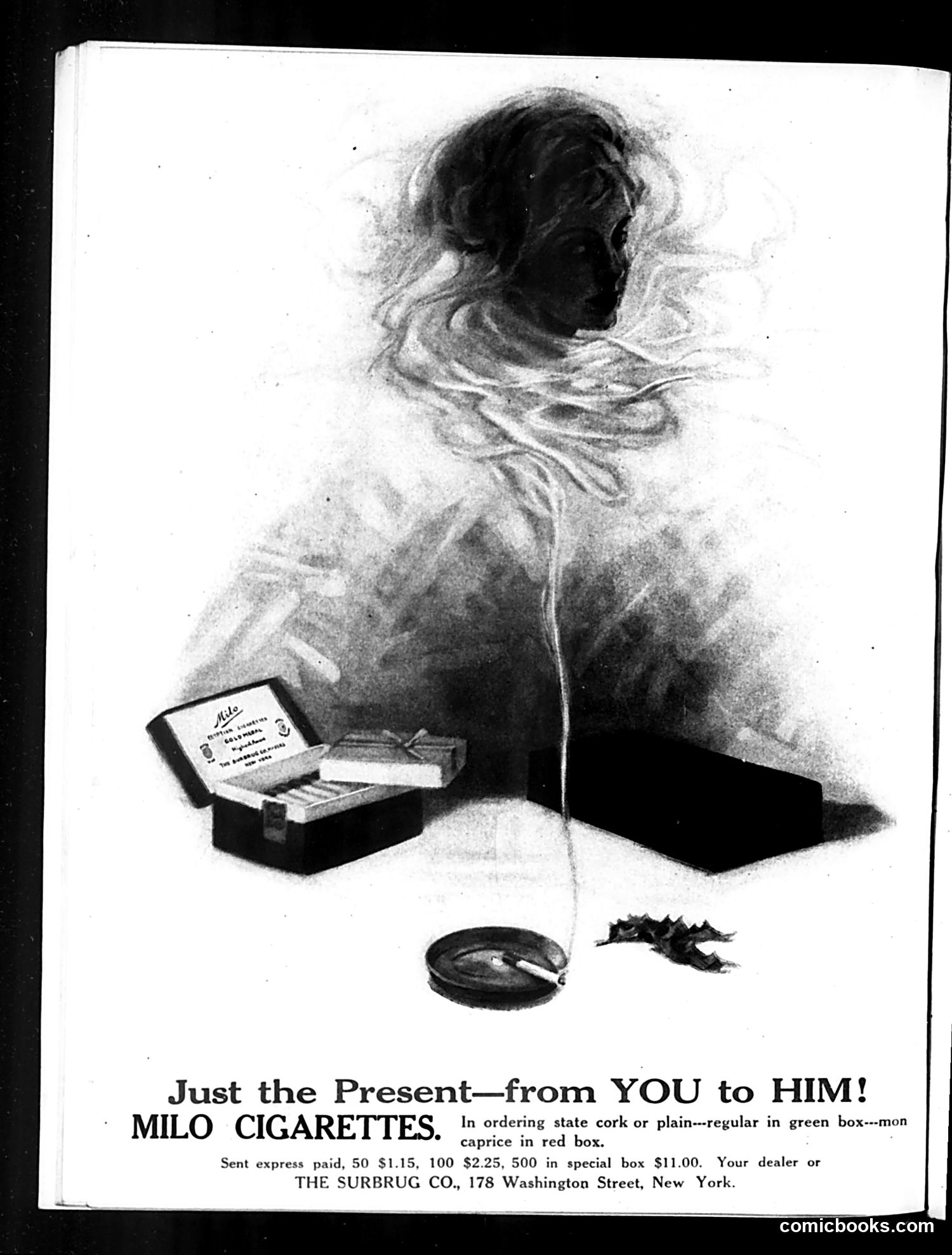
This is an advertisement for Milo Cigarettes, not a political cartoon. The image shows a ghostly or ethereal male figure emerging from cigarette smoke, with a compass, matches, and holly leaves arranged below—evoking gift-giving imagery appropriate to the holiday season (the holly suggests Christmas). The ad's headline "Just the Present—from YOU to HIM!" pitches cigarettes as an ideal gift for men. The copy provides ordering details for different quantities and box styles (cork or plain filters, green or red packaging). The Surbrug Company handled mail orders from their New York address. This represents early-20th-century American advertising that marketed cigarettes directly to consumers, before modern restrictions on tobacco promotion.