
Judge, 1910-12-03 · page 24 of 52
Judge — December 3, 1910 — page 24: what you’re looking at
What you’re looking at
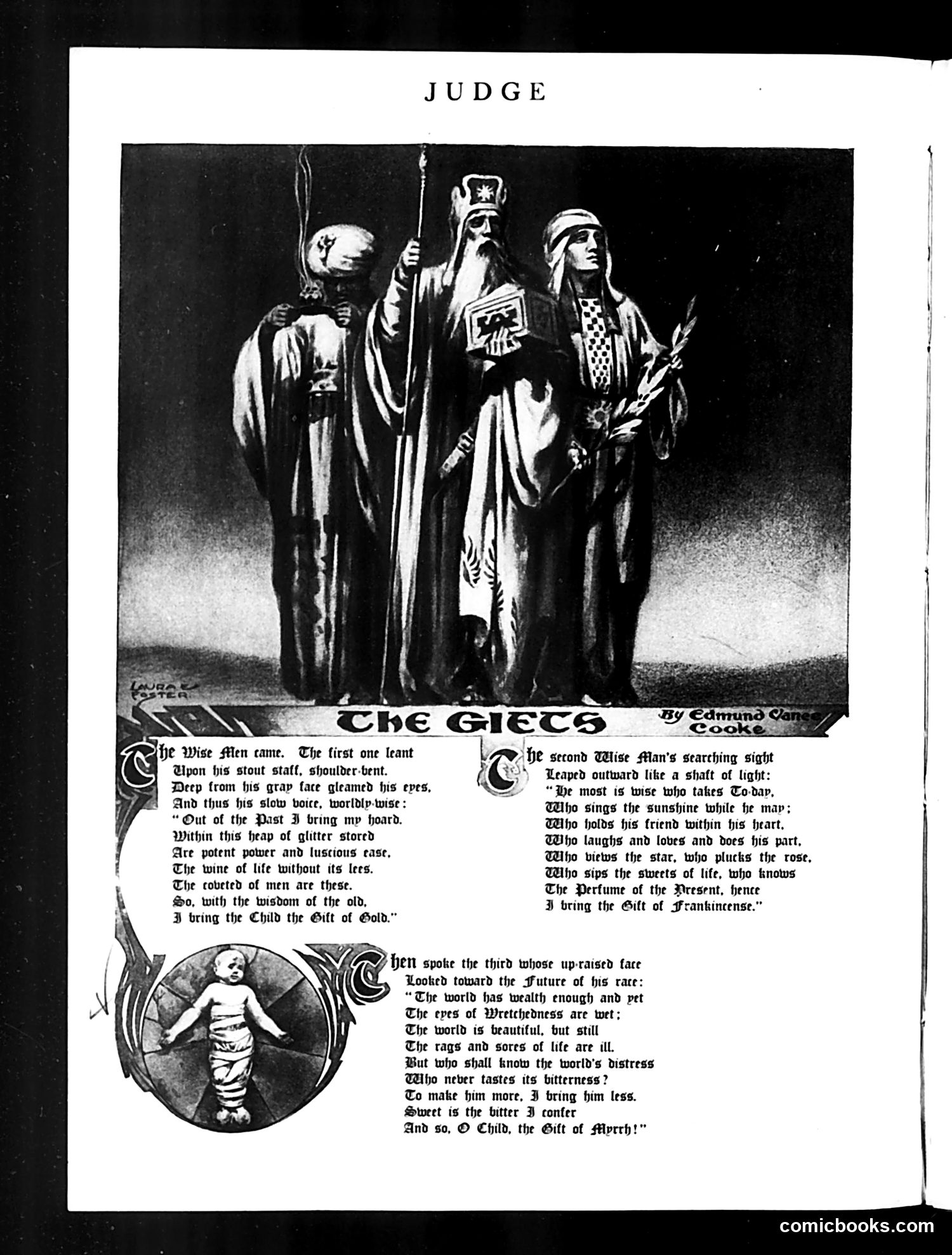
This page illustrates the biblical story of the Three Wise Men visiting the infant Jesus, reimagined as an allegorical poem about life's values. The three figures represent different philosophical approaches to existence: 1. **The first Wise Man** brings Gold—representing the Past and material wealth/power 2. **The second** brings Frankincense—representing the Present, advocating for enjoying life's pleasures and relationships in the moment 3. **The third** brings Myrrh—representing the Future, arguing that hardship and sorrow are necessary for wisdom and character The satire appears to critique materialism and nostalgia while championing mindful present-living. The poem suggests the child (humanity/each person) benefits most from experiencing life's bitter alongside its sweet—that suffering builds compassion and understanding. This reflects early-20th-century progressive thought valuing experience and personal growth over inherited wealth or future abstraction.
📄 Transcribed text from this page (OCR, searchable)
Machine-transcribed from the original scan — historical spelling and the odd misread are preserved.
He Wise Men came. The first one leant he second Wise Man's searching sight Upon his stout staff, shoulder-bent. ‘) Leaped outward like a shaft of light: ret) Deep from his grap face gleamed his eves, “De most is wise who takes To-day, | We And thus his slow voice, worldly-wise : ho sings the sunshine while he map; f “Out of the Past J bring mp hoard. Who holds his friend within his heart, ; Within this heap of glitter stored Who laughs and loves and does his part, Are potent power and luscious ease, Tho views the star, who plucks the rose, The wine of life without its lees. Who sips the sweets of life, who knows The coveted of men are these. The Perfume of the Present, hence So, with the wisdom of the old, ¥ bring the Gift of Frankincense.” B bring the Child the Gift of Gold.” hen spoke the third whose up-raised face Looked toward the Future of his race: “The world has wealth enough and pet The eves of Wretchedness are wet; The world is beautiful, but still The rags and sores of life are ill. But who shall know the world's distress Tho never tastes its bitterness ? To make him more, J bring him less. i] Sweet is the bitter J confer And so, O Child, the Gift of Myrrh!” comicbooks.com