
Judge, 1910-12-03 · page 11 of 52
Judge — December 3, 1910 — page 11: what you’re looking at
What you’re looking at
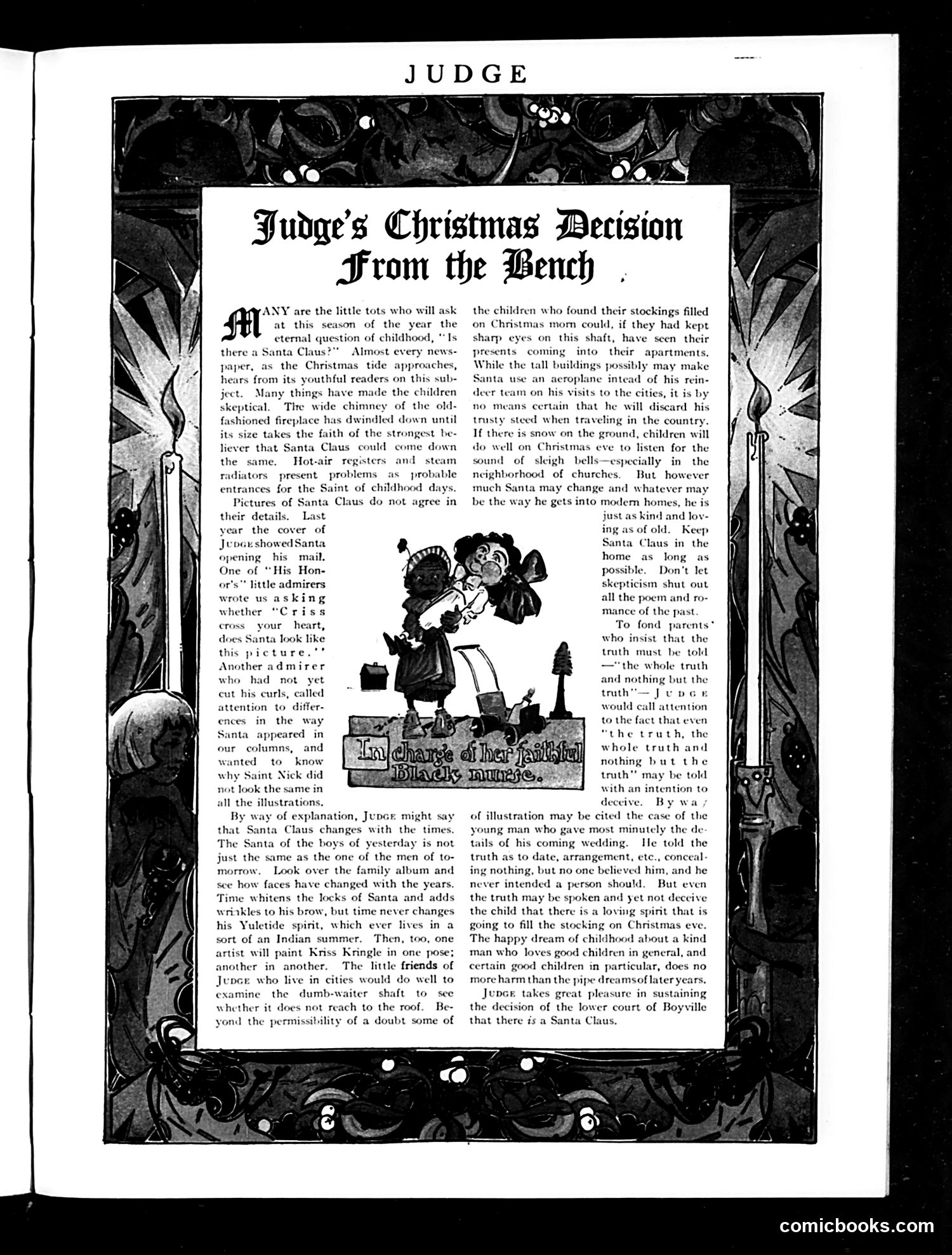
This is an editorial piece styled as a judicial ruling on whether Santa Claus exists. The "Judge" (the magazine itself, personified) addresses children's letters questioning Santa's reality, which newspapers receive annually around Christmas. The piece acknowledges modern obstacles to Santa belief: apartment buildings lack proper chimneys, steam radiators and dumbwaiters replace fireplaces, Santa's artistic depictions vary inconsistently. Rather than debunk Santa, the Judge argues that Santa adapts with the times—using airplanes instead of reindeer in cities, for instance. The central argument: parents demanding children accept "the whole truth and nothing but the truth" can technically tell the truth while still deceiving. The Judge sides with maintaining childhood wonder, ruling that the loving spirit of Santa—a kind man rewarding good children—causes no harm and enriches childhood imagination. The accompanying illustration shows Santa delivering presents via modern methods.
📄 Transcribed text from this page (OCR, searchable)
Machine-transcribed from the original scan — historical spelling and the odd misread are preserved.
Judge's Christmas Decision From the Bench . ANY are the little tots who will ask at this season of the year the eternal question of childhood, "Is there a Santa Claus?" Almost every news- paper, as the Christmas tide approaches, hears from its youthful readers on this sub- ject. Many things have made the children s cal. The wide chimney of the old- fashioned fireplace has dwindled down until its size takes the faith of the strongest be- liever that Santa Claus could come down the same. Hot-air registers and steam radiators present problems as probable entrances for the Saint of childhood days. Pictures of Santa Claus do not agree in their details. Last year the cover of Jevax showed Santa opening his mail. One of “His Hon- or's” little admirers wrote us asking whether “Criss cross your heart, does Santa look like this picture.’" Another admirer who had not yet cut his curls, called attention to differ- ences in the way Santa appeared in our columns, and Wanted 20 know why Saint Nick did not look the same in all the illustrations, By way of expla’ that Santa Claus changes with the times. ‘The Santa of the boys of yesterday is not just the same as the one of the men of to- morrow. Look over the family album and sce how faces have changed with the Time whitens the locks of Santa and a wrinkles to his brow, but time never c his Yuletide spirit, which ever lives in a sort of an Indian summer. Then, too, one artist will paint Kriss Kringle in one pose: another in another. The little friends of Jupce who live in cities would do well to examine the dumb-waiter shaft to see whether it does not reach to the roof. Be- yond the permissibility of a doubt some of the children who found their stockings filled on Christmas mom could, if they had kept sharp eyes on this shaft, have seen their presents coming into. their apartments. While the tall buildings possibly may make Santa use an aeroplane intead of his rein- deer team on his visits to the cities, it is by no means certain that he will discard his trusty steed when traveling in the country. If there is snow on the ground, children will do well on Christmas eve to listen for the sound of sleigh bells—especially in the neighborhood of churches. But however much Santa may change and whatever may be the way he gets into modem homes, he is just as kind and lov- ing as of old. Keep anta Claus in the home as long as possible. Don't let skepticism shut out all the poem and ro- mance of the past To fond parents* who insist that the truth must be told —"the whole truth and nothing but the truth"— Juoaer would call attention to the fact that even “the truth, the whole truth and nothing but the truth” may be told with an intention to deceive. By wa of illustration may be cited the case of the young man who gave most minutely the de tails of his coming wedding. He told the truth as to date, arrangement, etc., conceal ing nothing, but no one believed him, and he never intended a person should. But even the truth may be spoken and yet not deceive the child that there is a loving spint that is going to fill the stocking on Christmas eve. The happy dream of childhood about a kind man who loves good children in general, and certain good children in particular, does no more harm than the pipe dreamsof later years. Jupce takes great pleasure in sustaining the decision of the lower court of Boyville that there és a Santa Claus. comicbooks.com