
Judge, 1910-12-03 · page 41 of 52
Judge — December 3, 1910 — page 41: what you’re looking at
What you’re looking at
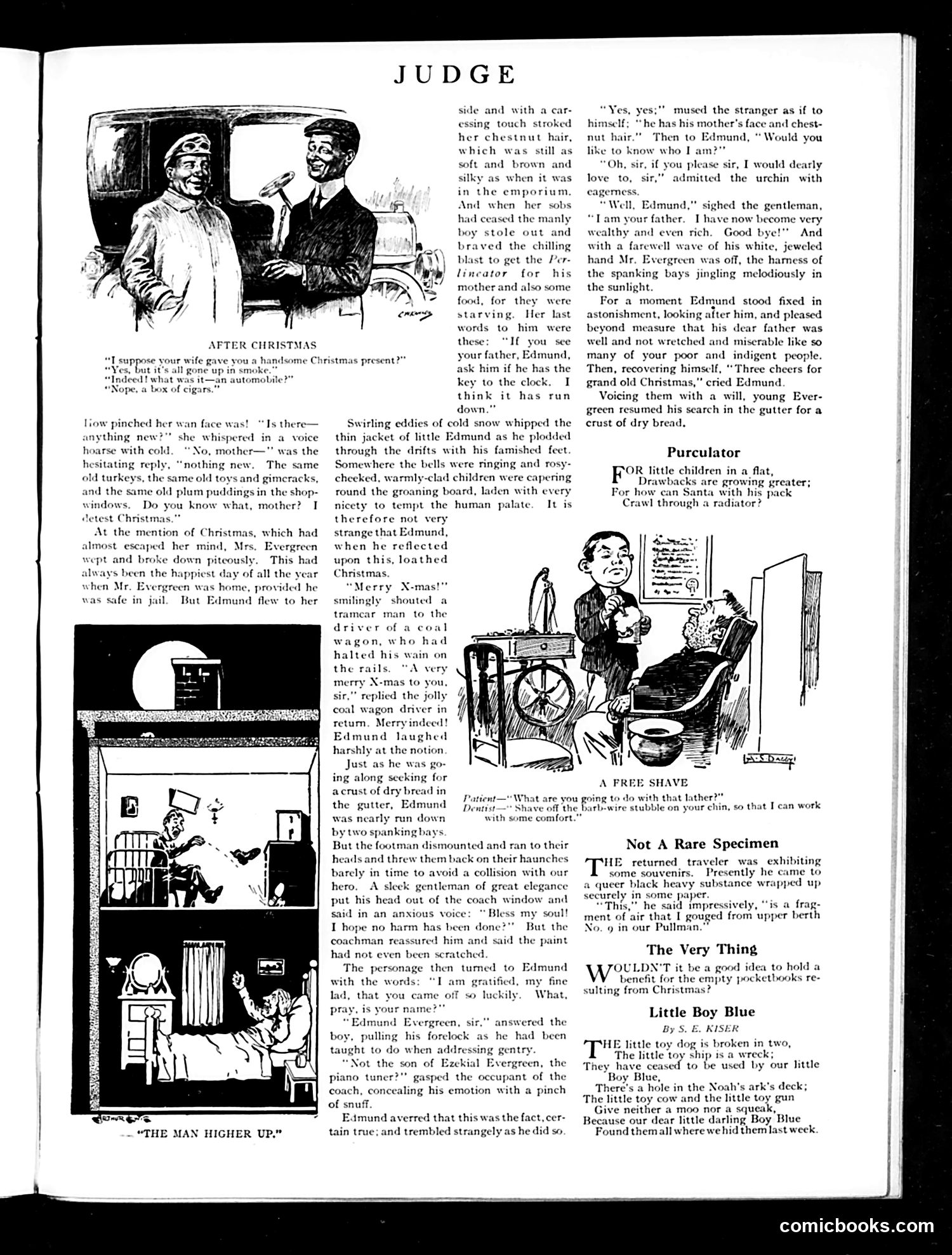
This page presents a sentimental Christmas tale mocking melodramatic Victorian fiction. The story follows poor young Edmund, whose starving family despises Christmas because his father is imprisoned. Edmund encounters a wealthy gentleman whose carriage nearly hits him; the gentleman—revealed to be Edmund's own father, now mysteriously rich—reconciles with his son after years in jail. The satire targets **overwrought serialized fiction** popular in the era: orphaned children in gutters, implausible coincidental reunions, and abrupt class mobility presented as heartwarming. The repeated emphasis on Edmund's "manly" poverty and the father's sudden wealth satirize how such stories resolved social problems through luck rather than systemic change. The gentleman's casual concern only about his coach's paint satirizes upper-class indifference to the poor—except their own relatives. The final "three cheers for Christmas" mockingly endorses the unrealistic happy ending such fiction promised working-class readers.
📄 Transcribed text from this page (OCR, searchable)
Machine-transcribed from the original scan — historical spelling and the odd misread are preserved.
AFTER CHRISTMAS your wife gave you 4 “s all gone up in sm twas it liow pinched her wan face was! “Is there— anything nev hoarse with cold was the hesitating reply The same old turkeys, the same old toys and gimeracks, and the same old plum puddings in the shop- windows. Do you know what, mother? I detest Christmas." At the mention of Christmas, which had almost escaped her mind, Mrs, Evergreen wept and broke down piteously. This had always been the happiest day of all the year when Mr. Evergreen was home, provided he was safe in jail. But Edmund flew to her she whispered in . mother— “nothing new. voice “THE MAN HIGHER UP.” handsome Christmas present?” JUDGE side and with a car- essing touch stroked her chestnut hair, which was still as soft and brown and silky as when it was in the emporium. And when had ceased the manly boy stole out braved the chilling blast to get the Per- lineator for his mother and also some food, for they starving, Her last words to him were th your father, ask him if he has the key to the clock. I think it has run down.” Swirling eddies of cold snow whipped the thin jacket of little Edmund as he plodded through the drifts with his famished fee Somewhere the bells were ringing and rosy cheeked, warmly-clad children were capering round the groaning board, laden with every nicety to tempt the human palate. It is therefore not very strange that Edmund, when he reflected upon this, loathed Christmas. “Merry X-mas!" shouted a tramcar man to the driver of a coal wagon, who had halted his wain on the rails. “A very merry X-mas to you, sir,” replied the jolly coal wagon driver in retum. Merry inde Edmund laughed harshly at the notion Just as he was go- ing along seeking for acrust of dry bread in the gutter, Edmund was nearly run down by two spanking bays But the footman dismounted and ran to their heads and threw them back on their haunches barely in time to avoid a collision with our hero. A sleck gentleman of great elegance put his head out of the coach window and said in an anxious voice: “Bless my soul! I hope no harm has be But the coachman reassured him and said the paint had not even been scratched The personage then turned to Edmund with the words: “I gratified, my fine lad, that you so luckily. What, is your name Imund Evergreen, si boy, pulling his forelock taught to do when addressing gentry. Not the son of Ezekial Evergreen, the piano tuner?" gasped the occupant of the coach, concealing his emotion with a pinch of snuff. E.mund averred that this was the fact, cer- tain true; and trembled strangely as he did so her sobs and were smilingly n done?"" ame © answered the as he had been ¢ you going to do with that lathe e off the barb-wire stubble on your chin, so that I can work some comfort.” himself; “he has his mother’s fac nut hair." Then to Edmund, like to know who Iam “Oh, sir, if you please sir, I would dearly love to, sir,” admitted the urchin with cageme! mused the stranger as if to and chest- Would you * sighed the gentleman, I have now become very wealthy and even rich. Good bye!" And with a farewell wave of his white, jeweled hand Mr. Evergreen was off, the harness of the spanking bays jingling melodiously in the sunlight. For a moment Edmund stood fixed in astonishment, looking after him, and pleased beyond measure t his dear father was well and not wretched and miserable like so many of your poor and indigent people. Then, recovering himself, ‘Three cheers for grand old Christn " cried Edmund Voicing them with a will, young Ever- green resumed his search in the gutter for a crust of dry bread. Purculator ‘OR little children in a flat, at can Santa with his pack Crawl through a radiator? ne Not A Rare Specimen HE returned traveler was exhibiting ‘ome souvenirs. Presently he came to a queer black heavy substance wrapped up securely in some paper. “This,” he said impressively, “is a frag- ment of air that I gouged from upper berth No. 9 in our Pullman.” The Very Thing OULDN'T it be a good idea to hold a benefit for the empty pocketbooks re- sulting from Christmas? Little Boy Blue By S. E. KISER HE little toy dog is broken in two, le toy ship is a wrecl sed to be used by our little The Tittle t toy cow y moo nor a squeak, Because our dear little darling Boy Blue Found themall where we hid them last week. comicbooks.com