
Judge, 1910-12-03 · page 20 of 52
Judge — December 3, 1910 — page 20: what you’re looking at
What you’re looking at
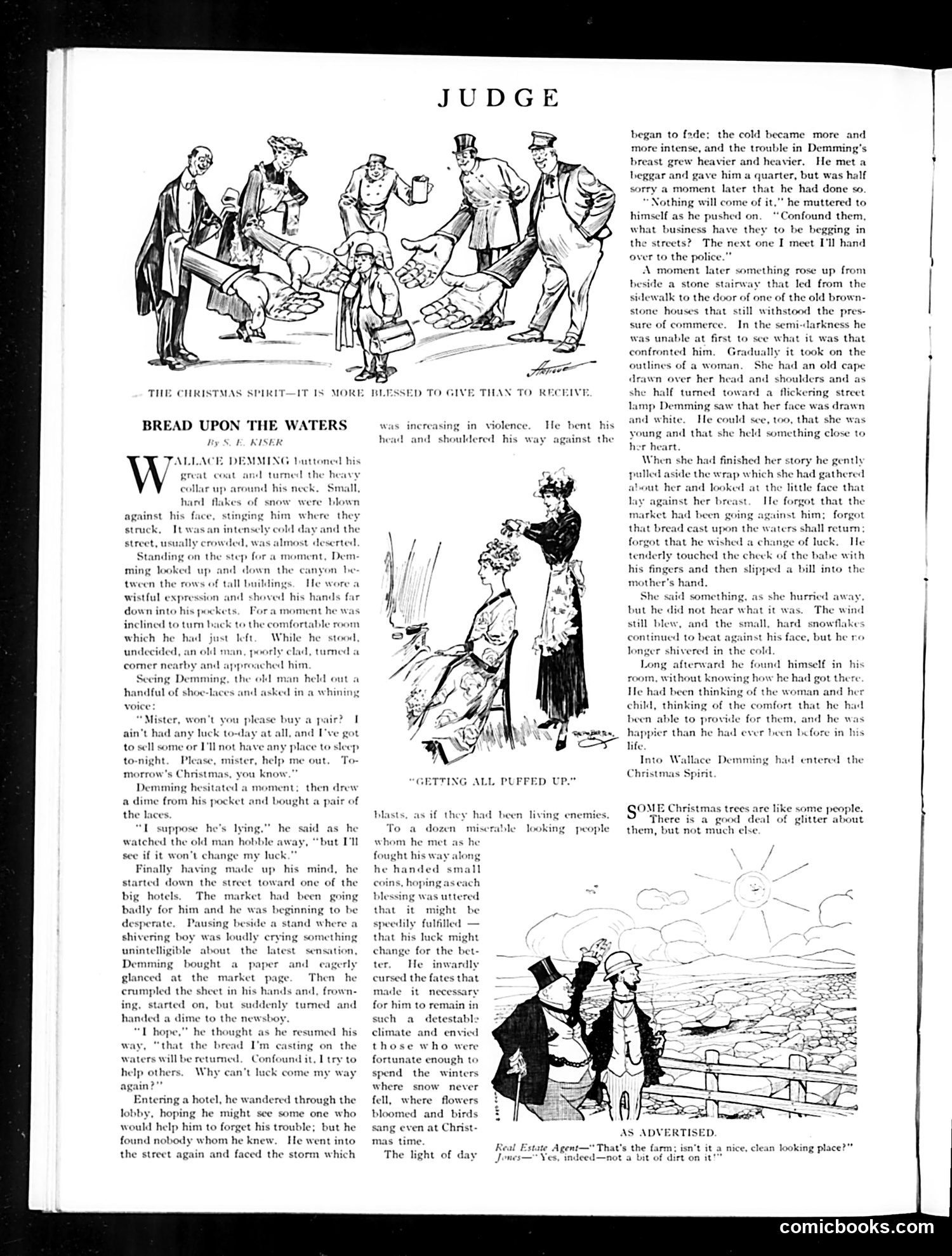
This page presents "Bread Upon the Waters," a Christmas morality tale about Wallace Demming, a financially struggling man facing a cold winter day in what appears to be late 19th-century America. **The Story's Point:** Despite his own financial desperation, Demming gives money to multiple poor people he encounters—a shoelace vendor, a newsboy, beggars on the street. He does this while cynically doubting it will help ("Nothing will come of it"), yet hoping his charitable acts might reverse his bad business luck, based on the biblical principle that generosity returns blessings. **The Satire/Message:** The page satirizes the tension between self-interest and Christian charity during the Gilded Age. Demming embodies the era's wealthy struggling with guilt—he wants luck to change *because* he helps others, not from pure altruism. The illustrations and text suggest this story will reveal whether his self-serving charity actually brings redemption or if the universe is indifferent to such calculations. The top cartoon emphasizes the Christmas moral: giving is "more blessed" than receiving—a pointed message for Judge's prosperous readership.
📄 Transcribed text from this page (OCR, searchable)
Machine-transcribed from the original scan — historical spelling and the odd misread are preserved.
THE CHRISTMAS SPIRIT—IT IS MORE BREAD UPON THE WATERS Ry SE TALLACE DEMMING buttoned his great coat and tumed the heavy collar up around his neck. Small, hard flakes of snow were blown against his they struck. Itwasan intensely cold day and the street, usually crowded, was aln t deserted Standing on the step f« Dem ming looked up and down the tween the rows of tall bu wistful expression and shoved his hands down into his pockets. F RISER him) where am canyon be He wore a far a moment he was lings inclined to tum back to the comfortable room which he had just left. While he stood undecided, an old man, poorly clad, tumed a comer nearby and approached him. Secing Demming, the old man held out handful of shoe-laces and asked in a whining voice Mister, won't you please buy a pair? I ain't had any luck to-day at all, and [ve got to sell some or I'll not have any Please, mister, help know.” ne out, To- to-night morrow’s Christr Demming he a dime from his pocket and bought a pair of the laces. “LT suppose he’s lying,” hes watched the old man hobble aw see if it won't change my luck.” Finally having made up his mind, he started down the street toward one of the big hotels. The market had been going badly for him and he was beginning to be Pausing beside a stand where was loudly erying something as, Yo ted a moment; then drew 1 as he put TM desperate a shivering b unintelligible about the latest sensation, Demming bought a paper and eagerly glanced at the market page. Then he the sheet in his hands and, frown- but suddenly tumed and dime to the newsboy. he thought as he resumed his the crumple ing, started or a way, “that the bread I'm casting waters will be retumed. Confound it, L try to help others. Why can’t luck come my way red through the some one who ntering a hotel, he wan¢ . hoping he might would help him to forget his trouble; but he found nobody whom he knew. He went into the street again and faced the storm which JUDGE BLESSED TO GIVE THAN TO RECEIVE, was increasing in violence. He bent his head and shouldered his way against the “GETTING ALL PUFFED UP.” blasts, as if they had been living enemies. To a dozen miserable looking people whom he met as he fought his way along he handed small coins, hoping as each : blessing was uttered that it might speedily fulfilled — that his luck might change for the bet- ter. He inwardly cursed the fates that made it necessary for him to remain in such detestable climate and envied those who were fortunate enough to be spend the winters where snow never fell, where flowers bloomed and birds sang even at Christ- mas time. The light of day the cold became more and more intense, and the trouble in Demming’s breast grew h and heavier, He met a beggar and gave him a quarter, but was half sorry a moment later that he had done so. “ Nothing will come of it,"" he muttered to himself as he pushed on. ‘Confound them, what business have they to be begging in the streets? The next one I meet I'll hand over to the police.” A moment later something rose up from beside a stone stairway that led from the sidewalk to the door of one of the old brown- stone houses that still withstood the pres- sure of commerce. In the semi-darkness he was unable at first to sce what it was that Gradually it took on the n. She had an old cape began to {sde: viet confronted him. outlines of a wor drawn over her head and shoulders half tured toward a flickering street lamp Demming saw that her face was drawn and white. He could sce, too, that she was young and that she held something ¢ her heart. When she had finished her story he gently vulled aside the wrap which she had gathered out her and looked at the little face that lay against her b: He forgot that the inst him; forgot ers shall return forgot that he wished a change of luck. He tenderly touched the cheek of the babe with his fingers and then slipped a bill into the mother’s hand. She said something, as she hurried away, but he did not hear what it was. The wind still blew, and the small, hard snowflakes continued to beat against his face, but he ro and as she t upon the w longer shivered in the cold Long afterward he found himself in_ his room, without knowing how h got there He had been thinking of the woman and her child, thinking of the comfort that he had been able to provide for them, and he was happier than he had ever been before in his life Into Wallace Demming had entered the Christmas Spirit GOME Christmas trees are like some people. There is a good deal of glitter about them, but not much else comicbooks.com