
A complete issue · 68 pages · 1922
Captain Billy's Whiz Bang #31
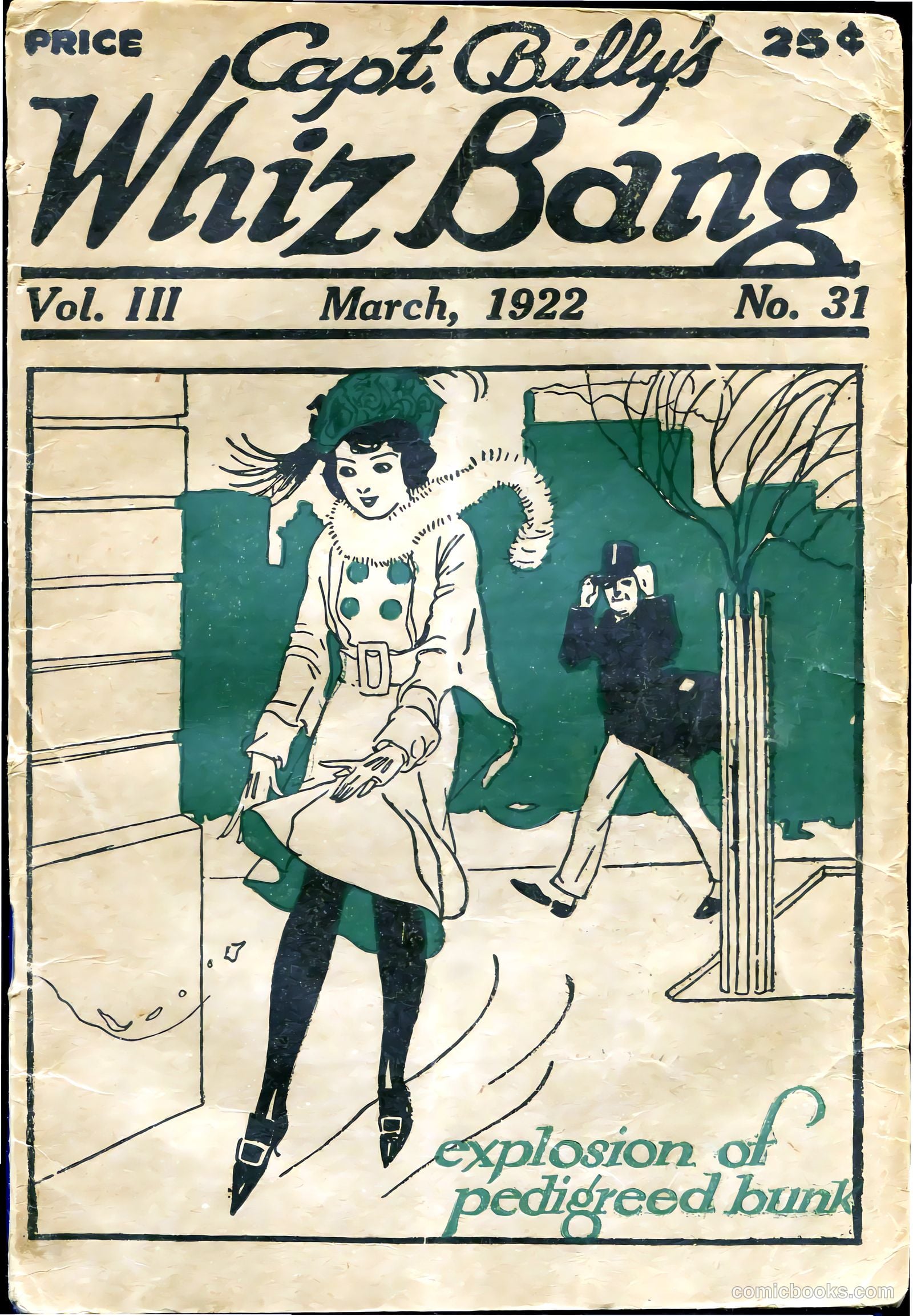
This is the cover of *Captain Billy's Whiz Bang*, a humor magazine from March 1922. The illustration depicts a stylishly dressed woman ice-skating, with a small man in formal attire (top hat and tails) tumbling behind her. The caption promises "explosion of pedigreed bunk"—indicating the issue contains satirical debunking of pretentious claims or high-society nonsense. The image likely satirizes class pretension: the woman's fashionable winter outfit and confident demeanor contrast with the formally-dressed man's embarrassing fall, suggesting mockery of upper-class affectation or pomposity. "Pedigreed bunk" implies the magazine will expose fraud or absurdity dressed up as refined respectability—a common theme in 1920s satirical humor during the Jazz Age.
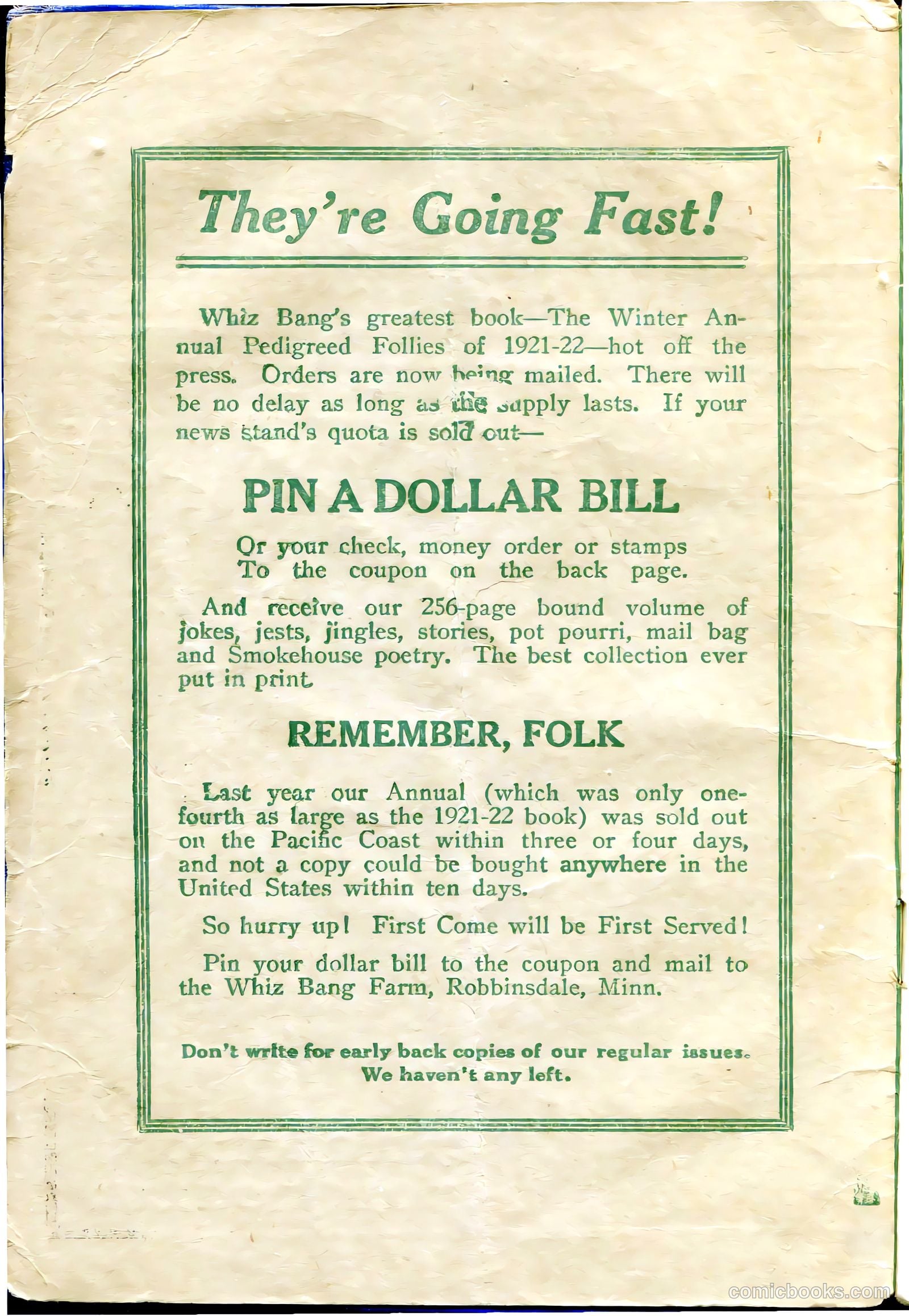
This is **not a cartoon or satirical content page**—it's a **direct-mail advertisement** for Whiz Bang magazine's 1921-22 Winter Annual. Whiz Bang was a popular American humor magazine of the 1920s. This ad uses aggressive sales tactics common to the era: urgency ("They're Going Fast!"), scarcity messaging (last year's smaller edition sold out in days), and a low barrier to entry (mail a dollar bill pinned to a coupon). The promised content—jokes, jests, jingles, stories, "pot pourri," and "Smokehouse poetry"—reflects the magazine's irreverent, bawdy humor typical of post-WWI American comedy publications aimed at working-class readers. The note about not requesting back issues reveals the publication's supply-chain limitations during this period. The Robbinsdale, Minnesota address indicates a regional publisher with national distribution ambitions.
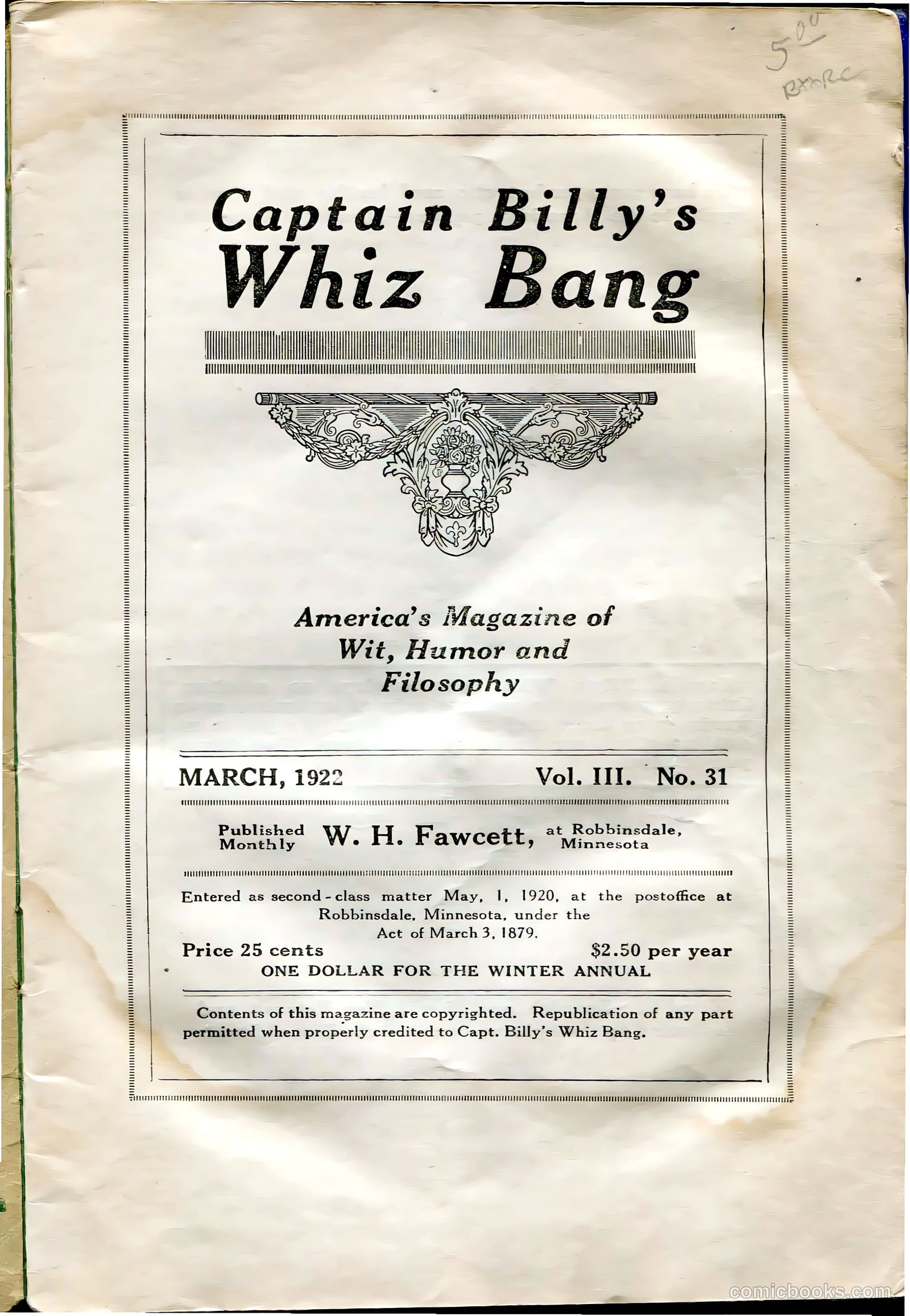
This is a **title page**, not a cartoon page. It identifies *Captain Billy's Whiz Bang* as "America's Magazine of Wit, Humor and Philosophy," published monthly by W.H. Fawcett in Robbinsdale, Minnesota. The decorative header features an ornate Art Deco-style design. Key details: priced at 25 cents per issue or $2.50 annually, it was entered as second-class mail in May 1920. The copyright notice states content could be republished if properly credited to the magazine. This was a genuine early-20th-century humor publication, though its specific satirical content appears on subsequent pages not shown here.
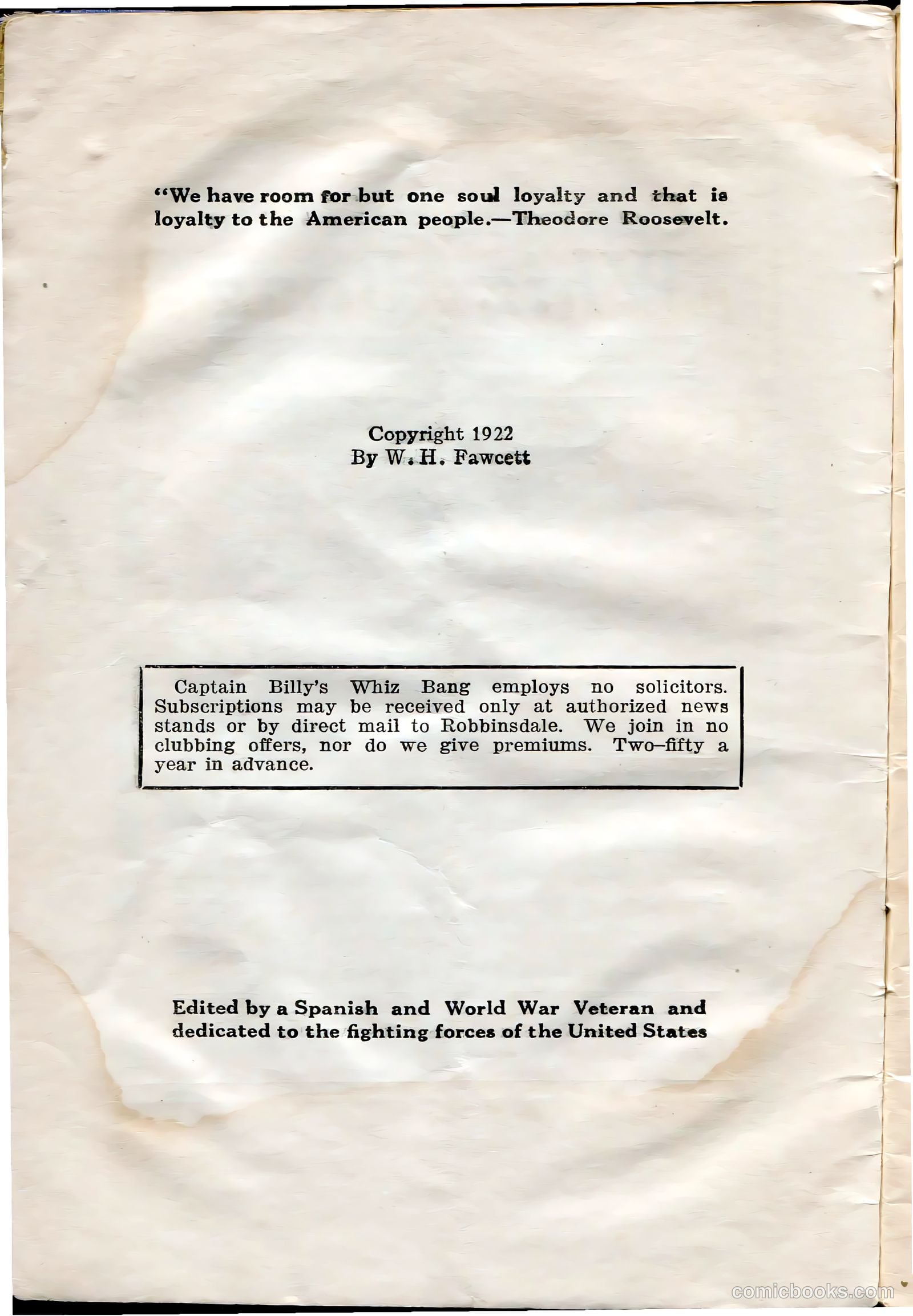
This is a title page for *Captain Billy's Whiz Bang*, a 1922 satirical magazine edited by a Spanish-American and World War I veteran. The page features a Theodore Roosevelt quote about undivided loyalty to America—likely referencing contemporary concerns about hyphenated Americanism and immigrant assimilation, hot-button issues in the post-WWI period. The subscription notice emphasizes the magazine's independence: no solicitors, no premiums, no clubbing offers. This suggests *Whiz Bang* positioned itself as straightforward and commercially honest, contrasting with other magazines' aggressive marketing tactics. The page contains no visible cartoons—it's primarily informational, establishing the publication's patriotic credentials and business practices for readers.
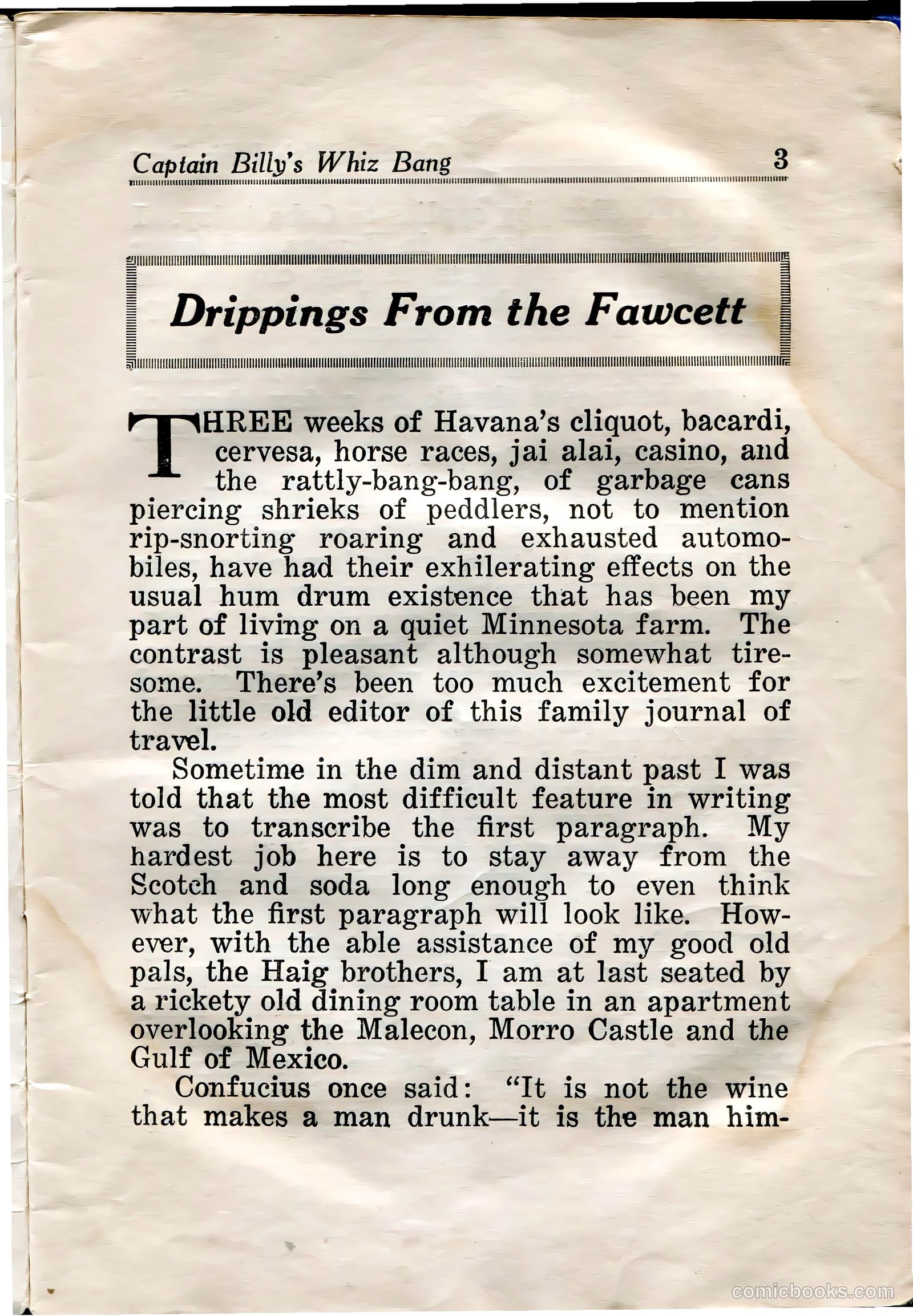
This is a humorous travel column, not a political cartoon. The author—identified as the editor of *Captain Billy's Whiz Bang*—recounts a three-week vacation in Havana, Cuba, contrasting the exciting nightlife (gambling, horse racing, jai alai, bars) with his quiet Minnesota farm life. The satire is self-directed: the editor jokes about his difficulty writing the opening paragraph while admitting he's been drinking heavily with "the Haig brothers" (likely whiskey reference—Haig is a Scotch brand). The Confucius quote at the end wryly acknowledges personal responsibility for overindulgence rather than blaming alcohol itself. The piece captures 1920s American attitudes toward Havana as a playground for leisure and drinking, particularly relevant during Prohibition in the U.S. The tone is light, self-mocking comedy aimed at readers of this satirical magazine.
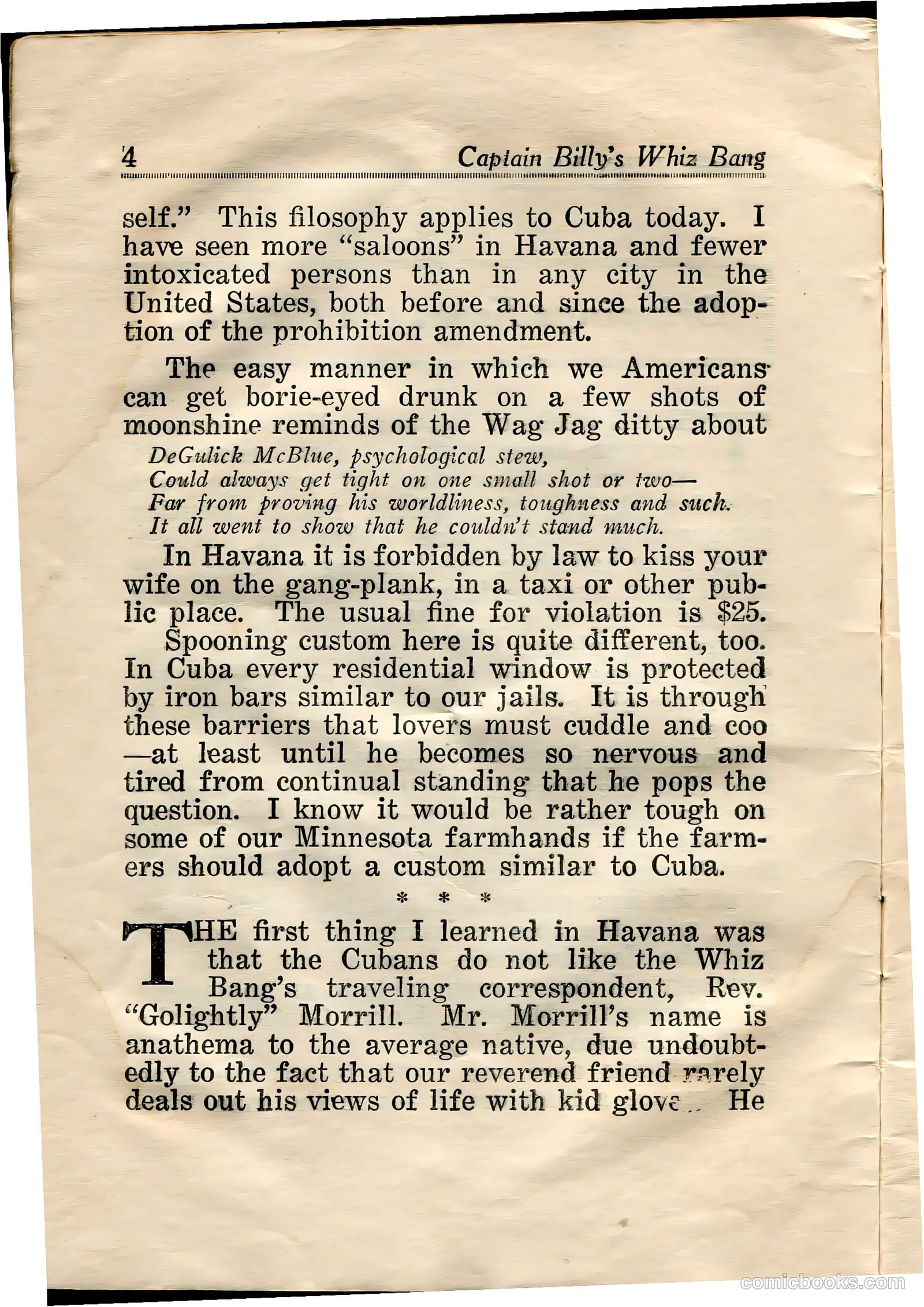
This page is primarily **satirical commentary on Cuba and Prohibition**, not a cartoon. The author compares Cuban and American drinking cultures, noting Cuba has more bars but fewer drunk people—a jab at America's failed Prohibition policy (adopted 1920). The humor relies on: 1. **A fictional character, DeGulick McBlue**, depicted as someone who gets drunk easily, used to mock Americans' weakness for moonshine versus Cubans' restraint. 2. **Cuban social customs** presented as absurdly restrictive (public kissing banned, window iron bars for courting), mocking both Cuban prudishness and suggesting Minnesota farmers would struggle with such rules. 3. **Rev. "Golightly" Morrill**, the magazine's traveling correspondent, apparently known for blunt, tactless commentary that offends Cubans—presented as the publication's intentionally provocative persona. The satire targets American hypocrisy: Prohibition hasn't reduced drinking; it's created dangerous moonshine culture while Cuba, less restrictive, maintains better social order.
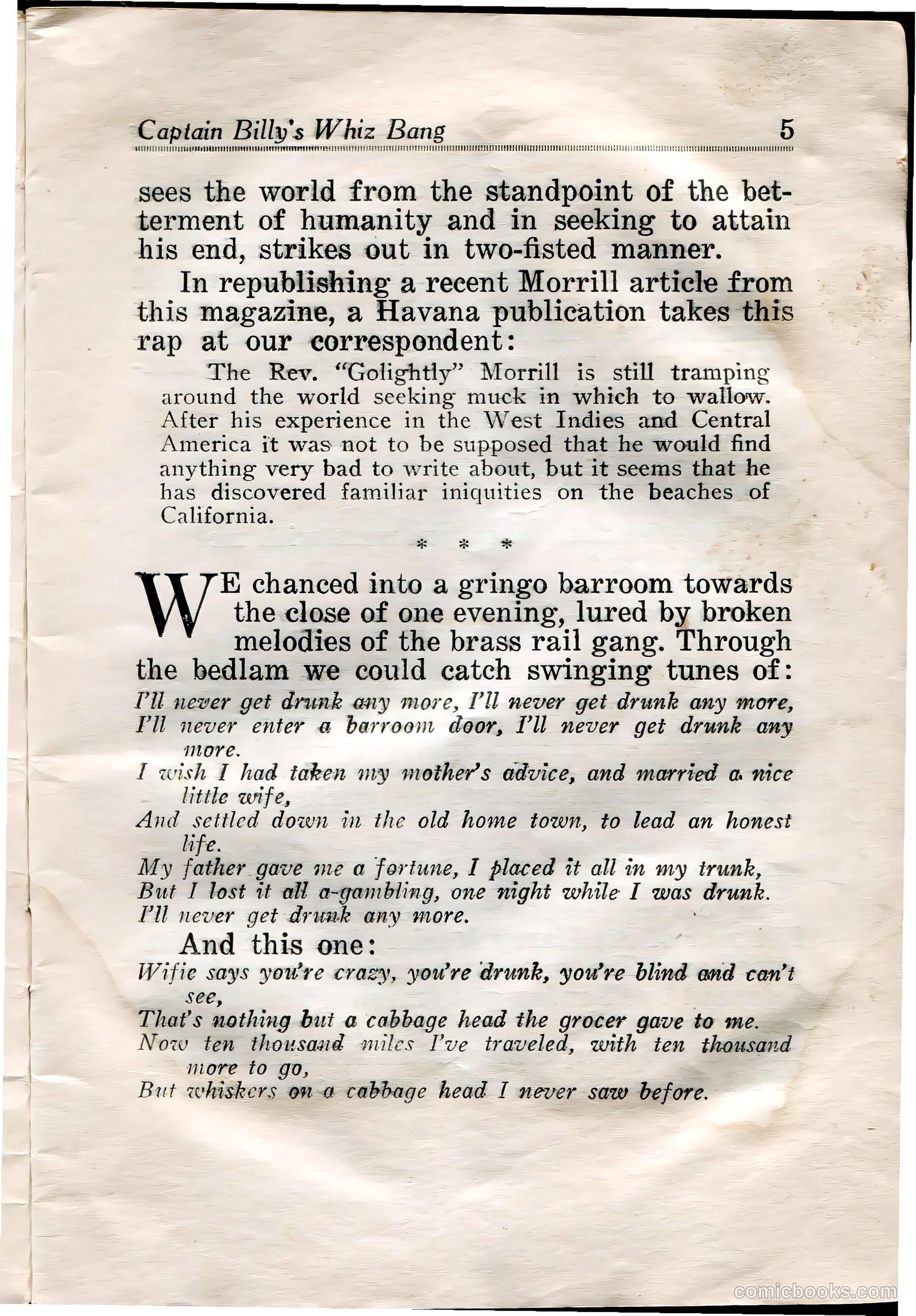
This page satirizes **temperance movement** rhetoric and working-class morality tales. The Rev. "Golightly" Morrill (a recurring character) is mocked as a self-righteous reformer who travels abroad seeking moral failings to expose—a jab at sanctimonious journalists. The main content presents **barroom songs**—satirical drinking ballads parodying temperance warnings. They mock the predictable moralizing: regretful drunks swearing off alcohol, warnings about lost fortunes and failed marriages. The absurdist final verse (whiskers on a cabbage head) suggests the absurdity of drunk perception itself. **Whiz Bang's** point: temperance crusaders and their melodramatic cautionary tales are laughable and hypocritical. The magazine adopts a cynical, working-class perspective rejecting moral panic about drinking as pretentious moralizing. The satire targets both self-righteous reformers and the formulaic sentimental songs used to warn against vice.
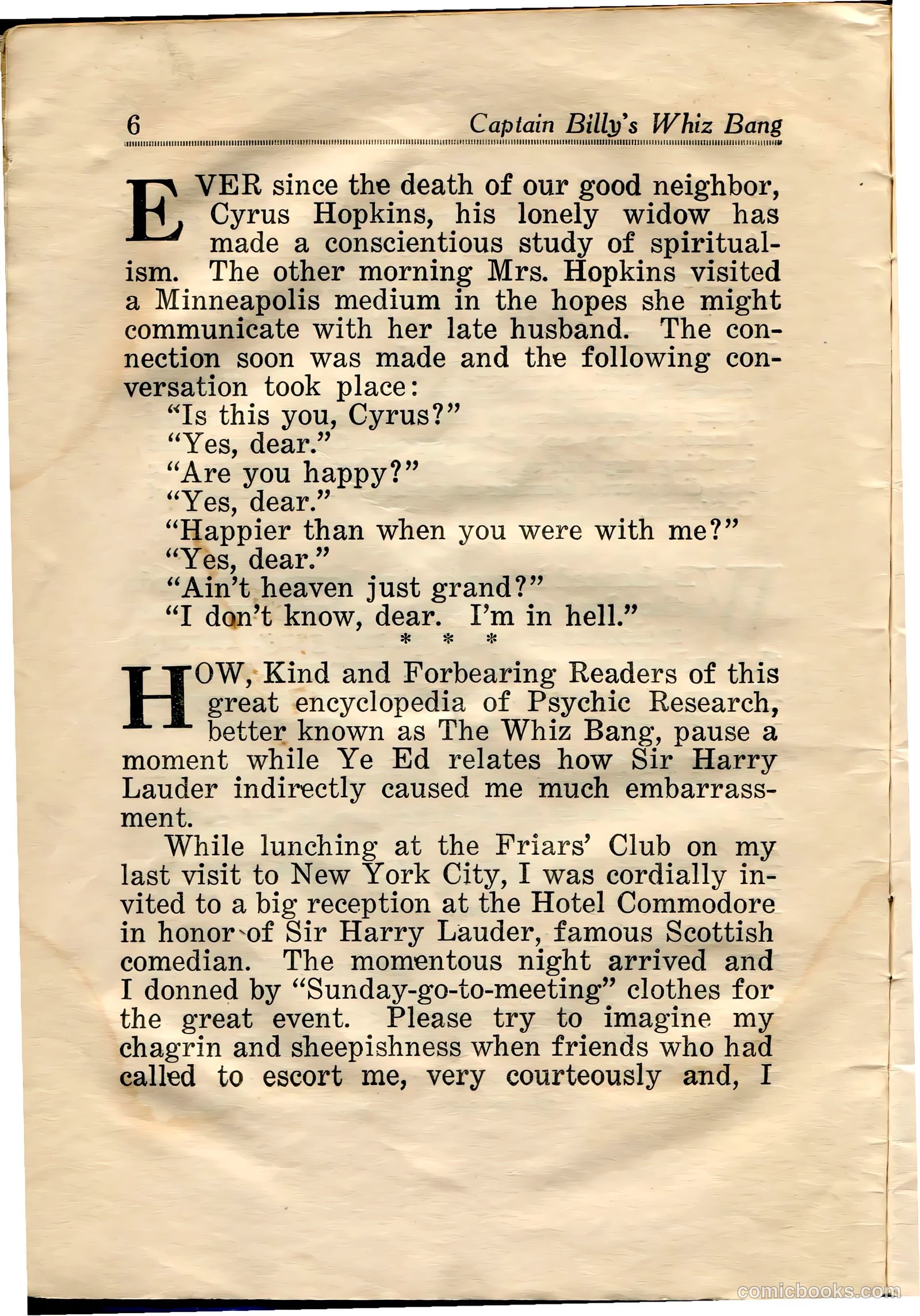
This page from *Captain Billy's Whiz Bang* contains two pieces of satirical humor: **The Spiritualism Joke**: A widow consults a medium to contact her deceased husband Cyrus Hopkins. The punchline subverts expectations—when she asks if he's happy in heaven, he reveals he's "in hell." The humor targets both spiritualism (a popular but widely mocked practice of the era) and suggests marital discord, implying the husband is unhappy even in the afterlife, presumably because he's still connected to his wife. **The Harry Lauder Anecdote**: The editor ("Ye Ed") begins recounting an embarrassing incident involving Scottish comedian Sir Harry Lauder, a famous vaudeville performer of the 1920s. The incomplete passage suggests he dressed overly formally or informally for a reception in Lauder's honor, creating comedic anticipation for the punchline to follow on the next page. Both pieces exemplify *Whiz Bang's* style: irreverent humor targeting spiritualism fads and poking fun at the magazine's own editor.
This page from *Captain Billy's Whiz Bang* (a early 20th-century satirical magazine) recounts the author's encounter with Scottish entertainer **Harry Lauder**, a famous performer known for comedic portrayals of Scottish characters and, apparently, a reputation for thriftiness ("jokes on Sir Harry's thrift"). The humor turns on class and rural identity: the author—identified with the magazine's "Captain Bilious Billy" persona—was invited to a formal "full dress affair" but, as a farmer ("horny-handed tiller of the soil"), humorously suggests overalls would be more fitting. The magazine's chairman introduced Lauder to the audience, and Scottish humor followed. The second section addresses readers' skepticism that "Captain Billy" was a real person rather than a fictional character created for the magazine. People questioned whether the author actually consumed moonshine (illegally distilled liquor) or had a hired hand named Gus—elements apparently featured in the publication's satirical content about rural American life.
This page from the satirical magazine features the editor, "Captain Billy," responding to reader questions with humorous exaggerations about his rural life. The joke hinges on his admission that he's guilty of the absurd allegations—owning a prize bull named Pedro (now dead), living near a real town called Robbinsdale, and having kept a couple's car seat as collateral during a theft report. The page then shifts to publishing a poem by "Gus," the editor's hired man, about a wandering tramp. The satire here appears gentle: Gus aspires to poetry while working as a farmhand, producing sentimental verse about homelessness and hardship. The editor's framing—suggesting Gus is inspired by the "whiff" of pine forests—gently mocks the man's romantic pretensions while publishing his work anyway. This reflects *Whiz Bang's* lighthearted, rural-focused humor and small-town perspective.
This page contains the beginning of a humorous short story rather than a political cartoon. The narrative describes a weary traveler seeking shelter at a Tennessee mountain cabin during the Prohibition era (implied by references to "mountain dew" and "moonshine"). The story appears to be setting up a crude joke: after drinking moonshine and removing his shoes to warm his feet by the fire, the hounds suddenly react with alarm and hide under the bed "as if they had gone crazy." The implication is that the traveler's feet smell so bad they frighten the dogs—a common earthy humor style for *Whiz Bang*, a magazine known for bawdy, working-class humor. There's no overt political satire here, merely rustic comedy centered on bodily humor, frontier hospitality, and the social customs of Appalachian mountain life. The story remained unfinished on this page.
This page contains two humorous pieces from an American satirical magazine (likely early 20th century). **Upper story**: A traveler's comedic misunderstanding about dogs behaving strangely under a bed. The punchline uses rural dialect—the farmer's daughter explains the dogs are simply reacting to one having brought a dead animal inside, for which their father beats them. The joke plays on the traveler's alarm versus the commonplace reality. **"The Young Gringo"**: An introductory poem about proper American behavior in Cuba and tropical countries, framed as drunken inspiration ("Ron Bacardi Superior"). The poem satirizes American tourists abroad, advising younger visitors to listen rather than speak, avoid arrogance ("cheek"), and show respect to experienced expatriates ("hardened old gringo"). It appears to mock American tourists' reputation for loud, entitled behavior while abroad—particularly in Cuba, a colonial-era American sphere of influence. The satire targets American excess and cultural insensitivity in tropical destinations.
This page contains satirical advice poetry addressed to "gringos" (American men, likely in Mexico or Latin America) and a joke mocking stuttering. The main poem offers tongue-in-cheek life guidance: don't complain when gambling, pay your debts cheerfully, marry white women, order cheap beer on dates, drink whisky, and conduct yourself honorably. The repeated refrain "gringo" frames these as stereotypical American behaviors—the satire mocking both American conduct abroad and the patronizing term itself. The term "gringo" carries implicit criticism of American arrogance and poor behavior in foreign contexts. The brief joke below ridicules a man's stutter by having a boy suggest the parrot would be better off dead than speaking as poorly. This reflects the era's cruder attitudes toward disabilities and speech impediments—humor at the disabled person's expense was considered acceptable. The satire targets American male behavior and attitudes, particularly regarding money, relationships, and alcohol consumption.
This page contains two short joke stories rather than political cartoons: **"This Sounds Like Bull"** mocks both the absurdity of the patient's claim (swallowing a mouse while sleeping) and the doctor's impractical solution. The humor lies in the escalating ridiculousness: a hotel doctor calls in a cat to catch a mouse using cheese bait, then abandons the patient to drink. The punchline—the cat disappears—suggests the cat may have eaten the patient's imaginary mouse, leaving no evidence. **"Pat's Hole"** is an Irish-immigrant joke (indicated by "Pat" and "sor"). The boss questions whether all the excavated dirt will fit back into the hole Pat is digging. Pat's response—that he hasn't dug the hole deep enough—is intentionally obtuse, treating a straightforward geometric problem as requiring unrealistic solutions. Both stories exemplify early-20th-century American magazine humor: absurdist scenarios played straight, with punchlines depending on characters' illogical reasoning.
This page is not a political cartoon but a philosophical essay by Princess Bibesco (daughter of British political figure Margot Asquith), published in *Captain Billy's Whiz Bang*, a popular satirical magazine. The piece contrasts two perspectives on romantic love through the voices of "LOVE" and "PASSION." The author critiques those who romanticize love through conventional imagery (moon, flowers) while dismissing physical desire as "degrading." She argues that genuine love includes passion and that stammering reveals authentic emotion. The satire targets uptight attitudes toward sexuality and passion—mocking people like "Mr. Adrian Roses" who wish to avoid both "the ridiculous and the sublime" of love. The piece suggests that denying passion's legitimacy is itself a form of restricted, inauthentic living. This reflects 1920s-era cultural debates about modernizing attitudes toward sexuality and emotion against Victorian restraint.
This page from the satirical magazine presents philosophical musings on love and marriage through labeled sections rather than traditional cartoons. The content satirizes early 20th-century romantic and modernist attitudes. The opening passage romanticizes first love with flowery, almost religious language. The "MARRIAGE" section mocks the period's relationship dynamics through paradoxical dialogue—a couple unable to communicate honestly, where admitting love becomes a reason *against* marriage. "PROTEST AGAINST REALISM" appears to critique modernist disillusionment: the speaker laments that experience destroys innocence and yearns impossibly to relive emotions "for the first time again," suggesting futility in seeking authentic feeling after past relationships. "DISILLUSIONMENT" (incomplete) hints at anxiety about what wisdom to pass to the next generation—implying society's uncertainty about modern love and values. The satire targets post-WWI intellectual cynicism and the tension between romantic ideals and harsh experience that characterized 1920s cultural discourse.
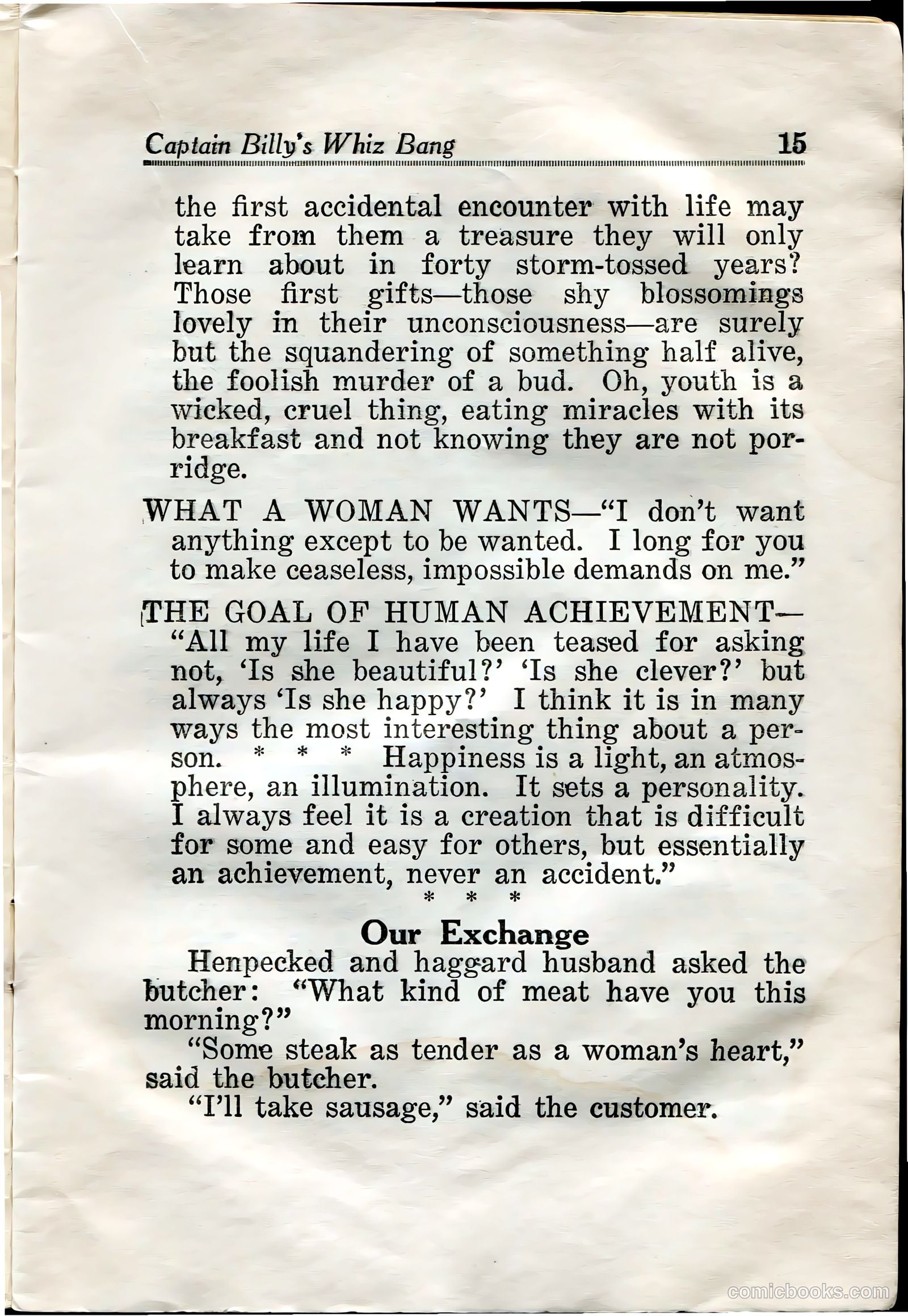
This page contains philosophical musings and a humorous anecdote typical of 1920s satirical magazines. The opening passage reflects on youth's wasted potential—a romantic meditation on how young people squander "miracles" through ignorance, unaware of their own gifts. "What a Woman Wants" presents a paradoxical statement about female desire: women want to be desired and valued through constant, demanding attention—a commentary on romantic/marital dynamics. "The Goal of Human Achievement" argues that happiness matters more than conventional markers like beauty or intelligence, framing contentment as an earned creation rather than luck. The final joke, "Our Exchange," uses gendered mockery. When a butcher describes steak as "tender as a woman's heart," the customer sarcastically orders sausage instead—implying women's hearts are actually hard or unfeeling. This reflects the magazine's cynical, anti-sentimental humor about women and marriage, typical of the era's male-oriented satirical publications.
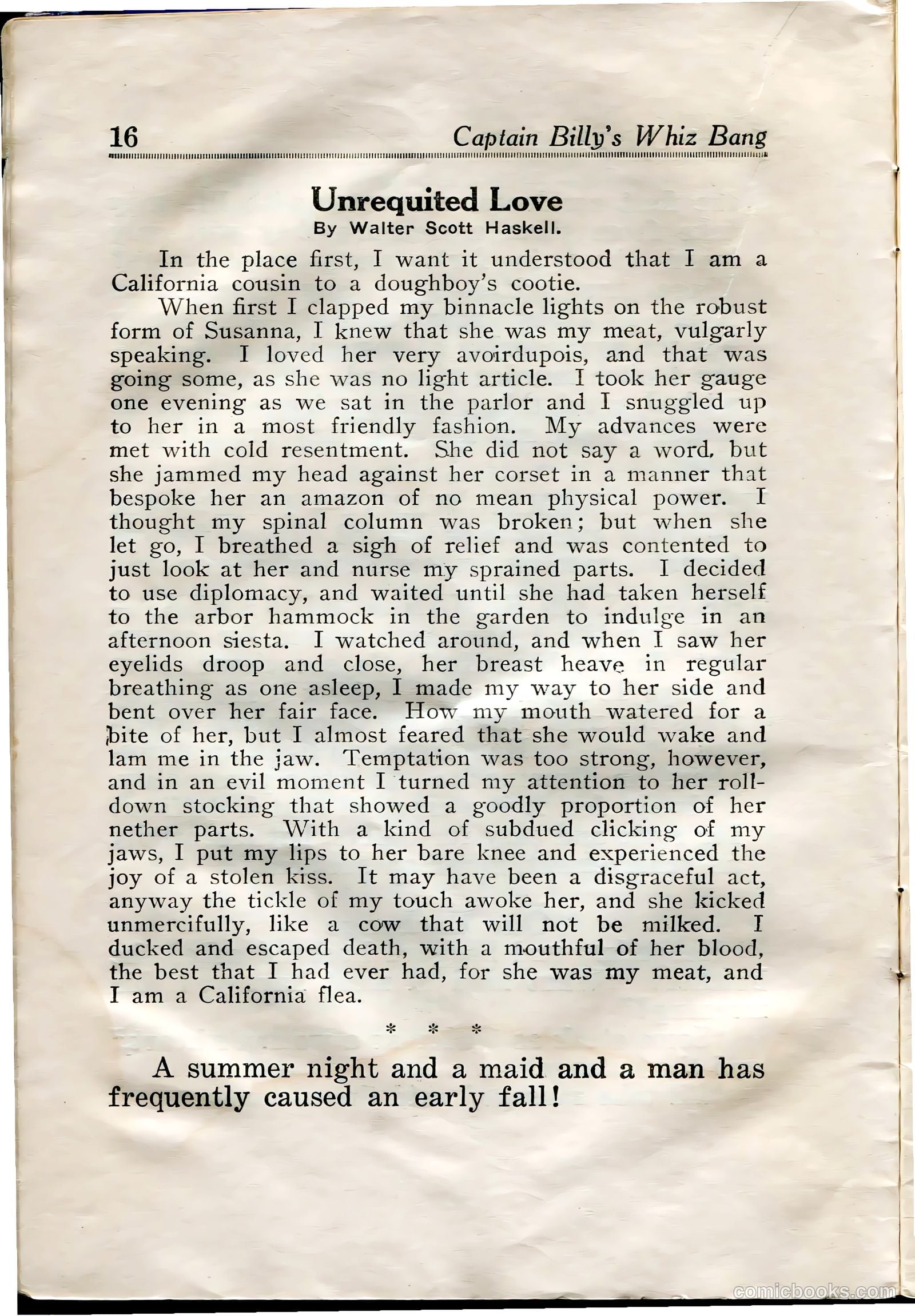
This is a humorous short story from *Captain Billy's Whiz Bang*, a post-WWI satirical magazine. The narrator is a flea ("California cousin to a doughboy's cootie"—lice were common in trenches) who becomes infatuated with a woman named Susanna. The joke relies on the contrast between the flea's anthropomorphized romantic aspirations and his actual nature. He describes pursuing her with exaggerated passion—physical advances in the parlor, sneaking kisses while she sleeps—but the punchline reveals his true motivation: she's simply "his meat." When he finally kisses her knee, she violently kicks him awake, and he escapes with "a mouthful of her blood." The closing couplet plays on morality: "A summer night and a maid and a man has frequently caused an early fall"—suggesting sexual scandal, but literally referring to the flea's literal fall/failure. The satire likely mocks both overwrought romantic narratives and post-war anxieties about morality.
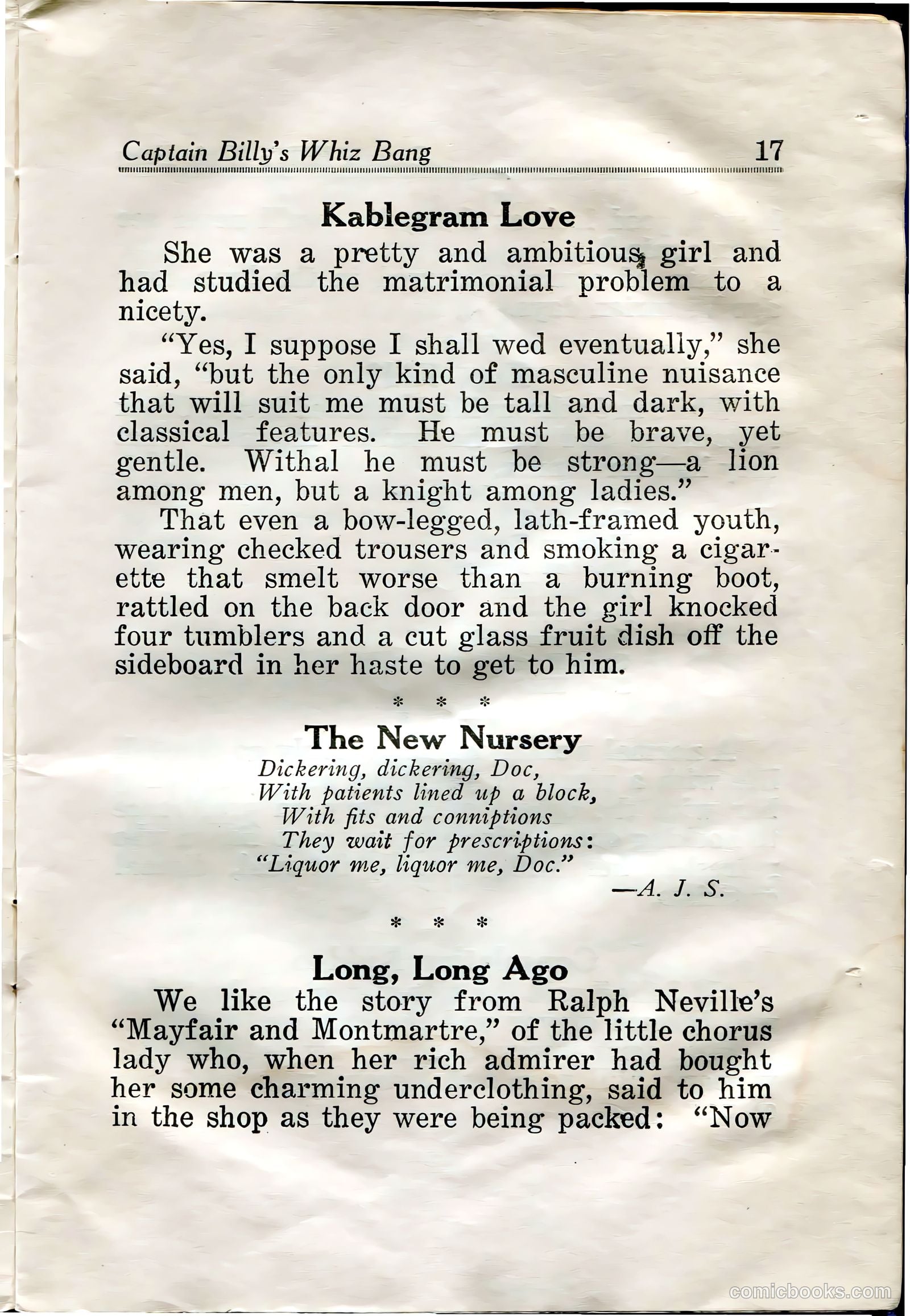
This humorous piece mocks the gap between women's stated romantic preferences and their actual behavior. The unnamed female protagonist declares exacting standards for a husband—he must be tall, dark, classically handsome, brave, gentle, and noble. Yet when an unattractive young man (bow-legged, poorly dressed, smoking a foul cigarette) simply shows up at her door, she abandons all pretense and frantically rushes to greet him, knocking over household items in her haste. The satire targets female hypocrisy and the notion that women's carefully reasoned matrimonial calculations collapse instantly when opportunity presents itself, regardless of the suitor's actual qualities. The "kablegram" (wireless message) title suggests this attitude is universally transmitted among women. It's a cynical joke about the unreliability of women's stated preferences versus their demonstrated behavior—a common theme in 1920s-era satirical magazines aimed at male readers.
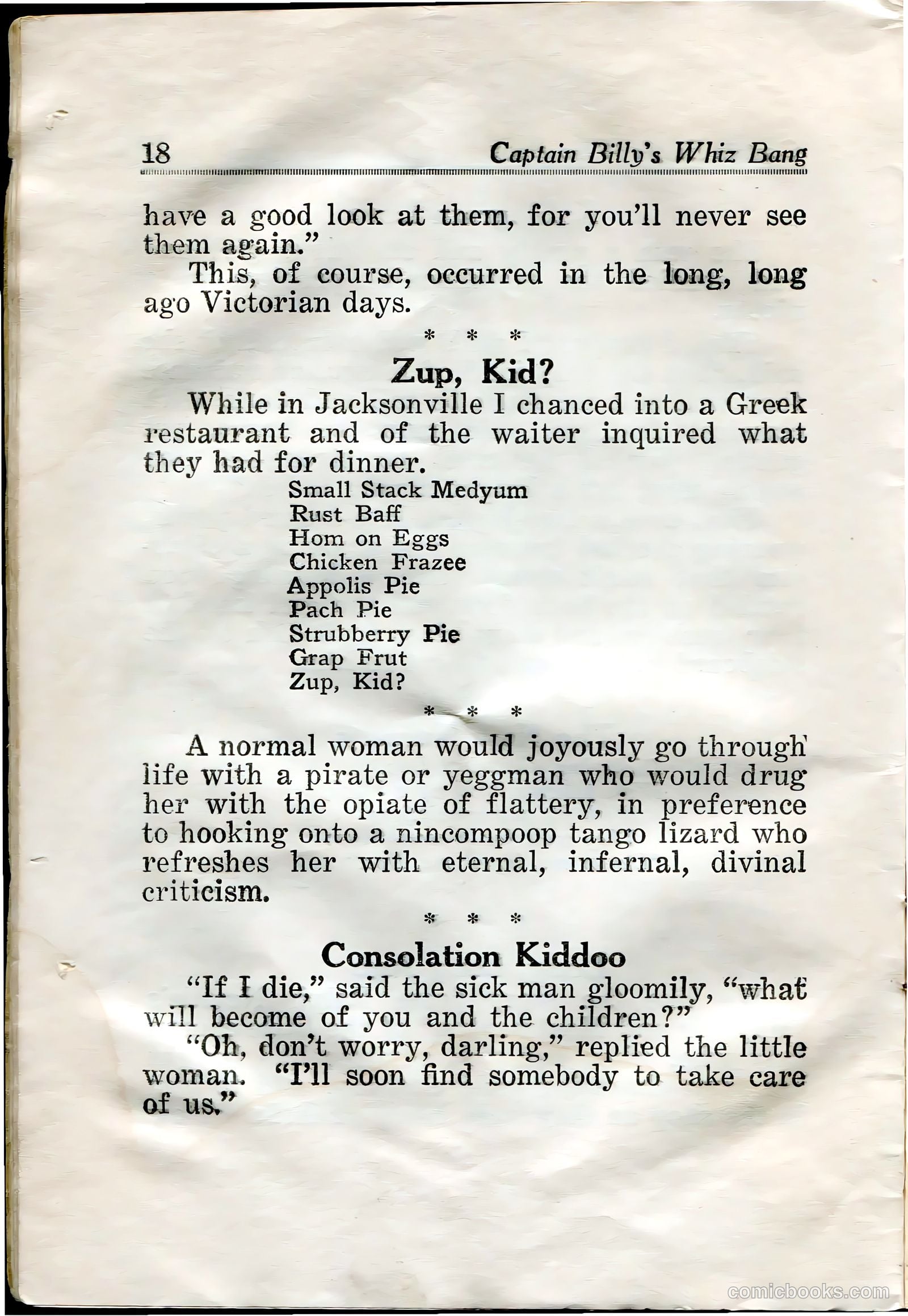
This page from *Captain Billy's Whiz Bang* contains three separate humor pieces typical of 1920s satirical magazines: 1. **"Zup, Kid?"** mocks Greek immigrants and ethnic dialects through a fake menu with phonetic misspellings ("Medyum," "Rust Baff," "Strubberry"). The humor relies on stereotyping immigrant speech patterns—a common form of period satire. 2. **The untitled middle piece** critiques relationship dynamics, contrasting a charming but dishonest "pirate or yeggman" (criminal types) with a nagging, critical husband. It suggests women prefer flattery from rogues over constant criticism from respectable men—cynical commentary on marriage. 3. **"Consolation Kiddoo"** is a dark joke where a dying man worries about his family's welfare, but his wife cheerfully responds she'll simply remarry—implying his death is convenient rather than tragic. The overall tone reflects *Whiz Bang's* irreverent, somewhat misogynistic humor targeting immigrants, domestic life, and mortality.
This page contains three separate humor pieces typical of early 20th-century American joke magazines: **"No Offense Here, Paddy"** plays on Irish ethnic stereotypes—the protagonist is characterized as "Paddy," a common name used to mock Irish immigrants. The joke relies on the premise that an Irishman would mistake a talking parrot for a bird, suggesting simple-mindedness. **"Let's Sing It Again"** appears to reference a popular song about a woman wearing something (the word censored as "'el"—likely "hell") for a distant lover, suggesting romantic or risqué content common to period music hall entertainment. **"Hot Stuff"** is a domestic humor piece where a husband's tactlessness—asking about a recently deceased man—embarrasses his wife at a social gathering. The joke targets awkward masculinity and social ignorance. All three reflect period conventions: ethnic caricature, innuendo, and husband-as-buffoon tropes standard to 1920s-era satirical magazines.
This page contains four separate humor pieces typical of 1920s satirical magazines: 1. **"Our Puzzle Department"**: A joke about intoxication. The father uses a classic drunk test—double vision—to explain inebriation. The son's response (seeing only one man) becomes the punchline, implying he's already drunk. 2. **"Let This One Sink In"**: A racial stereotype joke featuring a character named "Rastus" (a common derogatory name for Black characters in period media). The humor relies on dialect humor and the premise of a lion tamer's assistant joking about being eaten. 3. **Actors commentary**: A brief social observation about actors' inconsistency and shamelessness—willing to insult different cities depending on their audience for applause. 4. **"Our Spring Thriller"**: A setup-and-punchline about a chess match presented as dramatic confrontation, subverting reader expectations with an anticlimax. These pieces reflect typical lowbrow humor of the era, including casual racial stereotyping now considered offensive.
This is a humor column featuring "Captain Billy" answering readers' questions with comedic one-liners. The jokes rely on early 20th-century social commentary: 1. **The bull registration joke** mocks voting rights restrictions—suggesting animals are as qualified as certain excluded groups (likely targeting recent suffrage debates). 2. **The cast iron plates quip** is dark domestic humor about spousal violence, treating wife-beating as a joking matter acceptable for entertainment. 3. **The love definition** offers sentimental romance language typical of period advice columns. 4. **"The Eternal Triangle"** references the popular theatrical trope of romantic entanglements. The Adam and Eve reference and "Cribbed" (cheated/plagiarized) punchline suggest even biblical figures engaged in infidelity—irreverent humor mocking religious propriety. These reflect crude, often offensive humor standards of the era, normalizing violence and treating serious social issues as punchlines.
This page contains a humorous advice column titled "Captain Billy's Whiz Bang" from what appears to be an early 20th-century American satirical magazine. The column features tongue-in-cheek responses to reader questions about World War I military experiences, Turkish geography and rulers, and gender differences. The humor relies on period-specific references: the "Spanish influenza" epidemic that killed millions during WWI, jokes about soldiers' personal hygiene ("American Shavetails"), and contemporary cultural assumptions about women and Turkish culture. The "Black Eye Susan" reference appears to be slang or a folk figure unknown in modern context. The final exchange defines a "diplomat" as someone with particular social skills, characteristic of the magazine's irreverent approach to authority and convention. The overall tone mocks both military life and contemporary social pretensions through crude, direct humor typical of 1920s American satire.
This page from *Captain Billy's Whiz Bang* (a popular early-20th-century American humor magazine) presents a question-and-answer advice column featuring absurdist jokes. The humor relies on deliberate non-sequiturs and deadpan responses: **The jokes include:** - A man sneaking into bed backwards to deceive his wife about arriving late - Crediting William Tell with inventing apple sauce (a pun: shooting an apple creates "sauce") - Answering whether women matter everything with cynical agreement - Advice to use both hands when hammering (missing the actual safety question) - Defining absentmindedness as forgetting one's own marriage - A dangerously absurd toothache remedy (filling mouth with water then sitting on a hot stove) The satire targets everyday marital tensions, male behavior, and the gap between literal and practical answers. The humor is deliberately stupid and dangerous—typical of *Whiz Bang*'s irreverent, working-class sensibility popular in the 1920s-30s.
This page from *Whiz Bang*, an early 20th-century American humor magazine, contains several short jokes mocking various targets: **The jokes** satirize: - Baldness (cigar box as hair container) - Clergy hypocrisy (preacher collecting money before preaching thrift) - Children's naiveté (Percy's circular logic about sin) **The main story, "Proudie! Proudie!"** ridicules a man with an effeminate soprano voice and lisp. The humor relies on stereotyping: an actor snubs him for his mannerisms, repeatedly ignores him, but the soprano-voiced man publicly humiliates the actor in a cafe by loudly calling "Proudie!" in his exaggerated high voice and lisp—turning the actor's coldness back on him socially. The satire targets masculine pride and social prejudice, while simultaneously mocking effeminacy through caricature. This reflects period attitudes toward gender nonconformity as inherently laughable and deserving of public ridicule.
This page contains four brief satirical jokes typical of 1920s American humor magazines. The **"Parlor Story"** mocks NYC tenement overcrowding—four families crammed into one room separated only by chalk lines. The joke's dark humor: conditions are so bad that the punchline (one tenant taking in *boarders* in his quarter-room) seems plausible rather than absurd. The **mackerel/macaroons joke** appears to mock either ethnic stereotypes or food-based prejudice, though the exact target is unclear without more context about 1920s Manhattan demographics. **"Another Nut Story"** parodies both asylum inmates' typical sob stories and the absurdist punchline format—the man's complaint escalates ridiculously (Grape-Nuts cereal, sleeping with rats, a squirrel as a pet), culminating in him referencing Napoleon's lost love Josephine, conflating his supposed trauma with historical melodrama. **"Oh, Doc Crafts!"** is a one-liner comparing boring people to chewing blotting paper—a simple observational gag. The humor relies on exaggeration, wordplay, and surreal non-sequiturs typical of the era.
This page contains three brief satirical jokes typical of 1920s American humor magazines: **"This Ain't Very Hot"** mocks miserly grooms—a man gives his bride a nickel's candy and a trolley ride honeymoon, then wants to save the candy "for the children," suggesting stinginess even on his wedding day. **"Lampoon's Stuff"** describes a seduction on a Boston trolley (references to Park, Kendall, Central, and Harvard suggest actual Boston locations). The humor relies on a double standard: the man keeps "notches" (conquests) while the woman loses her watch, with both attributing success to different reasons—suggesting sexual double standards and male conquest culture. **"Fido, Quit Your Pekin"** is a pun on "Peking" (Beijing). The joke: Marie is so modest she removes her *Pekingese dog* while undressing—playing on the phrase "Pekinese" sounding like "peek-at-these." The final aphorism mocks passive people versus thinkers—mild social commentary typical of the era.
This page contains several brief jokes typical of the 1920s-era satirical magazine. The humor relies on wordplay and social observations: **"The Fireless Telephone"** plays on heavenly/hellish greetings ("Hell-o" vs. "Hal-o"). **Fashion joke** mocks women's fashion trends of the era—"piled up hair and shoulders bare / And vertebrae all in a row," likely referencing the flapper style with bobbed hair and exposed backs. **The miners anecdote** jokes about rough mining culture: a miner's heavy "hob-nailed shoes" accidentally punch holes in a meal ticket like a time card. **"Sandy Lost His Ball"** is a Scottish dialect joke where a devoted golfer is absent from the course—his golfing companions assume illness, but he's simply lost his golf ball, treating it as a tragedy worthy of skipping his morning routine. The final line expresses bewilderment at irrational behavior—comparing a "locoed" (crazed) cow to a lovesick man as equally incomprehensible.
This page contains five brief jokes typical of 1920s-30s American humor magazines: 1. **"This Can't Be True"**: A domestic infidelity joke where a husband catches his wife with his best friend. The punchline plays on the friend's shamelessness—he'll happily return if tempted by such "bait." 2. **"On Picket Duty"**: A labor pun. "Striking" references both a fashionable dress and labor strikes; the "union suit" (a type of undergarment) creates a double meaning about union membership. 3. **Murphy's clothes line**: Dark humor about a man's suicide, with his wife making a practical joke about her missing laundry line. 4. **"A Thing of Beauty"**: A quip mocking women's beauty expenses. 5. **"Where Words Failed"**: A joke about a Welsh station name so difficult to pronounce (Llanfairfeshawpwllgogerych) that a guard gives up and simply announces "If there's anybody there for here, this is it."—poking fun at Welsh language complexity. These reflect era-typical attitudes toward infidelity, labor, and regional/linguistic differences.
This page contains three separate jokes typical of 1920s satirical humor, all relying on ethnic and racial stereotypes: **"Mr. Harper's Special"** uses racist caricature of Black people. The "joke" centers on a couple applying for a marriage license already having children—the clerk is scandalized, but the woman deflects by blaming bad roads for the delay. The humor derives entirely from dehumanizing stereotypes about Black sexuality and family structure. **"It's a New One On Us"** is a mild domestic joke where a child mistakes her father's mustache for something else, with a punchline implying the mother is hairy or masculine. Relatively harmless compared to the others. **"Dot's Right"** uses Yiddish-inflected English dialect humor, portraying Jewish immigrants ("Cohen," "Ikey") as penny-pinching and physically awkward. The "joke" is the father's concern about the son splitting his pants while taking stairs two at a time to save shoe wear. All three exemplify how early 20th-century American humor normalized crude ethnic mockery as entertainment.
This page from *Captain Billy's Whiz Bang* (a 1920s humor magazine) contains three separate jokes; there are no political cartoons visible. The main anecdote mocks a professional beauty who claims the Sultan of Turkey honored her with a decoration for "virtue"—but hastily adds it's only "second class." The joke satirizes her hypocrisy: she's implying her virtue (sexual propriety) is questionable, yet she displays the medal proudly to King Edward (the future Edward VII). It's social satire about the gap between respectable appearance and actual reputation among high society. The second and third items are unrelated humor: one about teenage hand-holding in parlors, the other a morbid punchline about cremation. The references to Constantinople, the Sultan, and King Edward date this to the 1880s-90s era being discussed, though the magazine itself is from decades later. No specific political event is referenced—it's purely social mockery of aristocratic hypocrisy.
This editorial attacks Rev. Bob Shuler, a Los Angeles Methodist pastor, for publishing a pamphlet sermon blaming the movie industry for a death. The text references "the only screen star ever charged with a felony"—likely referring to Roscoe "Fatty" Arbuckle, involved in a 1921 scandal. Shuler claims to have proof of the industry's responsibility but published as a pamphlet because newspapers rejected it. The editorial's headline, "The Bull is Mightier Than the Bullet," suggests the pastor is spreading unsubstantiated accusations ("bull"—nonsense). The satire mocks Shuler's moral crusade against Hollywood's sexual content and loose marital attitudes, portraying him as self-righteous while making serious criminal accusations without solid evidence. The magazine defends the film industry against religious moralizing.
This page presents a moral critique of Hollywood actors through two contrasting examples. A Dr. Shuler condemns an unnamed actor as representative of movie industry immorality—citing booze parties, smoking, and loose behavior reported by studio neighbors. Shuler characterizes such figures as people who reject public moral standards, making their own rules. The page then juxtaposes this with a newspaper eulogy for actor Harry S. Duffield, delivered by fellow actor James Neill. The eulogy praises Duffield's devoutness: clean speech, church attendance, prayer, and moral judgment. The satire's point appears to be **ironic contrast**: while Hollywood broadly faces moral condemnation, individual actors like Duffield demonstrated genuine virtue. This reflects 1920s cultural anxieties about Hollywood's moral influence versus evidence that respectable individuals worked in the industry. The magazine uses real versus idealized morality to critique both blanket condemnation and actual moral failure.
This page from the satirical magazine contains three distinct pieces: 1. **An Editorial Fragment** criticizing yellow journalism and character assassination—attacking publications that gain attention through misrepresentation and defame "clean men and women" by generalizing individual failings to larger groups. 2. **"The Difference"** — A humorous anecdote about **Marshal Pétain** (French WWI military leader), mocking marriage. Before marrying, Pétain claimed all married couples fight like "cats and dogs." A friend counters by pointing to two harmonious pets on the hearth. Pétain's punchline: "Tie them together and watch"—implying forced proximity creates conflict. The joke satirizes pessimistic views of marriage. 3. **A Brief Joke** about courtroom absurdity: a prisoner claims innocence before hearing evidence, suggesting legal incompetence or willful ignorance. The page reflects *Whiz Bang*'s satirical targets: media ethics, social pretension, and institutional foolishness.
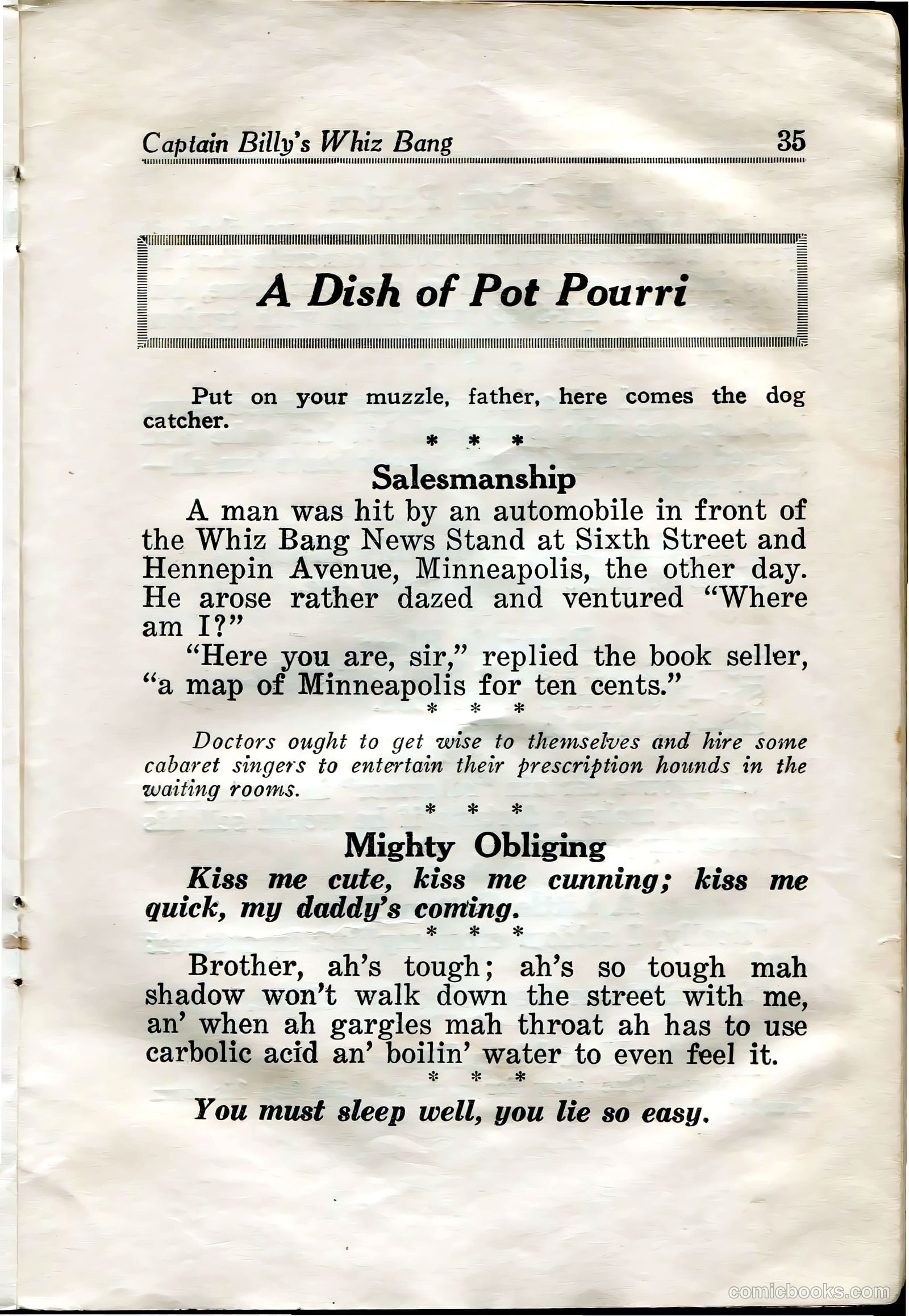
This page contains satirical short jokes and quips typical of the magazine's format. The content includes: **"Salesmanship"** — A dark humor joke about a hit-and-run victim at a Minneapolis newsstand who asks "Where am I?" The bookseller responds by trying to sell him a map, satirizing aggressive salesmanship and indifference to human suffering. **"Mighty Obliging"** — Contains period slang and flirtation humor ("kiss me cute, kiss me cunning"). **"Brother, ah's tough"** — An exaggerated boast about toughness using colloquial dialect, claiming even carbolic acid won't affect him when gargling—satirizing street tough-guy posturing. These are typical of *Whiz Bang's* bawdy, irreverent humor targeting American social behavior, salesmanship culture, and masculine braggadocio. The magazine was known for crude but accessible satire of everyday life and social pretension.
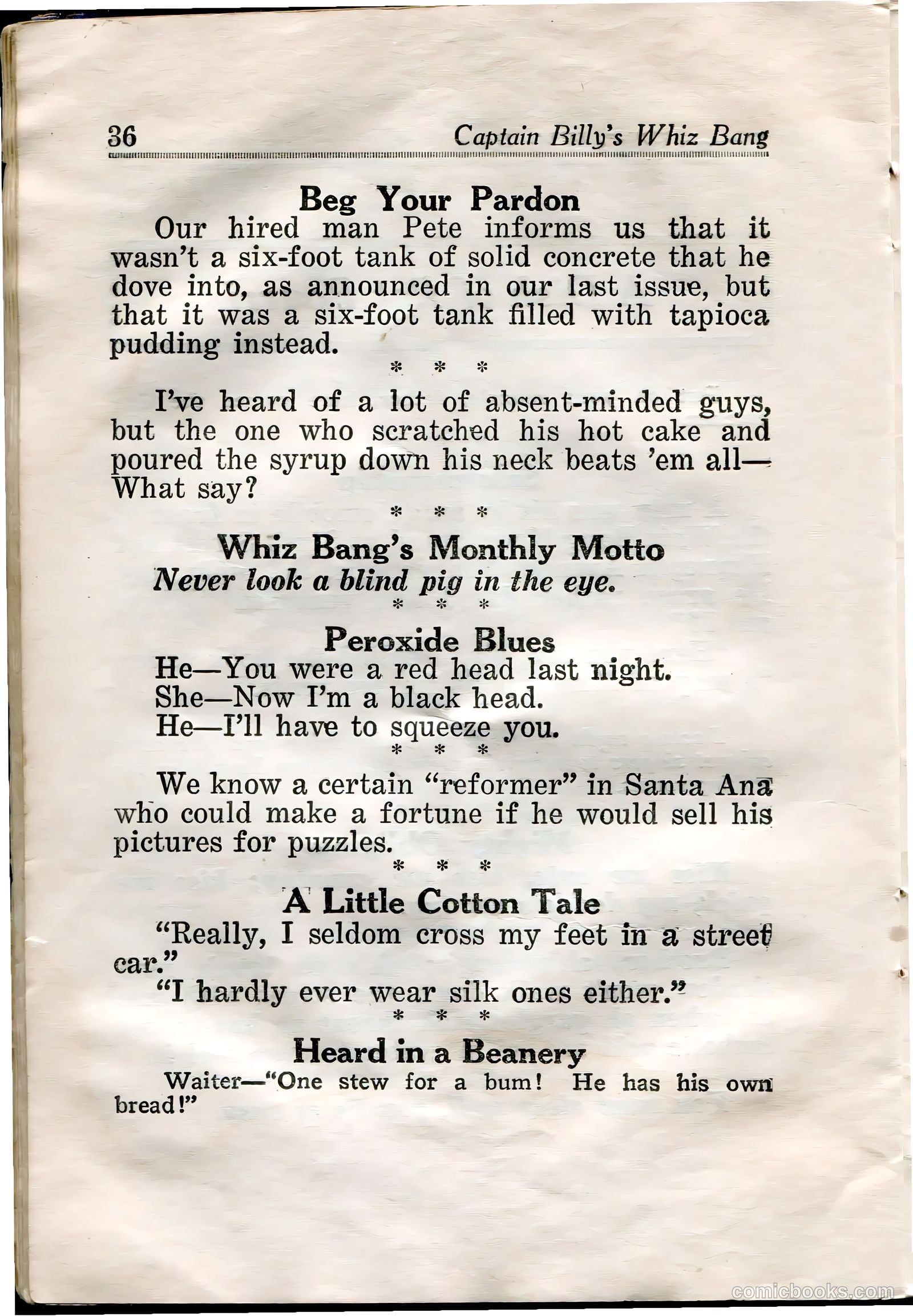
This is a humor/joke page from an early 20th-century satirical magazine featuring brief, disconnected comedic items: **"Beg Your Pardon"** corrects a prior issue's claim about Pete diving into concrete—it was actually tapioca pudding, a absurdist joke about mishearing or misreporting. **"Peroxide Blues"** mocks women who dye their hair, suggesting infidelity (she changed hair color overnight) while making a crude innuendo about "squeezing" her—likely referencing violence or revenge. **"A Little Cotton Tale"** appears to be a subtle joke about women's underwear and modesty in public transit, referencing cotton versus silk undergarments. **"Heard in a Beanery"** is a working-class gag: a waiter sarcastically announces a vagrant's meal while noting the man brought his own bread—mocking cheap diners and poverty. The humor is crude, class-conscious, and focused on physical mishaps, gender stereotypes, and lower-class life. No specific political figures appear to be caricatured on this page.
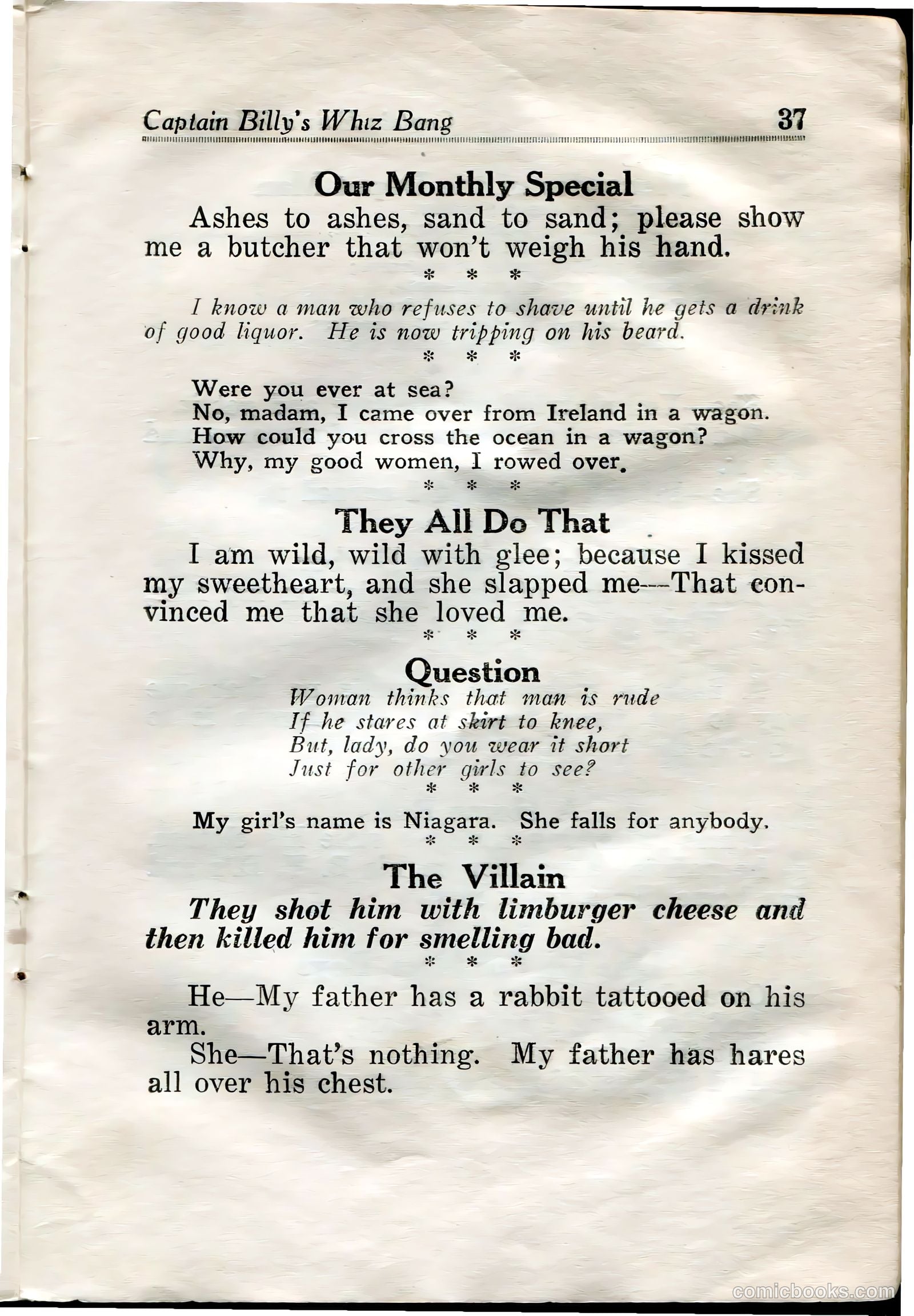
This page from *Captain Billy's Whiz Bang* (a 1920s-era humor magazine) contains brief jokes and quips typical of the era's satirical content. The humor relies on: - **Butchers cheating customers** by weighing their hand with the meat - **Prohibition-era drinking references** (a man won't shave without liquor) - **Irish immigrant stereotypes** (absurd ocean-crossing story) - **Gender dynamics**: women being "rude" for staring, then the twist that women dress to be looked at - **Sexual innuendo**: "Niagara" falls easily for men; tattoo wordplay (hares/hairs) suggesting body hair - **Absurdist humor**: killing someone with limburger cheese for smelling bad The page contains no political cartoons—just rapid-fire one-liners and joke exchanges reflecting working-class humor, consumer skepticism, and risqué double-entendres typical of American humor magazines during the 1920s Prohibition era.
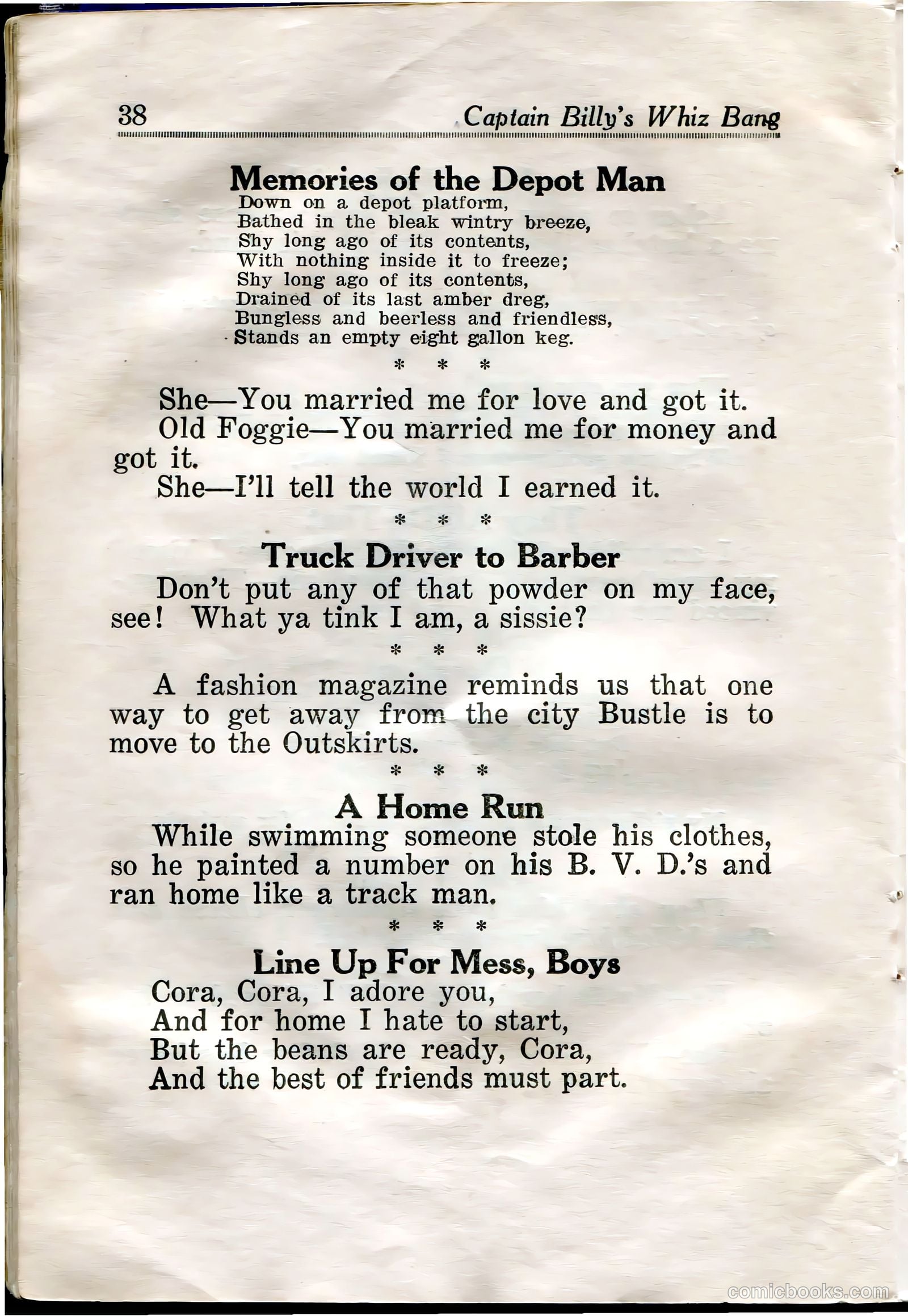
This page from *Whiz Bang*, a post-WWI American humor magazine, contains six brief comedic sketches targeting social conventions and masculinity anxieties of the 1920s. **Key satirical points:** - **"Depot Man"**: Mourns an empty beer keg—Prohibition-era commentary on alcohol deprivation. - **Marriage exchanges**: Mock hypocrisy in relationships; the woman claims to have "earned" money through marriage. - **Truck Driver/Barber**: Mocks working-class masculine anxiety about appearing effeminate (refusing powder/cosmetics). - **City/Outskirts pun**: Wordplay on "Bustle" (corset garment) versus urban congestion. - **Home Run**: Absurdist humor about a man streaking home in underwear after clothing theft. - **"Mess" (military dining)**: A soldier torn between homesickness and army food, using romantic language to describe beans—satirizing both military life and sentimental patriotism. The humor targets Prohibition, gender norms, working-class identity, and military experience—contemporary concerns for the magazine's readership.
This humor piece satirizes post-WWI economic strain and changing gender roles. Warren's salary has been reduced slightly (from $3,000 to $2,984), yet Helen obsesses over every penny—willing to climb a dangerous flagpole herself to save 50-75 cents on a laborer. The satire targets two things: (1) the absurdity of penny-pinching over trivial amounts during modest hardship, and (2) Helen's eagerness to take on physically dangerous "men's work" to save money. The joke's dark edge appears in Warren's threat to break her ribs if she attempts it—presented as comedic concern, reflecting the era's casual domestic violence humor. The casual mention of "a worm for our still" references Prohibition-era home liquor production, adding period flavor. The piece mocks both excessive frugality and the tension between wives' domestic roles and economic necessity during economic uncertainty.
This page from *Captain Billy's Whiz Bang* is a satirical domestic fiction piece mocking upper-class American life during Prohibition (referenced by "whisky runner's car"). The humor targets excessive wealth and poor parenting: Helen's household is so affluent yet understaffed that she gives her toddler "Baby Winifred" a cocktail of potato whisky and snuff to manage her tantrums. The satire escalates absurdly—a pet cobra that bites neighbors, leisure spent on Victrola music lessons while household help is scarce, and a three-hour butcher order. The piece ridicules both the frivolous priorities of the wealthy and the moral bankruptcy of Prohibition-era excess, where alcohol flows freely despite legal restrictions. The casual child endangerment (drugging an infant) amplifies the satirical critique of irresponsible privilege during this era.
This page contains satirical fiction from *Captain Billy's Whiz Bang*, an American humor magazine. The text describes a character named Helen engaging in a series of absurdly chaotic domestic events: violently knocking a woman into furniture and out a window, drinking "hemlock wine" (poison), hiding broken furniture, learning her daughter has been arrested for vandalizing a Benedict Arnold statue, burying a dead dog, and reading "Naughty Stories." The humor relies on escalating domestic chaos and Helen's remarkably casual attitude toward violence, property damage, and criminal activity. This reflects the magazine's satirical style—exaggerating working-class or lower-middle-class domestic dysfunction for comedic effect. The references suggest early 20th-century American life, with Helen portrayed as an incompetent, indifferent housewife whose day is filled with increasingly ridiculous calamities she accepts with resignation. The satire appears to mock both domestic violence norms and female character stereotypes of the era.
This page from the satirical magazine contains several brief humorous sketches and one-liners typical of 1920s-era comedy: **Main narrative**: A domestic scene where Warren comes home drunk from the office, collapses on the porch, then sits silently at dinner. His wife Helen complains about his lack of conversation and masculine rudeness, then cries—satirizing marital discord and the stereotype of the silent, uncommunicative husband. **"Too Fast!"**: A visual gag about the Victor Dog (RCA's famous mascot from "His Master's Voice" records) moving so fast its head catches its tail—mocking early talking machine technology. **Remaining items**: Brief one-liners and mock verses playing on physical appearance jokes ("Sweet Dada" about large ears) and moral aphorisms. These represent the magazine's typical mix of domestic comedy, absurdist humor, and quick gags aimed at post-WWI American audiences. The overall tone is light, anti-romantic, and gently mocking of contemporary relationships and technology.
This page features two poems in *Captain Billy's Whiz Bang*, a satirical magazine known for ribald humor. **"Smokehouse Poetry"** advertises an upcoming reprint of "Absolution" by Nesbit—a dramatic poem about a priest who becomes emotionally/physically involved with a female penitent during confession. The excerpts show the priest's internal struggle and aftermath, with religious language ("sin," "pardoned") masking an illicit encounter. The satire targets clerical hypocrisy—a priest violating his vows while hearing confession. **"Night After Night"** is a philosophical poem using card games as a metaphor for life's randomness and fate. The speaker accepts poor luck ("got no hand") with equanimity, concluding that unseen forces control outcomes beyond human effort. Both poems fit the magazine's blend of irreverent humor and literary content, with the first directly mocking religious authority through suggestive narrative.
This page contains a poem titled "The Kid's Last Fight" from Captain Billy's Whiz Bang, a satirical magazine. The poem narrates a boxer's rise to fame through various fights against opponents with colorful nicknames (Brooklyn Mike, Frisco Jim, Battlin' Ben, and "The Yorkshire Pet"). The narrator describes training under a manager named "Slim," winning successive bouts, and gaining attention from sportswriters. The poem culminates with references to fighting in France during what appears to be World War I, suggesting the boxer's ultimate challenge was military service rather than the ring. The satire likely mocks the boxing culture of the early 20th century while drawing a parallel between prizefighting and warfare—both presented as tests of masculine prowess.
This page contains a narrative poem about boxing, likely from the 1920s. The narrator describes becoming a boxing champion in the U.S., then traveling abroad (likely to Europe—"cross the drink") to fight for money and a championship title. The central plot twist: the narrator's opponent turns out to be "the Kid," apparently someone he knows personally. Despite the emotional conflict, "the Kid" insists they fight fairly and honestly rather than fake/throw the match, even though the crowd has bet money on the outcome. The satire targets the boxing world's corruption—the expectation that matches are rigged, that fighters would throw bouts, and that crowds knowingly gamble on dishonest contests. The "Kid's" insistence on honesty becomes ironic commentary on how abnormal genuine sportsmanship has become in professional boxing. The poem's colloquial language and casual treatment of bribery and match-fixing satirizes the era's widespread acceptance of sports corruption.
This page contains a first-person boxing narrative poem describing a brutal fight that ends in the opponent's death. The narrator, appearing to be an amateur or carnival boxer, defeats his opponent—called "the Kid"—but the victory becomes tragedy when the defeated fighter dies. The satire operates on multiple levels: the poem mocks both the violence of boxing and the crowd's bloodlust. Spectators initially accuse the narrator of "faking" when he hesitates to deliver a killing blow, then demand he finish the fight. The tragic ending—the Kid's death—indicts the sport itself and the mob mentality that drives it. The unrelated advertisement at bottom (about Ingersoll watches) is typical of *Whiz Bang*'s satirical format, using absurdist humor to mock consumer culture and false expertise.
This page from *Captain Billy's Whiz Bang* (a 1920s-era humor magazine) contains several distinct joke types typical of the era: **"The Rolling Stone"** is a sentimental poem about wanderlust and restlessness—the desire to always seek what lies beyond the next horizon. It's likely satirizing romantic notions of the vagabond lifestyle. The remaining content consists of brief jokes: - A pun on "mousetrap" being "snappy" - A double entendre about a woman's affairs being in "good shape" as she dresses - A dark humor joke about railroad ties (used for suicide) as "neckwear" for trainmen - A suggestive joke implying a modest girl won't look at her house's "weather strip" (likely a euphemism) The humor relies on wordplay, sexual innuendo, and crude jokes typical of this magazine's irreverent style. There are no identifiable political figures or caricatures on this page—it's primarily satirical humor targeting social conventions and using double meanings common to 1920s-era "men's magazines."
This page from the satirical magazine contains four brief humorous anecdotes typical of early-20th-century American comedy: 1. **"Slobbering Blues"**: A sentimental romantic scene undercut by mundane reality—the woman's tears aren't from emotion but hay fever, deflating the male character's romantic gestures. 2. **"Encore Ha Ha"**: A play on religious language. The minister's congratulatory phrase "the Lord has smiled on you" is twisted into dark humor—Jones suggests God is *laughing at* him (implying twins are a punishment or burden), not blessing him. 3. **"A Colorado Egg"**: An absurdist asylum joke where an inmate claims to literally *be* a poached egg and requests toast to sit on—the humor relies on the inmate's delusional reasoning. 4. **"Jockey" joke**: References wrestler Zybszko (likely Stanislaus Zbyszko, a famous strongman). The thrown jockey suggests replacing a human rider with the physically powerful Zbyszko—a non-sequitur punchline. The jokes employ wordplay, twisted expectations, and physical comedy typical of 1920s-era humor magazines.
This page contains three brief humorous anecdotes typical of 1920s satirical magazines: **"A Startling Exegesis"** mocks African American dialect and religious services through a caricatured sermon about the biblical parable of the ten virgins. The humor relies on racist stereotyping—phonetic dialect ("mawnin'," "war") and the preacher's supposed confusion about the parable's meaning. This reflects the period's casual racist humor in mainstream publications. **"Must Be Dr. Cupid"** is a wordplay joke: a doctor diagnoses heart trouble, but the young man reveals his "heart trouble" is actually caused by a woman (unnamed), playing on "heart action" having romantic rather than medical implications. **"Roll 'Em Out Kid"** is a tall-tale about potatoes rolling downhill so prolifically that pulling one vine released two bushels. It's hyperbolic rural humor typical of the era's farm-themed jokes. All three anecdotes were reprinted from other publications (Harper's Magazine, Pathfinder), indicating Whiz Bang's practice of republishing humor.
This page contains two separate humor pieces from *Captain Billy's Whiz Bang*, an early 20th-century American satirical magazine. **First piece**: A colored minister delivers a sermon on free salvation, then announces a collection. A congregant protests the contradiction. The parson's response uses an extended water metaphor: salvation itself is "free" like river water, but the *infrastructure* to deliver it (the church institution, clergy, buildings) costs money—like piping water to your house. The joke mocks how religious institutions frame mandatory donations as unavoidable institutional costs rather than true charity. **Second piece**: A brief, darkly comic exchange between Deacon Miller and his jailed son. The son writes he's imprisoned; the father replies he is too. The joke's meaning is deliberately opaque—whether both are literally incarcerated, the father is metaphorically "imprisoned" by shame, or it's simply absurdist humor—remains unclear from the text alone. Both pieces employ working-class characters and irreverent humor typical of the magazine's style.
This page from *Captain Billy's Whiz Bang* (a 1920s satirical magazine) contains a travelogue article—not a cartoon—by Rev. "Golightly" Morrill describing his visit to Canton, China. The piece employs **racist stereotypes and exoticization** common to early-20th-century American travel writing. It depicts Chinese people as bizarre and backwards through anecdotes like a woman performing folk magic with dirt after domestic violence, and describes the environment with disgust ("stinking canal"). The casual inclusion of a guide named "Ah Cum"—a stereotypical "Oriental" name—and the coffin-sedan-chair detail further emphasize the author's intent to portray China as grotesque and foreign. For modern readers, this reflects how American popular media used "exotic" travel tales to reinforce prejudice and cultural superiority during an era of significant anti-Chinese sentiment in America.
This page contains a satirical travel narrative mocking early 1920s China during political upheaval. The author describes Chinese street life with grotesque exaggeration—rotting food, dead animals, filthy soup—invoking Shakespeare's "Macbeth" to heighten the horror. The satire targets post-revolutionary China: temples converted to political use, traditional religion abandoned, cultural destruction (painted dragons "wiped out"). Marco Polo is mocked as the first Western "globe-trotter" whose successors are now "nuisances"—likely criticizing foreign intervention. The graveyard section satirizes class divisions and superstition: rich Chinese pay "grafting geomancers" (corrupt feng shui practitioners) for ideal burial spots, while the poor rest in common graves. "The Great Dragon" appears to reference geomancy beliefs or possibly political instability. Overall, the piece ridicules both Chinese traditionalism and Western colonial attitudes simultaneously.
This page contains a travelogue narrative (not a cartoon) from the satirical magazine describing a visit to China's Execution Grounds. The piece uses darkly humorous, orientalist language typical of early 20th-century American magazines to describe Chinese capital punishment practices. The satire targets both China and Western attitudes toward it. It portrays China as "uncivilized" (executing criminals visibly) while depicting the narrator as a detached, morally superior observer making literary references (invoking Shakespeare's "Yorick" over actual skulls). The executioner's estimated 300,000 kills is presented as darkly comedic. The final section's tone shift—surprise at officers "embracing the coolies"—suggests satirizing Western hypocrisy about racial attitudes and colonial superiority. References to "Bayard Taylor" (a real 19th-century travel writer) lend false authority to the sensationalized account.
This is travel writing from an American satirical magazine describing Macao (the Portuguese colonial gambling enclave near Hong Kong). The author recounts observations of gambling houses, opium use, and Chinese culture. The satire operates on multiple levels: 1. **Colonial condescension**: The writer describes Chinese gambling, opium use, and entertainment with bemused detachment typical of early 20th-century Western attitudes toward Asian societies. 2. **Government hypocrisy**: Macao's government officially searches for "concealed arms" while openly backing gambling houses that fund social services for gambling victims—a cynical system the author finds darkly humorous. 3. **Orientalist stereotyping**: References to "song-parlors," opium pipes, and "almond-eyed" women reflect period racial caricatures. The invocation of Confucius on women having "no souls" exemplifies how Western writers weaponized Asian philosophy to justify their prejudices. 4. **Ironic luxury details**: Exotic foods (bird-nest soup, shark-fins) and Portuguese wines highlight the colonial mixing of cultures while maintaining Western superiority. The piece reflects early 1900s American attitudes: fascination mixed with moral disapproval of non-Western practices.
This page contains a first-person travel narrative—not a cartoon—describing the author's visit to Macao, likely early 20th century. The text reflects period Western attitudes toward Asian cultures through heavily stereotyped description. The passage describes Chinese women with racist imagery (exaggerated makeup, betel-nut staining, "unnattractive to an Occidental eye"), presenting them as exotic and morally suspect via a quoted proverb about female deception. The opium factory section uses gothic, dehumanizing language—workers as "imps," the facility as "Devil's smithyshop." This reflects Western moral panic about opium while documenting actual industrial processing. The tone combines voyeuristic travel journalism with moral disapproval, typical of early 20th-century American periodicals. The satire targets Asian practices rather than critiquing Western imperialism or exploitation.
This page contains two distinct pieces of satirical content: **The opening passage** describes opium addiction in China with vivid, moralizing language—depicting addicts as tragic figures trapped in cycles of drug use and poverty. This reflects early 20th-century American attitudes toward Asian drug use, treating it as both exotic and culturally symptomatic. **"Be An 'I Can' Giant"** is an allegorical poem contrasting two personified concepts: "I Can't" (depicted as a weak, disabled dwarf who sabotages others) versus "I Can" (a strong, capable giant representing self-reliance and honest work). This is motivational verse—common in Whiz Bang—promoting American optimism and individual determination. The implicit message: success depends on mindset and willpower rather than circumstances. Both pieces reflect the magazine's blend of cautionary tales about vice and inspirational messages about personal responsibility, typical of 1920s American popular culture.
This page collects brief humorous items typical of 1920s American satirical magazines. The humor relies on: **"An Immediate Saving"**: A dark joke playing on Jewish immigrant stereotypes (the Yiddish-accented "Ikey" and maid "shixa"). The punchline: despite his wife's death, the protagonist economizes by ordering only one egg for breakfast—mocking both grief-stricken priorities and perceived Jewish frugality. **"Fancy Poetry"**: Wartime humor (likely WWI-era, given the "Paris falling" reference). The jokes juxtapose tragedy with petty concerns—a blown-off hand mattering less if it wasn't the wage-earning hand; a garter falling while discussing military collapse. **"Bang! Bang!"**: A double-entendre joke where "bust" (clothing measurement) sounds like gunfire, creating false alarm humor. The page emphasizes working-class perspectives, ethnic humor stereotypes, and irreverent treatment of serious subjects (death, war, female bodies)—typical of Whiz Bang's lowbrow satirical approach targeting post-war American audiences.
This page from *Captain Billy's Whiz Bang* (a 1920s-era humor magazine) contains three brief comedic pieces: **"They Shot Spitballs"** satirizes military exercises by mocking their absurdity. The joke: defending forces "destroy" a bridge by posting a notice, then are bewildered when attackers cross anyway—while pantomiming swimming. The Major's retort ("swimming the dang river") highlights how rigid rule-following in war games becomes ridiculous when soldiers mime actions instead of actually performing them. The humor lies in the gap between military procedures and practical reality. **"Let's Now Sing"** is a brief, cheeky verse about an attractive woman with contradictory qualities (naughty yet classy)—typical lowbrow magazine humor of the era. **"The Morning Mail"** contains two unrelated quips: a pun on "Daily Undershirt" (likely poking fun at newspaper names), and an observation about women's beauty being simultaneously advantageous and problematic—a dated, somewhat cynical attitude reflecting era attitudes toward gender. The overall tone is irreverent, military-focused, and aimed at working-class male readers.
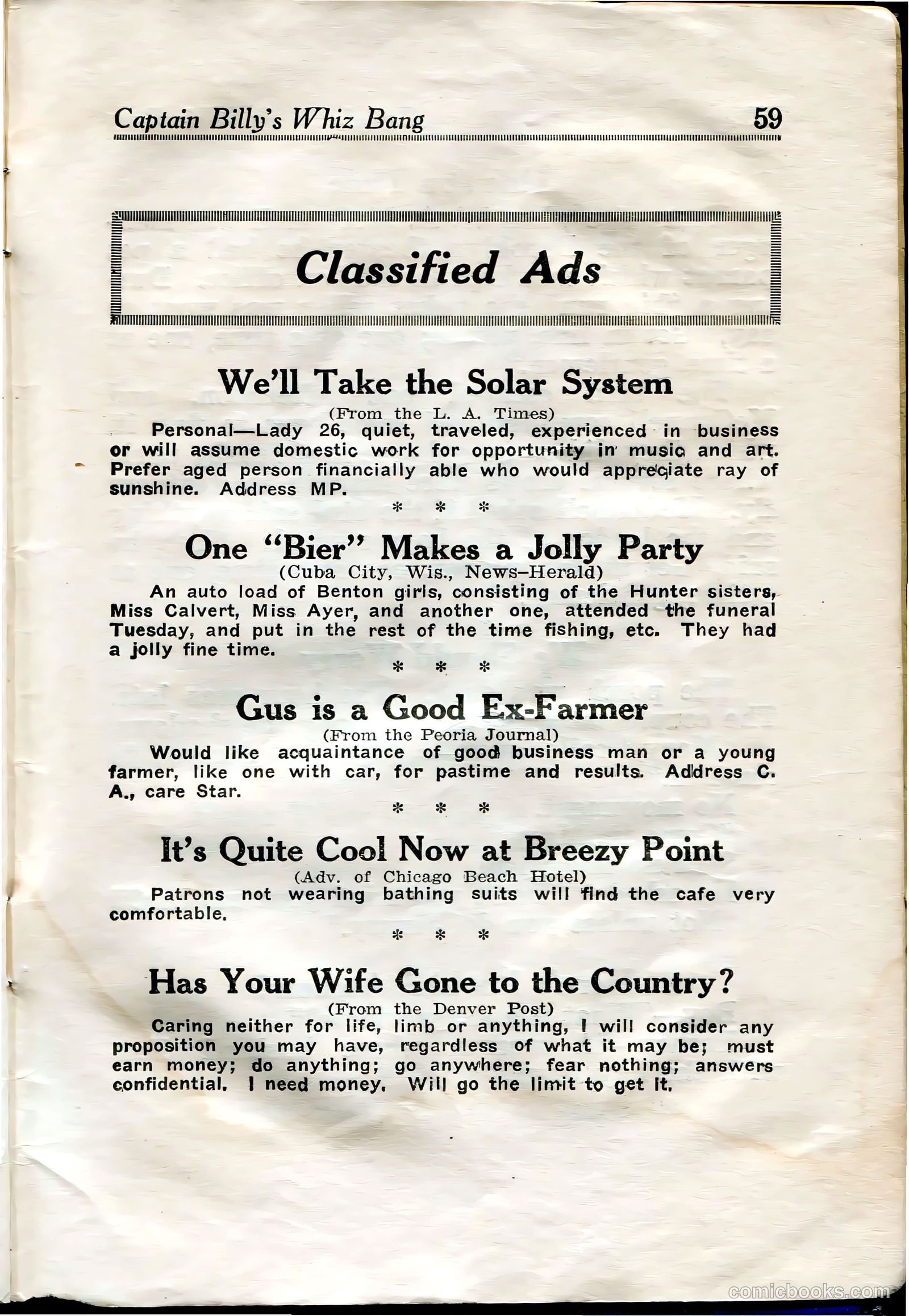
This page contains no cartoons—it's a compilation of humorous classified ads clipped from real newspapers and republished for satirical effect. The humor relies on double meanings and suggestive language that appears innocent but carries risqué implications, typical of 1920s "adult" magazine humor. "We'll Take the Solar System" features a woman seeking an older, wealthy man under the guise of business/domestic work. "One 'Bier' Makes a Jolly Party" plays on the German word for beer while describing girls mixing funeral attendance with recreation. Other ads feature women seeking money/companionship with increasingly desperate language, especially the final ad's "will go the limit" phrasing. The satire mocks both the desperation of post-WWI joblessness and the thinly-veiled propositions in personal ads—suggesting these classified sections were venues for transactional relationships during economically difficult times.
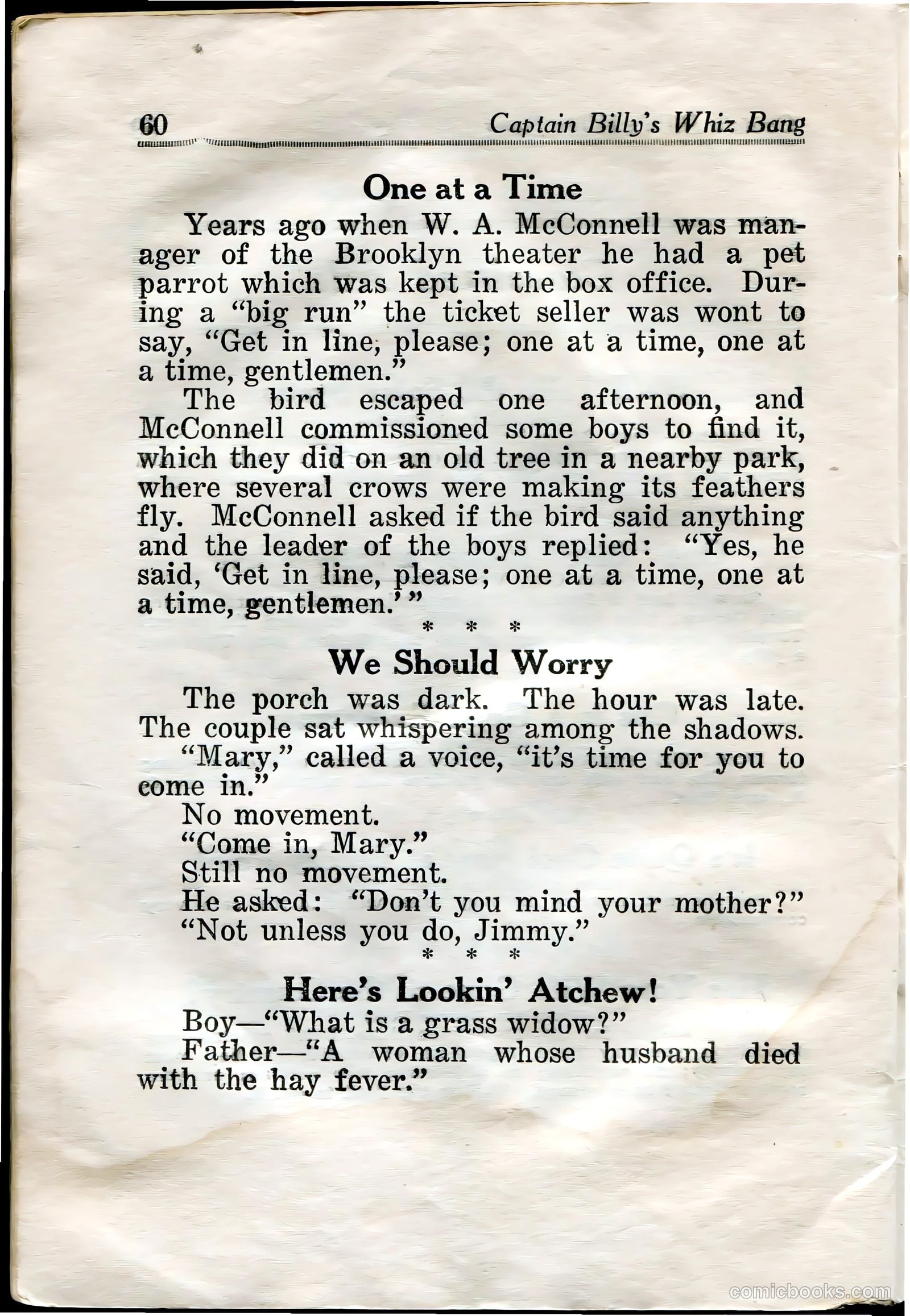
This page contains three brief humor pieces typical of 1920s American comic magazines: **"One at a Time"**: A anecdote about a Brooklyn theater manager's escaped parrot that had memorized the ticket seller's repeated phrase. The joke relies on the parrot mimicking human behavior and speech—humor based on the bird's unexpected "training." **"We Should Worry"**: A courtship scene where a young couple ignores a mother's calls from inside. The punchline—the girl saying she'll obey her mother only if the boy does—uses mild flirtation and cheek toward parental authority, reflecting 1920s youth culture's gradual loosening of Victorian propriety. **"Here's Lookin' Atchew!"**: A father-son joke defining "grass widow" (a woman separated from her husband, often temporarily) as one whose husband died of hay fever. The humor is purely pun-based wordplay. These are straightforward jokes with no political content—typical of *Whiz Bang*, which was primarily a humor and satire magazine rather than political commentary.
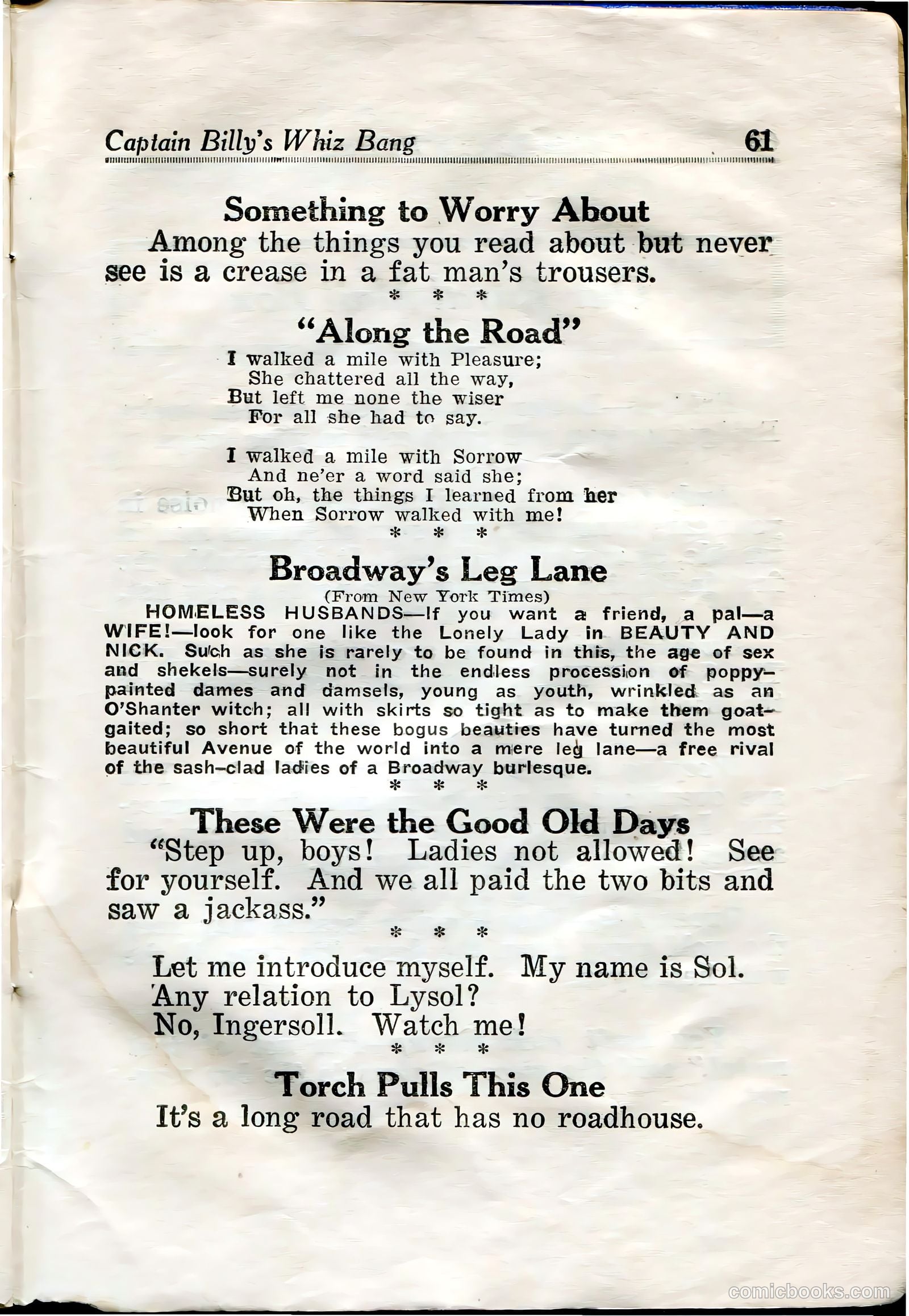
This page from the satirical magazine consists of brief humorous observations and verses rather than visual cartoons. The content targets several early-20th-century social anxieties: **"Something to Worry About"** mocks body image concerns—the notion that overweight men maintain perfectly creased trousers is absurdly unrealistic. **"Broadway's Leg Lane"** criticizes modern women's fashion (likely 1920s flapper styles), lamenting short, tight skirts that supposedly turn Fifth Avenue into a display comparable to burlesque theaters. It nostalgically contrasts this with "Beauty and Nick" (likely a film), depicting an idealized modest woman. **"These Were the Good Old Days"** uses ironic nostalgia, comparing past entertainment (paying to see a donkey) to present amusements, suggesting modern culture is equally ridiculous. **The Sol/Lysol/Ingersoll jokes** are puns playing on product names and brand recognition. **"Torch Pulls This One"** is a standard proverb variation. The page presents social commentary through wordplay rather than visual satire, typical of Whiz Bang's irreverent humor style.
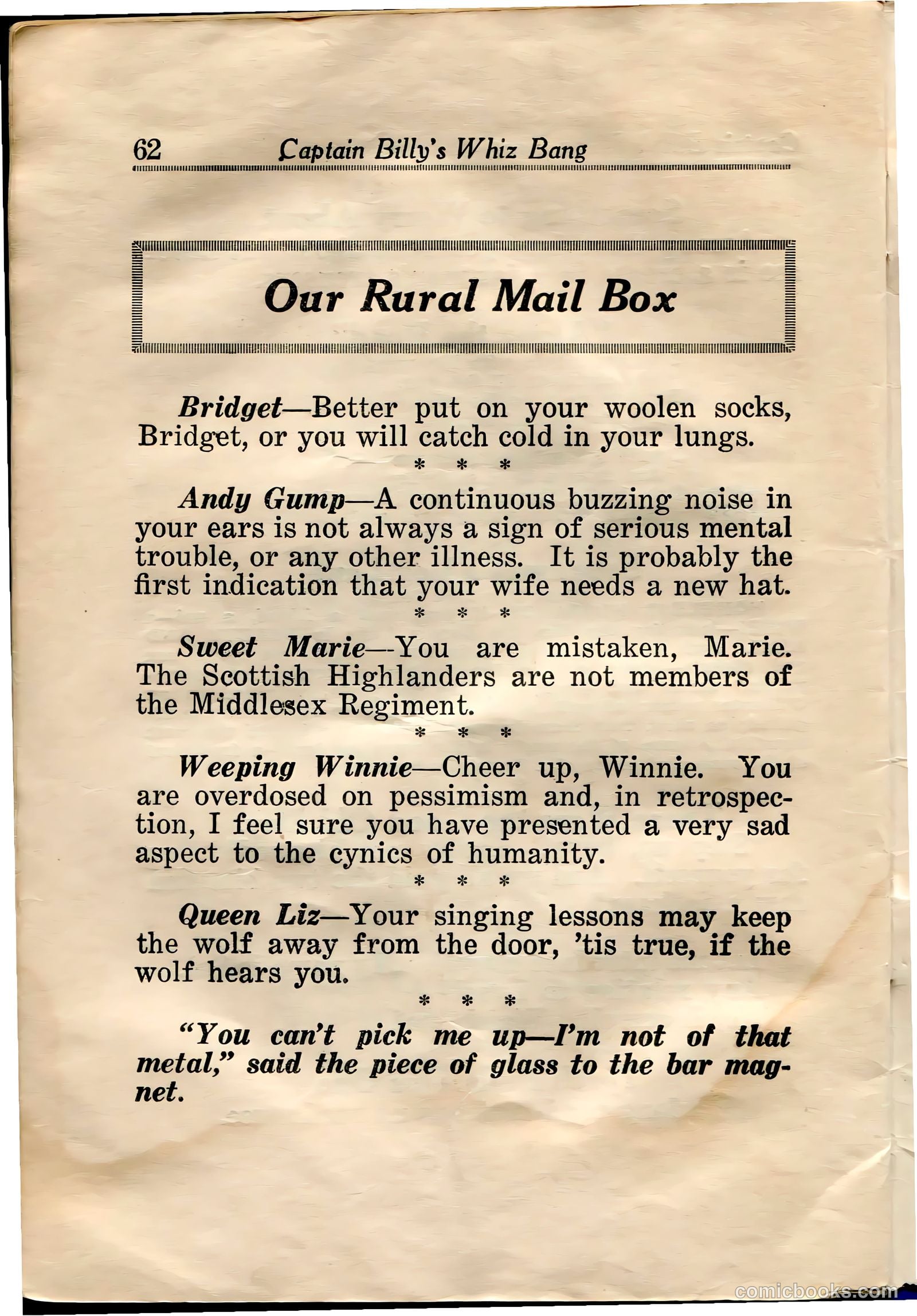
This is a humor column featuring mock advice letters from rural readers with stereotypical names, a common format in early 20th-century American satirical magazines. The jokes target: - **Domestic life**: "Andy Gump" (referencing the popular comic strip character) receives advice that his wife's constant nagging (symbolized by wanting a new hat) causes his ear buzzing—blaming wives for husbands' ailments was standard period humor. - **Working-class characters**: "Bridget" (Irish servant stereotype), "Sweet Marie," "Weeping Winnie," and "Queen Liz" represent lower-class women readers. - **Trivial complaints**: The column mocks readers' petty concerns with tongue-in-cheek "wisdom"—e.g., Queen Liz's bad singing won't scare away wolves, and the glass/magnet joke is pure nonsense. The overall satire mocks rural America's supposed naïveté and domestic squabbles, presenting them as worthy of comedic dismissal by a knowing urban audience.
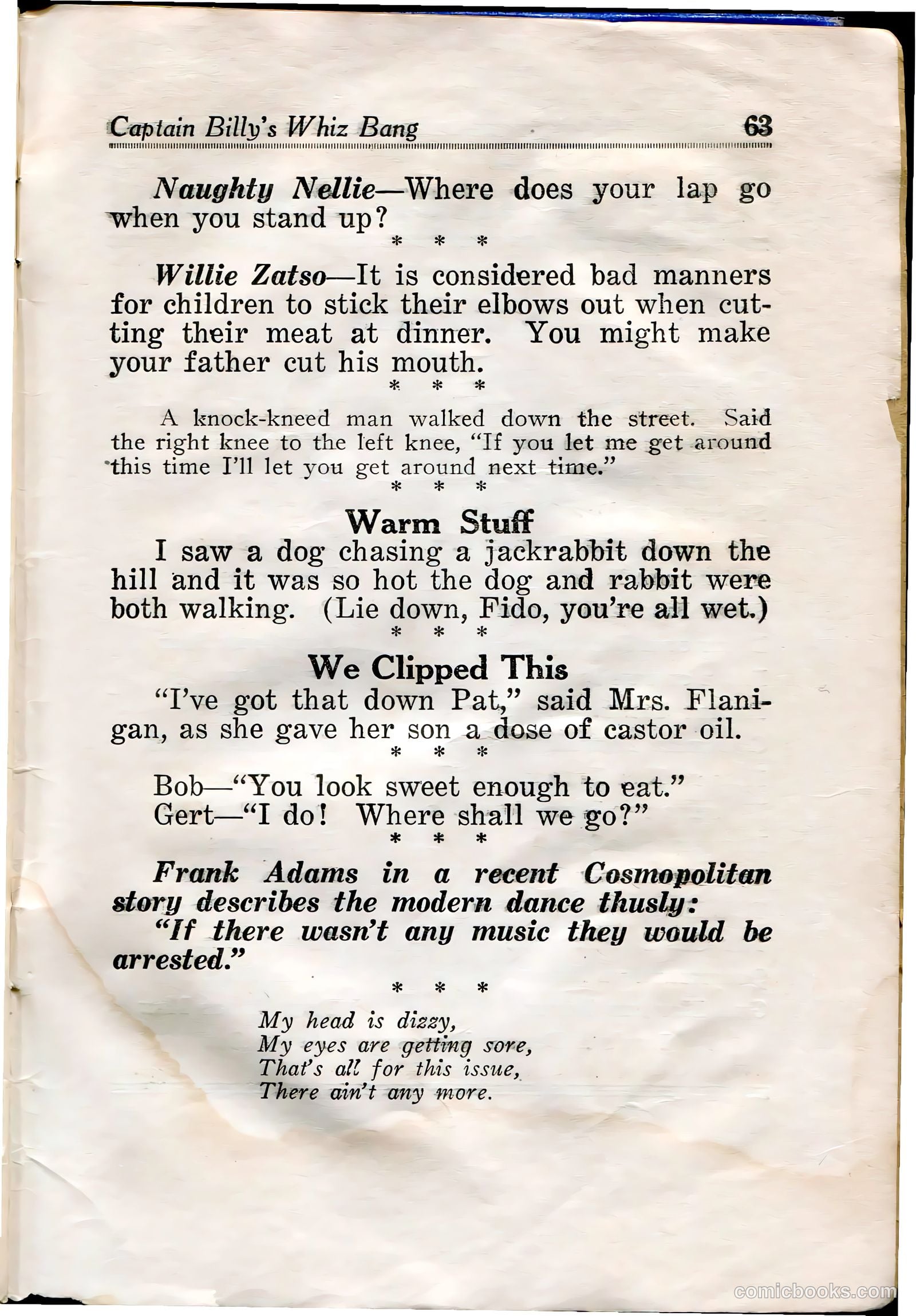
This is a humor page from an early 20th-century American satirical magazine featuring brief jokes and witticisms. The content reflects period attitudes and concerns: **Social commentary**: References to children's table manners, modern dancing ("If there wasn't any music they would be arrested"—implying the dances were undignified without musical cover), and courtship banter reflect contemporary anxieties about changing social behavior. **Physical humor**: Knock-kneed man, the heat-induced slow chase between dog and rabbit, and puns ("I've got that down Pat" paired with castor oil) exemplify the magazine's broad comedic style. **"We Clipped This" section**: Reprints quips attributed to published writers like Frank Adams (Cosmopolitan), a common practice for magazines. The final verse signals the issue's end. Overall, this represents typical early 1900s American humor magazines—lighthearted, topical, focused on manners, courtship, and contemporary social change viewed with bemused skepticism.
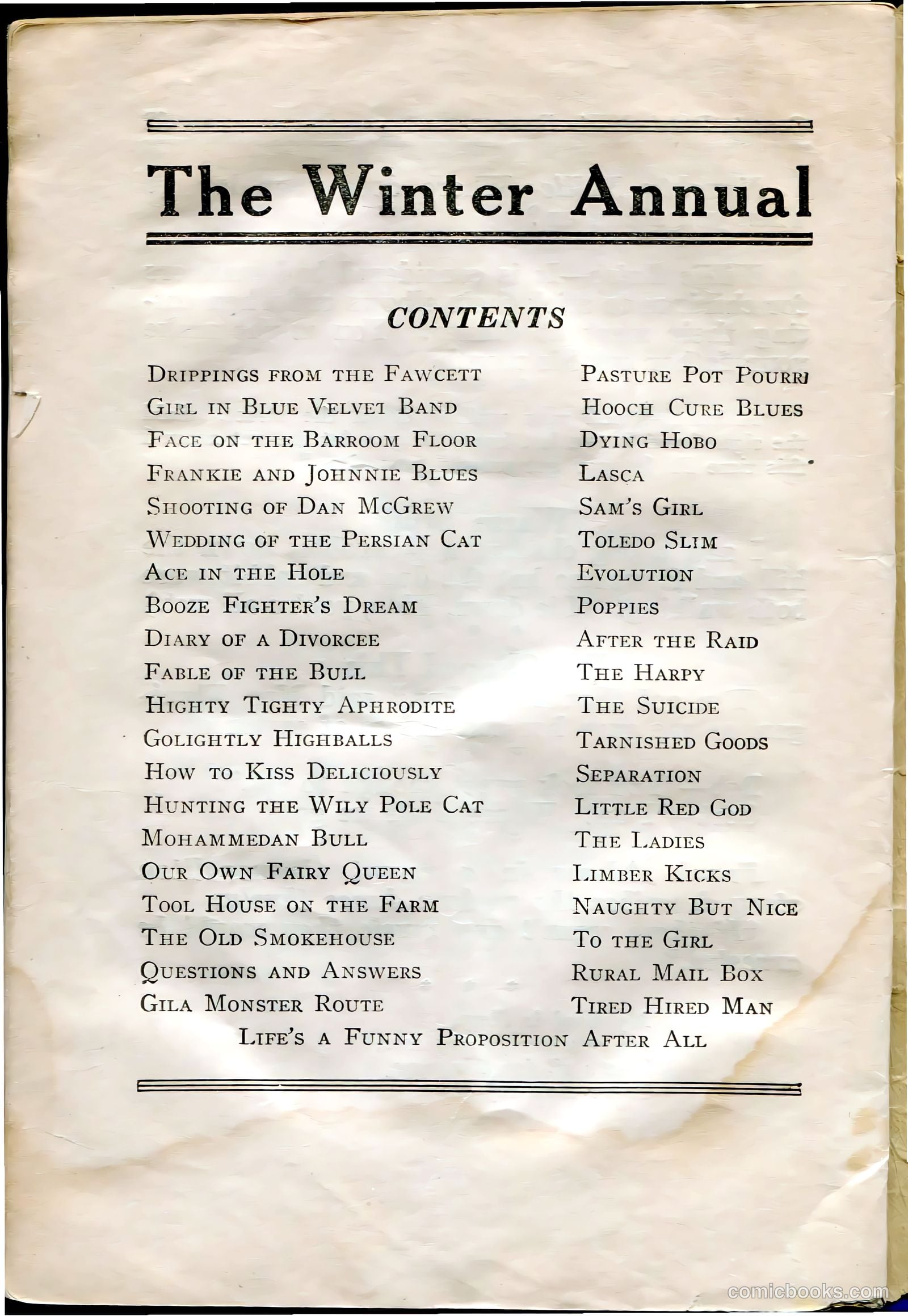
This is a **table of contents** rather than a cartoon page. It lists articles and stories from what appears to be a humor/satire magazine's winter edition. The titles reflect early 20th-century satirical interests: sexual humor ("How to Kiss Deliciously," "Highty Tighty Aphrodite"), drinking culture ("Golightly Highballs," "Booze Fighter's Dream"), and social commentary ("Diary of a Divorcee," "Separation"). Several titles parody famous poems or songs ("Shooting of Dan McGrew," "Frankie and Johnnie Blues," "Face on the Barroom Floor"). The overall tone suggests risqué humor targeting adult readers—typical of American satirical magazines like *Whiz Bang* that pushed boundaries on sexuality, alcohol (likely during Prohibition), and social conventions during the 1920s-30s.
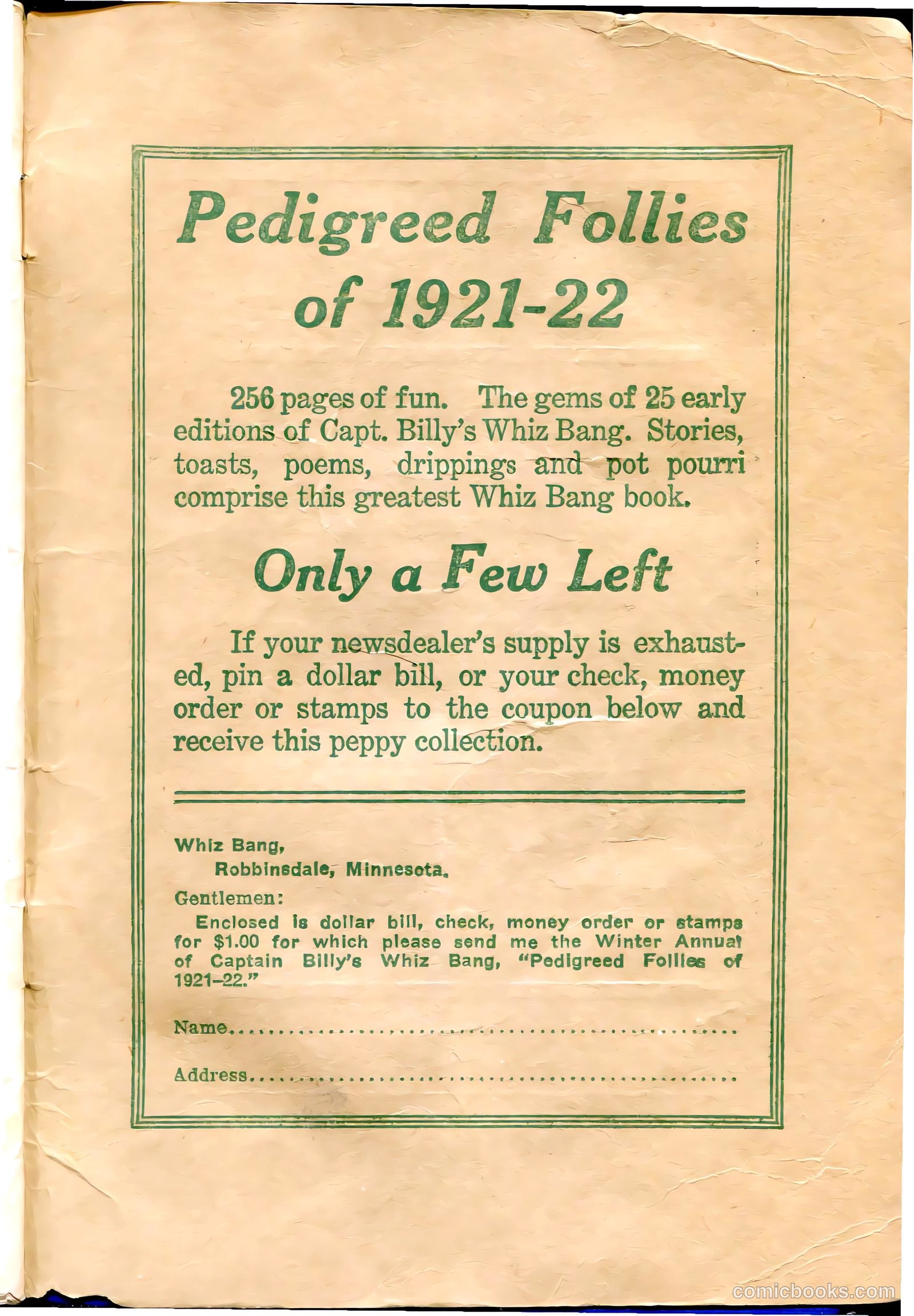
This is a **title page and mail-order advertisement**, not a cartoon page. It promotes Captain Billy's Whiz Bang magazine's annual collection, promising 256 pages of humor content—stories, toasts, poems, and satirical pieces ("drippings and pot pourri") compiled from 25 earlier editions. The appeal to "Only a Few Left" uses scarcity marketing to drive sales. Readers could mail $1.00 via check, money order, or stamps to Robbinsdale, Minnesota to obtain the book. Whiz Bang was a popular American humor magazine of the 1920s, known for ribald jokes and social satire. The term "pedigreed" in the title appears tongue-in-cheek—humorously treating lowbrow comic material as if it were refined or thoroughbred. No specific political figures or cartoon content appear on this page; it's purely commercial promotion.
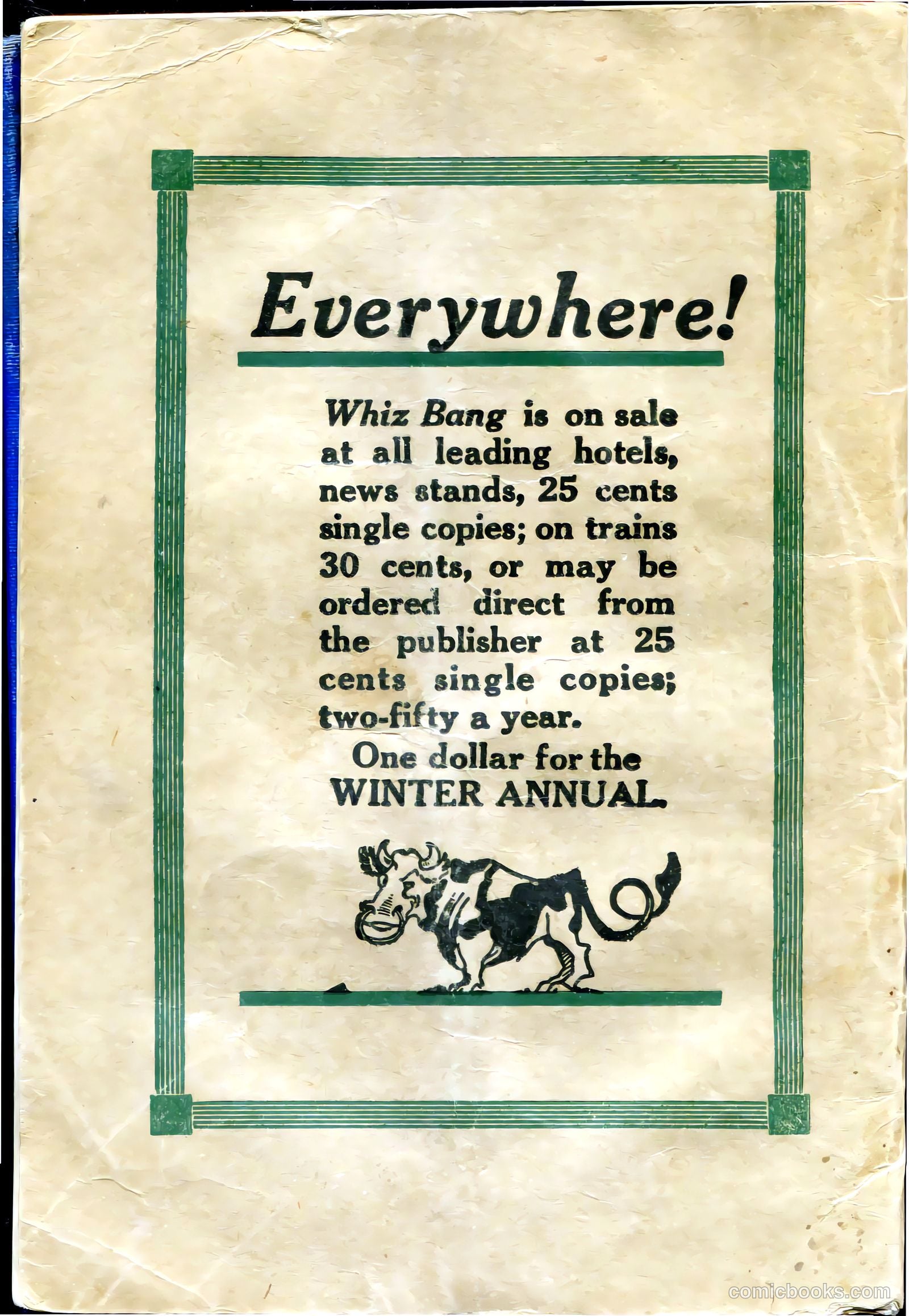
This is a **title/advertising page**, not a cartoon. It announces the availability and pricing of *Whiz Bang*, a satirical magazine popular in the 1920s-30s. The page shows where readers could purchase *Whiz Bang*: hotels, newsstands (25 cents), trains (30 cents), or by direct subscription ($2.50/year). A special **Winter Annual** cost one dollar. The decorative mascot is a **cow**—likely a recurring character or brand identity for the magazine, though its specific satirical significance is unclear without broader context about *Whiz Bang*'s editorial stance. The green art deco border and layout reflect typical magazine advertising design of the early 20th century. This page functioned as both promotion and distribution information for the publication's readers.