
Captain Billy's Whiz Bang, March 1922 · page 19 of 68
Captain Billy's Whiz Bang #31 — page 19: what you’re looking at
What you’re looking at
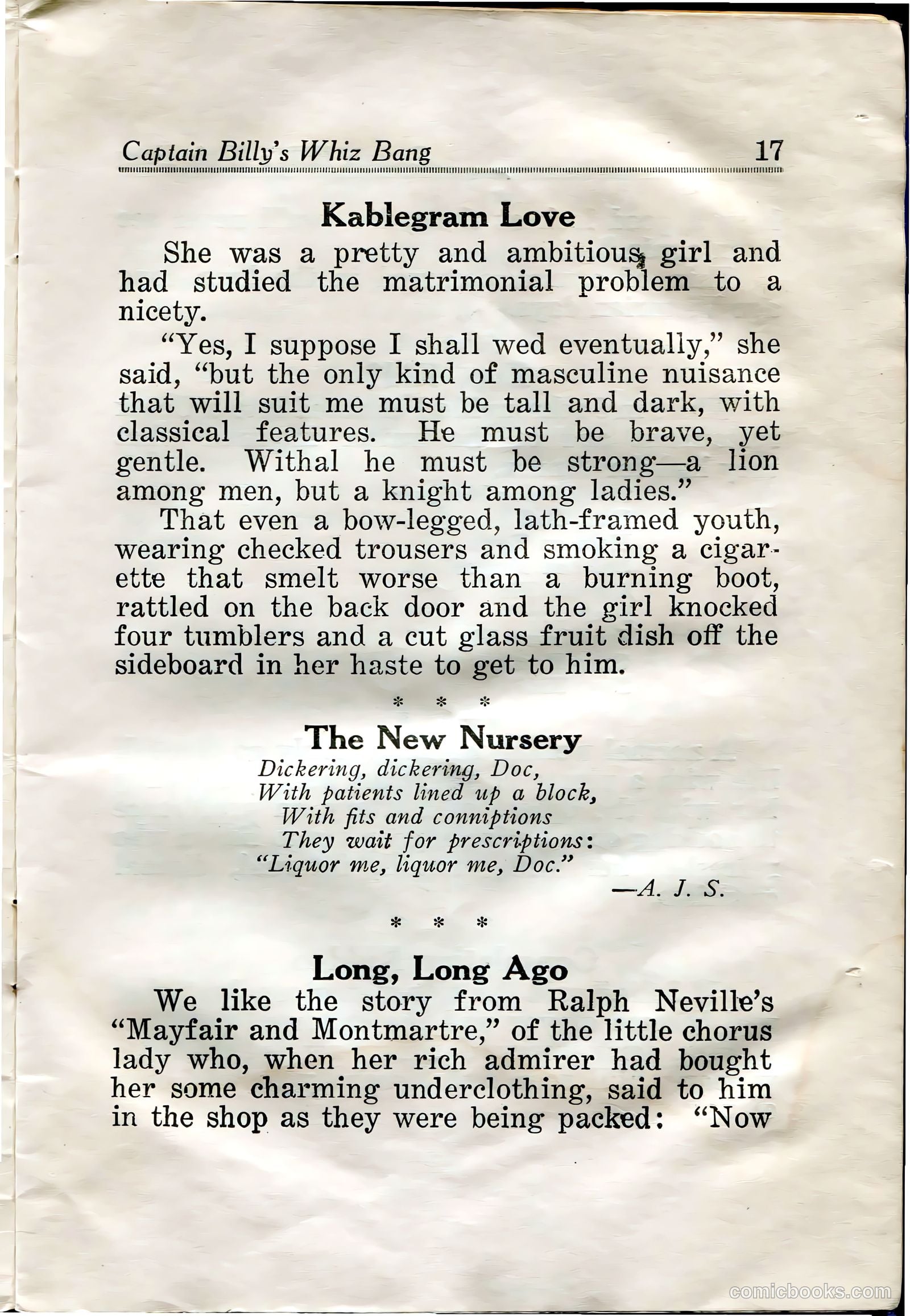
This humorous piece mocks the gap between women's stated romantic preferences and their actual behavior. The unnamed female protagonist declares exacting standards for a husband—he must be tall, dark, classically handsome, brave, gentle, and noble. Yet when an unattractive young man (bow-legged, poorly dressed, smoking a foul cigarette) simply shows up at her door, she abandons all pretense and frantically rushes to greet him, knocking over household items in her haste. The satire targets female hypocrisy and the notion that women's carefully reasoned matrimonial calculations collapse instantly when opportunity presents itself, regardless of the suitor's actual qualities. The "kablegram" (wireless message) title suggests this attitude is universally transmitted among women. It's a cynical joke about the unreliability of women's stated preferences versus their demonstrated behavior—a common theme in 1920s-era satirical magazines aimed at male readers.
📄 Transcribed text from this page (OCR, searchable)
Machine-transcribed from the original scan — historical spelling and the odd misread are preserved.
Captain Billy's Whiz Bang 17 Kablegram Love She was a pretty and ambitious girl and had studied the matrimonial problem to a nicety. “Yes, I suppose I shall wed eventually,” she said, “but the only kind of masculine nuisance that will suit me must be tall and dark, with classical features. He must be brave, yet gentle. Withal he must be strong—a lion among men, but a knight among ladies.” That even a bow-legged, lath-framed youth, wearing checked trousers and smoking a cigar-ette that smelt worse than a burning boot, rattled on the back door and the girl knocked four tumblers and a cut glass fruit dish off the sideboard in her haste to get to him. * * * The New Nursery Dickering, dickering, Doc, With patients lined up a block, With fits and conniptions They wait for prescriptions: “Liquor me, liquor me, Doc.” —A. J. S. * * * Long, Long Ago We like the story from Ralph Neville’s “Mayfair and Montmartre,” of the little chorus lady who, when her rich admirer had bought her some charming underclothing, said to him in the shop as they were being packed: “Now