
Captain Billy's Whiz Bang, March 1922 · page 54 of 68
Captain Billy's Whiz Bang #31 — page 54: what you’re looking at
What you’re looking at
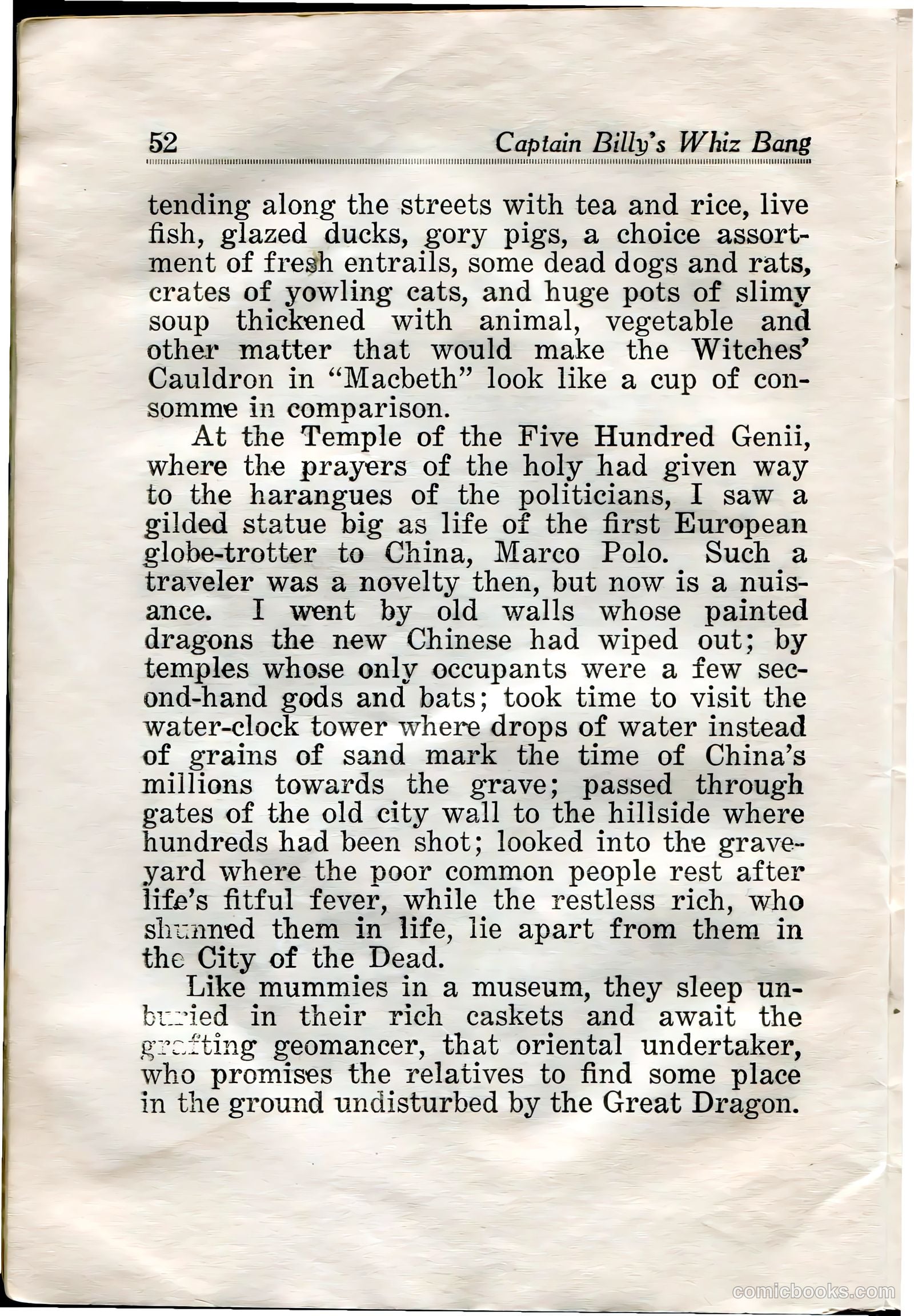
This page contains a satirical travel narrative mocking early 1920s China during political upheaval. The author describes Chinese street life with grotesque exaggeration—rotting food, dead animals, filthy soup—invoking Shakespeare's "Macbeth" to heighten the horror. The satire targets post-revolutionary China: temples converted to political use, traditional religion abandoned, cultural destruction (painted dragons "wiped out"). Marco Polo is mocked as the first Western "globe-trotter" whose successors are now "nuisances"—likely criticizing foreign intervention. The graveyard section satirizes class divisions and superstition: rich Chinese pay "grafting geomancers" (corrupt feng shui practitioners) for ideal burial spots, while the poor rest in common graves. "The Great Dragon" appears to reference geomancy beliefs or possibly political instability. Overall, the piece ridicules both Chinese traditionalism and Western colonial attitudes simultaneously.
📄 Transcribed text from this page (OCR, searchable)
Machine-transcribed from the original scan — historical spelling and the odd misread are preserved.
52 Captain Billy's Whiz Bang tending along the streets with tea and rice, live fish, glazed ducks, gory pigs, a choice assortment of fresh entrails, some dead dogs and rats, crates of yowling cats, and huge pots of slimy soup thickened with animal, vegetable and other matter that would make the Witches' Cauldron in "Macbeth" look like a cup of consomme in comparison. At the Temple of the Five Hundred Genii, where the prayers of the holy had given way to the harangues of the politicians, I saw a gilded statue big as life of the first European globe-trotter to China, Marco Polo. Such a traveler was a novelty then, but now is a nuisance. I went by old walls whose painted dragons the new Chinese had wiped out; by temples whose only occupants were a few second-hand gods and bats; took time to visit the water-clock tower where drops of water instead of grains of sand mark the time of China's millions towards the grave; passed through gates of the old city wall to the hillside where hundreds had been shot; looked into the graveyard where the poor common people rest after life's fitful fever, while the restless rich, who shunned them in life, lie apart from them in the City of the Dead. Like mummies in a museum, they sleep un-buried in their rich caskets and await the grafting geomancer, that oriental undertaker, who promises the relatives to find some place in the ground undisturbed by the Great Dragon.