
Captain Billy's Whiz Bang, March 1922 · page 35 of 68
Captain Billy's Whiz Bang #31 — page 35: what you’re looking at
What you’re looking at
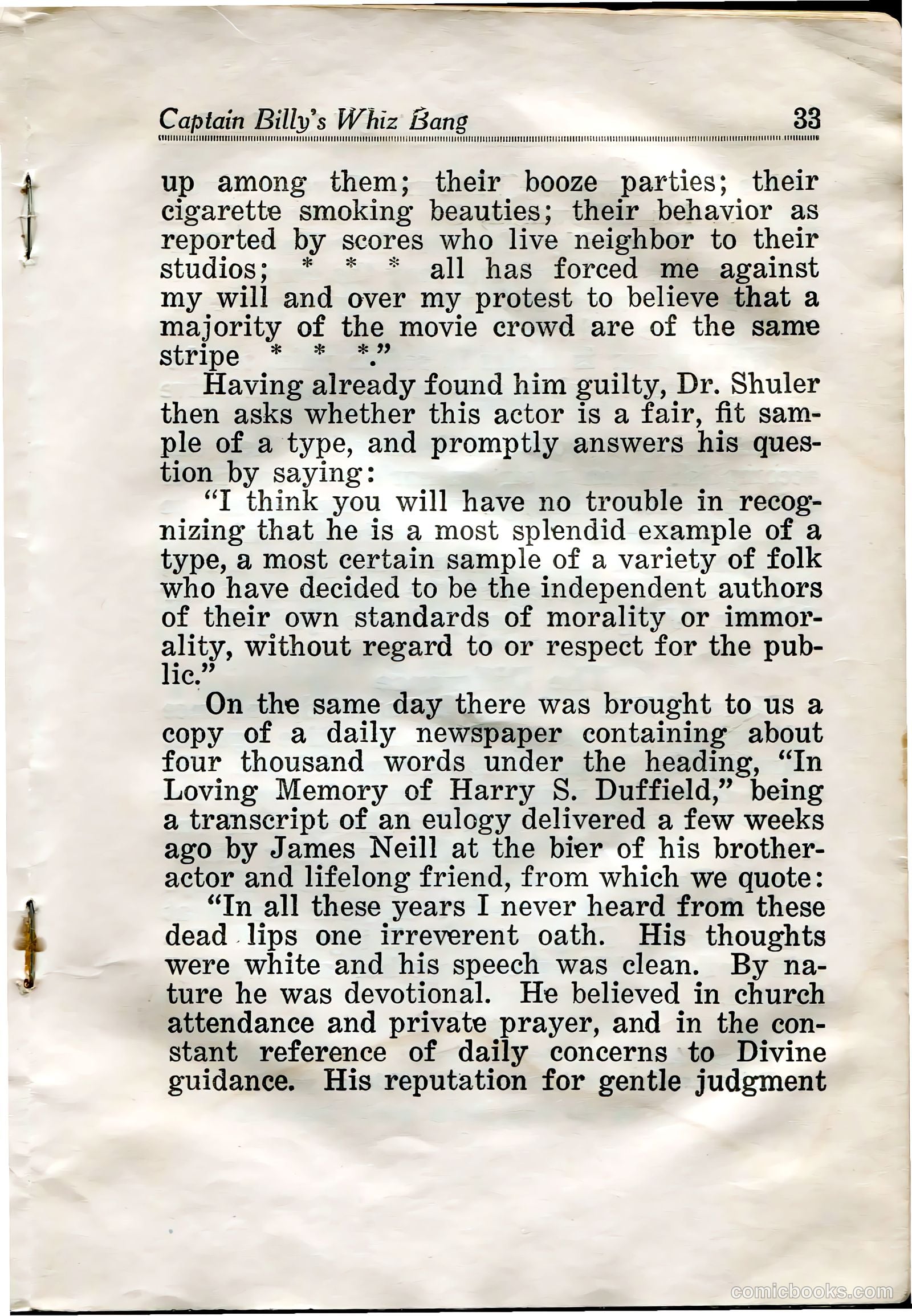
This page presents a moral critique of Hollywood actors through two contrasting examples. A Dr. Shuler condemns an unnamed actor as representative of movie industry immorality—citing booze parties, smoking, and loose behavior reported by studio neighbors. Shuler characterizes such figures as people who reject public moral standards, making their own rules. The page then juxtaposes this with a newspaper eulogy for actor Harry S. Duffield, delivered by fellow actor James Neill. The eulogy praises Duffield's devoutness: clean speech, church attendance, prayer, and moral judgment. The satire's point appears to be **ironic contrast**: while Hollywood broadly faces moral condemnation, individual actors like Duffield demonstrated genuine virtue. This reflects 1920s cultural anxieties about Hollywood's moral influence versus evidence that respectable individuals worked in the industry. The magazine uses real versus idealized morality to critique both blanket condemnation and actual moral failure.
📄 Transcribed text from this page (OCR, searchable)
Machine-transcribed from the original scan — historical spelling and the odd misread are preserved.
Captain Billy's Whiz Bang 33 up among them; their booze parties; their cigarette smoking beauties; their behavior as reported by scores who live neighbor to their studios; * * * all has forced me against my will and over my protest to believe that a majority of the movie crowd are of the same stripe * * *” Having already found him guilty, Dr. Shuler then asks whether this actor is a fair, fit sample of a type, and promptly answers his question by saying: “I think you will have no trouble in recognizing that he is a most splendid example of a type, a most certain sample of a variety of folk who have decided to be the independent authors of their own standards of morality or immorality, without regard to or respect for the public.” On the same day there was brought to us a copy of a daily newspaper containing about four thousand words under the heading, “In Loving Memory of Harry S. Duffield,” being a transcript of an eulogy delivered a few weeks ago by James Neill at the bier of his brother-actor and lifelong friend, from which we quote: “In all these years I never heard from these dead lips one irreverent oath. His thoughts were white and his speech was clean. By nature he was devotional. He believed in church attendance and private prayer, and in the constant reference of daily concerns to Divine guidance. His reputation for gentle judgment