
Captain Billy's Whiz Bang, March 1922 · page 15 of 68
Captain Billy's Whiz Bang #31 — page 15: what you’re looking at
What you’re looking at
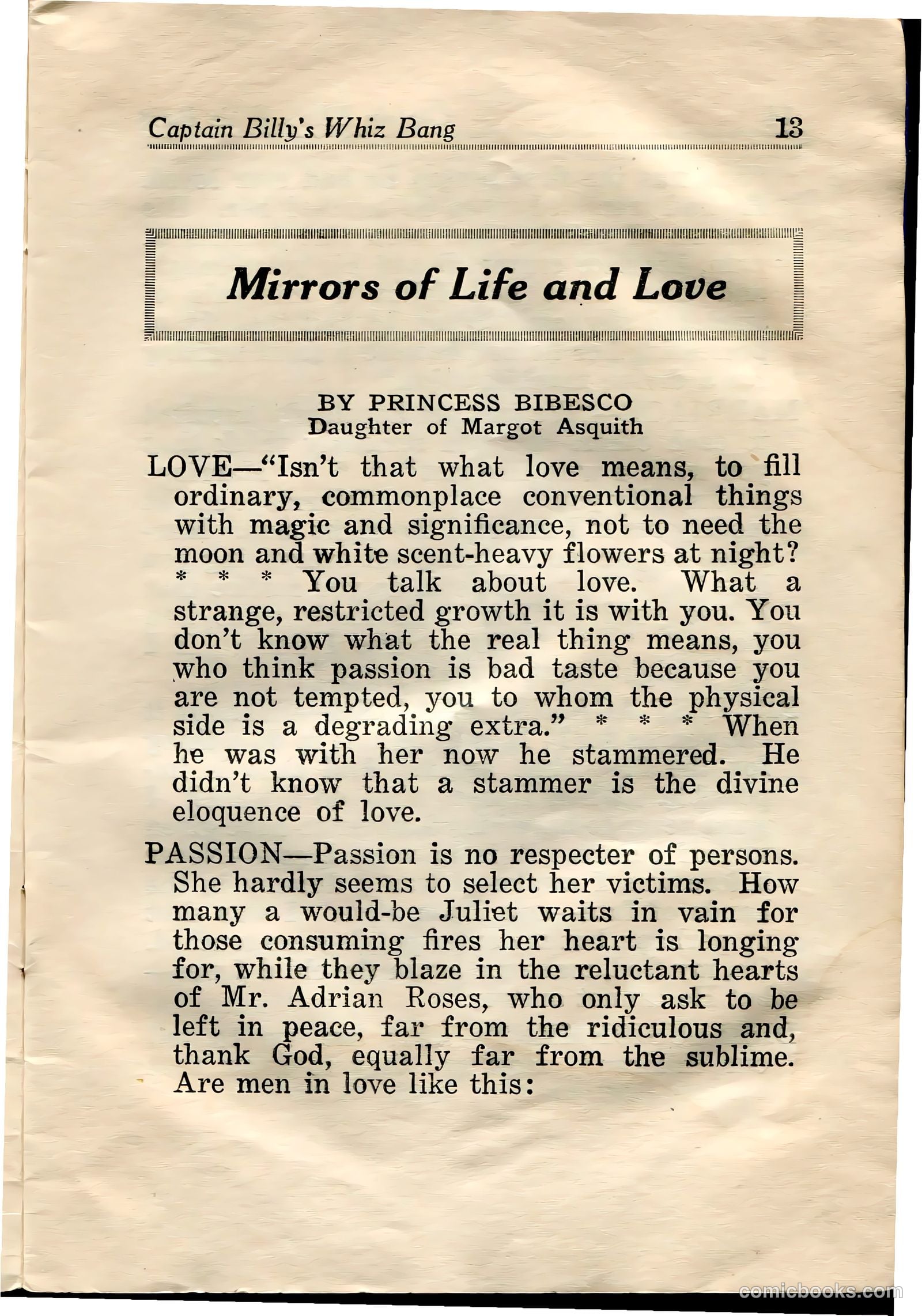
This page is not a political cartoon but a philosophical essay by Princess Bibesco (daughter of British political figure Margot Asquith), published in *Captain Billy's Whiz Bang*, a popular satirical magazine. The piece contrasts two perspectives on romantic love through the voices of "LOVE" and "PASSION." The author critiques those who romanticize love through conventional imagery (moon, flowers) while dismissing physical desire as "degrading." She argues that genuine love includes passion and that stammering reveals authentic emotion. The satire targets uptight attitudes toward sexuality and passion—mocking people like "Mr. Adrian Roses" who wish to avoid both "the ridiculous and the sublime" of love. The piece suggests that denying passion's legitimacy is itself a form of restricted, inauthentic living. This reflects 1920s-era cultural debates about modernizing attitudes toward sexuality and emotion against Victorian restraint.
📄 Transcribed text from this page (OCR, searchable)
Machine-transcribed from the original scan — historical spelling and the odd misread are preserved.
Captain Billy's Whiz Bang 13 Mirrors of Life and Love BY PRINCESS BIBESCO Daughter of Margot Asquith LOVE—"Isn't that what love means, to fill ordinary, commonplace conventional things with magic and significance, not to need the moon and white scent-heavy flowers at night? * * * You talk about love. What a strange, restricted growth it is with you. You don't know what the real thing means, you who think passion is bad taste because you are not tempted, you to whom the physical side is a degrading extra." * * * When he was with her now he stammered. He didn't know that a stammer is the divine eloquence of love. PASSION—Passion is no respecter of persons. She hardly seems to select her victims. How many a would-be Juliet waits in vain for those consuming fires her heart is longing for, while they blaze in the reluctant hearts of Mr. Adrian Roses, who only ask to be left in peace, far from the ridiculous and, thank God, equally far from the sublime. Are men in love like this: