
Captain Billy's Whiz Bang, March 1922 · page 34 of 68
Captain Billy's Whiz Bang #31 — page 34: what you’re looking at
What you’re looking at
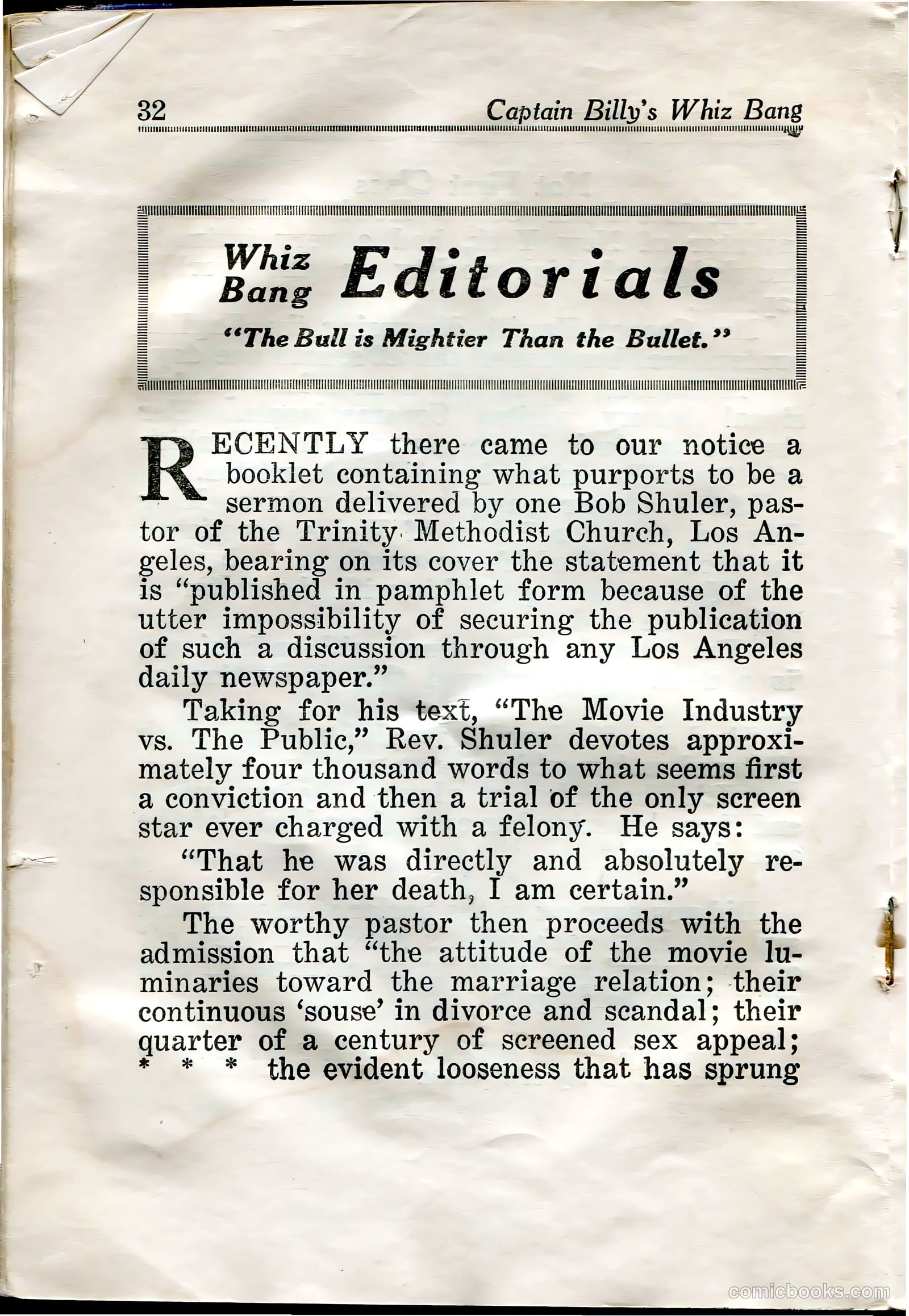
This editorial attacks Rev. Bob Shuler, a Los Angeles Methodist pastor, for publishing a pamphlet sermon blaming the movie industry for a death. The text references "the only screen star ever charged with a felony"—likely referring to Roscoe "Fatty" Arbuckle, involved in a 1921 scandal. Shuler claims to have proof of the industry's responsibility but published as a pamphlet because newspapers rejected it. The editorial's headline, "The Bull is Mightier Than the Bullet," suggests the pastor is spreading unsubstantiated accusations ("bull"—nonsense). The satire mocks Shuler's moral crusade against Hollywood's sexual content and loose marital attitudes, portraying him as self-righteous while making serious criminal accusations without solid evidence. The magazine defends the film industry against religious moralizing.
📄 Transcribed text from this page (OCR, searchable)
Machine-transcribed from the original scan — historical spelling and the odd misread are preserved.
32 Captain Billy's Whiz Bang Whiz Bang Editorials “The Bull is Mightier Than the Bullet.” RECENTLY there came to our notice a booklet containing what purports to be a sermon delivered by one Bob Shuler, pastor of the Trinity Methodist Church, Los Angeles, bearing on its cover the statement that it is “published in pamphlet form because of the utter impossibility of securing the publication of such a discussion through any Los Angeles daily newspaper.” Taking for his text, “The Movie Industry vs. The Public,” Rev. Shuler devotes approximately four thousand words to what seems first a conviction and then a trial of the only screen star ever charged with a felony. He says: “That he was directly and absolutely responsible for her death, I am certain.” The worthy pastor then proceeds with the admission that “the attitude of the movie luminaries toward the marriage relation; their continuous ‘souse’ in divorce and scandal; their quarter of a century of screened sex appeal; * * * the evident looseness that has sprung