
Captain Billy's Whiz Bang, March 1922 · page 58 of 68
Captain Billy's Whiz Bang #31 — page 58: what you’re looking at
What you’re looking at
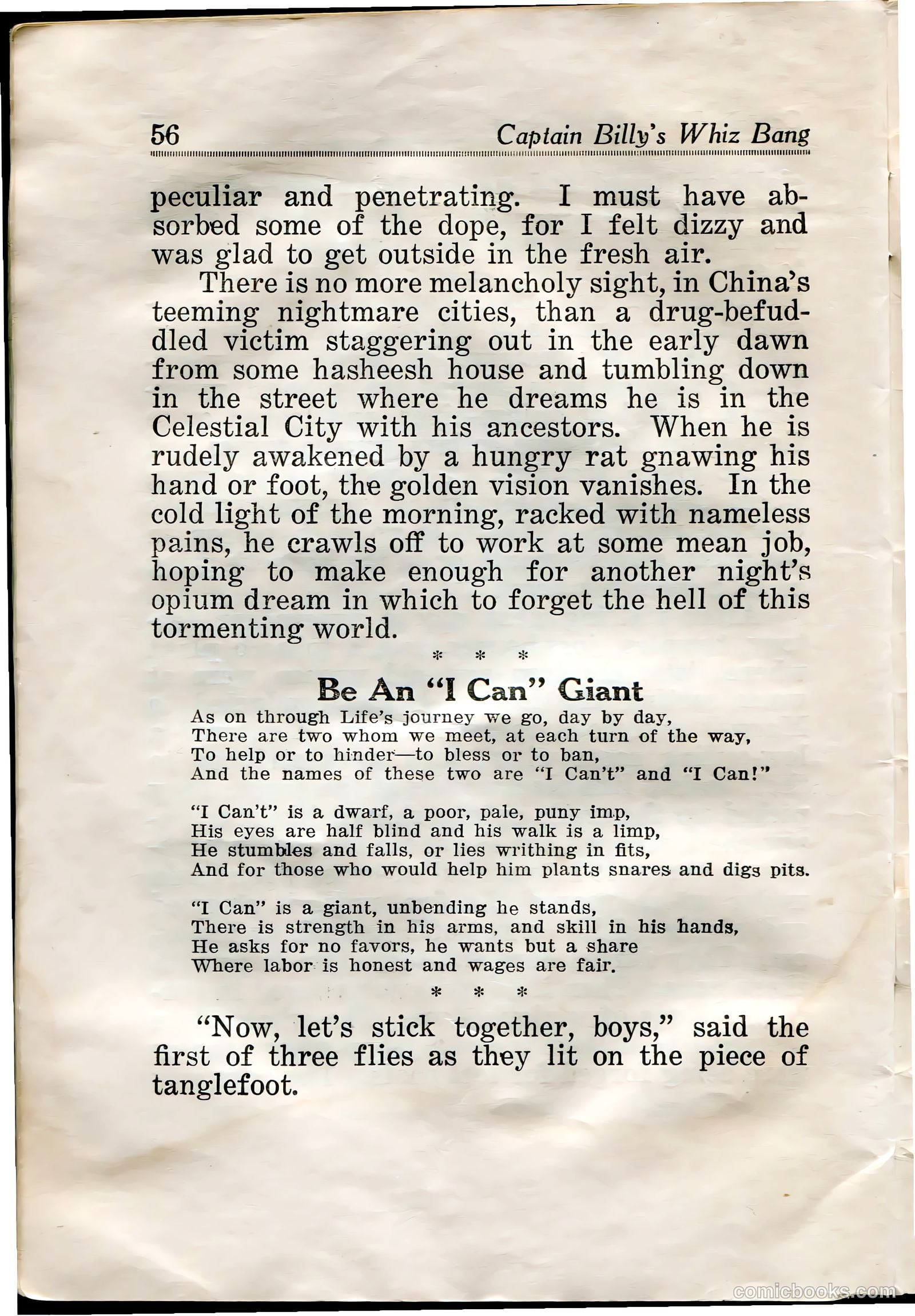
This page contains two distinct pieces of satirical content: **The opening passage** describes opium addiction in China with vivid, moralizing language—depicting addicts as tragic figures trapped in cycles of drug use and poverty. This reflects early 20th-century American attitudes toward Asian drug use, treating it as both exotic and culturally symptomatic. **"Be An 'I Can' Giant"** is an allegorical poem contrasting two personified concepts: "I Can't" (depicted as a weak, disabled dwarf who sabotages others) versus "I Can" (a strong, capable giant representing self-reliance and honest work). This is motivational verse—common in Whiz Bang—promoting American optimism and individual determination. The implicit message: success depends on mindset and willpower rather than circumstances. Both pieces reflect the magazine's blend of cautionary tales about vice and inspirational messages about personal responsibility, typical of 1920s American popular culture.
📄 Transcribed text from this page (OCR, searchable)
Machine-transcribed from the original scan — historical spelling and the odd misread are preserved.
56 Captain Billy's Whiz Bang peculiar and penetrating. I must have ab- sorbed some of the dope, for I felt dizzy and was glad to get outside in the fresh air. There is no more melancholy sight, in China's teeming nightmare cities, than a drug-befud- dled victim staggering out in the early dawn from some hasheesh house and tumbling down in the street where he dreams he is in the Celestial City with his ancestors. When he is rudely awakened by a hungry rat gnawing his hand or foot, the golden vision vanishes. In the cold light of the morning, racked with nameless pains, he crawls off to work at some mean job, hoping to make enough for another night's opium dream in which to forget the hell of this tormenting world. * * * Be An “I Can” Giant As on through Life's journey we go, day by day, There are two whom we meet, at each turn of the way, To help or to hinder—to bless or to ban, And the names of these two are “I Can't” and “I Can!” “I Can't” is a dwarf, a poor, pale, puny imp, His eyes are half blind and his walk is a limp, He stumbles and falls, or lies writhing in fits, And for those who would help him plants snares and digs pits. “I Can” is a giant, unbending he stands, There is strength in his arms, and skill in his hands, He asks for no