
Captain Billy's Whiz Bang, March 1922 · page 56 of 68
Captain Billy's Whiz Bang #31 — page 56: what you’re looking at
What you’re looking at
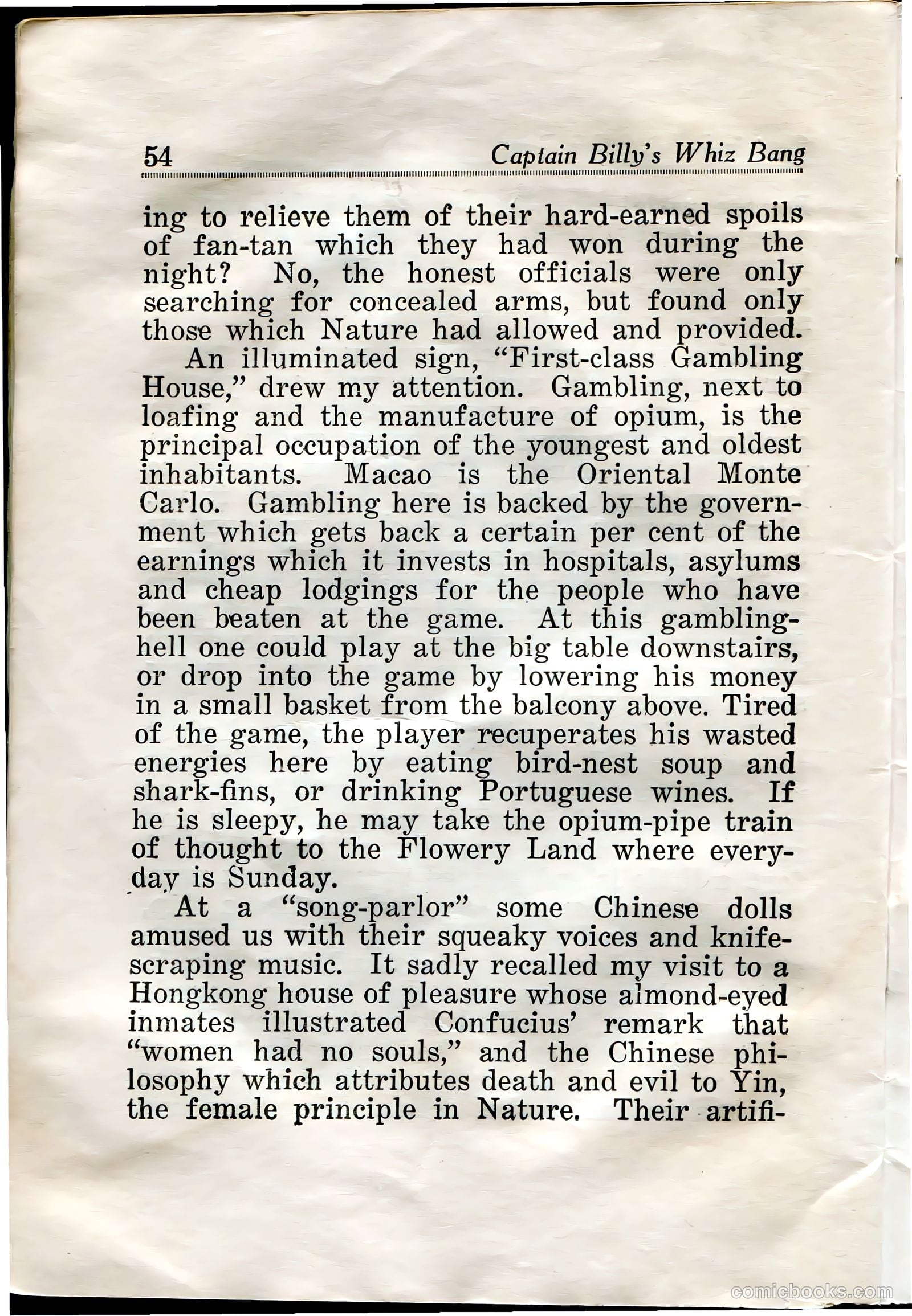
This is travel writing from an American satirical magazine describing Macao (the Portuguese colonial gambling enclave near Hong Kong). The author recounts observations of gambling houses, opium use, and Chinese culture. The satire operates on multiple levels: 1. **Colonial condescension**: The writer describes Chinese gambling, opium use, and entertainment with bemused detachment typical of early 20th-century Western attitudes toward Asian societies. 2. **Government hypocrisy**: Macao's government officially searches for "concealed arms" while openly backing gambling houses that fund social services for gambling victims—a cynical system the author finds darkly humorous. 3. **Orientalist stereotyping**: References to "song-parlors," opium pipes, and "almond-eyed" women reflect period racial caricatures. The invocation of Confucius on women having "no souls" exemplifies how Western writers weaponized Asian philosophy to justify their prejudices. 4. **Ironic luxury details**: Exotic foods (bird-nest soup, shark-fins) and Portuguese wines highlight the colonial mixing of cultures while maintaining Western superiority. The piece reflects early 1900s American attitudes: fascination mixed with moral disapproval of non-Western practices.
📄 Transcribed text from this page (OCR, searchable)
Machine-transcribed from the original scan — historical spelling and the odd misread are preserved.
54 Captain Billy’s Whiz Bang ing to relieve them of their hard-earned spoils of fan-tan which they had won during the night? No, the honest officials were only searching for concealed arms, but found only those which Nature had allowed and provided. An illuminated sign, “First-class Gambling House,” drew my attention. Gambling, next to loafing and the manufacture of opium, is the principal occupation of the youngest and oldest inhabitants. Macao is the Oriental Monte Carlo. Gambling here is backed by the govern- ment which gets back a certain per cent of the earnings which it invests in hospitals, asylums and cheap lodgings for the people who have been beaten at the game. At this gambling- hell one could play at the big table downstairs, or drop into the game by lowering his money in a small basket from the balcony above. Tired of the game, the player recuperates his wasted energies here by eating bird-nest soup and shark-fins, or drinking Portuguese wines. If he is sleepy, he may take the opium-pipe train of thought to the Flowery Land where every- day is Sunday. At a “song-parlor” some Chinese dolls amused us with their squeaky voices and knife- scraping music. It sadly recalled my visit to a Hongkong house of pleasure whose almond-eyed inmates illustrated Confucius’ remark that “women had no souls,” and the Chinese phi- losophy which attributes death and evil to Yin, the female principle in Nature. Their artifi-