
Captain Billy's Whiz Bang, March 1922 · page 55 of 68
Captain Billy's Whiz Bang #31 — page 55: what you’re looking at
What you’re looking at
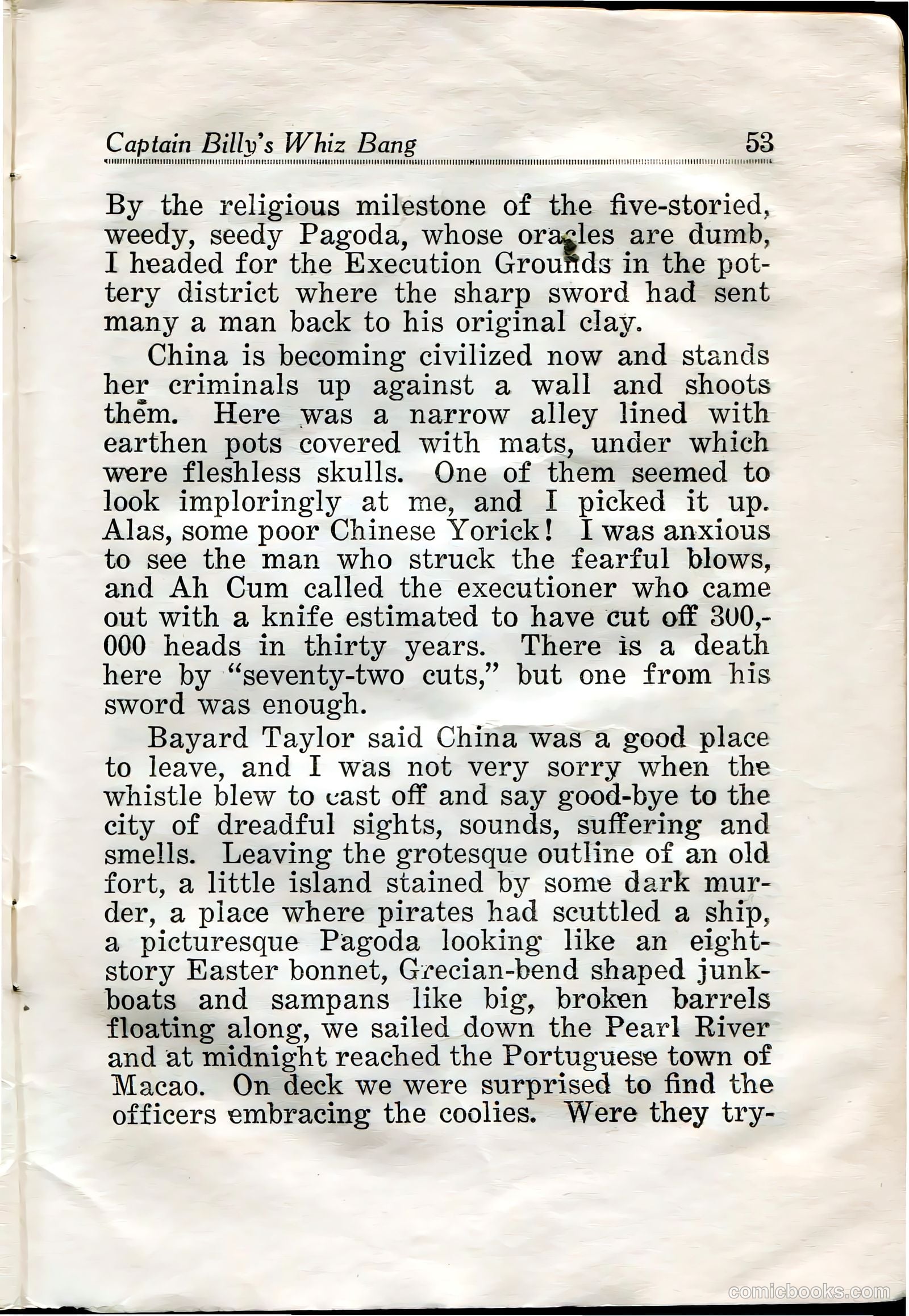
This page contains a travelogue narrative (not a cartoon) from the satirical magazine describing a visit to China's Execution Grounds. The piece uses darkly humorous, orientalist language typical of early 20th-century American magazines to describe Chinese capital punishment practices. The satire targets both China and Western attitudes toward it. It portrays China as "uncivilized" (executing criminals visibly) while depicting the narrator as a detached, morally superior observer making literary references (invoking Shakespeare's "Yorick" over actual skulls). The executioner's estimated 300,000 kills is presented as darkly comedic. The final section's tone shift—surprise at officers "embracing the coolies"—suggests satirizing Western hypocrisy about racial attitudes and colonial superiority. References to "Bayard Taylor" (a real 19th-century travel writer) lend false authority to the sensationalized account.
📄 Transcribed text from this page (OCR, searchable)
Machine-transcribed from the original scan — historical spelling and the odd misread are preserved.
Captain Billy's Whiz Bang 53 By the religious milestone of the five-storied, weedy, seedy Pagoda, whose oracles are dumb, I headed for the Execution Grounds in the pot- tery district where the sharp sword had sent many a man back to his original clay. China is becoming civilized now and stands her criminals up against a wall and shoots them. Here was a narrow alley lined with earthen pots covered with mats, under which were fleshless skulls. One of them seemed to look imploringly at me, and I picked it up. Alas, some poor Chinese Yorick! I was anxious to see the man who struck the fearful blows, and Ah Cum called the executioner who came out with a knife estimated to have cut off 300,- 000 heads in thirty years. There is a death here by “seventy-two cuts,” but one from his sword was enough. Bayard Taylor said China was a good place to leave, and I was not very sorry when the whistle blew to cast off and say good-bye to the city of dreadful sights, sounds, suffering and smells. Leaving the grotesque outline of an old fort, a little island stained by some dark mur- der, a place where pirates had scuttled a ship, a picturesque Pagoda looking like an eight- story Easter bonnet, Grecian-bend shaped junk- boats and sampans like big, broken barrels floating along, we sailed down the Pearl River and at midnight reached the Portuguese town of Macao. On deck we were surprised to find the officers embracing the coolies. Were they try-