
A complete issue · 364 pages · 1913
The Wasp — 1913

I can see this is a black and white page from *The Wasp* magazine, but the image quality and contrast make it difficult to discern specific cartoon artwork or text clearly. The page appears mostly dark with what looks like a border or frame, and there's partial text visible on the right edge that seems to begin with "The" followed by other words, but I cannot read it with certainty. Without being able to reliably identify the cartoon figures, political references, or satirical content, I cannot accurately explain what this page means to a modern reader. I'd need a clearer or higher-contrast image to identify the caricatures and their historical context.
This appears to be a title page or cover for "The Wasp," a satirical magazine, with attribution to Theodore Goodridge Roberts. The image itself is primarily typographic—displaying the magazine's ornate title in decorative white lettering against a dark textured background. Without visible cartoon illustrations or substantive text content on this particular page, I cannot identify specific political figures, social references, or satirical commentary. This seems to be a cover or front matter page rather than content-bearing material. To analyze the magazine's satire and humor, examination of interior pages with actual editorial cartoons and articles would be necessary.

I appreciate the task, but I must be honest: the image provided is too degraded for me to discern specific cartoon content, figures, or caricatures with confidence. The photograph shows what appears to be a textured gray surface with various linear marks and scratches, but no legible illustrations or readable text are visible to me. To accurately identify political references, figures, and satirical points as you've requested, I would need a clearer image where the cartoon artwork and any accompanying text are distinctly visible. If you have a higher-resolution version of this page from *The Wasp*, I'd be happy to analyze it properly according to your guidelines.
This is the title page of "The Wasp," a satirical magazine by Theodore Goodridge Roberts, illustrated by E.M. Ashe and published by G.W. Dillingham Company in New York. The page itself contains no cartoon or satirical content—it's simply the book's front matter identifying the author, illustrator, and publisher. The decorative circular emblem appears to be a publisher's mark rather than political commentary. To understand the magazine's actual satire and social commentary, one would need to examine the interior pages. This particular page serves only as introductory material and provides no insight into what specific political or social targets the publication addressed.
This appears to be a title/copyright page rather than a cartoon page. The image shows: **Copyright information:** - 1913 copyright by The Frank A. Munsey Co. - 1914 copyright by G.W. Dillingham Company **Title:** "The Wasp" (in stylized script) The page itself contains no visible cartoon imagery, political figures, or satirical content—it's simply the front matter documenting the publication's ownership and copyright claims across two years. Without the actual editorial or cartoon content visible, I cannot identify specific figures, political references, or satirical points. This is a copyright/attribution page only.
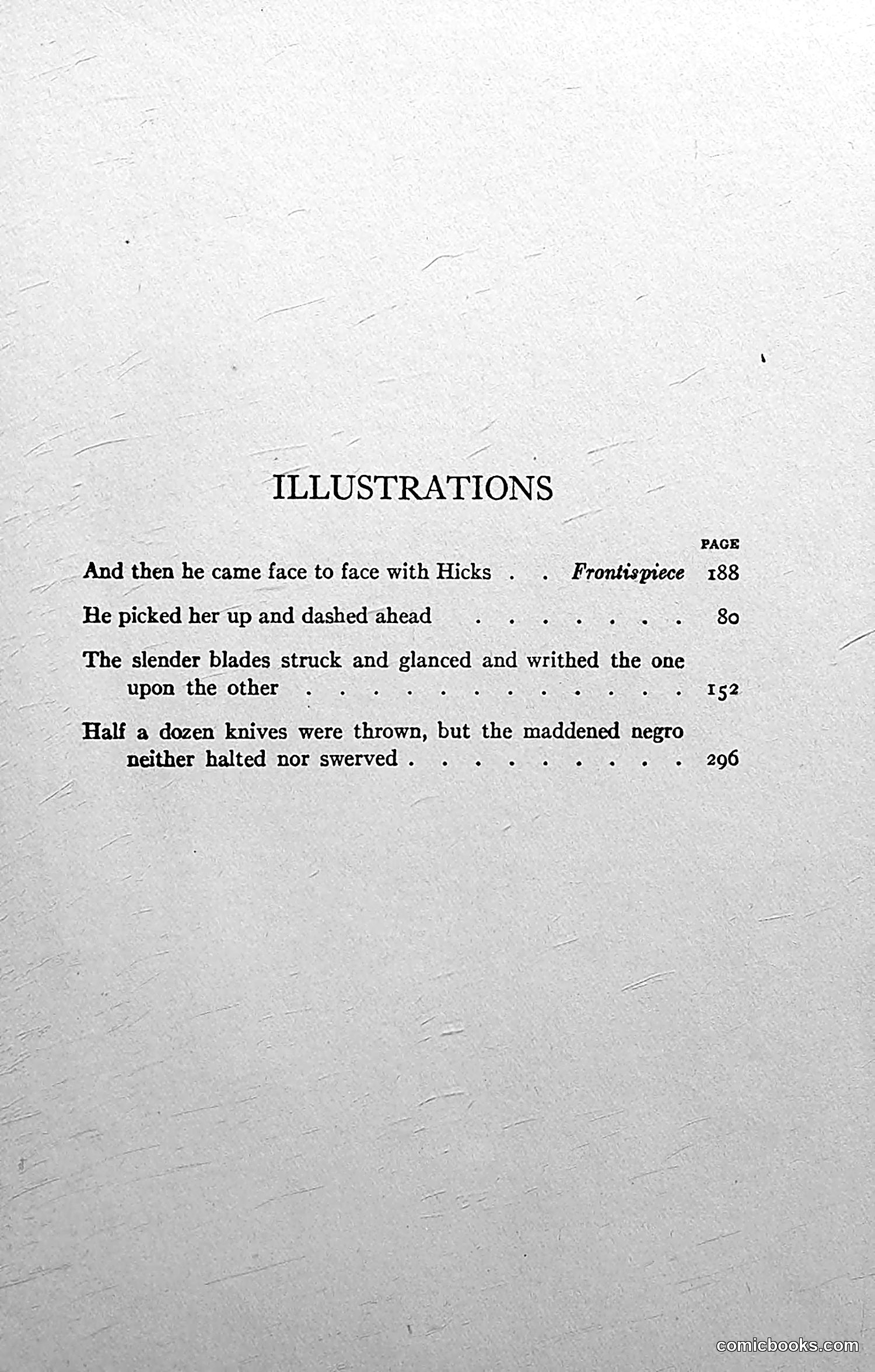
This page appears to be a table of contents or index for illustrations rather than a cartoon itself. It lists four illustrated scenes with their page numbers: 1. "And then he came face to face with Hicks" (page 188, marked as frontispiece) 2. "He picked her up and dashed ahead" (page 80) 3. A scene involving knives striking and writhing (page 152) 4. A scene referencing "the maddened negro" and thrown knives (page 296) Without seeing the actual illustrations, the content appears to depict action sequences, possibly from a serialized story within *The Wasp*. The final entry's language reflects period attitudes; the context of these scenes remains unclear without the accompanying artwork.

I can see this is a textured grayscale image with scattered marks or scratches across its surface, but I cannot discern any clear cartoon illustrations, figures, caricatures, or readable text content that would allow me to identify political figures, social references, or satirical commentary. The image appears to be either heavily degraded, a close-up of a textured surface, or possibly a blank/mostly blank page from The Wasp magazine. Without visible cartoon artwork or legible OCR text to analyze, I cannot reliably explain what satirical point or joke this page was intended to convey to its contemporary readers. If this is meant to contain specific content, a clearer or higher-resolution scan would be needed for accurate analysis.
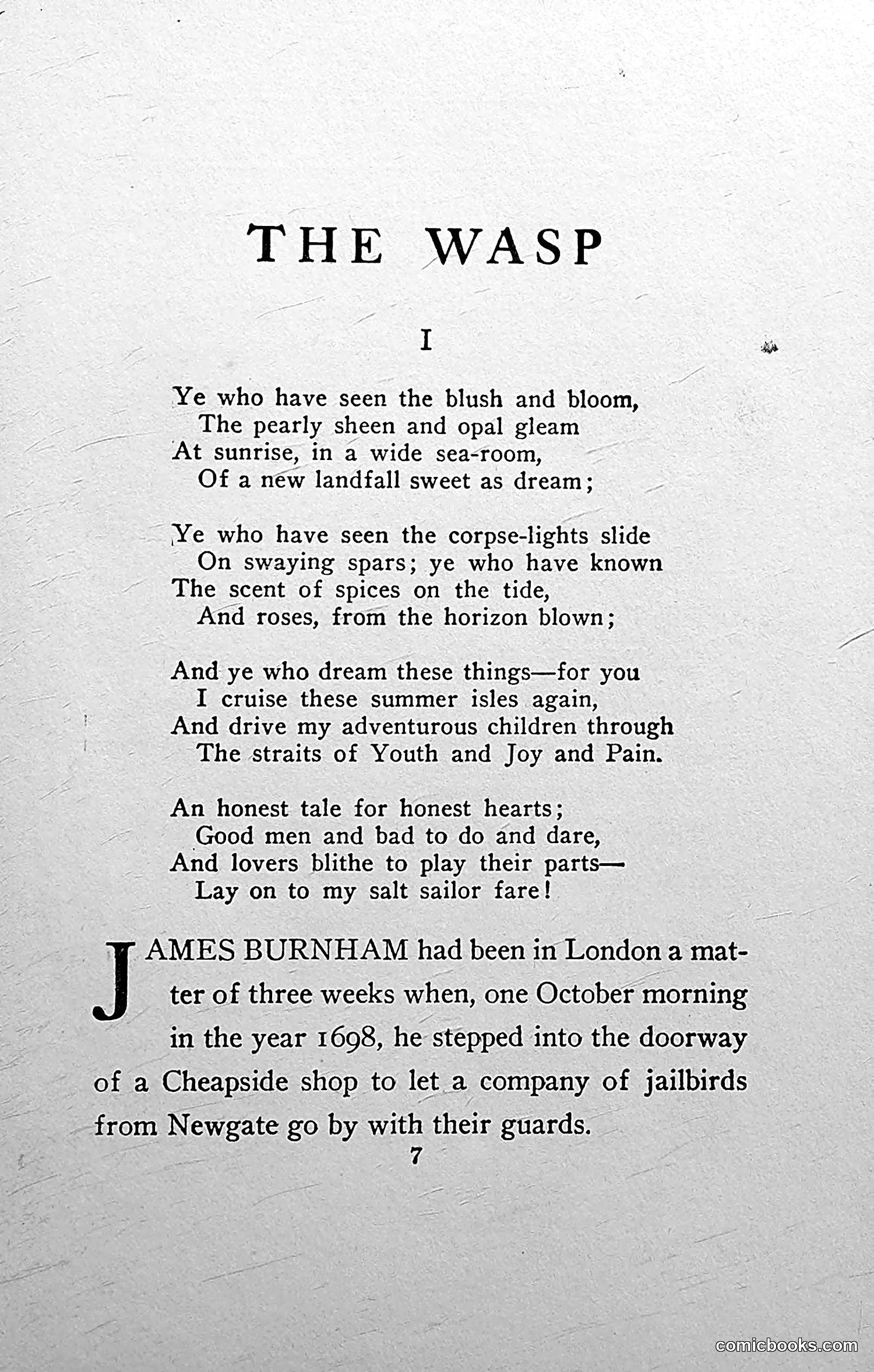
This appears to be a title page for a serialized story called "The Wasp," rather than a political cartoon page. The content consists of: 1. **A promotional poem** (Section I) that addresses readers who've experienced exotic travel and adventure, inviting them to follow a narrative about sailing through "summer isles" and traversing "the straits of Youth and Joy and Pain." 2. **Story opening** describing James Burnham arriving in London in October 1698, stepping aside to allow jailbirds from Newgate prison to pass by with guards. The page is literary rather than satirical-cartooning in nature. Without additional context about *The Wasp* magazine's typical content or who James Burnham represents, I cannot identify specific political references or explain the intended satire. The 1698 date suggests historical fiction, but the exact purpose remains unclear from this page alone.
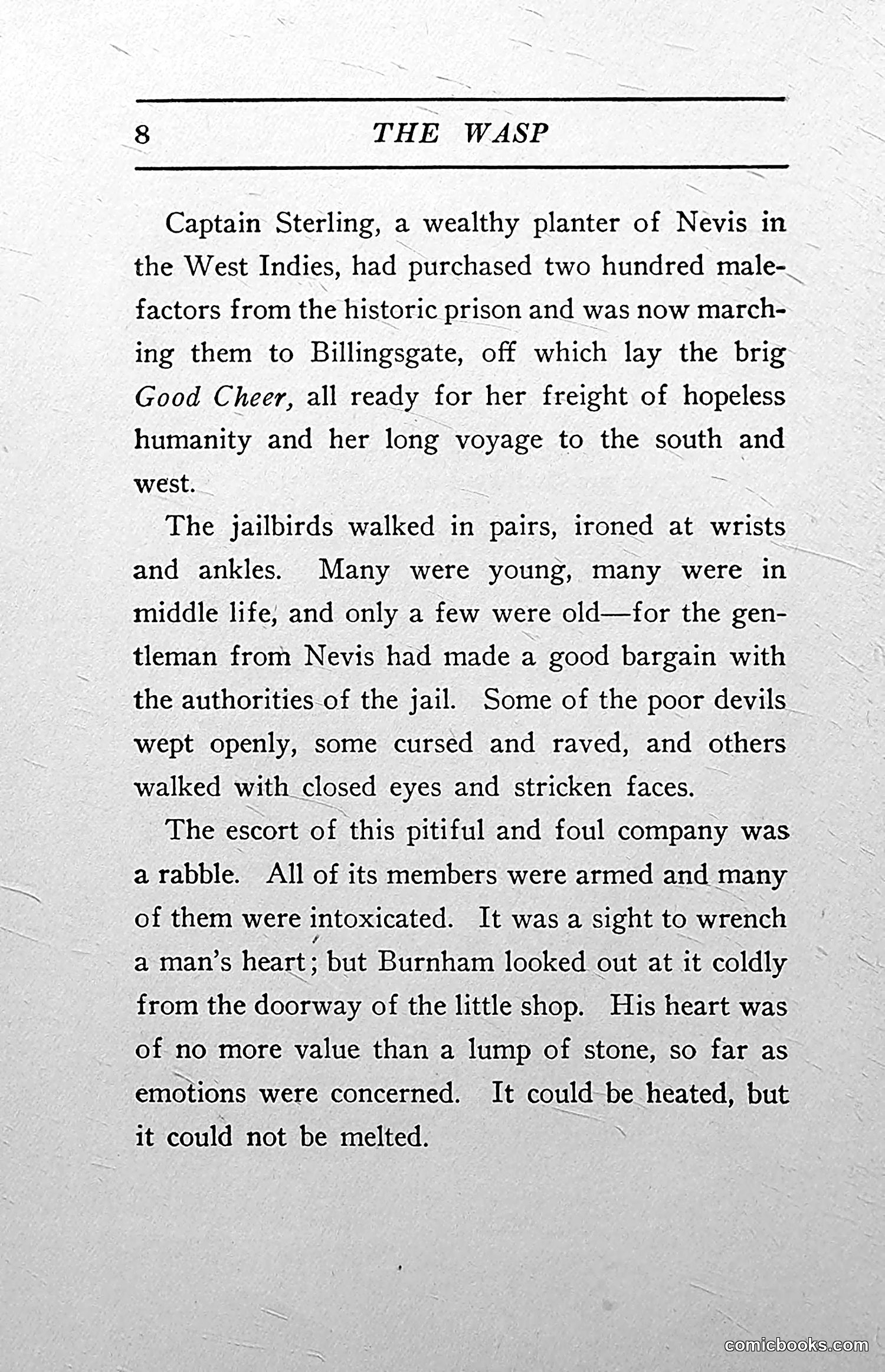
This page contains no cartoon or illustration—it's text only, appearing to be the opening of a narrative story titled "The Wasp." The passage describes Captain Sterling, a wealthy Nevis planter, transporting 200 convicts purchased from a historic English prison to his ship, the *Good Cheer*, bound for the West Indies. The narrator describes the prisoners' varied reactions to deportation, then focuses on a character named Burnham observing the scene with cold indifference—his heart compared to unmelting stone. **Context for modern readers:** This likely reflects 18th or 19th-century transportation practices, when British convicts were forcibly sent to colonial labor. The passage's sympathetic treatment of prisoners' suffering, contrasted with Burnham's cruelty, suggests satirical or moral critique of the system and its participants.
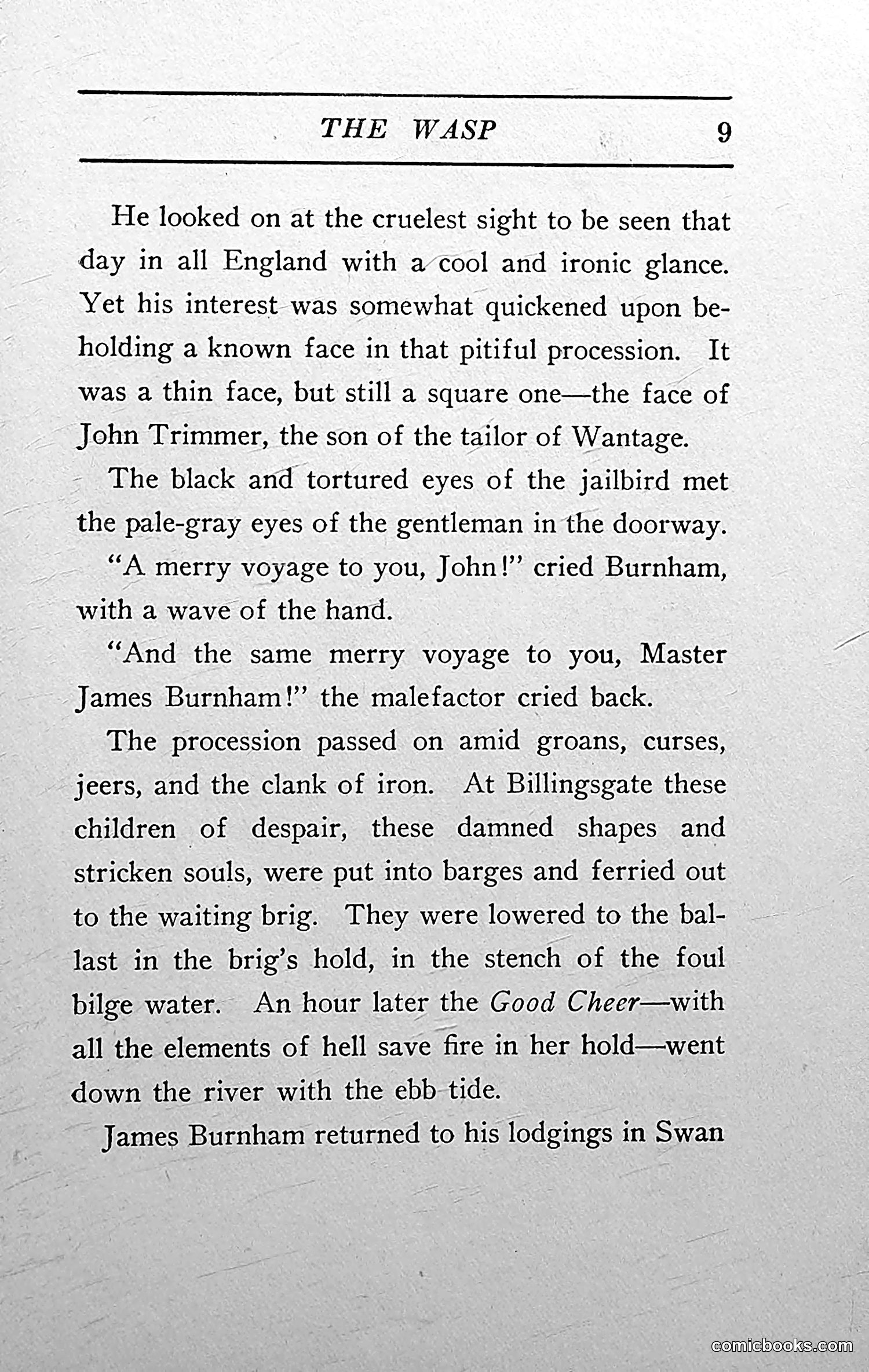
This page contains literary text rather than a political cartoon. It appears to be from a serialized story titled "The Wasp," depicting a scene where a gentleman named James Burnham observes a prisoner procession that includes John Trimmer, "the son of the tailor of Wantage." The passage describes prisoners being transported by barge down a river in harsh conditions. Burnham and Trimmer exchange a brief, sardonic greeting ("A merry voyage to you, John!"), suggesting social acquaintance despite their opposing circumstances—Burnham as a free gentleman, Trimmer as an imprisoned convict. The text emphasizes the prisoners' misery and the brutality of their transportation, but without visible illustrations on this page, the specific satirical or political targets remain unclear from the image alone.
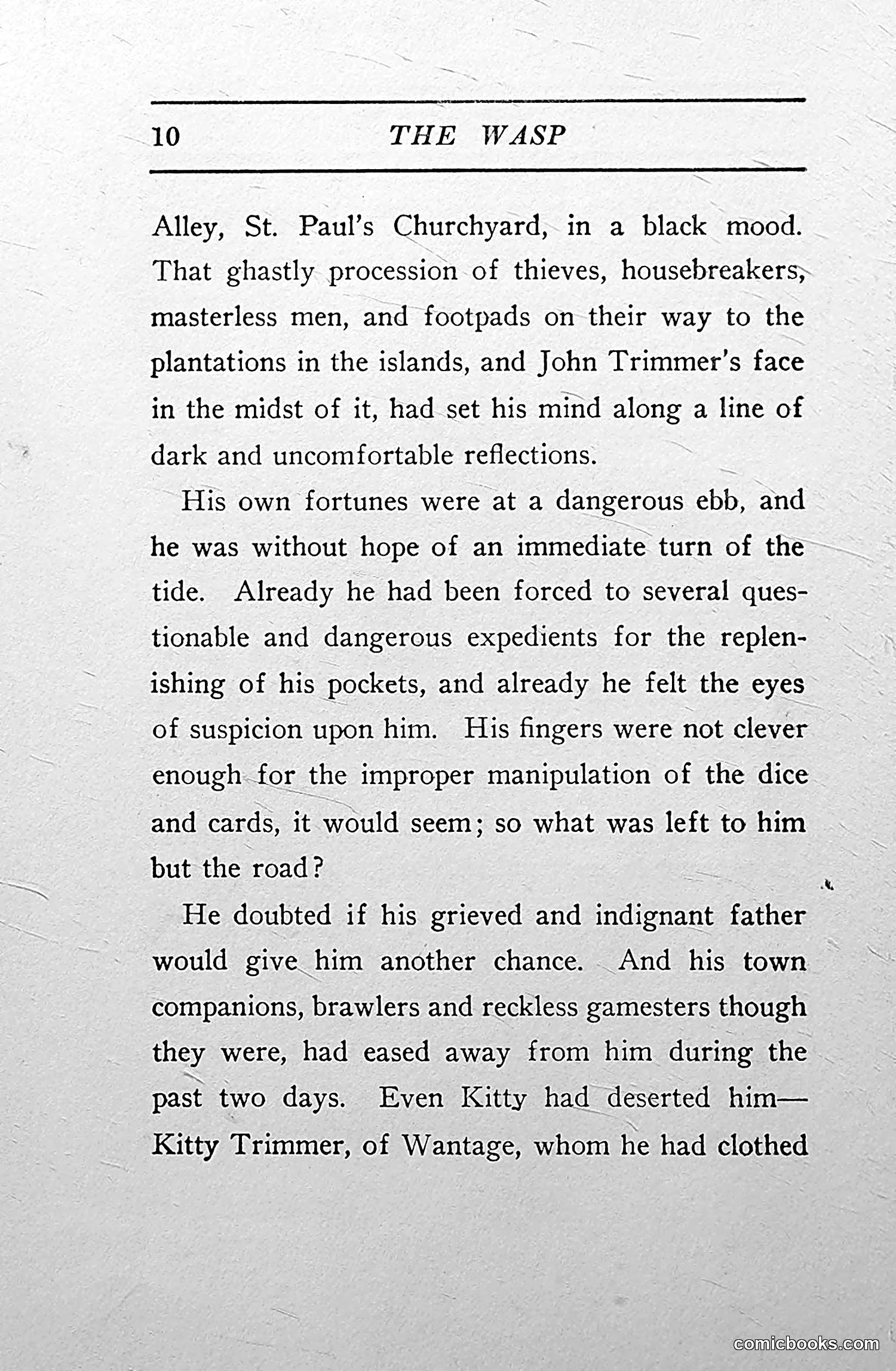
This page is prose fiction rather than a cartoon—a narrative excerpt from a story about a character named John Trimmer facing financial and social ruin. The text describes Trimmer in St. Paul's Churchyard, depressed after witnessing "a ghastly procession of thieves, housebreakers, masterless men, and footpads" bound for plantations (likely transportation to penal colonies). Trimmer's own fortunes are failing. He's been caught cheating at gambling (his "fingers were not clever enough" for dice manipulation), abandoned by companions and even "Kitty Trimmer, of Wantage, whom he had clothed"—suggesting he'd been a kept woman's patron. The satire mocks a dissolute gentleman now desperate and friendless, his criminal options exhausted, facing only the "road" (highway robbery) as remaining recourse.
This page contains no cartoon or visual satire—it's narrative prose from a story titled "The Wasp." The text introduces **James Burnham**, third son of Sir Walter Burnham of Berkshire, and describes his father as a hard, temperamental man obsessed with marking his possessions with the family heraldic device. The passage focuses on Sir Walter's compulsive need to brand everything he owns—from valuable silver plate engraved with full coats of arms to farmhouses marked with a four-barred hurdle device. This appears to be character exposition establishing James's family background and his father's controlling, aristocratic personality as setup for the narrative. Without seeing other pages, the satirical target of this story remains unclear.
This page contains no cartoon—it's a biographical narrative about James Burnham, son of Sir Walter Burnham. The text recounts Burnham's scandalous behavior: striking a schoolmaster, assaulting an Oxford proctor, seducing a tailor's daughter in Wantage, then shooting at a rival admirer (who happened to be a magistrate and his uncle), and finally being held up by a highwayman while fleeing to London. The satire targets a young aristocratic male who possesses his family's "courage" and "dangerous temper" but lacks their sense of honor. The piece mocks how dangerous privilege without restraint becomes—a cautionary tale about dissolute gentry. The detailed recounting of escalating misdeeds suggests contemporary scandal-sheet humor.
This page contains text only—no visible cartoon or illustration. It continues a narrative about James Burnham, a highwayman who robbed John Trimmer on the road. After being unmasked, they strike a deal: Trimmer keeps half his stolen money back in exchange for Burnham leaving him alone. The story then describes Burnham's subsequent exploits in London with his newfound wealth—courting a woman named Kitty Trimmer, living lavishly in Swan Alley, and gaining notoriety among "hell-rakes and harmless young fools." The narrative notes his luck eventually turns when he's forced to use loaded dice cheating, which angers his young associates. The passage appears to be serialized fiction rather than political satire, depicting 18th-century criminal underworld activities.
This page contains narrative text rather than a cartoon. It appears to be from a serialized story involving characters named James Burnham, Kitty, Stanton, and John Trimmer. The plot involves romantic betrayal and social degradation—Kitty abandons Burnham, and he witnesses John Trimmer in "that gang," facing possible transportation to plantations or execution via gallows. The passage explores themes of class anxiety and downward mobility common to 19th-century satire. Burnham's fear that he might follow Trimmer's trajectory suggests social precariousness for men of his status. Without seeing the full serial context or publication date, the specific satirical targets remain unclear, though the narrative critiques moral corruption and social vulnerability among middle/upper-class men.
This page appears to be a literary excerpt from a serialized story titled "The Wasp" rather than a political cartoon. The passage describes a man named James in a deteriorating room—abandoned by servants, with overturned furniture and a crushed fan. James becomes agitated, curses those who've wronged him, and dramatically drinks brandy before throwing the bottle across the room. Without additional context or visible illustrations on this page, I cannot identify specific political figures or satirical targets. The text suggests themes of abandonment, desperation, and emotional instability, but determining whether this represents actual political satire or social commentary requires more information about the story's broader context and the magazine's publication date.
This page contains prose fiction rather than political satire or cartooning. It's an excerpt from a story titled "The Wasp" featuring characters named James and William Stow (identified as Sir Walter Burnham's steward). The scene depicts William arriving at a room where James is present, discovering cards and bottles scattered about—suggesting dissolute behavior. William expresses disapproval in dialect-heavy speech, sarcastically commenting that one would find "more order an' decency in a carters' tavern." Without additional context about the publication date or the larger narrative, I cannot determine what specific social commentary or satirical intent this excerpt may contain. It appears to be serialized fiction rather than editorial satire, which was common in American magazines of this era.
This appears to be a literary excerpt rather than a cartoon. The text depicts a confrontation between two characters: Stow and Burnham. Stow, described as a well-dressed "prosperous country freeholder," delivers a harsh rebuke to "Master James" (Burnham), accusing him of bringing shame and financial ruin to his family and leaving England in disgrace. Without additional context or visible illustrations, the specific political or social satire is unclear. However, this seems to be satirizing either a real scandal involving a disgraced family member or a commentary on class dynamics between country gentry. The formal Victorian language and the emphasis on family honor suggests this references a specific contemporary event familiar to *Wasp* readers circa the late 1800s.
This page is a dialogue scene from a serialized story rather than a political cartoon. The exchange involves characters named James, Burnham, and William Stow discussing a stolen ring that Burnham sold to "the Jew" in Cheapside (a London district). The passage reflects period antisemitic attitudes common in Victorian-era fiction, casually identifying a Jewish character by religion rather than name. The plot concerns Burnham's cowardice—he fired on an unarmed man and is now being exiled to Jamaica as punishment, with Stow delivering harsh moral judgment. Without additional context or images visible on this page, the specific satirical targets remain unclear, though the content demonstrates the casual prejudices embedded in period literature.
This page appears to be a narrative excerpt rather than a cartoon. It depicts a dialogue between William Stow and Burnham regarding Burnham's fate. Stow threatens him with transportation to colonial plantations as punishment for an unspecified offense, where he'd face brutal treatment under overseers' whips. Burnham initially despairs, but Stow then offers him redemption: passage aboard "The Lass o' London" under Captain Hobkirk, with money and instructions from "Sir Walter" to outfit him for a voyage. The satire likely mocks either redemption narratives or colonial labor practices of the period. Without knowing the full serial context, the specific political targets—whether individual figures or systemic critique—remain unclear. The reference to "Sir Walter" suggests a notable contemporary figure, but cannot be confirmed from this excerpt alone.
This appears to be a narrative or dialogue excerpt rather than a political cartoon. The text depicts a conversation between characters named Burnham and Stow regarding a voyage to Jamaica. Stow is explaining that Burnham will receive 500 guineas in Kingston to enter trade with a sugar exporter named Angus McLatchy. The passage's satirical thrust lies in Stow's cynical warning: Burnham will either multiply his wealth through legitimate trade or squander it on vice. More pointedly, Stow threatens that if Burnham ever returns to England—rich or poor—he'll be imprisoned. Without seeing the accompanying illustration or knowing *The Wasp*'s publication date, the specific political context remains unclear. This likely satirizes colonial commerce, emigration schemes, or business corruption of the era.
This page appears to be prose fiction rather than a political cartoon. It depicts a narrative involving characters named James (Burnham), William Stow, and Captain Hobkirk discussing money and voyages. The text suggests a story about a young man who received 500 guineas from his father—a substantial sum—after angering him. James plans to use this money for a voyage without returning to England, apparently having been warned never to return. The passage emphasizes his shrewd calculation that future wealth and respectability would make him welcome despite the warning. Without additional context about The Wasp's publication date or the story's broader narrative, I cannot identify specific historical figures being satirized or determine what contemporary event or social condition this fiction satirizes.
This page contains **serialized fiction**, not a political cartoon. It's a narrative excerpt about a character named James Burnham aboard a ship. The text describes Burnham—apparently a "wild young blood" of good family—deliberately deceiving a shipmaster and crew during a sea voyage. Despite outward performances of foolishness, drunkenness, and good humor, Burnham maintains inner discipline, "keeping the devil out of his eyes." The passage suggests his good behavior is merely tactical dissembling. The final lines reveal his true nature reasserting itself: the peaceful voyage acts as a "tonic" that awakens his appetite for "vice" and "tavern brawls." **Without seeing earlier installments, the specific satirical target is unclear**—whether this mocks a particular public figure, social class behavior, or hypocrisy generally. The passage emphasizes the contrast between performed respectability and suppressed vice, a common satirical theme of the era. The story appears to be building toward depicting Burnham's eventual moral deterioration or exposure.
This appears to be an excerpt from a serialized fiction story rather than a political cartoon. The narrative depicts a merchant ship encountering a suspected pirate vessel at sea. The characters—Captain Hobkirk, mate Mr. Boyle, and crew member Burnham—prepare for potential combat upon spotting a suspicious schooner. Hobkirk identifies the threat as possibly "Major Deck" or "Duval the Frenchman," both known pirate captains operating fast schooners. The social commentary embedded here critiques England's maritime vulnerability: Hobkirk protests that "every honest trader must run for his life and cargo," suggesting widespread piracy threatens legitimate commerce. This reflects 19th-century concerns about privateering and piracy's economic impact on British trade routes. The narrative uses this threat to establish dramatic tension while highlighting a genuine contemporary problem affecting shipping and national prosperity.
This is a literary text page (labeled "II"), not a political cartoon. It appears to be from a serialized story in *The Wasp* magazine featuring characters named Burnham and Hobkirk debating naval combat strategy. The dialogue depicts two men disagreeing about engaging an enemy schooner. Burnham, appearing confident but naive, argues their "taller ship" and firearms give them advantage. Hobkirk, the experienced shipmaster, dismissively counters that the opposing vessel carries "one hundred and fifty devils"—implying ruthless, formidable fighters—and warns that Burnham will "whistle through a slit gizzard" (have his throat cut) for his five hundred guineas if he pursues this reckless plan. The passage's satirical edge lies in contrasting Burnham's theoretical optimism against Hobkirk's weathered, cynical realism about actual combat danger. Without additional context about who Burnham represents historically or politically, the specific satirical target remains unclear.
This page contains serialized fiction rather than a political cartoon. It depicts a scene between James Burnham (a merchant) and a shipmaster who encounter a pirate vessel at sea. The passage reveals Burnham's passionate, aggressive nature—his intense physical reaction to seeing the pirate ship causes the shipmaster to remark that Burnham appears "as wicked as any red pirate" himself. The mariner then suggests Burnham is naturally suited for military service ("fightin' for yer king") rather than merchant work, implying he's wasted in commerce given his obvious warrior temperament. The text appears to be satirizing class assumptions about aptitude and occupation—that a man with Burnham's evident fighting spirit and aggressive nature belongs in combat rather than business, questioning whether peaceful commercial life suits those with martial inclinations. Without seeing illustrations or knowing the broader narrative context, the specific satirical target remains unclear.
This appears to be a literary excerpt rather than a cartoon—a scene from a serialized story in the satirical magazine *The Wasp*. The dialogue features two characters, Burnham and Hobkirk (a shipmaster), discussing a pursuing vessel. The context involves naval conflict, likely referencing the era of privateering or naval warfare (possibly involving French ships, given the historical references). Burnham expresses frustration that the King's navy is occupied chasing French vessels, leaving pirates or privateers ("spawn o' the evil one") free to operate at sea. The shipmaster assures Burnham they can outrun their pursuer if the wind holds, as the other ship is fouled and slow. The satire likely mocks either naval incompetence, privateering, or maritime dangers of the period. Without seeing the magazine's date or broader context, the specific historical event or figures being satirized remains unclear.
This page is from a fictional narrative rather than a political cartoon. It depicts a scene aboard a pirate vessel where Captain Burnham is angered by a failed pursuit—a schooner escaped before the pirates could engage. When Mate Boyle expresses relief they weren't caught, Burnham mocks him, suggesting he'd have died of cowardice rather than combat. The text describes Boyle as self-important ("very fine opinion of himself") and portrays Burnham as frustrated, having wanted violence but forced to suppress his rage. Without additional context about *The Wasp* magazine's satirical targets or when this appeared, it's unclear whether this story satirizes specific historical figures, contemporary political figures, or serves purely as adventure fiction with character commentary.
This page contains **narrative fiction, not a political cartoon**. It's an excerpt from a serialized adventure story aboard the ship *Lass o' London*, featuring characters James Burnham and Henry Boyle (the mate). The passage dramatizes a violent confrontation: Boyle taunts Burnham about allegedly expressing fear of pirates, challenging his masculinity. Burnham, initially restraint-conscious about maintaining his reputation as peaceful, suddenly attacks—vaulting the table, choking Boyle, and slamming him against the ship's wall. Captain Hobkirk discovers them mid-fight. **Context for modern readers:** This reflects late-19th-century adventure fiction tropes—working-class maritime settings, masculine honor codes, and sudden explosive violence. The dialogue captures period nautical dialect. The irony lies in Burnham's internal conflict between wanting to fight and maintaining appearances—a tension resolved through violent action rather than restraint. No specific political satire or historical event appears referenced on this page.
This page appears to be prose fiction rather than a cartoon—a serialized story in the satirical magazine. It depicts a ship voyage where James Burnham, a man of apparent social pretension, assaults a crew mate, claiming the insult offended his "breeding." The ship's captain Hobkirk accepts this excuse and punishes the mate instead, treating Burnham as a gentleman deserving deference. The satire targets class hypocrisy: Burnham's violence is excused because he claims gentlemanly status, while the working-class mate faces punishment for perceived disrespect. The phrase "nice feelings of a man of breeding" is sarcastic—true gentlemen don't brutalize others. The introduction of Angus McLatchy suggests a new character embodying Protestant respectability (Bible and ledger equally important). The satire likely critiques how wealth and claimed social standing allow moral transgressions the working poor cannot commit with impunity.
This page appears to be a narrative excerpt rather than a cartoon. It describes a conflict between James Burnham, Esq., and a Scottish merchant named McLatchy over a two-day visit. The satire targets Burnham's unsuitability for respectable commercial life. He's portrayed as temperamentally violent and unstable—imagining himself brutally attacking McLatchy with a ledger. The irony is that despite his murderous impulses, Burnham leaves peacefully with his money intact, then immediately "fell among gentlemen who had no dealings with either Bibles or ledgers"—suggesting he gravitates toward dissolute or criminal companions. The joke mocks a certain class of British gentleman: financially independent but morally and temperamentally unfit for legitimate business. McLatchy represents Victorian commercial virtue (Bibles, ledgers, respectability), which Burnham finds intolerable. The satire suggests some men are simply *constitutionally* unsuited to honest work, preferring disreputable company. The target and specific historical context remain unclear without additional context about *The Wasp* magazine's publication date and focus.
This appears to be a narrative passage from *The Wasp* rather than a political cartoon. The text introduces Mr. Peter Queery, described as a new companion to someone named James Burnham. The satire here targets Queery's transparent social pretension. Though he claims to enjoy the company of "reckless, good-natured, useless fellows" and treats them with "kindly superiority," his behavior reveals his actual contempt—he makes clear (without stating it directly) that he belongs to "more respectable circles." The wit lies in exposing Queery's hypocrisy: his polished manners and flattering attention mask condescension. By treating Burnham with special consideration and intimacy, Queery subtly signals that Burnham ranks above the other "broken gentlemen," a backhanded compliment that reveals Queery's class consciousness and snobbery. The target of satire is likely this type of social climber or snob who uses performative politeness as a tool for social positioning.
This passage satirizes Caribbean piracy and crime as organized, legitimate "business enterprises." The narrator describes notorious criminals—Major Deck (formerly a Barbados planter), Duval (a "polite" Canadian), and Hellfire Hicks (ex-shopkeeper)—as if they were respectable merchants operating with secretaries, treasurers, and agents. The satire's point: these criminals have professionalized their operations so thoroughly they're indistinguishable from honest commerce. The joke deepens when blaming Major Deck's wife for "driving him to" piracy through her tantrums—mocking how society romanticizes or excuses criminality while deflecting responsibility onto women. The speaker's casual tone and personal connection (mentioning Deck's wife is his cousin) underscores how normalized these criminal operations apparently were in certain social circles, making the satire social commentary on complicity and moral corruption.
This page depicts a tavern conversation about piracy, likely set in a colonial American or Caribbean setting. The men discuss notorious pirates—apparently "Major Deck" and "Hellfire Hicks"—and their agents who operate among respectable society. A character named Burnham listens intently to gossip about how pirate operatives infiltrate elite circles (one allegedly posed as a tutor in Bermuda before stealing Dame Murdock's jewels). The satire mocks both the romanticization of piracy as a "gentlemanly occupation" by drunk gentlemen and the anxiety that dangerous criminals hide within respectable appearances. Peter Queery soberly notes piracy's ultimate consequence: execution. The passage satirizes loose talk in taverns and the paranoia about hidden subversives in colonial society—a recurring theme in 19th-century American satire about criminality and social trust.
This page contains prose narrative rather than cartoons—it appears to be a serialized story from *The Wasp*, a 19th-century satirical magazine. The text describes a character named James Burnham, a dangerous man of refined background who becomes a pirate. The satire targets class hypocrisy: Burnham is "born the son of a bishop and educated for holy orders" yet becomes "the most desperate pirate." The passage emphasizes his menacing presence in Kingston through physical description—his "pale eyes," "white rage," and distinctive appearance that intimidates hardened criminals. The earlier anecdote about a tutor-turned-pirate serves a similar purpose: exposing how respectable education masks violent depravity. The humor lies in the incongruity between genteel background and ruthless behavior, while mocking both the criminal underworld and the social pretensions of the upper classes.
This page from *The Wasp* appears to be **prose fiction rather than a cartoon**, consisting of a satirical narrative excerpt. The text describes a scheme in which Peter Queery, a planter from Nevis in the Caribbean, persuades James Burnham to travel with him under the guise of a generous business partnership. The satire targets **financial opportunism and deception**: Queery flatters Burnham with brotherly affection and promises of partnership, while Burnham cynically accepts, viewing Queery as a "fool" who will finance his travels. Burnham brings a "box of guineas" (money), suggesting he's not the naïve party Queery assumes. The joke appears to concern **Caribbean plantation schemes of the colonial era**—ventures that attracted investors and adventurers. The shabby vessel and late-night wine-drinking suggest dubious dealings. Without seeing illustrations or knowing the publication date, the specific satirical target (whether a real scheme, a type of person, or political figures) remains unclear, though the setup suggests mutual deception between con artist and opportunist.
This appears to be a narrative fiction excerpt rather than a political cartoon. The text describes a deceptive scheme where a character named Queery manipulates James Burnham through false friendship and hospitality. **The Satire:** Queery boasts about his valuable estate in Nevis to the ship's master while befriending the young Burnham, hinting at making him an heir. After getting Burnham drunk on rum punch at midnight, Burnham awakens abandoned in an open boat—suggesting Queery has robbed and abandoned him, likely a confidence scheme. **The Point:** This appears to satirize maritime fraud and the dangers of trusting smooth-talking strangers who flatter you with promises of inheritance and wealth. The story illustrates how alcohol and false charm are tools of deception—a cautionary tale for readers about con artists who prey on young, gullible men. Without seeing illustrations or knowing the publication date, it's unclear if this references specific real events or public figures.
This appears to be a literary excerpt rather than a political cartoon. The passage describes a man named Burnham who has been poisoned, drugged, robbed, and cast adrift by someone named Peter Queery. The text is a dramatic narrative focusing on Burnham's predicament in an open boat and his encounter with a seagull. The gull's detailed description—with its "round, crimson eyes" and pristine appearance—suggests symbolic meaning: the bird's indifference and untroubledness contrast sharply with Burnham's sickness and vulnerability. Without additional context about *The Wasp* magazine's publication date or the broader story, the specific satirical target is unclear. However, the passage may be part of a serialized tale or commentary on betrayal, crime, or social injustice typical of the magazine's satirical content.
This page contains serialized fiction rather than political satire or cartooning. It depicts a dramatic narrative about a character named James Burnham adrift in a boat, seemingly under the influence of drugs ("ravages of the drug"), observed by a large shark or sea creature ("that convoying fin"). The text emphasizes Burnham's deteriorated physical and mental state—haggard, rage-filled, starving—as he drifts helplessly at sea. The circling fin represents an immediate mortal threat. Without additional context about *The Wasp* magazine's satirical targets or the larger story, it's unclear whether this fiction carries allegorical political meaning or comments on contemporary social issues. It may simply be adventure/horror fiction serialized for entertainment. The page shows no visible cartoon illustrations, only printed text.
This appears to be a **literary excerpt rather than a political cartoon**—specifically a dramatic narrative passage from a serialized story in the satirical magazine *The Wasp*. The text depicts a character named **Burnham** having vivid, drugged dreams where he strangles a man named **Peter Queery**. The passage moves through multiple hallucinatory locations (London lodgings, a Kingston wine-shop, an open boat) before climaxing in Queery's actual death. The narrative suggests **revenge or murder**, with references to **Kitty Trimmer** (possibly a love interest) and drugged punch—implying the killer was incapacitated during the crime but still managed his violent act. Without additional context about *The Wasp's* satirical targets or the larger story, the specific identities and political references remain unclear. This reads as **sensationalized crime fiction** rather than direct political satire.
This appears to be a literary excerpt rather than a political cartoon. The text describes a nightmarish scene: a character named Burnham repeatedly throws a corpse into a flaming sea, but the body persistently returns to his boat. The corpse—described as "wide-eyed, purple-faced"—seems almost sentient, deliberately avoiding his oar strikes. The final line reveals this is a dream sequence ("awakened him"), suggesting the narrative is exploring guilt, psychological torment, or obsession through surreal imagery. Without seeing the magazine's publication date or additional context, the specific political or social satire remains unclear. However, *The Wasp* was a San Francisco-based satirical publication known for commentary on local politics and social issues. This passage may allegorize a public figure or scandal that contemporary readers would recognize, but the literary nature of the text—rather than visual caricature—makes the specific target impossible to determine from this page alone.
This page contains **fictional narrative text**, not a political cartoon. It's an excerpt from what appears to be an adventure or survival story serialized in *The Wasp* magazine. The passage depicts a man stranded in a boat, weakened from hunger and thirst, who awakens from a nightmare. He's haunted by the image of a dead man and now discovers—terrifyingly but apparently in reality—a shark circling his boat mere feet below the surface. **No identifiable political figures or satirical commentary** are present on this page. The content is dramatic fiction rather than satire or social commentary. Without additional context about the full story's author, publication date, or surrounding pages, we cannot determine if this narrative carries broader allegorical meaning for *The Wasp*'s readership, though the survival-at-sea scenario was a popular literary genre of the era.
This page contains **narrative prose, not a cartoon**. It appears to be from a serialized story in *The Wasp* magazine titled "The Wasp," following a character named James Burnham during an encounter with a shark at sea. The text describes a dramatic moment: Burnham spears a shark, which escapes, then he observes the dawn breaking over the ocean. The prose is deliberately literary and romantic—contrasting the beautiful sunrise imagery with the underlying danger (the "fanged shark" lurking below). Without additional context or images, it's unclear what *The Wasp's* satirical point might be. This could be a dramatic serial story mixed among the magazine's typical political cartoons and satire, or the satire might emerge in subsequent installments. The excerpt itself reads as straightforward adventure fiction rather than social commentary.
This page contains prose narrative rather than a political cartoon. It depicts a castaway named Burnham spotting a approaching ship (a "brig") and desperately attempting to signal it using oars and canvas. The passage emphasizes Burnham's physical desperation—he's weak with hunger, fantasizing about coffee and stale bread aboard the vessel. The sailor crew is mockingly described as "hairy-handed, foul-mouthed fellows in tarry breeks" (typical sailor stereotypes). The narrative appears to be serial fiction, likely a shipwreck or survival story. Without additional context about *The Wasp's* publication date or Burnham's identity, it's unclear whether this references a specific historical event, real person, or is purely fictional satire. The ornate, romantic prose style was typical of 19th-century magazine serialization.
This appears to be a serialized adventure narrative rather than a political cartoon. The text describes James Burnham, a castaway, being rescued by a Boston-bound ship and encountering its moralistic captain. The satire lies in the shipmaster's character: a pious, judgmental New England Calvinist who delivers sanctimonious lectures about sin and divine providence while scrutinizing Burnham's appearance for signs of moral corruption. The captain's exaggerated dialect and self-righteous moralizing—warning against "ungodliness, roistering, an' high-bellied living"—appears to mock hypocritical religious zeal and Puritan prudishness common in New England. The humor relies on the gap between the captain's sanctimony and his calculating assessment of the stranger, suggesting that pious moralizing often masks ulterior motives or shallow character judgment.
This is a satirical narrative scene mocking religious hypocrisy in maritime commerce. A pious shipmaster delivers sanctimonious advice to James Burnham about dedicating his life to the Lord, yet the sermon reveals the speaker's complicity in the slave trade—he casually mentions his brother captained a ship carrying "red rum an' black negroes" that was pirated. The satire targets the contradiction between professed Christian piety and participation in slavery and exploitation. The captain's religiosity ("constant reader...of the Good Book") contrasts sharply with his acceptance of slave trafficking as normal business. Burnham's "crooked smile" and "dancing eyes" suggest he sees through the hypocrisy. The joke exposes how 19th-century maritime traders justified brutal commerce through selective moral reasoning—grateful to survive while indifferent to enslaved Africans' fates. The satirist uses dialect humor and the captain's crude tobacco-spitting to emphasize his moral degradation.
This appears to be a narrative excerpt rather than a cartoon. It depicts a tense shipboard negotiation between a desperate man (Burnham) and a shipmaster (Smith). The scene satirizes the precarious position of penniless white men in 19th-century colonial Caribbean waters. The shipmaster cynically offers Burnham a berth to Barbados after a crew member's death, framing it as Providence. Burnham immediately recognizes this as a trap—suspecting the shipmaster intends to sell him into indentured servitude or bondage to a Caribbean planter, a common practice for desperate laborers. Burnham counters by inventing a connection to "Mr. Angus McLatchy of Kingston," a presumably respectable contact whose patronage would protect him from exploitation. The satire critiques the vulnerability of poor white men in colonial systems and how quickly they learned to navigate—or fabricate—protective social connections to avoid being trafficked as laborers.
This appears to be a **serialized fiction excerpt** rather than a political cartoon. The text is narrative prose from what seems to be an adventure or maritime story featuring characters named James Burnham and Smith aboard a ship (a "brig"). The plot concerns **proof of identity and trust**: Burnham claims to know someone named Angus McLatchy and possesses a "mark on his shoulder" as evidence, but Smith—apparently a ship's officer—doubts this will convince strangers. Burnham is treated as an outsider: he's isolated on deck, denied cabin meals, and eats with the crew in the galley. **The satirical context is unclear from this page alone.** Without knowing *The Wasp's* publication date, who the author is, or what real-world figures or events these characters reference, I cannot determine if this is political satire, social commentary, or simply adventure fiction used to fill magazine space. The page number (47) suggests this is mid-serialization, requiring earlier context to understand any intended meaning.
This page contains only text with no visible cartoon or illustration. The passage describes a narrative scene involving an unnamed male figure joining a ship's crew. The crew members—described as "rough and dejected-looking fellows"—regard him with curiosity and suspicion, yet neither he nor they ask questions. Without seeing an accompanying image, it's impossible to identify who this figure represents or what specific political/social satire *The Wasp* intended. The text alone suggests themes of mystery, social tension, or outsider status common to 19th-century American satire, but the cartoon's actual meaning and targets remain unclear from this page fragment alone.
This page presents narrative fiction rather than political satire or cartooning. It depicts a confrontation between James Burnham (described as a "castaway" and "New Englander") and an unnamed shipmaster aboard a vessel. The scene involves Burnham politely requesting tobacco and information about his berth from a lounging shipmaster with a pipe. The shipmaster responds with "rattling oaths" and physical aggression, attacking Burnham at the throat. Burnham defensively sidesteps and kicks the man into the starboard rail, then evades a second attack. The passage appears to be serialized adventure or maritime fiction—a narrative story rather than editorial commentary or visual satire. Without additional context about the publication date, *The Wasp's* editorial stance, or who Burnham represents (if anyone), the specific satirical target remains unclear. The page number (49) suggests this is mid-story continuation.
This page appears to be **text narrative rather than a cartoon**—a serialized story about a shipboard fight. The scene depicts a brawl between Smith and Burnham aboard a vessel, where Burnham uses clever footwork to evade Smith's attacks. Mate Winch intervenes by striking Burnham with a belaying-pin (a nautical tool), after which Burnham is imprisoned in the ship's forecastle. The passage is naturalistic fiction describing nautical life and maritime conflict. Without seeing the original cartoon or knowing the publication date, it's unclear whether this satirizes real contemporary figures or events, or if it's simply adventure storytelling. *The Wasp* was a San Francisco satirical magazine, so it may reference local politics or personalities, but the text alone doesn't reveal those connections. This reads as serialized adventure fiction rather than political satire.
This page contains fiction rather than satire or political commentary. It's an excerpt from a serialized narrative titled "The Wasp," depicting a prisoner named Burnham confined below deck in a ship's brig (jail). The passage describes Burnham regaining consciousness after being struck by an officer, discovering he's shackled at the ankles, and attempting escape when a young crew member—Henry Todd, the ship's boy—descends the ladder. The text emphasizes Burnham's thirst, confinement, and growing awareness of his situation. Without additional context about the larger story or *The Wasp* magazine's specific satirical aims, we cannot determine if this narrative itself carries political or social commentary. The scene appears to be straightforward adventure fiction focused on suspense and character development rather than satire.
This appears to be a fictional narrative excerpt rather than a political cartoon. The text depicts a shipboard scene involving a character named James Burnham and a young boy named Todd. The passage satirizes Burnham's callous cynicism masked by false civility. Though he claims a "tender and genial disposition," the narrative reveals his actual cruelty: he feels "no pity" for suffering and speaks kindly to Todd only out of "contrariness"—to contradict the brutality of others. His sneering monologue about the "blessing" of his supposed kindness is clearly ironic mockery. The scene likely critiques hypocrisy and performative benevolence—the gap between what people claim about their moral character and their actual indifference or malice. Todd's terrified gratitude for basic kindness underscores the brutal conditions aboard ship. Without knowing *The Wasp's* publication date and specific focus, the broader target appears to be social pretense and the exploitation of the vulnerable.
This page contains narrative fiction rather than a political cartoon. It depicts a scene aboard a ship where a character named Burnham, apparently having been knocked unconscious, recovers in the forecastle (crew's quarters). He drinks rum to ease his thirst and pain, then hides the bottle. A New England shipmaster arrives and addresses Burnham as a "mutinous dog," suggesting Burnham has rebelled against authority. The shipmaster asks mockingly how Burnham likes his "berth" (bunk/position), then attempts to rouse him by kicking, but Burnham feigns unresponsiveness. The text suggests a conflict between crew and captain—likely satirizing maritime labor disputes or class tensions common in the era. The shipmaster's contempt and physical abuse illustrate the harsh treatment sailors endured, which was a social criticism The Wasp frequently targeted.
This page appears to be part of a serialized narrative rather than a political cartoon. It depicts a shipboard scene where sailors debate the fate of an unconscious man named Burnham, found adrift. The satire targets maritime corruption and opportunism: the shipmaster cynically calculates Burnham's value—worthless dead, but worth thirty guineas to a planter if revived, or even more valuable if framed as a pirate captain to claim a government reward and see him hanged. The crude sailor dialect emphasizes the callousness of those profiting from colonial trade. The passage satirizes how maritime law could be weaponized for profit, and suggests that accusations of piracy were convenient—used to eliminate inconvenient people while claiming civic virtue. The reference to pirate captains being "set adrift" by their crews reflects real historical practices, here invoked ironically to justify false accusation.
This page contains narrative text—not a cartoon—from what appears to be a serialized pirate fiction story. The passage describes James Burnham, a prisoner aboard a ship, being identified as the notorious pirate "Hellfire Hicks" (with a bounty of 200 pounds alive, 100 dead). A young crew member named Henry Todd, mistreated aboard the vessel, secretly asks Burnham to help him join a pirate crew, expressing his desperation to escape his brutal circumstances. The dialect-heavy dialogue and dramatic setup suggest this is pulp fiction entertainment rather than political satire. Without additional context about *The Wasp* magazine's satirical mission or the story's arc, it's unclear whether this adventure narrative carries satirical intent or simply represents the magazine's entertainment content.
This page appears to be from a serialized narrative story rather than a political cartoon. It depicts a scene aboard a ship where a character named Henry Todd expresses willingness to abandon his current vessel, the *Virtue*, to serve with a pirate named Burnham instead. The satire likely targets **maritime labor conditions and religious hypocrisy**. Todd claims his pious upbringing—reading the Bible daily, honest parents—yet readily abandons virtue (the ship's symbolic name) to join piracy, suggesting that moral instruction fails against harsh working conditions under Captain Smith, Mr. Winch, and others. The brig *Virtue* versus the pirate's life represents a contrast between claimed respectability and actual circumstances. Burnham's skepticism ("So you would ship with a pirate?") underscores the absurdity of Todd's willingness. The reference to selling Burnham's "neck for a reward" indicates bounty hunting concerns. Without knowing *The Wasp's* publication date or broader context, the specific targets remain unclear, though the critique of shipboard authority and morality's emptiness appears evident.
This page contains prose fiction rather than a political cartoon. It appears to be an excerpt from a serialized adventure story in *The Wasp* magazine, depicting a scene of escape or clandestine boat departure. The dialogue references **Nevis and St. Kitts** (Caribbean islands) and mentions the threat of impressment into piracy or indentured servitude to planters—historical concerns in colonial Caribbean narratives. The characters "Todd" and "Burnham" are planning a nighttime escape by boat, with Todd preparing supplies (water, biscuits, weapons). The passage emphasizes dramatic tension through nautical language and dark atmosphere rather than satire. Without seeing accompanying illustrations or understanding the broader narrative context within *The Wasp*, the specific satirical target—if any—remains unclear. This may be straight adventure fiction serialized alongside the magazine's satirical content, or context about who these characters represent would be needed to identify any political commentary.
This appears to be a **serialized fiction excerpt** rather than a political cartoon. The text depicts a dramatic nighttime scene aboard a ship, with characters named Burnham and Henry Todd attempting a covert operation—likely stealing or sabotaging a boat, given their sneaking movements and the bottle Burnham carries. The passage builds suspense as they navigate past sleeping crew members. Discovery seems imminent when someone wakes and physically confronts Burnham, causing an adrenaline surge described in vivid language ("blood went through Burnham's veins like spurting flame"). Without seeing the magazine's publication date or broader context, the specific satirical or political meaning remains **unclear**. This could be adventure fiction, social commentary, or parody. The page shows no visible illustrations or cartoons—it's purely text, suggesting *The Wasp* published serialized stories alongside its satirical content.
This page contains narrative text rather than a political cartoon. It depicts a dramatic escape scene aboard a ship involving characters named Burnham and Todd. Burnham strikes an unconscious sailor with a bottle, then helps a terrified boy flee the vessel by rope into a small boat under cover of darkness. The passage appears to be fictional serialized fiction rather than satire or political commentary. Without additional context about the publication date or the broader narrative, it's unclear what social or political meaning this adventure story may carry. The violent escape and the emphasis on the frightened boy suggest themes of danger or wrongdoing, but the specific satirical point—if one exists—cannot be determined from this page alone.
This page contains **narrative fiction rather than a political cartoon**. It's an excerpt from a serialized adventure story featuring a character named James Burnham engaged in a nighttime maritime conflict. The passage describes Burnham and a young man named Todd in a small boat approaching a larger vessel (a "brig"). After a musket shot from the brig, Burnham fires back deliberately at the torchlight on the brig's rail, extinguishing it and causing a scream. He then continues rowing and sets sail toward islands visible at dawn. The text appears to be from an adventure or nautical tale—possibly historical fiction—rather than satirical commentary. Without additional context about *The Wasp* magazine's publication date or the story's larger narrative, **the specific historical event or figure being referenced remains unclear**. The dramatic action and dialogue are characteristic of 19th-century serialized adventure fiction.
This page appears to be from a serialized adventure narrative rather than a political cartoon. It depicts a scene where a character named James Burnham and a boy named Henry Todd have escaped from a ship called the *Virtue* in a stolen boat. The boy, impressed by their escape and Burnham's seamanship, enthusiastically asks to become a pirate with him. Burnham responds indignantly, denying he's a pirate and asserting his respectable identity. The satire likely targets **respectable men engaged in morally questionable acts**—Burnham has clearly stolen a boat and fled a vessel, yet vehemently rejects the "pirate" label while claiming honest status. The humor lies in this contradiction: his actions suggest piracy, but he clings to respectability through mere denial and a name. Without additional context about *The Wasp*'s publication date or satirical targets, the specific social commentary remains unclear, though it appears to mock hypocrisy and self-deception among the supposedly virtuous.
This appears to be a narrative excerpt rather than a cartoon page. It's prose fiction describing two characters—Todd and Burnham—who have been set adrift and landed on St. Kitts in the West Indies. The passage satirizes the plight of gentlemen reduced to poverty and degradation. Burnham, clearly a man of some social standing (he maintained smooth skin and wore fine linen), is now desperate, penniless, and disheveled after apparently being robbed and abandoned. The humor lies in the contrast between his former civilized existence and his current squalid condition—stripped of stockings and shoes, shirt torn and soiled, unshaven. The text suggests this is from a serialized adventure story in *The Wasp*, likely mocking the misfortunes of its protagonist through detailed descriptions of his physical and social decline. Without seeing accompanying illustrations, the satirical intent focuses on the humiliation of a once-refined gentleman.
This appears to be a serialized fiction excerpt from *The Wasp*, likely from the late 19th century. The text shows a dialogue between James Burnham (who was previously known as "Hellfire Hicks," suggesting a criminal past or alias) and Henry Todd, a nervous young man. The passage depicts Burnham reassuring Todd of his reformed identity while requesting a knife. Todd's anxious response—worrying about losing his pirate berth and settling scores with Captain Smith and Mr. Winch—suggests this is adventure fiction involving nautical crime or piracy. Without visible illustrations, the satirical or political content remains unclear. This may be serialized melodrama rather than satire, or the cartoon/commentary portion appears on another page. The text alone reads as dramatic narrative rather than social commentary.
This appears to be a narrative fiction excerpt rather than a political cartoon. The text describes a scene from an adventure story featuring characters named Burnham and an unnamed boy who have apparently escaped some dangerous situation ("corner") and are stranded near a coast. The passage details their survival activities: preparing breakfast in a grove of trees and Burnham shaving himself using butter as lather and a stolen knife from someone named Mr. Winch. The humor derives from the practical difficulties of this improvised grooming—Burnham struggles to remove the butter afterward, requiring repeated scrubbing with seawater and sand. There are no identifiable political figures or social commentary visible. This reads as serialized adventure fiction typical of 19th-century periodicals, likely intended for entertainment rather than satire.
This page contains **narrative fiction**, not a political cartoon. It appears to be from a serialized story in *The Wasp* magazine (a 19th-century American satirical publication). The passage describes a tense beach scene: two men—Burnham and Henry Todd—are waiting anxiously on a sandy shore near whitewood trees. Burnham sits holding a knife, scanning the ocean and beach with a "baffled, desperate glance," suggesting he's awaiting something significant. Todd has fallen asleep. A woman then appears, approaching "wearily and unsteadily" from around a point of land. **The satirical context is unclear from this excerpt alone.** Without seeing previous installments or understanding the broader story, we cannot determine what situation Burnham and Todd are involved in, why they're waiting, or what the woman's arrival signifies. The narrative tension suggests drama or intrigue, but the specific social or political commentary—if any—remains obscure from this page alone.
This appears to be a page from a serialized fiction story in *The Wasp* magazine, not a political cartoon. The text describes a dramatic scene where a character named Burnham encounters an unconscious woman on a beach. The woman is depicted as young, white, and dressed in equestrian attire (boots, spurs, a whip)—suggesting she's a woman of means or status accustomed to riding. Her collapse on the hot sand and Burnham's immediate response ("Here's a guide for me") sets up narrative tension. Without additional context about the story's plot, characters, or publication date, I cannot identify specific satirical or political references. This reads as adventure or romance fiction rather than satire. The page number (66) indicates this is mid-story. To understand any social commentary, we'd need to know the story's broader context and whether *The Wasp* was satirizing a particular contemporary work or social situation.
This appears to be a text passage rather than a cartoon. It's a narrative excerpt from *The Wasp*, a 19th-century American satirical magazine, describing a character named Burnham discovering an unconscious woman after a riding accident. The passage reveals Burnham's character through his motivations: he's relieved she's alive, but the text explicitly states this is "for his own sake rather than for the lady's." Her gold whip indicates wealth and social importance, which brightens his outlook. The detail that he carries her to rest near the sleeping Henry Todd suggests a plot involving opportunism or self-interest rather than genuine concern. Without seeing accompanying illustrations or cartoons, the satirical intent isn't fully clear, but the narrative suggests social commentary on opportunism, class dynamics, or male self-interest masquerading as chivalry.
This appears to be a literary excerpt rather than political satire or a cartoon. The text is from a serialized fiction story featured in *The Wasp*, a 19th-century American satirical magazine. The passage depicts a romantic melodrama: a character named Burnham discovers an unconscious young woman on a beach and revives her. She reveals herself as the governor's daughter of Nevis (a Caribbean island), apparently thrown from a horse by someone named Turk. The narrative employs period romance conventions—detailed descriptions of her striking eyes, the gentleman's chivalrous behavior, and hints of social class distinction through her elevated status. Without seeing illustrations or additional context on this page, it's unclear whether *The Wasp* is satirizing this melodramatic genre itself or simply serializing entertainment fiction alongside its satirical content. The romantic tone seems sincere rather than mocking.
This page appears to be from a serialized fiction story rather than a political cartoon or satire. It's narrative prose describing a character named Burnham's dilemma after escaping from a New England ship called the *Virtue*. The plot concerns Burnham's predicament: he's fled violently from Captain Smith (who planned to sell him into piracy or slavery), but now finds himself stranded near the very island where Smith operates. Contacting authorities to prove his story of robbery and misfortune is risky because his violent escape—he brained one man with a bottle and shot another—will work against him legally. The passage shows Burnham contemplating whether to take this risk, "glancing down at the girl with a calculating eye," suggesting he may involve her in his scheme. Without seeing additional context or illustrations on this page, I cannot identify specific satirical targets or political commentary typical of *The Wasp* magazine. This reads as adventure fiction rather than satire.
This page appears to be from a serialized dramatic narrative rather than a political cartoon. It depicts a scene involving three characters: a young unconscious woman, a boy named Todd, and a man named Burnham who seems to be reviving the woman by pouring water on her face. The opening quote about holding "the card with which it must be won" suggests Burnham views the woman as a prize or strategic advantage in some larger game. His behavior—prodding Todd away, his sudden shift to courtly politeness once the woman awakens—indicates manipulative, calculated charm. Without additional context about the full story, the specific historical reference, or what "game" is being referenced, it's difficult to identify any particular political satire or social commentary. This reads more as melodramatic fiction than topical satire typical of The Wasp's usual editorial content.
This page is a literary excerpt, not a political cartoon or satire. It's prose fiction from *The Wasp* magazine (page 71), depicting a scene where James Burnham, a shipwrecked gentleman in tattered clothes, encounters the governor's daughter on a beach. She questions his identity, noting the contradiction between his ragged appearance and his refined manners and speech. Burnham explains he is genuinely a gentleman currently in dire circumstances. The passage explores themes of class, appearance versus character, and social distinction—common Victorian literary concerns. Without seeing illustrations or additional context, the satirical intent of *The Wasp* regarding this particular story remains unclear from this text alone.
This appears to be a page from a serialized narrative or serial story rather than a political cartoon. The text shows dialogue between a young injured woman and a man named Burnham on a beach near Government House. The woman describes being thrown from her horse inland, making her way through jungle to the sea, then collapsing on the sand—where Burnham found her unconscious. She has a cut and bruise on her forehead. Burnham, claiming his "misfortunes" led him to this shore, is now inquiring about her father's residence and its proximity to a harbor. Without additional context about *The Wasp* magazine's date, location, or typical content, and without visible illustrations, it's unclear what political or social satire this narrative might contain. The page reads as adventure/romantic fiction rather than obvious satire. The reference to "Government House" suggests a colonial setting, but specifics remain unclear.
This page contains narrative prose rather than a cartoon. It depicts a social encounter between a woman and a man named Burnham near Charles Town harbor. The satire concerns class perception: the woman observes Burnham's shabby appearance—torn linen shirt, missing stockings and shoes—yet notes his gentlemanly bearing, clean hands, and refusal to apologize for his condition. The humor lies in her realization that only a "man of breeding" would maintain dignity despite visible poverty. The brig *Virtue* anchored offshore appears significant, though its specific reference is unclear. Her startled reaction to his water-travel suggestion implies either surprise at the proposal itself or anxiety about traveling by boat—the satire's exact point remains somewhat ambiguous without fuller context about *The Wasp* magazine's themes.
This page appears to be **narrative fiction or serialized literature** rather than political satire or a cartoon. It depicts a dramatic scene between a character named Burnham and a young woman who has apparently suffered trauma ("greatly this morning"). The woman initially fears going out in a boat with Burnham alone, possibly suspecting he might abduct her to St. Kitts. Burnham responds with measured kindness, instructing his assistant Henry to hide the boat and provisions. The woman then has a change of heart, offering to accompany Burnham in the boat and apologizing "most humbly." **Without additional context** about *The Wasp's* publication date, editorial focus, or the surrounding story, it's unclear what social or political commentary this passage might contain. The dramatic tone and class dynamics (Burnham appears to be a gentleman; Henry is his servant) suggest possible commentary on social relationships, but the specific satirical point remains **unclear from this page alone**.
This page contains **serialized fiction**, not political satire or cartoon content. It appears to be a dramatic narrative featuring characters named Burnham and an unnamed young woman in a romantic/adventure scenario involving escape by boat. The text describes Burnham helping an apparently distressed woman flee by sea, with dialogue emphasizing his gallantry and her trust in him despite his self-described status as "an outcast." The scene includes period details (musket, sail) suggesting a historical setting, though the specific era and context remain unclear from this excerpt alone. **Without additional context or visible illustrations**, it's impossible to identify whether this is: - A serialized novel adapted for the magazine - A satirical story mocking romantic conventions - Commentary on contemporary events The dramatic tone and earnest dialogue suggest this may be sincere serialized entertainment rather than *The Wasp's* typical satirical content.
This page appears to be **narrative fiction rather than political satire or editorial cartoon**. It's a serialized story titled "The Wasp" depicting a dramatic boat scene: Burnham and a young man named Todd are rowing toward Charles Town while the governor's daughter rests under a sail. The intense heat causes Todd to collapse at the oars. Burnham, showing restraint and compassion, tells Todd to stop rowing and rest—notably suppressing an oath out of respect for the young woman's presence. The passage emphasizes character through action: Burnham's concern for propriety and kindness, Todd's physical exhaustion, and the harsh environment. Without additional context about this particular Wasp publication's date and editorial stance, I cannot identify specific political references or determine if "the governor's daughter" or other figures carry satirical meaning beyond the narrative itself.
This page contains **narrative text, not a cartoon**. It appears to be from a serialized fiction story in *The Wasp* magazine rather than satirical comic content. The passage describes a boat arriving at Charles Town (likely Charleston, South Carolina) with characters named Burnham and Todd. Burnham performs an impressive rowing display to impress "the young woman" aboard, then surveys the harbor with apparent strategic interest—noting three vessels and specifically identifying "the New England brig." The tone suggests this is adventure or romance fiction rather than political satire. **Without additional context or visual elements**, it's unclear what historical event or social commentary this story might reference. The colonial setting and mention of vessels suggests possible Revolutionary War-era fiction, but this cannot be confirmed from this page alone. To identify the satirical purpose, one would need to see the accompanying illustrations or read more of the narrative.
This page contains **narrative fiction**, not a cartoon. It appears to be from a serialized story in *The Wasp* magazine featuring characters named Burnham and the governor's daughter in a tropical colonial setting. The passage depicts Burnham rowing ashore near Government House, following the governor's daughter's directions. The tension suggests Burnham is anxious about proximity to a ship called the *Virtue*—a detail implying this is adventure or intrigue fiction, possibly involving smuggling, espionage, or romantic complications typical of period serials. The reference to "Government House" and colonial infrastructure suggests a British colonial possession, likely Caribbean. Without additional context about the story's title or author, the specific satirical or political point—if any—remains unclear from this excerpt alone.
This page appears to be from a serialized adventure narrative rather than a political cartoon. It depicts a dramatic rescue scene: a man named Burnham retrieves a young woman from a boat (the *Virtue*) while under fire from pursuers. The woman is weak and can barely walk, suggesting she may have been imprisoned or ill. The text offers no clear political or social satire—it reads as straightforward adventure fiction. Without additional context about *The Wasp* magazine's editorial stance or the broader narrative surrounding this episode, I cannot identify what "Burnham" or this scenario reference or satirize. The scene could be a serialized story, a parody of popular adventure tales, or commentary on a contemporary event, but the page itself provides insufficient information to determine which.
This page is from a serialized story rather than a political cartoon. It depicts a dramatic narrative scene featuring a character named Burnham carrying the governor's daughter through woods while fleeing danger. Henry Todd suddenly appears armed, apparently as an antagonist. The text references a "New England shipmaster" seeking revenge, suggesting a plot involving maritime conflict. Burnham is using the governor's daughter as leverage for his escape—recognizing she won't be harmed due to her status, making her valuable as a hostage or protection. The page contains no obvious political satire or social commentary visible in the image itself. *The Wasp* was known for satirical content, but this particular excerpt appears to be serialized adventure fiction rather than satire. Without additional context about the broader story arc or publication date, the specific historical references remain unclear.
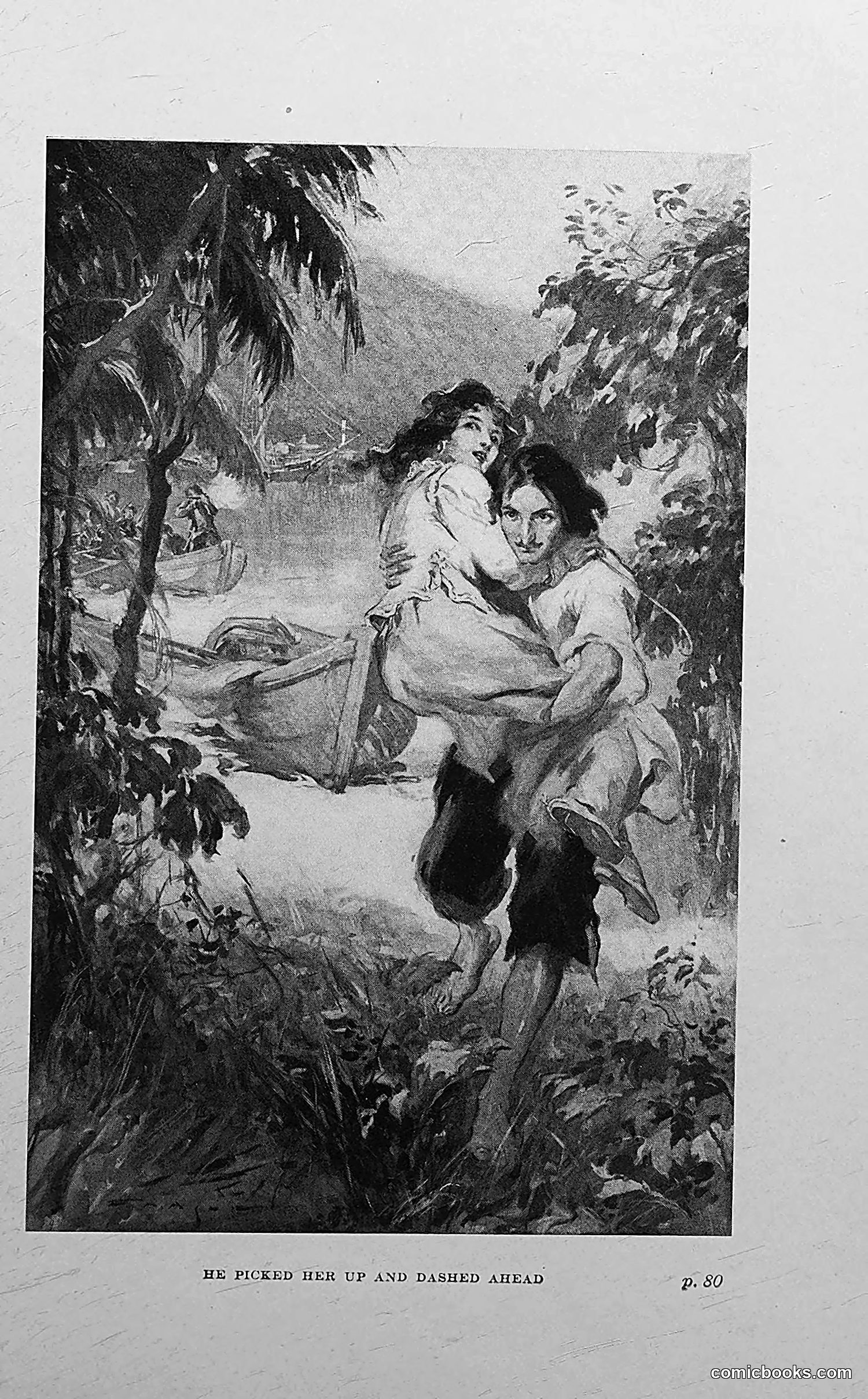
This appears to be an illustration from a serialized story or serial fiction piece in *The Wasp* magazine, rather than a political cartoon. The image shows a dramatic scene: a man carrying a woman while running through a tropical or jungle setting with palm trees and dense vegetation. A dog runs alongside them. The caption "HE PICKED HER UP AND DASHED AHEAD" suggests this is a moment of action or escape from a narrative—possibly an adventure story. Without additional context from surrounding pages or the story's title, the specific plot details remain unclear. The illustration style and page number (p. 80) indicate this is part of a longer serialized work rather than standalone satire or political commentary.

I can see this is a page from *The Wasp*, an American satirical magazine, but the image quality is too degraded for me to reliably read any text or identify specific cartoon content with confidence. The page shows a grayscale/faded appearance with some linear marks or scratches throughout, and while there appear to be some illustrated elements, I cannot make out enough detail to accurately identify figures, captions, or the specific political or social references being satirized. To properly explain the satirical meaning and historical context to a modern reader, I would need a clearer, higher-resolution version of this page. I cannot responsibly guess at identities or meanings without seeing them clearly.
This page contains narrative text rather than a cartoon. It appears to be serialized fiction depicting an action scene in a jungle setting, likely from the late 19th or early 20th century. The scene involves characters named Burnham, a young woman, and a boy named Todd navigating a dangerous jungle path. Burnham is exhausted; the woman supports him while Todd, positioned behind them with a loaded musket, fires at an unseen threat. The passage emphasizes physical struggle, suspense, and gunfire amid tropical foliage. Without additional context about the story's title, publication date, or earlier installments, it's unclear what specific historical event or political issue this fiction satirizes or references. The Wasp typically mixed satirical cartoons with serialized stories. This appears to be adventure fiction rather than direct political satire, though the content or characters may carry contemporary meanings now obscured.
This appears to be a narrative fiction excerpt rather than a political cartoon. The passage depicts **Captain Algernon Nash, governor of Nevis** (a Caribbean island), arriving in panic with armed servants after his daughter Elizabeth goes missing. The satire targets colonial authority figures: Nash is portrayed as a pompous, out-of-shape administrator, comically undignified while wielding weapons and threatening executions ("some necks will be stretched"). His overreaction—mobilizing armed men and immediately threatening death—mocks both colonial governance and the arbitrary cruelty of colonial officials. The reference to "Turk" (likely a horse) and a mysterious "gentleman" (Burnham) who rescued Elizabeth unconscious suggests a melodramatic plot. The "musket shots" hint at action and danger typical of serialized adventure fiction *The Wasp* published. Without seeing illustrations or knowing the publication date, the exact satirical target remains unclear, but the piece clearly ridicules colonial administrators' pomposity and casual authoritarianism.
This appears to be a narrative passage from a serialized story rather than a political cartoon. The text depicts a dramatic confrontation scene where Burnham—apparently having escaped from a ship called "the New England brig"—encounters Captain Nash (seemingly a governor or authority figure) and appeals for fair hearing before "Master Smith" and his party can lodge accusations against him. The satire targets religious hypocrisy, suggested by the sarcastic description of Smith as "sanctimonious." Burnham preemptively frames himself as a benefactor to the governor's daughter to gain sympathy before accusations emerge. Without seeing the accompanying illustration clearly, the specific political or social references remain unclear. The New England setting and maritime escape plot suggest 19th-century American origins, but the precise historical context or satirical target cannot be determined from text alone.
This appears to be a dramatic scene from a serialized story in *The Wasp*, rather than a political cartoon. The page depicts a confrontation involving: - **Burnham**: a dignified man accused of being a pirate - **The Governor**: a colonial official skeptical of the accusation - **Smith**: a crew member from a ship ("the brig") making the accusation against Burnham, whom he identifies as "Hellfire Hicks," a pirate Smith accuses Burnham of seducing the governor's daughter and uses moralistic language ("lust o' the blood") to inflame the situation. The satire appears to target Smith's hypocritical righteousness—he denounces "lustful men" while working for a pirate ship and using inflammatory rhetoric to manipulate authority. The piece likely mocks opportunistic informants or self-righteous accusers who exploit moral panic for personal gain, a common *Wasp* theme.
This appears to be a serialized fiction excerpt rather than a political cartoon. The passage depicts a dramatic confrontation scene featuring Elizabeth Nash, a Southern woman who whips a "New England shipmaster" named Smith after her father warns her against his seduction. The scene carries **regional and class tensions**: a Northern businessman attempting to seduce a Southern belle, which the father frames as moral danger. Elizabeth's violent response—whipping Smith—positions her as defending Southern honor and femininity against Northern exploitation. A character named Burnham intervenes to help her. The content likely reflects **post-Civil War anxieties** about Northern commercial interests and their perceived moral corruption of the South, a common theme in late 19th-century American literature and satire. The whip itself may carry additional symbolic weight given the antebellum context. Without the magazine's date and broader context, precise historical reference remains unclear, but the North-South conflict and class dynamics are evident.
This page appears to be from a serialized narrative rather than a political cartoon. It depicts a dramatic confrontation between James Burnham (likely a protagonist) and a "shipmaster" from a brig, with a governor intervening to save Burnham from armed sailors. The passage satirizes Captain Nash's authority: he wins not through combat prowess but through his official rank, which demoralized the opposition. The governor's "red face" may suggest embarrassment or anger at the disorder. Without seeing the accompanying illustration or knowing the publication date, it's unclear what specific historical event or political figure this references. The presence of a governor, naval vessel, and conflict suggests colonial-era American setting, but the exact satirical target—whether corrupt officials, maritime law, or class conflict—remains ambiguous from text alone.
This page appears to be from a serialized narrative fiction rather than a political cartoon. The text describes a dramatic scene involving characters named Burnham, Elizabeth, Smith, and a governor—likely from a serialized adventure story published in *The Wasp*, a San Francisco-based satirical magazine. The passage depicts action-adventure plot mechanics: righteous confrontation, a woman's fainting spell, a wounded hero's physical collapse, and surreal near-death imagery (the "voice of the Last Trump," lying "at the bottom of the sea"). Without seeing illustrations or additional context, it's unclear whether this narrative itself contains satire of political figures or contemporary events. The content reads as melodramatic serialized fiction typical of late 19th/early 20th-century magazines, but whether the characters or situations parody real public figures remains indeterminable from this text alone.
This page contains prose fiction rather than a cartoon. It depicts a dramatic scene of someone awakening from either drowning or a deep unconsciousness—swimming upward through ocean depths toward consciousness. The protagonist regains awareness lying in bed, observing two faces: an unfamiliar young man and the governor of Nevis (a Caribbean island). The passage emphasizes sensory details of the underwater struggle and the disorientation of coming to. Without seeing the full narrative context, it's unclear what political or satirical point *The Wasp* intended here. The mention of the governor of Nevis suggests colonial Caribbean themes, possibly relevant to late 19th/early 20th-century American imperial interests, but the specific satirical target—whether mocking colonial officials, adventure narratives, or something else—cannot be determined from this excerpt alone.
This appears to be a **serialized fiction narrative** rather than a cartoon or satire piece. The page depicts a dramatic scene in which a bedridden man named Burnham regains consciousness after an apparent accident or attack. Captain Nash informs him that the governor's daughter has safely recovered from an incident involving a villain named Smith, and that Burnham had heroically intervened. The tension centers on **mistaken or concealed identity**: Burnham closes his eyes to "veil his thoughts," suggesting he's strategically hiding something from Nash. The phrase "my dear sir" seems to carry significance—possibly indicating Nash's tone has shifted, or Burnham is gauging whether Nash suspects deception. Without additional context about the publication's date or this story's arc, the specific satirical target remains **unclear**. The narrative resembles Victorian-era melodrama conventions, but whether it's genuinely fictional entertainment or parody of such conventions cannot be determined from this page alone.
This page is **prose narrative**, not a cartoon—it's from a serialized story in *The Wasp* (a 19th-century American satirical publication). The scene depicts a **colonial or period drama**: A young man named James Burnham, bearing a family crest branded on his back, has washed ashore in desperate condition. A governor and surgeon tend to him, recognizing his aristocratic English lineage (the Burnhams of Berkshire). The governor assures Burnham he's safe among friends and instructs the surgeon to medicate him. The narrative reveals Burnham escaped a "New England brig" (ship) with help from a boy named Todd. The details—the branded crest, the shipwreck, the mysterious escape—suggest an adventure story involving class, identity, and maritime misfortune. Without seeing the full publication context or date, the specific satirical target remains **unclear**—though the emphasis on English aristocracy and colonial settings suggests possible social commentary on class or colonial relations typical of 19th-century American satire.
This page appears to be narrative text rather than a political cartoon—it's a serialized story excerpt. The passage depicts a scene involving a wounded man named James Burnham and a governor (Nash), with a young surgeon (Willis) attending to him. The scene emphasizes gentlemanly conduct and honor: Burnham graciously accepts care without complaint, the surgeon offers humble service, and Nash promises to look after a boy named Todd. The dialogue stresses Christian virtue and courage. Without seeing the full story or knowing the publication date, the specific political or social satire remains unclear. *The Wasp* was a California-based satirical publication, but this particular excerpt reads more as sentimental Victorian fiction than pointed social commentary. The identities of these characters and any historical references they may embody are not determinable from this text alone.
This page appears to be **narrative fiction rather than a political cartoon**—specifically, a serialized story from the satirical magazine *The Wasp*. The text describes a romantic scene between a recovering man named Burnham and a young woman named Elizabeth, orchestrated by her father (the governor). The satire targets the **father's social climbing and pretentiousness**: he's described as eagerly displaying his knowledge of Berkshire landed families and their "rent rolls," suggesting mercenary interest in Burnham's family wealth and estates. The humor lies in the **pompous governor's transparent matchmaking**—he's "vastly pleased" to position himself between the young couple, and his romantic posturing ("as romantic as the slenderest ensign") is gently mocked. The wounded Burnham, convalescing and dependent, makes an easy target for such schemes. This reflects *The Wasp's* satirical focus on **social pretension and economic anxiety** among California's aspiring gentry, though the specific context and characters remain unclear without prior story knowledge.
This page contains **narrative fiction rather than political satire or cartoons**. It appears to be from a serialized story featuring characters named James Burnham, Elizabeth, and Mr. Queery. The passage depicts a romantic scene where Burnham—presented as a modest hero—recounts his adventures to Elizabeth after she's recovered from fainting. The narrator observes that Burnham exaggerates the money involved (inflating 500 guineas to 1,500), attributing this to "natural, youthful vanity and pride." **The satire here is gentle character critique**: the text ironically excuses Burnham's dishonesty as understandable vanity rather than condemning it as serious deception. This reflects *The Wasp*'s satirical approach to human nature—exposing pretense and small hypocrisies rather than launching political attacks. Without seeing the accompanying illustrations, the full satirical intent remains unclear, though the written commentary suggests mockery of masculine vanity and self-aggrandizement among social climbers.
This page appears to be narrative prose rather than a cartoon—it's dialogue from a story in *The Wasp* magazine. The text depicts a conversation between a governor and a man named Burnham, an Englishman who has come west seeking his fortune. **The setup:** Burnham arrived in distress after a failed venture. The governor, feeling obligated (he apparently saved the governor's child's life), offers financial assistance. Burnham has funds from a maternal great-aunt's estate and plans to contact his agents back in England. **The satirical point:** The humor lies in Burnham's prideful denial of distress while clearly being in financial straits—he won't draw on his father, must wait for agent replies, yet accepts the governor's help. The governor's two-part justification (owing Burnham his child's life, plus general charity) undercuts Burnham's attempted dignity. **Without seeing illustrations**, the satire targets English pride and the awkwardness of accepting help while maintaining social pretense—a common *Wasp* theme mocking Victorian gentility.
This page contains dialogue from what appears to be a serialized story rather than a cartoon. It depicts a conversation between a young man and Captain Nash, seemingly the father of a daughter the young man helped save. The satire targets **upper-class male entitlement and hypocrisy**. The young man performs elaborate self-righteousness—refusing money while strategically requesting hospitality, a tailor's services, and employment. His speech is ornate and self-congratulatory ("consciousness of well-doing is all the reward"). Captain Nash's internal monologue reveals the real joke: he's **relieved the young man didn't demand cash outright**, despite knowing wealthy young men routinely forget their benefactors. The phrase "we forgive you your" (incomplete) suggests Nash views even the *refusal* as a calculated performance. The satire mocks the performative morality of the privileged class—how they disguise self-interest as virtue while remaining cynical about others' motives.
This page appears to be from a **serialized fiction story** rather than a political cartoon. It depicts a scene where an authority figure (apparently a chief magistrate) welcomes a young man named James Burnham into his household, providing him with twenty-five golden guineas as pocket money. The money represents Burnham's share of a fine levied against Amos Smith, master of the brig *Virtue*, for illegally imprisoning "a free subject of his majesty." The magistrate's warning that he'll "hang him like a pirate" if Smith offends again suggests this concerns **maritime law and the rights of free subjects**. Burnham's scheming thoughts at passage's end suggest the story involves him exploiting this fortunate situation—typical of 19th-century adventure fiction. Without seeing the full narrative context or publication date, the specific satirical target remains unclear, though it may reference colonial administration or nautical commerce disputes.
This appears to be a literary excerpt rather than a cartoon page. It's prose fiction narrating a character named Burnham's strategic calculations about his precarious situation on an island. The passage describes Burnham as a disreputable Englishman with empty pockets, family estrangement, and a "shady reputation" who has ingratiated himself with a governor and his daughter. His plan is opportunistic: exploit their gratitude for three months before damaging information arrives from England. The satirical point targets social climbing and deception—Burnham treats relationships as "high trump cards" in a cynical game, banking on the slow communication across the Atlantic to maintain his fraudulent position. Without seeing accompanying illustrations, the specific political figures or historical references remain unclear, but the text suggests satire of fortune-hunters and social fraud in colonial or maritime settings.
This page from *The Wasp* appears to be **narrative text rather than a political cartoon**—it's a serialized story excerpt discussing a character named Burnham in Nevis (a Caribbean island). The passage describes Burnham writing deceptive letters to his father and to fabricated "men of business," characterized as "a masterpiece of impudence and fiction." He's portrayed as manipulative, with a "sardonic squint" and "impish and menacing" demeanor. The text emphasizes his determination to leave Nevis within three months and his willingness to deceive authority figures. Without additional context about *The Wasp*'s specific satirical targets or the identity of "Burnham," the exact social/political reference remains **unclear**. However, the narrative satirizes someone of dubious character and dishonest dealings—likely mocking a real public figure or type known to contemporary readers. The focus on deception to colonial officials suggests commentary on colonial-era duplicity or specific scandal.
This page contains serialized fiction rather than political satire or cartoons. It appears to be a narrative installment about a character named James Burnham in colonial Nevis (a Caribbean island). The text describes Burnham's advantageous social position: he enjoys favor from Governor Captain Nash, companionship with Nash's daughter Elizabeth, and employment assisting the governor. The passage establishes the colonial setting and social hierarchy—Burnham mingles with English military officers and plantation owners when not attending the governor. Notably, Burnham inquires about someone named Peter Queery, whose name is "not known on the island"—suggesting this mystery figure may be significant to the plot. The *Wasp* was primarily a satirical magazine, but this particular page is narrative fiction exploring themes of colonial society, social advancement, and romance in the West Indies, rather than topical satire.
This page appears to be from a serialized narrative rather than a political cartoon. The text describes a character named Burnham who, after gambling success, decides to marry Elizabeth Nash to secure his financial future and hide his disreputable past from exposure. The plot hinges on dramatic irony: Burnham has just committed to this marriage scheme when a naval frigate unexpectedly arrives in the roadstead. Officers from the frigate and a relief company of the Sixty-second Regiment begin paying respects to the governor—suggesting Burnham's past may be about to catch up with him. Without seeing illustrations on this page, the satire likely targets themes common to *The Wasp*'s social commentary: opportunistic fortune-hunters, class pretension, or the vulnerability of respectable families to deception. The arrival of military personnel suggests an impending revelation that will disrupt Burnham's plans.
This page appears to be text from a serialized narrative fiction rather than a political cartoon. It depicts a dramatic personal confrontation at what seems to be a colonial gathering (referenced location: Nevis, a Caribbean island). The passage describes James Burnham's shock at encountering Young Mr. Stanton—a man he had wronged twice: through card cheating in London and by losing a woman named Kitty Trimmer to him. Burnham's anxiety upon this chance meeting suggests the story explores themes of social embarrassment, karmic consequences, and masculine honor disputes typical of 19th-century fiction. Without seeing accompanying illustrations or additional context, the satirical angle remains unclear—though *The Wasp's* reputation as a satirical publication suggests this narrative likely contained social commentary about colonial society, duplicitous gentlemen, or romantic entanglements among the upper classes.
This appears to be a text page from a serialized story in *The Wasp* magazine rather than a political cartoon. It's Chapter VI of what seems to be a fictional narrative featuring characters named James Burnham, Mr. Percy Stanton, and a governor. The passage describes a formal reception or breakfast gathering where Burnham meets military officers and visitors. The narrative focuses on Burnham's emotional reaction upon seeing Stanton—he experiences shock but quickly regains composure. The scene depicts upper-class social etiquette of an unspecified historical period, with servants, formal greetings, and elaborate dining preparations. Without additional context about the story's plot, political allegory, or the historical moment *The Wasp* was published, the satirical or comedic intent remains unclear from this excerpt alone.
This page depicts a genteel social confrontation between two men of unequal standing. Young Mr. Stanton, apparently an ensign (military officer) of some rank, is shocked and embarrassed to encounter James Burnham, an older man he knew during Burnham's "humiliating sojourn in Swan Alley"—suggesting Burnham had fallen into poverty or disrepute in that poor London neighborhood. Burnham, now apparently restored to respectability (claiming Berkshire residence), coolly humiliates Stanton in return by feigning forgetfulness of their acquaintance, implying it was too insignificant to remember. The satire targets social pretension and class anxiety: Stanton's mortification reveals how status-conscious society was, while Burnham's dignified deflection suggests that true gentility transcends temporary misfortune. The punch recipe detail emphasizes refined hospitality contrasting with the social awkwardness.
This page depicts a confrontation between two men: Stanton and Mr. Burnham of Burnham. Stanton accuses Burnham of cheating him at dice in Swan Alley, calling out his "loaded dice." Burnham responds with aristocratic disdain, insulting Stanton's manner and proposing a duel in "his excellency's gardens"—a secluded spot where they could fight "discreetly" with witnesses present. The satire targets **class pretension and dishonest gentlemen**. Burnham's flowery, dismissive language ("porcine quality of your grunt") masks his willingness to fight over an insult, while his proposal for a "discreet" duel suggests elite hypocrisy: cheating at dice is acceptable, but being called out loudly is not. Stanton's outrage that he's invited to fight "a common cheat" highlights the contradiction—Burnham's refined manner cannot erase his actual criminality. The piece mocks how wealthy men maintained social facades while engaging in fraud.
This page depicts a confrontation between two men: James Burnham (the dominant figure) and young Stanton (an ensign, likely military). Burnham is intimidating Stanton, apparently over a gambling dispute ("cheated you in play"), and challenges him to a duel in the garden after breakfast. The satire targets Stanton's social powerlessness and cowardice. Burnham mockingly suggests Stanton could appeal to the governor for protection, implying such an appeal would be shameful and futile—that Stanton's word means nothing on "this island" compared to Burnham's. The forced toast afterward adds humiliation: Burnham drinks with "ironic" and "sardonic" contempt while Stanton drinks mechanically, "confused with shame and rage and...fear." The scene likely satirizes either a specific historical incident or the broader code of honor duels that governed gentlemanly disputes, exposing how such systems could be weaponized by powerful men against weaker ones.
This page appears to be narrative text rather than a cartoon, presenting a social scene with psychological tension. The passage describes an unnamed character's internal conflict after making an indiscreet remark to someone named James Burnham regarding past "cheatery" in London. The scene establishes a power dynamic: Burnham's presence and gaze unnerve the protagonist, who regrets his loose tongue and questions his own courage. The tension is interrupted when Miss Nash appears and guests are invited to an elaborate breakfast. Without seeing the accompanying illustration or having publication dates and broader context, the specific identities of these figures and the particular scandal being referenced remain unclear. The passage suggests a Victorian-era social setting with undertones of blackmail or social leverage, typical of *The Wasp*'s satirical treatment of San Francisco society and politics, but the precise targets cannot be determined from text alone.
This text passage (no visible cartoon on this page) satirizes 19th-century American dining customs and masculine behavior. It describes a formal dinner where spirits flow freely and heavy drinking is socially expected among gentlemen—a normalized excess that wives and mothers accept without shock. The satire focuses on **James Burnham**, who notably avoids alcohol not from moral conviction but purely practical reasons: he needs steady hands and clear eyes to clip **Stanton's comb** (unclear what this means—possibly a literal task or an idiom for some act). **Elizabeth Nash's tea urn** receives minimal patronage, highlighting how tea-drinking was socially marginal compared to spirits and wine consumption. The passage mocks the era's "robust" drinking culture while exposing Burnham's unsentimental, utilitarian approach to sobriety—undermining any romantic interpretation of his restraint.
This page appears to be narrative fiction rather than a political cartoon. It depicts a character named Burnham attending a formal dinner where he maintains a composed public facade while internally struggling with a serious problem. Burnham is preoccupied with a conflict involving someone named Stanton (described as "the ensign") and a woman named Elizabeth. He recognizes that killing his rival would financially ruin him, yet wounding Stanton wouldn't resolve the underlying issue—creating an unresolvable dilemma that "gnawed his heart." The passage contrasts his outward charm—smiling at Elizabeth, chatting pleasantly, eating heartily—with his inner turmoil. At the page's end, he overhears two young men discussing someone named Percy, described as "a fool about" something (text cuts off). Without additional context about this serialized story, the specific historical or social references remain unclear, though the themes involve honor, romantic rivalry, and social performance typical of period fiction.
This page contains satirical dialogue about *The Wasp's* apparent serialized fiction. Two men gossip about a young woman who has attracted the wealthy Percy Stanton. She's described as a "penniless" parson's daughter—a social climber in the eyes of Stanton's family, who desire a nobler match. The satire targets class anxiety: Stanton's family resents his beloved because her father makes corsets (then considered low-status manufacturing), while they themselves owe their fortune to that very trade. The men mock this hypocrisy—one wishes his own grandfather had "tried something of the kind." A character named Burnham overhears this gossip and contemplates blackmail, threatening to expose the romance to Stanton's disapproving family. The passage satirizes Victorian-era social climbing, snobbery about commercial origins, and mercenary attitudes toward marriage among the wealthy.
This page contains prose fiction rather than a cartoon. It's an excerpt from a serialized story involving characters Percy Stanton and James Burnham in what appears to be a 19th-century social drama. The passage depicts Percy Stanton, drunk and agitated over an apparent confrontation with Burnham regarding "the story of Kitty Trimmer"—likely a woman or scandal. Stanton initially wants to fight Burnham but loses courage through drinking. Burnham, meanwhile, strategically decides to avoid forcing a duel unless necessary, planning instead to use the threat of publicly "interviewing" (exposing details about) "the new charmer" to silence Stanton. This reflects period concerns about honor, dueling, sexual reputation, and blackmail among gentlemen. The satire likely mocks the absurdity of masculine honor codes and how men use threats and social exposure as weapons. Without seeing preceding pages, the specific historical or political reference remains unclear, though the tone suggests social commentary on gentleman behavior.
This page appears to be from a serialized narrative story in *The Wasp* rather than a political cartoon. The text depicts a dramatic moment involving rivalry between two male characters—one (the unnamed protagonist, likely Burnham) and Percy Stanton—over a woman named Kitty. The satire targets Percy's weakness: he's passed out drunk under a breakfast table while a woman has summoned him. When other officers mock Percy as "a gay blade" (meaning a carefree ladies' man), Burnham opportunistically claims Percy, offering to put him to bed in his quarters—likely to remove him from the romantic competition. The humor depends on Percy's humiliation and Burnham's calculated manipulation of the situation. The reference to "West Indian" suggests a colonial military setting, typical of period adventure fiction used in satirical magazines for entertainment alongside political commentary.
This appears to be a literary excerpt rather than a cartoon page. The text depicts a dialogue among young British military officers discussing a woman named Kitty Trimmer, described as beautiful but penniless, who is a lady's companion to a senior major's wife. One officer (Stanton) is romantically interested in her. The satirical target seems to be the British colonial officer class—their casual gossip about women's marriageability, their betting on romantic outcomes, and their easy assumption of servant availability ("servants of all colors and shades"). Burnham's exit with an "exultant smile" suggests ironic amusement at their foolish romantic entanglements. The comedy centers on class pretension and the officers' obliviousness to how their gossip and assumptions might appear to an observer. *The Wasp* was known for mocking San Francisco's social hierarchies and pretension.
This appears to be a literary excerpt rather than a cartoon page. The text describes a scene between characters named Burnham and Stanton at what seems to be a governor's social gathering. The satire concerns Stanton, who has become dramatically intoxicated—the only guest to fully "succumb to the governor's hospitality." Servants have revived him with water (the "usual treatment" for drunkenness). Burnham taunts Stanton with mock congratulations about a "sweet romance" with someone named Kitty, sarcastically praising his "fidelity." The earlier dialogue hints at gossip: Stanton has "queer eyes" fixed on a girl, and he's identified as "One of the Berkshire Burnhams"—suggesting he's from an old, distinguished family now acting foolishly. The satire targets upper-class social pretension: a man of supposedly good breeding rendered ridiculous through overindulgence, while his peers gossip and mock him. It's commentary on the gap between social status and actual behavior.
This page appears to be from a serialized story or narrative feature in *The Wasp*, a 19th-century American satirical magazine. The dialogue suggests a confrontation between two men—Stanton and Burnham—regarding a woman named Kitty Trimmer, whom they apparently knew in the past when living in "Swan Alley." The exchange is a form of blackmail or coercion: Burnham threatens to reveal or publicize knowledge of Stanton's past relationship with Kitty, implying social scandal. Stanton's responses ("They wouldn't believe you") suggest he's from a higher social position where such revelations could damage his reputation. The satire likely mocks Victorian-era class pretensions and hypocrisy—a man of apparent respectability being vulnerable to exposure of his earlier, less genteel associations. Burnham's patronizing tone ("leering," "coolly") emphasizes the power dynamic in this confrontation.
This appears to be a narrative prose passage rather than a cartoon page. The text depicts a scene from what seems to be a serialized story in *The Wasp* magazine, featuring characters named Burnham, Percy Stanton, and Mrs. Black. The scene shows Stanton, apparently drunk and agitated, being dismissed by Burnham and directed to seek counsel from someone named "Kitty" before making decisions. Stanton then travels to Major Black's quarters, where he encounters Mrs. Black—described as a large, weather-beaten woman with a "calculating eye"—who unusually abandons her typical "playful auntly affection" toward him and grabs his arm, suggesting urgent news or concern. Without seeing the full story context or identifying the specific publication date, the exact satirical target remains unclear. The reference to "an obliging negro" reflects the period's racial attitudes. This appears to be part of a longer serialized narrative rather than political satire with specific contemporary references.
This page presents a dramatic dialogue between two characters—apparently an older woman of social standing (daughter of an archdeacon) and a man named Stanton, identified as an ensign (military officer). The scene depicts a confrontation over a scandal involving "Kitty," a young woman whose past connection to someone at Government House has been exposed. The woman accuses Stanton of compromising her respectable reputation through his deceptive dealings. Stanton, in turn, dismisses her moral objections while implying he's paid her substantially for her complicity. The satire targets social hypocrisy—the woman's outrage at exposure despite her willing participation, and Stanton's cynical assumption that money absolves ethical concerns. The reference to a "whole island" suggests a specific colonial or naval setting, though the exact location remains unclear from this excerpt alone.
This page depicts a dramatic Victorian-era dialogue between characters named Stanton, Mrs. Black, and references to "Kitty." The scene appears to be a serialized fiction excerpt rather than a political cartoon. The satire concerns social scandal and blackmail. Mrs. Black attempts to intimidate Stanton by revealing that Kitty's father is merely a tailor in Wantage, implying her low social status should embarrass Stanton (who appears to be of higher rank). Stanton responds aggressively, dismissing the threat—he claims mutual acquaintance with "James Burnham," a gentleman of Sir Walter Burnham's family, and suggests they share secrets that ensure mutual silence ("He'll keep his mouth shut"). The humor derives from the exposure of upper-class hypocrisy: gentlemen protect each other's reputations regardless of moral failings, while women of lower social standing remain vulnerable to shame. The tailor's daughter represents the precarious position of working-class women in this rigid class system.
This page from *The Wasp* appears to be **prose fiction rather than a political cartoon**—specifically, a serialized romantic narrative. The text describes a military officer named Stanton finding his beloved "Kitty" (likely his wife or romantic interest) after she's been upset by an encounter with a senior officer's wife. The content is sentimental melodrama typical of early 20th-century magazine fiction: it depicts Stanton's devotion to Kitty through flowery descriptions of her appearance and his emotional response to her distress. There's no visible political satire or social commentary on this particular page. Without additional context about *The Wasp's* satirical purpose or the surrounding narrative, the modern reader should understand this is simply romantic fiction from a satirical magazine—possibly parodying the sentimental conventions of its era, though that irony isn't explicit here.
This page contains **narrative fiction rather than a political cartoon**. It appears to be part of a serialized romantic story published in *The Wasp*, a 19th-century American satirical magazine. The text describes a dramatic domestic scene involving characters named Kitty, James Burnham, and Elizabeth Nash. A male character comforts a weeping woman (Kitty), assuring her he has "silenced" Burnham and holds power over him—implying blackmail or coercion regarding some shameful past. The passage concludes with Burnham himself reading poetry in a rose garden with another woman. **Without seeing the accompanying illustration(s)**, the satirical intent is unclear. The content may mock romantic melodrama, social hypocrisy, or Victorian propriety conventions. The dramatic tension (threats, affairs, secrets) suggests social satire, but the specific targets remain uncertain without visual evidence or additional context about *The Wasp's* editorial focus.
This page is **not a cartoon or satirical illustration**—it's prose fiction, specifically Chapter VII of a serialized story appearing in *The Wasp* magazine. The text describes a clandestine nighttime meeting between two characters, Tanton and James Burnham, in what appears to be a tropical setting (sugarcane, bananas, sea breeze). Burnham is portrayed as an elegantly dressed, sober dandy with distinctive affectations (amber glass cane, long pipe), while his companion shows signs of recent heavy drinking. The chapter ends mid-dialogue with Burnham's cryptic question: "Is it live and let live? Or—" **Without additional context** (earlier chapters, publication date, author), the story's satirical purpose remains unclear. The page number (120) suggests this is mid-narrative. The dramatic nighttime encounter hints at conflict or moral confrontation, but the specific political or social satire *The Wasp* intended is not evident from this excerpt alone.
This appears to be a **narrative fiction excerpt rather than a political cartoon**—it's prose dialogue from a serialized story in the satirical magazine *The Wasp*. The scene depicts a tense reconciliation between two characters: **Stanton** (an ensign/military officer) and **Burnham** (apparently a government official). They've reached a grudging truce—agreeing to "forget the past" and maintain a civil facade despite mutual dislike. Each explicitly states they don't like the other, yet promises to keep faith with an unstated "agreement." The satire likely mocks **hypocrisy in public life**: political or military figures who maintain superficial civility while harboring genuine animosity, and who reach backroom deals based purely on mutual self-interest rather than principle or honor. Stanton's immediate return to gambling suggests character commentary on military vice. Without seeing previous pages, the nature of their "agreement" remains unclear, but the tone suggests *The Wasp* is satirizing government corruption or duplicitous dealings.
This page contains narrative fiction rather than a political cartoon. It describes a seaside horseback riding excursion among Hawaii's colonial elite—high officials, military officers, and wealthy planters—a leisure activity that marked their social status. The passage focuses on a romantic subplot: Elizabeth Nash and James Burnham riding ahead together, exchanging meaningful glances. The narrator notes Nash had recently discovered "the art of the eye" (flirtation) and was becoming half in love with Burnham—remarkable because she'd previously loved no man except her father. The satirical target appears implicit: the idle pastimes and romantic intrigues of the governing classes, contrasted with Mr. Stanton sleeping heavily at home ("sunk seventy fathoms deep"). Without seeing illustrations or knowing the publication date, the broader satirical point remains unclear.
This page contains **no cartoon or satire**—it's a passage of serialized romantic fiction featuring characters named James Burnham and an unnamed woman. The text describes a pivotal romantic moment during horseback riding: Burnham, who has been ill and cautiously courteous, contemplates declaring his feelings. The woman responds with shy affection ("white lids drooping in a tender and veiled regard"), and he experiences a surge of genuine emotion beneath his usual emotional restraint ("cool blood jumped briskly"). The passage emphasizes Burnham's strategic restraint—he's carefully avoided overplaying his hand, understanding both her nature and his own limitations. The tension builds as he's about to speak when interrupted by passing riders. **What we're missing:** Without seeing surrounding pages, we cannot identify the story's title, author, publication date, or broader narrative context. This appears to be a serialized novel rather than satirical content.
This page contains fiction narrative, not political satire or cartooning. It's a serialized story from *The Wasp* magazine featuring romantic tension between characters. The passage describes a chance encounter: a man named Burnham observes Kitty Trimmer (identified as "the tailor's daughter") riding with a young naval officer. Their brief eye contact carries loaded meaning—Burnham reads "fear, inquiry" and "coquettish challenge" in her gaze because he knows her "of old." He then deflects to a companion, Elizabeth Nash, with a somewhat dismissive comment about Kitty being "the toast of" (the text cuts off). The narrative suggests prior romantic history between Burnham and Kitty, and hints at social commentary about a tailor's daughter's elevated status ("the toast of"). This appears to be serialized romantic fiction rather than editorial satire—a common *Wasp* feature mixing literary content with political commentary.
This page appears to be from a serialized fiction story rather than a political cartoon. It depicts a flirtation scene between James Burnham and Elizabeth (the governor's daughter), with romantic tension created through Burnham's suggestive compliment. The satire is social rather than political: it mocks the superficiality of male attraction and courtship conventions of the era. Burnham's behavior—his meaningful glance implying Elizabeth is "beautiful" while dismissing another woman (Kitty Trimmer)—satirizes manipulative flirtation tactics. Elizabeth's response, with her "wide" eyes and strategic modesty, parodies feminine performance in courtship. The passage critiques how Burnham responds to "glittering attractions" of superficial charm (Kitty) over Elizabeth's deeper intellectual qualities, suggesting commentary on shallow Victorian courtship values and gendered social dynamics. Without additional context about *The Wasp's* publication date or this story's arc, the specific targets remain unclear.
This page contains narrative text rather than a cartoon. It appears to be from a serialized story in *The Wasp* magazine featuring characters named Kitty Trimmer, Stanton, and Burnham on the island of Nevis. The passage describes a romantic rivalry: Kitty Trimmer's arrival has captivated multiple suitors including a surgeon, a wealthy planter, military officers, and two men—Stanton and Burnham—who were already in love with her. Stanton responds with jealousy and drinking, while Burnham is paralyzed between ambition and desire, making no progress with "the governor's daughter" (unclear if this is Kitty or another woman). Without seeing accompanying illustrations, the satirical point is unclear. The passage may mock romantic melodrama, military life, or colonial society, but without visual context or additional text, firm conclusions cannot be drawn about *The Wasp*'s specific satirical intent.
This page contains serialized fiction rather than political satire or cartooning. It's part of a narrative story featuring characters including Kitty, James Burnham, Mr. Willis, Stanton, Captain Sterling, and John Trimmer—a convict who led a shipboard rebellion against officers transporting "jailbirds" (convicts) from Newgate Prison. The passage describes romantic entanglements (Kitty's conflicted affections) and reveals that Trimmer, after seizing the ship, has become romantically pursued by Captain Sterling, who ironically doesn't realize Trimmer was originally among the convicts he purchased. The text appears to be from a serialized adventure/romance tale typical of 19th-century magazines, using melodramatic plot conventions rather than social commentary.
This page introduces a pirate ship narrative for *The Wasp* magazine's readers. The text describes a new pirate vessel operating in the Caribbean near Nevis, distinguished by a white schooner flying a red flag bearing a broken leg-iron device—symbolizing liberation from slavery's chains. The pirate has already attacked shipping three times near Barbados and St. Lucia. The broken leg-iron flag is significant: it suggests this pirate targeted slave ships or vessels involved in slavery, positioning themselves as anti-slavery raiders rather than common criminals. The text's reference to "dreadful and brazen outrages against humanity" appears ironic given the flag's abolitionist symbolism—likely the magazine's commentary on who actually commits outrages (slavery itself) versus how authorities characterize resistance to it. Without seeing illustrations, the exact satirical angle remains unclear, but this appears to be documenting piracy with anti-slavery dimensions during the slavery era.
This page appears to be from a serialized fiction story rather than a political cartoon. It describes officials' (a governor and Captain Moore) outraged reaction to a shipmaster's account of piracy—specifically men being forced to walk the plank and ships being destroyed—occurring in view of English-controlled land. The narrative contrasts this "flagrant" behavior with three named figures: Duval, Deck, and "Hellfire Hicks," who "had ever been guilty of such insolence." These appear to be references to actual or semi-legendary pirates, though without additional context it's unclear whether they're historical figures or fictional characters within *The Wasp*'s narrative. The passage's tone is satirical—mocking the authorities' shock at piracy committed so brazenly near their own shores, implying hypocrisy or ineffectual governance. The satire likely critiques either colonial administration or contemporary attitudes toward maritime lawlessness.
This page contains no visible cartoon or illustration—it appears to be text-only narrative content from a serialized story in *The Wasp* magazine. The passage describes colonial Caribbean naval politics. "The Wasp" refers to a ship engaging in acts of defiance ("slaps in the faces") against British authority—the Crown, its representatives, and its naval vessels. The narrative follows James Burnham, apparently a colonial official, receiving dispatches about a newly-arrived British sloop-of-war, the *Tartar*, which will patrol waters around St. Kitts and Nevis. The passage includes social details (references to "Kitty Trimmer's lovelorn swains") suggesting romantic subplots typical of serialized fiction of the era. Without seeing the broader context or illustrations, the specific satirical targets remain unclear, though the content evidently mocks British naval authority in the colonies.
This appears to be a narrative passage rather than a cartoon—a scene from a serialized story in the satirical magazine *The Wasp*. The text depicts a conversation between Governor Captain Nash and a young man named James Burnham. The governor mentions receiving letters via Barbados and discusses the arrival of the naval sloop *Tartar* at Carlisle Bay. He then casually asks Burnham if he has any relatives in the navy. Burnham's response—answering "instantly, without turning his head" while gazing out the window—suggests he's concealing something or reacting with unexpected emotion to this seemingly innocent question. The passage builds narrative tension, hinting at some secret connection to the navy or the arriving ship that Burnham wishes to hide from the governor. Without seeing subsequent pages, the specific satirical point remains unclear.
This appears to be a narrative passage rather than a political cartoon—a scene from a serialized story in *The Wasp* magazine. The text depicts a conversation between Governor Nash and a young man named James Burnham about Burnham's brother Alexander, a naval lieutenant aboard the ship *Tartar*. The dramatic tension is psychological: Nash makes a seemingly friendly speech praising Burnham's family, but Burnham's internal reaction contradicts his polite exterior. His "heart was like lead" despite the flush the governor interprets as pleasure. This suggests Burnham has hidden concerns or secrets—perhaps related to his brother, the ship, or his own circumstances—that he's concealing beneath social courtesy. The satire likely critiques the performative nature of Victorian social interaction, where true feelings remain masked behind proper behavior and politeness.
This page contains narrative prose rather than a cartoon. It depicts a conversation between James Burnham and a governor regarding Burnham's brother Alexander, who is arriving on the ship *Tartar* within ten to fourteen days. The satire operates through Burnham's internal conflict: he initially appears pleased at his brother's impending arrival, but privately curses his luck. The text suggests Burnham has nefarious plans in Nevis that his brother's arrival will ruin—he had hoped to reestablish himself in "respectable" society, implying his current schemes are disreputable. *The Wasp* was a 19th-century American satirical publication, and this appears to be serialized fiction mocking social pretense and moral hypocrisy. The humor derives from exposing the gap between Burnham's public demeanor and his actual (apparently dishonest) intentions.
This page is **not a cartoon** but prose fiction—likely an excerpt from a serialized story appearing in *The Wasp* magazine. It follows the character **James Burnham**, who faces social disgrace and romantic disappointment (he cannot marry Elizabeth Nash due to a sloop-of-war's arrival). The narrative emphasizes Burnham's resilience: despite losing "honor and place" and family rejection, he's survived hardship and prospered through gambling luck on the island of Nevis. Now confronting "organized society"—his "old, natural enemy"—he maintains optimistic humor. The concluding reference to thinking of "Kitty Trimmer" and smiling suggests romantic interest, possibly hinting at future plot developments. Without seeing the magazine's cover date or author attribution, the specific biographical or political references remain unclear, though Burnham's outsider status and conflict with social institutions suggest *The Wasp's* typical satirical interest in social critique.
This page appears to be from a serialized story rather than a satirical cartoon. It depicts a plot involving characters on the island of Nevis: James Burnham, who withdraws money and instructs his servant Henry Todd to hide twelve guineas on his person, then arranges a secluded meeting with a young woman named Kitty Trimmer. The passage suggests a scheming setup—Burnham's careful preparation, the hidden money, and the clandestine hillside rendezvous imply either seduction, robbery, or blackmail is being planned. Kitty Trimmer's blushing reaction and hasty glance away suggest she is either naive or uncomfortable with Burnham's intentions. Without additional context about *The Wasp's* publication date or the full narrative, the specific satirical target remains unclear, though the story appears designed to critique or mock aristocratic or colonial male behavior toward young women.
This appears to be a **literary excerpt rather than a political cartoon**. The page contains dialogue between two characters—James and an unnamed woman—in what seems to be a serialized story or novel. The scene depicts a dramatic confrontation where James reminisces about past romantic entanglement. He references sacrificing a respectable life (a parsonage in Wantage) for the woman, claiming continued devotion despite her previous deception. He contrasts his constancy unfavorably with another man named Stanton. The woman mentions a third man, "Percy," suggesting a love triangle or complex romantic situation. The physical detail of James holding her hand against her resistance suggests Victorian-era melodrama. **Without additional context or visible images/cartoons on this page, the specific satirical target remains unclear.** This may be part of a serialized narrative *The Wasp* published, or commentary on contemporary romantic scandals through fictional narrative.
This page presents a cruel monologue by a character named Burnham, attempting to dissuade a woman named Kitty from marrying "Percy." The satire targets class-conscious Victorian society attitudes about marriage and social rank. Burnham argues that Percy—whose parents are wealthy—will be financially abandoned by his family upon learning he's marrying "the wench of the tailor of Wantage" (a working-class woman whose father makes corsets and breeches). Burnham dismisses Percy as a weak coward dependent on parental money, mocking the idea that two tradespeople could marry someone of supposedly superior social standing. The satire ridicules both the rigid class hierarchies of the period and the mercenary attitudes of the wealthy toward marriage. Kitty's emotional collapse suggests the real human cost of such social prejudice. *The Wasp* uses this scene to mock fashionable society's obsession with "sameness of degree"—the notion that people should only marry within their social class.
This page contains prose fiction rather than a political cartoon. It depicts a romantic/dramatic scene between a male character and a woman named "Kitty" in what appears to be a Caribbean setting ("these islands," "Nevis"). The man makes an impassioned appeal to the woman, boasting of his self-made success despite hardship and proposing marriage. He presents himself as a daring adventurer ("born with teeth") unafraid of risk. The woman's ambiguous response—verbally refusing but physically unresisting—suggests she may be testing or manipulating him. The narrator hints the man is too emotionally aroused to notice her deception. Without knowing the publication date or this story's context in *The Wasp*, the exact satirical target remains unclear, though the passage may mock romantic melodrama or certain masculine archetypes popular in period fiction.
This appears to be a narrative fiction excerpt rather than a political cartoon. The text describes a dramatic romantic/action scene involving characters named James Burnham, a young woman (Kitty), and three men including Percy Stanton. The scene depicts Burnham attempting to kiss the woman on a trail, only to be deceived—she screams and escapes on horseback while three drunk men ("under the influence of the mess port") attack him with whips. Burnham defends himself with a wooden billet, disarming them. Without additional context about *The Wasp* magazine's specific satirical targets or the broader narrative, it's unclear whether these are real public figures being caricatured or purely fictional characters. The tropical setting and colonial military references ("mess port") suggest this may be set in a British colonial context, but the specific social or political commentary remains unclear from this page alone.
This page appears to be text only, without visible cartoons or illustrations. It describes a violent scene where someone named **Burnham** physically attacks an unnamed person ("by the scruff of the neck and thrashed him soundly"), while **Stanton** and **Kitty Trimmer** stand watching. During the beating, Burnham vents his opinions about Stanton and Trimmer. Without seeing the accompanying illustration or knowing the specific historical context and date of this *Wasp* issue, it's unclear who these figures represent or what local/national scandal or political dispute this satirizes. The passage suggests a conflict between these named individuals, likely meant to ridicule or criticize them.
This page appears to be from a serialized narrative fiction rather than a political cartoon. It depicts a dramatic scene involving three male characters—Stanton, Burnham, and others—and a woman named Kitty. The plot involves Stanton orchestrating an ambush of his rival Burnham using Kitty as bait. However, Stanton's accomplices have become suspicious of the setup. They confront "Percy" Stanton, accusing him and Kitty of laying a trap and questioning why Kitty didn't resist Burnham's advances if the situation was genuine. The passage ends with a reference to Burnham physically defeating Stanton in combat ("dusted your coat"). The satire targets masculine honor codes and the hypocrisy of gentlemen who engage in dishonorable schemes while maintaining pretense of respectability. The accomplices' moral awakening—rejecting the ambush as ungentlemanly—underscores the contradiction between Stanton's actions and his social status.
This page depicts a dramatic confrontation between military officers over a romantic rivalry. James Burnham has apparently kissed a lady of interest to Mr. Stanton, prompting a challenge to a duel. Captain Cross and Mr. Throgmorton are arranging the affair of honor. Burnham shrewdly defuses the immediate threat by proposing delay—suggesting Stanton needs rest and bathing before they're on "equal footing." This is a clever stalling tactic that appeals to practical fairness rather than passion. The satire likely mocks the absurdity of military honor codes and dueling culture, where gentlemen must fight over romantic interests regardless of logic. Burnham's reasonable proposal contrasts with the rigid formality the officers maintain, exposing how ridiculous the entire ritual appears when examined rationally. The delay request transforms a moment of heated honor into something almost comical—the suggestion that cleanliness and sleep matter more than principle.
This page depicts a duel arrangement between gentlemen, likely from a serialized story in *The Wasp*. The text shows Burnham (apparently an excellent marksman) graciously choosing swords as weapons for a challenge against Stanton, rather than pistols where Burnham would have a decisive advantage. The satire appears to target the absurdity of honor-bound dueling culture among the upper classes. Burnham's choice of swords—deliberately handicapping his superior marksmanship to create a "fair" contest—is presented as noble ("very handsome"), yet the entire premise is ridiculous: grown men arranging dawn combat over what remains unclear. Stanton's silent dread at facing bloodshed, despite his swordsmanship, underscores the era's contradictions: gentlemen valorized martial prowess while often fearing actual violence. The page mocks both the performative chivalry and the hollow masculinity underlying such conflicts.
This page is prose fiction rather than a political cartoon. It appears to be from a serialized story in *The Wasp* magazine featuring characters named James Burnham, Kitty, and Henry Todd. The narrative depicts Burnham returning to Government House in emotional distress after a woman named Kitty has betrayed and abandoned him again. He meets with a young assistant, Henry Todd, who has apparently secured a boat and awaits orders. Burnham sarcastically questions whether Todd still believes him to be a pirate, and Todd—speaking in working-class dialect—responds that he'll follow Burnham regardless of what role or identity he assumes. The text suggests an adventure story involving escape or flight, but without additional context or images showing caricatures, the specific political or social satire *The Wasp* intended remains unclear. The page may be mid-narrative with satirical meaning dependent on preceding or following installments.
This page appears to be **prose fiction rather than a political cartoon**—specifically a serialized story rather than satirical commentary. The narrative describes a gentleman named James Burnham helping someone named Todd escape via window with a box and leather bag, then writing a farewell letter to "the governor's daughter." The opening quote about "a fine gentleman makes a brisker pirate nor any common sailorman" suggests the story involves gentlemen engaged in piracy or criminal activity—likely satirizing the romantic notion of gentleman criminals. The reference to Todd's secret window departure and Burnham's fatalistic farewell letter implies an adventure narrative, possibly involving crime, espionage, or political intrigue. Without additional context about this serial story's plot or The Wasp's publication date, the specific historical references remain unclear, though the gentlemanly criminal theme was a common satirical subject in 19th-century American publications.
This page presents a dramatic love letter rather than a political cartoon. The narrative describes a man composing an emotional farewell letter to a woman, seemingly contemplating suicide or departure due to unrequited love. The satire likely targets **sentimental romantic conventions** of the era—the overwrought melodrama of lovesick declarations. The framing description mocks the writer as a "half-inspired poet" and "utterly lovesick" figure, suggesting *The Wasp* is ridiculing excessive romantic sentimentality and self-pitying male behavior. The letter's pseudo-noble rhetoric—claiming he's unworthy because he lacks "virtue" and only "a good man" deserves her love—reads as insincere posturing. The satire appears to be **exposing the hypocrisy of male romantic pretense**: a man claiming self-sacrifice while actually indulging in dramatic self-pity. Without seeing the accompanying illustration (if present), the full satirical impact is unclear, but the text mocks romantic melodrama itself.
This page contains no cartoon—it's prose fiction, likely from a serialized story in *The Wasp*. The passage depicts a character (James Burnham) writing an elaborately romantic, flowery love letter to Miss Elizabeth Nash. The satire lies in the revelation that follows: after sealing this passionate missive, Burnham reflects that he almost believes his own overwrought sentiments, then cynically concludes this is "what it is to be a poet"—the ability to manufacture convincing emotional falsehoods temporarily. The joke mocks both romantic literary pretension and male insincerity: the "poet" has crafted a letter he doesn't genuinely feel, demonstrating how artistic language can deceive both recipient and writer. It's satire on sentimental Victorian romance writing and the dishonesty lurking beneath poetic flourish.
This page appears to be from a serialized fictional narrative rather than a political cartoon. It depicts the preparation for a formal duel at dawn between unnamed gentlemen on a beach. The text describes five men—including Captain Cross, James Burnham, Stanton, Mr. Willis (a surgeon), and Mr. Throgmorton—gathering before sunrise with rapiers and medical supplies. The elaborate, poetic description of the seaside setting contrasts with the serious, ritualistic nature of their meeting. While *The Wasp* was primarily a satirical magazine, this particular page reads as dramatic fiction, possibly satirizing the gentleman's code of honor or the absurdity of dueling practices. Without seeing previous pages establishing context or character identities, the specific satirical target remains unclear, though the theatrical staging and inclusion of a surgeon suggests commentary on the ritualized violence of dueling culture.
This page depicts a formal duel being arranged on a beach. Captain Cross inspects two rapiers, declaring them "as like as two peas"—ensuring fair weapons. He then approaches James Burnham with formal military courtesy, presenting a sword and instructing him to take his position. The passage emphasizes the ritualistic, almost absurd formality of the proceeding: the captain salutes grimly, checks the sand's footing, and notes approvingly that "the light is not bad." Burnham's emotionless response—not even glancing at his weapon but tucking it under his arm—suggests detachment or resignation. **Without seeing the cartoon itself or knowing *The Wasp's* specific date and context**, I cannot identify who Burnham represents or what actual duel or political figure this satirizes. The ritual formality suggests the piece may mock either the outdated practice of dueling itself or a specific historical duel. More information about the publication date and *The Wasp's* editorial focus would be needed to interpret the satire's target.
This page depicts a duel between two men—one identified as "Stanton" and another character (unnamed here but apparently well-known to contemporary readers). The detailed physical descriptions and formal combat setup suggest this is a dramatic narrative illustration or serialized story rather than a political cartoon. The text presents a tense moment before swordplay begins, with careful attention to each duelist's appearance, posture, and psychological state. One fighter is described as lean and aristocratic; Stanton as heavier-built and taller than someone named "James Burnham" (possibly a real or fictional reference). Without additional context about *The Wasp's* publication date or the story's origin, I cannot identify the specific historical duel being referenced or whether this is fictional satire of a real event. The page appears to be narrative fiction rather than political commentary, though *The Wasp* was a satirical publication.
This page depicts a dramatic sword duel between two military officers: Burnham and Stanton, overseen by Captain Cross. The narrative describes a physical confrontation between skilled swordsmen, with detailed attention to their bodily condition and martial technique. The text emphasizes Stanton's superior swordsmanship despite his out-of-condition physique—suggesting theoretical skill versus practical wear. The passage builds tension through precise description of the duel's opening moments: the clash of blades, the muscular strain, the tactical positioning. Without seeing the accompanying illustration, the exact satirical target remains unclear. However, *The Wasp* was a San Francisco-based satirical magazine known for political commentary. This could represent a metaphorical "duel" between political or social figures of the era, using military combat as allegory. The emphasis on condition and appearance hints at criticism of one or both parties involved. The specific identities and historical context require additional information to determine definitively.
This appears to be a literary excerpt rather than a political cartoon—it's descriptive prose depicting a duel between two characters, Burnham and Stanton. The passage emphasizes Burnham's composure and skill against Stanton's more aggressive, physical approach. Key details: Stanton strategically positions himself to throw sunlight in Burnham's eyes, but Burnham remains unaffected, controlling his physiological response. The observers (seconds and Willis) show anxiety about the outcome. The flowery language ("like dancing masters," "slender blades struck and glanced") treats the duel as both martial skill and aesthetic performance. Without knowing the specific publication date or context of *The Wasp* magazine, I cannot identify the real-world figures these characters may represent or what political/social conflict this duel allegorically depicts. The content suggests this may be serialized fiction rather than editorial satire.
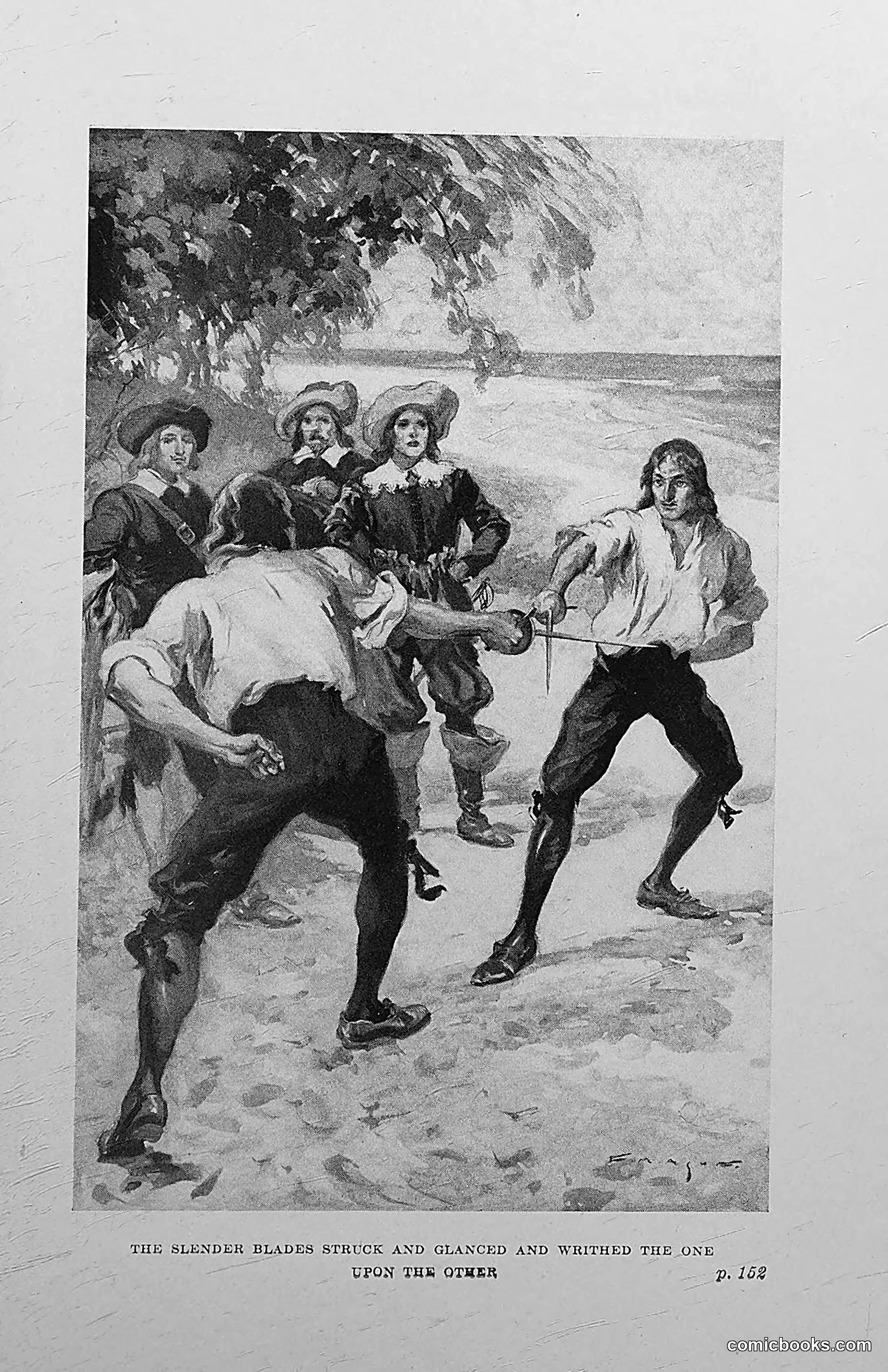
This illustration appears to be a literary scene rather than political satire—likely an engraving accompanying a serialized story in *The Wasp* magazine. The caption references "slender blades" striking and writhing "upon the other," suggesting a sword duel. The image shows two men engaged in combat with swords while three well-dressed observers watch from beneath a tree. The dynamic poses convey violent action. The reference to "p. 162" indicates this continues a narrative from elsewhere in the publication. Without identifying the specific story, this appears to be adventure or romance fiction depicting a period swordplay scene—common serialized content in 19th-century American magazines. The theatrical composition and dramatic action suggest the scene's importance to the plot.

I cannot reliably read the text or discern clear imagery on this page. The image appears to be a heavily degraded or faded scan of a historical document, with significant grain, speckles, and scratches throughout. While there may be content present, the quality is too poor for me to confidently identify any cartoon figures, text passages, political references, or satirical points. To properly analyze this page from *The Wasp* magazine, a higher-quality scan or image would be necessary. I'd recommend checking if a clearer version is available from the source collection.
This page contains prose narrative rather than a cartoon. It depicts a dramatic sword duel between two men—Stanton and Burnham—with named witnesses including Willis and Throgmorton present. Stanton appears to gain the upper hand but is struck down at the moment of apparent victory. Burnham claims the light hindered his aim, suggesting he didn't intend a fatal blow. The passage emphasizes the sudden, brutal reversal of fortune and the emotional reactions of onlookers. Without additional context about *The Wasp* magazine's specific satirical targets or the broader narrative this excerpt comes from, the political or social meaning remains unclear. The text may be satirizing dueling culture, honor codes, or specific historical figures, but this cannot be determined from the page alone.
This page from *The Wasp* depicts a literary narrative rather than a political cartoon. It shows a dialogue following a duel between characters named James and Stanton. Cross reassures James that he fought honorably—Stanton was a skilled swordsman, the conditions were fair, and James's wounding of him ("pinked him") was unavoidable. The scene concerns the aftermath of what appears to be a gentlemanly duel, with James now needing to flee the island while awaiting news of whether Stanton survives. The conversation emphasizes honor, fair play, and the social codes governing dueling among gentlemen. James claims the sun hindered his aim, suggesting he didn't intend a fatal wound. Without additional context about *The Wasp's* date or the specific historical figures involved, the precise satirical target remains unclear, though the passage itself satirizes the formal justifications and social protocols surrounding dueling.
This appears to be a serialized fiction excerpt rather than a political cartoon. The text describes a dramatic scene where James Burnham, having wounded someone named Stanton with a sword, meets his associate Todd at a beach cove with a prepared fishing boat. Todd asks if Burnham killed "the military gentleman," suggesting Burnham may be fleeing after a violent confrontation. Without seeing the full context of *The Wasp* magazine's publication date or the larger narrative, it's unclear whether this is satire of actual historical figures or purely fictional adventure storytelling. The names "Stanton" and "Burnham" *could* reference real 19th-century Americans, but the text alone doesn't confirm a specific political target. This reads as serialized drama rather than editorial satire.
This page appears to be narrative fiction rather than a political cartoon. It's prose describing adventure/action scenes involving characters named Burnham, Henry Todd, Percy Stanton, and Willis. The text depicts two concurrent events: Burnham and Todd departing by boat with supplies, seemingly fleeing their "sheltered" island life to seek fortune ("pinch a living") on the seas; and Percy Stanton—apparently wounded in a duel mentioned earlier—being tended to by Willis after medical examination. Without seeing the full publication context or surrounding illustrations, the specific satirical target is unclear. However, *The Wasp* was a San Francisco-based satirical magazine known for political commentary. This serialized fiction may have used adventure narrative to critique contemporary society, though the exact point remains obscure from this page alone.
This page depicts a scene from a narrative story (likely serialized fiction), not a political cartoon. A regimental surgeon examines an injured man named Stanton, revealing that he's been wounded in a *duel*—apparently with someone named Percy. The surgeon's dialogue mocks the era's changing moral standards. He complains that society now hides such "accidents" (duels) rather than accepting them openly, nostalgia for when "men were men" who settled disputes through violence without pretense. The surgeon boasts of his own three duels and having killed a man, and sarcastically notes that even clergy once fought each other. The satire targets Victorian-era hypocrisy: the contradiction between publicly condemning dueling while privately accepting it among gentlemen. The surgeon represents old-guard attitudes clashing with "nice morals" of the present day.
This page reproduces dialogue from a narrative, likely a serialized story rather than a standalone cartoon. The text describes the aftermath of a duel between two men: Stanton (apparently killed or seriously wounded) and Burnham (the shooter). Dr. Hamm boasts about his own dueling prowess while confidently predicting Burnham's victory based on the Burnham family's reputation for fighting. He then cynically advises Willis that authorities need only hear Stanton "fell from his horse"—suggesting a cover-up. Willis responds that Burnham merely intended to wound ("wing") Stanton, implying the death was unintended. The satire appears to mock the code of honor surrounding dueling and the casual corruption of authority figures (Dr. Hamm) who help conceal such deaths. Without seeing the full publication date or broader context, the specific historical figures remain unclear, but the critique of dueling culture and official complicity is evident.
This page contains **no cartoon or satirical illustration**—it is purely text, appearing to be Chapter IX of a serialized story in *The Wasp*. The passage describes a narrative incident: Captain Algernon Nash, governor of Nevis, discovers that his dependable aide James Burnham has disappeared one morning, leaving behind only a sealed letter addressed to "Miss Nash" (Elizabeth). A witness reports seeing Burnham early that morning. Without additional context from *The Wasp* itself, this reads as a melodramatic plot development rather than political satire. The reference to "Nevis" (a Caribbean island) and the formal colonial setting suggest this may be a serialized adventure or mystery story. Whether this represents actual political figures or events from the magazine's era remains unclear from this page alone.
This page appears to be from a serialized narrative rather than a political cartoon. The text describes a dramatic scene involving a duel: a governor (Captain Nash) confronts his daughter Elizabeth about a young man who has fled after fighting a duel with someone named Stanton. The daughter is distraught, holding an open letter from the absent man. Without additional context about *The Wasp* magazine's publication date or the specific story being serialized, it's unclear what political or social satire this represents. The scene could be parodying melodramatic 19th-century literature, or it might reference specific historical figures or events from the magazine's era. The emphasis on dueling as an outdated code of honor suggests possible commentary on social conventions, but the exact target remains unclear from this excerpt alone.
This page contains **serialized fiction rather than a political cartoon**. It appears to be a romantic narrative involving characters named Elizabeth, a governor, James Burnham, and Henry Todd, set in the Caribbean (Nevis and St. Kitts). The passage depicts an emotional scene where a governor confronts Elizabeth about her feelings for a man who loves her deeply but whom she's uncertain about. The governor's exasperation ("a mighty queer thing!") suggests generational frustration with youthful romantic confusion. The subsequent paragraph shifts to a nautical scene with Burnham and Todd sailing near Caribbean islands, suggesting this is a serialized adventure or romance story typical of *The Wasp's* content. Without additional context about the publication date or full narrative, the specific historical references or satirical intent—if any—remain unclear.
This page appears to be from a serialized narrative story rather than a political cartoon. It describes a sailing scene where characters named Burnham and Henry Todd are aboard a vessel, with Burnham scanning the coast while reflecting on a recent duel with someone named Stanton. The text suggests this is from a fictional adventure or dramatic story published in *The Wasp* magazine. The passage emphasizes Burnham's calm demeanor and satisfaction with how he conducted himself in the duel—he's philosophically accepting of fate while awaiting whatever may come. The reference to risking "the sun in his eyes" during the duel and valuing "the artistic conclusion" suggests the narrative is concerned with honor, skill, and aesthetics in combat. Without seeing illustrations or having publication details, I cannot identify specific historical figures or events being satirized. This reads as adventure fiction rather than political satire.
This page contains narrative fiction rather than political cartoon content. It depicts a maritime encounter involving characters named Burnham, Henry Todd, and a woman referred to as "Kitty." The passage describes an armed confrontation at sea: Burnham's boat is intercepted by another vessel with four oars carrying approximately ten armed men. A musket-wielding figure confronts them. Burnham's pragmatic response is to avoid immediate conflict, reasoning they're outnumbered and outpositioned by wind—he chooses to let the approaching boat draw alongside to "explain what they want" before deciding whether to fight. The earlier passage suggests this is part of a larger narrative involving romantic or personal conflict ("teaching her...the error of her ways"), though without additional context about the publication date, author, or full story arc, the specific satirical or political significance remains unclear.
This page appears to be prose fiction rather than a political cartoon—it's a narrative excerpt from a serialized story in *The Wasp* magazine. The text describes an encounter between James Burnham (in a fishing boat) and John Trimmer (commanding an armed long-boat with eleven men). The scene depicts Trimmer, identified as "the highwayman, the breeches maker's son," approaching Burnham on water. Their recognition is mutual but tense—Burnham maintains a wooden composure despite apparent inner calculation while observing Trimmer's armed company. Without seeing the full serial or magazine context, the specific satirical target remains unclear. However, *The Wasp* typically lampooned contemporary political figures and social scandals. The reference to a "breeches maker's son" becoming a highwayman suggests class commentary, though which historical or political figure this represents—if any—cannot be determined from this excerpt alone.
This appears to be a narrative passage from a serialized story rather than a political cartoon. The text describes a meeting between James Burnham and John Trimmer, apparently childhood friends who've reunited under dramatic circumstances. The satire's target is unclear from this excerpt alone, but the context suggests commentary on criminality and social mobility: "John Trimmer" has apparently escaped legal consequences for highway robbery ("taken toll of the roads") and now commands a crew as a pirate ("taking toll of the seas"). Burnham's greeting—unarmed, friendly, congratulatory toward a wanted criminal—may satirize either: - Corruption or complicity among the respectable classes - Romantic glorification of outlaws - Class commentary on how the lawless can gain autonomy and authority Without additional context about *The Wasp's* publication date or political leanings, the precise target remains unclear. This reads as literary satire rather than direct political commentary.
This appears to be a narrative passage rather than a political cartoon. The text depicts dialogue between two characters: John Trimmer and a man named Burnham discussing their circumstances. The passage references several specific locations (Nevis, Kingston) and a naval vessel (*Tartar*), suggesting this is fictional serialized fiction with adventure/maritime themes rather than political satire. The mention of "Alexander" being expected and Burnham fleeing to avoid him implies a plot involving pursuit or family conflict. The characterization—Burnham as a vain but strong man from a prominent family, now a fugitive—suggests themes of social disgrace and adventure common to 19th-century adventure fiction. Without additional context or visible illustrations on this particular page, the exact satirical target or social commentary remains unclear. This may be installment fiction rather than editorial satire.
This page contains fictional narrative text from *The Wasp*, a satirical magazine. It appears to be an excerpt from a serialized story rather than a political cartoon or satirical commentary on current events. The passage depicts a dramatic encounter between characters named Burnham, Henry Todd, and John Trimmer. Trimmer commands armed men who seize control of boats, and the group is taken ashore. Trimmer speaks "with authority," using aggressive gestures (slamming his fist), suggesting he's planning something forceful or threatening. Without additional context about the story's publication date, author, or source material, I cannot identify the specific political or social references this narrative might contain. The dramatic maritime setting and power dynamics suggest possible themes of piracy, mutiny, or conflict, but the actual satirical point—if one exists—remains unclear from this excerpt alone.
This page appears to be from a serialized narrative rather than a political cartoon. It depicts a dialogue between characters named Trimmer, Burnham (Jim), and Henry Todd. The scene involves a recruitment conversation: Burnham, claiming to have seventy guineas and unable to return to England (where his father would prosecute him as a highwayman), is being recruited by Trimmer into some kind of organization or gang. Trimmer offers to accept the younger Todd as well "for your sake." The passage suggests criminal activity—references to a problematic ring, legal consequences, and highwaymanry. Without additional context about *The Wasp* magazine's specific satirical targets or the larger narrative, the precise political or social commentary remains unclear. This could be satirizing criminal underworld culture, legal corruption, or class dynamics of the period, but the text alone doesn't definitively establish which.
This page contains serialized fiction rather than a political cartoon. The text describes a narrative scene involving characters named Burnham and Trimmer discussing a schooner hidden in a forest inlet. The story appears to involve a mutiny or escape: Trimmer has freed himself and companions from bondage, overpowered the officers and crew of a brig called the *Good Cheer*, and now possesses a white schooner. Burnham, described as resembling "a tailor's son" rather than "a gentleman of fortune," apparently agrees to join Trimmer's enterprise. Without additional context or visible illustrations, it's unclear what specific historical event or contemporary scandal this fictional narrative might be satirizing or referencing. The Wasp typically mixed illustrated satire with serialized stories, but this page shows only text. The maritime mutiny plot suggests possible commentary on labor conditions or class struggle, common Wasp themes, but specifics remain unclear from this excerpt alone.
This appears to be **narrative fiction or serialized story** rather than a political cartoon. The text describes a ship (*Good Cheer*) controlled by criminals—escaped convicts and former criminals (Trimmer, Dodd, and "Slim Sam")—who have elected themselves to command positions. The satire targets **maritime lawlessness and deception**: the criminal crew deliberately deceives a New England schooner's captain by staging a false distress signal, claiming pirate attack rather than admitting their true identity as convicts. The authorities are portrayed as skeptical ("doubtless to ascertain...with a view to confiscating"), suggesting corruption and mercenary interests rather than genuine rescue. The underlying critique appears to be about **criminal enterprise at sea** and the difficulty of maintaining order on ships—the only surviving officer was kept because prisoners lacked navigation skills, highlighting incompetence among the criminal leadership. Without knowing the publication date or broader context, the specific historical reference remains unclear.
This page contains narrative text—likely fiction or serialized story—rather than political cartoons. It describes the exploits of "Captain Trimmer," a ruthless pirate or brigand who attacks a merchant schooner with twenty armed men, cripples her with cannon fire, and plunders her cargo. Weeks later, Trimmer opportunistically joins a merchant ship's mutiny, boarding during combat when both sides are weakened. He brutally overpowers both factions and recruits survivors. The repeated name "Trimmer" may carry satirical weight—possibly referencing someone who opportunistically sides with the winning faction (political trimming). However, without additional context about *The Wasp*'s publication date or other pages, the specific real-world reference remains unclear. The text appears to be a adventure narrative using piracy as its vehicle, possibly to satirize ruthless opportunism or mercenary conduct.
This page is narrative text, not a cartoon—it appears to be from a serialized fiction story titled "The Wasp" in this satirical magazine. The passage describes a privateer or pirate captain named James Burnham who has captured a white schooner. He deliberately leaves the vessel unnamed for superstitious luck, though his associate Trimmer skeptically dismisses such notions. Burnham eventually names the ship "the Wasp," joking it will sting "fools"—likely a self-aware reference to the magazine's own title and satirical mission. The text suggests this is adventure fiction, possibly set during naval conflicts (mention of "Burnham's fight with Percy Stanton" suggests a duel or combat story). The Wasp magazine apparently serialized popular fiction alongside its satirical content. Without seeing illustrations or knowing the publication date, the specific historical context remains unclear.
This page contains **no visible cartoon or illustration**—it's purely text from a serialized story about a ship and its crew. The narrative describes a vessel with a deteriorating command structure. Key details suggest this is a **pirate or outlaw ship**: references to "violent deaths," crew members who are "ex-pickpockets," "ripe for the gallows," and sailors from "Newgate" (London's notorious prison) indicate a crew of criminals and desperate men. The satire appears to critique **leadership and social hierarchy**. Despite their criminal backgrounds, some crew members (Wells, the boatswain, chief gunner) are described as "sailors, not jailbirds"—yet they're equally suspect. The irony is that appearances and official roles mask the ship's true criminal nature. Without seeing the magazine's date or broader context, the specific political target remains unclear, though the piece likely satirizes either actual piracy, naval corruption, or the social disorder of its era.
This page contains **serialized fiction rather than cartoons**—it's a narrative passage describing characters aboard a ship. The text appears to be from a longer story featuring a schooner and its crew of forty-six men. The passage characterizes two crew members for the reader: **Trimmer**: A robust, jovial sailor-type with a square face and ruddy complexion. Despite the harsh maritime life, he remains cheerful, loves tavern singing, and is flirtatious with women ashore. **Slim Sam**: Presented as an ascetic contrast—narrow-faced, serious, introspective, modestly dressed and quiet-spoken, resembling a priest in self-denial. The narrative voice (Burnham, apparently the protagonist) observes these men with detached amusement, noting that sailors and maritime society mirror the social hierarchies and character types found among English gentry, London's dissolute wealthy, and colonial planters. This appears to be serialized adventure fiction rather than political satire, though *The Wasp* was primarily a satirical magazine.
This page contains **no visible cartoon or illustration**—it is purely text, appearing to be from a serialized nautical fiction story rather than satirical content. The passage describes a ship's departure from Bottle Harbor and crew activities during a calm day at sea. It introduces characters including James Burnham, who works under "Slim Sam's watch," and mentions a white schooner handled skillfully by someone named Wells. The text emphasizes the crew's leisure activities—smoking, gambling with cards and dice, and trading trinkets and silks—suggesting either a merchant or privateering vessel with accumulated goods. **Without visible illustrations, political references, or satirical commentary on this specific page, I cannot identify the cartoon's subject, intended targets, or satirical point.** The content reads as straightforward nautical narrative rather than satire typical of *The Wasp*.
This page appears to be from a serialized narrative rather than a political cartoon. It describes the internal operations of what seems to be a pirate ship under a captain named Trimmer, detailing their prize-distribution system and crew conduct rules. The text recounts a hierarchical profit-sharing arrangement where the captain takes three shares, officers take two, and crew members take one (with three young sailors receiving half-shares). It emphasizes the crew's honor code—they don't steal from each other directly, only through gambling—and maintain discipline through social pressure rather than punishment. The passage then introduces dramatic tension: crew member James Burnham has lost fifty of seventy guineas gambling within two days, and a mysterious sail appears on the horizon, suggesting an impending encounter or conflict. **Without seeing accompanying illustrations, the satirical or humorous intent remains unclear.** This reads as adventure fiction rather than explicit social or political satire targeting specific contemporary figures or events.
This page contains no cartoon or satirical illustration—it's purely text, appearing to be a serialized fiction story published in *The Wasp* magazine. The passage describes a nautical scene: a character named Trimmer spots another ship (the *Tartar*) through a telescope, heading toward Nevis. Later, a man named Burnham gambles in the cabin, winning ten guineas at dice from Trimmer and Wells, then makes a makeshift bed on deck. Without additional context about the story's full narrative or the historical moment of publication, the satirical or political purpose—if any—is unclear. This could be straight adventure fiction rather than satire. The nautical setting and gambling detail suggest 19th-century seafaring narrative, but without seeing the surrounding pages or knowing the story's larger arc, I cannot identify what, if anything, is being satirized.
This page is not a cartoon or satire, but rather an excerpt from a serialized adventure novel or short story appearing in *The Wasp* magazine. The text depicts a dramatic scene aboard a schooner at sea, where a character named James Burnham is awakened by another crew member who reports hearing musketry (gunfire) and seeing a light in the misty darkness. The passage emphasizes tension and action—Burnham's quick reflexes with his knife, the ominous weather conditions, and the mysterious sounds suggesting danger nearby. This appears to be narrative fiction rather than satirical commentary, so there are no political caricatures or social satire to decode. The page simply continues a suspenseful maritime adventure story.
This page contains **narrative fiction rather than political satire or cartooning**. It's an excerpt from what appears to be a sea adventure story, describing a character named Burnham observing distant naval combat in darkness—two ships engaged in battle, detected only by sound and a glimpse of red (likely gunfire). The text is purely literary: evocative prose about naval warfare, with sensory details (breathing, pipe smoke, sail sounds) building tension as Burnham realizes fighting is occurring nearby. **There is no visible cartoon, caricature, or satirical commentary** on this page. *The Wasp* was primarily a satirical magazine, but this particular issue apparently included serialized fiction alongside its typical political humor. Without additional context about which story this is or when it was published, the specific narrative cannot be identified.
This page contains text from a serialized adventure story, not a political cartoon. The narrative depicts a naval scene aboard a merchant vessel (a "white schooner") where Captain Trimmer and James Burnham anticipate encountering pirates or privateers at sea. The story suggests they've detected suspicious activity—possibly another ship attacking a trader—and the crew prepares for potential combat. Burnham eagerly expresses his willingness to fight, declaring he'd spend his last money for the chance to "draw and have at something." This appears to be pulp fiction or serialized adventure entertainment rather than satire, typical of *The Wasp* magazine's content during its publication period.
This appears to be a literary excerpt rather than a political cartoon. The text is narrative prose depicting sailors spotting two damaged vessels at sea. The characters—Trimmer, Captain, and James Burnham—discuss what appears to be an opportunity to "reap the harvest" from these crippled ships, with mention of "Hellfire Hicks," suggesting piracy or salvage of wrecked vessels. The passage uses period nautical dialect ("d'ye," "blister me") and implies opportunistic maritime predation. Without additional context about *The Wasp's* publication date or the full story, the specific satirical target remains unclear—though the tone suggests commentary on maritime lawlessness or unethical salvage practices. The page number (181) indicates this is mid-story, making isolated interpretation difficult.
This page appears to be a narrative or fictional story rather than a political cartoon. It describes a naval encounter between two damaged ships: a white schooner pursuing a crippled brig and schooner (possibly identified as "Hellfire Hicks's Black Polly"). The text employs nautical language metaphorically—"lame ducks" typically referred to disabled or weakened entities. The passage depicts the white schooner's crew preparing weapons and pursuing the struggling vessels, which the crew finds somewhat humorous given the vessels' diminished condition. **Without additional context or visible illustrations**, it's unclear what specific political or social figures these ships represent, or what 19th-century event this satirizes. The magazine *The Wasp* was known for satirical commentary, but this particular passage requires identifying the historical reference and visual content to explain the satire's target and point to a modern reader.
This page appears to be **literary fiction rather than political satire or cartooning**. It's a narrative excerpt from what seems to be a serialized adventure novel about James Burnham, a vengeful protagonist preparing for maritime conflict. The passage describes Burnham's bitter psychological state as he arms himself with a cutlass, having previously wounded someone named Stanton. References to a "brig," "schooner," and sailors making dark jokes about salvaging a ship suggest a nautical melodrama. The text emphasizes Burnham's emotional disconnection—his rejection of family (mother, father), romantic interests (Elizabeth Nash, Kitty Trimmer), and conventional morality. This appears to be **popular serialized fiction** typical of 19th-century magazines like *The Wasp*, not political or social satire. Without visible illustrations or more context, the specific satirical or comedic intent remains unclear.
This page contains narrative text—likely from a serialized story—rather than a political cartoon. It depicts a naval confrontation between rival ship captains during what appears to be a piracy or privateering scenario. The passage describes Captain Trimmer observing two damaged vessels (the white schooner "Black Polly" and a black schooner) that have already engaged in combat, having exhausted their ammunition and suffered severe damage. Trimmer references a rival named Hicks who previously threatened to chase him from these seas. Rather than waste gunpowder on already-crippled opponents, Trimmer decides to send boats to finish them off directly. The tone is cynical and bloodthirsty, typical of adventure fiction from this era. Without the magazine's publication date or surrounding context visible, the specific historical or satirical references remain unclear.
This page appears to be from a serialized adventure narrative rather than a political cartoon. It depicts a naval action sequence between two schooners—the *Wasp* and the *Black Polly*—with detailed descriptions of combat and casualties. The text describes James Burnham in a suspended boat shooting the helmsman of the *Black Polly* at the request of "Trimmer." The scene emphasizes maritime violence: blood, corpses, overturned cannons, and armed men among the dead. Without additional context about the publication date or surrounding narrative, the specific satirical or political meaning remains unclear. This could be adventure fiction, naval satire, or commentary on contemporary maritime events, but the page itself provides only the dramatic action sequence without visible editorial cartoons or clear satirical captions that would indicate *The Wasp*'s intended critique.
This page contains **narrative fiction rather than political satire or editorial cartoons**. It's an excerpt from an adventure story titled "The Wasp," depicting a naval combat scene involving pirate ships—specifically the "Black Polly" and another vessel. The passage describes a dramatic boarding action where James Burnham leads boats to attack a wounded pirate ship. Pirates defend themselves by dropping explosives onto the attacking boats, causing a chaotic explosion that throws men, oars, and debris into the sea. **No political figures or social satire are visible here.** This appears to be serialized adventure fiction—common content in *The Wasp*, which despite its satirical reputation, also published entertainment fiction. The page shows no cartoons, illustrations, or editorial commentary; it's purely narrative text depicting a swashbuckling maritime battle.
This page appears to be text from a serialized adventure story rather than a cartoon or satirical piece. It depicts a dramatic naval battle scene between two vessels—the "Polly" (apparently a brig under attack) and a schooner commanded by "Hellfire Hicks." The passage describes hand-to-hand combat during a boarding action, with vivid descriptions of sword and knife fighting on deck. The narrative emphasizes that despite losing men, Hicks commands experienced defenders, while the attacking "boarders" under someone named Trimmer are fresher but only slightly outnumber their opponents. Without additional context about *The Wasp* magazine's specific issue or the serialized story's title and author, it's unclear what political or social satire (if any) this adventure narrative contains. The page may simply be literary content rather than satirical commentary.
This page is from a serialized adventure narrative in *The Wasp*, not a political cartoon. It depicts a naval battle scene featuring ships named the *Wasp* and *Polly*, with characters including Captain Trimmer, James Burnham, and a pirate named Hicks. The text describes combat during what appears to be a privateering or pirate-hunting engagement. Burnham fatally wounds Hicks in hand-to-hand combat, and the *Polly's* crew is decimated. The narrative emphasizes brutal action and martial heroism—common themes in late 19th-century American adventure fiction. Without additional context (issue date, author, surrounding pages), the specific historical or political references remain unclear. This appears to be entertainment fiction rather than satire or social commentary.
This page contains narrative text from what appears to be a serialized adventure or action story in *The Wasp* magazine, rather than a political cartoon or satire. The text describes a violent maritime conflict aboard a ship called the *Polly*, recounting casualties from what seems to be a boarding action or attack. The passage focuses on James Burnham, apparently a heroic figure who has distinguished himself in combat—described as "the first over the rail, the first to kill, and the slayer of the terrific Hicks." The narrative emphasizes his prowess and bravery while his comrades suffer significant casualties. Without seeing the accompanying illustration(s), it's unclear whether this relates to historical events, fictional adventure, or satirical commentary. The page number (189) suggests this is mid-serialization. To identify any satirical intent or topical references, the images would need to be examined.
This page contains **narrative fiction**, not a political cartoon. It's an excerpt from what appears to be an adventure or romance story titled "The Wasp," featuring a character named James Burnham who breaches a locked cabin aboard a ship, discovering a young woman inside. The text describes a dramatic scene: wounded men, a ship's cabin exploration, and Burnham's encounter with an elegant, dark-haired woman with carefully applied cosmetics. The detailed physical description—"dark and liquid" eyes, "silken texture" hair, "artful bloom of white powder" on her cheeks—suggests this is either a romantic encounter or the introduction of a significant female character to the narrative. Without additional context about the publication date or story's plot, the specific satirical or political meaning remains unclear, though *The Wasp* was known for sharp social commentary.
This appears to be a serialized fiction excerpt rather than a political cartoon. The page presents a dramatic scene between a woman holding a small knife and a man named James Burnham, surrounded by sailors. The scene depicts a stock Victorian melodrama trope: a mysterious, elegantly-dressed woman confronting a rogue male character. Burnham's patronizing dialogue—appealing to chivalry and flattery to disarm her—suggests he's a charming scoundrel attempting to manipulate her through feigned gallantry. The "tough rascals" admiring her reinforces the theatrical nature of this confrontation. Without additional context about *The Wasp* magazine's publication date or the serialization's broader narrative, the specific satirical target remains unclear. However, this likely mocks either contemporary Victorian romance conventions or specific social/political figures through fictional parody.
This page appears to be from a serialized novel or story rather than a political cartoon. It's Chapter XI of a narrative featuring characters named Burnham and Bolt. The scene depicts a tense confrontation: a young foreign woman addresses Burnham as "captain" and identifies him as gentry based on his manner. A crew member named Bolt mocks Burnham's authority despite his genteel status. Burnham responds with an intimidating, controlled threat—his physical description (drooping lids, glinting eyes, twisted mouth) conveying menace. The context suggests a maritime/pirate setting: Bolt is described as "one of the recruits from the mutineers," indicating a ship's crew, likely mutineers who've challenged established hierarchy. The satire targets class pretension—Burnham claims gentlemanly status despite his circumstances, while rough sailors like Bolt question whether birth confers actual authority. Without seeing the full narrative, the specific satirical intent remains unclear, but the page explores tensions between social class and practical power.
This page appears to be from a serialized fiction story in *The Wasp* magazine, not a political cartoon. It depicts a confrontation between two men—James Burnham and someone called "Master Bolt"—aboard a ship, with a woman present observing them carefully. Burnham challenges Bolt's authority, insults him directly, and threatens violence ("room enough in the scuppers for one more corpse"). The dialogue uses period nautical vernacular and dialect. Burnham then turns to the woman, noting the "deck is foul with blood," suggesting recent violence has already occurred. Without additional context about this serialized narrative, it's unclear what specific political or social satire *The Wasp* intended here. This appears to be adventure fiction rather than commentary on contemporary events or figures.
This page contains narrative fiction rather than a political cartoon. It depicts a violent duel between characters named Bolt and Burnham aboard a ship, with an unnamed woman present. The text describes Bolt's assassination attempt, Burnham's successful counterattack with a rapier, and Bolt's death. The bystanders' dialogue characterizes Bolt as treacherous and references his previous victim, "Jersey Dick." Without additional context about *The Wasp* magazine's publication date or the story's title, I cannot identify whether these are fictional characters, historical figures, or satirical representations of contemporary political/social figures. The nautical setting and pirate-like language ("mates," "captain") suggest either adventure fiction or possibly satirical commentary on maritime/naval matters, but the specific satirical target remains unclear from this page alone.
This page appears to be text from a serialized adventure story rather than a political cartoon. It depicts a violent pirate narrative featuring a character named James Burnham who has just killed someone (apparently an associate of the pirate "Hellfire Hicks") during a boarding action at sea. The dialogue reveals period nautical slang and character types typical of 19th-century adventure fiction: sailors discussing a treacherous, bullying man who exploited connections ("strong with Trimmer") for advancement. Burnham and an unnamed woman escape a sinking vessel while other survivors attempt to plunder treasure chests below deck. Without seeing the original illustrations or understanding *The Wasp's* typical satirical targets, it's unclear whether this narrative parodies specific contemporary figures or simply entertains readers with swashbuckling action. The content lacks obvious political messaging visible in the text alone.
This page appears to be from a serialized narrative or novella in *The Wasp*, rather than a political cartoon. The text depicts a flirtacious conversation between a woman and a man named Burnham aboard a ship. The scene involves romantic/sexual intrigue: the woman mentions being taken from a ship by the "late Captain Hicks" a year prior, and expresses preference for Burnham over "Captain Trimmer." She references Hicks as a serial philanderer ("lover of many women"). Without seeing the accompanying illustration, it's difficult to determine if this is satirizing specific maritime figures, social attitudes about women and sailors, or sexual conduct. The content suggests either a melodramatic serialized adventure story or satire of such literature. The reference to schooners and maritime trade suggests late 19th-century American setting, but specific historical figures remain unclear from text alone.
This page depicts a dialogue between two characters—**Burnham** (apparently a pirate or criminal) and a woman with a French accent. The exchange reveals a satirical critique of pirate hierarchy and ambition. Burnham has killed someone named **Hicks** and boasts of it coolly. The woman praises his courage but questions why he doesn't aspire to be **captain** (who controls the spoils), comparing him to her father—a French soldier who would demand leadership. She suggests Burnham has the nerve for command but settles for subordinate status. Burnham dismisses her flattery, claiming listening to such suggestions is "treason" since the captain controls distribution of plunder. He then attempts to seduce her with a kiss. The satire likely mocks either contemporary criminal organizations, political hierarchies, or ambitious men who lack the will to lead despite possessing ruthlessness. The woman's role—encouraging ambition while being easily charmed—suggests satirical commentary on female manipulation or romantic entanglement clouding judgment.
This page appears to be **text only—a narrative passage, not a cartoon**. It's excerpted from what seems to be a serialized adventure story about piracy, featuring characters named Trimmer, Hicks, and James Burnham. The passage describes a pirate raid on a Spanish merchant brig. Trimmer boards the captured vessel *Polly* to find treasure: bar silver, rare wines, ecclesiastical items, gold coins (worth two thousand guineas), silks, jewels, and silver coins hidden in the commander's berth. The narrative emphasizes plunder and treasure discovery—typical *The Wasp* content mixing entertainment with satirical storytelling. Without visible illustrations or political commentary on this particular page, the satire's target remains unclear. The reference to "ecclesiastical dignitary" among stolen goods might carry anti-religious satire typical of the era's *Wasp* content, though this is speculative.
This page from *The Wasp* appears to be **narrative text rather than a cartoon**—it's prose fiction describing a pirate action sequence. The passage recounts Captain Trimmer's raid on a vessel called the *Polly*: his crew plunders valuables (jewels, gold, silver, weapons, merchandise), takes captives including a woman and a priest, recruits Spanish sailors, and scuttles the ship. The satirical angle remains unclear from the text alone. Without seeing accompanying illustrations or knowing the broader story context, it's uncertain whether this is mocking a specific historical pirate, a contemporary political figure, or adventure fiction conventions. The numbered page (199) suggests this is mid-narrative in a serialized story. To understand *The Wasp's* satirical intent here would require additional context about what this Captain Trimmer represents—whether he's a real person, a fictional stand-in for someone, or purely entertainment.
This page contains prose fiction rather than a cartoon. It describes a ship meeting after what appears to be a violent encounter or raid. Captain John Trimmer addresses his surviving crew, including named characters like Slim Sam, Wells, and James Burnham, plus an unnamed young woman at Trimmer's side. The satirical point targets the crew's callous mercenary attitudes: Trimmer jokes that fewer survivors means larger shares of plunder from their spoils—a dark humor that the men appreciate with crude laughter and oaths. The scene suggests maritime piracy or privateering, with the bishop notably absent and some crew wounded. James Burnham watches the woman "covertly, with an ironic glimmer," suggesting romantic or duplicitous subtext. The passage satirizes brutal seafaring culture and the greed motivating such ventures. Without seeing the full serialized story, the specific historical or fictional raid being referenced remains unclear.
This page appears to be from a serialized fiction story rather than political satire or cartoon commentary. The narrative depicts a scene aboard a ship where a captain announces a vacant quartermaster position. A character named Burnham—described as elegantly dressed with a Spanish leather rapier—stands aloof from the crew's discussion. The scene captures shipboard tension: one crew member (with a broken nose) advocates for promoting Burnham, a newcomer and apparent outsider. Another sailor protests, viewing this as unfair preferment over established crew members. He accuses the broken-nosed man of toadyism (sycophancy) and attacks his ancestry. The satire appears directed at naval hierarchy, favoritism, and class conflict aboard ship rather than contemporary politics. Without knowing the publication date or broader context of this serial, it's difficult to identify specific historical figures or events referenced.
This is a narrative passage (not a cartoon) from a serialized story in *The Wasp*, a 19th-century satirical magazine. The scene depicts violence aboard a ship during a crew meeting. A drunk passenger insults someone, resulting in a knife fight that leaves him bleeding on deck. The ship's leader, Trimmer, unusually tolerates this unauthorized violence—a departure from his normal brutal discipline. The passage suggests Trimmer is deliberately overlooking the incident, possibly to manipulate the election of quartermaster James Burnham. Slim Sam, the first mate, scrutinizes Trimmer's passivity, sensing something suspicious. The narrative implies Trimmer may be using the chaos and Burnham's selection for unstated purposes. Without additional context about the full story's characters and plot, specific historical references remain unclear, but the passage portrays shipboard politics through violence and coercion.
This page appears to be from a serialized fiction story rather than a political cartoon. It depicts a scene aboard a ship where a character named Burnham is being promoted to quartermaster by Captain Trimmer after fighting bravely. The narrative describes a moment of dark irony: despite receiving this honor and promotion from his crew of pirates or sailors of questionable character, Burnham feels no genuine gratitude. Instead, he experiences a brief flash of disgust for Trimmer, "the woman," the cheering crew, and himself—a moment too fleeting to fully register. The satire appears subtle: the "gentlemen of fortune" (a euphemism for pirates) conducting formal ceremonies with bows and cheers, while one crew member still holds a "red knife," suggesting recent violence. The piece critiques the performative nature of honor and camaraderie among morally compromised men. Without additional context about *The Wasp* magazine or this serialized story's plot, the specific social commentary remains unclear.
This appears to be a narrative excerpt from a serialized story rather than a political cartoon. The scene depicts a ship's hierarchy during what seems to be an election for a new quartermaster named Burnham. Welsh Owen, a crew member with a bandaged head and broken nose, approaches the newly elected Burnham to claim credit for supporting his candidacy. Owen, notably intoxicated, makes a philosophical speech about his dual nature—claiming his drunk self represents his "real" self, contrasting with his sober, ordinary demeanor. The satire appears to target working-class pretension and self-delusion: Owen presents himself as an educated man of "whims" who admires gentlemen, yet his drunken rambling and physical injuries undercut this self-image. The joke hinges on the gap between how Owen sees himself and his actual station. Without seeing accompanying illustrations or knowing publication dates, the specific political or social commentary remains unclear.
This page contains no visible cartoon or illustration—it's prose dialogue from what appears to be a serialized story in *The Wasp*, a 19th-century American satirical magazine. The passage depicts a conversation between a character named Burnham and a first mate ("Slim Sam") aboard a ship. The mate explains that the captain (Trimmer) has grown weak and fearful due to romantic involvement with a woman smuggled aboard—violating company rules. The mate cynically observes this weakness invites further trouble from crew members like Welsh Owen, who recently committed violence (a knifing) but escaped punishment. The satire likely critiques how romantic entanglement compromises leadership and enforces shipboard hierarchy. Without knowing the larger serial context or publication date, the specific social commentary remains unclear, but the passage emphasizes maritime discipline and the danger of rule-breaking aboard vessels.
This page contains dialogue from a serialized story in *The Wasp* (a 19th-century American satirical magazine). The text depicts a conversation aboard a ship between Burnham (a quartermaster) and Slim Sam (a first mate and former pickpocket). The passage introduces a mysterious woman named Hélène da Silva, allegedly the daughter of Saint-Ovide, a French pirate who was executed. Slim Sam hints cryptically that this woman will be "put ashore" tomorrow—suggesting she's either a stowaway or a problem the captain must address. The narrative tone suggests intrigue and potential mutiny: Slim Sam appears to be testing Burnham's loyalty while hinting at some scheme. Burnham, cautious, pretends ignorance to avoid commitment. This is **adventure/melodrama fiction**, not political satire. The humor derives from character interaction and suspense rather than social commentary. The exotic references (French pirates, Spanish heritage) add sensationalism typical of period serialized tales.
This page contains narrative text rather than visual satire or cartoons. It appears to be from a serialized story in *The Wasp* magazine featuring characters aboard a ship: James Burnham, Captain John Trimmer, and Welsh Owen. The passage depicts a dangerous maritime setting where discipline has collapsed. Welsh Owen commits violence (knifing a man) unpunished, creating an atmosphere of fear and instability. Burnham sleeps with his knife close, anticipating treachery from shipmates. The text references a woman—apparently a woman of ill repute ("bird of paradise")—taken from a governor by someone named Hicks after killing the governor. The satire likely critiques lawlessness and brutality in maritime settings, or uses this violent shipboard environment to comment on social disorder. Without seeing earlier installments or knowing the publication date, the specific political allegory remains unclear.
This page appears to be prose fiction rather than a cartoon—specifically, a narrative passage from a serialized story in *The Wasp* magazine featuring pirates or seafaring men. The story concerns a captain (apparently named Trimmer) who has taken a woman (formerly belonging to "Hellfire Hicks") as his own without consulting his crew who did the fighting. His men are resentful and disillusioned—they risked their lives but see him enjoying the spoils, particularly the woman's company and possessions, while planning to marry her with a Spanish bishop's blessing. Trimmer recognizes the crew's discontent but pretends indifference. The passage ends with crew member Wells sarcastically suggesting the woman has already made their captain a fool. The satire appears to target masculine vanity and the chaos when authority figures prioritize personal desires over crew loyalty and fairness—a common theme in adventure fiction of this era.
This page appears to be narrative text rather than a political cartoon—it's prose fiction from *The Wasp*, a 19th-century American satirical magazine. The passage describes a dramatic scene involving a character named Trimmer, a Spanish bishop, and a woman named Hélène aboard what appears to be a ship. The scene depicts the bishop's death, treated darkly comic by Trimmer but received grimly by others (Wells, Burnham, and unnamed crew). The satire seems to target religious authority through the bishop's forced costume, physical weakness, and undignified death. References to "holding a candle to the powder" and the general brutality suggest this may be historical fiction critiquing Spanish colonialism or religious hypocrisy, though without additional context, the specific historical reference remains unclear.
This appears to be an excerpt from a serialized story rather than a political cartoon. The text depicts a confrontation between Captain Trimmer and Slim Sam (his first mate) aboard a ship. The passage shows Trimmer's tyrannical nature: he draws pistols when challenged, demands absolute obedience, and reminds his crew of past favors (freeing them "from death on the plantations," providing gold). His rage at being questioned about his authority suggests the satirical point: **a critique of arbitrary, despotic leadership that uses past generosity as justification for unchecked power**. The "rules" being debated appear significant but aren't fully clarified in this excerpt. Without seeing illustrations or knowing the publication date, the specific historical or political target remains unclear—though the plantation reference suggests antebellum or post-Civil War American themes.
This page contains text from a serialized story rather than a political cartoon. The narrative describes a pirate or criminal captain ("Slim Sam") aboard a schooner, enforcing brutal discipline among his crew. After one member breaks a rule, the captain—initially ready to shoot—is persuaded to spare him only because the crew is understaffed. The captain warns this mercy won't be repeated. The story then describes the crew putting ashore at a lawless port to offload treasure and resupply before returning to sea. The tone is sensationalized adventure fiction typical of *The Wasp*, a San Francisco satirical weekly. Without seeing illustrations or surrounding context, the political/social satire remains unclear. It may reference contemporary California maritime crime, labor conditions, or lawlessness in frontier ports—but this cannot be confirmed from text alone.
This page is **not a cartoon** but rather prose fiction—likely from a serialized story in *The Wasp* magazine. The text describes a colonial scene on the island of Nevis, where a ship called the *Tartar* has arrived. The passage introduces **Mr. Willis**, a character who appears to be a doctor or medical professional. The final paragraph contains the thematic point: Willis has been treating **Percy Stanton**—a man he apparently dislikes—back to health, assisted by "the beautiful Miss Kitty." The satire is **ironic and psychological**: Willis must use his medical skills to save someone's life whom he would "gladly have dead," suggesting romantic rivalry (Kitty is likely the love interest both men want). The cruel humor lies in Willis's moral and emotional torture—forced to preserve his rival's life while witnessing their closeness during treatment.
This appears to be a narrative passage from a serialized story rather than a cartoon. The text describes Lieutenant Alexander Burnham's uncomfortable arrival at a governor's reception, where he receives unexplained stares from assembled guests. The passage establishes that Burnham is puzzled by the attention directed at him—he self-consciously wonders if his appearance is somehow wrong or inappropriate. The narrative then notes that Alexander physically resembles his brother James, differing only in facial expression and eye color, with notably similar chin, jaw, and brow lines. The satire's point remains unclear from this excerpt alone, as the full context of what makes Burnham's presence noteworthy or embarrassing isn't revealed. The passage seems to be building toward some reveal about Burnham's identity or background that would explain the guests' reactions, but that explanation is cut off at the page's end. Without seeing the image clearly or reading surrounding pages, the specific social or political satire intended remains uncertain.
This page contains no cartoon or satirical illustration—it's purely text. The content is a character description from a serialized story in *The Wasp* magazine, likely from the late 19th century. The passage describes two brothers, Alexander and James, who are physically identical but temperamentally opposite. Alexander is portrayed as honest, honorable, kind, sympathetic, and modest—qualities contrasted implicitly with his brother's apparent different nature ("day differs from night"). The final sentence introduces a governor speaking with "Lieutenant Burnham," suggesting a narrative involving military or political figures, though the full context is unclear from this excerpt alone. This appears to be literary fiction rather than satire or political commentary.
This page appears to be from a serialized narrative story rather than a political cartoon. It depicts a dramatic scene where Governor Nash informs Alexander Burnham that his brother James has fled after fighting a man named Stanton. The governor anxiously denies involvement in James's disappearance, insisting he only showed James a letter from Scovil encouraging the reunion. The narrative tension suggests James was forced into a duel or fight, defeated his opponent ("pinked his man"), and then escaped. Without seeing additional context or the magazine's date, it's unclear what real historical figures or events this fiction references—if any. The names and scenario could be entirely fictional, or they could allegorically represent contemporary political/social conflicts that *The Wasp* readers would have recognized. The dramatic tone and gentleman characters suggest upper-class intrigue, possibly satirizing elite behavior, but the specific satirical target remains unclear from this passage alone.
This page appears to be from a serialized narrative rather than a political cartoon. It depicts a dramatic scene involving Lieutenant Burnham and a governor discussing a man named James who allegedly fled after a confrontation with someone named Stanton. The passage suggests a duel or violent incident occurred. Lieutenant Burnham reacts with shock and relief upon learning James departed before "the Tartar's" arrival—implying James may have avoided serious consequences or that his absence protects someone. Burnham's exclamation about an "impostor" and reference to James sailing to Jamaica suggests the narrative involves deception or mistaken identity. Without additional context about *The Wasp's* publication date or the specific story being serialized, the precise historical or political references remain unclear. The dramatic, melodramatic tone suggests this was popular entertainment satire or serialized fiction typical of 19th-century American magazines.
This is **not a cartoon page**, but rather prose fiction—likely an excerpt from a serialized story in *The Wasp* magazine. The passage depicts Captain Nash defending a stranger's identity as James Burnham, son of Sir Walter Burnham. Nash establishes credibility through specific details: he witnessed identifying marks on the man's back (a family custom of Sir Walter's, who marks his children "as he marks his silver"), and notes the stranger's physical resemblance to the questioner (apparently another Burnham son). The exchange concerns **identity verification and legitimacy**—whether this ill man is genuinely a Burnham heir or an impostor. Captain Nash's insistence on physical evidence and family knowledge suggests themes of inheritance, class status, and proof of legitimacy that would resonate with *The Wasp*'s Victorian readership. The conversation's dramatic tension indicates a plot centered on disputed identity or inheritance claims.
This page is **text only** — it's prose fiction, not a political cartoon. It appears to be from a serialized story in *The Wasp* magazine featuring characters named Alexander Burnham, James, Sir Walter (a baronet), and Captain Nash. The passage depicts Alexander's confusion about his brother James appearing unexpectedly in Nevis. James was supposedly in Jamaica engaged in commerce, but has somehow earned Captain Nash's friendship and gratitude. Alexander wrestles with whether their father misjudged James's character, calling him the "black goat of his family" (a scapegoat). The narrative builds intrigue around James's mysterious arrival and changed circumstances, suggesting a family drama involving social standing, character disputes, and reconciliation. Without broader context, the specific satirical or social critique intended remains unclear.
This appears to be a **page of prose text rather than a cartoon or satirical illustration**. It's from *The Wasp*, a 19th-century American satirical magazine, but this particular page contains narrative fiction describing conversations between characters named Alexander Burnham, Willis, and references to James Burnham and Elizabeth Nash. The text describes Willis recounting James Burnham's heroic deeds—rescuing a girl, his courteous behavior toward Elizabeth Nash, and a duel—to Alexander, who listens carefully to gauge James's character. The passage emphasizes James's virtues: helpfulness, politeness, and devotion. **Without seeing accompanying illustrations, I cannot identify what satire or social commentary this page contains.** It reads as straightforward narrative prose rather than the kind of biting political or social satire *The Wasp* was known for. More context about the publication date and surrounding pages would be needed to explain any satirical intent.
This page appears to be from a serialized fiction story rather than a political cartoon. It describes a narrative involving two brothers—James and Alexander Burnham—and their interaction on the island of Nevis. The text depicts Alexander's surprise at James's honorable behavior during a duel, despite knowing James to be "a rascal at heart." James has apparently rescued the governor's daughter, earning respect despite his unsavory reputation. The passage ends with Alexander being waylaid by military men who force rum punches upon him. **Without seeing the actual illustrations**, I cannot identify specific caricatures or visual satire. The *Wasp* was known for satirical commentary, but this particular excerpt reads as dramatic narrative fiction—possibly serialized entertainment rather than political or social satire. The context and meaning would depend entirely on the accompanying illustrations, which aren't clearly visible in this image.
This page appears to be from a serialized narrative fiction rather than a political cartoon. It's prose text describing interpersonal drama among colonial characters in an island setting. The passage concerns Alexander Burnham, who has traveled to an island and learned troubling news about his brother James. James apparently has a romantic history—he previously courted the tailor's daughter at Wantage, and currently loves Elizabeth Nash. However, James's rival Stanton plans to marry Kitty Trimmer, creating conflict. Alexander feels discouraged, characterizing his brother as "the same rascal—only cleverer, perhaps," suggesting James is a morally compromised womanizer. The narrative setup implies impending confrontation. Without additional context about *The Wasp* magazine's satirical targets or the broader story, the specific social commentary remains unclear. This reads as serialized melodrama rather than overt political satire.
This page appears to be **prose fiction rather than a political cartoon**. It's a narrative passage from a serialized story titled "The Wasp," depicting a romantic encounter between a governor's daughter and a sailor named Alexander Burnham. The text describes the woman's emotional response upon meeting Alexander, whom she initially confuses with or compares to James Burnham. The passage emphasizes the contrast between her idealized, romantic vision of James (from dreams) and reality. Over a week of meetings with Alexander, she gradually stops discussing James, suggesting her romantic interest shifts. The content is sentimental melodrama typical of serialized fiction from this era—not satire or political commentary. Without additional context about the publication's date or the full story, the specific satirical point (if any) remains unclear. This may be entertainment content rather than the magazine's typical satirical cartoon work.
This page contains prose fiction rather than a political cartoon. It appears to be a serialized romantic story titled "The Wasp" (page 223), depicting a romantic scene between two characters: Alexander and Elizabeth, set in what appears to be a colonial-era Government House. Alexander, a naval officer under Commander Scovil, is departing the next morning to hunt pirates. The scene emphasizes the emotional tension of their parting through romantic, poetic language—starlight, her shining eyes, his military finery. The passage culminates in Alexander's sudden, vulnerable question asking if Elizabeth loves someone named James, suggesting romantic rivalry or conflict. Without additional context about the story's publication date and political significance, it's unclear if this represents satire of actual historical figures or events, or simply sentimental fiction typical of the era.
This page contains a romantic dialogue with no visible cartoon or illustration—it appears to be a serialized short story or dramatic piece from the magazine. The text depicts an emotional conversation between a man and woman about a third person named James. The man attempts to dissuade the woman from romantic feelings toward James, suggesting men are generally unworthy of women's love despite superficial displays of bravery and courtesy. The woman responds innocently that men seem honorable to her. The man becomes flustered, apologizes for "talking like a fool," and impulsively kisses her hand before departing. Without the original publication date or illustration context, the satirical target remains unclear—though the piece may mock Victorian courtship conventions or male hypocrisy regarding honor and worthiness.
This page contains **serialized fiction**, not a political cartoon. It's a narrative story published in *The Wasp* magazine (page 225). The excerpt depicts a dramatic moment: Elizabeth receives disturbing news via Captain Nash, who has read a letter from Sir Walter Burnham. The letter appears to contain a revelation about Elizabeth's romantic situation—possibly regarding her relationship with Alexander Burnham or Captain Nash himself. Nash's violent emotional reaction (burning the letter, swearing) suggests the contents are damaging or conclusive about Elizabeth's prospects. The story deals with **personal drama and morality** rather than political satire: themes of pirate-hunting, social propriety ("queerness of mankind"), and romantic entanglement among colonial figures. Without additional context about the full narrative, the specific scandal or revelation remains unclear, but the tone suggests *The Wasp* was publishing serialized fiction alongside its satirical content.
This page contains **prose fiction**, not a political cartoon. It appears to be from a serialized story titled "The Wasp" featuring characters named James Burnham, Percy Stanton, Willis, and a governor. The passage depicts a dramatic domestic scene: a governor questioning a woman about her feelings for James Burnham. She denies loving him, which relieves the governor. He then reveals that Burnham is "wild—too devilish wild," information received from Sir Walter (Burnham's father) rather than from someone named Alexander. The narrative then shifts to describing the return of a ship called "the Tartar" after a two-week voyage, and mentions Stanton's recovery from a wound. **Without knowing the story's larger context**, the specific satirical or political references remain unclear. This appears to be **serialized adventure/romance fiction** rather than satirical commentary, though *The Wasp* was primarily a satirical magazine.
This page is **prose fiction, not a cartoon**. It appears to be a serialized story published in the satirical magazine *The Wasp*. The narrative concerns romantic entanglements among colonial figures: Stanton (a wealthy, wounded gentleman) and Kitty Trimmer plan marriage and return to England, while Stanton hides this from his "ambitious family." Separately, Alexander Burnham visits Government House, maintaining restrained affection for Elizabeth (Captain Nash's daughter) after a previous intimate conversation. The Governor possesses damaging information about "the precious James" (apparently Stanton) and considers whether to inform Alexander. The passage emphasizes discretion, class consciousness, and tension between personal desires and family/social expectations—themes typical of 19th-century colonial social satire in *The Wasp*. **Without the image, I cannot identify specific caricatures or visual commentary.**
This page contains prose narrative rather than cartoons—it appears to be a serialized story from *The Wasp* satirical magazine. The passage depicts a confrontation between Alexander Burnham and an official (possibly a colonial governor or authority figure named Nash) regarding Alexander's brother, whose disreputable past in England has become public knowledge on an island. The satire targets Alexander's wounded pride: he's mortified that his family shame is exposed and that people now pity him. Nash's working-class bluntness—declaring brotherly loyalty transcends scandal—contrasts with Alexander's aristocratic obsession with family honor and reputation. The passage illustrates *The Wasp's* typical social satire: mocking upper-class vanity and the gap between genteel pretense and honest human decency. Alexander's suffering from pity rather than condemnation reveals the magazine's irreverent take on class sensibilities.
This page appears to be from a serialized fictional narrative rather than a political cartoon. It's chapter XIII of a story about Alexander Burnham, a character on the island of Nevis who is suffering acute embarrassment over a family scandal involving his brother James (apparently a "cheat and a thief"). The passage uses the metaphor of a "skeleton in the closet"—a family secret—that has been publicly exposed. Burnham's shame is compounded by his pride; knowing others know his family's disgrace makes it unbearable. His paranoia leads him to obsessively interpret the behavior of those around him, searching for confirmation that everyone has learned of the scandal. The reference to "Elizabeth Nash" at the passage's end suggests romantic subplot elements. This appears to be a serialized novel published in *The Wasp*, likely from the late 19th or early 20th century, focusing on social embarrassment and family reputation rather than political satire.
This page contains serialized fiction rather than a political cartoon. It appears to be from a narrative story involving two male characters—Alexander Burnham and Mr. Stanton—who have apparently engaged in a duel. The text describes Stanton's recovery from a wound, noting his improved health due to abstaining from alcohol ("wines and punches"). The scene shifts to a waterfront location where Alexander encounters Stanton celebrating his newfound freedom from the supervision of "Mr. Willis and Dr. Hamm"—likely physicians or authority figures. The satirical humor appears directed at Stanton's conflicting situations: newly recovered and supposedly reformed (sober), yet immediately found at a gathering with a "huge punch-bowl." The irony of his "first day of freedom" being marked by potential return to drinking suggests social commentary on weakness, hypocrisy, or the difficulty of maintaining reform among San Francisco's leisure class. Without seeing preceding pages or identifying specific historical figures these characters may represent, the precise satirical target remains unclear.
This appears to be a literary excerpt rather than a cartoon page. It's a narrative scene depicting social tension aboard what seems to be a naval vessel, featuring officers and sailors named Alexander, Stanton, Captain Cross, Willis, Morton, and a midshipman. The passage describes a moment of class-conscious awkwardness: an unnamed figure (possibly Burnham, based on context) joins Captain Cross's table while others toast the sailors' health. The key dramatic moment involves Stanton—who appears excluded or resentful—staring at Alexander with "owlish but insolent eyes and a sneering mouth," unnoticed by Alexander himself. The satire likely critiques naval hierarchy, social pretension, or interpersonal dynamics aboard ship. Without seeing the actual illustration or knowing *The Wasp's* specific publication date and context, the exact satirical target remains unclear. This reads like a serialized story rather than standalone political commentary.
This appears to be a literary excerpt rather than a cartoon. The passage depicts a dramatic scene at what seems to be a social gathering, likely from a serialized story in *The Wasp*, a 19th-century San Francisco satirical magazine. The scene shows a man named Stanton, apparently recovering from illness, becoming intoxicated after drinking punch. Emboldened by alcohol, he aggressively targets someone named Burnham at another table, whom he clearly dislikes. His companions attempt to restrain him as he shouts insults. The satire appears directed at Stanton's behavior—the contrast between his weakened physical state and sudden aggressive drunkenness, suggesting mockery of masculine bravado fueled by alcohol. The surgeon's callous dismissal ("Let him die his own death") adds dark humor. Without additional context about who these figures represent historically or politically, the specific targets of *The Wasp's* satire remain unclear.
This page presents dramatic dialogue from what appears to be a serialized story rather than a political cartoon. The scene depicts a military confrontation: a drunk officer named Stanton publicly insults Alexander Burnham (an "Admiral") by mocking his brother's expulsion from London. Captain Cross intervenes furiously, ordering Stanton arrested and removed to barracks for disgracing "the regiment and the service." The satire targets military discipline and social shame. Stanton's drunken insolence—questioning why Burnham's brother was "chased out of London"—suggests scandal involving the upper classes, yet the military hierarchy brutally suppresses this critique. Cross's apology to Burnham emphasizes the regiment protects its own despite apparent misconduct. The vivid detail of soldiers restraining themselves from kicking the ill officer reveals the casual violence underlying military order. Without knowing the specific historical context or Burnham's brother's actual scandal, the excerpt satirizes how institutions prioritize reputation over justice.
This page contains no visible cartoon or illustration—it is purely text from a narrative passage in *The Wasp* magazine. The text describes a social scene where "Alexander" graciously accepts an apology regarding an incident involving "Mr. Stanton," who allegedly forced Alexander's brother to fight, lost, and then slandered his opponent while drunk. Captain Cross and other gentlemen defend Alexander's honor. Alexander responds magnanimously, attributing Stanton's behavior to drunkenness and recent illness, and promises to forget the matter. He then thanks the gentlemen and offers refreshments. The passage concludes with Alexander deciding to report Stanton's actions to "his excellency" at Government House—suggesting official consequences may follow despite Alexander's public forgiveness. Without seeing illustrations or having additional context about who these figures represent, the specific satirical target remains unclear from this page alone.
This appears to be a **literary excerpt** rather than a political cartoon. The text is from a serialized story featuring characters named Alexander, Captain Nash, and Percy Stanton. The passage depicts a dramatic confrontation where Captain Nash furiously accuses Alexander of suspecting him of leaking information about someone named James. Nash defends his honor passionately, mentioning his "motherless child" (Miss Nash) and threatening to challenge Alexander to a duel were it not for his official position. Alexander realizes his mistake and retreats, deducing that a "Trimmer girl" is actually responsible for the information leak. He laments having damaged his relationship with the Nash family. **The satire appears social rather than explicitly political**—mocking masculine honor codes, hasty accusations, and social embarrassment among what seems to be a naval or official circles setting. Without additional context about *The Wasp's* specific publication date or the serialized story's plot, precise historical references remain unclear.
This page contains **narrative fiction rather than a political cartoon**—it's a serialized story from *The Wasp*, a 19th-century American satirical magazine. The text depicts a dramatic confrontation between Alexander Burnham and Kitty Trimmer on what appears to be a Caribbean island (references to "manchineel-bush" and "island" suggest a tropical setting). Alexander threatens Kitty to silence gossip about his brother James's "unfortunate past," warning that he'll kill James and publicly humiliate her ("strip you of your fine, false plumes") if the talk continues. The passage emphasizes Alexander's menacing demeanor—his refusal to remove his hat or bow suggests deliberate disrespect and dominance. The story appears to involve themes of honor, scandal, and class (references to "Wantage," a governor, and fine dress suggest colonial gentry). Without seeing other pages or knowing the publication date, the specific historical or political references remain unclear, though the colonial island setting and class dynamics are evident.
This page appears to be from a serialized fictional story rather than a political cartoon. The text describes "Captain Trimmer," a pirate operating off Trinidad's coast who has built a crew of 120 ruthless men through capturing merchant vessels. The narrative then introduces a Canadian-owned schooner called *Le Diable*, whose deceased master was a French-sympathizing Canadian privateer operating during a period when Canada's "mother country was at war with England"—likely referencing the Napoleonic Wars era. Rather than satire, this reads as adventure fiction typical of *The Wasp* magazine's content. The satire may lie in the romanticized portrayal of piracy and privateering, or in depicting a Canadian nobleman as a profit-motivated "adventurer" serving France while enriching himself—though without seeing illustrations or additional context, the specific satirical target remains unclear.
This page contains narrative fiction rather than a political cartoon. It appears to be from a serialized story in *The Wasp* magazine about maritime adventure and piracy. The text describes Captain John Trimmer's discovery of a dead Canadian privateer and the captured French ship *Le Diable*. Trimmer believes this fortunate turn of events benefits him, but the narrator ironically notes "John was wrong"—foreshadowing trouble ahead. The "germ of ambition" planted in Trimmer's mind, combined with the nearly identical Canadian schooner, twenty prisoners of undetermined fate, and his overmanned crew, suggests Trimmer is contemplating some scheme—possibly assuming the captured ship's identity or engaging in further piracy. Without seeing illustrations on this page, the satirical intent remains unclear, though the tone suggests critique of opportunistic maritime adventurism during what appears to be a colonial-era conflict.
This page appears to be from a serialized fiction story rather than a traditional political cartoon. It depicts a character named John Trimmer, apparently a pirate or privateer captain commanding the ship *Le Diable*, contemplating expanding his criminal operations by using two vessels instead of one to outpace rivals ("Deck and Duval") and accumulate wealth faster. The narrative reveals Trimmer's vanity and ambition—he wants to impress a woman named Hélène by proving himself superior to a deceased predecessor, "Hellfire Hicks." His first mate, "Slim Sam," subtly opposes the expansion plan by kicking another officer (James Burnham) under the table, then diplomatically claiming the scheme has "one and only weak spot." Without seeing earlier context or knowing *The Wasp*'s specific publication date, the satirical target remains unclear—whether this mocks actual historical figures, contemporary business practices, or adventure fiction itself.
This page appears to be from a serialized story or narrative fiction rather than a political cartoon. It depicts a business disagreement among sea captains—apparently privateers or smugglers operating schooners ("monopolizing the business in these waters"). Captain Trimmer wants to expand operations with a second vessel, but his officers advise against it. The first mate and Mr. Burnham both counsel caution, fearing a second ship cannot maintain the efficiency of their current operation. Trimmer dismisses their concerns dismissively, calling them "silly old women." The satire targets either business overexpansion or maritime enterprise (possibly smuggling/piracy given the secretive tone). Without knowing the broader context of *The Wasp* magazine's specific targets or when this was published, the exact political/social reference remains unclear, though it appears to mock either aggressive capitalism or criminal ambition.
This page appears to be **text only—no cartoon visible**. It's an excerpt from a serialized fiction story about maritime piracy or privateering, likely published in *The Wasp*, a San Francisco satirical magazine. The passage describes rival pirates (Trimmer, Wells, Slim Sam, and James Burnham) negotiating command of a second stolen ship called *Le Diable*. The reluctant appointments and the establishment of "secret havens" for coordinating plunder suggest the story satirizes either actual criminal operations or corrupt maritime ventures of the era. Without seeing illustrations or knowing the publication date, it's unclear whether this mocks specific historical figures or serves as general satire of lawlessness. The narrative tone is surprisingly matter-of-fact about piracy, suggesting *The Wasp* may have been using this fictional framework to comment on contemporary scandals or moral corruption.
This page contains text from what appears to be a serialized fictional narrative rather than a political cartoon. It describes a piracy plot involving characters named Trimmer, Burnham, Major Deck, and Duval, who are dividing stolen goods and planning coordinated attacks on rivals. The passage depicts a criminal agreement sworn with profane oaths, followed by recruitment of fifty volunteers for a ship under Burnham's command. When all men volunteer—rather than just the requested fifty—Trimmer interprets this as a public slight to his authority, though he masks his displeasure. The text suggests this is from a serialized adventure or crime story published in *The Wasp*, a satirical magazine. Without seeing accompanying illustrations or knowing the broader context, it's unclear whether this narrative itself constitutes satire of actual historical events or figures, or is simply fictional entertainment.
This page contains narrative text from what appears to be a serialized adventure story in *The Wasp* magazine, rather than a political cartoon or satirical commentary. The passage describes a pirate or privateering scenario: Captain James has captured twenty prisoners whom he enlists into his crew aboard the ship *Le Diable*. He appoints officers including "Slim Sam" as first mate. Slim Sam dismissively refers to someone named "Trimmer" as a "wooden-headed peacock"—likely a rival captain or authority figure they've escaped or outsmarted. James learns navigation from a man named Wells, then alters the ship's course. The narrative tone is adventurous rather than satirical. **Without seeing an accompanying illustration or knowing the publication date, I cannot identify specific historical figures or political references** this story may have been intended to satirize. The text alone reads as straightforward nautical fiction rather than social or political commentary.
This passage appears to be from a serialized narrative rather than a standalone cartoon. It describes a scheme where a ship called the *Wasp* is disguised to resemble John Trimmer's schooner, then sent to sea to damage Trimmer's reputation through piracy or misconduct. The text reveals the plot's manipulation: "Slim Sam" befriends James Burnham while verbally attacking the absent Trimmer, calling him dishonest and self-serving. This is classic satirical portraiture of duplicitous behavior—praising one person to their face while sabotaging another's character behind their back. Without seeing the illustration or knowing the magazine's date and local context, the specific identities of these figures remain unclear. However, the satire targets hypocrisy, maritime fraud, and character assassination—presumably referencing real San Francisco shipping disputes or political rivalries of *The Wasp*'s era (likely late 19th century).
This page is **not a political cartoon** but rather **prose fiction**—specifically Chapter XIV from a serialized adventure novel appearing in *The Wasp* magazine. The text describes a naval chase narrative involving two vessels: the white schooner "Wasp" (feared as a "menace") and the "Tartar" (a pursuing ship). Characters include Major Deck, Commander Scovil, and Alexander Burnham. The passage recounts a maritime conflict where the *Tartar* captures the *Wasp*, returning to Nevis with prisoners destined for execution ("material for a score of hangings"). This appears to be **historical fiction**, possibly set during the Caribbean colonial period or a similar era of naval conflict. The page contains no visible editorial cartooning, caricature, or satire—it's simply serialized literary content with period page numbering (246).
This page is **narrative fiction**, not a political cartoon. It appears to be serialized fiction from *The Wasp*, a 19th-century American satirical magazine. The passage describes a romantic subplot involving characters named Alexander and Elizabeth Nash. After Alexander recovers from a fight (apparently stabbed in the neck), he confesses his love to Elizabeth. She declares she loves *him* personally, indifferent to his family's social disgrace—specifically his brother James's misconduct and his father's apparent piracy. The satire lies in Alexander's response: despite his joy, family pride compels him to assure Elizabeth that it's "scarcely possible" for *more than one* member of the prominent Burnham family to "fall from grace in the same century"—a darkly humorous commentary on upper-class hypocrisy and the assumption that social standing provides immunity from repeated scandal. The passage mocks aristocratic self-importance and selective morality.
This page contains no political cartoon or satirical imagery—it's narrative fiction text from *The Wasp* magazine. The passage describes a naval chase scene: the British sloop *Tartar*, commanded by Commander Scovil, encounters a French twenty-two gun warship while sailing south from Nevis. Though the *Tartar* is outgunned and designed for pirate-hunting rather than naval combat, she appears to be sailing faster than the French vessel. The text references earlier plot points involving characters named Alexander and Elizabeth, suggesting this is part of a serialized adventure story. No specific historical event, political figure, or satirical commentary is evident from this particular page.
This page appears to be from a serialized fiction story rather than a political cartoon. The text describes a naval chase involving three ships: a brig, a sloop, and a schooner identified as the *Wasp*. A character named Scovil spots the *Wasp*—apparently a known vessel—approaching during an engagement with what he calls "the Frenchman." Scovil expresses frustration that the *Wasp* will merely observe the conflict rather than participate, leaving "no pickings" (plunder/prizes) for her crew afterward. Without additional context about *The Wasp* magazine's publication date or the source material being serialized, I cannot identify the specific historical naval engagement or political allegory this may reference. The italicized ship names and period language suggest 19th-century maritime fiction, possibly involving privateers or naval warfare, but the exact satirical or political point remains unclear from this excerpt alone.
This page is from a serialized narrative rather than a political cartoon. It depicts a naval chase scene involving three vessels: the *Tartar* (a sloop), a pursuing "big brig" (a twenty-two gun warship), and a white schooner. The text describes desperate preparations for battle. A character named Scovil and young sailors (reefers) brace for combat, knowing their odds are nearly impossible—"not two in a hundred." The crew makes grim jokes while preparing guns and loading ammunition before dawn. Without additional context about *The Wasp's* publication date or the story's framing, the specific historical naval conflict remains unclear. However, this appears to be adventure fiction using naval warfare as dramatic entertainment—a common Victorian-era serialized format. The satirical magazine likely included such stories alongside its political commentary and cartoons. The page emphasizes the sailors' courage facing near-certain defeat.
This page contains serialized fiction rather than a political cartoon. It depicts a naval battle involving multiple vessels: a sloop (commanded by someone named Scovil), a brig called the *Tartar*, a white schooner, and a French ship. The narrative describes an exchange of cannon fire between these vessels at sea. The text references "the Frenchman," suggesting this is likely a naval engagement from a historical period when France and Britain (or America) were adversaries—possibly the Napoleonic Wars or American Revolutionary era, though the page provides no explicit dating. The passage emphasizes the tactical vulnerability of Scovil's damaged vessel after losing its topmast and men in combat. This appears to be a dramatic moment in a longer serialized story rather than satirical commentary on current events. Without additional context about *The Wasp* magazine's publication date or the story's origin, the specific historical reference remains unclear.
This page contains a prose narrative (not a cartoon) describing a naval battle involving three vessels: a sloop, a French brig, and a white schooner commanded by Commander Scovil. The text depicts an intense combat sequence where the sloop, despite being damaged and suffering casualties, manages to disable the French brig's rigging while a white schooner provides supporting fire from a distance. The narrative emphasizes the schooner's superior gunnery and tactical positioning. **Context:** This appears to be from a serialized naval adventure story—likely involving American vessels engaging a French enemy. *The Wasp* was a San Francisco-based satirical magazine, but this particular page reads as straightforward military fiction rather than satire or political commentary. Without seeing page numbers or issue dates, the specific historical naval action referenced remains unclear.
This page contains narrative text from what appears to be a serialized adventure story, likely titled "The Tartar" (mentioned at bottom). It describes a naval encounter between three vessels: a sloop captained by Scovil, a French frigate, and a white schooner that is mysteriously pursuing Scovil's damaged sloop rather than continuing battle with the brig. **The narrative setup:** Scovil chooses to withdraw from the conflict to protect his own wounded crew and ship, only to have an unknown schooner chase him down. The schooner's crew cheers and throws a bottle onto Scovil's deck—suggesting a message or communication rather than hostile intent. The story concludes with Scovil's ship, the *Tartar*, limping into Nevis harbor damaged. **Context:** Without seeing accompanying illustrations or earlier story pages, the specific satirical point is unclear. This may be political allegory, naval satire, or adventure fiction. The page shows no visible cartoons or caricatures—it's primarily text.
This appears to be a **literary excerpt rather than a political cartoon or satirical illustration**. The page contains prose narrative describing a naval encounter between characters named Alexander Burnham and Scovil following a battle with a French brig. The text describes Scovil's character in detail—a refined, artistic officer who is also a brave fighter—and notes his curious observation of Burnham during their conversation about the battle. The final line's reference to "the pirate" getting them "out of that scrape" suggests either an ironic comment or a plot twist. Without seeing illustrations or knowing the magazine's publication date and larger narrative context, the specific satirical target is unclear. This reads as serialized fiction rather than topical satire, though *The Wasp* was primarily known for political commentary. The page number (254) indicates this is mid-story.
This page is a narrative excerpt, likely from a serialized story in *The Wasp*, rather than a political cartoon. The text describes characters—Alexander, Scovil, and Burnham—aboard a naval vessel (the sloop-of-war *Tartar*). A mysterious letter, delivered via bottle by someone identified as "the notorious Wasp" (an Englishman), creates dramatic tension when it's revealed to be addressed to Burnham, causing him to pale and shake with apparent dread or guilt. The "Wasp" appears to be a character or operative within the story—possibly a spy or agent—rather than a reference to the magazine itself. The narrative hinges on naval intrigue and the contents of the sealed letter, which remains unopened. Without seeing previous pages, the exact historical or political context remains unclear, though the Royal Navy setting suggests 19th-century British naval fiction.
This page is a **literary excerpt rather than a cartoon**—it appears to be serialized fiction from *The Wasp* magazine. The passage depicts a dramatic scene aboard what appears to be a ship, where Commander Scovil receives a letter bearing the Burnham family seal and passes it to his senior lieutenant, Alexander. The scene is emotionally charged: after reading the letter, Alexander becomes visibly devastated—colorless, trembling, unable to speak. Scovil, observing this distress from across the room, finally moves to help him. **Without additional context**, the specific political or social satire is unclear. The Burnham name may reference a notable figure or family, and the naval setting could suggest military or political commentary typical of *The Wasp's* satirical focus. However, the excerpt alone—focusing on intimate human drama rather than explicit social commentary—prevents definitive identification of what's being satirized. More pages or the story's title would clarify the intended meaning.
This page appears to be from a serialized fiction story rather than a political cartoon. The scene depicts two naval officers—Alexander and Peter Scovil—in what seems to be a ship's cabin, discussing a mysterious letter. Alexander has received correspondence containing apparently damaging information ("our disgrace"). Scovil, his commanding officer and friend, urges him to burn it unread to protect both their reputations and careers. Alexander refuses, insisting the letter be read by Scovil and someone named Elizabeth Nash, suggesting the matter concerns honor and duty to country over personal self-protection. The satire likely targets 19th-century naval culture—the tension between loyalty, honor, and self-preservation. Without additional context about *The Wasp's* publication date or the broader narrative, the specific political or social commentary remains unclear. The exchange emphasizes competing values: friendship versus duty, discretion versus transparency.
This page appears to be a satirical letter rather than a cartoon. "Scovil" reads a communication from "James Burnham" to his brother Alexander, likely a fictional or pseudonymous figure. The satire targets James's shameless hypocrisy: he claims to have abandoned the "exportation of rum and sugar" for a more gentlemanly maritime occupation, yet his language ("following at sea...the same gentlemanly calling") strongly implies he's now engaged in **piracy or smuggling**—activities his family founder apparently practiced "on land in the days of old." The joke lies in his self-deception and family pride: James frames criminal activity as an honorable tradition and "considerable success," while dismissively rejecting Miss Elizabeth as beneath his "tastes." This mocks both pretentious class consciousness and moral hypocrisy among the wealthy. The specific context—references to Nevis, Captain Nash—remains unclear without additional historical information about The Wasp's targets.
This page appears to be from a **serialized fiction story** rather than political satire or cartooning. The text shows dialogue between characters named Scovil, Alexander, and references to Elizabeth—a dramatic narrative about naval or maritime conflicts. The scene depicts two men resolving a conflict: Scovil has received a damaging letter about Alexander's brother (apparently a coward or traitor), but chooses to destroy it rather than expose the family shame. They reconcile in friendship, and Alexander decides to show the letter to his fiancée Elizabeth before destroying it, valuing honesty over reputation protection. This reads as **Victorian-era melodrama**—likely a serialized adventure tale popular in 19th-century magazines. Without knowing the specific story's context, date, or publication details, I cannot identify which historical or satirical references might be embedded. The moral struggle between honor, family loyalty, and transparency drives the narrative.
This page contains **narrative fiction rather than a political cartoon**. It appears to be from a serialized story in *The Wasp* magazine titled "The Wasp" (page 260), following characters named Elizabeth and Alexander Burnham. The passage describes a romantic scene where Elizabeth receives and destroys a letter, then embraces Burnham. The narrative then explains Burnham's decision to retire from naval service and pirate-hunting to marry Elizabeth, having inherited a Berkshire property from his grandmother. Without additional context about the story's publication date or broader narrative, it's unclear what social commentary or satire this might contain. The text reads as straightforward romantic fiction rather than satire, suggesting this page may be part of *The Wasp*'s serialized story content rather than its satirical commentary sections.
This page appears to be from a serialized fictional narrative rather than a political cartoon. It describes a romantic plot involving Elizabeth, Alexander, and James Burnham (identified as a pirate). The text suggests a historical adventure story set during a period involving naval conflict and royal authority. The narrative involves Elizabeth pressuring her lover Alexander to secure his resignation from naval service so they can marry, motivated by fear that his brother James—a pirate—might be exposed and ruin her marriage prospects with the governor. The story references "a remarkable sea-fight in which a pirate had come to the help of a king's" forces (text cuts off). Without seeing accompanying illustrations or knowing *The Wasp's* specific date and satirical targets, the exact political references remain unclear. The page appears to be part of a longer serialized story rather than standalone satirical content with identifiable contemporary figures or events.
This page contains no visible cartoon or illustration—it's prose narrative text only, likely from a serialized story running in *The Wasp*. The passage describes two military weddings in what appears to be a colonial Caribbean setting (Nevis). Elizabeth Nash marries Alexander Burnham with official ceremony; shortly after, Kitty Trimmer marries Mr. Stanton "very quietly." Both couples plan to sail to England via Boston. The satirical point remains unclear without broader context. The phrase "get his hands on the paternal fortune" suggests gentle mockery of Stanton's mercenary motivations, but without seeing other installments or illustrations, we cannot determine if these are fictional characters or caricatures of real people, or what social commentary *The Wasp* intended. The stark contrast between the formal first wedding and the quiet second suggests possible commentary on class or social pretension.
This is a text passage (Chapter XV) from what appears to be a serialized adventure story, not a political cartoon or satirical comic. The page contains no illustrations or visual satire. The narrative describes James Burnham, a successful privateer or pirate captain, whose crew is loyal and prosperous. He maintains an alliance with fellow captain John Trimmer despite advice from his officers (particularly "Slim Sam") to abandon him. The story then recounts how Burnham and Trimmer's ships encounter each other near Barbuda, revealing that Trimmer's fortunes have declined—he's suffered military defeats against merchant vessels and faced other reversals. This appears to be adventure fiction focusing on maritime privateering/piracy, likely from the 18th or 19th century based on the language and subject matter. Without seeing the illustrations that likely accompanied this serialized story in *The Wasp* magazine, the satirical or comedic intent remains unclear from the text alone.
This page continues a serialized story about rival sea captains. Captain Trimmer, described as an "ex-highwayman," hired James Burnham as first mate aboard the ship *Le Diable*. When Burnham's superior seamanship wins over Trimmer's crew, Trimmer becomes enraged and confronts him. Burnham responds by punching Trimmer in the face, breaking his nose. The conflict escalates into a brawl. Burnham then sails away with his supporters—including some of Trimmer's own men—aboard *Le Diable*, leaving Trimmer's scheme in ruins. The moral is captured in the final line: Trimmer reflects that he "nursed a viper in his bosom"—meaning his own hiring decision has created an enemy determined to destroy him. The satire likely mocks themes of misplaced trust, wounded vanity, and criminal ambition.
This page is narrative text rather than a political cartoon. It appears to be from a serialized adventure story featured in the satirical magazine *The Wasp*. The passage describes a naval plot: Captain Robinson of the ship *Thunderous* receives mysterious intelligence about a pirate vessel called the *Wasp* operating in the Caribbean. The text suggests romantic intrigue—a beautiful woman named Hélène is somehow connected to the pirate ship's hidden location, which the anonymous tip deliberately omits. The satire likely involves the pirate ship bearing the magazine's own name, creating a playful self-referential joke. The melodramatic elements (anonymous messages, naval pursuits, hidden romance) parody adventure fiction popular in the era. Without seeing the surrounding pages or knowing the magazine's date, the specific historical or political context remains unclear.
This page contains narrative prose rather than a cartoon. It appears to be from a serialized story in *The Wasp* magazine featuring characters named Alexander Burnham, Captain Robinson, and others aboard a ship called the *Thunderous*. The text describes a pursuit of a pirate leader, with Captain Robinson planning to capture and hang him in Boston for glory. Alexander Burnham, apparently a passenger and relative of the pirate being hunted, is emotionally devastated by the prospect. He fears his family name—the Burnhams—will suffer public disgrace and humiliation when his connection to piracy is revealed. The passage emphasizes Alexander's internal conflict: horror at the crime, shame for his family's honor, and despair about whether his wife Elizabeth can forgive him. This appears to be melodramatic fiction rather than political satire, focusing on themes of family shame and social standing rather than contemporary satirical commentary.
This page appears to be prose fiction rather than a political cartoon. It's a narrative excerpt from *The Wasp* magazine depicting a dramatic scene involving characters named Sir Walter, James Burnham, Alexander Burnham, and Elizabeth. The text describes anxieties about an impending trial and public execution by hanging in Boston, apparently related to piracy ("notorious pirate"). A character anticipates the shame of the courtroom proceedings and fears being forced to testify against James Burnham, who is apparently revealed to be a criminal. The passage ends with Alexander Burnham departing by cutter from a ship called the *Thunderous*. Without additional context about the specific narrative this excerpts, publication date, or the magazine's satirical targets, the precise historical or political references remain unclear. The text suggests melodramatic fiction rather than direct social satire or political commentary.
This page contains **narrative text only—no visible cartoon or illustration**. It appears to be from a serialized story or fiction piece in *The Wasp* magazine, not satirical content. The text describes a military raid: cutters (small boats) approach Bottle Harbor under cover of darkness to attack a white schooner. A character named Alexander, disguised as a common seaman, is aboard but determined to prevent someone named "James" from being captured alive. When the attack begins with a pistol shot, Alexander refuses to participate and instead "slunk into" (the text cuts off mid-sentence). **Without visible illustrations or clear historical context**, it's unclear what real political event or figure this narrative might satirize. The story reads as either a fictional adventure or possibly an allegory for a specific naval/military incident, but the page alone doesn't provide sufficient information to identify its satirical target or contemporary relevance.
This page contains text from what appears to be a serialized adventure story rather than a political cartoon or satire. The narrative describes a military raid against pirates, focusing on the capture of a pirate captain named James Burnham and the discovery of a mysterious "device" or mark on his shoulder by a young lieutenant from a ship called the *Thunderous*. A character named Alexander witnesses this revelation while hiding. The story involves combat, prisoners, and dramatic tension around Burnham's identity. Without additional context about the original publication date or the larger narrative, it's unclear what real historical events or figures this fictional account might reference, or whether it contains satirical commentary on contemporary politics or society.
This page contains **narrative text only—no visible cartoon or illustration**. It appears to be from a serialized story about a naval engagement, describing the capture of a pirate schooner and the subsequent escape of the pirate captain. The text recounts a dramatic nighttime scene: the U.S. warship *Thunderous* has captured an enemy vessel, but during the chaotic landing, a pirate accomplice extinguishes a lantern, cuts the bound captain's wrists and ankles, and helps him escape into the jungle. Despite a brief pursuit, the pirates vanish into the dense vegetation. **Without visible illustrations**, we cannot identify specific political figures or satirical targets. The content reads as straightforward adventure fiction rather than political commentary. To understand *The Wasp's* satirical intent here, we would need to see accompanying cartoons or have additional context about the publication date and any contemporary events being referenced.
This page appears to be from a serialized fiction story rather than a political cartoon. The narrative follows a character named Alexander who has apparently engaged in a nighttime military action (a "cutting-out expedition") against pirates near St. Kitts. The text describes Alexander disposing of his soiled clothing by dropping it weighted into the sea, then concealing the night's events from his wife Elizabeth. The story suggests he's relieved a "shameful tragedy had been averted," implying he prevented something dire from occurring. The final paragraph introduces dramatic tension: Alexander suddenly realizes the pirate captain's identity was revealed to the attackers before escaping, creating potential future danger. Without additional context or visible illustrations, this reads as adventure fiction rather than political satire. The page number (271) suggests this is mid-narrative in a longer work. The Wasp magazine did publish both satirical cartoons and serialized stories; this appears to be the latter.
This page appears to be from a serialized fiction story rather than a satirical cartoon. It depicts a dramatic moment where Alexander is summoned to Captain Robinson's cabin following a naval encounter with pirates. The scene reveals that the pirate leader escaped, and Robinson cryptically explains this was done "for your sake." Alexander's shocked reaction—"color died slowly out of Alexander's face"—suggests the pirate leader has some personal connection to him, likely compromising or scandalous. The text emphasizes Alexander's internal struggle with "humiliating scandal" and his need to "face" this "like a man," indicating a serious personal or family matter has been exposed or is at risk of exposure. Without seeing the cartoon imagery or earlier context, the specific historical reference and satirical target remain unclear. The page reads as dramatic fiction exploring themes of honor, family reputation, and moral compromise rather than topical political satire typical of *The Wasp*.
This page is **narrative fiction**, not a political cartoon. It's from a serialized story appearing in *The Wasp*, a San Francisco satirical magazine. The passage describes Alexander Burnham learning that his brother James—notorious for a "bloody reputation" among Caribbean islands—commanded the ship *Wasp*. Captain Robinson and his officers diplomatically express sympathy for Alexander, hoping family shame won't distress him. Alexander's reaction reveals character: he's offended by their pity rather than embarrassed by his brother's notoriety. The text suggests he finds their condescension insulting—"Pity was ever a dose to offend a Burnham gullet"—implying the Burnham family values pride above respectability. The satire targets genteel hypocrisy: officers maintain official silence about the *Wasp's* identity while the crew gossips freely, and their "polite and mournful" sympathy masks barely-concealed scorn.
This appears to be a narrative passage rather than a cartoon, presenting a character named Alexander defending his disreputable brother James to an audience of gentlemen. The context involves maritime crime: James has apparently turned to piracy or smuggling (the "hellish trade"). However, Alexander argues for a measure of redemption—James once heroically assisted the ship *Tartar* in a naval engagement against a French vessel, with help from a white schooner. James communicated his identity via a bottled letter, but Alexander's wife (then his fiancée) destroyed it to protect the family reputation. The social satire centers on class anxiety: the gentlemen pitied Elizabeth for marrying "a Burnham," suggesting the family name carried shame. Alexander's plea essentially argues that even criminals deserve *some* credit for honorable acts, however rare—a nuanced defense that likely mocked Victorian attitudes toward morality and redemption among the disreputable classes.
This page presents a **serialized narrative fiction** rather than a political cartoon. It depicts sailors from Captain James Burnham's crew stranded at Bottle Harbor after being attacked by a king's ship—apparently betrayed by someone named John Trimmer. The crew expresses bitterness about their capture and losses, including a man called "Slim Sam." When Burnham emerges from the jungle, he rallies the men with talk of revenge against Trimmer. **Without additional context**, it's unclear whether this story carries **satirical political meaning** (perhaps referencing actual historical pirates or naval conflicts) or if it's simply adventure fiction. The Wasp published both satire and entertainment. The naval setting and betrayal theme suggest it *could* reference contemporary events, but the specific figures and references are **not identifiable from this page alone**.
This appears to be **literary fiction rather than a political cartoon**—a narrative page from what may be a serialized story in *The Wasp* magazine. The text is Chapter XVI of an adventure narrative involving pirates and military officers. The passage describes James Burnham's rescue by his brother, Lieutenant Burnham (a king's officer), who freed him from bonds despite being on opposite sides of the law. James notes the irony that "family pride" drove a military officer to aid a pirate's escape. **No political satire or caricature is evident** on this page. Rather, it's a dramatic scene exploring themes of **family loyalty versus duty and honor**—common tensions in 19th-century adventure literature. The "ruffians" and pirate setting suggest popular melodramatic fiction of the period, though without additional context, the specific story's political or social commentary remains unclear.
This page appears to be from a serialized pirate story rather than political satire. The text depicts dialogue between characters named James, Tom Croft, and Todd—seemingly pirates discussing hidden treasure near Bottle Harbor. The narrative involves a recovered cache of pirate plunder (gold, jewelry, silver) worth "a dozen comfortable fortunes," stored in sail-cloth bags within oak chests. James references "meditating on my sins" and plotting to meet someone named John Trimmer, suggesting a coming confrontation or betrayal plot. Tom Croft's dialogue uses period-authentic nautical dialect ("Ye done him a good turn," "blood bes thicker nor water"), typical of adventure fiction from this era. The passage emphasizes the "thickness of blood" as brotherhood among pirates—ironic given James's apparent plans against Trimmer. This reads as serialized adventure fiction rather than political commentary.
This page contains text from what appears to be a serialized adventure story in *The Wasp* magazine, not a political cartoon. The narrative describes a group of thirteen men (including a commander named Tom Croft) who are fugitives or outlaws hiding with buried treasure. They're planning to find and confront someone called "Trimmer." The story details their meager resources—sea-biscuits, a hidden boat, arms in a cave, and fresh provisions—and their physical condition. One member, Bill Hook, a red-haired man of about forty, is weakened by intermittent fever. The final line suggests tension: Croft notes there are "thirteen" of them while seemingly regarding the ailing Hook with concern, implying the sick man may be a liability to their group. Without additional context or visible illustrations, the specific political or social satire *The Wasp* intended here remains unclear, though the outlaw/treasure narrative suggests adventure fiction rather than direct political commentary.
This page presents a dialogue between sailors debating superstition versus practical leadership. Bill Hook expresses fear about pursuing rival captain John Trimmer with thirteen men—invoking maritime superstitions (unlucky numbers, Fridays, black cats). James Burnham dismisses these "old wives' tales," arguing that Trimmer's superstitious nature—avoiding Fridays, checking the moon—hasn't actually protected him; rather, Burnham himself (a "better man") defeated him through competence, not luck. The satire targets folk superstition among working-class sailors, positioning rational leadership as superior. However, Tom Croft's final retort—that Trimmer still commands a full ship and crew while Burnham has neither—undercuts Burnham's bravado, suggesting his superiority is merely rhetorical posturing. The piece appears to be a fictional narrative excerpt rather than a political cartoon, likely satirizing class pretensions and the gap between boastful talk and actual power among maritime characters.
This page presents a dramatic dialogue between two sea captains—James (apparently "Captain Burnham") and Tom Croft—discussing a rival named Trimmer who commands a schooner with a full crew. James threatens to poach Trimmer's men and attack his vessel at night, proposing violence ("cut out Trimmer's stinking heart"). Croft resists, citing superstition: the number thirteen has brought bad luck to his crewmates. James responds with a death threat to silence further objections. The scene appears to depict piracy, mutiny, or maritime crime of the 19th century. Without seeing accompanying illustrations or knowing *The Wasp's* specific satirical targets, it's unclear whether this represents actual historical figures, contemporary maritime rivalries, or allegory for political/business conflicts. The dialogue emphasizes themes of loyalty, fear, and violent coercion at sea.
This appears to be a narrative excerpt from a serialized adventure story rather than a political cartoon. The text describes a captain (James Burnham) and his crew preparing for a military or raiding expedition along a French coast during what seems to be a colonial-era conflict. The "satire" here involves superstition: the crew's fear of the number thirteen and their plan to eliminate one member (Bill Hook) to reduce their company from thirteen to twelve. The captain finds this superstition amusing but doesn't openly mock it, instead efficiently organizing the expedition—supplies, weapons, and a plan to approach a French fishing village under cover of darkness. The humor targets the crew's irrational belief in unlucky numbers, contrasting their folk superstition with the captain's pragmatic leadership. Without seeing accompanying illustrations or knowing the publication date and context, the broader satirical purpose remains unclear, though this appears to be adventure fiction rather than political commentary.
This page appears to be from a serialized adventure story rather than a political cartoon or satire. The text describes a fictional plan wherein characters will commandeer fishing boats from "Bottle Harbor," sail to Nevis to acquire a trading schooner, secretly recruit sailors, and then voyage to a hidden harbor to locate "John Trimmer the traitor" and someone named Helene. The narrative suggests a swashbuckling plot involving pursuit, deception, and maritime adventure—possibly from a larger serial fiction piece The Wasp was running. Without seeing the accompanying illustrations or knowing the story's context, it's unclear whether this is satirizing real historical events (piracy, naval politics) or simply entertaining readers with romantic adventure fiction typical of the era.
This appears to be a narrative text passage rather than a political cartoon or satirical illustration. The page shows page 283 from *The Wasp*, a satirical magazine, but the content is a fictional story excerpt. The passage describes "Bill Hook," a fevered member of a thirteen-person expedition, who discovers that his companion "Tom Croft" plans to murder him that night to reduce their unlucky number to twelve. Bill reasons that while he agrees thirteen is bad luck, it's unfair his mates assume *he* should be eliminated simply because he's sick. **Without seeing accompanying illustrations**, I cannot identify specific historical figures or political references this story might satirize. The narrative appears to be either: adventure fiction with satirical undertones about group dynamics and survival ethics, or an allegory for some contemporary (to *The Wasp*) social or political situation—but the specific target remains unclear from text alone. To properly identify the satire's meaning, the magazine's publication date and any illustrations would be essential.
This page depicts a dramatic murder scene from what appears to be a pirate adventure narrative. Bill Hook, a rival pirate, creeps through a darkened jungle where twelve sleeping sailors rest, locating Tom Croft by feeling for a gold cross on his chest. Hook then kills Croft with a knife while he sleeps. The text frames this as a matter of pirate "honor"—Hook justifies the murder as necessary revenge, claiming he's merely matching Croft's own brutal nature. The satire lies in the elaborate rationalization: Hook presents himself as a "practical anatomist" and "self-respecting gentleman of fortune" while committing cold-blooded murder, highlighting the hypocrisy of criminals who adopt genteel language to justify violence. The page likely satirizes contemporary adventure literature's romanticization of piracy and moral relativism among outlaws.
This appears to be a serialized story rather than a political cartoon. The narrative describes Bill Hook disposing of a corpse (Tom Croft's body) in the forest while other men sleep, then returning to their camp where Tom's absence is discovered at daybreak. The text references "the defender of superstitions" and "the fateful number," suggesting this is a fictional tale involving superstition-related conflict. The phrase "the red-headed instrument of fate" likely refers to Bill Hook himself as the agent of Tom's death. The humor appears ironic: Bill, appearing ill with "morning chills," successfully deceives the group about his involvement in Tom's death. When one character remarks Bill "got 'im" (killed Tom), James Burnham's response suggests dark humor about the situation. Without additional context about *The Wasp* magazine's date, intended satirical targets, or the story's full narrative arc, the specific social or political commentary remains unclear. This reads as sensationalist fiction typical of 19th-century American periodicals.
This page appears to be from a serialized story rather than a political cartoon. The narrative depicts a group of sailors/adventurers who have lost a crew member (Tom Croft) at sea—apparently due to superstition around the number thirteen. One survivor wants to collect a debt owed by the dead man, but is shut down by James, who insists they focus on the living. The passage then describes the group's clandestine nighttime approach to a coastal village, hiding their boat and scouting the settlement under cover of darkness while villagers sleep. The tone suggests illicit activity—likely piracy, smuggling, or raiding. **Without seeing illustrations or knowing the magazine's date and context**, the satire's specific target remains unclear, though the story's dark humor about maritime superstition and morally questionable "adventurers" suggests social commentary on nautical commerce or criminality of the era.
This page contains text from a serialized fiction story, not a political cartoon or satire. It appears to be from a narrative about James Burnham and associates conducting maritime thefts—first stealing a fishing boat, then a trading schooner. The story describes their coordinated heist: provisioning vessels quietly, sailing under cover of darkness, and forcibly taking over the trader's ship. A character named Bill Hook dies during the schooner's capture, which the narrator dismisses callously ("it did not matter much"). **Context unclear**: Without knowing the publication date or larger story context, it's uncertain whether this serialized fiction was meant as social commentary, adventure entertainment, or satire on criminality. The page number (287) suggests this is mid-story, making isolated interpretation difficult. The cynical tone toward Hook's death might be satirical commentary on piracy or working-class expendability, but that's speculative without additional information.
This page contains **serialized fiction**, not a political cartoon. It's a narrative excerpt from *The Wasp*, a satirical magazine, describing what appears to be a seafaring adventure story. The text follows characters James and Henry Todd who spot a Boston brig called the *Virtue* (spelled variously as "Vartue" and "Virtue"). James uses this sighting to propose an alternative plan to his original scheme—a night attack on someone named John Trimmer's stronghold, which he now doubts would succeed. The passage suggests internal crew conflict: James suspects John Trimmer may have regained his crew's loyalty through persuasion ("wormed and blustered his way back into the confidence"). **Without seeing page imagery or knowing the publication date and story title, I cannot identify whether this is satirizing actual historical events, specific individuals, or political movements.** The nautical setting and names appear fictional rather than referential to recognizable historical figures or contemporary (to the magazine) scandals.
This page contains narrative text from what appears to be a serialized fiction story in *The Wasp* magazine, rather than a cartoon or satirical commentary. The passage describes a plan involving maritime characters: someone named James plans to use a brig called the *Virtue* to lure John Trimmer into an attack. The scheme relies on exploiting the harsh conditions aboard the *Virtue* (where captains Smith and Winch allegedly mistreat the crew) to recruit mutineers, then use the vessel as bait to draw Trimmer's schooner close enough for an ambush. The reference to "gentlemen of fortune" is period slang for pirates. The narrative suggests this is an adventure or pirate story with strategic naval conflict. Without seeing illustrations or having publication date context, I cannot identify specific historical figures being satirized or determine whether this mocks real events or simply entertains readers with fictional pirate intrigue.
This page appears to be from a serialized adventure narrative rather than a political cartoon. It depicts a dramatic maritime plot involving characters named James Burnham, Trimmer, and Captain Smith. The passage describes a planned violent mutiny: Burnham intends to incite a demonstration against "Trimmer's treachery" aboard a white schooner, and if that fails, he plans to throw bombs and grenades from a brig called the *Virtue* onto the schooner's deck, then lead ten followers in an assault during the chaos. Captain Smith examines the shabby brig through a telescope, seeing only an ordinary French trading-schooner with minimal crew and supplies (chickens, rum casks). Without seeing illustrations or additional context, the satirical intent remains unclear, though the narrative suggests commentary on maritime treachery, mob violence, or possibly 19th-century naval conflicts. The specific historical or political references are not evident from this text alone.
This appears to be a narrative fiction excerpt rather than a political cartoon. The passage depicts a dialogue between two ship officers (Smith and Mr. Winch) aboard a vessel called the *Virtue*, anticipating an encounter with another small ship. The humor derives from their reminiscence about a previous transaction with a French trader, where they obtained valuable goods (brandy, fowl, pig, cigars). When Smith asks what those provisions cost, Winch's witty reply—"a polite good-day-to-ye"—suggests they obtained the goods through deception or theft rather than honest trade, with both men laughing at the memory. The passage then shifts to the anticipated meeting as another vessel approaches at noon. Without seeing accompanying illustrations, the satirical intent remains unclear, though the piece appears to humorously portray maritime trading practices, possibly critiquing dishonest commerce or nautical opportunism.
This appears to be a **narrative text passage** rather than a political cartoon. The page contains a literary excerpt describing an encounter between an American sea captain (Smith) and a French ship master (Pierre Hatté/David Jones) negotiating a trade of salt fish for rum and supplies. The passage contains **no obvious political satire or social commentary**. It reads as straightforward maritime fiction, likely from a serialized story in *The Wasp*—a 19th-century American humor and satire magazine. The only potentially satirical element is the reveal that "Pierre Hatté" (the Frenchman) is actually "David Jones"—a common nautical alias suggesting deception or a false identity. This may be humorous misdirection, but without seeing illustrations or additional context, the specific point of satire remains unclear. The passage simply establishes character and scene for what appears to be an ongoing narrative.
This page is prose narrative rather than a political cartoon—it appears to be a serialized story from *The Wasp* magazine (Chapter XVII). The text describes a dramatic encounter aboard a ship involving Captain Smith, Mr. Winch, and a visitor named M. Hatte. The scene depicts a pirate confrontation: M. Hatte, initially mistaken for a French trader, reveals himself as "a bloody pirate, and one o' the Wasp's company," drawing knives and threatening Smith and Winch at gunpoint in the ship's cabin. The narrative builds tension through dialogue written in period nautical dialect ("Ye took me," "yer flippers"). Without seeing the broader context or publication date, the satirical purpose remains unclear—whether this mocks maritime trade, piracy, or specific historical events. The *Wasp's* reference to itself ("Wasp's company") suggests possible self-referential humor typical of satirical publications.
This appears to be a page from a serialized adventure story rather than a political cartoon. The text describes a violent mutiny scene aboard a ship, with characters named David Jones, Smith, Winch, and Captain James Burnham engaged in combat. The narrative depicts Jones and Burnham suppressing crew resistance through brutal force—Jones kills Smith with thrown knives, Burnham kills Winch with his sword. The text notes that the crew's "half-hearted resistance" has been overcome, with only "the huge negro cook" continuing to fight. Without seeing the accompanying illustrations or knowing the publication date, it's unclear whether this story carries satirical intent about maritime authority, class conflict, or racial dynamics, or if it's straightforward adventure fiction. The racial descriptor of the cook suggests period attitudes, but the story's actual satirical point—if any—cannot be determined from text alone.
This page appears to be from a serialized narrative rather than a political cartoon—likely from a novel or story running in *The Wasp* magazine. The text describes a dramatic siege scene set aboard a ship, where a cook named Henry Todd defends the galley against attackers. The passage references "Burnham's shouted offer" of surrender terms and mentions Todd's prior mistreatment of "the boy Todd," suggesting a maritime conflict or mutiny scenario. The cook, described as a 220-pound bully who amused himself by striking sailors with a skillet, now uses boiling water and scalding food as weapons to repel invaders attempting to breach the galley door and window. Without seeing illustrations or having publication context, the specific political or social satire remains unclear. The narrative tone is serious rather than satirical, making this appear to be fiction rather than commentary on contemporary events.
This appears to be an excerpt from a serialized adventure story rather than a political cartoon. The text describes a violent confrontation aboard a ship (a "brig"), where characters named James Burnham and Todd are engaged in combat with an enslaved Black man who has armed himself with an iron bar and stove. The passage reflects 19th-century popular fiction's depiction of racial violence and slavery-era conflict. The language—particularly "huge negro" and the dehumanizing description of the enslaved man's actions—uses period-typical racist terminology and portrays him as a dangerous threat to be contained. Without seeing accompanying illustrations, I cannot identify whether this is satirical commentary or straightforward adventure narrative. The Wasp was known for satire, but this excerpt's function—whether mocking such violent narratives or endorsing them—remains unclear from text alone.
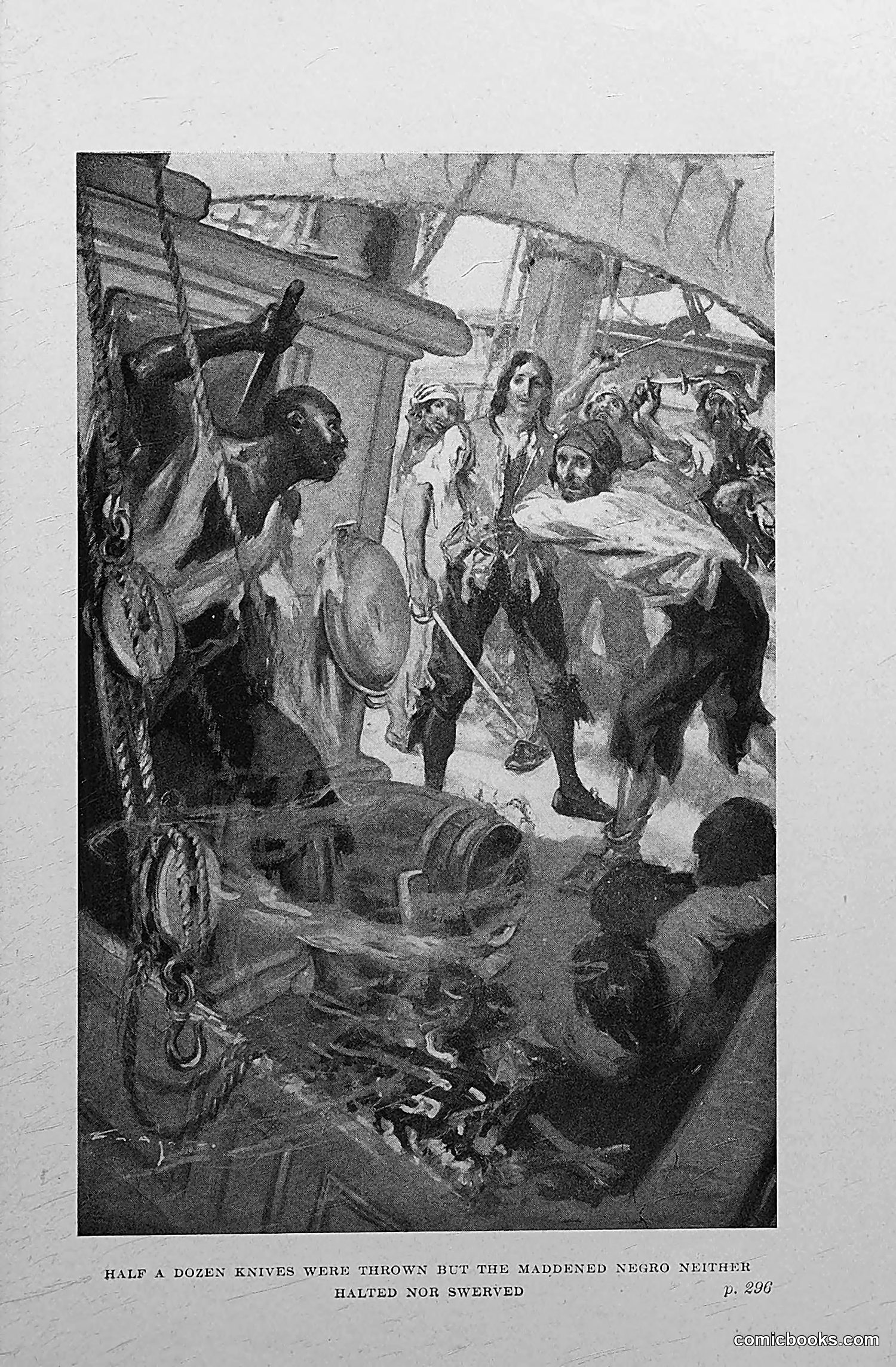
This illustration appears to be from a serialized story rather than a political cartoon. The caption references a dramatic scene where weapons are thrown at a Black character who continues moving forward undeterred. The image depicts what appears to be a ship's interior with multiple figures, including sailors and other individuals. The scene suggests action or violence, consistent with the caption's description. Without additional context about the story's title, publication date, or narrative, I cannot definitively explain the satirical point or social commentary intended. The dehumanizing language in the caption ("maddened Negro") reflects the racist terminology common in early American publications, but the specific story being illustrated—and whether it was meant as satire or adventure fiction—remains unclear from this page alone.

I can see this is a page from *The Wasp*, a historical satirical magazine, but the image quality is too degraded for me to read the OCR text clearly or discern specific cartoon content, figures, or caricatures with confidence. The page appears to show a textured, grayscale surface with various marks and scratches, but I cannot reliably identify political figures, social references, or the satirical point being made without being able to read the accompanying text or see distinguishing visual details clearly enough. To provide accurate historical context, I would need either a higher-quality image or clearer text. I cannot responsibly guess at identities or meanings without adequate visual or textual support.
This page appears to be from a serialized pirate fiction narrative rather than a political cartoon. The text describes the aftermath of a ship capture ("the Virtue"), detailing casualties and the consolidation of crew under a leader named James Burnham. The passage depicts Burnham as a charismatic pirate captain who recruits new crew members through persuasive rhetoric about the appeal of a "gentleman of fortune's" lifestyle. The narrative emphasizes his reputation and ability to convince "ignorant and unscrupulous mariners" to follow him. Without seeing accompanying illustrations, it's unclear if this contains satirical commentary on contemporary figures or events. The page reads as straightforward adventure fiction—possibly satirizing pirate romanticism or 19th-century tales of outlaws as "gentlemen"—rather than topical political satire typical of *The Wasp* magazine. The referenced figures (Burnham, Jones, Todd) appear fictional rather than historical references.
This page contains narrative text rather than a cartoon. It describes a pirate conflict involving John Trimmer (characterized as a "traitor" and "treacherous pirate") and James Burnham, who appears to be challenging Trimmer's authority. The passage depicts Burnham rallying followers by promising them treasure and assuring them they'll fight against a pirate rather than fellow seamen. The text notes Trimmer is having trouble controlling his own followers, and he's hoping the arrival of a passing brig will help him "silence" dissidents. The satire likely mocks pirate hierarchies, mutiny, and the brutal methods used to maintain control through violence and wealth distribution. Without seeing the magazine's date or broader context, the specific political allegory remains unclear, though it may reference contemporary disputes over leadership or authority.
This page is from a serialized narrative fiction rather than a political cartoon. It depicts a pirate settlement established by "Captain Trimmer" in a remote port, initially beautiful but now corrupted by an influx of criminal and marginalized people—fugitives, deserters, gamblers, murderers, and enslaved people fleeing the Spanish Main and colonial ships. The satire appears social rather than political: it critiques how such lawless settlements naturally attract society's "dregs," creating a mock-aristocracy where Trimmer and his lover Hélène rule, while immigrants are exploited as spies, gambling-house operators, and laborers. The passage suggests that without legitimate governance, such places inevitably devolve into vice and exploitation. The reference to "lights-o'-love" (mistresses) forming an "aristocracy" carries biting social commentary on the pretensions of criminal hierarchies.
This page is primarily **text rather than a cartoon**—it appears to be from a serialized narrative within *The Wasp* satirical magazine. The passage depicts a fictional pirate crew led by "John Trimmer" experiencing internal decay. The satire critiques how criminal enterprises collapse from within: Trimmer's crew, hiding after betraying associates Burnham and another schooner captain, gradually weakens as idle followers lose money to "parasite gamblers." Deaths mount through violence, disease, and alcoholism. Morale deteriorates as crew members question Trimmer's leadership—why aren't they raiding for new plunder? What happened to Burnham's vessel? The piece likely uses piracy as a metaphor for **corrupt political machines or criminal syndicates**, showing how inactivity and parasitism hollow out organizations from inside. The specific historical references to Burnham and Trimmer remain unclear without additional *Wasp* context, but the narrative structure suggests this is satirizing real figures or contemporary events recognizable to 19th-century readers.
This page contains serialized fiction rather than a cartoon. It's a moralistic narrative about John Trimmer, apparently a ship captain or naval officer who has committed treachery against figures named Burnham and "Le Diable" (The Devil). The text describes Trimmer's psychological unraveling following his betrayal—he murdered a spy who exposed him, and now suffers paranoid dread. The passage emphasizes divine retribution, suggesting his guilt is literally a "sickness of the soul" rather than physical illness. His authority crumbles and his life faces ruin. This appears to be a serialized tale with moralistic undertones typical of 19th-century American magazines: betrayal and sin inevitably bring supernatural or karmic consequences. Without additional context about the full story or publication date, the specific historical references remain unclear, though naval settings were common in period fiction.
This page contains prose narrative rather than a political cartoon—it's an excerpt from a serialized adventure story about piracy. The passage describes a character named "Trimmer" (likely a pirate captain) rallying a ragged crew to attack an unarmed merchant brig ("trader"). The narrative depicts the crew's degraded state—many are drunk, ill, or dead—and their excitement upon discovering the target carries minimal defense: no guns and only ten men. The text emphasizes the brig's vulnerability ("dull and helpless commerce") and the crew's predatory anticipation. Without additional context or visible illustrations, it's unclear what specific social or political critique *The Wasp* intended here. The passage may satirize maritime lawlessness, naval incompetence, or American merchant vulnerability during a particular historical period, but the page alone doesn't reveal *The Wasp's* satirical target.
This page contains fictional narrative prose rather than a political cartoon. It depicts a violent naval battle scene between two ships—a schooner attacking a brig—focusing on a character named Trimmer leading a boarding action. The satirical commentary appears embedded in the description of the attacking force: soldiers so weakened by fever and rum that many cannot stand under their weapons' weight. The narrator's mordant observation—"Here was a text for a sermon"—suggests The Wasp is satirizing military readiness or colonial military forces of its era, likely criticizing how diseased, intoxicated, and poorly-conditioned troops were deployed. The dramatic climax depicts Trimmer's fatal charge onto the enemy vessel, where he encounters armed defenders and explosives. Without seeing accompanying illustrations or knowing The Wasp's publication date, the specific historical military conflict or colonial power being mocked remains unclear, though the content suggests American or European imperial naval operations.
This page contains narrative text from a serialized fiction story, not a political cartoon. It describes a violent naval battle between two ships—a brig and a schooner—involving characters named James Burnham and someone called Trimmer. The passage depicts a brutal attack: makeshift explosives (bottles and jugs filled with powder) are thrown onto crowded decks, followed by close-quarters combat with pistols and knives. Burnham leads a decisive assault that becomes a one-sided slaughter rather than a fair fight. Most of Trimmer's forty-man crew are killed; only Welsh Owen and five others survive. Without seeing the magazine's date or broader context, I cannot identify the historical event or social commentary this fictional narrative may reference. The style suggests 19th-century adventure fiction.
This page contains narrative text rather than a cartoon. It appears to be from a serialized story in *The Wasp* magazine describing a pirate or naval adventure. The passage recounts a meeting where a character named Burnham proposes a risky venture to his crew. Having already won an easy victory (explained by Welsh Owen), Burnham now argues for returning to "Trimmer's harbor" to fight approximately 100 shore-based opponents for treasure allegedly hidden in the jungle and stored aboard a captured schooner. The text emphasizes the treasure's value ("rich as lords") against the dangers ("risk of their ship and their lives"), presenting a classic risk-versus-reward scenario. Without seeing the actual illustrations, we cannot determine if this is satirizing real historical figures, contemporary politicians, or serving as pure adventure fiction. The magazine's satirical nature suggests potential political allegory, but the text alone doesn't clarify the specific targets or commentary.
This appears to be the **final page of a serialized story** rather than a political cartoon. The text describes the fate of a ship called the *Wasp* and a colonial settlement at "Trimmer's harbor." The narrative concerns a character named Héléne da Silva, described as "oft-widowed," who escapes in a boat with provisions and "parasites" as the settlement collapses into disease, crime, and abandonment. The jungle reclaims the abandoned village while treasure and remnants (corroded knives, a silver buckle from Héléne's slipper, bones) presumably remain buried. **Context unclear**: Without seeing earlier pages, it's impossible to identify the specific political satire or social commentary intended. This could reference actual colonial ventures, piracy, or serve as allegorical commentary on imperial collapse—but the page alone doesn't reveal what real events or figures are being satirized.
This appears to be a prose narrative rather than a cartoon page. The text describes a mysterious passenger named James Fitzwalter boarding a ship from Jamaica to London, four months after someone named John Trimmer's death. The passage emphasizes Fitzwalter's suspicious appearance—eye patch, ill-fitting wig and clothes, hunched shoulders, heavy books—and his antisocial behavior (reading constantly, not conversing). These details suggest he's either hiding his identity or fleeing something. Without seeing an actual image or knowing the broader *Wasp* article context, the satire's specific target remains unclear. However, this setup typically signals either political commentary on a real figure in disguise or general mockery of suspicious characters. The Jamaica-to-London route and the emphasis on concealment suggest possible commentary on colonial affairs or criminal evasion, but I cannot definitively identify the intended subject without additional context.
This page appears to be text from a serialized story rather than a cartoon. It describes a mysterious character named Mr. Fitzwalter arriving in London. The satire seems to target Victorian-era social deception and class performance. Key satirical elements: **The mystery man**: Fitzwalter presents an ambiguous persona—his sad demeanor and mourning ring suggest he's a widower, yet his age is deliberately unclear (anywhere from early 30s to late 50s), mocking how people construct false identities. **Social performance**: His deliberate lodging in London and isolated lifestyle suggest calculated concealment. The revelation that his "hump" is a fake leather contrivance indicates deliberate physical deception. **The satire**: The piece likely mocks Victorian characters who fabricate tragic backstories and false appearances to manipulate social standing and sympathy. The detailed exposure of his artifice—the fake mourning, the constructed deformity—suggests *The Wasp* is exposing fraudulent social climbing or criminal masquerade common in Victorian literature and society.
This appears to be a narrative passage rather than a political cartoon. It describes a character named James Burnham (also called Mr. Fitzwalter) who removes a disguise—an artificial hump, black eye patch, and scratch-wig—revealing himself as nobility (the "heraldic device of the Burnhams"). He then visits a tailor to obtain fashionable court clothing befitting "the greatest dandy at the court of the new queen." The satire likely mocks aristocratic pretension and social climbing: a nobleman must literally shed a lowborn disguise and acquire expensive tailored clothes to present himself at court. The reference to "the new queen" suggests this may relate to a specific historical moment, though the exact context is unclear without additional publication information. The humor targets vanity, class consciousness, and the superficiality of courtly fashion.
This appears to be a serialized fiction piece rather than a political cartoon. The narrative follows a character named James who is conducting an undercover investigation, disguising himself with wigs, patches, and altered clothing to move undetected through taverns and coffee houses. The passage establishes James's detective work—he's searching for someone (likely Percy Stanton, whom other characters discuss) while maintaining a convincing disguise. The final dialogue reveals that Percy Stanton has disappeared, and the speakers care more about his wealth than his absence. The satire targets social hypocrisy: the young men admit they don't value Stanton's companionship, only his money. This reflects broader *Wasp* themes mocking materialistic Victorian society and moral pretense among the wealthy. Without seeing illustrations or knowing the full serial context, the specific political or social figures referenced remain unclear.
This appears to be prose dialogue rather than a cartoon. Two young men ("Jack" and another) gossip about a character named Percy—a disgraced aristocrat. The satire targets class pretension and hypocrisy: Percy's family rejected his marriage to a tailor's daughter despite her beauty, preferring a ruined baron's daughter for financial gain. When Percy married for love instead, his family expelled him with minimal support (1,000 guineas plus a meager annuity). The passage mocks Percy as a "bully, sot, and coward" whose privileged background—military service, a corset-maker grandfather's fortune—couldn't prevent his social and moral collapse into poverty and domestic violence. The final question ("Why does she stay?") suggests contemporary concerns about women trapped in abusive marriages, though without ironic commentary offered here.
This page contains **text narrative rather than a cartoon**—it's a satirical story or serial fiction typical of *The Wasp*, a 19th-century San Francisco satirical magazine. The passage describes a love triangle involving a woman named Kitty, her husband Percy (apparently wealthy), and Bob Willis, a poor ship's surgeon. Willis, who loved Kitty before her advantageous marriage, now haunts Percy, repeatedly slapping him while Percy refuses to fight back—suggesting Percy is either cowardly or morally compromised. The satire targets **marriage motivated by wealth over love** and the social hypocrisy it enables. Kitty remains bound to Percy by law despite her probable preference for Willis. The final paragraph shifts focus to James (likely a character witnessing this drama), whose hardened expression shows how this sordid affair has changed him—the moral corruption spreading outward. The piece satirizes Victorian marriage conventions and masculine honor codes.
This page appears to be from a serialized fictional narrative rather than a political cartoon or satirical commentary. The text describes a character named James Burnham who, spiritually broken by God's judgment, retains only an unrequited infatuation for "Kitty." He disguises himself in rough clothing to search for his enemy, Percy Stanton, in taverns and gaming houses. The passage reveals that Stanton has physically and morally deteriorated since a duel occurred on the sands of Nevis. The narrative employs melodramatic language typical of Victorian-era fiction, presenting themes of moral degradation, vengeance, and lost love. Without seeing the accompanying illustration and lacking historical context about *The Wasp* magazine's typical content, I cannot definitively explain any satirical or political point this narrative may be making. This reads as serialized literary fiction rather than topical satire.
This page contains prose narrative rather than visual satire. It describes a morality tale of moral degradation: a character named Stanton is depicted as a dissolute drunkard—"three parts coward and one part brute"—who frequents cheap taverns, gambles, and drinks spirits excessively. The passage catalogs his cruelty: he brutally assaults a crippled beggar for requesting a penny. James Burnham, following Stanton, observes this violence approvingly and recognizes it as a template for future predatory behavior. The narrative suggests social commentary on urban vice, poverty, and moral corruption—common *Wasp* themes. Stanton embodies the dissolute gentleman fallen to depravity, while the episode illustrates the callousness of the wealthy toward the disabled poor. James's calculated observation suggests this is building toward some act of exploitation or crime, positioning the narrative as cautionary tale about society's moral decay.
This appears to be a narrative passage from a serialized story in *The Wasp* magazine, rather than a cartoon. The text describes a dramatic scene involving characters named Stanton, Burnham, and a woman named Kitty in a decrepit tenement building. The passage depicts Burnham following Stanton into a shabby, poverty-stricken dwelling and discovering a woman sobbing behind a door. Burnham then deliberately adopts a drunken disguise to enter the room and observe the scene. The narrative suggests a plot involving deception and surveillance of an intimate moment, possibly implying infidelity or seduction. Without additional context about *The Wasp's* editorial stance or the full story, the specific satirical target remains unclear, though the emphasis on urban poverty and moral transgression suggests social commentary typical of Gilded Age satirical magazines.
This appears to be a **serialized fiction excerpt** rather than a political cartoon. The passage depicts a domestic violence scene: a man named Stanton is about to strike his wife with a "supple-jack" (a flexible West Indian cane) when sailor James Burnham interrupts. Burnham intervenes by tripping Stanton during a confrontation. The text emphasizes the woman's suffering—she's thin, pale, weeping, with a torn gown—portraying her as a victim of abuse. The scene's dramatic staging (candlelit, frozen moment) suggests this is from a serialized melodrama or adventure narrative. Without seeing the original publication date or surrounding context, it's unclear whether this is genuine fiction or satirical commentary on domestic relations, but the visceral depiction of spousal abuse suggests *The Wasp* may have been running serialized dramatic stories alongside its political satire.
This appears to be a passage from a serialized fictional narrative rather than a political cartoon. The text describes a dramatic scene involving theft and violence, likely from a crime or adventure story. The plot involves a protagonist named James who has hidden stolen diamonds inside a fake leather hump (a disguise device). After an intruder brutally beats a husband with a supple-jack (a flexible weapon), James retrieves his hidden treasure—gemstones described as glowing with colored fire. Without seeing accompanying illustrations or knowing the publication date and story title, it's unclear what social commentary this might contain. The narrative emphasizes James's careful preparation and the violence of the theft, but **I cannot identify the specific political or satirical targets** this story may have been mocking or critiquing in its original context. The page represents *The Wasp's* literary content rather than visual satire.
This page from *The Wasp* contains serialized fiction rather than a cartoon. It depicts James Burnham, a character who has stolen jewels (rubies, emeralds, sapphires) and sold his soul for them. Now emotionally deadened, he sells some stones to a London pawnbroker. The narrative satirizes criminal desperation and moral corruption through Burnham's cold calculation. He deceives the pawnbroker by posing as an aristocratic gambler forced to liquidate family heirlooms—a common Victorian-era excuse. The satire targets both the criminal underworld and the gullibility of pawnbrokers who accept such transparent lies. The "devilish glint in his eyes" suggests he's a con artist exploiting social assumptions about class and respectability to fence stolen goods. This appears to be a morality tale about damnation and spiritual emptiness disguised as social criticism.
This page appears to be from a serialized fiction story rather than a political cartoon—it's prose narrative text describing a character named James engaged in what seems to be a criminal scheme. The passage describes James conducting a jewelry theft or fraud (selling stones for gold), then disguising himself in various personas (dandy, scholar, mariner) to move through town undetected. He's carrying substantial money and diamonds to Stanton's lodgings under cover of darkness, having previously beaten someone named Robert Willis with a "supple-jack." **Without additional context**, it's unclear whether this satirizes a real historical figure or event, or is simply serialized fiction. The narrative emphasizes deception, criminal activity, and clandestine nighttime movement—suggesting either adventure fiction or social satire about urban crime. The specific reference to "Stanton" and the elaborate disguises suggest these may be recognizable characters to *The Wasp*'s contemporary readers, but modern readers would need additional historical context to identify them.
This page contains **narrative fiction rather than a cartoon**—it's a serialized story installment from the satirical magazine. The text depicts a melodramatic encounter between two characters: James, a gentleman caller dressed formally ("marquis or a duke"), and Kitty, apparently a married woman in distress. The scene suggests a domestic tragedy involving infidelity or abandonment. James claims he previously beat Kitty's husband (though disguised with a beard), yet insists he never harmed Kitty herself. She fears and despises him, calling him "evil." **The satire likely mocks**: Victorian melodrama conventions, the hypocrisy of "gentleman" behavior, and marital discord among the wealthy or fashionable classes—typical subjects for *The Wasp*'s social commentary. Without seeing accompanying illustrations or knowing the full serialization context, the specific political figures or events referenced remain unclear.
This appears to be a dramatic satirical scene rather than a political cartoon. The text presents a confrontation between characters named Stanton and Willis, with a woman caught between them. The passage depicts a morality play: a woman married to the despicable Stanton (whom she now hates) finds herself threatened by him when he discovers her true love is Willis—described as "good and kind and brave." The satire likely targets wealthy, corrupt men (Stanton, now rich) who use their status to control women, contrasting them with virtuous alternatives (Willis). Without additional context about *The Wasp's* publication date or specific targets, the exact figures remain unclear, but the scene critiques male villainy and female vulnerability within marriage, common themes in 19th-century American satirical literature. The drama suggests social commentary on power imbalances and moral character.
This page is from a serialized narrative fiction piece, not a political cartoon. Chapter XIX depicts a melodramatic scene between characters named James Burnham, Kitty (presumably a wife), and references to Percy (her husband), Willis, and Bob. The scene shows James taunting Kitty by suggesting her husband Percy is cowardly—afraid to fight "the little man" (Willis) despite Willis's apparent threat. James presents himself as magnanimous, claiming he poses no danger to anyone, while psychologically manipulating Kitty by emphasizing Percy's fear. This appears to be Victorian-era serialized fiction emphasizing interpersonal drama and masculine honor codes around fighting and courage. Without additional context about the publication date and the broader narrative, the specific satirical or social commentary intent remains unclear, though the piece does explore themes of masculine courage and infidelity.
This page contains **serialized fiction rather than a political cartoon**. It's a dramatic narrative scene featuring a character named James delivering contraband wealth (guineas and diamonds) to a woman, sent by her brother John who has fled to the West Indies. The passage suggests a melodramatic plot involving: - A dangerous criminal underworld (references to "guardians of the law," murder, sword combat) - Illicit money and gemstones being hidden from someone named "Master Stanton" - Threats and moral conflict between characters Without seeing the illustration (if one exists on this page), the specific satirical target is unclear. However, *The Wasp* was a satirical magazine, so this narrative likely functioned as social commentary—possibly mocking adventure literature, criminal classes, or contemporary scandals. The context and identities of the referenced figures remain uncertain without additional biographical information about the serial.
This appears to be a serialized fictional narrative rather than a political cartoon. The text describes a morality tale about Percy Stanton, a drunk man leaving a pub ("the Spotted Dog") at 2 AM, who resents his wife Kitty and threatens domestic violence with a leather belt. The passage then shifts to introduce what appears to be a setup for criminal action: two con artists or criminals at the corner of Hound Alley and Little Spanish Street. One poses as a cripple with golden guineas (wealth), while another pretends to be injured, renting crutches from the first man. This suggests they're setting a trap—likely to rob or assault the intoxicated Stanton. The satire appears to target working-class moral failings: drunkenness, domestic abuse, and petty crime in Victorian-era urban streets. Without seeing illustrations or knowing *The Wasp's* specific editorial stance, the exact satirical point remains unclear, though it seems to depict vice and criminality as interconnected social problems among the lower classes.
This appears to be a narrative illustration from *The Wasp*, a 19th-century American satirical magazine. The text describes a violent street encounter in which a disabled beggar (posing as a war veteran who "lost 'is leg a servin' o' 'is king") tricks a drunk man named Stanton into falling, then stabs him repeatedly. The satire targets **false disability claims and street crime**. The "cripple" is revealed as a con artist—he uses a fake disability to elicit sympathy and coins ("yellow boy" = gold guineas), then commits murder for profit. His survival without actual injury and his deception of genuinely sympathetic observers suggests social commentary on urban fraud and the difficulty of distinguishing real need from exploitation. The brutal violence and the beggar's calculated escape emphasize the dangers of underworld crime in cities, likely reflecting Victorian anxieties about urban poverty and criminality.
This appears to be a narrative excerpt from a serialized story rather than a political cartoon. The text describes a murder in Victorian London's underworld. The plot involves: an old man with crutches who kills a man named Stanton in a drunken brawl, leaving his body in a gutter. Stanton's widow, Kitty, accepts the coroner's verdict of accidental death from drunkenness, though she suspects the truth. She pays for a burial and fears contacting her lover Willis, believing James Burnham (the old man) killed her husband and might kill her lover too. Without seeing the accompanying illustration, the satirical or comedic intent is unclear—though *The Wasp's* typical approach would likely involve social commentary on crime, morality, or class. The narrative's melodramatic tone and morally ambiguous characters (a widow with a lover) suggest Victorian-era sensationalism that the magazine may have been mocking.
This page contains serialized fiction rather than political satire or cartoons. It's a narrative installment continuing a romantic melodrama involving characters named Kitty, Willis (a surgeon), and James Burnham. The plot concerns Kitty nursing Willis through a fever at a respectable London inn (the Green Dragon), successfully concealing her lower-class circumstances and her connection to Burnham. Willis recovers, marries her, and they plan to relocate to his country village for a quiet life. The text appears designed for *The Wasp*'s readers as serialized entertainment rather than satirical commentary. Without additional context about the full narrative, the specific social commentary or humor remains unclear—though the story's emphasis on class performance (Kitty playing "the country sister") and romantic deception suggests typical Victorian melodramatic themes that might have amused satirical magazine audiences.
This page appears to be from a serialized romantic narrative rather than a political cartoon. It depicts a dramatic moment in a love story: a man (whose surname is Willis) describes his family's modest but respectable landed wealth to a woman named Kitty, promising her security and comfort in a charming cottage. Their intimate moment is interrupted by a sudden knock at the door, and Kitty fears it's someone named James Burnham—apparently a rival or threat to her relationship. The passage emphasizes class anxieties typical of late 19th-century fiction: respectable middle-class stability versus potential social ruin. Without seeing accompanying illustrations or knowing the full serialized context, the specific satirical point remains unclear, though *The Wasp* likely used such romantic narratives for social commentary.
This page contains no visible cartoon—it's prose fiction, likely serialized narrative content from the magazine. The text depicts a dramatic domestic scene: a woman (Willis's wife) has received diamonds from a man named James Burnham and is in distress over their implication. When Burnham visits to congratulate Willis on his marriage, his cryptic remarks about admiring Willis's wife in Nevis and his emotional farewell suggest a past romantic entanglement. The satire appears to target Victorian social hypocrisy—the gentleman's polite facade masks an inappropriate prior relationship. Burnham's affected sentimentality ("growing old...a sentimentalist") performs respectability while the diamonds' metaphorical "burning" reveals the wife's guilt and anxiety. The piece likely satirizes genteel society's ability to conduct scandalous affairs while maintaining outward propriety. The specific historical references (Nevis, frigate) remain unclear without additional context.
This page appears to be from a serialized fiction story rather than a political cartoon. Willis, apparently a surgeon, has just encountered James Burnham—described as a well-dressed man with courtly manners who is secretly "a bloody pirate" with "hands reek with the blood of hundreds." The satire likely targets 19th-century anxieties about appearance versus reality: respectable society figures who hide criminal pasts, or perhaps colonial-era privateers operating under social respectability. Burnham's fine clothes and jewels are framed as "the devil's wages," emphasizing hypocrisy. Kitty's defense—"He was your friend once"—suggests complicated loyalty and history. Without additional context about which historical James Burnham (if any) is referenced, the precise political target remains unclear, though the story dramatizes tension between duty to authorities and personal relationships with charismatic transgressors.
This page contains narrative text rather than a political cartoon. It appears to be the concluding passage of a serialized story published in *The Wasp*, a 19th-century American satirical magazine. The excerpt depicts a domestic scene where Willis reconciles with his wife ("sweeting") regarding his complicated feelings about a friend named James Burnham—apparently a duelist involved in a past incident on the island of Nevis. The passage emphasizes moral ambiguity: Willis acknowledges Burnham's past crimes ("murderer of innocent voyagers") while struggling with personal loyalty. The climax involves Kitty secretly discarding six diamonds from a silk pouch, which the narrator speculates were found by a desperate poor person. The passage suggests themes common to Victorian fiction: redemption, hidden virtue, and the tension between justice and compassion. Without seeing accompanying illustrations or knowing the story's full context, the specific satirical target remains unclear.
This page contains prose fiction rather than visual cartoons. It appears to be a narrative excerpt (marked "XX," suggesting it's from a serialized story) depicting what seems to be a character transformation or disappearance. The text describes Mr. James Fitzwalter—a bookish, modest gentleman—departing his lodgings. Simultaneously, a "distinguished-looking stranger" vanishes from fashionable coffeehouses, and a bearded mariner disappears from the Spotted Dog tavern. The passage suggests these may be the same person assuming different identities or personas. The satire appears to mock a life of vice and moral corruption. James, despite acquiring wealth ("pockets full of gold"), discovers that money cannot purchase genuine satisfaction or redemption from a life spent in "vileness" and "wickedness." The final lines deliver a moralistic message—that material wealth is hollow without ethical substance—which aligns with typical 19th-century satirical commentary on greed, hypocrisy, and urban social decay. Without additional context about the publication date or authorship, the specific target remains unclear.
This page contains **serialized fiction rather than political satire or cartoons**. It appears to be a dramatic narrative excerpt, likely from a serialized story running in *The Wasp* magazine. The text describes a male character aboard a merchant ship returning to Ireland, reflecting on a woman named Kitty and a dramatic escape. He recalls his brother Alexander cutting through his bonds during a capture at Bottle Harbor, freeing him from legal arrest. The protagonist experiences conflicted emotions—bitter amusement mixed with self-pity regarding lost love, and gratitude toward his brother's intervention. **No specific historical or political figures are identifiable** from this passage. Without seeing the complete story's title, author, or previous context, the specific references and plot remain unclear. The page serves primarily as narrative fiction content rather than satirical commentary typical of *The Wasp*'s usual political cartoons.
This page contains **narrative fiction rather than a political cartoon**—it's prose storytelling from what appears to be a serialized adventure tale in *The Wasp* magazine. The passage describes a character named James arriving in Port Royal (a historical pirate haven in Jamaica) and encountering the desperate young Henry Todd. James, despite his dissolute lifestyle—spending money recklessly on drink and carousing—shows unexpected compassion by giving Todd money and keeping him as a companion. The text references **Admiral Benbow**, a real 17th-century naval commander, suggesting this is historical fiction set during the age of piracy. The satire, if present, appears subtle: perhaps mocking the contradiction between James's self-destructive hedonism and his moments of human decency, or portraying Port Royal's lawlessness. Without seeing illustrations, the editorial commentary remains unclear.
This appears to be a literary excerpt rather than a visual cartoon. The text depicts a naval press-gang encounter, likely satirizing British military recruitment practices. James Fitzwalter, a gentleman found drunk in a harbor tavern, is impressively cooperative when conscripted into naval service against the French. Rather than resist like his companions, he accepts eagerly, volunteers gold for punch, and insists the admiral should recruit educated men alongside common laborers. The satire likely targets either: (1) the absurdity of "patriotic" volunteering for military service, or (2) the class-conscious hypocrisy of gentlemen claiming duty while the poor are forcibly conscripted. Fitzwalter's excessive enthusiasm and his emphasis on his breeding and education suggest ironic commentary on upper-class pretensions to patriotism or military honor during what appears to be a Napoleonic-era conflict.
This page presents a satirical narrative about naval recruitment, likely critiquing practices where positions could be purchased. James Burnham (alias Fitzwalter) offers fifty guineas to secure a master gunner's position aboard HMS *Breda*, a seventy-gun warship. The satire targets the corrupt system of buying military commissions and ranks. When Admiral Benbow questions why a man with fifty guineas would voluntarily enlist, James falsely claims it's his "last" fifty guineas and invokes recent widowhood—transparent lies that the admiral seemingly accepts anyway ("Enough"). The humor lies in the obvious dishonesty being tolerated, suggesting the Royal Navy accepted bribes without scrutiny during this period. The character's ready deception and the admiral's indifferent dismissal mock both naval recruitment standards and the financial desperation of would-be officers. The reference to a historical Admiral Benbow (real 17th-century naval figure) adds period authenticity to the satirical commentary.
This appears to be a **literary excerpt rather than a cartoon or satire**. The page presents prose fiction, likely a serialized story in the magazine. The text describes **Master Gunner Fitzwalter**, a naval officer serving under **John Benbow** (a historical English admiral). The passage establishes Fitzwalter's character through physical description—meticulous in dress, disciplined, quiet, and devoted to his duties commanding five guns aboard a warship. A character named **Du Casse** (a French naval commander) is mentioned as a rival force to pursue. This reads as historical naval fiction, possibly depicting a 17th or 18th-century naval engagement. The reference to Benbow, who was a real historical figure, suggests this may be fictionalized history or adventure fiction serialized in *The Wasp*. Without visual cartoons present, this page functions as **text-based entertainment content** rather than satirical commentary.
This page is not a political cartoon but rather **narrative text** from what appears to be a serialized historical fiction story about Admiral John Benbow. The content describes Benbow's character and a naval expedition departing July 11, 1702, to pursue Admiral du Casse. The passage portrays Benbow as a stern, demanding but dedicated naval commander—respected by crew for his sailing expertise but feared rather than loved. He's depicted as austere and solitary, motivated by duty rather than ambition. This appears to be historical narrative content rather than satirical commentary. Without seeing illustrations or knowing the larger serial's context within *The Wasp*, it's unclear what satirical point, if any, the editors intended. The piece may have been entertainment rather than social/political satire.
This appears to be a fictional narrative excerpt rather than a political cartoon. The text describes a naval scene where an admiral promotes James Fitzwalter, a volunteer gunner, to command the starboard guns—apparently on an irregular, unauthorized basis ("I will see to it that your rank is confirmed later by the so-called proper authorities"). The satire targets naval bureaucracy and the gap between actual merit and official rank. James's dry internal reflection—wondering if he'll be hanged from his own yard-arm when his irregular promotion is discovered—mocks the arbitrary nature of military advancement. The admiral's contemptuous tone ("Fitz-What's-Yer-Name") and his circumventing proper channels suggest institutional hypocrisy: competence is recognized and rewarded, yet through improper means that expose both officer and sailor to potential legal consequences. The joke is on the absurdity of military formalism: a man promoted for genuine ability may face execution for the manner of his advancement.
This appears to be prose fiction rather than a cartoon—a narrative excerpt from a serialized story about naval warfare. The text describes a character named James (likely a naval officer) preparing his gun crews for battle against a French fleet, sighted on August 19 off Santa Marta. The passage portrays James as a harsh but competent commander—a slave-driver of men, yet generous with payment. He's motivated by pride and duty rather than ambition, expecting imminent combat with the French under Du Casse. **Historical context**: This likely references actual 18th-century Caribbean naval conflicts between British and French forces, possibly the War of Spanish Succession era. Without seeing illustrations or additional pages, the satirical point remains unclear—whether *The Wasp* was mocking British naval practices, specific historical figures, or something else entirely. The magazine appears to blend fiction with satire typical of American periodicals of this era.
This page contains narrative prose rather than a political cartoon. It appears to be serialized fiction about a naval fleet, featuring Admiral Benbow (a historical figure from English naval history) meeting with his captains aboard the flagship *Breda*. The passage describes Captain Walton of the *Ruby* arriving first—physically unprepossessing but earning Benbow's approval—while other captains arrive leisurely and without urgency. Captain Kirkby of the *Defiance* arrives last despite his ship being only two miles away, which visibly irritates the admiral. Without seeing the illustration or knowing *The Wasp's* publication date, the satirical intent remains unclear. However, this likely uses a historical naval scenario as a vehicle for contemporary social commentary about authority, dereliction of duty, or class differences—common *Wasp* themes. The characterization of Walton (humble appearance, admired anyway) versus the negligent Kirkby suggests satire about merit versus status.
This page contains **narrative text only**—no visible cartoon or illustration. It appears to be from a serialized story in *The Wasp* magazine about naval conflict between British Admiral Benbow and French forces under Admiral du Casse. The text recounts a historical naval encounter: Benbow maneuvering to engage the French fleet, signaling his captains to advance, and positioning to cut off the enemy's retreat to open sea. By the 21st, Benbow has caught the French flagship within gunshot range. This likely references the **real Battle of Barlavento (1702)**, where Admiral Benbow fought French and Spanish fleets off the Caribbean coast. The story's dramatic military narrative was apparently serialized entertainment in *The Wasp*. **Without visible illustrations**, I cannot identify satirical targets, caricatures, or political commentary this page may have contained originally.
This page contains no cartoon or satire—it's a historical narrative excerpt describing a naval battle involving the British ships *Breda* and *Ruby* against French vessels. The text recounts an engagement where British captain Benbow (likely Admiral John Benbow, a famous 17th-century British naval commander) attacks the French line, while most of his fleet hangs back cautiously. The passage emphasizes the contrast between Benbow's aggressive tactics and his captains' reluctance to engage fully—describing them as "fools and laggards." This appears to be from a longer account critical of the English fleet's performance, calling the battle "the most infamous recorded in the annals of the British navy." This is straightforward historical reportage rather than satirical commentary, possibly included in *The Wasp* as serious historical interest content.
This page contains serialized fiction rather than a political cartoon. It narrates a naval battle featuring English ships—notably the *Breda* and *Ruby*—fighting against a larger enemy force (nine ships). Key figures mentioned include John Benbow (described as lucky and valorous but angered by cowardly captains), James Burnham (commanding the *Breda's* guns with skill despite heavy casualties), and Henry Todd (a cockpit worker who joins the gun crews). The text celebrates British naval courage and gunnery expertise under extreme conditions—one-third of Burnham's men dead or disabled, yet maintaining effective fire. The narrative emphasizes individual valor and duty, with other English ships criticized for hanging back rather than engaging. Without seeing illustrations, I cannot identify specific satirical targets or cartoons, but this appears to be a jingoistic adventure narrative typical of The Wasp's era.
This appears to be a serialized fictional narrative rather than a political cartoon. The text depicts a dramatic naval encounter between Admiral John Benbow and James Burnham, a pirate captain operating under the ship-name "the Wasp." The scene plays on historical pirate lore—referencing the infamous Captain Flint (a legendary pirate figure). Benbow, recognizing Burnham as a notorious criminal, nonetheless respects his bravery in combat and grants him the courtesy of finishing the battle before execution ("you shall swing"). The passage emphasizes a code of honor among military men, even enemies: they shake hands gravely despite Benbow's death sentence hanging over Burnham. This romanticized portrayal of piracy and naval combat was typical entertainment literature for *The Wasp*'s audience. Without seeing accompanying illustrations, the satirical or comedic intent (if any) remains unclear—this reads as adventure fiction rather than satire.
This page appears to be narrative text rather than a cartoon—it's an excerpt from a serialized story about naval combat, likely depicting a historical or semi-historical battle involving British naval officers named James, Burnham, and Benbow against French ships. The passage celebrates individual heroism (Burnham's superhuman strength, Benbow's leadership) while condemning cowardice—specifically criticizing captains who refuse to engage the enemy and desert their commander. The mention of hanging "cowards who had deserted him, their country, and their queen" suggests this reflects period military values emphasizing duty and patriotic sacrifice. Without knowing the publication date or broader context of *The Wasp*, it's unclear whether this is historical fiction, contemporary commentary on military conduct, or something else entirely. The italicized ship names (*Ruby*, *Breda*) suggest actual vessels, but confirmation would require additional research.
This page contains **no cartoon or satire**—it's a straightforward historical narrative about a naval battle. The text describes what appears to be a real engagement: a British ship and brig (commanded by someone named John Benbow) fighting against superior French forces (five ships and four frigates) over multiple days. The passage recounts the fourth day of battle, emphasizing British determination ("We are not beaten yet") and casualties, including an officer named James Burnham struck by a wooden splinter. The tone is heroic and commemorative rather than satirical. **The Wasp** was primarily a satirical magazine, so this historical naval account likely served as serious editorial content rather than humor—possibly referencing an actual historical engagement to make a political point about British naval prowess or contemporary naval affairs. Without additional context about the publication date or surrounding pages, the specific historical battle referenced remains unclear.
This page appears to be **prose fiction rather than a political cartoon**—a dramatized account of a naval battle, likely from the Napoleonic Wars era (references to French ships and "Breda" suggest a historical engagement). The narrative depicts a heroic death scene: James Burnham, a young sailor, sacrifices himself in battle while an admiral (Benbow) witnesses the act from his cot after losing his leg. The text romanticizes naval warfare through dialogue emphasizing duty, sacrifice, and patriotism. The passage's satirical purpose—if any—is **unclear from the image alone**. It may be earnestly depicting British naval heroism, or *The Wasp* may be ironically mocking overwrought patriotic narratives. Without additional context about *The Wasp's* editorial stance or publication date, the intended tone cannot be determined with certainty.
This page from *The Wasp* contains no cartoon—it's a historical narrative text about a naval engagement with the French. The piece describes an admiral's final days after amputation from combat wounds, occurring seventy-two days post-injury. The text documents naval justice: two captains executed, one imprisoned, one suspended for apparent cowardice during battle. Notably, Captain Walton receives promotion for conduct during the *Ruby*'s engagement. The page concludes with the admiral's deathbed letter to Sir Walter Burnham, praising a crew member named James Fitzwalter for exceptional courage as a volunteer master gunner at Port Royal. The text appears to be commemorating military valor and accountability, typical of *The Wasp*'s occasional serious editorial content alongside its satirical cartoons.
This page presents a letter from Admiral John Benbow praising a gun captain who died heroically during a four-day naval battle against M. du Casse. The satire's point emerges in the final paragraphs: Benbow commends the officer for fighting "like a hero and died like a gentleman"—**despite** acknowledging the man's questionable past ("however he may have fought and lived in the past"). The joke targets Victorian hypocrisy about redemption and respectability. The "distinguished device tattooed on his back" likely signals the man was a convict or social outcast, yet wartime heroism supposedly erases his previous character. Benbow's formal, sympathetic language—"God have mercy on his soul"—ironically elevates someone society would normally disdain, mocking how war conveniently rebrands disreputable men as patriots when they're useful. The satire critiques both military necessity and middle-class moralism about social standing.

I cannot reliably read the content in this image. The photograph shows what appears to be a heavily worn or damaged page with significant grain, scratches, and deterioration that obscures most text and visual details. While there appears to be some printed material and possibly illustrations, the image quality is too poor for me to confidently identify specific figures, caricatures, political references, or satirical content. To properly analyze this page from *The Wasp* magazine, a higher-quality scan or photograph would be necessary. If you have access to a clearer version, I'd be happy to examine it.

I can see this is a page from *The Wasp*, a historical satirical magazine, but the image quality is too degraded for me to read the OCR text clearly or identify specific cartoon content with confidence. The page appears to show a textured surface with some fine lines or marks scattered across it, but I cannot make out distinct figures, caricatures, or illustrations that would allow me to explain the satire or political references to a modern reader. To provide accurate historical analysis as you've requested, I would need a clearer image where the cartoon artwork and text are legible. I cannot responsibly speculate about content I cannot clearly see.

I appreciate your request, but I must be honest about what I can observe here: this image is extremely dark and low-contrast, making it nearly impossible to discern specific cartoon details, figures, caricatures, or text content beyond the watermark "comicbooks.com" at the bottom. While you've indicated OCR text should be present, I cannot reliably read any text on the page itself. Without being able to identify specific figures, labels, or satirical elements, I cannot responsibly explain the cartoon's meaning to a modern reader. To provide accurate historical context as you've requested, I would need either a clearer image or the complete OCR text you reference. I'd recommend verifying the image quality or providing the extracted text separately.

This page appears to be largely blank or heavily degraded, making it impossible to discern any actual cartoon imagery or legible text content. The OCR output is gibberish—strings of random characters that don't form coherent words or sentences. The only clearly readable element is the archival barcode at the bottom ("*P4-ANL-660*"), which identifies this as a catalog item from The Wasp magazine's collection. Without visible cartoon illustrations or readable satirical text, I cannot identify specific political figures, social references, or the intended joke or message. The page may be a blank issue, severely damaged, or poorly scanned.

I cannot reliably interpret this image. The photograph shows what appears to be an open dark cabinet or box with metal hardware and hinges, photographed in black and white. There are no clearly visible cartoon illustrations, text, or human figures that would allow me to identify political references, caricatures, or satirical content. The OCR text provided consists only of scattered letters and characters that don't form readable words or sentences. Without legible content or visible illustrations, I cannot explain what this page from *The Wasp* magazine means or what satire it contains. If this is indeed a magazine page, the image quality or angle may be preventing proper analysis.