
The Wasp, 1913 · page 306 of 364
The Wasp — 1913 — page 306: what you’re looking at
What you’re looking at
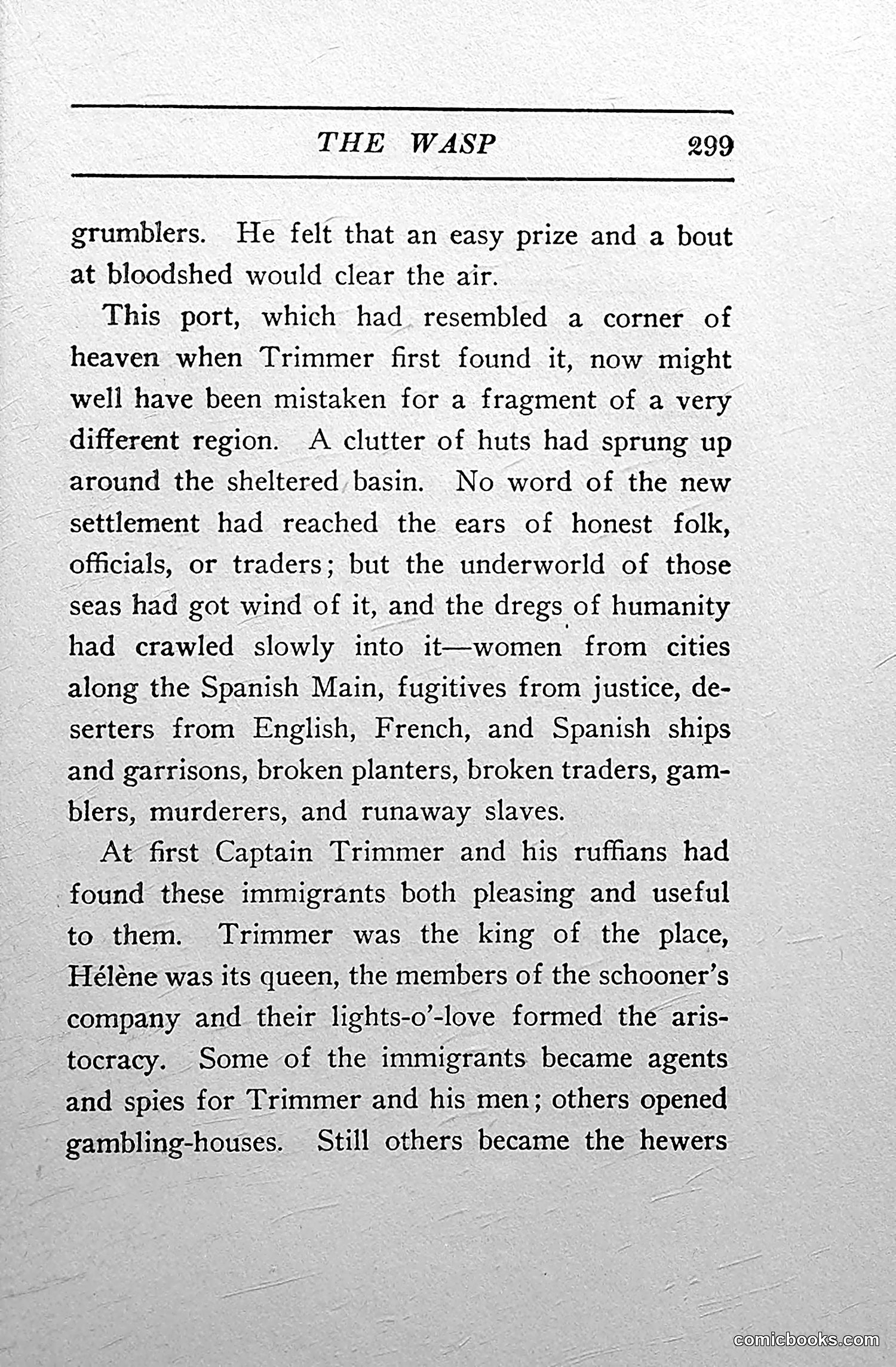
This page is from a serialized narrative fiction rather than a political cartoon. It depicts a pirate settlement established by "Captain Trimmer" in a remote port, initially beautiful but now corrupted by an influx of criminal and marginalized people—fugitives, deserters, gamblers, murderers, and enslaved people fleeing the Spanish Main and colonial ships. The satire appears social rather than political: it critiques how such lawless settlements naturally attract society's "dregs," creating a mock-aristocracy where Trimmer and his lover Hélène rule, while immigrants are exploited as spies, gambling-house operators, and laborers. The passage suggests that without legitimate governance, such places inevitably devolve into vice and exploitation. The reference to "lights-o'-love" (mistresses) forming an "aristocracy" carries biting social commentary on the pretensions of criminal hierarchies.
📄 Transcribed text from this page (OCR, searchable)
Machine-transcribed from the original scan — historical spelling and the odd misread are preserved.
RSE er EON LE GO Lr SSE THE WASP 299 grumblers. He felt that an easy prize and a bout at bloodshed would clear the air. This port, which had. resembled a corner of heaven when Trimmer first found it, now might well have been mistaken for a fragment of a very different region. A clutter of huts had sprung up around the sheltered basin. No word of the new settlement had reached the ears of honest folk, officials, or traders; but the underworld of those seas had got wind of it, and the dregs of humanity had crawled slowly into it—women from cities along the Spanish Main, fugitives from justice, de- serters from English, French, and Spanish ships and garrisons, broken planters, broken traders, gam- blers, murderers, and runaway slaves. At first Captain Trimmer and his ruffians had found these immigrants both pleasing and useful to them. Trimmer was the king of the place, Héléne was its queen, the members of the schooner’s company and their lights-o’-love formed the aris- tocracy. Some of the immigrants became agents and spies for Trimmer and his men; others opened gambling-houses. Still others became the hewers Comichooks.com