
The Wasp, 1913 · page 252 of 364
The Wasp — 1913 — page 252: what you’re looking at
What you’re looking at
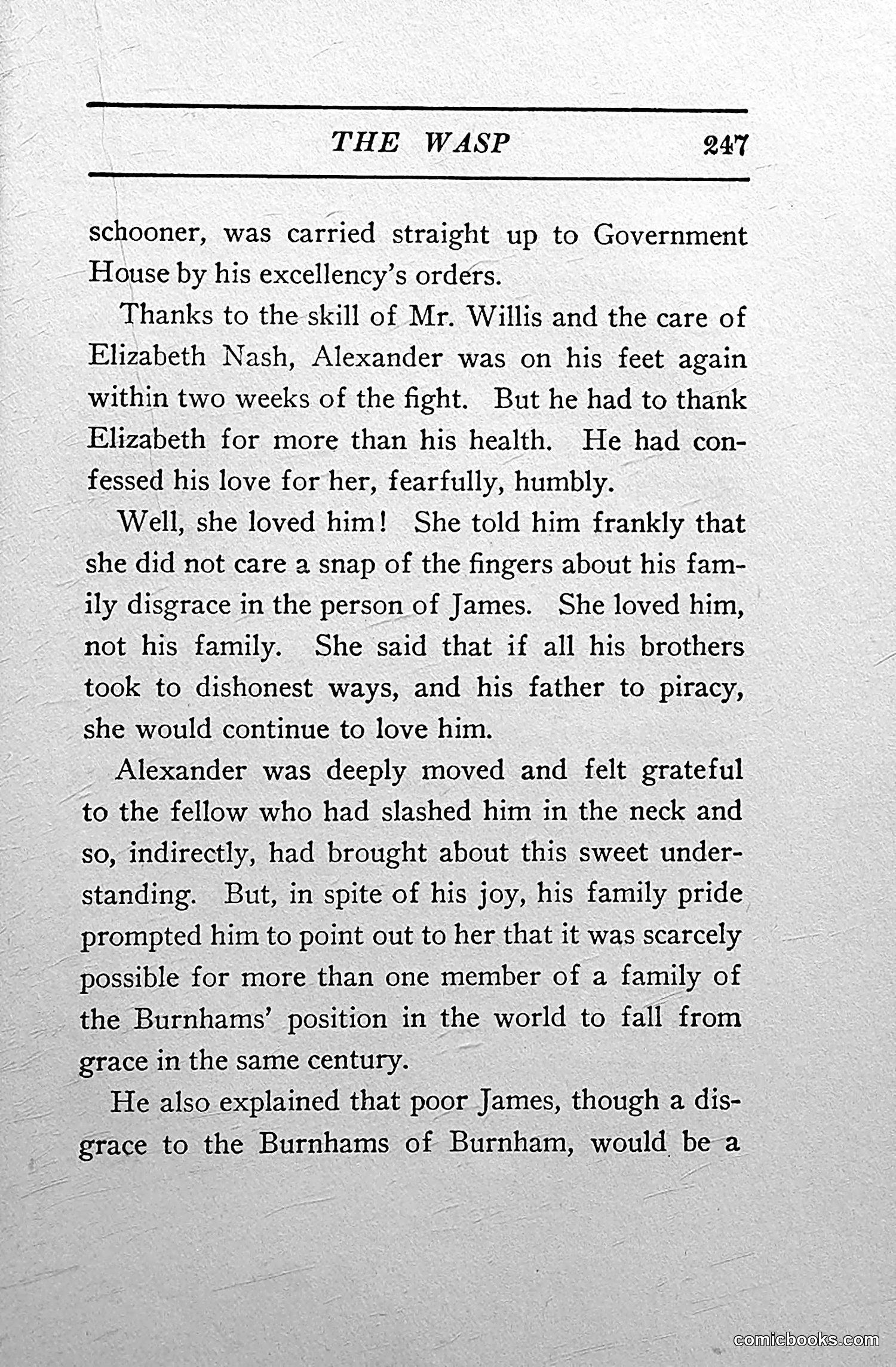
This page is **narrative fiction**, not a political cartoon. It appears to be serialized fiction from *The Wasp*, a 19th-century American satirical magazine. The passage describes a romantic subplot involving characters named Alexander and Elizabeth Nash. After Alexander recovers from a fight (apparently stabbed in the neck), he confesses his love to Elizabeth. She declares she loves *him* personally, indifferent to his family's social disgrace—specifically his brother James's misconduct and his father's apparent piracy. The satire lies in Alexander's response: despite his joy, family pride compels him to assure Elizabeth that it's "scarcely possible" for *more than one* member of the prominent Burnham family to "fall from grace in the same century"—a darkly humorous commentary on upper-class hypocrisy and the assumption that social standing provides immunity from repeated scandal. The passage mocks aristocratic self-importance and selective morality.
📄 Transcribed text from this page (OCR, searchable)
Machine-transcribed from the original scan — historical spelling and the odd misread are preserved.
SS THE WASP 247 schooner, was carried straight up to Government House by his excellency’s orders. Thanks to the skill of Mr. Willis and the care of Elizabeth Nash, Alexander was on his feet again within two weeks of the fight. But he had to thank Elizabeth for more than his health. He had con- fessed his love for her, fearfully, humbly. Well, she loved him! She told him frankly that she did not care a snap of the fingers about his fam- ily disgrace in the person of James. She loved him, not his family. She said that if all his brothers took to dishonest ways, and his father to piracy, she would continue to love him. Alexander was deeply moved and felt grateful to the fellow who had slashed him in the neck and so, indirectly, had brought about this sweet under- standing. But, in spite of his joy, his family pride prompted him to point out to her that it was scarcely possible for more than one member of a family of the Burnhams’ position in the world to fall from grace in the same century. He also explained that poor James, though a dis- grace to the Burnhams of Burnham, would be a _ comichooks.comm