
The Wasp, 1913 · page 32 of 364
The Wasp — 1913 — page 32: what you’re looking at
What you’re looking at
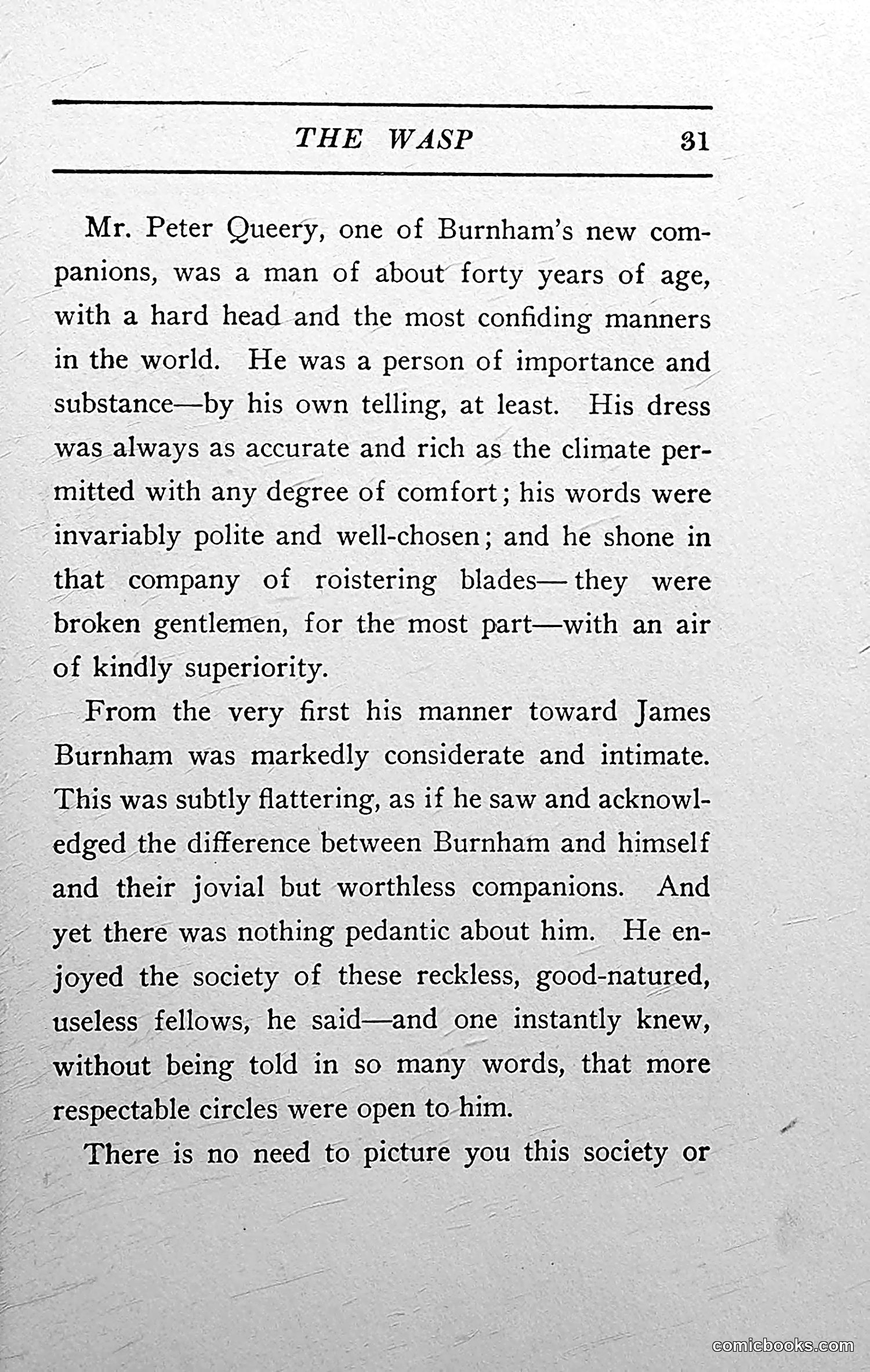
This appears to be a narrative passage from *The Wasp* rather than a political cartoon. The text introduces Mr. Peter Queery, described as a new companion to someone named James Burnham. The satire here targets Queery's transparent social pretension. Though he claims to enjoy the company of "reckless, good-natured, useless fellows" and treats them with "kindly superiority," his behavior reveals his actual contempt—he makes clear (without stating it directly) that he belongs to "more respectable circles." The wit lies in exposing Queery's hypocrisy: his polished manners and flattering attention mask condescension. By treating Burnham with special consideration and intimacy, Queery subtly signals that Burnham ranks above the other "broken gentlemen," a backhanded compliment that reveals Queery's class consciousness and snobbery. The target of satire is likely this type of social climber or snob who uses performative politeness as a tool for social positioning.
📄 Transcribed text from this page (OCR, searchable)
Machine-transcribed from the original scan — historical spelling and the odd misread are preserved.
THE WASP 31 Mr. Peter Queery, one of Burnham’s new com- panions, was a man of about forty years of age, with a hard head and the most confiding manners in the world. He was a person of importance and substance—by his own telling, at least. His dress was always as accurate and rich as the climate per- mitted with any degree of comfort; his words were invariably polite and well-chosen; and he shone in that company of roistering blades—they were broken gentlemen, for the most part—with an air of kindly superiority. From the very first his manner toward James Burnham was markedly considerate and intimate. This was subtly flattering, as if he saw and acknowl- edged the difference between Burnham and himself and their jovial but worthless companions. And yet there was nothing pedantic about him. He en- joyed the society of these reckless, good-natured, useless fellows, he said—and one instantly knew, without being told in so many words, that more respectable circles were open to him. There is no need to picture you this society or Comichooks.com