
The Wasp, 1913 · page 319 of 364
The Wasp — 1913 — page 319: what you’re looking at
What you’re looking at
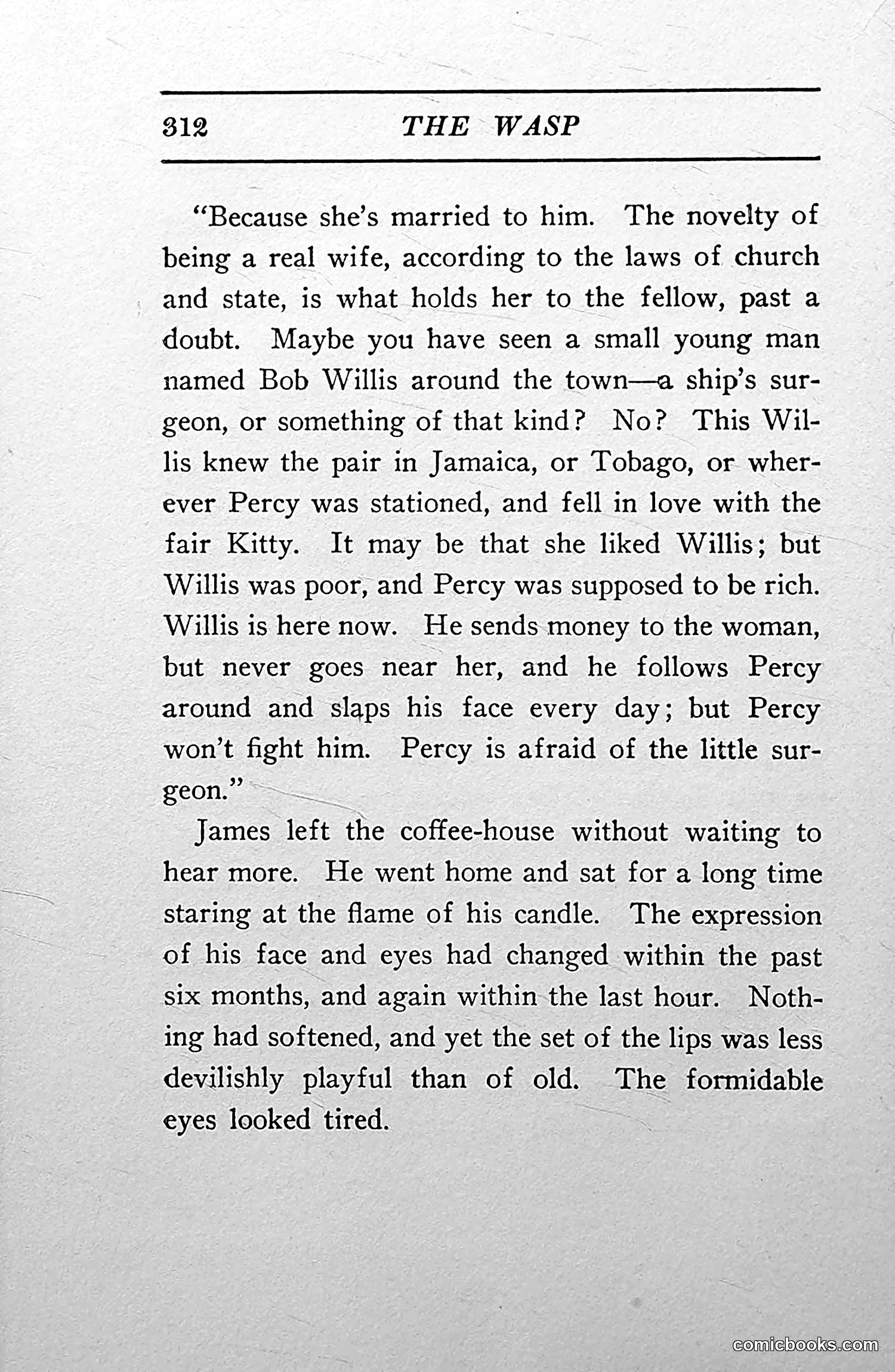
This page contains **text narrative rather than a cartoon**—it's a satirical story or serial fiction typical of *The Wasp*, a 19th-century San Francisco satirical magazine. The passage describes a love triangle involving a woman named Kitty, her husband Percy (apparently wealthy), and Bob Willis, a poor ship's surgeon. Willis, who loved Kitty before her advantageous marriage, now haunts Percy, repeatedly slapping him while Percy refuses to fight back—suggesting Percy is either cowardly or morally compromised. The satire targets **marriage motivated by wealth over love** and the social hypocrisy it enables. Kitty remains bound to Percy by law despite her probable preference for Willis. The final paragraph shifts focus to James (likely a character witnessing this drama), whose hardened expression shows how this sordid affair has changed him—the moral corruption spreading outward. The piece satirizes Victorian marriage conventions and masculine honor codes.
📄 Transcribed text from this page (OCR, searchable)
Machine-transcribed from the original scan — historical spelling and the odd misread are preserved.
312 THE WASP “Because she’s married to him. The novelty of being a real wife, according to the laws of church and state, is what holds her to the fellow, past a doubt. Maybe you have seen a small young man named Bob Willis around the town—a ship’s sur- geon, or something of that kind? No? This Wil- lis knew the pair in Jamaica, or Tobago, or wher- ever Percy was stationed, and fell in love with the fair Kitty. It may be that she liked Willis; but Willis was poor, and Percy was supposed to be rich. Willis is here now. He sends.money to the woman, but never goes near her, and he follows Percy around and slaps his face every day; but Percy won't fight him. Percy is afraid of the little sur- geon.” James left the coffee-house without waiting to hear more. He went home and sat for a long time staring at the flame of his candle. The expression of his face and eyes had changed within the past six months, and again within the last hour. Noth- ing had softened, and yet the set of the lips was less devilishly playful than of old. The formidable eyes looked tired. Comichooks.com