comicbooks.com Join Free

A complete, restored issue of Pulp Fiction from 1939 — all 116 pages of painted-cover fiction magazines that launched science fiction, horror, and hardboiled crime, free to page through at comicbooks.com.

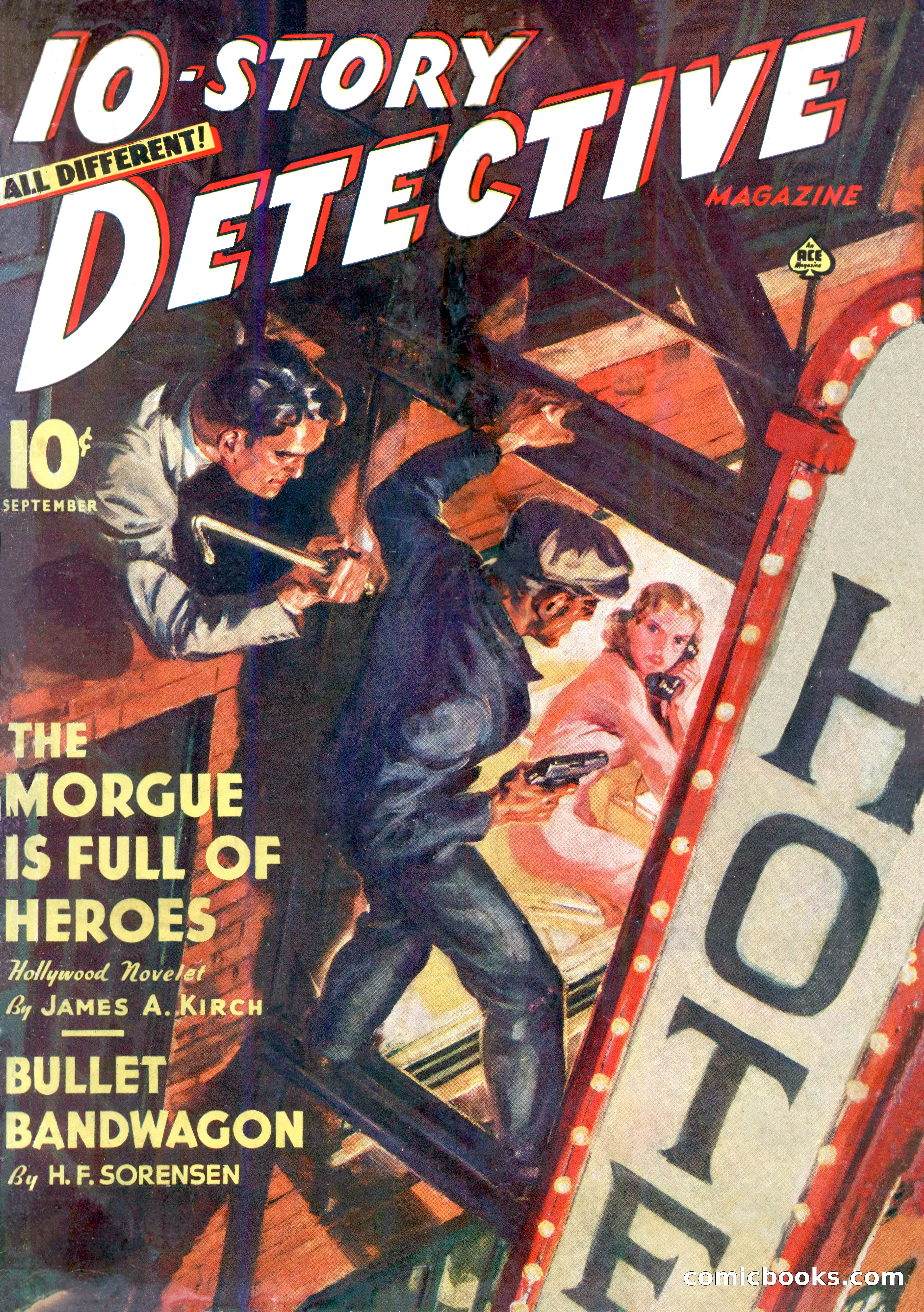
On the cover: This is the cover of a 10-story Detective Magazine from September, priced at 10 cents. The illustration depicts a dramatic scene at what appears to be a nightclub or theater entrance, with a detective examining or confronting a figure while a woman and man look on in apparent distress or concern. The main featured story, "The Morgue Is Full of Heroes," is a Hollywood novella by James A. Kirch. Another story, "Bullet Bandwagon" by H.F. Sorensen, is also advertised. The cover emphasizes the pulp magazine's typical blend of crime, mystery, and dramatic action.

🖼️ Every page has a plain-English note on what you’re looking at — the figures, the references, the point of the satire.

← Back to Pulp Fiction All exhibitions

HomeExhibitionPulp FictionRead

A complete issue · 116 pages · 1939

10-Story Detective Magazine Cover
1939 · Free to read

10-Story Detective Magazine Cover — page 1 of 116
1 / 116
What you’re looking at · open this page on its own ↗

This is the cover of a 10-story Detective Magazine from September, priced at 10 cents. The illustration depicts a dramatic scene at what appears to be a nightclub or theater entrance, with a detective examining or confronting a figure while a woman and man look on in apparent distress or concern. The main featured story, "The Morgue Is Full of Heroes," is a Hollywood novella by James A. Kirch. Another story, "Bullet Bandwagon" by H.F. Sorensen, is also advertised. The cover emphasizes the pulp magazine's typical blend of crime, mystery, and dramatic action.

10-Story Detective Magazine Cover — page 2 of 116
2 / 116
What you’re looking at · open this page on its own ↗

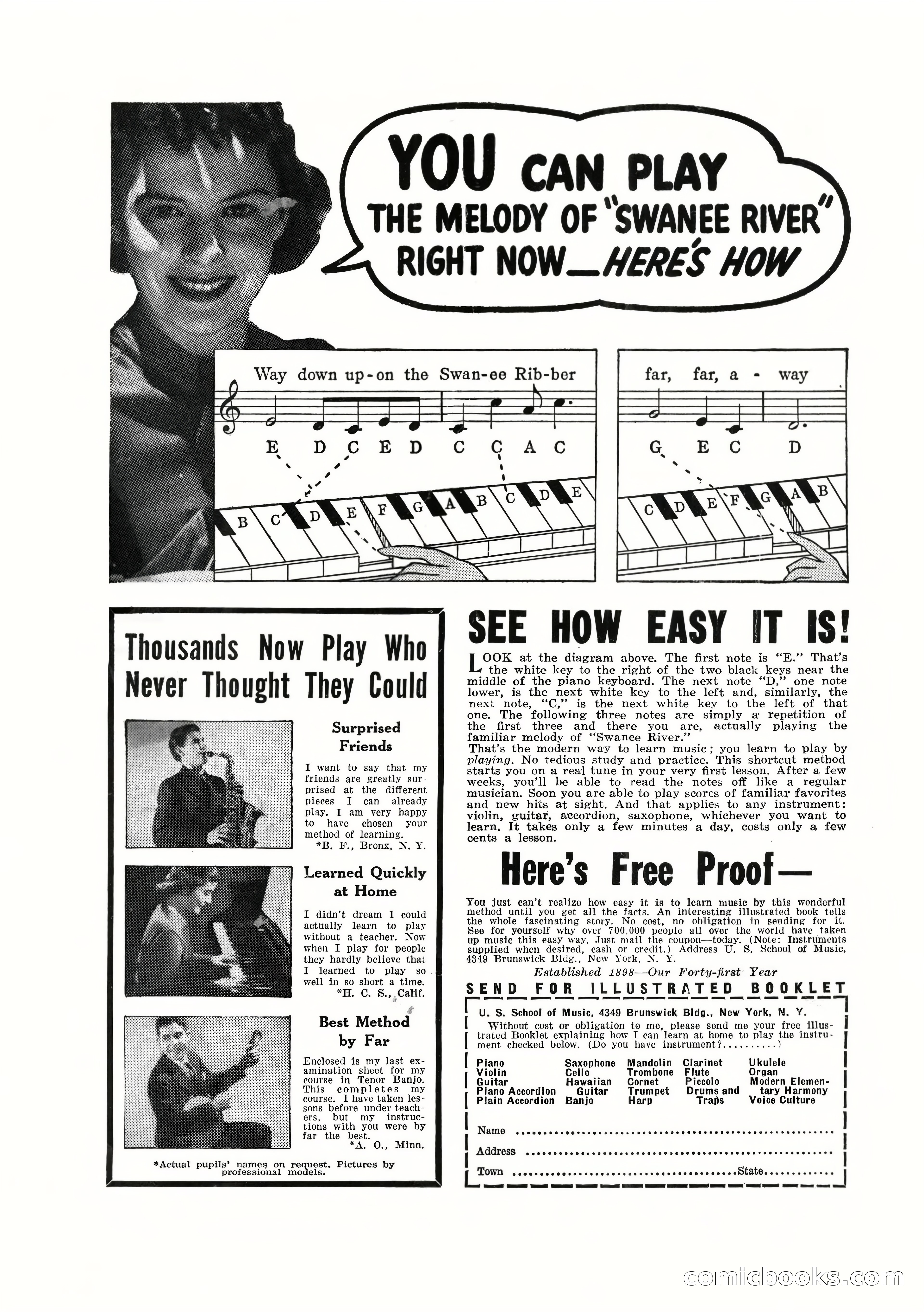
# Advertisement Page: U.S. School of Music This is an advertisement page promoting the U.S. School of Music's method for learning to play instruments at home. The top half features a woman instructing readers on how to play "Swanee River" on piano using a simple diagram. Below are testimonials from satisfied students claiming they learned quickly without traditional teachers. The bottom half is a mail-in coupon offering a free illustrated booklet explaining the school's teaching method, which claims over 700,000 people worldwide have used it. The ad emphasizes learning music through playing familiar tunes rather than tedious practice.

10-Story Detective Magazine Cover — page 3 of 116
3 / 116
What you’re looking at · open this page on its own ↗

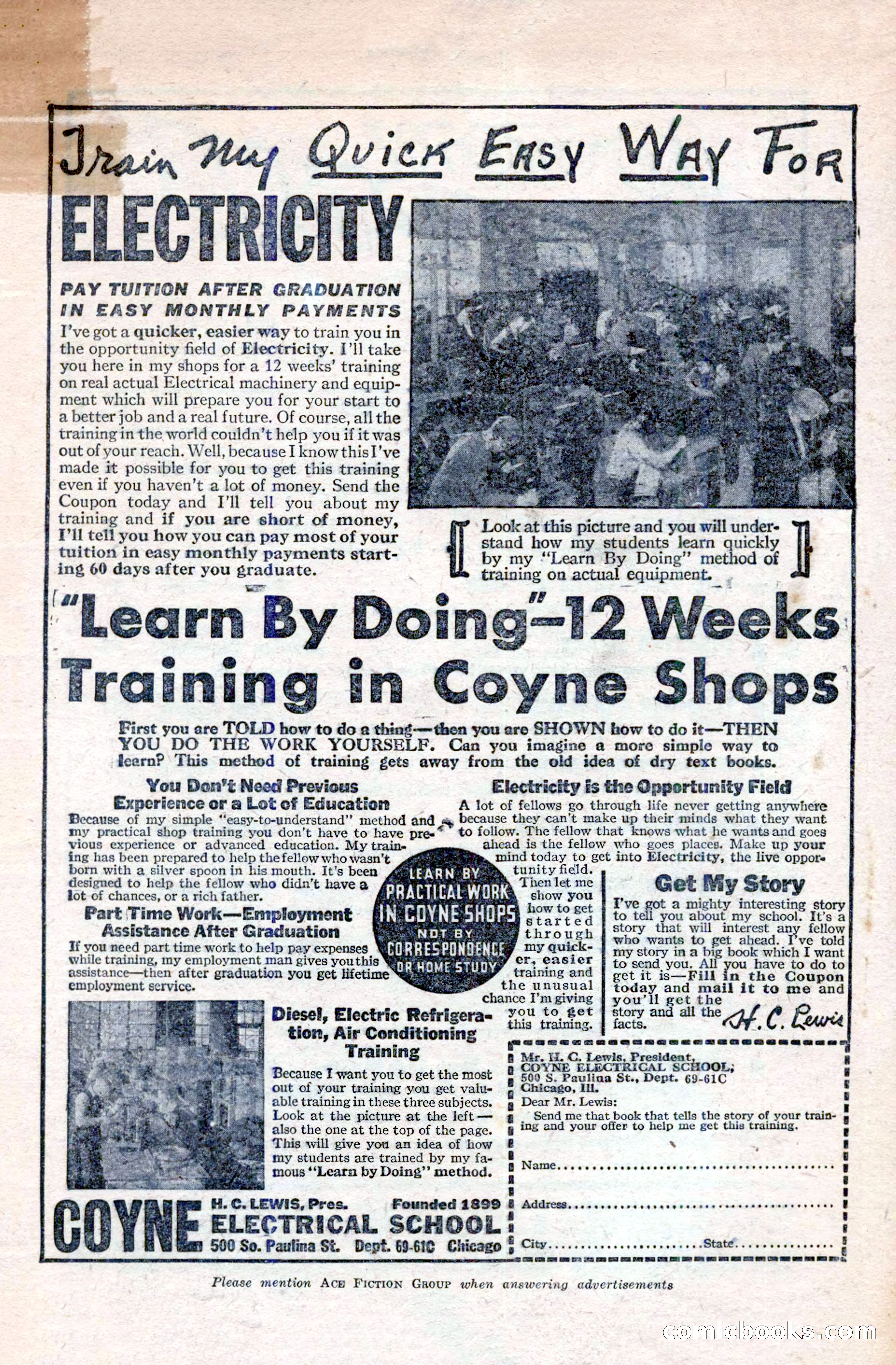
# Analysis of This Magazine Page This is a full-page **advertisement**, not story prose or editorial content. It promotes the Coyne Electrical School in Chicago, founded in 1899, offering a twelve-week "Learn By Doing" vocational training program in electricity, diesel engines, refrigeration, and air conditioning. The ad emphasizes hands-on training without requiring prior experience, affordable tuition with monthly payments beginning sixty days after graduation, and employment assistance after completion. It includes photographs of students working with electrical equipment, testimonial language from school president H.C. Lewis, and a coupon for readers to request an informational booklet.

10-Story Detective Magazine Cover — page 4 of 116
4 / 116
What you’re looking at · open this page on its own ↗

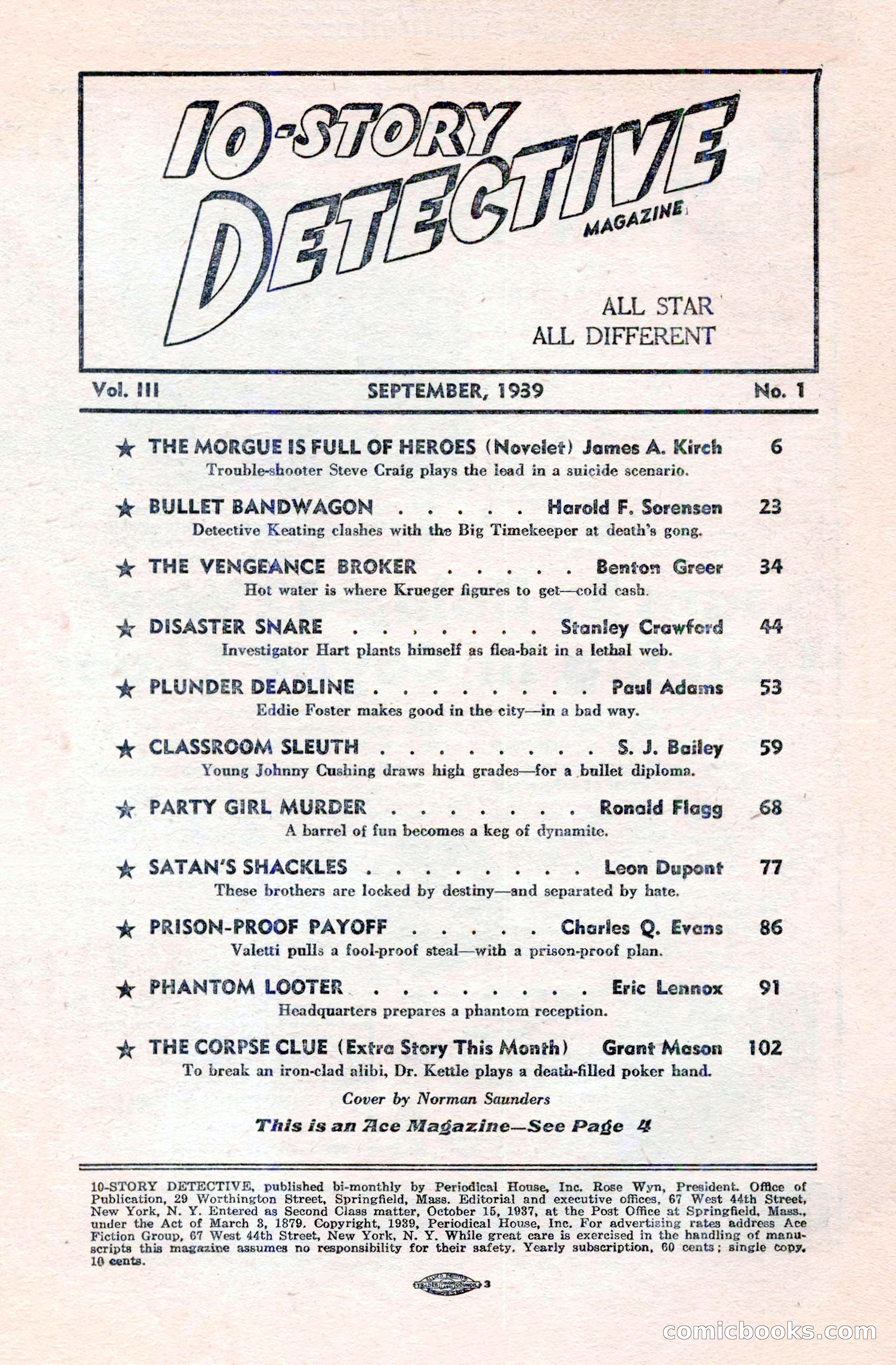
# 10-Story Detective Magazine Table of Contents This is a **table of contents page** from the September 1939 issue of *10-Story Detective* magazine (Vol. III, No. 1), published bi-monthly by Periodical House, Inc. The page lists eleven crime and detective stories by various authors, including titles like "The Morgue is Full of Heroes" by James A. Kirch and "Bullet Bandwagon" by Harold F. Sorenson, along with brief plot summaries and page numbers. The cover illustration is credited to Norman Saunders. Publication details appear at the bottom, noting the magazine cost 10 cents per copy.

10-Story Detective Magazine Cover — page 5 of 116
5 / 116
What you’re looking at · open this page on its own ↗

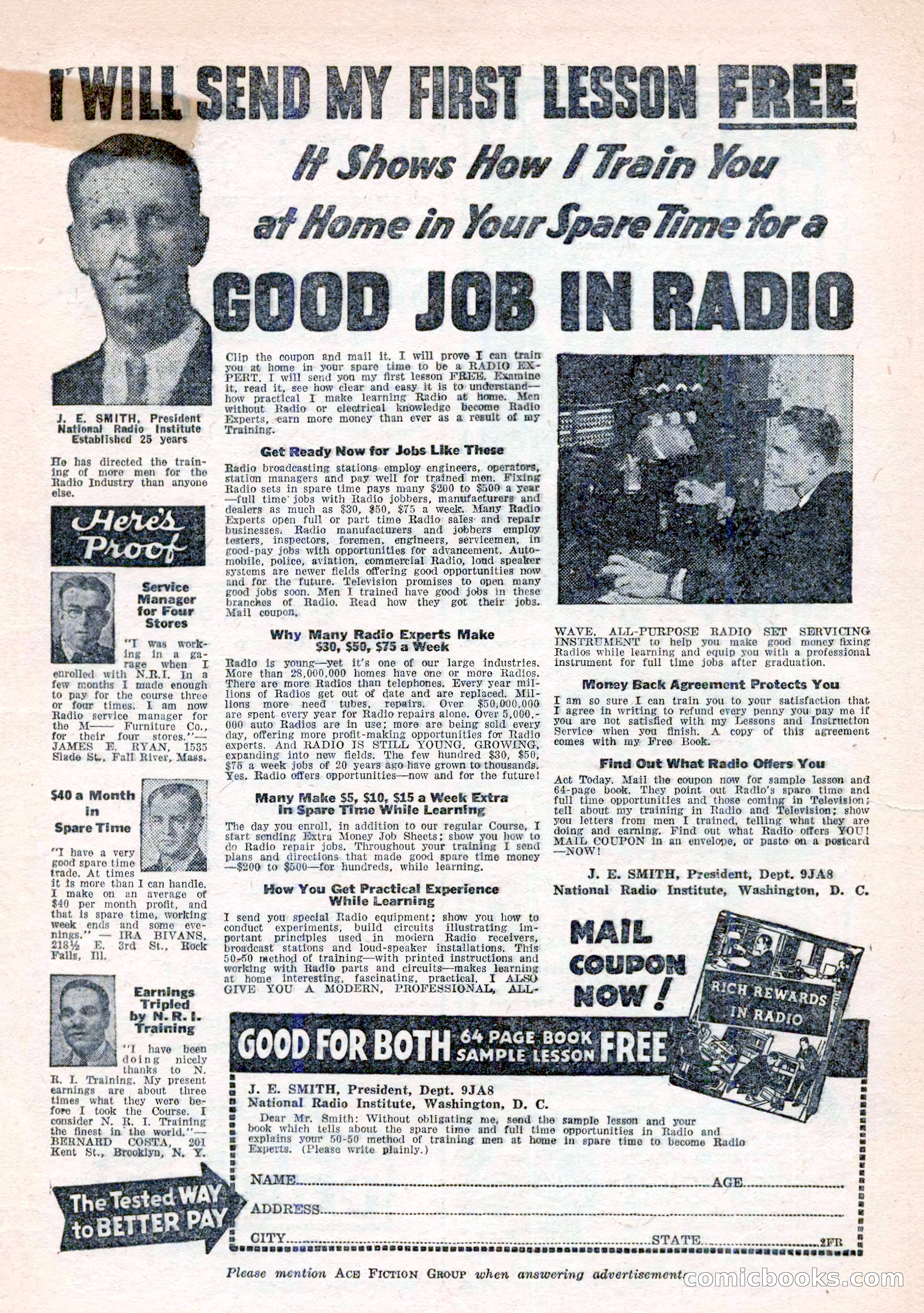
# This Page: Advertisement This is a full-page advertisement for the National Radio Institute's home-study radio training course, presented by J. E. Smith, the institute's president. The ad promises free first lessons and emphasizes job opportunities in the growing radio industry, featuring testimonials from men who reportedly earned $40-75 per week after completing the training. A mail-in coupon appears at the bottom for interested readers to request information.

10-Story Detective Magazine Cover — page 6 of 116
6 / 116
What you’re looking at · open this page on its own ↗

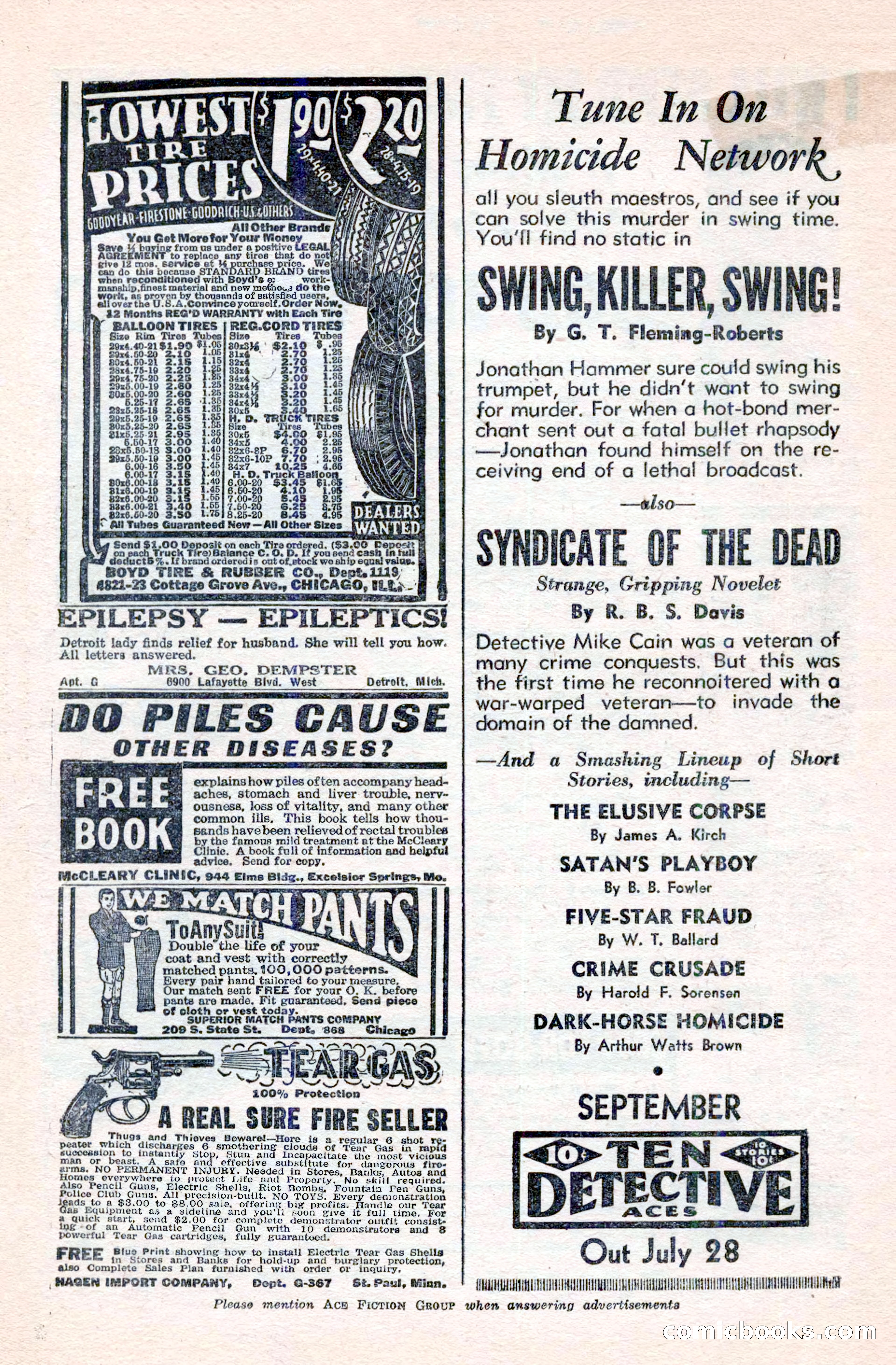
# Analysis of This Pulp Magazine Page This is a contents/advertisement page from a pulp fiction magazine (appears to be *Ten Detective Aces*, dated September, out July 28). The right side promotes the magazine's featured crime and detective stories, including "Swing, Killer, Swing!" by G. T. Fleming-Roberts about a trumpet player accused of murder, and "Syndicate of the Dead" by R. B. S. Davis featuring Detective Mike Cain. The left side consists entirely of period advertisements for tire sales, epilepsy treatments, medical remedies for piles, mail-order pants matching, and tear gas weapons—typical commercial ads found in early pulp magazines targeting working-class readers.

10-Story Detective Magazine Cover — page 7 of 116
7 / 116
What you’re looking at · open this page on its own ↗

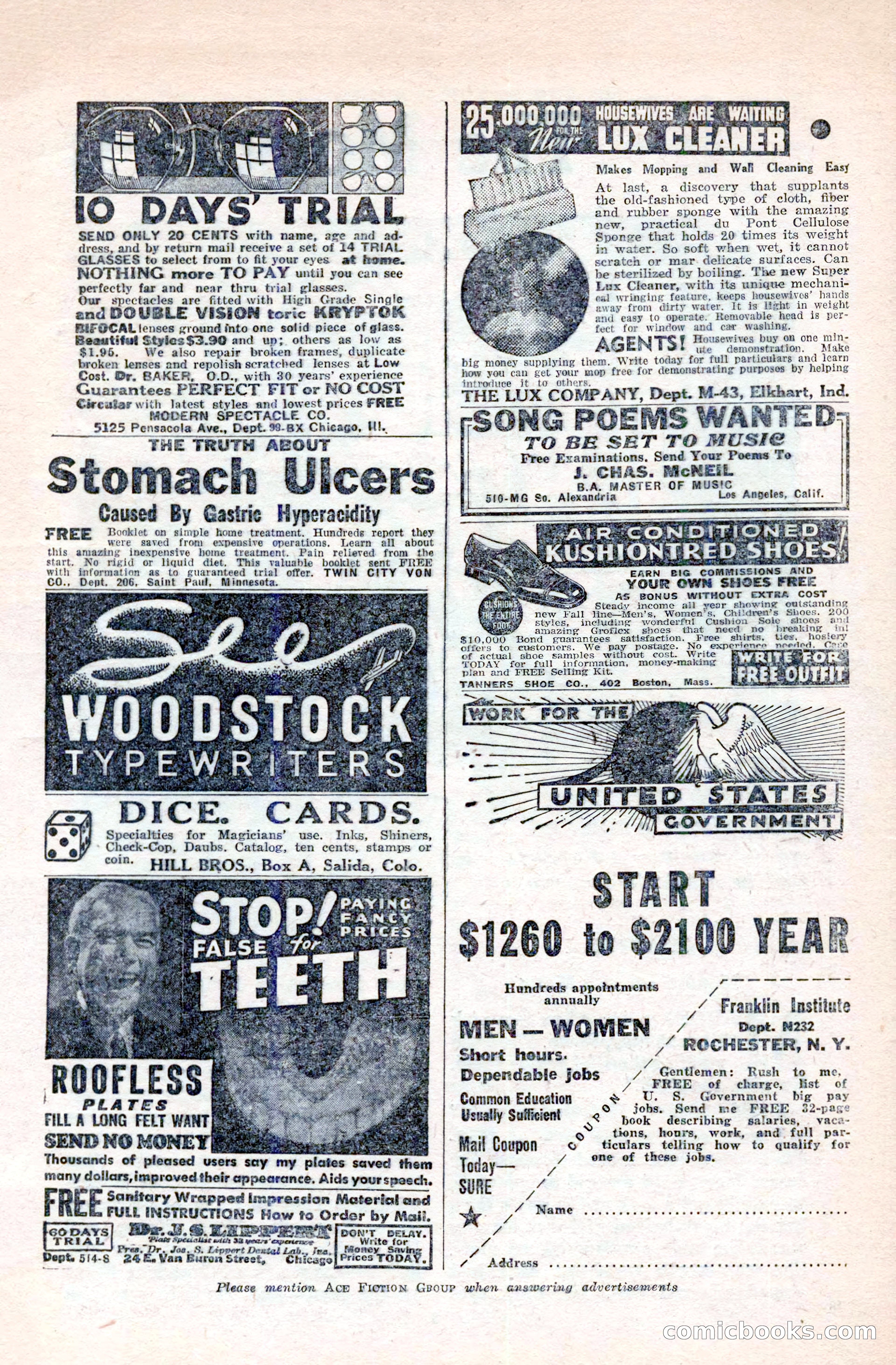
This page is primarily advertising, typical of pulp magazine back matter. It features various mail-order product and service advertisements including eyeglasses, stomach ulcer treatments, typewriters, dice and magic tricks, denture plates, shoe sales commissions, a mop/cleaning device, song composition services, and a U.S. Government job recruitment notice offering $1,260 to $2,100 yearly salaries. The ads promise free trials, home demonstrations, and quick money-making opportunities—standard appeals of early-20th-century direct-mail marketing aimed at working-class readers.

10-Story Detective Magazine Cover — page 8 of 116
8 / 116
What you’re looking at · open this page on its own ↗

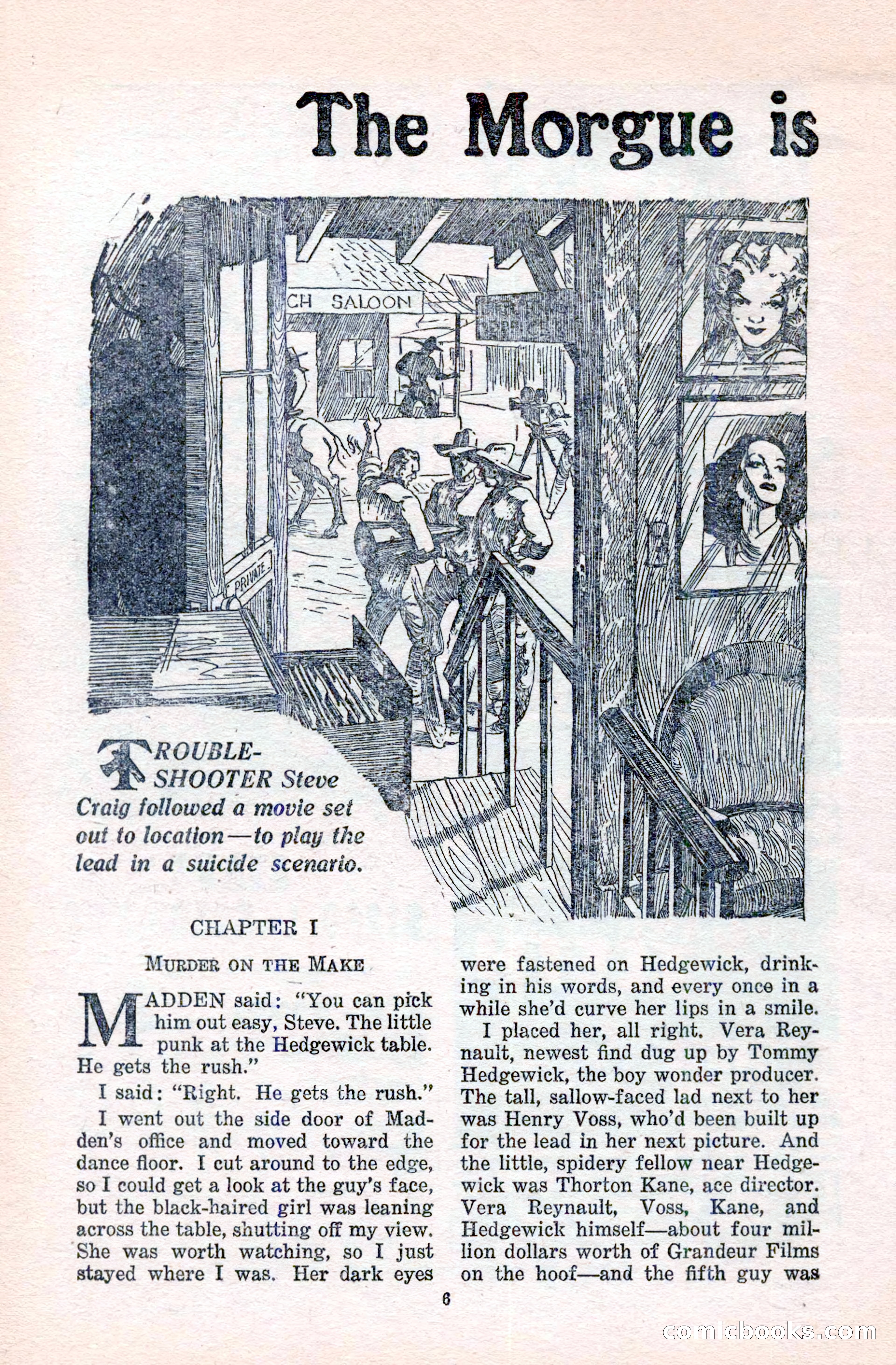
# Page Analysis This is an interior story page from a pulp magazine featuring both illustration and prose text. The top half shows a sketch illustration of what appears to be a nightclub or saloon scene with multiple figures. Below that begins "Chapter I: Murder on the Make," a hardboiled crime story narrated by a character named Steve Craig, who appears to be a troubleshooter following a movie production to a location shoot. The visible text introduces Craig's assignment to identify a target at a table where film industry figures—including producer Hedgewick, actress Vera Reynault, and director Thorton Kane—are gathered, establishing a noir mystery plot involving Hollywood personalities and apparent danger.

10-Story Detective Magazine Cover — page 9 of 116
9 / 116
What you’re looking at · open this page on its own ↗

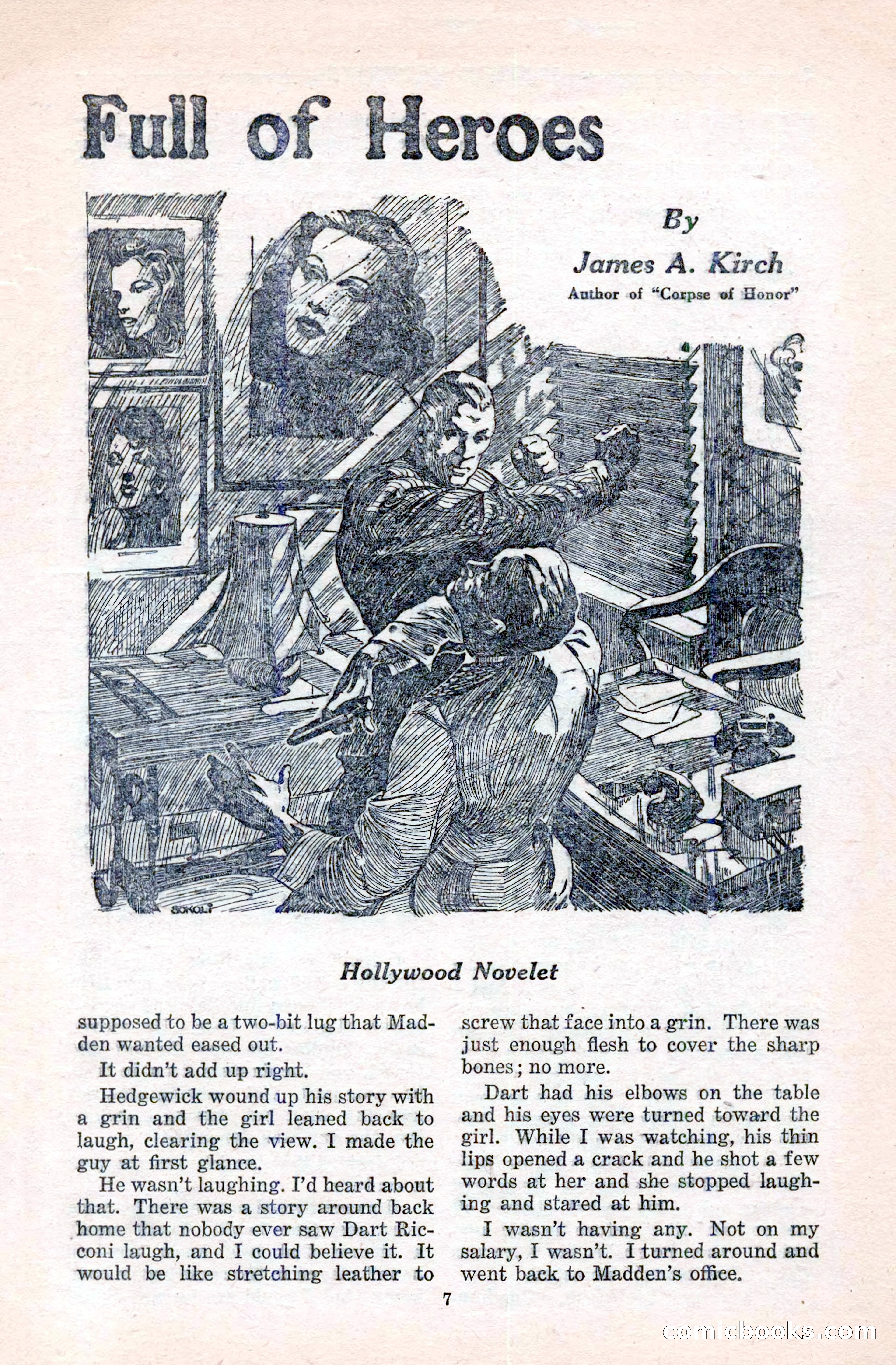
# Page Analysis This is an interior story page from a pulp magazine featuring a short story titled "Hollywood Novelet" by James A. Kirch (author of "Corpse of Honor"). The page includes a dramatic illustration at the top showing several figures in what appears to be an office or indoor setting, rendered in stark black-and-white woodcut style. Below the illustration is narrative prose describing a hardboiled crime scene: a narrator observing characters named Hedgewick, Dart Ricconi, and a girl, with Dart notably unable or unwilling to laugh despite the others' amusement. The narrator ultimately decides to leave the situation and return to Madden's office.

10-Story Detective Magazine Cover — page 10 of 116
10 / 116
What you’re looking at · open this page on its own ↗

# Page Analysis: 10-Story Detective This page contains story prose from what appears to be a hardboiled crime narrative. The narrator, a character named Steve, negotiates with his boss Madden to remove a troublemaker named Dart Ricconi from what seems to be a nightclub or bar. Madden agrees to pay Steve one hundred dollars to handle the situation. The narrative then follows Steve observing Ricconi on the dance floor, noting his dangerous demeanor and physical presence. The page is dense with dialogue and internal narration typical of pulp detective fiction, focusing on a seemingly straightforward job that carries hints of danger and complexity.

10-Story Detective Magazine Cover — page 11 of 116
11 / 116
What you’re looking at · open this page on its own ↗

This is story prose from page 9 of a hardboiled crime pulp magazine titled "The Morgue Is Full of Heroes." The narrator describes a violent confrontation in a bar with a man named Ricconi, disarming him of a gun, then forcing him to back down when he produces a knife. The scene culminates with Ricconi silently departing after being struck on the wrist. The passage emphasizes tough-guy dialogue, physical confrontation, and the narrator's control of the situation in a classic pulp-fiction style.

10-Story Detective Magazine Cover — page 12 of 116
12 / 116
What you’re looking at · open this page on its own ↗

# Page Analysis: 10-Story Detective This page contains story prose from a hardboiled crime fiction tale. It shows the continuation of a scene in a bar where the narrator, Steve Craig, encounters a mysterious and flirtatious woman after witnessing a confrontation involving a man named Ricconi. The woman reveals she's part of a film production crew—working with people named Hedgewick, Voss, and Kane—and that they're relocating to the valley to finish a picture. The text emphasizes the narrator's attraction to her while also conveying his suspicion about her intentions and her enigmatic comments regarding Ricconi's future. Chapter II is titled "Corpse Rendezvous," suggesting ominous events ahead. A small decorative illustration of what appears to be a bird or similar design marks the chapter opening.

10-Story Detective Magazine Cover — page 13 of 116
13 / 116
What you’re looking at · open this page on its own ↗

# Page Analysis This is **story prose** from a hardboiled crime or mystery pulp magazine, page 11 of a story titled "The Morgue Is Full of Heroes." The narrator, who works at what appears to be a nightclub or restaurant, describes an encounter with a woman named Vera, an actor named Ricconi, and a director named Hedgewick. After they leave, the narrator closes up for the night and heads to his car, where he discovers someone mysteriously waiting in the back seat—a cliffhanger ending that cuts off mid-sentence.

10-Story Detective Magazine Cover — page 14 of 116
14 / 116
What you’re looking at · open this page on its own ↗

# Page Analysis This is story prose from a hardboiled crime/detective pulp magazine titled "10-STORY DETECTIVE" (visible at page top). The narrative follows a detective named Steve who discovers a man named Ricconi dead in his car with a knife wound. Steve then confronts someone named Madden at an office, slapping and interrogating him about the murder. The page depicts the escalating confrontation as Steve tries to determine whether Madden is responsible for Ricconi's death, with Madden appearing confused or evasive about the killing.

10-Story Detective Magazine Cover — page 15 of 116
15 / 116
What you’re looking at · open this page on its own ↗

# Page Analysis This is **story prose** from a hardboiled crime pulp magazine, specifically page 13 of "The Morgue Is Full of Heroes." The narrative depicts a tense interrogation scene where the narrator (Steve) confronts a man named Madden about a murder. A corpse—that of someone named Dart Ricconi, whom Steve was hired to remove from premises hours earlier—has been planted in Steve's car. Through aggressive questioning, Steve learns that a film producer named Hedgewick hired Madden to have Ricconi "eased out." The page concludes with Steve stealing Madden's roadster and driving toward a town called Larido to investigate further.

10-Story Detective Magazine Cover — page 16 of 116
16 / 116
What you’re looking at · open this page on its own ↗

# Page Analysis This is **story prose** from a hardboiled detective fiction piece titled "10-Story Detective" (visible in the header). The page shows the narrator, apparently a detective or investigator, arriving at a movie film location where he's searching for information about a man named Dart Ricconi. He encounters a young camera operator, a mysterious spidery man in old-fashioned dress, and then enters a cottage where he finds a woman named Vera Reynault playing with a white Persian cat. The narrator begins questioning her about Ricconi and her relationship to him, noting her calculated composure and suspicious reactions to his inquiries.

10-Story Detective Magazine Cover — page 17 of 116
17 / 116
What you’re looking at · open this page on its own ↗

# Page Content Analysis This page contains **story prose** from a hardboiled crime or detective pulp fiction, titled "The Morgue Is Full of Heroes" (page 15). The narrative follows a protagonist named Craig who is investigating someone named Ricconi's disappearance. After a confrontational conversation with a woman who deliberately has her cat scratch him as a warning, Craig departs to find someone named Hedgewick at a cabin near a saloon. The text depicts classic pulp crime fiction: interrogation, physical threat, and the protagonist pursuing leads while evading police attention.

10-Story Detective Magazine Cover — page 18 of 116
18 / 116
What you’re looking at · open this page on its own ↗

# Page 16 of 10-Story Detective This page contains prose fiction from a hardboiled crime story. The narrator, a detective named Steve Craig, confronts a man named Hedgewick at what appears to be a film production lot. After learning that Ricconi—a man Craig fought with the previous night—has been murdered with a knife, Craig attempts to question Hedgewick about his involvement. The scene includes a brief physical altercation and reveals that Craig has Ricconi's body hidden in his car. Hedgewick's reaction to learning of the murder suggests he may be implicated in the crime.

10-Story Detective Magazine Cover — page 19 of 116
19 / 116
What you’re looking at · open this page on its own ↗

# Page Analysis This page contains story prose from a hardboiled crime fiction narrative titled "The Morgue Is Full of Heroes." The text shows a dialogue-heavy scene in which a character (apparently named Craig) interrogates someone named Hedgewick about a murder involving a woman named Vera Reynault and a man named Ricconi. Hedgewick, who appears to work in film production, discusses his knowledge of Reynault's romantic entanglement with Ricconi and explains his own motivations regarding the crime. The conversation reveals details about the victim, the circumstances of the relationship, and suggestions of manipulation or setup.

10-Story Detective Magazine Cover — page 20 of 116
20 / 116
What you’re looking at · open this page on its own ↗

# 10-Story Detective: Story Prose with Illustration This page contains hardboiled crime fiction prose alongside a chapter break illustration. The narrative follows a detective navigating a murder investigation involving multiple suspects in the entertainment industry—a director named Kane, an actor named Voss, and a producer named Hedgewick. A radio bulletin interrupts the dialogue, announcing the discovery of gangster Dart Ricconi's body and naming Stephen Craig as a suspect. Chapter IV begins with a tense confrontation as Kane enters unexpectedly, followed by Voss, creating a dangerous standoff. The illustration depicts a skeletal Death figure, introducing the chapter titled "Hollywood Hellcat."

10-Story Detective Magazine Cover — page 21 of 116
21 / 116
What you’re looking at · open this page on its own ↗

# Page Analysis This is **story prose** from a pulp-fiction mystery or crime narrative titled "The Morgue Is Full of Heroes." The page depicts a dramatic discovery: the narrator and companions arrive at a saloon set to find a young actress named Miss Croy lying dead on the sawdust floor with an apparent gunshot wound to her chest. The scene captures the confused reactions of those present—a film director named Kane who screams and becomes hysterical, and other characters attempting to process what appears to be a murder during what was meant to be a routine film production day.

10-Story Detective Magazine Cover — page 22 of 116
22 / 116
What you’re looking at · open this page on its own ↗

# Page Analysis This page contains **story prose** from a hardboiled crime narrative, likely from *10-Story Detective* magazine (visible in the header). The text depicts a narrator who has discovered a body and is fleeing a crime scene. After leaving the location, a cameraman approaches asking for a ride to the village to call police. During their conversation, the cameraman mentions the victim was a "script girl" in Hollywood—someone who checks continuity between scenes. This detail triggers recognition in the narrator, who realizes its significance and forces the cameraman out of the car. The narrative involves apparent murder, conspiracy, and the narrator's attempts to evade police while piecing together the crime's circumstances.

10-Story Detective Magazine Cover — page 23 of 116
23 / 116
What you’re looking at · open this page on its own ↗

# Page 21: Story Prose from "The Morgue Is Full of Heroes" This page contains prose narrative from a hardboiled crime story. The unnamed narrator describes a shootout in a film studio's projection room, pursuing an unseen murderer. The action escalates from a confrontation over film rushes to an intense gunfight with spotlights and gunfire in darkness, culminating in the narrator diving at an armed attacker who tumbles down the stairs. A female voice shouts "Got him!" as the narrator loses consciousness. The text emphasizes noir-style tension and violent action typical of pulp crime fiction.

10-Story Detective Magazine Cover — page 24 of 116
24 / 116
What you’re looking at · open this page on its own ↗

# 10-STORY DETECTIVE, Page 22 This page contains story prose from a hardboiled crime pulp magazine. The narrative reveals the resolution of a murder case: the character Voss has confessed to killing someone named Ricconi and has died in police custody. The protagonist and producer Hedgewick discuss how a script girl's observation of changed gloves led Voss to murder her, and how the character Vera Reynault actually shot Voss in defense of the protagonist. Hedgewick asks the narrator to keep Reynault's involvement secret to protect her career, but the narrator expresses deep unease about her violent nature.

10-Story Detective Magazine Cover — page 25 of 116
25 / 116
What you’re looking at · open this page on its own ↗

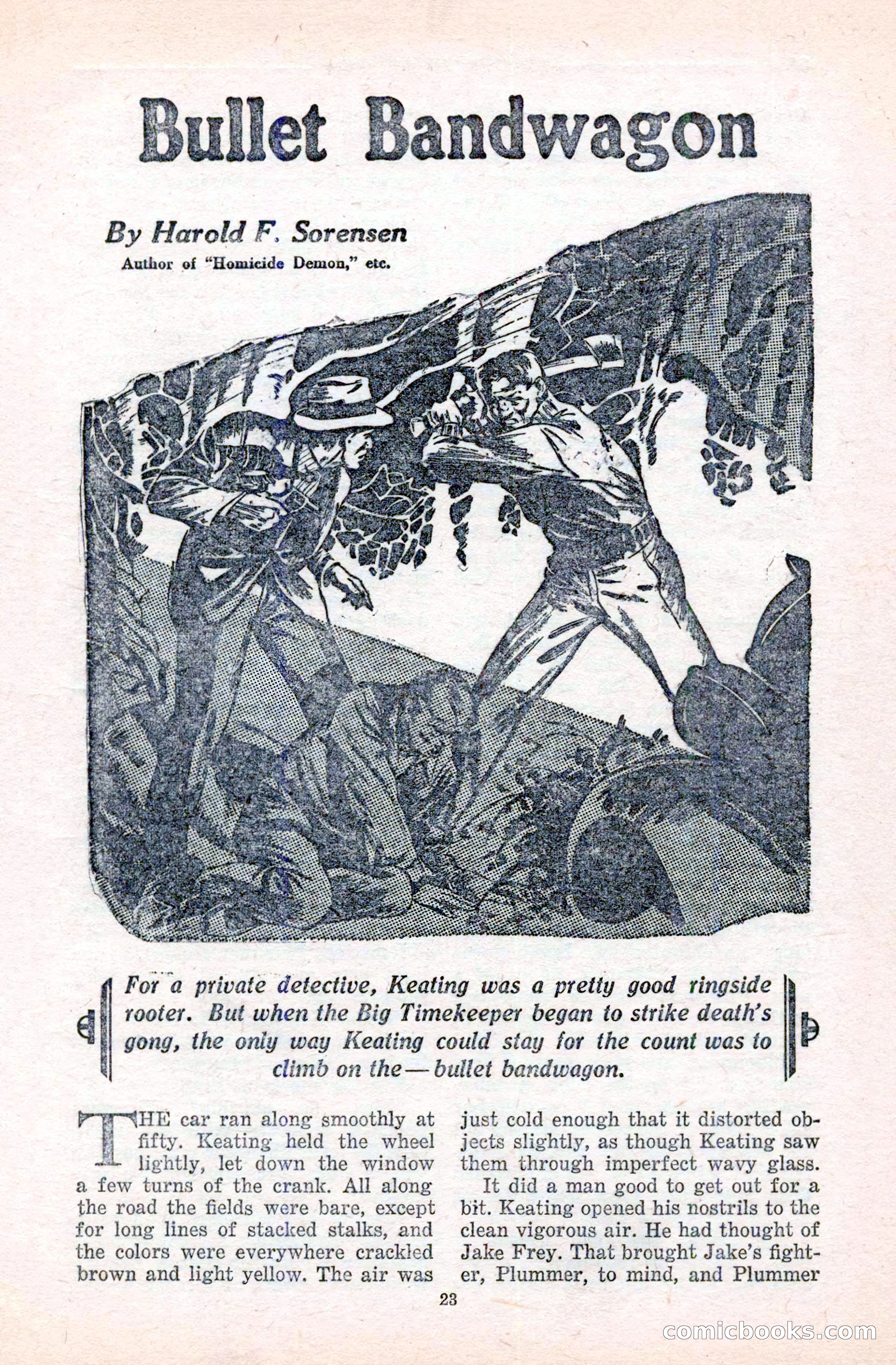
This page displays the opening of a hardboiled crime story titled "Bullet Bandwagon" by Harold F. Sorensen. It includes a dramatic illustration showing what appears to be a violent confrontation, and begins the narrative prose about a private detective named Keating driving through rural farmland. The subtitle indicates Keating must board a "bullet bandwagon" (apparently involving violence or danger) to survive a deadly situation, though the full plot remains unclear from this opening section.

10-Story Detective Magazine Cover — page 26 of 116
26 / 116
What you’re looking at · open this page on its own ↗

# Page Analysis This is **story prose** from a pulp detective magazine titled "10-Story Detective." The page depicts a scene where a character named Keating visits a training gym (converted barn) to observe a boxer named Plummer, who has an important fight scheduled for the following night. Keating observes Plummer punching a heavy bag while sensing internal conflict in the fighter—Plummer appears intelligent but resentful of mental exertion, and Keating suspects the boxer may be naturally lazy despite his physical conditioning. When Keating enters, the gym's occupants react with surprise, and Plummer greets him, implying that someone named Jake should have sent for Keating's assistance, likely regarding some unresolved problem.

10-Story Detective Magazine Cover — page 27 of 116
27 / 116
What you’re looking at · open this page on its own ↗

This is a page of prose fiction from a pulp magazine titled "Bullet Bandwagon." The text depicts a hardboiled crime story involving boxing and corruption. Detective Keating visits boxer Plummer at a gym, where Plummer reveals that a man named Alfred Giles has offered him money to throw tomorrow's fight to protect the current champion's financial interests. Plummer refuses and reports that their mutual associate Jake has discovered damaging information about Giles and has gone to town, apparently angry. Keating agrees to help Jake investigate the situation.

10-Story Detective Magazine Cover — page 28 of 116
28 / 116
What you’re looking at · open this page on its own ↗

This is story prose from a hardboiled crime/detective pulp magazine titled "10-Story Detective." The page depicts a scene where detective Keating searches for a man named Jake to prevent him from confronting the wealthy gambler Giles. Keating locates Giles at an illegal betting parlor, where the formerly arrogant man is visibly falling apart after losing money on horse races, his psychological unraveling described in clinical detail by the narrator.

10-Story Detective Magazine Cover — page 29 of 116
29 / 116
What you’re looking at · open this page on its own ↗

# Page Analysis: Bullet Bandwagon This page contains prose fiction from what appears to be a hardboiled crime story. The narrative depicts a tense confrontation between two men, Keating and Giles, beginning with a street fight outside a cigar store and continuing in Keating's car. Keating attempts to dissuade Giles from some scheme involving fixing a boxing match (references to "Jake's boy" and "Plummer"). The scene develops as a psychological duel where Keating tries to manipulate Giles by explaining his powerlessness in the criminal underworld—that Giles has been "cleaned out" because he's not among "the top ten" and operates only when they permit it.

10-Story Detective Magazine Cover — page 30 of 116
30 / 116
What you’re looking at · open this page on its own ↗

# Page 28 of "10-Story Detective" This page contains story prose from a hardboiled crime narrative. The text depicts a tense conversation between detective Keating and a man named Giles, apparently caught in a dangerous situation involving fixed fights, mobsters, and threats of violence. Keating warns Giles against killing someone named Jake, then drives to confront Jake at his sister's house across a bridge. The passage ends as Jake emerges from the house and greets Keating warmly, mispronouncing his name as "Wesling" instead of "Wesley."

10-Story Detective Magazine Cover — page 31 of 116
31 / 116
What you’re looking at · open this page on its own ↗

This page contains story prose from what appears to be a hardboiled crime pulp fiction magazine. The text depicts a conversation between a detective named Keating and a man named Jake, a fight promoter, regarding Jake's knowledge of someone named Giles who appears to be dangerous. Jake refuses to inform the police, preferring to handle the situation himself, while Keating advises caution. The passage concludes with Keating's internal monologue as he attempts to distract himself from nervous tension about an impending boxing match.

10-Story Detective Magazine Cover — page 32 of 116
32 / 116
What you’re looking at · open this page on its own ↗

# Page Analysis: "10-Story Detective" Pulp Fiction This page contains story prose from what appears to be a hardboiled crime/detective pulp magazine. The narrative follows a character named Keating who receives an urgent phone call from Plummer about Jake being in danger from someone named Giles. Keating drives frantically to a house, arrives to find Jake running and shots being fired, then physically fights Giles. The scene climaxes with Plummer emerging from behind the house carrying an axe, claiming Giles murdered Jake with it. The action is intense and violent, typical of early pulp crime fiction.
10-Story Detective Magazine Cover — page 33 of 116
33 / 116
What you’re looking at · open this page on its own ↗

# Page Analysis: "Bullet Bandwagon" This page contains story prose from what appears to be a hardboiled crime or detective pulp magazine. The narrative depicts a violent physical struggle between characters named Keating and Plummer over an axe, with a third character named Jake apparently injured or unconscious. The text describes their brutal hand-to-hand combat in dark surroundings, culminating in Keating using a gun against Plummer and then discovering Jake's body. The prose emphasizes physical action and violence typical of early pulp fiction crime stories.

10-Story Detective Magazine Cover — page 34 of 116
34 / 116
What you’re looking at · open this page on its own ↗

# Page Analysis: *10-Story Detective* Pulp Magazine This is **story prose** — specifically page 32 of what appears to be a hardboiled crime or detective fiction story. The text depicts a violent confrontation between characters named Keating, Jake, Giles, and Plummer, involving an axe attack and gunfire. After Plummer is shot and killed, Giles reveals he was secretly working to ensure Plummer would lose a boxing match because gangsters had bet heavily on him. Giles explains that Plummer, despite his strength, ultimately wanted to lose because the betting odds made it more profitable than winning legitimately. The scene focuses on the moral ambiguity and deception surrounding the boxing scheme.

10-Story Detective Magazine Cover — page 35 of 116
35 / 116
What you’re looking at · open this page on its own ↗

# Page Analysis This is **story prose** from a hardboiled crime pulp magazine titled "Bullet Bandwagon." The page shows a conversation between characters named Keating, Giles, and Jake, in which Giles confesses to blackmailing a boxer named Plummer after discovering Plummer planned to throw a fight. Giles reveals that Plummer, realizing Giles knew his scheme, attempted to murder both Giles and Jake with an axe but was apparently killed in the ensuing struggle. Keating reassures Jake that there will be no legal consequences.

10-Story Detective Magazine Cover — page 36 of 116
36 / 116
What you’re looking at · open this page on its own ↗

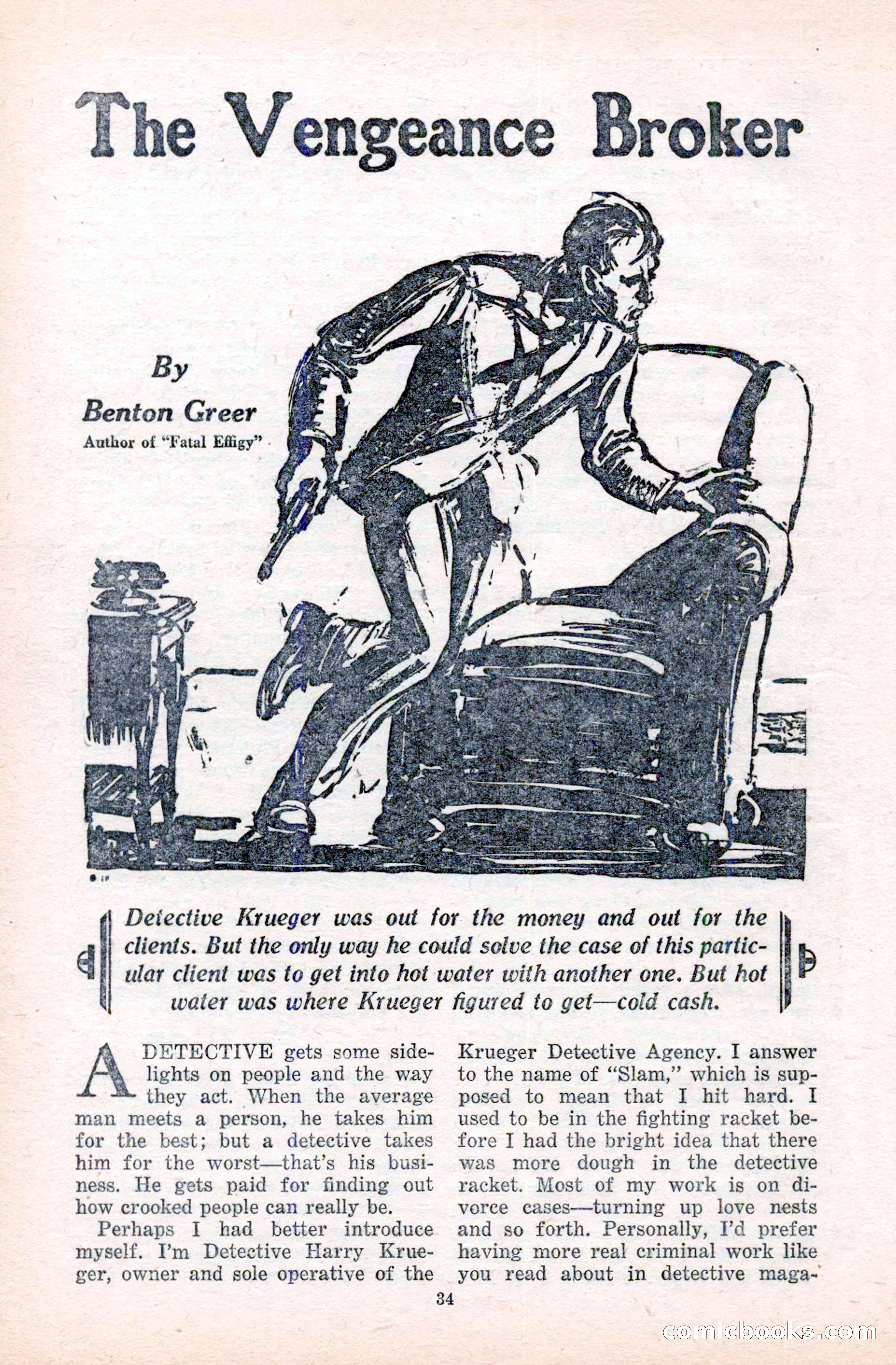
This is the opening page of a hardboiled detective story titled "The Vengeance Broker" by Benton Greer. The page features an illustration of a man being thrown or ejected from a chair by another man, accompanied by story text below. Detective Harry Krueger, owner of the Krueger Detective Agency, introduces himself as a cynical operative who takes on divorce cases and criminal work, explaining that he's nicknamed "Slam" for his fighting prowess and now pursues cases for money rather than the law.

10-Story Detective Magazine Cover — page 37 of 116
37 / 116
What you’re looking at · open this page on its own ↗

# Page Analysis This is **story prose** from a hardboiled detective fiction piece titled "The Vengeance Broker" (page 35). The narrator, private detective Krueger, describes receiving a phone call from jewelry store owner Laverne Neihart requesting an appointment about a robbery. When Krueger visits Neihart's home that evening, he instead meets Jackson, a man living in the same house who runs a nearby pharmacy. Jackson cryptically warns Krueger against taking Neihart as a client, hinting at personal animosity and financial stinginess, before abruptly shifting conversation to mention his own drug store robbery—details that intrigue the detective.

10-Story Detective Magazine Cover — page 38 of 116
38 / 116
What you’re looking at · open this page on its own ↗

# Page from "10-Story Detective" This is a page of story prose from what appears to be a hardboiled detective fiction magazine. The narrative follows a detective being recruited by two rival businessmen—Jackson and Neihart—who each want him to investigate a drug store robbery that occurred the previous month. Jackson offers the detective work on the condition he not take Neihart's case; Neihart then arrives and makes the opposite demand. The detective remains noncommittal while learning that Neihart suspects his clerk, William Madigan, of responsibility for the theft of six thousand dollars. The page ends mid-sentence as Neihart begins explaining the robbery's details.

10-Story Detective Magazine Cover — page 39 of 116
39 / 116
What you’re looking at · open this page on its own ↗

This page is prose from a hardboiled crime story titled "The Vengeance Broker." The narrator, a detective called "Slam," discusses a jewelry store robbery with the shop's owner Neihart and later with Assistant Chief Hamilton at the police station. Hamilton provides background on two eccentric cousins—Neihart and Jackson—who are wealthy, live together despite hating each other, and have willed their money to one another while waiting for the other to die. The narrative establishes the case details and introduces suspicious family dynamics relevant to the investigation.

10-Story Detective Magazine Cover — page 40 of 116
40 / 116
What you’re looking at · open this page on its own ↗

# Page Content: Story Prose This page contains prose fiction from a hardboiled detective story titled "10-Story Detective." The narrative follows a detective (nicknamed "Slam") who discovers fingerprints on a silver cigarette case that match prints found on Jackson's Pharmacy safe, revealing that a man named Neihart committed the robbery. Rather than immediately reporting this to his police contact Hamilton, the detective decides to withhold the information until he's paid his full fee, then visits William Madigan's apartment to continue his investigation.

10-Story Detective Magazine Cover — page 41 of 116
41 / 116
What you’re looking at · open this page on its own ↗

# Page Analysis: "The Vengeance Broker" This page contains story prose from a hardboiled crime fiction narrative titled "The Vengeance Broker" (page 39). A detective interrogates a shop owner named Madigan about a robbery, suspecting the perpetrator might be someone named Mr. Jackson. Through questioning, the detective develops a theory that Jackson robbed Neihart's jewelry store in retaliation for Neihart robbing Jackson's pharmacy safe of six thousand dollars. The detective struggles with proving Jackson's guilt while working for the paying client Neihart, uncertain whether Jackson has already fenced the stolen jewelry.

10-Story Detective Magazine Cover — page 42 of 116
42 / 116
What you’re looking at · open this page on its own ↗

# Page Description This is story prose from page 40 of *10-Story Detective*, a pulp crime magazine. The narrative, told in first-person by a detective called "Slam," follows him as he visits a pharmacy owner named Jackson who has been robbed. After initially declining the case, Jackson reluctantly hires the detective for fifty dollars plus a contingency fee. The detective examines Jackson's office safe and the back door through which the robber entered, then abruptly claims to know the thief's identity—shocking Jackson, who expected a longer investigation.

10-Story Detective Magazine Cover — page 43 of 116
43 / 116
What you’re looking at · open this page on its own ↗

# The Vengeance Broker — Page 41 This is story prose from a hardboiled crime pulp fiction magazine. The page depicts a private detective negotiating with an irate client to extract a two-hundred-dollar fee by claiming to know who robbed the man's pharmacy. After being paid, the detective reveals the thief is "Mr. Neihart," then immediately meets with his criminal associate "Shorty" to break into that same pharmacy safe—implying the "detective" has orchestrated the entire scheme himself, using the client's own confession to frame an innocent man.

10-Story Detective Magazine Cover — page 44 of 116
44 / 116
What you’re looking at · open this page on its own ↗

# Page 42 of "10-Story Detective" — Story Prose This page contains story prose from a hardboiled detective narrative. The protagonist detective has recovered stolen jewelry from the Neihart Jewelry Store by finding it hidden in a safe belonging to Jackson. He now confronts the store owner Neihart, the police captain Hamilton, and Jackson in the police station, revealing that Jackson—apparently a cousin of Neihart's—is the thief. The detective demands his fee before disclosing this information, then dramatically produces the recovered jewelry and identifies the culprit, leaving both cousins stunned at the revelation.

10-Story Detective Magazine Cover — page 45 of 116
45 / 116
What you’re looking at · open this page on its own ↗

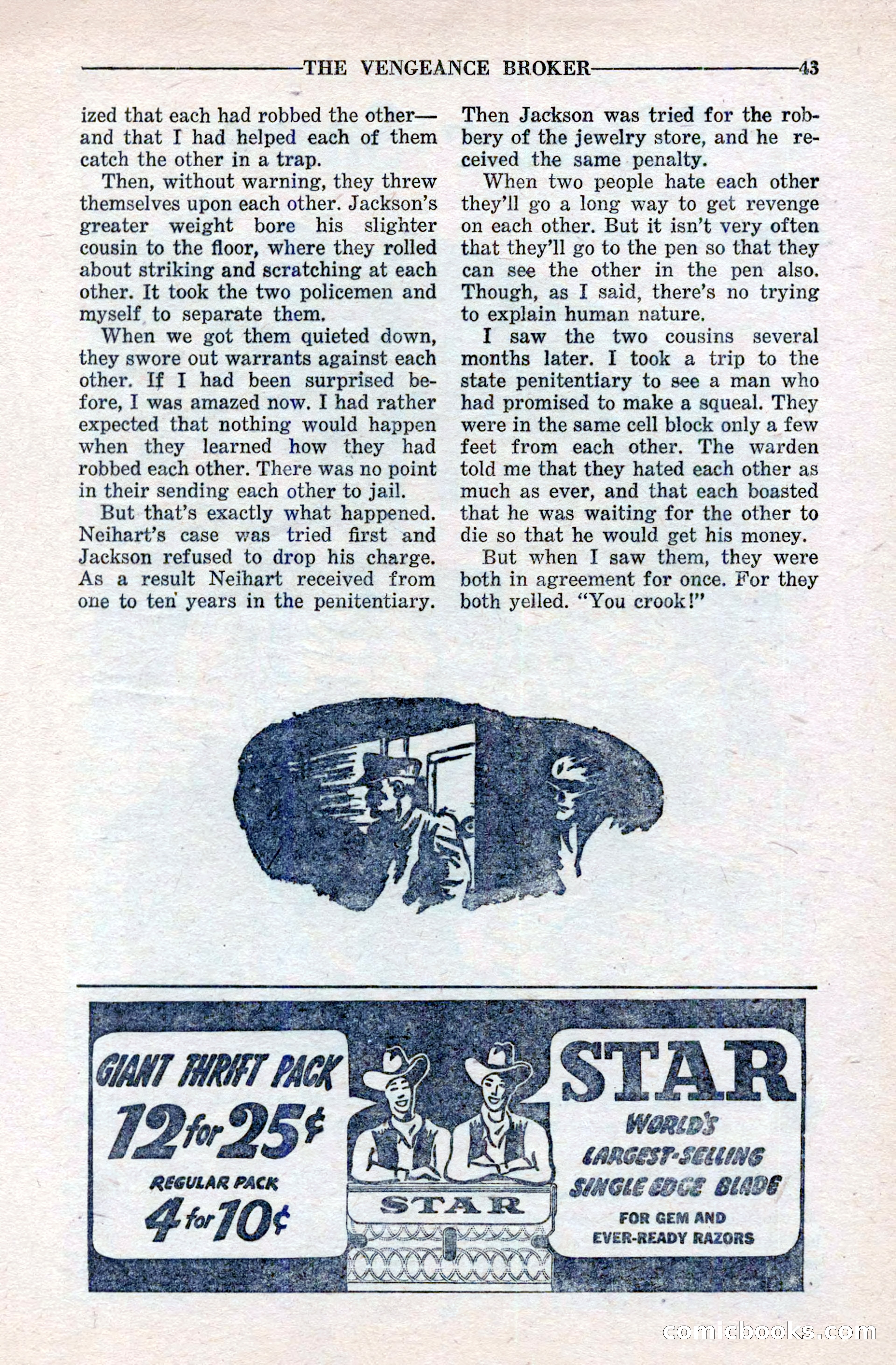
# Page Analysis This page contains prose narrative from a crime story titled "The Vengeance Broker" (page 43). The text describes two cousins who robbed each other, fought violently when their scheme was exposed, then mutually prosecuted one another—both receiving one-to-ten-year penitentiary sentences. The narrator later visits them in the same cell block, where despite their continued hatred, they briefly unite to insult each other as "crooks." The page concludes with a vintage advertisement for Star brand razor blades, promoting a "Giant First Pack" of twelve blades for 25 cents.

10-Story Detective Magazine Cover — page 46 of 116
46 / 116
What you’re looking at · open this page on its own ↗

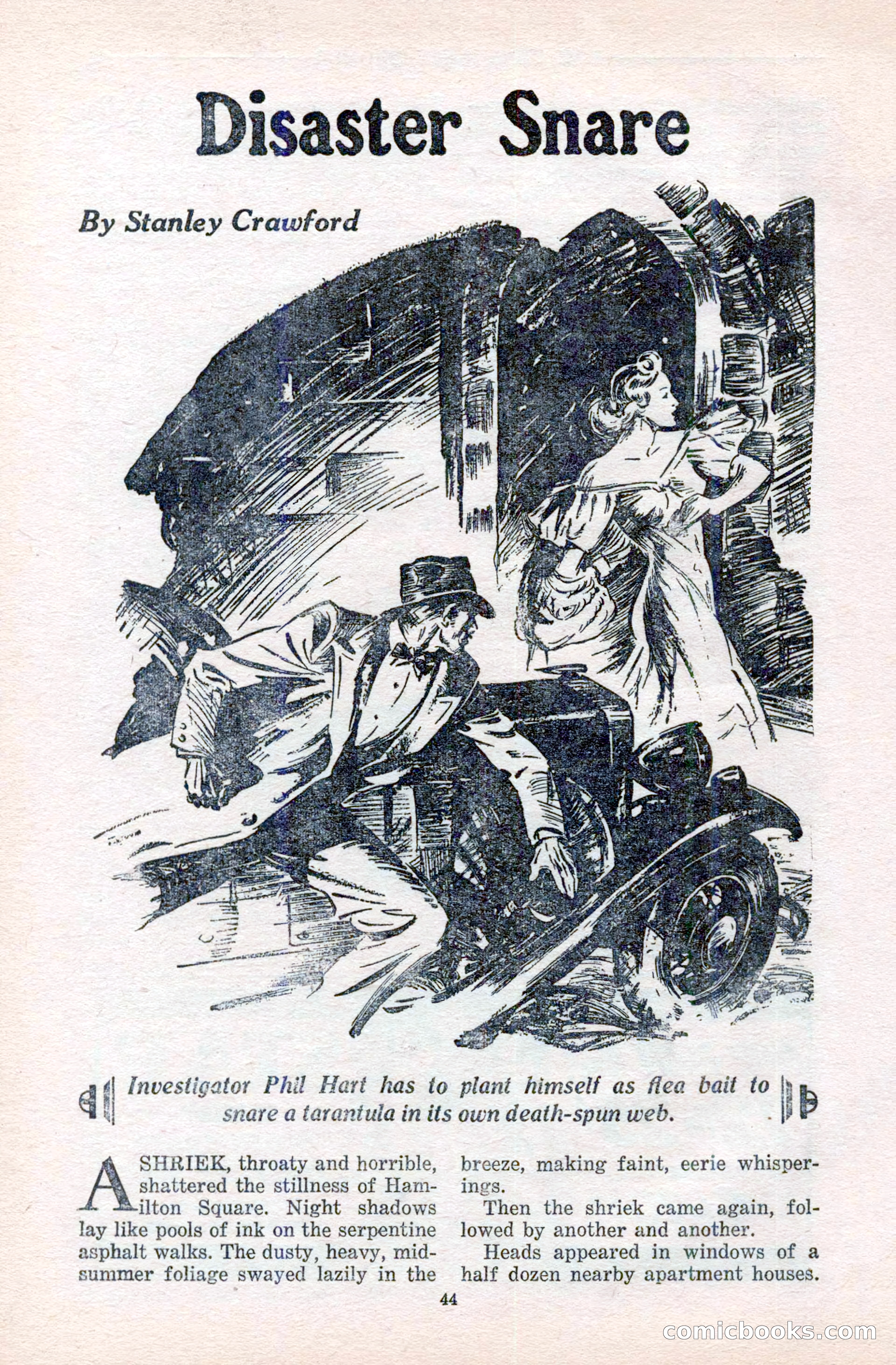
This page shows the opening of a short story titled "Disaster Snare" by Stanley Crawford. It features an illustration depicting a man in formal attire and a woman near a damaged automobile in an urban setting, with a menacing shadowy figure looming above them. The visible prose describes mysterious shrieks disturbing the night in Hamilton Square, with neighbors awakening in nearby apartment houses to investigate the disturbance. The subtitle notes that investigator Phil Hart must use himself as bait to trap a tarantula in its own web.

10-Story Detective Magazine Cover — page 47 of 116
47 / 116
What you’re looking at · open this page on its own ↗

# Page Analysis This is **story prose** from a pulp fiction magazine titled "Disaster Snare" (page 45). The text depicts a crime or mystery narrative in which a hysterical girl collapses before a policeman claiming to have seen a creature called "the Tarantula" in a city square. Detective Phil Hart is summoned to investigate the incident. Police search the area but find nothing, leading them to suspect the girl may be unreliable. Hart arrives at an apartment building where the girl is recovering, with detectives preparing to question her about what she allegedly witnessed.

10-Story Detective Magazine Cover — page 48 of 116
48 / 116
What you’re looking at · open this page on its own ↗

# Page Analysis This page contains **story prose** from a hardboiled detective narrative titled "10-Story Detective." The visible text depicts detectives Hart and Sergeant Stix investigating a woman named Faith Tashman, who claims to have seen a creature called "the Tarantula" with hairy legs and red eyes. After taking her to an apartment where she allegedly rests, a terrifying scream erupts from her room. Hart discovers the window open and Faith missing—glimpsing her crumpled body on the sidewalk three stories below, suggesting either suicide or foul play connected to the mysterious Tarantula.

10-Story Detective Magazine Cover — page 49 of 116
49 / 116
What you’re looking at · open this page on its own ↗

# Page Analysis This page contains **story prose** from a pulp fiction narrative titled "Disaster Snare." The text depicts a detective mystery involving a suspicious death: a woman named Miss Tashman has fallen from a third-story window, but detective Hart discovers two mysterious fang wounds on her neck, suggesting she was killed by something called "the Tarantula" before the fall. The prose follows Hart's investigation as he interrogates witnesses—including a magician named Marko Durer and a wealthy man named Jack Baron, Jr.—while trying to determine how the killer accessed the locked room. The story combines elements of horror and crime fiction typical of pulp magazines.

10-Story Detective Magazine Cover — page 50 of 116
50 / 116
What you’re looking at · open this page on its own ↗

# Page 48: Crime Story Prose This page contains prose fiction from a hardboiled detective story titled "10-Story Detective." The narrative follows Detective Hart investigating the murder of Miss Tashman, a performer found dead in her third-floor room. Hart observes suspicious behavior from several circus performers and a magician named Marko Durer at the crime scene, then stakes out the building at night, spotting mysterious light signals on a nearby roof—suggesting a crucial clue to the mystery.

10-Story Detective Magazine Cover — page 51 of 116
51 / 116
What you’re looking at · open this page on its own ↗

# Page Analysis **Format:** Story prose (text only, no illustrations) **Content:** This page contains the climactic scene from a story titled "Disaster Snare" in which a character named Hart witnesses a supernatural or mysterious creature—identified as "the Tarantula"—attack and kill a magician named Marko Dürer in a city square. Hart attempts to intervene but the creature vanishes into the shadows before he can fire his gun, leaving only Dürer's body with fatal throat wounds as evidence of the attack.

10-Story Detective Magazine Cover — page 52 of 116
52 / 116
What you’re looking at · open this page on its own ↗

# 10-Story Detective, Page 50 This page contains story prose from a hardboiled crime/detective fiction narrative. Detective Phil Hart investigates a mysterious killer called "the Tarantula" responsible for multiple murders. After discovering whitish powder (magnesia) at a crime scene, Hart becomes interested in suspect Jack Baron's radio apparatus. Unable to find Baron, Hart rents a room overlooking the square where the murders occurred, positioning himself to observe and wait. The page establishes mounting tension as Hart develops a theory he's not yet ready to share, while stage performers from a nearby murder house express their intention to leave the unsettling location.

10-Story Detective Magazine Cover — page 53 of 116
53 / 116
What you’re looking at · open this page on its own ↗

# Page Analysis: "Disaster Snare" This is **story prose** from a pulp fiction magazine, appearing on page 51. The text depicts a suspenseful scene where a character named Hart encounters a mysterious, hairy creature with red eyes entering his room through a window. After firing at the creature and seeing it escape, Hart deduces something crucial from "powdered magnesia" and pursues the threat to a nearby rooftop where an experimental radio station operates. The narrative builds toward a confrontation, suggesting the creature may be connected to someone named Jack Baron and the radio equipment on the roof.

10-Story Detective Magazine Cover — page 54 of 116
54 / 116
What you’re looking at · open this page on its own ↗

# Page Content Analysis This is **story prose** from a pulp detective magazine titled "10-Story Detective." The visible text concludes an action scene where detective Hart has confronted and shot a criminal dressed as a mechanical "Tarantula" on a rooftop. Hart discovers the attacker is Bowers, a trapeze performer. The page then shifts to exposition where Bender, Bowers' partner, reveals the criminal plot: Bowers murdered his estranged wife Faith Tashman and another man named Marko Direr in a scheme involving blackmail and a radio mast. Hart reflects that complex mysteries often have simple explanations. The narrative emphasizes clever mechanical murder devices and deception.

10-Story Detective Magazine Cover — page 55 of 116
55 / 116
What you’re looking at · open this page on its own ↗

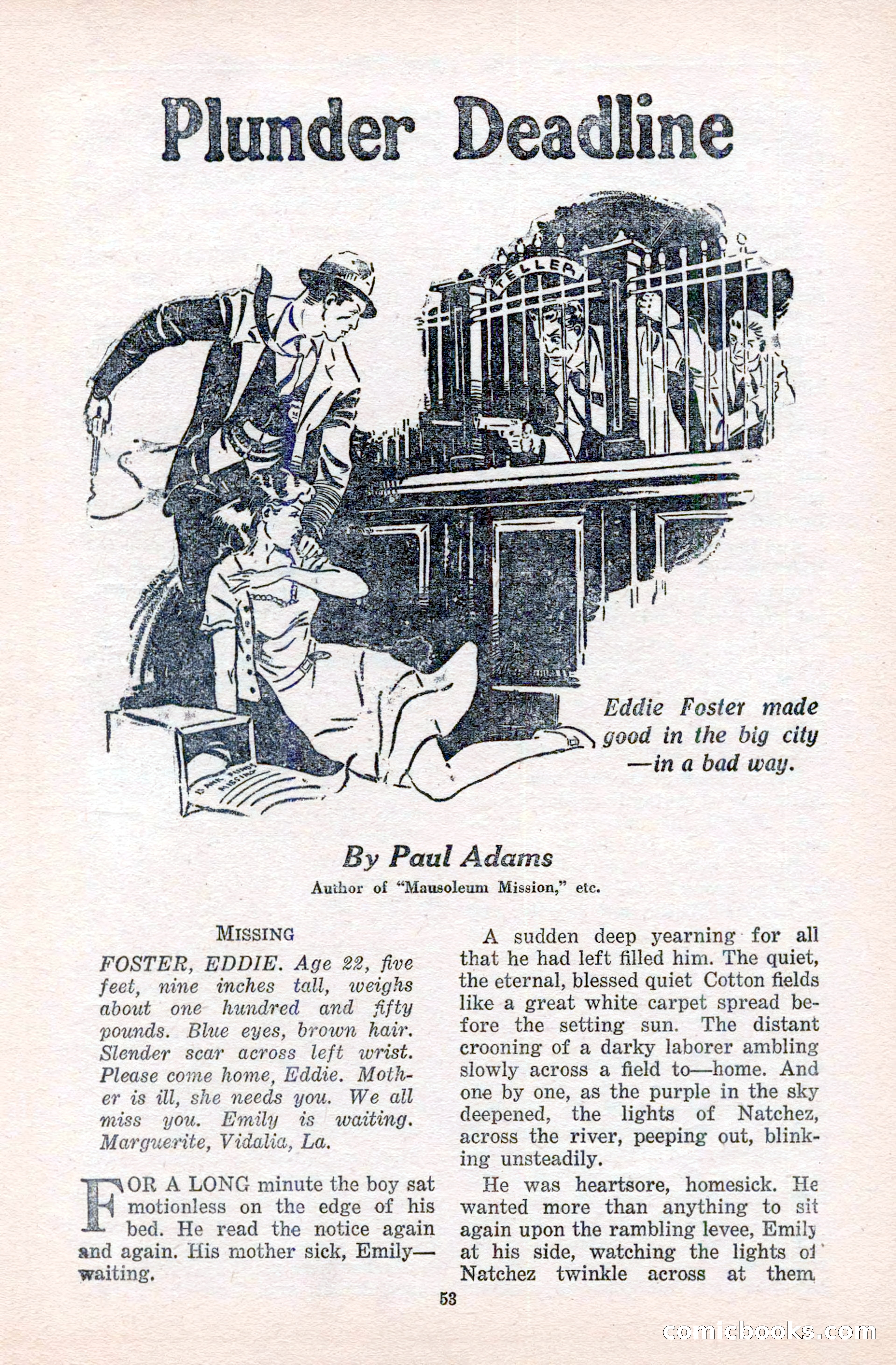
# Page Analysis: "Plunder Deadline" This is an interior story page from a pulp magazine, featuring the beginning of a short story titled "Plunder Deadline" by Paul Adams. The page includes an illustration showing a man in a suit with a rope, a woman kneeling, and a caged structure in the background, along with the tagline "Eddie Foster made good in the big city—in a bad way." The visible text comprises a missing-person notice seeking Eddie Foster (age 22) and the story's opening, in which a homesick young man reads a letter from home while in the city, yearning for his rural Louisiana origins and his waiting mother and fiancée Emily.

10-Story Detective Magazine Cover — page 56 of 116
56 / 116
What you’re looking at · open this page on its own ↗

# Page Analysis: 10-Story Detective This page contains story prose from a hardboiled crime pulp magazine. The narrative follows Eddie Foster, a young man who came to New Orleans hoping to earn ten thousand dollars for his sweetheart Emily. Desperate after months of unemployment, Eddie has just robbed the Acme payroll of $15,000—inspired by overhearing criminals discuss the plan at a local establishment. The page depicts Eddie in his room with the stolen money hidden under his mattress, experiencing conflicting emotions of calm determination and post-crime panic. A newspaper headline about "Lone Bandit Robs Acme of $15,000 Payroll" is visible on the floor.

10-Story Detective Magazine Cover — page 57 of 116
57 / 116
What you’re looking at · open this page on its own ↗

# Page Analysis This page contains story prose from "Plunder Deadline" (page 55), a pulp fiction narrative. The text follows Eddie, who has stolen money but has had a change of heart upon learning his mother is ill. Eddie decides to mail the stolen funds to the Acme and return home to his family in the South, abandoning his criminal scheme. The passage emphasizes his moral conflict and ultimate decision to act honestly. The excerpt ends with a dramatic entrance: Sergeant O'Toole unexpectedly arrives at Eddie's door, creating suspense about whether the protagonist's plan will be discovered.

10-Story Detective Magazine Cover — page 58 of 116
58 / 116
What you’re looking at · open this page on its own ↗

# 10-Story Detective Page 56 This page contains prose fiction from what appears to be a hardboiled crime/detective pulp magazine. The narrative depicts a confrontation between Sergeant O'Toole and a young man named Eddie Foster in Eddie's room. The sergeant, arriving ostensibly to check on unemployed Eddie, reveals he knows Eddie committed a $15,000 robbery at the Acme company—deduced from a distinctive scar on Eddie's wrist and the young man's nervous reaction. Eddie confesses, and the sergeant notes Eddie's clever method of disguising the stolen money by padding rolled bills with cotton, commenting that Eddie has wasted his talents (he was a valedictorian) on crime.

10-Story Detective Magazine Cover — page 59 of 116
59 / 116
What you’re looking at · open this page on its own ↗

# Page Analysis This page contains **story prose** from a hardboiled crime pulp fiction magazine titled "Plunder Deadline." The text depicts a conversation between Sergeant O'Toole and a young criminal named Eddie as the officer arrests him for robbery. O'Toole escorts Eddie from his home toward the police station, offering fatherly advice and attempting to ease the boy's shame by keeping the arrest quiet from his family. The sergeant reveals he's been concerned about Eddie's deteriorating behavior and associates, and treats the arrest as a teaching moment despite Eddie's crime.

10-Story Detective Magazine Cover — page 60 of 116
60 / 116
What you’re looking at · open this page on its own ↗

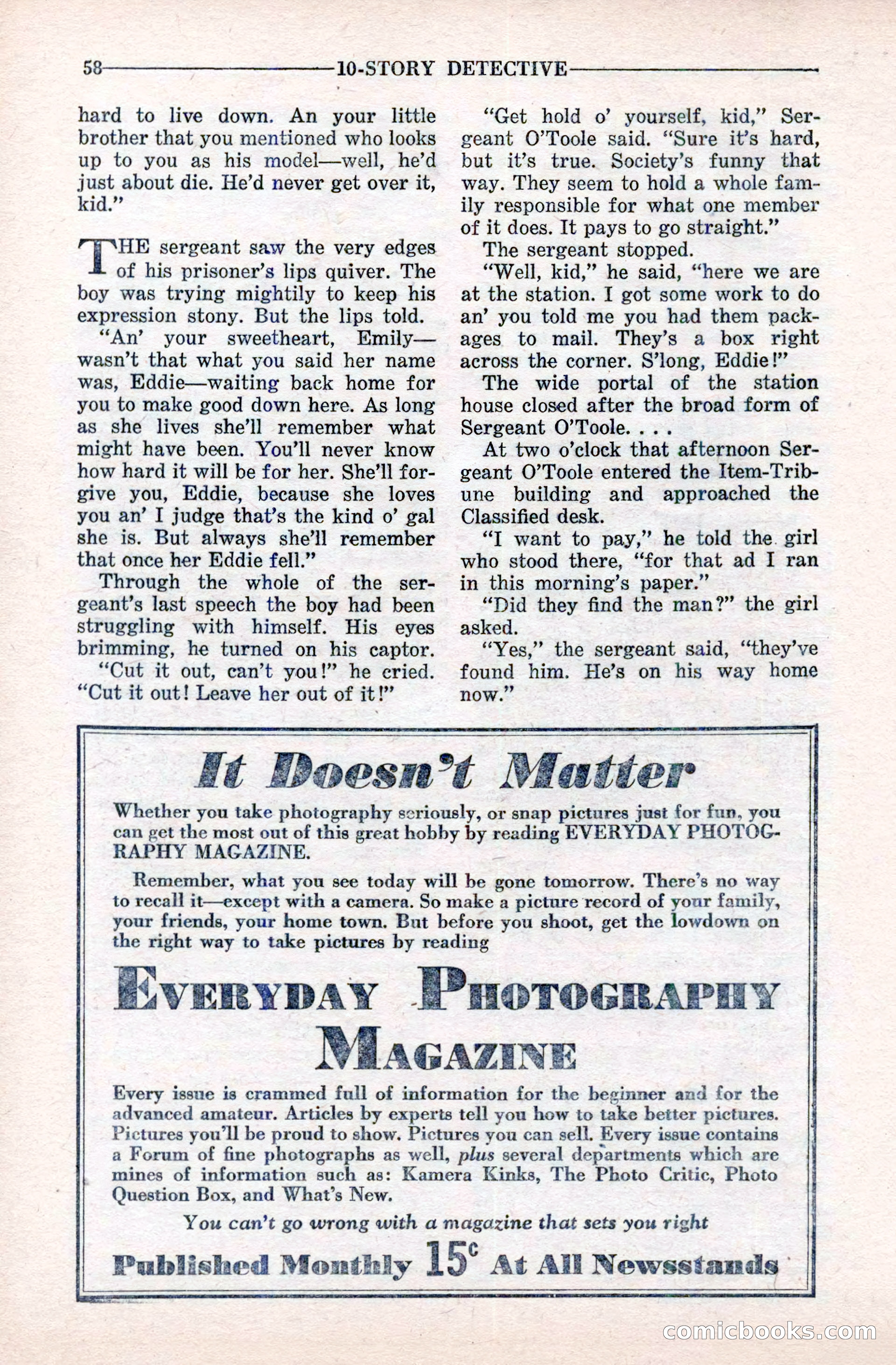
This page contains story prose from a pulp detective magazine ("10-Story Detective," visible in the header). The narrative depicts Sergeant O'Toole interrogating a young prisoner named Eddie, using emotional appeals about family and his sweetheart to encourage him to go straight. The sergeant later visits a newspaper office to pay for a classified ad, revealing that the man Eddie was apparently sought for has been found and is heading home. Below the story text is a full-page advertisement for *Everyday Photography Magazine*, a monthly publication costing 15 cents, which promoted itself as instructional material for amateur and professional photographers.

10-Story Detective Magazine Cover — page 61 of 116
61 / 116
What you’re looking at · open this page on its own ↗

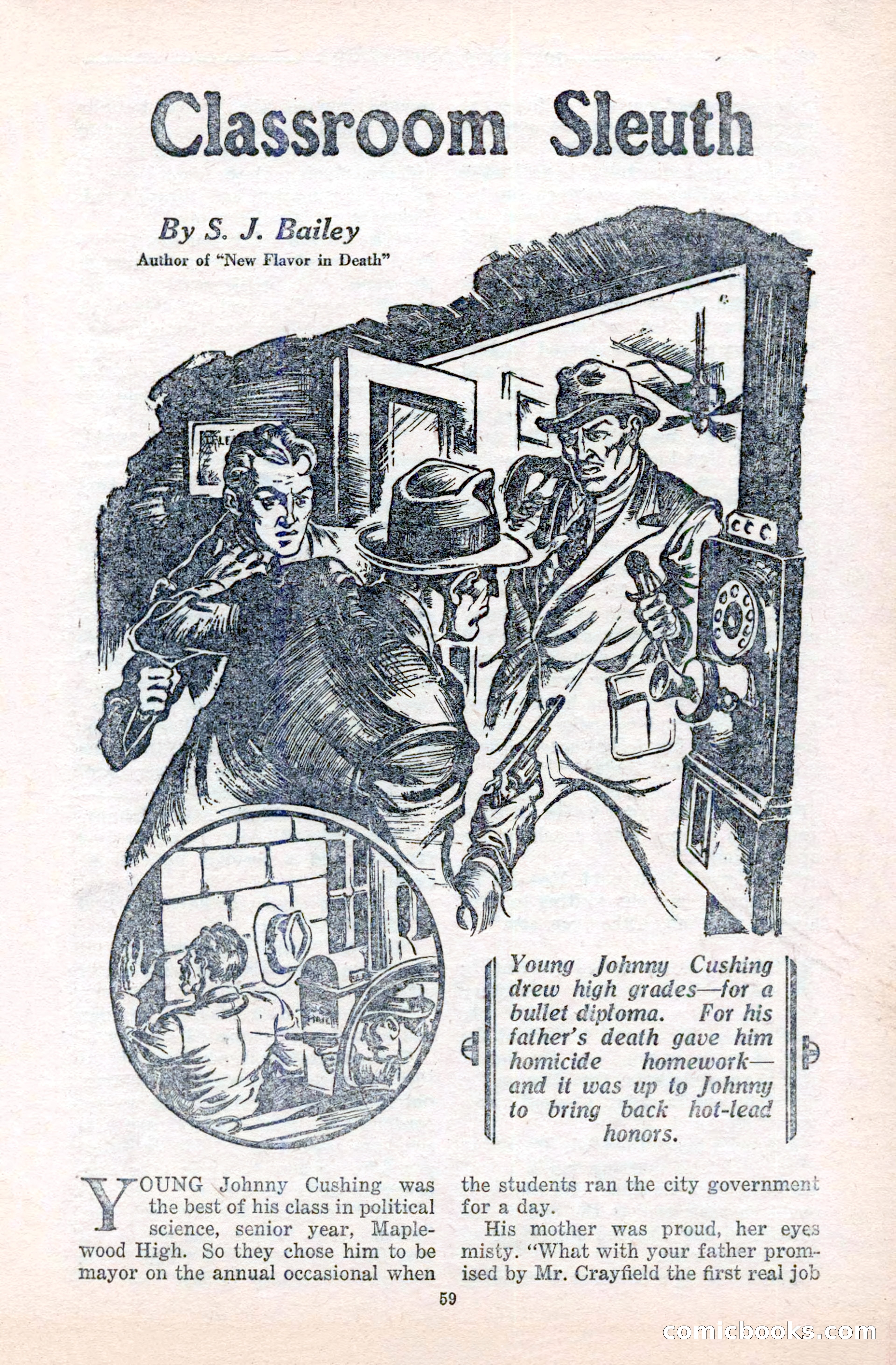
# Analysis This is a **story illustration and opening page** from a pulp fiction magazine. The page shows the title "Classroom Sleuth" by S. J. Bailey and features a dramatic black-and-white illustration depicting what appears to be a confrontation or crime scene with multiple figures. The visible text introduces young Johnny Cushing, a top political science student at Maplewood High who is chosen as mayor during an annual student-run city government day. The story appears to involve his father's death, which has given him "homicide homework"—suggesting a murder mystery plot where Johnny must solve a crime, likely related to his father, to restore his family's honor.

10-Story Detective Magazine Cover — page 62 of 116
62 / 116
What you’re looking at · open this page on its own ↗

# Page Analysis This is story prose from a pulp detective magazine (page 60 of "10-Story Detective"). The narrative follows a young man named Johnny who has been appointed honorary mayor and discovers Mayor Harrigan receiving threatening orders from an unseen authority figure called "the chief." When Johnny innocently asks the secretary who this chief is, the secretary becomes evasive and warns him not to pry into such matters. The passage suggests Johnny has stumbled upon evidence of corruption or criminal influence within city government.

10-Story Detective Magazine Cover — page 63 of 116
63 / 116
What you’re looking at · open this page on its own ↗

# Classroom Sleuth (Page 61) This page contains story prose from a pulp fiction narrative. The text describes a young student named Johnny Cushing who participated in a civic simulation exercise at city hall. After returning home to learn his father has died by apparent suicide (likely related to job loss due to political pressure), Johnny attends school the next day and reports to his political science class about his experience in the mayor's chair. He describes feeling an unsettling presence guiding his actions, though he cryptically suggests it was not what his teacher expects—implying something darker than civic responsibility or community will influenced him during his time in office.

10-Story Detective Magazine Cover — page 64 of 116
64 / 116
What you’re looking at · open this page on its own ↗

# Page Analysis This is **story prose** from page 62 of a pulp detective magazine titled "10-Story Detective." The narrative follows a student named Johnny who blames a corrupt police chief for his father's suicide. After his emotional breakdown in class, Johnny obsessively tracks the chief to a lunchroom near city hall, watching him intently. A gaunt, haggard man then enters and sits directly across from the chief, exchanging a meaningful glance with him—suggesting a confrontation or revelation is imminent. The passage combines crime drama with the psychological turmoil of a grief-stricken teenager seeking vengeance.
10-Story Detective Magazine Cover — page 65 of 116
65 / 116
What you’re looking at · open this page on its own ↗

# Page Analysis: "Classroom Sleuth" This is story prose from what appears to be a hardboiled crime or mystery pulp magazine (page 63). The text depicts a confrontation between Professor Crayfield, a reformer returned to his hometown, and a corrupt local Police Chief in a lunchroom. After Crayfield threatens to expose the Chief's crimes, he leaves—followed by two hired men in a limousine. Johnny, the apparent protagonist, witnesses the Professor being shot down on the street moments later. The narrative concludes with Johnny discovering the wounded Crayfield and accusing the Chief of orchestrating the attack.

10-Story Detective Magazine Cover — page 66 of 116
66 / 116
What you’re looking at · open this page on its own ↗

# Page Analysis This is story prose from a pulp detective magazine (page 64 of "10-Story Detective"). The text depicts a dramatic scene in which a dying professor appears to convince young Johnny Cushing to commit murder. After the professor passes away, Johnny retrieves a broken gun from the professor's pocket and resolves to kill the police chief, whom the professor blamed for corrupting the town of Maplewood. Johnny then enters a lunchroom where the chief is dining, apparently determined to carry out the assassination.

10-Story Detective Magazine Cover — page 67 of 116
67 / 116
What you’re looking at · open this page on its own ↗

# Page Analysis: "Classroom Sleuth" This page contains **story prose** from what appears to be a hardboiled crime pulp fiction tale. The narrative follows a young character named Johnny who is hiding in a lunchroom telephone booth, overhearing a criminal conspiracy. Johnny had apparently stolen a gun, intending to shoot someone called "the chief," but his resolve crumbles as he realizes the organizational structure of crime is far more complex—killing the chief would require eliminating multiple people in succession. The page ends with discovery, as a large man notices Johnny's involuntary sound and confronts him about the stolen weapon.

10-Story Detective Magazine Cover — page 68 of 116
68 / 116
What you’re looking at · open this page on its own ↗

This page contains story prose from a hardboiled crime detective pulp magazine. The narrative depicts a dramatic shooting incident where a character named Johnny becomes framed for killing a police chief, when actually another man named Mills fired the shot while Johnny was being physically restrained. The scene then shifts to police headquarters, where Captain Andrews and a teacher named Miss Hutch discuss Johnny's fate—he faces execution despite his moral objections to violence. The page ends with Andrews suggesting they could manipulate evidence to help Johnny, which Johnny refuses on ethical grounds.

10-Story Detective Magazine Cover — page 69 of 116
69 / 116
What you’re looking at · open this page on its own ↗

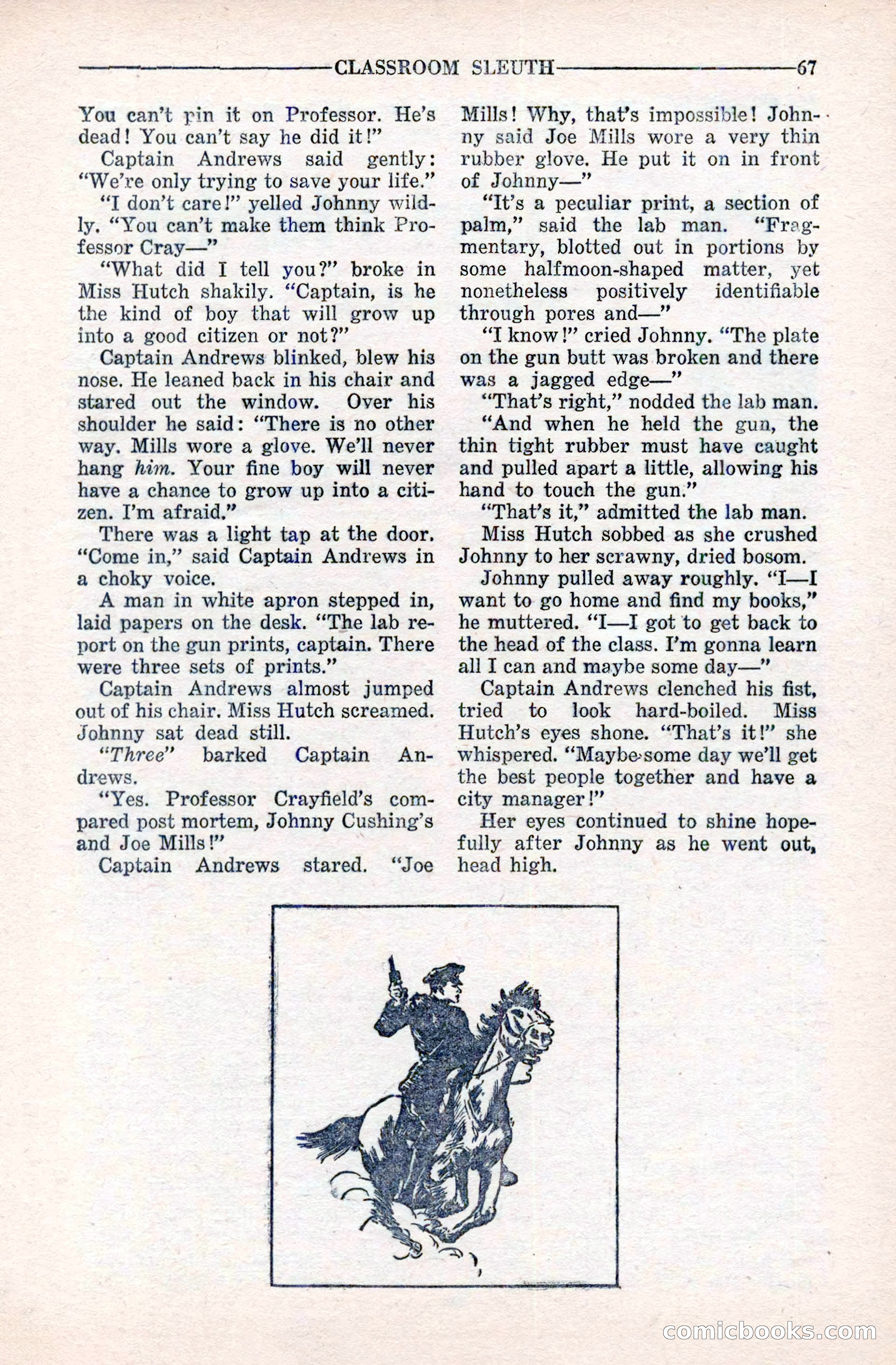
# Page 67: "Classroom Sleuth" This page contains story prose from what appears to be a mystery or crime fiction narrative. The text depicts a dramatic scene in Captain Andrews's office where forensic evidence—fingerprints from a gun—proves pivotal to a case involving a young boy named Johnny Cushing, a dead Professor Crayfield, and a suspect named Joe Mills. The lab report revealing three sets of prints on the gun creates a turning point; Johnny's deduction about Mills wearing a thin rubber glove that tore, leaving identifiable palm prints, solves the mystery. The passage ends with Johnny leaving, determined to excel academically and become a city manager someday, while Miss Hutch watches hopefully. An illustration of a figure on horseback appears at the bottom.

10-Story Detective Magazine Cover — page 70 of 116
70 / 116
What you’re looking at · open this page on its own ↗

# Page Analysis This is story prose from a pulp crime fiction magazine. The page presents the opening of "Party Girl Murder" by Ronald Flagg. It introduces Algie, a carefree forty-year-old pool-room collector who encounters Sophie, a quick-witted woman carrying a gun, on a late-night street. Sophie persuades him to accompany her to an apartment belonging to Parsons, a criminally-connected man of importance. At the apartment, Algie meets Parsons and two other men named Frank and Armand—men described as needing "steel, not muscles" for their work. The narrative sets up what appears to be a dangerous situation as Algie nervously enters this criminal milieu.

10-Story Detective Magazine Cover — page 71 of 116
71 / 116
What you’re looking at · open this page on its own ↗

# Page 69 from "Party Girl Murder" This page contains story prose from what appears to be a hardboiled crime pulp fiction. The text describes a character named Algie being lured into a bedroom where he discovers a bound and drugged young woman on a bed. Parsons and his associates (Frank and Armand) trap Algie in the room, blocking his exit and insisting he stay for what they call a "surprise party" and suggesting the unconscious woman will be his "travelling companion." The scene establishes a sinister kidnapping plot with Algie apparently an unwilling participant.

10-Story Detective Magazine Cover — page 72 of 116
72 / 116
What you’re looking at · open this page on its own ↗

# Page 70: Story Prose from "10-Story Detective" This page contains story prose from what appears to be a crime or detective pulp magazine. The passage depicts a criminal scheme in which a character named Parsons coerces an unwilling man named Algie into transporting an unconscious woman, Felice Fancone (a famous entertainer), in a trunk to an isolated country house. The text shows Parsons and his associates methodically executing this kidnapping, with Algie seemingly trapped as an unwilling participant under threat from a man named Frank who watches him closely.

10-Story Detective Magazine Cover — page 73 of 116
73 / 116
What you’re looking at · open this page on its own ↗

# Page Analysis **Type:** Story prose (text only, no illustrations) **Content:** This page from "Party Girl Murder" depicts a hardboiled crime narrative in which gangsters have kidnapped a woman named Felice Fancone for ransom. Crime boss Parsons coerces an unwilling accomplice named Algie into guarding the captive by implicating him in the scheme through planted evidence and manipulation. Parsons leaves Algie under the supervision of an armed woman named Sophie. The page ends with Algie and Sophie alone together, establishing tension between the characters.

10-Story Detective Magazine Cover — page 74 of 116
74 / 116
What you’re looking at · open this page on its own ↗

# Page 72 of "10-Story Detective" This page contains **story prose** from what appears to be a hardboiled crime pulp narrative. The text depicts a conversation between characters named Algie, Sophie, and references to a crime figure named Parsons. Sophie attempts to convince Algie to participate in a kidnapping scheme involving a woman named Felice Fancone, held for ransom from a wealthy man named Bert Funston. The passage shows Sophie's manipulation of the reluctant Algie, culminating in a scene where Algie brings food to the captive Felice in a locked bedroom, while Sophie watches suspiciously from the doorway.

10-Story Detective Magazine Cover — page 75 of 116
75 / 116
What you’re looking at · open this page on its own ↗

# Page Analysis This is story prose from a pulp crime/hardboiled fiction magazine titled "Party Girl Murder" (page 73). The text depicts a criminal conspiracy dialogue between two characters, Algie and Sophie. Sophie, who appears to control the situation with a gun, explains a plan involving a criminal named Parsons who intends to murder Algie and a woman named Felice after obtaining stolen money. Sophie proposes they kill Parsons first to steal the cash for themselves. The passage emphasizes Sophie's ruthlessness and her romantic/possessive interest in Algie, contrasted with his apparent concern for Felice.

10-Story Detective Magazine Cover — page 76 of 116
76 / 116
What you’re looking at · open this page on its own ↗

# Page 74 of "10-Story Detective" This page contains story prose from what appears to be a hardboiled crime narrative. The text depicts a tense scene involving kidnapping and double-crossing: Algie, a criminal accomplice, has been manipulated by the cunning Sophie into helping abduct a woman named Felice. When Sophie's boss Parsons returns and plans to harm the captive girl, Algie unexpectedly turns against his conspirators, seizes Sophie's gun, and declares he won't allow them to kill Felice—suggesting a last-minute moral awakening or shift in loyalty.

10-Story Detective Magazine Cover — page 77 of 116
77 / 116
What you’re looking at · open this page on its own ↗

# Page Analysis This is **story prose** from a hardboiled crime pulp magazine titled "Party Girl Murder." The page depicts a tense hostage situation where a gunman named Algie has shot a man named Frank and now holds Sophie at gunpoint. Algie forces Sophie to help him escape by unlocking a door to free a girl named Felice, while threatening another criminal named Parsons on the other side. The scene escalates with Algie wielding two guns and making threats to prevent anyone from following him.

10-Story Detective Magazine Cover — page 78 of 116
78 / 116
What you’re looking at · open this page on its own ↗

# Page Analysis This is **story prose** from a hardboiled detective or crime pulp magazine titled "10-Story Detective." The page depicts an action climax in which a wounded protagonist named Algie engages in a gunfight with criminals Parsons and Armand to protect a woman named Felice. After being shot multiple times, Algie manages to shoot Parsons, then escapes with Felice. The narrative concludes with Algie waking in a hospital bed where Felice visits him—but the final twist reveals she's accompanied by another man, deflating Algie's romantic hopes as he dismissively claims his heroic sacrifice was "just a gag."

10-Story Detective Magazine Cover — page 79 of 116
79 / 116
What you’re looking at · open this page on its own ↗

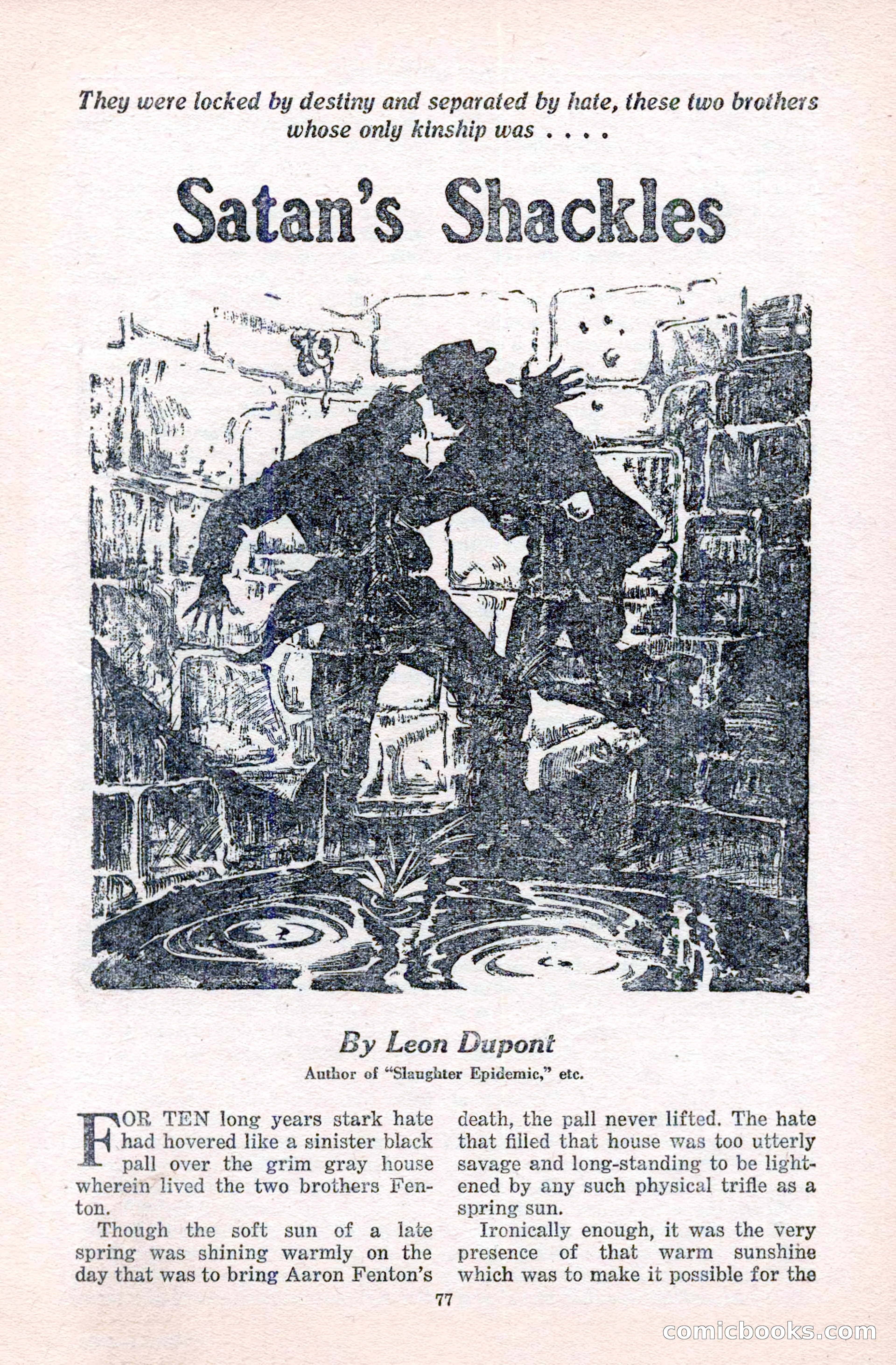
# "Satan's Shackles" by Leon Dupont This is the opening page of a short story from a pulp magazine. The page includes a dramatic woodcut-style illustration depicting two dark, demonic figures in what appears to be an interior setting, along with the story's title, author attribution, and the beginning of the prose narrative. The text introduces two brothers named Fenton who have harbored intense mutual hatred for ten years, living together in a gray house. The story suggests that a spring day and warm sunshine will somehow enable or trigger a significant event—though what occurs remains unclear from this opening passage alone.

10-Story Detective Magazine Cover — page 80 of 116
80 / 116
What you’re looking at · open this page on its own ↗

# Page Analysis This is story prose from page 78 of *10-Story Detective*, a pulp crime magazine. The text describes two stepbrothers, Dave and Aaron Fenton, locked in a bitter relationship by inheritance terms. Dave, a younger man trapped caring for his invalid, aging stepbrother Aaron in a gloomy Midwestern village, has been waiting ten years for Aaron's death to inherit money and return to Paris. The page culminates with Dave finally planning a "perfect murder" of Aaron, apparently timed for a clear Thursday when their servant is away. The passage establishes motive, opportunity, and the brothers' mutual hatred.

10-Story Detective Magazine Cover — page 81 of 116
81 / 116
What you’re looking at · open this page on its own ↗

# Page Analysis: "Satan's Shackles" This page contains **story prose** from a pulp fiction narrative titled "Satan's Shackles" (page 79). The text describes a murder plot in which a character named Dave has meticulously planned to kill Aaron, a man who previously framed him for arsenic poisoning. Dave relies on the predictable daily habits of village residents—particularly old Eli's routine marketing trips and Jed Turner's postal errands—to establish an alibi. The passage shows Dave checking alibis by phone and monitoring timing, suggesting the murder is imminent. The narrative emphasizes how ordinary routines will paradoxically shield Dave from suspicion.

10-Story Detective Magazine Cover — page 82 of 116
82 / 116
What you’re looking at · open this page on its own ↗

# Page Analysis This page contains **story prose** from what appears to be a crime or mystery story titled "10-Story Detective." The visible text depicts a calculated plot involving two brothers, Aaron (confined to a wheelchair) and Dave. Dave has meticulously planned something involving an abandoned well, stage properties, and the arrival of a train. The passage establishes that Aaron frequents the edge of a deep, uncovered well on their property, and Dave appears to be preparing to engineer a fatal "accident," manipulating the arrival of visitor Jed Turner as part of his scheme. The tone suggests premeditated murder disguised as misadventure.

10-Story Detective Magazine Cover — page 83 of 116
83 / 116
What you’re looking at · open this page on its own ↗

# Page from "Satan's Shackles" This is story prose from a pulp fiction tale titled "Satan's Shackles" (page 81). The passage depicts a dramatic confrontation between two brothers: Dave, a younger man, threatens to murder his invalid brother Aaron by staging an elaborate alibi involving a disguise—a mask and shawl meant to impersonate Aaron to a passing witness. Dave plans to throw Aaron down a well while wearing the disguise, then discard it and establish an alibi. The scene culminates with Dave physically attacking the helpless, wheelchair-bound Aaron. The narrative builds suspense through dialogue and internal descriptions of the characters' emotional states.

10-Story Detective Magazine Cover — page 84 of 116
84 / 116
What you’re looking at · open this page on its own ↗

# This Page Shows: This is story prose from a detective/crime pulp magazine. The text describes a carefully planned murder and subsequent cover-up: a character named Dave murders an invalid man named Aaron by throwing him down a well, then methodically erases all evidence of his crime—sweeping away footprints, arranging the victim's shawl to suggest an accident, and positioning Aaron's wheelchair at the well's edge. Dave then disguises himself as Aaron to establish an alibi, waiting for someone named Jed Turner to arrive and witness what appears to be Aaron's accidental death.

10-Story Detective Magazine Cover — page 85 of 116
85 / 116
What you’re looking at · open this page on its own ↗

# Page Analysis: Story Prose from "Satan's Shackles" This page contains story prose from a pulp fiction crime narrative titled "Satan's Shackles." The text depicts a murder's immediate aftermath: a character named Dave has apparently killed someone named Aaron and hidden the body, then establishes an alibi by having Jed Turner witness him alive moments before. Dave then rushes to dispose of incriminating evidence (a box containing disguises and props) down a cistern, and subsequently rides to the Turner farm to secure Turner's alibi testimony. The passage emphasizes Dave's calculated planning and the apparent perfection of his crime, though it hints at potential complications involving the sheriff's suspicions and Jed Turner's weakness for alcohol.

10-Story Detective Magazine Cover — page 86 of 116
86 / 116
What you’re looking at · open this page on its own ↗

# Page 84: Story Prose from "10-Story Detective" This page contains story prose from a hardboiled crime narrative. A man named Dave receives a phone call that his stepbrother Aaron—whom he despises—has died falling down a well. Dave rushes to the scene where a skeptical sheriff questions his whereabouts. Dave claims he was at a friend's house (Jed Turner's) all afternoon, and Jed corroborates the alibi, stating he saw Aaron alive on the porch shortly before Dave left. The sheriff, initially suspicious of Dave given their known hatred, appears to accept the explanation and clears Dave of suspicion.

10-Story Detective Magazine Cover — page 87 of 116
87 / 116
What you’re looking at · open this page on its own ↗

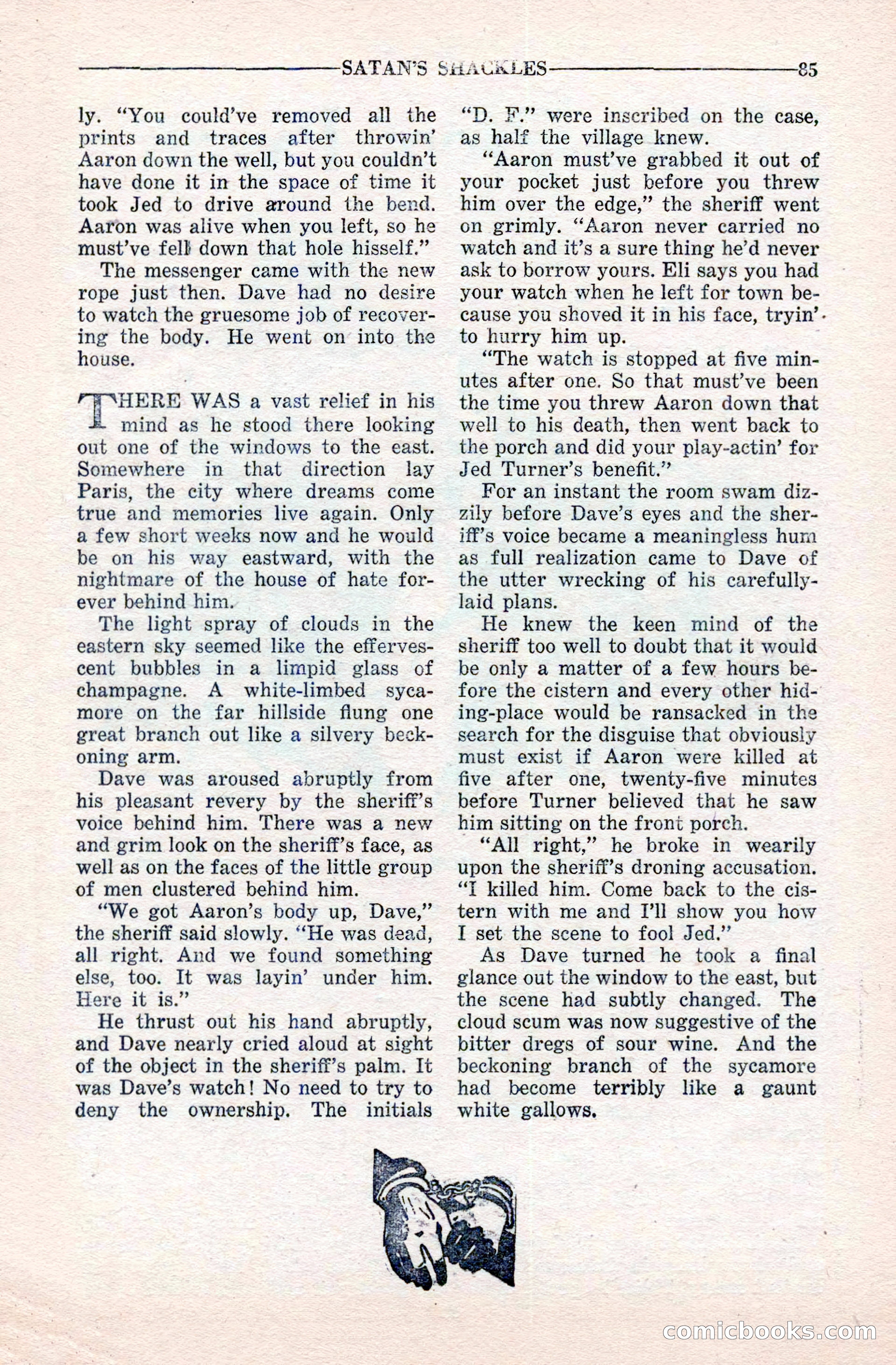
This is a page of story prose from a pulp fiction magazine titled "Satan's Shackles" (page 85). The text depicts a dramatic moment in a crime story where a sheriff confronts a man named Dave with evidence—Dave's initialed watch—found under the body of the victim Aaron, proving Dave threw him down a well. Dave confesses and agrees to show the sheriff where he hid a disguise used to stage a false alibi. The page ends with Dave's emotional realization that his carefully laid plans have unraveled, with the landscape outside appearing ominous.

10-Story Detective Magazine Cover — page 88 of 116
88 / 116
What you’re looking at · open this page on its own ↗

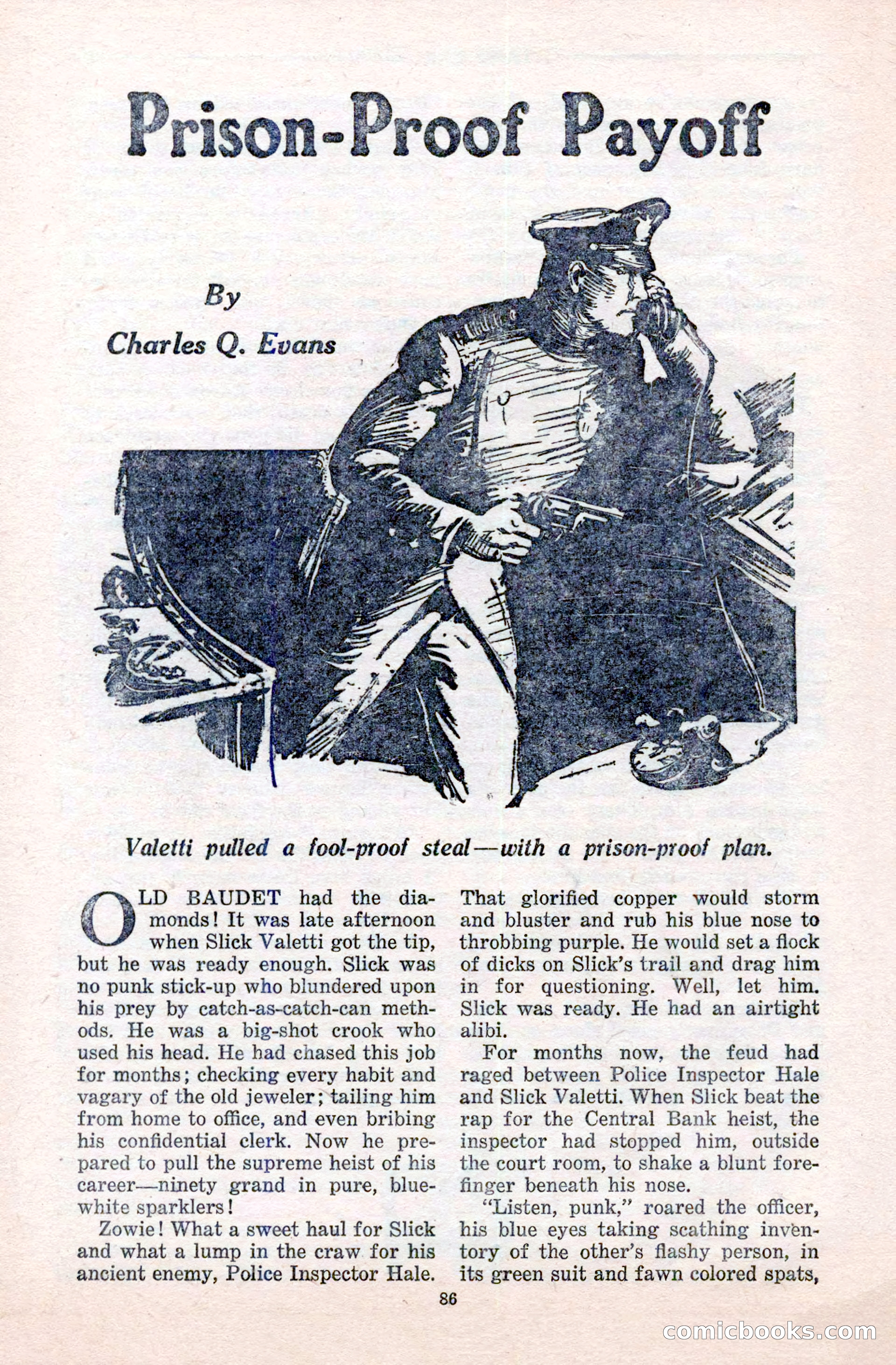
# Page Analysis This is an interior story page from a pulp-fiction magazine featuring the beginning of "Prison-Proof Payoff" by Charles Q. Evans. The page includes a pen-and-ink illustration of a man in a police uniform holding papers, accompanied by the caption "Valetti pulled a fool-proof steal—with a prison-proof plan." The visible prose introduces a hardboiled crime narrative: seasoned crook Slick Valetti plans to steal ninety thousand dollars in diamonds from jeweler Old Baudet, having spent months planning the heist. The text establishes an ongoing rivalry between Valetti and Police Inspector Hale, who previously confronted Valetti after he beat charges related to a Central Bank heist. Valetti believes he has arranged an airtight alibi for his impending theft.

10-Story Detective Magazine Cover — page 89 of 116
89 / 116
What you’re looking at · open this page on its own ↗

# Page Analysis This is story prose from a hardboiled crime pulp magazine, titled "Prison-Proof Payoff." The page depicts a criminal named Slick Valetti planning a jewel heist against Pierre Baudet, a wealthy gem importer. After being insulted by Inspector Hale, Slick decides to rob Baudet, who habitually carries home valuable diamonds from his office. The narrative follows Slick as he cases Baudet's old-fashioned house in a residential district and prepares to break in through French windows, intent on stealing the "cream" of a newly arrived Amsterdam diamond shipment.

10-Story Detective Magazine Cover — page 90 of 116
90 / 116
What you’re looking at · open this page on its own ↗

# Page 83 of 10-Story Detective This is **story prose** from a hardboiled crime narrative. The page depicts a jewel heist in progress: a criminal named Slick has hidden behind a screen in Pierre Baudet's library, waiting to rob the elderly gentleman of "blue white stones" (diamonds). When Baudet arrives—a small, fastidious man who arranges flowers and feeds his goldfish—Slick prepares to emerge from hiding and rob him at gunpoint. The passage captures the tension of the moment before the crime unfolds, with contrasting descriptions of the unsuspecting victim's innocent domestic routine and the hidden criminal's impatient calculations.

10-Story Detective Magazine Cover — page 91 of 116
91 / 116
What you’re looking at · open this page on its own ↗

# Page 89: Story Prose from "Prison-Proof Payoff" This page contains story prose from a hardboiled crime fiction piece titled "Prison-Proof Payoff." The narrative depicts a gunman named Slick Valetti robbing a jeweler, Pierre Baudet, searching frantically for diamonds the jeweler claims he doesn't possess. After exhaustively frisking his captive and finding nothing, Slick considers killing him but hesitates when Baudet calmly suggests he take a fat wallet instead. The tension centers on whether Slick will accept this compromise or commit murder over the missing jewels.

10-Story Detective Magazine Cover — page 92 of 116
92 / 116
What you’re looking at · open this page on its own ↗

# "10-Story Detective" — Story Prose, Page 96 This page contains story prose from a hardboiled crime fiction narrative. It depicts a police interrogation scene where Inspector Hale confronts a small-time crook named Slick Valetti about a botched jewelry robbery. The humor centers on Valetti's failure: he robbed an elderly jeweler of only two dollars and eighty-five cents, unaware the man had hidden ninety thousand dollars worth of diamonds—which the jeweler then fed to his aquarium goldfish while Valetti hid nearby. The inspector finds the situation hilarious, suggesting Valetti will serve ten years in prison.

10-Story Detective Magazine Cover — page 93 of 116
93 / 116
What you’re looking at · open this page on its own ↗

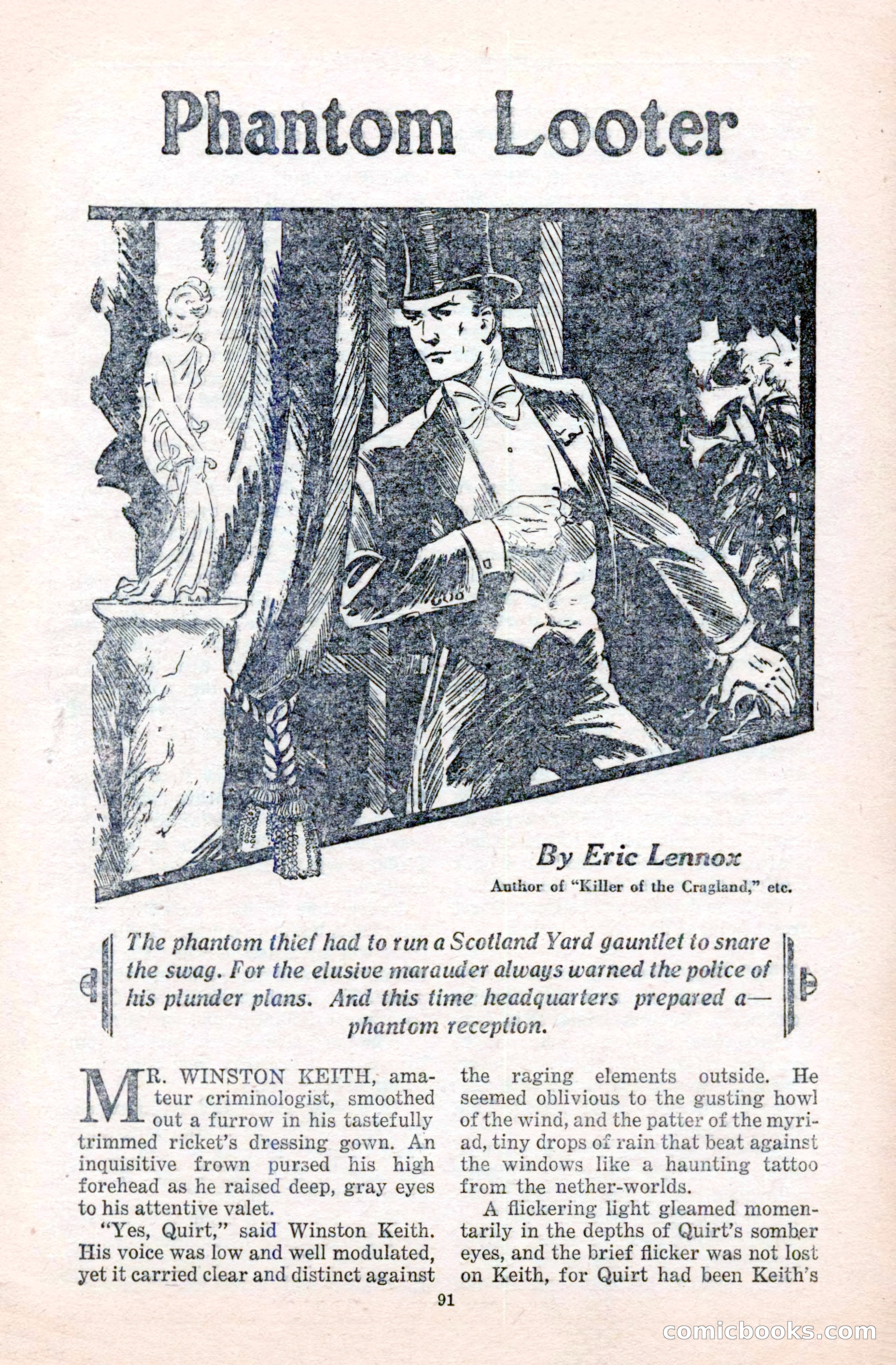
# Phantom Looter This is an interior story page from a pulp fiction magazine featuring the beginning of "Phantom Looter" by Eric Lennox. The page includes an illustration showing a well-dressed man in formal attire and a decorative header image, followed by story prose. The narrative introduces amateur criminologist Mr. Winston Keith and his valet Quirt as they prepare for an encounter with an elusive phantom thief who has been stealing valuables; Scotland Yard has arranged a trap this time to catch the criminal.

10-Story Detective Magazine Cover — page 94 of 116
94 / 116
What you’re looking at · open this page on its own ↗

# Page Analysis: 10-Story Detective Pulp Magazine This page contains story prose from a pulp detective fiction magazine. The narrative follows Winston Keith and Inspector Gilmardy of Scotland Yard as they discuss a mysterious criminal known as "the Gray Ghost," a sophisticated jewel thief who steals from the wealthy but distributes gains to London's poor. The Ghost has sent a taunting note to Gilmardy announcing his intention to rob the mansion of Wallace Cranther (a philanthropist and milk magnate) that very evening, inviting the inspector to attend. Keith deduces that the timing is strategic—Sunday night, when valuables from the previous night's reception remain in Cranther's safe. The page ends with Keith summoning his valet to order drinks.

10-Story Detective Magazine Cover — page 95 of 116
95 / 116
What you’re looking at · open this page on its own ↗

# Page Analysis: "Phantom Looter" This page contains story prose from what appears to be a crime or detective pulp fiction. The text depicts a conversation between Winston Keith (apparently a detective or criminologist) and Inspector Gilmardy, discussing strategy to catch a criminal known as the "Gray Ghost." Keith advises against an obvious trap, citing the criminal's psychology and cleverness, and suggests they meet with additional men that evening to devise a more subtle plan. The narrative includes descriptive details of Keith smoking a cigarette while conversing with his colleague about the case.

10-Story Detective Magazine Cover — page 96 of 116
96 / 116
What you’re looking at · open this page on its own ↗

# Page Analysis This is **story prose** from a hardboiled detective pulp magazine titled "10-Story Detective." The visible text depicts a nighttime scene in London where detective Winston Keith rides in a police car with two blunt Criminal Investigation Department sergeants, Harder and Svenson, apparently hunting a criminal known as "the Ghost." Keith trades barbed remarks with the officers while they drive through fog-shrouded streets toward Grosvenor Square, where Keith mentally calculates whether the rough-handed but not particularly intelligent sergeants pose a danger to their elusive quarry.

10-Story Detective Magazine Cover — page 97 of 116
97 / 116
What you’re looking at · open this page on its own ↗

# Page Analysis: Story Prose from "Phantom Looter" This page contains story prose from a pulp fiction narrative titled "Phantom Looter" (page 95). The text depicts Inspector Gilmardy and his associate Keith arriving at the Cranther house to warn Mrs. Cranther about a jewel thief known as the "Gray Ghost." After initially being turned away by a snobbish butler, the inspector gains entry and relays news of the threat to Mrs. Cranther, who becomes hysterical upon learning her jewels are at risk. Gilmardy attempts to calm her, assuring her the police will catch the criminal. The passage combines mystery-crime elements with comedic character descriptions of the butler and the wealthy Mrs. Cranther.

10-Story Detective Magazine Cover — page 98 of 116
98 / 116
What you’re looking at · open this page on its own ↗

# 10-Story Detective Magazine Page This page contains **prose fiction narrative** from what appears to be a hardboiled crime/detective story titled "10-Story Detective." The text describes Inspector Gilmardy and Winston Keith setting an ambush in a darkened house to catch a criminal known as "the Gray Ghost"—a notorious figure who steals from thieves and robbers, solves crime mysteries ahead of police, and maintains anonymity through blackmail and intimidation. The passage emphasizes the tense silence as the two men wait in separate rooms for their quarry to appear.

10-Story Detective Magazine Cover — page 99 of 116
99 / 116
What you’re looking at · open this page on its own ↗

# Page Analysis: "Phantom Looter" This is story prose—text only, no illustrations—from page 97 of what appears to be a pulp detective or mystery magazine titled "Phantom Looter." The passage depicts Inspector Gilmardy discovering that a criminal figure called "the Gray Ghost" has infiltrated the study where officer Keith was stationed. Finding Keith missing, an overturned chair, and a locked door, Gilmardy realizes the Ghost has taken Keith through it. As Gilmardy investigates, the Gray Ghost—a pale, mustached figure in a dark cape—calmly breaks into a wall safe hidden behind tapestry, steals a diamond necklace and emeralds, leaves an envelope for Gilmardy, then conceals himself as the inspector enters the library.

10-Story Detective Magazine Cover — page 100 of 116
100 / 116
What you’re looking at · open this page on its own ↗

# Page Analysis: "10-Story Detective" Pulp Magazine This is story prose—the main text content of a pulp detective/crime fiction magazine. The visible page (numbered 98) depicts a tense confrontation between Inspector Gilmardy and a mysterious villain called the Gray Ghost, who confronts the inspector at gunpoint in a library. The Ghost mocks Gilmardy and an associate named Winston Keith, then forces the inspector to submit to an injection from a hypodermic syringe, causing him to lose consciousness. The prose emphasizes the Ghost's theatrical menace and Gilmardy's helplessness as the drug takes effect.

10-Story Detective Magazine Cover — page 101 of 116
101 / 116
What you’re looking at · open this page on its own ↗

# Page Content Analysis This is story prose from a pulp fiction magazine titled "Phantom Looter" (page 99). The text depicts Inspector Gilmardy recovering from unconsciousness after an encounter with "the Gray Ghost," a criminal who has stolen jewels and left a taunting note. Gilmardy discovers his companion Mr. Keith bound and unconscious in a corner, revives him with brandy, and learns that Keith was ambushed without seeing his attacker. The narrative focuses on the inspector's frustration at another failure to catch the elusive criminal and his amusement at Keith's predicament.

10-Story Detective Magazine Cover — page 102 of 116
102 / 116
What you’re looking at · open this page on its own ↗

# Page Analysis: "10-Story Detective" This is a **story prose page** from a pulp detective magazine. The narrative follows Inspector Gilmardy and Keith as they conclude a failed investigation involving a criminal called "the Ghost." After losing their quarry despite an elaborate trap, the frustrated Gilmardy briefs his subordinates Harder and Svenson, then departs with Keith in a car toward London. The page depicts the detectives' disappointment at their inability to capture the elusive criminal, who escaped despite their efforts. The tone is one of resigned frustration mixed with dark humor.

10-Story Detective Magazine Cover — page 103 of 116
103 / 116
What you’re looking at · open this page on its own ↗

# Page 101: "Phantom Looter" Story Prose This page contains story prose from what appears to be a hardboiled crime pulp story titled "Phantom Looter." The narrative follows a character named Mr. Winston Keith returning home after dropping off a police officer named Gilmardy. Keith then retrieves a hollow walking stick containing disguise materials—belladonna drops, false mustaches, whitening cream—and stolen jewels including diamonds and the "Gray Ghost" and "Cranther jewels." The scene establishes Keith as apparently involved in jewel theft while maintaining a respectable public persona, with his servant Quirt assisting him.

10-Story Detective Magazine Cover — page 104 of 116
104 / 116
What you’re looking at · open this page on its own ↗

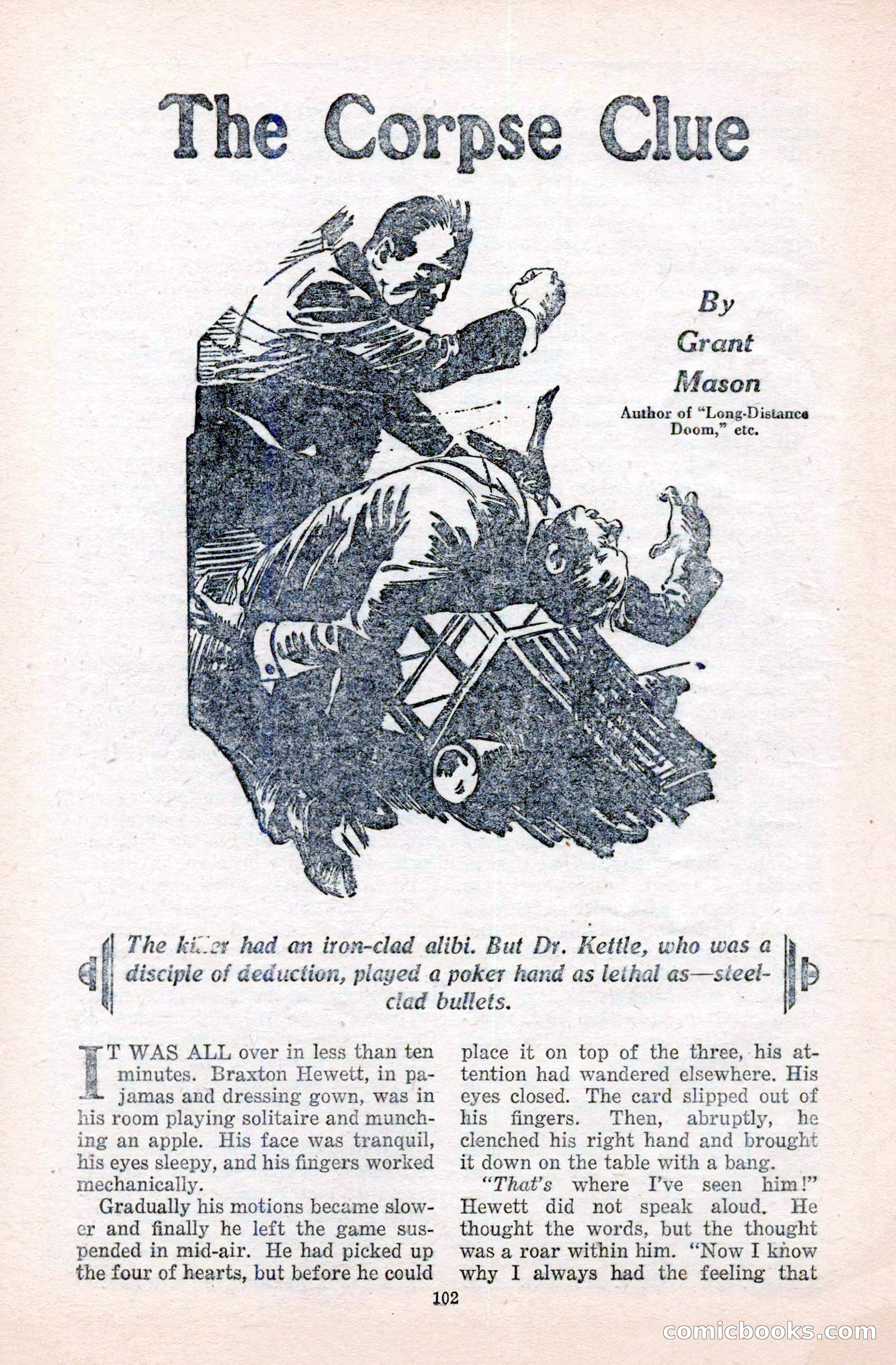
# "The Corpse Clue" by Grant Mason This is an interior story page (page 102) from a pulp-fiction magazine. The visible text shows the opening of a mystery or detective story featuring a character named Braxton Hewett playing solitaire in his pajamas when he suddenly experiences a moment of recognition or realization about someone's identity. The page includes a dramatic illustration of two figures in what appears to be a struggle or confrontation, and an epigraph noting that a killer had an "iron-clad alibi" but Dr. Kettle—described as "a disciple of deduction"—solved the case.

10-Story Detective Magazine Cover — page 105 of 116
105 / 116
What you’re looking at · open this page on its own ↗

# Page Analysis: *The Corpse Clue* This page contains story prose from a hardboiled crime/detective pulp fiction narrative titled "The Corpse Clue" (page 103). The text depicts a confrontation between a character named Hewett and a visitor identified as Val Leoni, a pianist. Hewett reveals knowledge of a nine-year-old incident in St. Paul involving Leoni, a stabbing death, and a mysterious disappearance. The passage escalates as Hewett threatens to expose Leoni's past to Betty (apparently Leoni's romantic interest) unless he cooperates, while also proposing to locate the victim's girlfriend from the original incident as part of his investigation.

10-Story Detective Magazine Cover — page 106 of 116
106 / 116
What you’re looking at · open this page on its own ↗

# Page Analysis This is **story prose** from a hardboiled detective pulp magazine called "10-Story Detective." The page depicts a violent confrontation: an actor named Braxton Hewett is shot and killed by a visitor after a struggle over a desk, apparently a case of mistaken intent. The narrative then shifts to introduce Doctor Alexander Kettle, a medical examiner with unofficial detective skills, arriving at a boarding house to investigate the murder. Inspector Baldock provides background on the victim—a versatile entertainer with stage and film experience.

10-Story Detective Magazine Cover — page 107 of 116
107 / 116
What you’re looking at · open this page on its own ↗

# Page Analysis This page contains **story prose** from a hardboiled detective fiction tale titled "The Corpse Clue." A detective named Baldock interrogates boarders about a murder victim named Hewett, who was shot at 8:14 p.m. The narrative follows Baldock's questioning of three suspects—Louis Lerian (a vaudeville performer), Valentine Janson (an actor in a mystery show), and Gene Miner—each providing alibis for their whereabouts during the killing. The page focuses on establishing timelines and suspicious details, typical of early pulp crime mystery conventions.

10-Story Detective Magazine Cover — page 108 of 116
108 / 116
What you’re looking at · open this page on its own ↗

# 10-Story Detective - Story Prose This page contains detective fiction prose from what appears to be a hardboiled crime pulp magazine. The narrative follows Inspector Baldock and Doctor Kettle investigating a murder victim named Braxton Hewett, who lies dead in his room with a gunshot wound to the temple. Through witness interrogations and crime scene observation, Baldock reconstructs that Hewett returned home from buying fruit, interrupted a burglar, and was shot. The page shows the investigation unfolding through dialogue and descriptive narrative, with no illustrations visible.

10-Story Detective Magazine Cover — page 109 of 116
109 / 116
What you’re looking at · open this page on its own ↗

# Page 107 of a Pulp Crime/Mystery Magazine This page contains story prose from what appears to be a detective mystery titled "The Corpse Clue." The narrative follows detectives examining a dead actor's body and discovering a bizarre contradiction: the victim was a noted fashion expert and writer on color coordination who was found wearing a wildly mismatched outfit (light-brown hat, bluish overcoat, cinnamon suit, orange tie on light-blue shirt, green vest, etc.). The detectives find this detail highly suspicious and puzzling. The right column contains an advertisement for the Newspaper Institute of America's writing courses, promoting their method for teaching commercial writing through practical newspaper work-style instruction.

10-Story Detective Magazine Cover — page 110 of 116
110 / 116
What you’re looking at · open this page on its own ↗

# 10-Story Detective Magazine Page **Page Type:** Story prose (interior page) **Content:** This page continues a detective mystery narrative. Doctor Kettle, investigating the murder of Braxton Hewett, demonstrates a card trick to a boarder named Lerian—apparently to set up a scheme involving a poker game. Kettle then gathers suspects (including Inspector Baldock, Gene Miner, Billy Watwood, and Valentine Janson) to play stud poker while he reveals details about Hewett's murder. The narrative notes that Hewett was murdered between ten and half-past (the text cuts off), and mentions the victim purchased six apples and six oranges, though fewer were found in his room—suggesting a clue to the crime.

10-Story Detective Magazine Cover — page 111 of 116
111 / 116
What you’re looking at · open this page on its own ↗

# Page Analysis: Story Prose with Advertisements This page contains the continuation of a detective mystery story titled "The Corpse Clue." The prose describes a murder investigation where Doctor Kettle explains to poker-playing suspects how he deduced the killer's identity—the murderer dressed the victim's body to establish a false alibi, but this action inadvertently narrowed suspicion to those who knew the victim had gone shopping. The passage ends as attention turns to a suspect named Billy Watwood. The right column is entirely filled with period advertisements for false teeth, tobacco cessation products, asthma remedies, and other medical treatments typical of early pulp magazines.

10-Story Detective Magazine Cover — page 112 of 116
112 / 116
What you’re looking at · open this page on its own ↗

# Page 116 of "10-Story Detective" This page contains story prose from a hardboiled crime/detective pulp magazine. The narrative depicts a dramatic murder investigation climax where Detective Doctor Kettle accuses a man named Watwood of killing Braxton Hewett. Kettle's key evidence: the murderer must be color blind, deduced from the victim's bizarrely mismatched, rainbow-colored outfit that someone with normal color vision would never wear. Kettle then demonstrates this theory using a switched card from Hewett's deck—a green-backed card Watwood allegedly cannot distinguish from the red-backed cards—causing Watwood to explode in denial.

10-Story Detective Magazine Cover — page 113 of 116
113 / 116
What you’re looking at · open this page on its own ↗

# Page Analysis: Story Prose with Advertisements This page contains the conclusion of a detective story titled "The Corpse Clue." The prose reveals that Doctor Kettle has identified Mr. Miner as a murderer through a card-trick deception, leading to Miner's dramatic escape attempt and eventual confession. The text discloses that Miner had killed a man in St. Paul nine years prior, fled to Italy where he underwent physical changes including eye surgery and weight gain, and recently returned to New York. The right column consists entirely of period advertisements for radios, social security card identification plates, air rifles, and false teeth—typical pulp magazine commercial content from approximately 1940.

10-Story Detective Magazine Cover — page 114 of 116
114 / 116
What you’re looking at · open this page on its own ↗

# Page Analysis: 10-Story Detective This page is primarily **advertising and story prose** from what appears to be a pulp detective magazine. The top half contains numerous classified advertisements (detective training courses, employment schemes, patent medicines), while the bottom half continues serialized detective fiction. The story prose describes a murder investigation where Detective Kettle has identified the killer through clever technique: having suspects pick a card from a switched deck (green-backed card from a red-backed deck) to expose the guilty party among three suspects—Watwood, Miner, and Janson. The narrative explains the crime's details and the detective's reasoning about the perpetrator's perfect alibi.

10-Story Detective Magazine Cover — page 115 of 116
115 / 116
What you’re looking at · open this page on its own ↗

# Advertisement Analysis This page is a **full-page advertisement** for Charles Atlas's bodybuilding program, "Dynamic Tension." The ad features a shirtless male physique model with labeled body measurements (neck 17 in., chest 47 in., biceps 17 in., waist 32 in., thigh 23½ in., calf 16 in.; height 5'10", weight 178 lbs) and promises to transform readers into muscular, well-developed men. The advertisement offers a free 48-page instructional book, a 7-day trial period, and mentions a sterling silver trophy awarded to the pupil showing the most improvement. A mail coupon appears at the bottom for readers to request the free book.

10-Story Detective Magazine Cover — page 116 of 116
116 / 116
What you’re looking at · open this page on its own ↗

# Description This is a full-page advertisement from an early 20th-century pulp magazine. The page features a medical photograph of an infected foot on the left, accompanied by promotional text advertising "H.F.," a liquid remedy for athlete's foot (tinea trichophyton infection). The advertisement explains the disease's symptoms, claims the product provides quick relief, and offers a free trial: customers need only mail the coupon without paying upfront, then send $1 after ten days if satisfied. Gore Products, Inc. of New Orleans, Louisiana is the manufacturer. A detachable coupon appears at the bottom for ordering.

Browse this issue page by page

Each page has its own page — the cartoon, who’s in it, and what the satire means.

  1. Page 1 This is the cover of a 10-story Detective Magazine from September, priced at 10 cents. The illustration depicts a dramatic scene at what appears to be a nightcl…
  2. Page 2 # Advertisement Page: U.S. School of Music This is an advertisement page promoting the U.S. School of Music's method for learning to play instruments at home. T…
  3. Page 3 # Analysis of This Magazine Page This is a full-page **advertisement**, not story prose or editorial content. It promotes the Coyne Electrical School in Chicago…
  4. Page 4 # 10-Story Detective Magazine Table of Contents This is a **table of contents page** from the September 1939 issue of *10-Story Detective* magazine (Vol. III, N…
  5. Page 5 # This Page: Advertisement This is a full-page advertisement for the National Radio Institute's home-study radio training course, presented by J. E. Smith, the …
  6. Page 6 # Analysis of This Pulp Magazine Page This is a contents/advertisement page from a pulp fiction magazine (appears to be *Ten Detective Aces*, dated September, o…
  7. Page 7 This page is primarily advertising, typical of pulp magazine back matter. It features various mail-order product and service advertisements including eyeglasses…
  8. Page 8 # Page Analysis This is an interior story page from a pulp magazine featuring both illustration and prose text. The top half shows a sketch illustration of what…
  9. Page 9 # Page Analysis This is an interior story page from a pulp magazine featuring a short story titled "Hollywood Novelet" by James A. Kirch (author of "Corpse of H…
  10. Page 10 # Page Analysis: 10-Story Detective This page contains story prose from what appears to be a hardboiled crime narrative. The narrator, a character named Steve, …
  11. Page 11 This is story prose from page 9 of a hardboiled crime pulp magazine titled "The Morgue Is Full of Heroes." The narrator describes a violent confrontation in a b…
  12. Page 12 # Page Analysis: 10-Story Detective This page contains story prose from a hardboiled crime fiction tale. It shows the continuation of a scene in a bar where the…
  13. Page 13 # Page Analysis This is **story prose** from a hardboiled crime or mystery pulp magazine, page 11 of a story titled "The Morgue Is Full of Heroes." The narrator…
  14. Page 14 # Page Analysis This is story prose from a hardboiled crime/detective pulp magazine titled "10-STORY DETECTIVE" (visible at page top). The narrative follows a d…
  15. Page 15 # Page Analysis This is **story prose** from a hardboiled crime pulp magazine, specifically page 13 of "The Morgue Is Full of Heroes." The narrative depicts a t…
  16. Page 16 # Page Analysis This is **story prose** from a hardboiled detective fiction piece titled "10-Story Detective" (visible in the header). The page shows the narrat…
  17. Page 17 # Page Content Analysis This page contains **story prose** from a hardboiled crime or detective pulp fiction, titled "The Morgue Is Full of Heroes" (page 15). T…
  18. Page 18 # Page 16 of 10-Story Detective This page contains prose fiction from a hardboiled crime story. The narrator, a detective named Steve Craig, confronts a man nam…
  19. Page 19 # Page Analysis This page contains story prose from a hardboiled crime fiction narrative titled "The Morgue Is Full of Heroes." The text shows a dialogue-heavy …
  20. Page 20 # 10-Story Detective: Story Prose with Illustration This page contains hardboiled crime fiction prose alongside a chapter break illustration. The narrative foll…
  21. Page 21 # Page Analysis This is **story prose** from a pulp-fiction mystery or crime narrative titled "The Morgue Is Full of Heroes." The page depicts a dramatic discov…
  22. Page 22 # Page Analysis This page contains **story prose** from a hardboiled crime narrative, likely from *10-Story Detective* magazine (visible in the header). The tex…
  23. Page 23 # Page 21: Story Prose from "The Morgue Is Full of Heroes" This page contains prose narrative from a hardboiled crime story. The unnamed narrator describes a sh…
  24. Page 24 # 10-STORY DETECTIVE, Page 22 This page contains story prose from a hardboiled crime pulp magazine. The narrative reveals the resolution of a murder case: the c…
  25. Page 25 This page displays the opening of a hardboiled crime story titled "Bullet Bandwagon" by Harold F. Sorensen. It includes a dramatic illustration showing what app…
  26. Page 26 # Page Analysis This is **story prose** from a pulp detective magazine titled "10-Story Detective." The page depicts a scene where a character named Keating vis…
  27. Page 27 This is a page of prose fiction from a pulp magazine titled "Bullet Bandwagon." The text depicts a hardboiled crime story involving boxing and corruption. Detec…
  28. Page 28 This is story prose from a hardboiled crime/detective pulp magazine titled "10-Story Detective." The page depicts a scene where detective Keating searches for a…
  29. Page 29 # Page Analysis: Bullet Bandwagon This page contains prose fiction from what appears to be a hardboiled crime story. The narrative depicts a tense confrontation…
  30. Page 30 # Page 28 of "10-Story Detective" This page contains story prose from a hardboiled crime narrative. The text depicts a tense conversation between detective Keat…
  31. Page 31 This page contains story prose from what appears to be a hardboiled crime pulp fiction magazine. The text depicts a conversation between a detective named Keati…
  32. Page 32 # Page Analysis: "10-Story Detective" Pulp Fiction This page contains story prose from what appears to be a hardboiled crime/detective pulp magazine. The narrat…
  33. Page 33 # Page Analysis: "Bullet Bandwagon" This page contains story prose from what appears to be a hardboiled crime or detective pulp magazine. The narrative depicts …
  34. Page 34 # Page Analysis: *10-Story Detective* Pulp Magazine This is **story prose** — specifically page 32 of what appears to be a hardboiled crime or detective fiction…
  35. Page 35 # Page Analysis This is **story prose** from a hardboiled crime pulp magazine titled "Bullet Bandwagon." The page shows a conversation between characters named …
  36. Page 36 This is the opening page of a hardboiled detective story titled "The Vengeance Broker" by Benton Greer. The page features an illustration of a man being thrown …
  37. Page 37 # Page Analysis This is **story prose** from a hardboiled detective fiction piece titled "The Vengeance Broker" (page 35). The narrator, private detective Krueg…
  38. Page 38 # Page from "10-Story Detective" This is a page of story prose from what appears to be a hardboiled detective fiction magazine. The narrative follows a detectiv…
  39. Page 39 This page is prose from a hardboiled crime story titled "The Vengeance Broker." The narrator, a detective called "Slam," discusses a jewelry store robbery with …
  40. Page 40 # Page Content: Story Prose This page contains prose fiction from a hardboiled detective story titled "10-Story Detective." The narrative follows a detective (n…
  41. Page 41 # Page Analysis: "The Vengeance Broker" This page contains story prose from a hardboiled crime fiction narrative titled "The Vengeance Broker" (page 39). A dete…
  42. Page 42 # Page Description This is story prose from page 40 of *10-Story Detective*, a pulp crime magazine. The narrative, told in first-person by a detective called "S…
  43. Page 43 # The Vengeance Broker — Page 41 This is story prose from a hardboiled crime pulp fiction magazine. The page depicts a private detective negotiating with an ira…
  44. Page 44 # Page 42 of "10-Story Detective" — Story Prose This page contains story prose from a hardboiled detective narrative. The protagonist detective has recovered st…
  45. Page 45 # Page Analysis This page contains prose narrative from a crime story titled "The Vengeance Broker" (page 43). The text describes two cousins who robbed each ot…
  46. Page 46 This page shows the opening of a short story titled "Disaster Snare" by Stanley Crawford. It features an illustration depicting a man in formal attire and a wom…
  47. Page 47 # Page Analysis This is **story prose** from a pulp fiction magazine titled "Disaster Snare" (page 45). The text depicts a crime or mystery narrative in which a…
  48. Page 48 # Page Analysis This page contains **story prose** from a hardboiled detective narrative titled "10-Story Detective." The visible text depicts detectives Hart a…
  49. Page 49 # Page Analysis This page contains **story prose** from a pulp fiction narrative titled "Disaster Snare." The text depicts a detective mystery involving a suspi…
  50. Page 50 # Page 48: Crime Story Prose This page contains prose fiction from a hardboiled detective story titled "10-Story Detective." The narrative follows Detective Har…
  51. Page 51 # Page Analysis **Format:** Story prose (text only, no illustrations) **Content:** This page contains the climactic scene from a story titled "Disaster Snare" i…
  52. Page 52 # 10-Story Detective, Page 50 This page contains story prose from a hardboiled crime/detective fiction narrative. Detective Phil Hart investigates a mysterious …
  53. Page 53 # Page Analysis: "Disaster Snare" This is **story prose** from a pulp fiction magazine, appearing on page 51. The text depicts a suspenseful scene where a chara…
  54. Page 54 # Page Content Analysis This is **story prose** from a pulp detective magazine titled "10-Story Detective." The visible text concludes an action scene where det…
  55. Page 55 # Page Analysis: "Plunder Deadline" This is an interior story page from a pulp magazine, featuring the beginning of a short story titled "Plunder Deadline" by P…
  56. Page 56 # Page Analysis: 10-Story Detective This page contains story prose from a hardboiled crime pulp magazine. The narrative follows Eddie Foster, a young man who ca…
  57. Page 57 # Page Analysis This page contains story prose from "Plunder Deadline" (page 55), a pulp fiction narrative. The text follows Eddie, who has stolen money but has…
  58. Page 58 # 10-Story Detective Page 56 This page contains prose fiction from what appears to be a hardboiled crime/detective pulp magazine. The narrative depicts a confro…
  59. Page 59 # Page Analysis This page contains **story prose** from a hardboiled crime pulp fiction magazine titled "Plunder Deadline." The text depicts a conversation betw…
  60. Page 60 This page contains story prose from a pulp detective magazine ("10-Story Detective," visible in the header). The narrative depicts Sergeant O'Toole interrogatin…
  61. Page 61 # Analysis This is a **story illustration and opening page** from a pulp fiction magazine. The page shows the title "Classroom Sleuth" by S. J. Bailey and featu…
  62. Page 62 # Page Analysis This is story prose from a pulp detective magazine (page 60 of "10-Story Detective"). The narrative follows a young man named Johnny who has bee…
  63. Page 63 # Classroom Sleuth (Page 61) This page contains story prose from a pulp fiction narrative. The text describes a young student named Johnny Cushing who participa…
  64. Page 64 # Page Analysis This is **story prose** from page 62 of a pulp detective magazine titled "10-Story Detective." The narrative follows a student named Johnny who …
  65. Page 65 # Page Analysis: "Classroom Sleuth" This is story prose from what appears to be a hardboiled crime or mystery pulp magazine (page 63). The text depicts a confro…
  66. Page 66 # Page Analysis This is story prose from a pulp detective magazine (page 64 of "10-Story Detective"). The text depicts a dramatic scene in which a dying profess…
  67. Page 67 # Page Analysis: "Classroom Sleuth" This page contains **story prose** from what appears to be a hardboiled crime pulp fiction tale. The narrative follows a you…
  68. Page 68 This page contains story prose from a hardboiled crime detective pulp magazine. The narrative depicts a dramatic shooting incident where a character named Johnn…
  69. Page 69 # Page 67: "Classroom Sleuth" This page contains story prose from what appears to be a mystery or crime fiction narrative. The text depicts a dramatic scene in …
  70. Page 70 # Page Analysis This is story prose from a pulp crime fiction magazine. The page presents the opening of "Party Girl Murder" by Ronald Flagg. It introduces Algi…
  71. Page 71 # Page 69 from "Party Girl Murder" This page contains story prose from what appears to be a hardboiled crime pulp fiction. The text describes a character named …
  72. Page 72 # Page 70: Story Prose from "10-Story Detective" This page contains story prose from what appears to be a crime or detective pulp magazine. The passage depicts …
  73. Page 73 # Page Analysis **Type:** Story prose (text only, no illustrations) **Content:** This page from "Party Girl Murder" depicts a hardboiled crime narrative in whic…
  74. Page 74 # Page 72 of "10-Story Detective" This page contains **story prose** from what appears to be a hardboiled crime pulp narrative. The text depicts a conversation …
  75. Page 75 # Page Analysis This is story prose from a pulp crime/hardboiled fiction magazine titled "Party Girl Murder" (page 73). The text depicts a criminal conspiracy d…
  76. Page 76 # Page 74 of "10-Story Detective" This page contains story prose from what appears to be a hardboiled crime narrative. The text depicts a tense scene involving …
  77. Page 77 # Page Analysis This is **story prose** from a hardboiled crime pulp magazine titled "Party Girl Murder." The page depicts a tense hostage situation where a gun…
  78. Page 78 # Page Analysis This is **story prose** from a hardboiled detective or crime pulp magazine titled "10-Story Detective." The page depicts an action climax in whi…
  79. Page 79 # "Satan's Shackles" by Leon Dupont This is the opening page of a short story from a pulp magazine. The page includes a dramatic woodcut-style illustration depi…
  80. Page 80 # Page Analysis This is story prose from page 78 of *10-Story Detective*, a pulp crime magazine. The text describes two stepbrothers, Dave and Aaron Fenton, loc…
  81. Page 81 # Page Analysis: "Satan's Shackles" This page contains **story prose** from a pulp fiction narrative titled "Satan's Shackles" (page 79). The text describes a m…
  82. Page 82 # Page Analysis This page contains **story prose** from what appears to be a crime or mystery story titled "10-Story Detective." The visible text depicts a calc…
  83. Page 83 # Page from "Satan's Shackles" This is story prose from a pulp fiction tale titled "Satan's Shackles" (page 81). The passage depicts a dramatic confrontation be…
  84. Page 84 # This Page Shows: This is story prose from a detective/crime pulp magazine. The text describes a carefully planned murder and subsequent cover-up: a character …
  85. Page 85 # Page Analysis: Story Prose from "Satan's Shackles" This page contains story prose from a pulp fiction crime narrative titled "Satan's Shackles." The text depi…
  86. Page 86 # Page 84: Story Prose from "10-Story Detective" This page contains story prose from a hardboiled crime narrative. A man named Dave receives a phone call that h…
  87. Page 87 This is a page of story prose from a pulp fiction magazine titled "Satan's Shackles" (page 85). The text depicts a dramatic moment in a crime story where a sher…
  88. Page 88 # Page Analysis This is an interior story page from a pulp-fiction magazine featuring the beginning of "Prison-Proof Payoff" by Charles Q. Evans. The page inclu…
  89. Page 89 # Page Analysis This is story prose from a hardboiled crime pulp magazine, titled "Prison-Proof Payoff." The page depicts a criminal named Slick Valetti plannin…
  90. Page 90 # Page 83 of 10-Story Detective This is **story prose** from a hardboiled crime narrative. The page depicts a jewel heist in progress: a criminal named Slick ha…
  91. Page 91 # Page 89: Story Prose from "Prison-Proof Payoff" This page contains story prose from a hardboiled crime fiction piece titled "Prison-Proof Payoff." The narrati…
  92. Page 92 # "10-Story Detective" — Story Prose, Page 96 This page contains story prose from a hardboiled crime fiction narrative. It depicts a police interrogation scene …
  93. Page 93 # Phantom Looter This is an interior story page from a pulp fiction magazine featuring the beginning of "Phantom Looter" by Eric Lennox. The page includes an il…
  94. Page 94 # Page Analysis: 10-Story Detective Pulp Magazine This page contains story prose from a pulp detective fiction magazine. The narrative follows Winston Keith and…
  95. Page 95 # Page Analysis: "Phantom Looter" This page contains story prose from what appears to be a crime or detective pulp fiction. The text depicts a conversation betw…
  96. Page 96 # Page Analysis This is **story prose** from a hardboiled detective pulp magazine titled "10-Story Detective." The visible text depicts a nighttime scene in Lon…
  97. Page 97 # Page Analysis: Story Prose from "Phantom Looter" This page contains story prose from a pulp fiction narrative titled "Phantom Looter" (page 95). The text depi…
  98. Page 98 # 10-Story Detective Magazine Page This page contains **prose fiction narrative** from what appears to be a hardboiled crime/detective story titled "10-Story De…
  99. Page 99 # Page Analysis: "Phantom Looter" This is story prose—text only, no illustrations—from page 97 of what appears to be a pulp detective or mystery magazine titled…
  100. Page 100 # Page Analysis: "10-Story Detective" Pulp Magazine This is story prose—the main text content of a pulp detective/crime fiction magazine. The visible page (numb…
  101. Page 101 # Page Content Analysis This is story prose from a pulp fiction magazine titled "Phantom Looter" (page 99). The text depicts Inspector Gilmardy recovering from …
  102. Page 102 # Page Analysis: "10-Story Detective" This is a **story prose page** from a pulp detective magazine. The narrative follows Inspector Gilmardy and Keith as they …
  103. Page 103 # Page 101: "Phantom Looter" Story Prose This page contains story prose from what appears to be a hardboiled crime pulp story titled "Phantom Looter." The narra…
  104. Page 104 # "The Corpse Clue" by Grant Mason This is an interior story page (page 102) from a pulp-fiction magazine. The visible text shows the opening of a mystery or de…
  105. Page 105 # Page Analysis: *The Corpse Clue* This page contains story prose from a hardboiled crime/detective pulp fiction narrative titled "The Corpse Clue" (page 103). …
  106. Page 106 # Page Analysis This is **story prose** from a hardboiled detective pulp magazine called "10-Story Detective." The page depicts a violent confrontation: an acto…
  107. Page 107 # Page Analysis This page contains **story prose** from a hardboiled detective fiction tale titled "The Corpse Clue." A detective named Baldock interrogates boa…
  108. Page 108 # 10-Story Detective - Story Prose This page contains detective fiction prose from what appears to be a hardboiled crime pulp magazine. The narrative follows In…
  109. Page 109 # Page 107 of a Pulp Crime/Mystery Magazine This page contains story prose from what appears to be a detective mystery titled "The Corpse Clue." The narrative f…
  110. Page 110 # 10-Story Detective Magazine Page **Page Type:** Story prose (interior page) **Content:** This page continues a detective mystery narrative. Doctor Kettle, inv…
  111. Page 111 # Page Analysis: Story Prose with Advertisements This page contains the continuation of a detective mystery story titled "The Corpse Clue." The prose describes …
  112. Page 112 # Page 116 of "10-Story Detective" This page contains story prose from a hardboiled crime/detective pulp magazine. The narrative depicts a dramatic murder inves…
  113. Page 113 # Page Analysis: Story Prose with Advertisements This page contains the conclusion of a detective story titled "The Corpse Clue." The prose reveals that Doctor …
  114. Page 114 # Page Analysis: 10-Story Detective This page is primarily **advertising and story prose** from what appears to be a pulp detective magazine. The top half conta…
  115. Page 115 # Advertisement Analysis This page is a **full-page advertisement** for Charles Atlas's bodybuilding program, "Dynamic Tension." The ad features a shirtless mal…
  116. Page 116 # Description This is a full-page advertisement from an early 20th-century pulp magazine. The page features a medical photograph of an infected foot on the left…