
Pulp Fiction, 1939 · page 10 of 116
10-Story Detective Magazine Cover — page 10: what you’re looking at
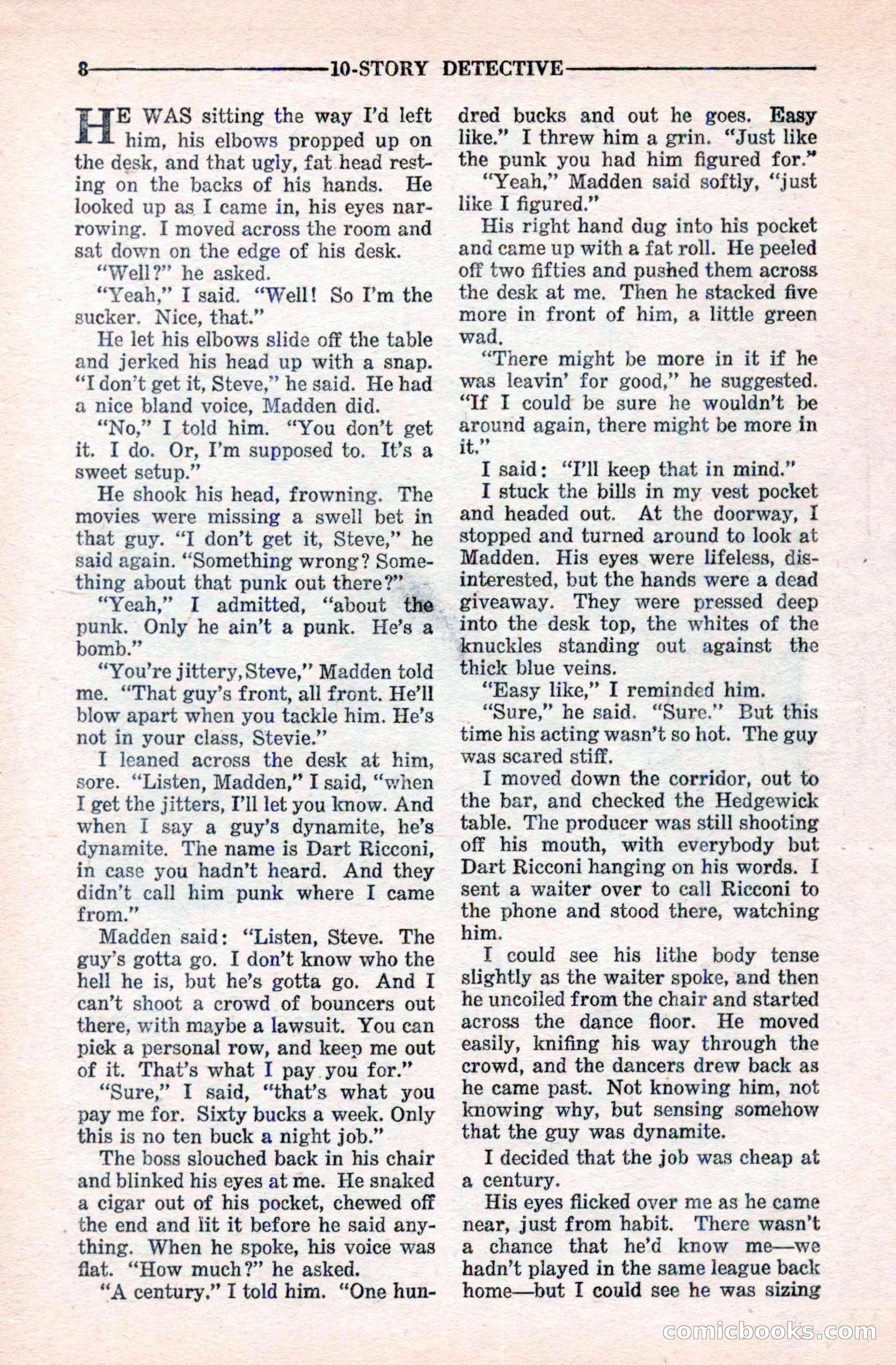
A restored page from Pulp Fiction, 1939. Page through the whole issue in the reader above.
📄 Transcribed text from this page (OCR, searchable)
Machine-transcribed from the original scan — historical spelling and the odd misread are preserved.
E WAS sitting the way I'd left him, his elbows propped up on the desk, and that ugly, fat head rest- ing on the backs of his hands. He looked up as I came in, his eyes nar- rowing. I moved across the room and sat down on the edge of his desk. “Well?” he asked. “Yeah,” I said. “Well! So I’m the sucker, Nice, that.” He let his elbows slide off the table and jerked his head up with a snap. “T don’t get it, Steve,” he said. He had a nice bland voice, Madden did. “No,” I told him. “You don’t get it. I do. Or, I’m supposed to. It’s a sweet setup.” He shook his head, frowning. The movies were missing a swell bet in that guy. “I don’t get it, Steve,” he said again. “Something wrong? Some- thing about that punk out there?” | - “Veah,” I admitted, “about the. punk. Only he ain’t a punk. He’s a bomb.” “You’re jittery, Steve,’”’ Madden told me. “That guy’s front, all front. He’ll blow apart when you tackle him. He’s not in your class, Stevie.” I leaned across the desk at him, sore. “Listen, Madden,” I said, “when I get the jitters, I'll let you know. And when I say a guy’s dynamite, he’s dynamite, The name is Dart Ricconi, in case you hadn’t heard. And they didn’t call him punk where I came from.” Madden said: “Listen, Steve. The guy’s gotta go. I don’t know who the hell he is, but he’s gotta go. And I can’t shoot a crowd of bouncers out there, with maybe a lawsuit. You can pick a personal row, and keev me out of it. That’s what I pay you for.” “Sure,” I said, “that’s what you pay me for. Sixty bucks a week. Only this is no ten buck a night job.” The boss slouched back in his chair and blinked his eyes at me. He snaked a cigar out of his pocket, chewed offi _ the end and lit it before he said any- thing. When he spoke, his voice was flat. “How much?” he asked. “A century.” I told him. “One hun- 10-STORY DETECTIVE dred bucks and out he goes. Easy like.” I threw him a grin. “Just like the punk you had him figured for.” “Yeah,” Madden said softly, “‘just like I figured.” His right hand dug into his pocket and came up with a fat roll. He peeled ofi two fifties and pushed them across the desk at me. Then he stacked five more in front of him, a little green wad, “There might be more in it if he was leavin’ for good,” he suggested. “If I could be sure he wouldn’t be around again, there might be more in i. I said: “T’ll keep that in mind.” I stuck the bills in my vest pocket and headed out. At the doorway, I stopped and turned around to look at Madden. His eyes were lifeless, dis- interested, but the hands were a dead giveaway. They were pressed deep - into the desk top, the whites of the knuckles standing out against the thick blue veins. “Easy like,” I reminded him. “Sure,” he said. “Sure.” But this time his acting wasn’t so hot. The guy was scared stiff, I moved down the corridor, out to the bar, and checked the Hedgewick table. The producer was still shooting off his mouth, with everybody but Dart Ricconi hanging on his words. I sent a waiter over to call Ricconi to the phone and stood there, watching him. T could see his lithe body tense slightly as the waiter spoke, and then he uncoiled from the chair and started across the dance floor. He moved easily, knifing his way through the crowd, and the dancers drew back as he came past. Not knowing him, not knowing why, but sensing somehow that the guy was dynamite. I decided that the job was cheap at a century. His eyes fiicked over me as he came near, just from habit. There wasn’t a chance that he’d know me—we hadn’t played in the same league back home—but I could see he was sizing COmiclbooks (C@