
Pulp Fiction, 1939 · page 37 of 116
10-Story Detective Magazine Cover — page 37: what you’re looking at
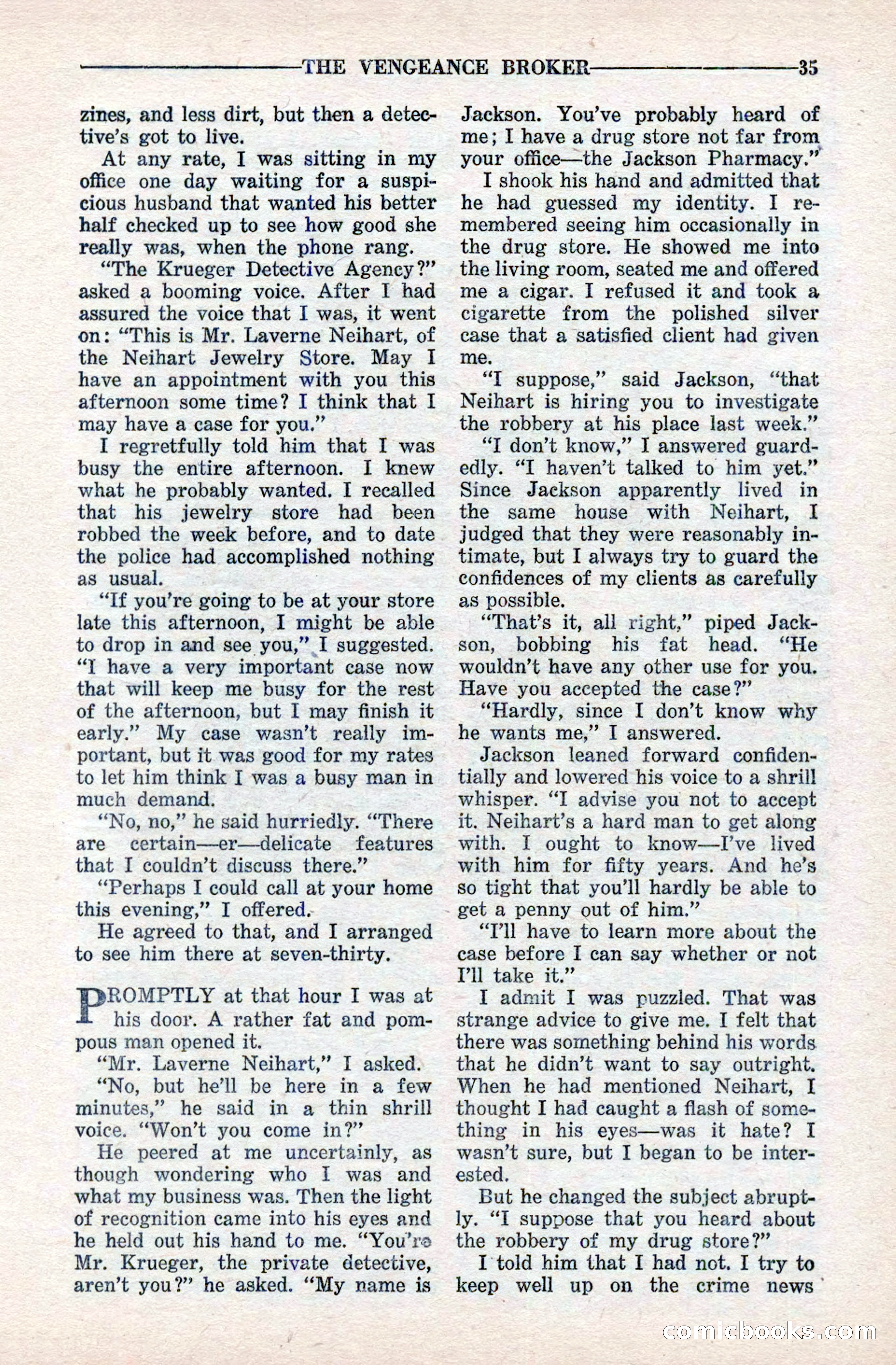
A restored page from Pulp Fiction, 1939. Page through the whole issue in the reader above.
📄 Transcribed text from this page (OCR, searchable)
Machine-transcribed from the original scan — historical spelling and the odd misread are preserved.
zines, and less dirt, but then a detec- tive’s got to live. At any rate, I was sitting in my office one day waiting for a suspi- cious husband that wanted his better half checked up to see how good she really was, when the phone rang. “The Krueger Detective Agency?” asked a booming voice. After I had assured the voice that I was, it went on: “This is Mr. Laverne Neihart, of the Neihart Jewelry Store. May I have an appointment with you this afternoon some time? I think that I may have a case for you.” I regretfully told him that I was busy the entire afternoon. I knew what he probably wanted. I recalled that his jewelry store had been robbed the week before, and to date the police had accomplished nothing as usual. “If you’re going to be at your store late this afternoon, I might be able to drop in and see you,” I suggested. “{ have a very important case now that will keep me busy for the rest of the afternoon, but I may finish it early.” My case wasn’t really im- portant, but it was good for my rates to let him think I was a busy man in much demand. “No, no,” he said hurriedly. “There are certain—er—delicate features that I couldn’t discuss there.” “Perhaps I could call at your home this evening,” I offered. He agreed to that, and I arranged to see him there at seven-thirty. ROMPTLY at that hour I was at his door. A rather fat and pom- pous man opened it. “Mr. Laverne Neihart,” I asked. “No, but he’ll be here in a few minutes,” he said in a thin shrill voice. ‘‘Won’t you come in?” He peered at me uncertainly, as though wondering who I was and what my business was. Then the light of recognition came into his eyes and he held out his hand to me. “You’re Mr. Krueger, the private detective, aren’t you?” he asked. “My name is THE VENGEANCE BROKER 30 Jackson. You’ve probably heard of me; I have a drug store not far from your office—the Jackson Pharmacy.” I shook his hand and admitted that he had guessed my identity. I re- membered seeing him occasionally in the drug store. He showed me into the living room, seated me and offered me a cigar. I refused it and took a cigarette from the polished silver case that a satisfied client had given me. “I suppose,” said Jackson, “that Neihart is hiring you to investigate the robbery at his place last week.” “T don’t know,” J answered guard- edly. “I haven’t talked to him yet.” Since Jackson apparently lived in the same house with Neihart, I judged that they were reasonably in- timate, but I always try to guard the confidences of my clients as carefully as possible. “That’s it, all right,” piped Jack- son, bobbing his fat head. “He wouldn’t have any other use for you. Have you accepted the case?” “Hardly, since I don’t know why he wants me,” I answered. Jackson leaned forward confiden- tially and lowered his voice to a shrill whisper. “I advise you not to accept it. Neihart’s a hard man to get along with. I ought to know—I’ve lived with him for fifty years. And he’s so tight that you'll hardly be able to get a penny out of him.” “lll have to learn more about the case before I can say whether or not I'll take it.” I admit I was puzzled. That was strange advice to give me. I felt that there was something behind his words that he didn’t want to say outright. When he had mentioned Neihart, I thought I had caught a flash of some- thing in his eyes—was it hate? I wasn’t sure, but I began to be inter- ested. But he changed the subject abrupt- ly. “I suppose that you heard about the robbery of my drug store?” I told him that I had not. I try to keep well up on the crime news’ GOMIGDOOKS (C@