
Pulp Fiction, 1939 · page 56 of 116
10-Story Detective Magazine Cover — page 56: what you’re looking at
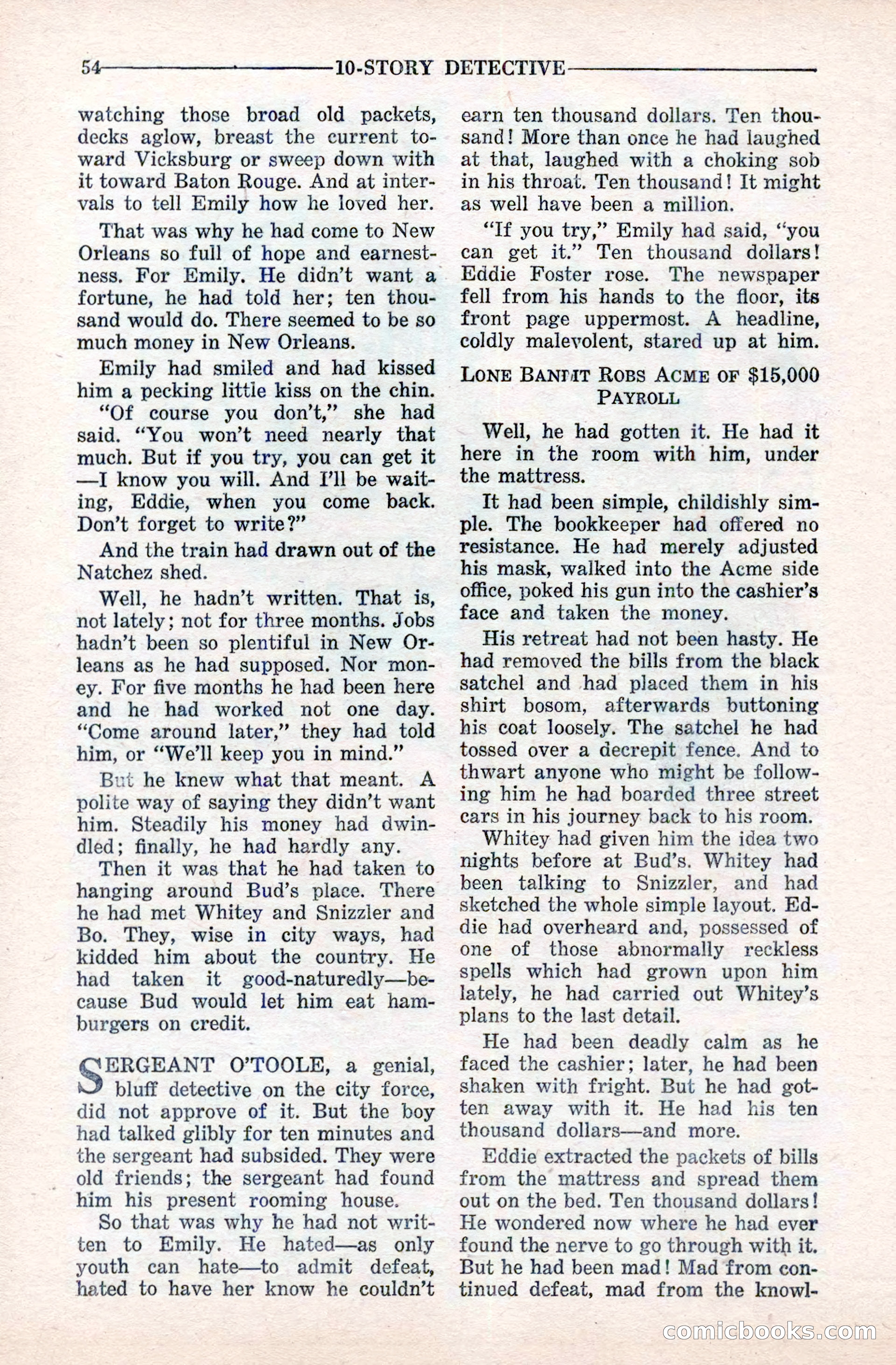
A restored page from Pulp Fiction, 1939. Page through the whole issue in the reader above.
📄 Transcribed text from this page (OCR, searchable)
Machine-transcribed from the original scan — historical spelling and the odd misread are preserved.
54—__—_—————————-10-STORY DETECTIVE watching those broad old packets, decks aglow, breast the current to- ward Vicksburg or sweep down with it toward Baton Rouge. And at inter- vals to tell Emily how he ioved her. That was why he had come to New Orleans so full of hope and earnest- ness. For Emily. He didn’t want a fortune, he had told her; ten thou- sand would do. There seemed to be so much money in New Orleans. Emily had smiled and had kissed him a pecking littie kiss on the chin. “Of course you don’t,” she had said. “You won’t need nearly that much. But if you try, you can get it —I know you will. And [’ll be wait- ing, Eddie, when you come back. Don’t forget to write?’ And the train had drawn out of the Natchez shed. Well, he hadn’t written. That is, not lately; not for three months. Jobs hadn’t been so plentiful in New Or- leans as he had supposed. Nor mon- ey. For five months he had been here and he had worked not one day. “Come around later,” they had told him, or “We’ll keep you in mind.” But he knew what that meant. A polite way of saying they didn’t want him. Steadily his money had dwin- dled; finally, he had hardly any. Then it was that he had taken to hanging around Bud’s place. There he had met Whitey and Snizzier and Bo. They, wise in city ways, had kidded him about the country. He had taken it good-naturedly—be- cause Bud would let him eat ham- burgers on credit. ERGEANT O’TOOLE, a genial, bluff detective on the city force, did not approve of it. But the boy had talked glibly for ten minutes and the sergeant had subsided. They were old friends; the sergeant had found him his present rooming house. So that was why he had not writ- ten to Emily. He hated—as only youth can hate—to admit defeat, hated to have her know he couldn’t earn ten thousand dollars. Ten thou- sand! More than once he had laughed at that, laughed with a choking sob in his throat. Ten thousand! It might as well have been a million. “If you try,” Emily had said, “you can get it.” Ten thousand dollars! Eddie Foster rose. The newspaper fell from his hands to the floor, its front page uppermost. A headline, coldly malevolent, stared up at him. LONE BANTAIT ROBS ACME OF $15,000 PAYROLL Well, he had gotten it. He had it here in the room with him, under the mattress. It had been simple, childishly sim- ple. The bookkeeper had offered no resistance. He had merely adjusted his mask, walked into the Acme side office, poked his gun into the cashier’s face and taken the money. His retreat had not been hasty. He had removed the bills from the black satchel and had placed them in his shirt bosom, afterwards buttoning his coat loosely. The satchel he had tossed over a decrepit fence. And to thwart anyone who might be follow- ing him he had boarded three street cars in his journey back to his room. Whitey had given him the idea two nights before at Bud’s. Whitey had been talking to Snizzler, and had sketched the whole simple layout. Ed- die had overheard and, possessed of one of those abnormally reckless spells which had grown upon him lately, he had carried out Whitey’s plans to the last detail. He had been deadly calm as he faced the cashier; later, he had been shaken with fright. But he had got- ten away with it. He had his ten thousand dollars—and more. Eddie extracted the packets of bills from the mattress and spread them out on the bed. Ten thousand dollars! He wondered now where he had ever found the nerve to go through with it. But he had been mad! Mad from con- tinued defeat, mad from the knowl- COMMIGLOOkKS (C@