
Pulp Fiction, 1939 · page 57 of 116
10-Story Detective Magazine Cover — page 57: what you’re looking at
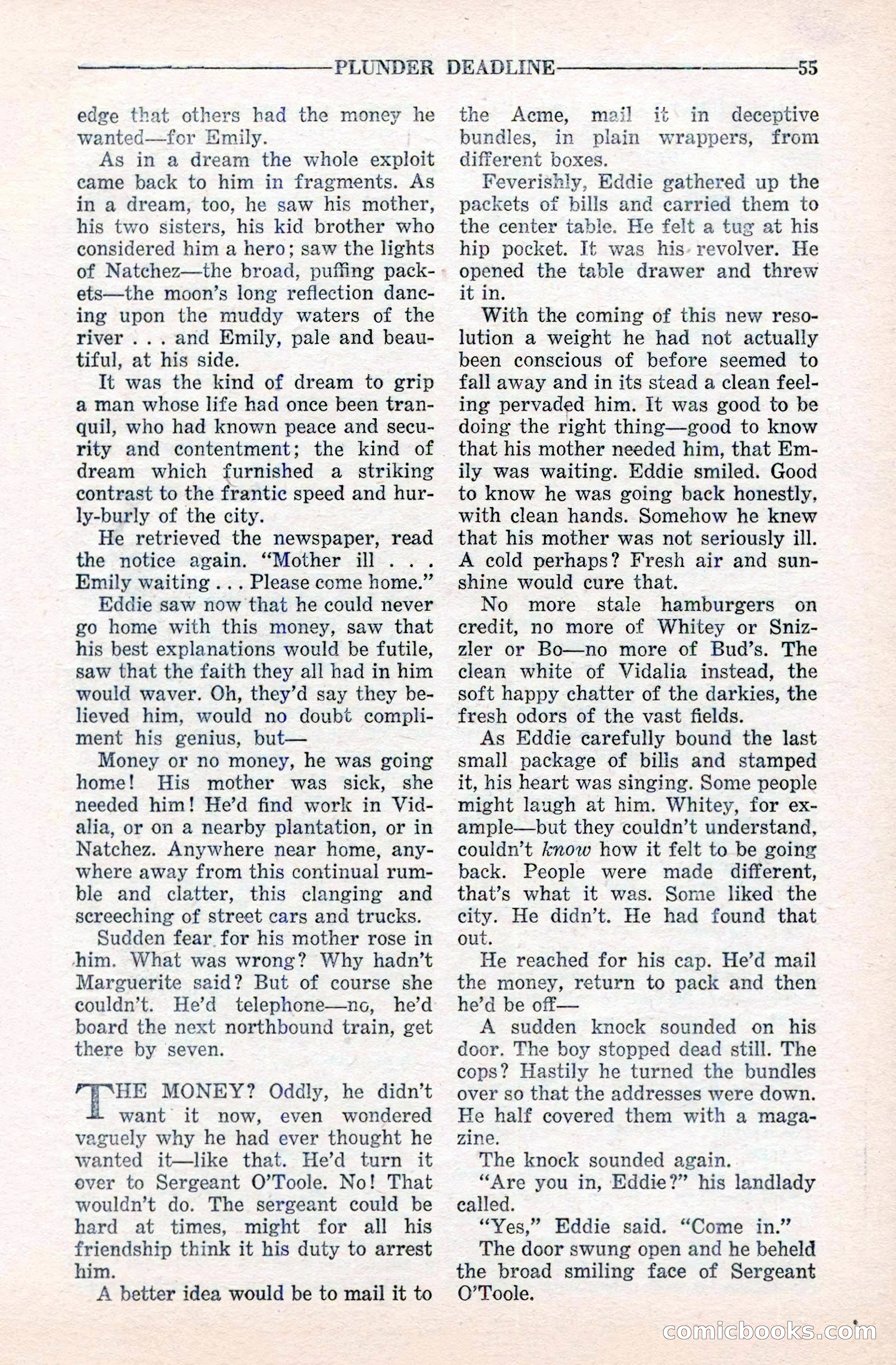
A restored page from Pulp Fiction, 1939. Page through the whole issue in the reader above.
📄 Transcribed text from this page (OCR, searchable)
Machine-transcribed from the original scan — historical spelling and the odd misread are preserved.
PLUNDER DEADLINE edge that others had the money he wanted—for Emily. As in a dream the whole exploit came back to him in fragments. As in a dream, too, he saw his mother, his two sisters, his kid brother who considered him a hero; saw the lights of Natchez—the broad, puffing pack- ets—the moon’s long reflection danc- ing upon the muddy waters of the river ...and Emily, pale and beau- tiful, at his side. It was the kind of dream to grip a man whose life had once been tran- quil, who had known peace and secu- rity and contentment; the kind of dream which furnished a striking contrast to the frantic speed and hur- ly-burly of the city. He retrieved the newspaper, read the notice again. “Mother ill... Emily waiting ... Please come home.” Eddie saw now that he could never go home with this money, saw that his best explanations would be futile, saw that the faith they all had in him would waver. Oh, they’d say they be- lieved him, would no doubt compli- ment his genius, but— Money or no money, he was going home! His mother was sick, she needed him! He’d find work in Vid- alia, or On a nearby plantation, or in Natchez. Anywhere near home, any- where away from this continual rum- ble and clatter, this clanging and screeching of street cars and trucks. Sudden fear for his mother rose in him. What was wrong? Why hadn’t Marguerite said? But of course she couldn’t. He’d telephone—no, he’d board the next northbound train, get there by seven. HE MONEY? Oddly, he didn’t want it now, even wondered vaguely why he had ever thought he wanted it—like that. He’d turn it over to Sergeant O’Toole. No! That wouldn’t do. The sergeant could be hard at times, might for all his friendship think it his duty to arrest him. A better idea would be to mail it to 55 in deceptive from wrappers, the Acme, bundles, in plain different boxes. Feverishiy, Eddie gathered up the packets of bills and carried them to the center table. He felt a tus at his hip pocket. It was his. revolver. He opened the table drawer and threw it in. With the coming of this new reso- lution a weight he had not actually been conscious of before seemed to fall away and in its stead a clean feel- ing pervaded him. It was good to be doing the right thing—good to know that his mother needed him, that Em- ily was waiting. Eddie smiled. Good to know he was going back honestly, with clean hands. Somehow he knew that his mother was not seriously ill. A cold perhaps? Fresh air and sun- shine would cure that. No more stale hamburgers on credit, no more of Whitey or Sniz- zler or Bo—no more of Bud’s. The clean white of Vidalia instead, the soft happy chatter of the darkies, the fresh odors of the vast fields. As Eddie carefully bound the last small package of bilis and stamped it, his heart was singing. Some people might laugh at him. Whitey, for ex- ample—but they couldn’t understand, couldn’t know how it felt to be going back. People were made different, that’s what it was. Some liked the city. He didn’t. He had found that out. He reached for his cap. He’d mail the money, return to pack and then he’d be off— A sudden knock sounded on his door. The boy stopped dead still. The cops? Hastily he turned the bundles over so that the addresses were down. He half covered them with a maga- zine. The knock sounded again. “Are you in, Eddie?” his landlady called. “Yes,” Eddie said. “Come in.” The door swung open and he beheld the broad smiling face of Sergeant O’Toole. COMMICLOOOKS Gol