
Pulp Fiction, 1939 · page 81 of 116
10-Story Detective Magazine Cover — page 81: what you’re looking at
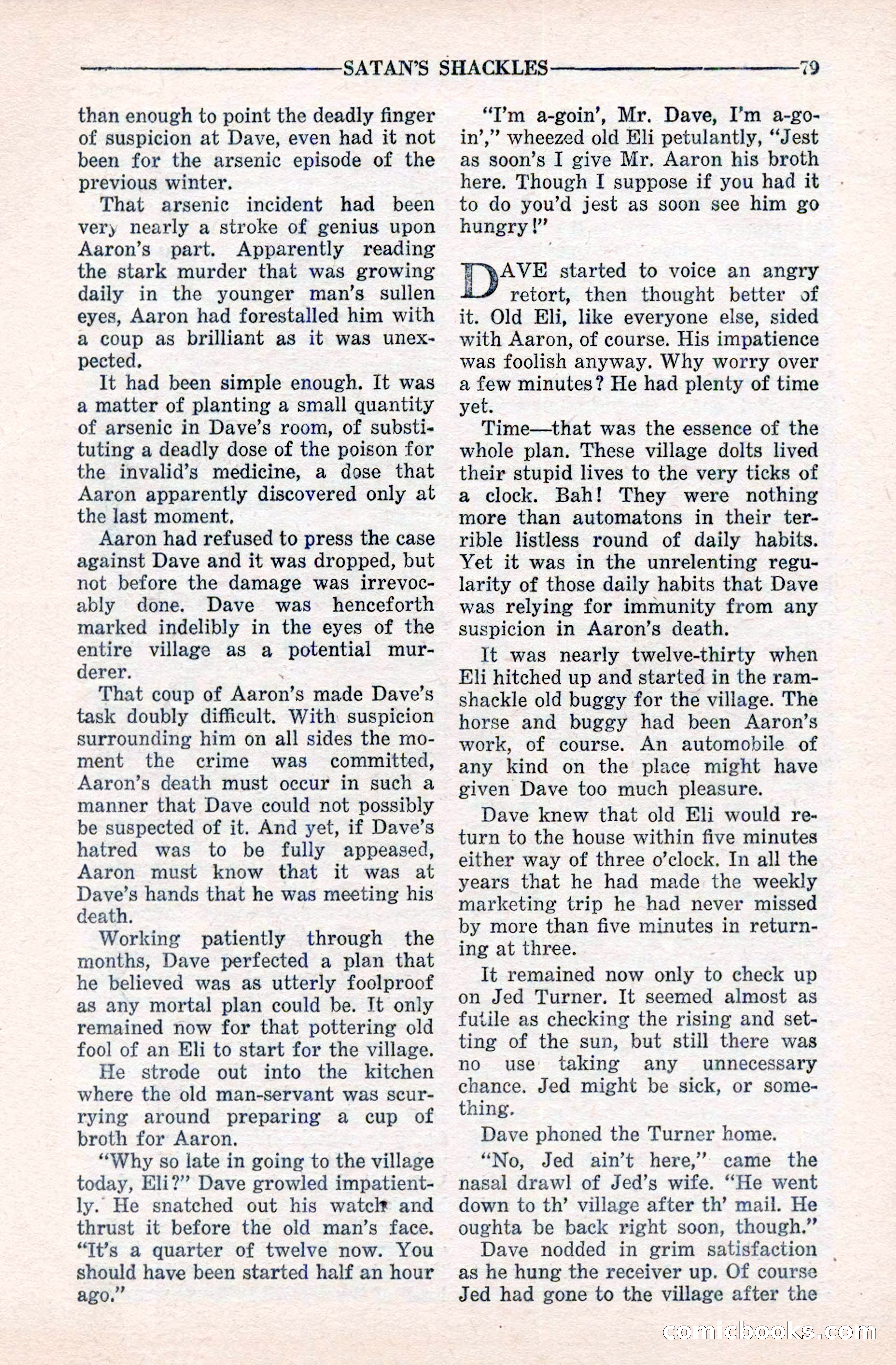
A restored page from Pulp Fiction, 1939. Page through the whole issue in the reader above.
📄 Transcribed text from this page (OCR, searchable)
Machine-transcribed from the original scan — historical spelling and the odd misread are preserved.
SATAN’S SHACKLES than enough to point the deadly finger of suspicion at Dave, even had it not been for the arsenic episode of the previous winter. That arsenic incident had been very nearly a stroke of genius upon Aaron’s part. Apparently reading the stark murder that was growing daily in the younger man’s sullen eyes, Aaron had forestalled him with a coup as brilliant as it was unex- pected, It had been simple enough. It was a matter of planting a small quantity of arsenic in Dave’s room, of substi- tuting a deadly dose of the poison for the invalid’s medicine, a dose that Aaron apparently discovered only at the last moment, Aaron had refused to press the case against Dave and it was dropped, but not before the damage was irrevoc- ably done. Dave was henceforth marked indelibly in the eyes of the entire village as a potential mur- derer. : That coup of Aaron’s made Dave’s task doubly difficult. With suspicion surrounding him on all sides the mo- ment the crime was committed, Aaron’s death must occur in such a manner that Dave could not possibly be suspected of it. And yet, if Dave’s hatred was to be fully appeased, Aaron must know that it was at Dave’s hands that he was meeting his death. Working patiently through the months, Dave perfected a plan that he believed was as utterly foolproof as any mortal plan could be. It only remained now for that pottering old fool of an Eli to start for the village. He strode out into the kitchen where the old man-servant was scur- rying around preparing a cup of broth for Aaron. ‘“‘Why so late in going to the village today, Eli?” Dave growled impatient- ly. He snatched out his watclr and thrust it before the old man’s face. “It’s a quarter of twelve now. You should have been started half an hour ago.” 79 “T’m a-goin’, Mr. Dave, I’m a-go- in’,” wheezed old Eli petulantly, “Jest as soon’s I give Mr, Aaron his broth here. Though I suppose if you had it to do you’d jest as soon see him go hungry!” AVE started to voice an angry retort, then thought better of it. Old Eli, like everyone else, sided with Aaron, of course. His impatience was foolish anyway. Why worry over a few minutes? He had plenty of time yet. Time—that was the essence of the whole plan. These village dolts lived their stupid lives to the very ticks of a clock. Bah! They were nothing more than automatons in their ter- rible listless round of daily habits. Yet it was in the unrelenting regu- larity of those daily habits that Dave was relying for immunity from any suspicion in Aaron’s death. It was nearly twelve-thirty when Eli hitched up and started in the ram- shackle old buggy for the village. The horse and buggy had been Aaron’s work, of course. An automobile of any kind on the place might have given Dave too much pleasure. Dave knew that old Eli would re- turn to the house within five minutes either way of three o’clock. In all the years that he had made the weekly marketing trip he had never missed by more than five minutes in return- ing at three. It remained now only to check up on Jed Turner. It seemed almost as futile as checking the rising and set- ting of the sun, but still there was no use taking any unnecessary chance. Jed might be sick, or some- thing. Dave phoned the Turner home. “No, Jed ain’t here,’ came the nasal drawl of Jed’s wife. “He went down to th’ village after th’ mail. He oughta be back right soon, though.” Dave nodded in grim satisfaction | as he hung the receiver up. Of course Jed had gone to the village after the Gomichdooks (C@