
Pulp Fiction, 1939 · page 70 of 116
10-Story Detective Magazine Cover — page 70: what you’re looking at
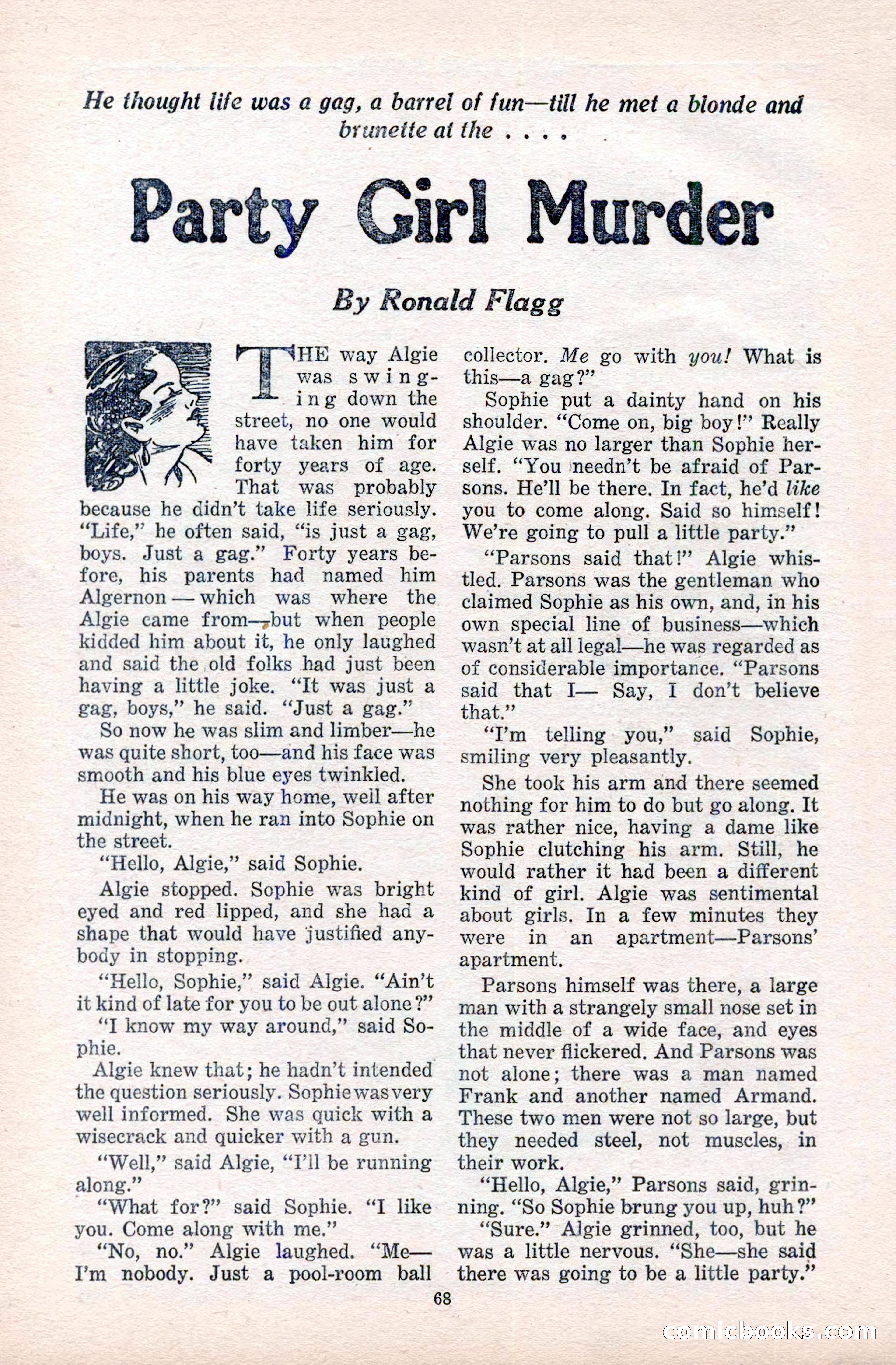
A restored page from Pulp Fiction, 1939. Page through the whole issue in the reader above.
📄 Transcribed text from this page (OCR, searchable)
Machine-transcribed from the original scan — historical spelling and the odd misread are preserved.
He thought life was a gag, a barrel of fun—tiil he met a blonde and brunette atthe .... Party Girl Murder By Ronald Flagg HE way Algie was swing- ing down the street, no one would have taken him for forty years of age. That was probably because he didn’t take life seriously. “Life,” he often said, “is just a gag, boys. Just a gag.” Forty years be- fore, his parents had named him Algernon — which was where the Algie came from—-but when people kidded him about it, he only laughed and said the old folks had just been having a little joke. “It was just a gag, boys,” he said. “Just a gag.” So now he was slim and limber—he was quite short, too—and his face was smooth and his blue eyes twinkled. He was on his way home, weil after midnight, when he ran into Sophie on the street. “Hello, Algie,’ said Sophie. Algie stopped. Sophie was bright eyed and red lipped, and she had a shape that would have justified any- body in stopping. “Hello, Sophie,” said Algie. “Ain’t it kind of late for you to be out alone?’ “T know my way around,” said So- phie. Algie knew that; he hadn’t intended the question seriously. Sophie was very well informed. She was quick with a wisecrack and quicker with a gun. “Well,” said Algie, “I’ll be running along.” “What for?” said Sophie. “I like you. Come along with me.” “No, no.” Algie laughed. “Me— I’m nobody. Just a pool-room ball 68 collector. Me go with you! What is this—a gag?” Sophie put a dainty hand on his shoulder. “Come on, big boy!” Really Algie was no larger than Sophie her- self. “You needn’t be afraid of Par- sons. He’ll be there. In fact, he’d like you to come along. Said so himself! We're going to pull a little party.” “Parsons said that!’ Algie whis- tled. Parsons was the gentleman who claimed Sophie as his own, and, in his own special line of business—which wasn’t at all legal—he was regarded as of considerable importance. “Parsons said that I— Say, I don’t believe that.” “T’m_ telling you,” smiling very pleasantly. She took his arm and there seemed nothing for him to do but go along. It was rather nice, having a dame like Sophie clutching his arm. Still, he would rather it had been a different kind of girl. Algie was sentimental about girls. In a few minutes they were in an apartment—Parsons’ apartment. Parsons himself was there, a large man with a strangely small nose set in the middle of a wide face, and eyes that never flickered. And Parsons was not alone; there was a man named Frank and another named Armand. These two men were not so large, but they needed steel, not muscles, in their work. “Hello, Algie,” Parsons said, grin- ning. “So Sophie brung you up, huh?” “Sure.” Algie grinned, too, but he was a little nervous. “She—she said there was going to be a little party.” said Sophie, CORMICLOOolkKs (C@)