
Pulp Fiction, 1939 · page 28 of 116
10-Story Detective Magazine Cover — page 28: what you’re looking at
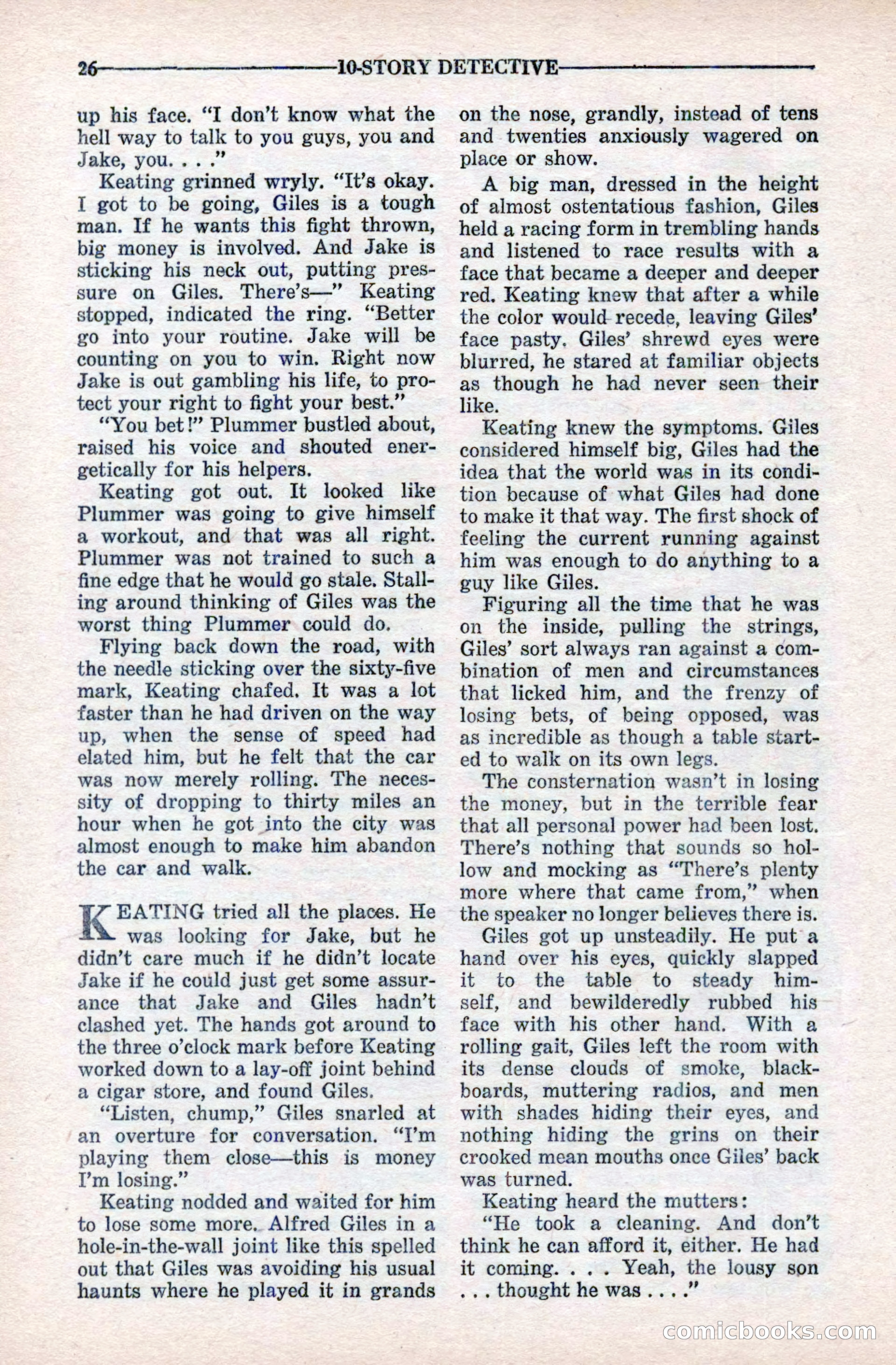
A restored page from Pulp Fiction, 1939. Page through the whole issue in the reader above.
📄 Transcribed text from this page (OCR, searchable)
Machine-transcribed from the original scan — historical spelling and the odd misread are preserved.
%6—_——__—_—_—_—_——_——10-STORY DETECTIVE up his face. “I don’t know what the hell way to talk to you guys, you and Jake; You... + Keating grinned wryly. “It’s okay. I got to be going, Giles is a tough man. If he wants this fight thrown, big money is involved. And Jake is sticking his neck out, putting pres- sure on Giles. There’s—” Keating stopped, indicated the ring. “Better go into your routine. Jake will be counting on you to win. Right now Jake is out gambling his life, to pro- tect your right to fight your best.” “You bet!” Plummer bustled about, raised his voice and shouted ener- getically for his helpers. Keating got out. It looked like Plummer was going to give himself a workout, and that was all right. Plummer was not trained to such a fine edge that he would go stale. Stall- ing around thinking of Giles was the worst thing Plummer could do. Flying back down the road, with the needle sticking over the sixty-five mark, Keating chafed, It was a lot faster than he had driven on the way up, when the sense of speed had elated him, but he felt that the car was now merely rolling. The neces- sity of dropping to thirty miles an hour when he got into the city was almost enough to make him abandon the car and walk. EATING tried all the places. He was looking for Jake, but he didn’t care much if he didn’t locate Jake if he could just get some assur- ance that Jake and Giles hadn’t clashed yet. The hands got around to the three o’clock mark before Keating worked down to a lay-off joint behind a cigar store, and found Giles. “Listen, chump,” Giles snarled at an overture for conversation. “I’m playing them close—this is money I’m losing.” Keating nodded and waited for him to lose some more. Alfred Giles in a hole-in-the-wall joint like this spelled out that Giles was avoiding his usual haunts where he played it in grands on the nose, grandly, instead of tens and twenties anxiously wagered on place or show. A big man, dressed in the height of almost ostentatious fashion, Giles held a racing form in trembling hands and listened to race results with a face that became a deeper and deeper red. Keating knew that after a while the color would recede, leaving Giles’ face pasty. Giles’ shrewd eyes were blurred, he stared at familiar objects as though he had never seen their like. Keating knew the symptoms. Giles considered himself big, Giles had the idea that the world was in its condi- tion because of what Giles had done to make it that way. The first shock of feeling the current running against him was enough to do anything to a guy like Giles. Figuring all the time that he was on the inside, pulling the strings, Giles’ sort always ran against a com- bination of men and circumstances that licked him, and the frenzy of losing bets, of being opposed, was as incredible as though a table start- ed to walk on its own legs. The consternation wasn’t in losing the money, but in the terrible fear that all personal power had been lost. There’s nothing that sounds so hol- low and mocking as “There’s plenty more where that came from,” when the speaker no longer believes there is. Giles got up unsteadily. He put a hand over his eyes, quickly slapped it to the table to steady him- self, and bewilderedly rubbed his face with his other hand. With a rolling gait, Giles left the room with its dense clouds of smoke, black- boards, muttering radios, and men with shades hiding their eyes, and nothing hiding the grins on their crooked mean mouths once Giles’ back was turned. Keating heard the mutters: “He took a cleaning. And don’t think he can afford it, either. He had it coming. ... Yeah, the lousy son ... thought he was... .” COmiclboooks (C@)